Apparently this was Lou’s final appearance onstage. The last few minutes are like some beautiful farewell…
Lou Reed & Antony, “Candy Says,” Salle Pleyel, Paris 6 March 2013

Apparently this was Lou’s final appearance onstage. The last few minutes are like some beautiful farewell…
Lou Reed & Antony, “Candy Says,” Salle Pleyel, Paris 6 March 2013
The definitive MC5 documentary feature film — two hours — made a few years ago — never released.
The following article on the making of this documentary was originally published in Arthur Magazine No. 9 (March 2004) (available from The Arthur Store) when the commercial/theatrical release of this wonderful, heartbreaking film seemed imminent…
HIGH FIVE
Detroit’s visionary MC5 receive a film tribute that aims to rewrite rock history
By Steffie Nelson
On New Year’s Eve, 1972, the MC5 took the stage at Detroit’s Grande Ballroom, a vast psychedelic venue where they’d held court as the “house band” between 1966 and 1969. Their live shows had been so incendiary, the five band members so arrogant, that even a huge star like Janis Joplin, no slouch in the live department, once refused to go on after them. This gig, their swan song as it were, was sloppy and dispassionate; the ghosts of past glories even more unforgiving than the sparse, cynical crowd. Guitarist Wayne Kramer took off mid-performance to go cop dope, and the MC5 never played again. Kramer and guitarist Fred “Sonic” Smith were 22; singer Rob Tyner and drummer Dennis Thompson were 24; bassist Michael Davis was 26. In the end they’d effectively been “pulled apart by the killer forces of capitalism and competition,” which their manager John Sinclair had railed against, perhaps presciently, in the liner notes to their now-legendary debut album Kick Out The Jams.
The MC5 hold a curious place in rock history. Their ascendance represented a moment in America when art and commerce converged, when all that was vital and visceral was also the pinnacle of hip. As the flamboyant and badass musical mouthpiece of the White Panther Party, the MC5 did embody the soul of the late ‘60s counterculture: one foot in the optimistic past and the other in the disillusioned, deadly future; one hand holding a guitar, the other a shotgun. It’s an irresistible image, one which was unappetizingly co-opted by Levis last spring for a series of T-shirts. A promotional performance in London by the three surviving Five (Rob Tyner suffered a fatal heart attack in 1991; Fred Smith died of heart failure in 1994) was seen by detractors as a final, sad sellout.
The question of whether or not the MC5 failed at the end of the day is much debated in the riveting feature-length documentary MC5: A True Testimonial, directed by David Thomas and produced by Laurel Legler. All parties agree, however, that for a fleeting, incandescent moment the MC5 were “at the center of the yin-yang,” as Michael Davis philosophizes in the film, “and it was our job to keep it going in a positive direction.”
But the proverbial yin-yang was already spinning into darkness, and it took the MC5 with it. Like fireworks on the fourth of July, they rose with a bright, beautiful bang and, as far as mainstream America was concerned, disappeared with a puff of smoke into the night. They were, ultimately, sacrificial – the artistic entity that was the MC5 didn’t survive more than seven years—but their legacy has continually inspired legions of punks, rockers, artists and freaks, who got turned on to their music through word-of-mouth, or more than likely though the persistent echo of a call to arms that rings with timeless resonance: “kick out the jams, motherfucker.”
As David Thomas says, “The people who know, know. The other people don’t get it.” The Chicago-based Thomas and his wife Laurel Legler began working on MC5: A True Testimonial in 1995, spurred on through financial troubles and licensing hassles by sheer love and respect and the determination to do justice to these American legends. As Legler points out, few bands have received this sort of filmic treatment, and if they have their way MC5: A True Testimonial will revise rock history. On the eve of a limited theatrical release and the worldwide release of a nearly four-hour DVD edition of the film (including deleted scenes, complete live performances, interview outtakes and fan testimonials), David Thomas and Laurel Legler are ready to testify.
Continue reading

From Michael Hurley:
Those who know of the evils and outrages of Monsanto, biotech agriculture, GMOs… what we’re rallying for is to save our food and our bodies from this sickening plague. I’m collecting songs from songwriters to put together for an instructive record album. Then we’ll have a nice concert and a big fish fry, and cook up the last of the non-mutated salmon and good potatoes and beans.
Mail your contribution here:
Michael Hurley
℅ Arthur Magazine
POB 1307
Joshua Tree, CA 92252
=====
Portrait photo of Michael Hurley by Liz Devine, published in Arthur No. 35 (Aug 2013), which features a gigantic, career-defining 11,500-word article on Hurley by Arthur Senior Writer Michael Hurley. You can buy a copy for $5 from a retailer near you, or order it via mail direct from us.
Saul Landau: official website
Available on DVD, with director’s commentary and other extras, from Microcinema.
A personal portrait of a political phenomenon and a view of the developments since the revolution a mere ten years before, Fidel! gives a rare glimpse into everyday life of the Cuban people and its leader. Whether listening to a complaints at a collective farm, playing baseball with the locals, or discussing Marxist revolution, Castro’s charisma is present in every frame and, like him or not, lends understanding to why so many call him “The Giant.”
(Via Unseen Worlds)
She took part in a cosmic public access TV program…
And as Turiyasangitananda, she released cosmic music on cassette…
From dhamma.org:
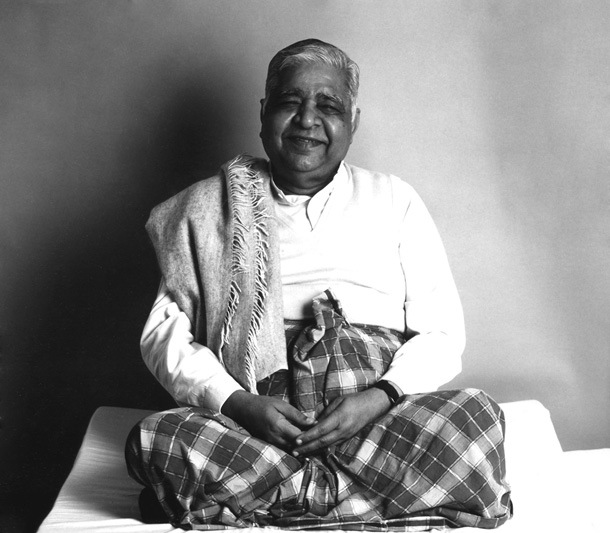
Param Pujya Gurudev Shri Satya Narayan Goenka, Global Acharya of Vipassana Meditation, has passed away peacefully at the ripe age of 90 at his residence on Sunday, 29th September, 2013 at 10:40 PM, Indian Time.
His Funeral will be held on Tuesday, 1st October 2013 at 10:30 AM, Indian Time, at Electric Funeral Ground near Oshiwara Bridge, Relief Road, (Opposite Ghaswala Compound), Jogeshwari West, Mumbai, India.
May he be happy, peaceful & liberated.
”All conditioned things are transitory. When one understands this with wisdom, then he is disgusted with suffering. This is the path to purity.” -Dhammapada-277.
From The Irrawaddy:
Burmese national Satya Narayan Goenka, a leading lay teacher of Vipassana meditation and the highly respected founder of an international network of meditation centers, died on Sunday in India. He was 90 years old.
Goenka “passed away peacefully” at his residence and the funeral will be held on Tuesday in Mumbai, according to the Vipassana Research Institute’s website. Famous for his nonsectarian approach to meditation, his teachings attracted people from across the globe, of all backgrounds, and of countless religions and creeds.
A Burmese citizen of Indian descent, Goenka was born in Mandalay, Burma’s second largest city, in 1924. After joining the family business in 1940, he became a leading figure in Burma’s influential Indian community and led business groups including the Burma Marwari Chamber of Commerce and the Rangoon Chamber of Commerce & Industry. He often accompanied government trade delegations on international tours as an advisor.
After receiving 14 years of Vipassana meditation training from his mentor U Ba Khin, Goenka traveled to India in 1969 and held his first 10-day meditation course. Thanks to its nonsectarian nature, the training was widely accepted in a country divided by caste and religion.
In 1979, Goenka began travelling abroad to introduce Vipassana to other countries. He personally taught tens of thousands of people in hundreds of 10-day courses around the world, in Nepal, Sri Lanka, Japan, the United States, Canada, Europe, Thailand, Australia and New Zealand. He trained more than 800 assistant teachers and each year more than 100,000 people attend Goenka-inspired Vipassana courses. More than 70 centers devoted to the teaching of Vipassana have been established in 21 countries.
Goenka once said Vipassana, though originally a teaching of the Buddha, was not only confined to Buddhism.
“Everybody from any religion and society can practice it easily, for Vipassana is universal and [concerns] the art of living,” he said.
Among his efforts to spread Vipassana meditation, one of the most remarkable may be his bringing the practice into prisons, first in India, and then in other countries as well. The Vipassana Research Institute estimates that as many as 10,000 prisoners, as well as many police and military personnel, have attended the 10-day courses. In Burma, the courses were first taught in prisons in 2008.
Asked during a workshop whether he believed peace was possible in armed conflicts that had been raging for decades, Goenka offered no assurances, but stressed personal responsibility.
“There are no problems that come from outside,” he said, explaining that individual inner peace would help prospects for a more far-reaching world harmony.
“All trouble comes from inside. Go down deep inside and find the root cause of your suffering. Remove it and you will be free.”
Hair has been cut since Aitken’s “Station to Station” agents were here.
Below: “Documentary on the Columbia University student strike and takeover in 1968” by guerrilla filmmaker collective Newsreel …
Anyone know of a similarly definitive/inside Occupy Wall Street documentary?
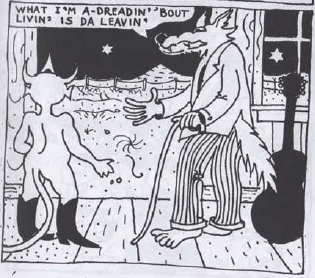
Above: Extract from a MICHAEL HURLEY comic strip included in the 8-page, 11,000-word feature on the great man by BYRON COLEY in the new issue of Arthur, out now. Find it at retailers for $5 or order it direct from us. While supplies last!
 Arthur Magazine