
“One Man Goofing: A visit with legendary Zen humorist Henry Jacobs” by Joel Rose (Arthur, 2007)

This article was originally published in Arthur No. 26 (2007), alongside an appreciation of Henry Jacobs’ The Fine Art of Goofing Off by artist/filmmaker Mike Mills. With the very welcome news that a) a new Henry Jacobs release is on the way, and b) the extremely highly recommended The Wide Weird World Of Henry Jacobs/The Fine Art Of Goofing Off cd/ & dvd set is finally back in print, we thought it was time to brush off the dust from this piece and offer it online for the first time. Here goes…
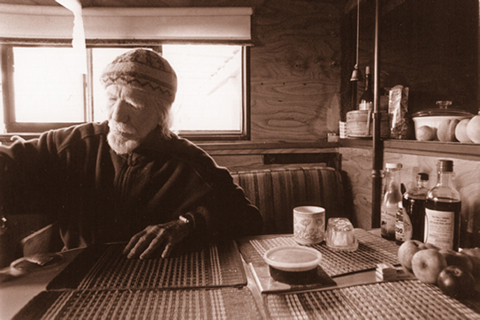
One Man Goofing: A visit with legendary Zen humorist Henry Jacobs
by Joel Rose

Once a week, Henry Jacobs drives to a community center near his house in Marin County, California to play ping-pong with his neighbors. But it’s ping-pong with a twist: Jacobs, a natural righty, insists on playing with his left hand. “I don’t know if I’m as good,” he says. “But I sure have a lot more fun, because I can surprise myself. With my right hand, I never surprise myself.”

The 82-year-old Jacobs has been playing left-handed ping-pong every Monday night for the last seven years. At first, he says, the neighbors were skeptical. But they’ve gradually come around and started playing with their off-hands, too. Jacobs recently started filming interviews with his fellow left-handed ping-pong players for a documentary. “I envision it mainly for the Third World,” he says, and for a second it’s hard to tell whether he’s joking or serious. “The motive is to try to clean up the rather ugly image [of Americans] in the last 50 years or so,” culminating with the present conflict in Iraq. Jacobs says he wants to offer an alternative view of American culture, and ping-pong is the perfect vehicle because of its popularity around the world. “The economics of it are pretty basic. A paddle which you could make out of banana leaf or whatever,” he deadpans. “It’s not about wiping out the planet. It’s about a simple activity called ping-pong.”

Jacobs sees the new documentary—which doesn’t yet have a title—as a kind of sequel to The Fine Art of Goofing Off, the series of animated television programs he worked on in the early 1970s. He says he’s filmed eight or nine interviews so far. Instead of shooting them head on, Jacobs had his subjects invent tasks to perform. (“One guy is fixing an electric lamp. Another guy is diddling around with some paintings.”) The point, says Jacobs, is they’re involved in what they’re doing, even while they’re talking out loud about ping-pong. “They’re not forced keep trying to remember all the points they wanted to make,” says Jacobs. “They can stop talking and get the screw-driver in the right place. It takes the pressure off to constantly be producing something useful and intelligent.”

And of course, “all this will be edited mercilessly. So you’ll only get little pieces of anything.” This, says Jacobs, was point of The Fine Art of Goofing Off: “Never do something so long as to bore someone.”

Continue reading

A Poem from Sharon Olds

Topography
by Sharon Olds

After we flew across the country we
got in bed, laid our bodies
delicately together, like maps laid
face to face, East to West, my
San Francisco against your New York, your
Fire Island against my Sonoma, my
New Orleans deep in your Texas, your Idaho
bright on my Great Lakes, my Kansas
burning against your Kansas your Kansas
burning against my Kansas, your Eastern
Standard Time pressing into my
Pacific Time, my Mountain Time
beating against your Central Time, your
sun rising swiftly from the right my
sun rising swiftly from the left your
moon rising slowly form the left my
moon rising slowly form the right until
all four bodies of the sky
burn above us, sealing us together,
all our cities twin cities,
all our states united, one
nation, indivisible, with liberty and justice for all.

'You're a dog… and I'm drunk.' – New 'Paws' by Pete Toms


Pete Toms is back with a stunning, expanded ‘PAWS‘!

ARTHUR readers experienced a nine page preview toke of ‘PAWS’ in February, but who would have seen this one coming?

The comic is essentially a horror comic about a guy that only experiences the outside world through television trying to sell an autobiographical screenplay. It has all the same themes as my other comics, how people choose identity roles, the media’s effect on memory, how we mythologize our personalities, but this one has a lot more dogs and possibly werewolves, and jokes about how creepy sitcom laugh-tracks are.

I’m doing the same stuff as always, drawing at night, using my natural jazz dancing ability to put my kids through college during the day.

We found an interview Pete did with Ecstatic Days back in November where he talks about what’s abstract and what’s real. Enjoy and follow up if you please over at Pete’s website!

About Arthur Comics
We are proud to bring you Arthur Comics curated by Floating World. Stop by our oasis, http://www.arthurmag.com/comics, for a leisurely bath in our new interactive format, an exclusive collaboration with GreenerMags / グリーナーマガジン.

IT'S SOLD OUT BUT IT'S UM…FINDABLE

BRAIN DONOR

“WASTED FUZZ EXCESSIVE”

BRAIN DONOR RECORDS
9918-4

Tracklisting:

Invocation: The Mead of Fimbulthul
1. GATES OF SKAGERRAK
2. DEATH BECOMES YOU
3. DYSLEXIA RULES K.O.
4. EMERGING/SHADOW OF MY CORPSE
5. FRANKENSTEIN
6. FOKKINGER SLAG/THE HANGING

WASTED FUZZ EXCESSIVE is the long awaited follow-up to Brain Donor’s 2006CE’s epic DRAIN’D BONER, this new album continuing in those dark traditions of declaimed metallic poetry, but extending further into works of epic construction and length. Driven by No Wave riffs and hoary proto-metal assaults, this Donor record burns at both ends. Here it hangs static and taut, whilst there it endures a rocket fired up its ass due to Mister E’s sudden and marvellous acceleration. The seven songs pan out across over an hour of music, and include Cope’s infamous stereo bass solo ‘Shadow of My Corpse’, previewed on his last tour. For those with a mind to listen to the far out, have it destroyed by the might of WASTED FUZZ EXCESSIVE. U-Know it makes sense … to somebody!

uh

The Pilgrims' beaver quest

From Russell Shorto’s review of author Nick Bunker’s Making Haste from Babylon: The Mayflower Pilgrims and Their World: A New History in today’s Sunday New York Times Book Review:

…Bunker, an Englishman devote[s] himself largely to the prehistory of the men and women who founded the colony. His book roams through archives and repositories in the British Isles. From county record offices and church account books, he teases out traces of William Brewster, William Bradford and the other principals who would later found the colony. His objective is to answer the very good question, Who were these people?

In their day the men and women we refer to as Pilgrims were called Separatists or Brownists, but what was the nature of their separation from the Puritan Protestantism that had rooted itself in England, and who was the Robert Browne who gave rise to the movement? How well known were these religious radicals? What was their role in English society? Exactly how were they persecuted? Where did they flourish? And how, one might add, could this new information alter the Pilgrims’ legacy?

…It is certainly true that religious belief—the desire not merely to purify the Church of England, as the Puritans wanted, but to break away altogether—was central to the Pilgrims. Separatism, however, was rooted not simply in the Bible. It was, Bunker shows, a form of Christianity blended “with ideas about gentility and good government, and seasoned with Greek and Roman ideals of republican virtue.”

And the Pilgrims were also businessmen. Unlike many other populist religious movements, Separatism, Bunker tells us, “was never the creed of the penniless.” Its founders were of the gentry. But what did that mean? The leaders of the American Pilgrims hailed from in and around Nottinghamshire in the East Midlands. It was a troubled land — not a place of mythic sentimentality, Bunker says, but “the old, feral England.” Unyielding forests, soggy fields, poor harvests and epidemics created a situation in which landowning gentlemen, desperate to maintain honor, could slip into debt, despair, sin, ruin. In such a vortex, Bunker argues, some people got religion and began pointing moralistic fingers at their neighbors.

The decision to flee thus had both religious and financial motivations. The Pilgrims’ voyage to America was a business venture whose backers — few of them especially religious — expected a return on their investment. And like millions after them, the Pilgrims themselves had a real-world American dream in mind, which was centered on the North American beaver. In the 1620s, a single beaver pelt fetched the same amount of money required to rent nine acres of English farmland for a year. For a time, the Pilgrims capitalized on that raw material: in the 1630s, they shipped 2,000 beaver pelts to England.

Bunker, a former investment banker, also shows the Pilgrims as pawns in a larger geopolitical game. James I despised both them and the Puritans (“very pestes in the Churche & common-weale,” he called them). The king might well have forbidden the Mayflower from sailing, but his secretary of state, Sir Robert Naunton, spoke to him on behalf of the religious radicals and their colonizing mission. “Without bases in America, England could not challenge Spanish control of the western ocean,” Bunker writes. “And without the supplies New England might provide, the Royal Navy could not put to sea. For Naunton, most likely it was all a matter of politics and naval doctrine, with Calvinism adding the impetus of zeal.” Bunker’s research reveals that the Pilgrim leaders were quite connected to events in England, and also that Separatism had a broader geographic scope than has long been thought.

…Having set himself the task of discovering who the real Pilgrims were, Bunker leaves it to others to square his findings against the Pilgrims of legend. So how do they measure up? Bunker shows them to be heartfelt Christians, but at the same time sectarians, as small-minded as any others, intent on getting their way within the petty struggles that split wattle-and-daub villages dotting the English countryside a long, long time ago. Pinned to the canvas of history by the points of so many archival records, they come across as relevant, certainly. But mythic? Not so much.

One from the Desert Files: CHRIS GOSS (2004)

Sound Methods and Weird Channels
How producer and Masters of Reality main man Chris Goss got his groove

by Jay Babcock

Originally published August 26, 2004 in the LAWeekly

Over a recent leisurely afternoon lunch at Silver Lake’s Astro Family restaurant, musician/producer Chris Goss is in muse-aloud mode.

“Music usually makes its way into the hands that want it,” he says quietly. “Eventually, if you’re meant to have it, it’ll get to you, through weird channels that you’d never expect.”

I’m catching up with Goss at an interesting point in his career. The night before, he was in Studio City, contributing work to the new Queens of the Stone Age album at the request of longtime friend Joshua Homme, with whom Goss has collaborated since taking Homme’s desert-rock teenagers Kyuss under his producer’s protective wing in 1992. (Goss was featured on last year’s Homme-supervised The Desert Sessions Volume 9 & 10 in a duet with PJ Harvey on the desolate “There Will Never Be a Better Time.”) QOTSA co-vocalist Mark Lanegan’s new solo album, Bubblegum, which Goss co-produced and performs on, is finally out. Goss just finished producing the new album from buzzed-up Britfreaks the Eighties Matchbox B-Line Disaster, and is itching to start writing songs in a new project called Sno-Balls [eventually renamed Goon Moon—Ed.], with ex–Marilyn Manson bassist Twiggy Ramirez and Hella drummer Zach Hill. And his old band, Masters of Reality, has a new album out.

Well, in Europe, anyway. Like the last three Masters albums, Give Us Barabbas has no American distribution and is available only as an import at specialty stores on- and offline. And Barabbas, technically credited to “Masters of Reality/Chris Goss,” is not really a “new” album, it’s a collection of Goss-penned songs from the last 20 years that have gone previously unreleased in studio form. Why many of these songs are only appearing now is a long, serendipitous story involving Rick Rubin, band turnover, a grunge-choked ’90s marketplace inhospitable to the Masters’ varied classic rock sound and non-pretty-boy look, an impasse with a major record label, a “lost” album and Goss’ busy career as a producer. Cautionary and instructional as that tale may be, it is ultimately less important than the songs themselves: gems like the windswept, string-laden “The Ballad of Jody Frosty,” the campfire sing-along “I Walk Beside Your Love,” the majestic chorale “Still on the Hill,” the country-blues chantey “Bela Alef Rose,” the gorgeous epic “Jindalee Jindalie.” Any collection spanning two decades inevitably carries with it the air of biography, and Barabbas is certainly that; but it also feels like a secret monograph—a collection of timeless scrolls from a legendary Master that will be passed among acolytes and disseminated to those who are meant to hear it.

“Whatever will be, will be,” says Goss, with a smile.

Continue reading