ANOTHER WAREHOUSE FIND: We’ve got 55 copies left of this sweetie and then it’s gone forever.
This beautifully sequenced, far-ranging album commemorates the second annual Plastic Crimewave-curated, Galactic Zoo Dossier/Arthur-presented “Million Tongues” festival that went down at the Empty Bottle in Chicago, November 3-6, 2005.
Track listing:
1. MOUNTAINS – “Speaking”
2. NO NECK BLUES BAND – “Pulse”
3. MIMINOKOTO – “Tokedasu”
4. TIM KINSELLA & AMY CARGILL – “Song for Josh”
5. MICHAEL CHAPMAN – “The Northern Lights”
6. JOSEPHINE FOSTER – “Wondrous Love”
7. CHRIS CONNELLY – “Pray’r”
8. PEARLS AND BRASS – “Waterfall”
9. TRAVELING BELL – “Apparitions”
10. THE SINGLEMAN AFFAIR – “Good to Be With You Again”
11. JACK ROSE – “Hey Fuck You Rag”
12. TAR PET – “Takeit Heri”
13. BIRDSHOW – “Pilz”
14. TONY CONRAD – “Bowstring 1”
15. HOTOTOGISU – “Blues for Steve K”
16. HAPTIC – “Indifference -> Building On Fire”
17. LUX – “Need Fade In + Out”
18. HARDSCRABBLE – “Sail It Away”
Track selection, art and lettering by Plastic Crimewave. Limited edition of 1,000 copies in jewelcase, released through Arthur’s “Bastet” imprint in 2005. 55 copies left and then they’re all gone!
Originally published in Arthur No. 11 (2004), with photography and art direction by W.T. Nelson…
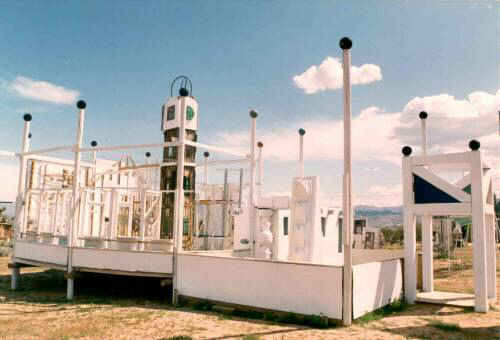
NOAH’S ART When artist Noah Purifoy died this past March, he left behind a remarkable desert masterwork.
by Kristine McKenna
Noah Purifoy was born in Snow Hill Alabama in 1917. By the time he died this past March in a fire at his home in Joshua Tree, California, he’d traveled many roads and re-invented himself several times.
For a Southern black man of Purifoy’s generation, being an artist wasn’t a readily available option, but Purifoy was a man of remarkable vision and patience. It wasn’t until he was 48 years old that he really got rolling as an artist, but by the time he died 38 years later he’d created a body of work of formidable power. Purifoy was a populist artist, a Surrealist, and a sculptor, and his masterpiece is a parcel of land in Joshua Tree which he landscaped with dozens of massive assemblages. Fashioned largely from scavenged materials, this dazzling environment was created without the help of assistants or interns; Purifoy was a lone wolf, and it was his joy to wake before sunrise and work in the early morning hours under an open sky, before the heat of the day settled in.
The tenth in a family of 13 children, Purifoy was the child of farmers who lived in Birmingham from 1920 until 1929, when they resettled in Cleveland. At the age of 22 Purifoy earned a teaching credential, but his teaching career was interrupted by World War II, which prompted him to enlist in the army in 1942. He was stationed in the South Pacific for three years, and after returning from the war, he earned a master’s degree in social work. He then landed a job at the Cuyahoga County Department of Social Services in Cleveland, where he worked from 1950 to 1952.
Purifoy passed through Los Angeles during the war and he’d always had a hankering to return, so in 1952 he relocated to Southern California. He spent the next two years doing social work at an L.A. county hospital, but the work didn’t suit him. In 1954 he enrolled at Chouinard Art Institute, where he earned a degree in 1956, and he spent the next eight years working in various capacities as an interior designer.
In 1964 Purifoy’s interest in civil rights led him to collaborate with musician Judson Powell and educator Sue Welch in the creation of the Watts Towers Art Center, a community outreach program in South-Central L.A. The next year he found himself in the eye of the hurricane of America’s racial conflict when the Watts riots erupted outside his door. It was at this point that Purifoy finally found his voice and sense of purpose as an artist; Purifoy scavenged three tons of material from the ashes of the Watts uprising and used them to create “66 Signs of Neon,” a massive group show of works created from the Watts’ debris that traveled to nine university galleries from 1966 through 1969.
The show was deemed an enormously successful marriage of art and social protest, but Purifoy found the politics of the art world distasteful, and in 1970 he turned his back on art altogether. Seventeen years later Purifoy’s longtime friend, artist Debbie Brewer, offered him permanent lodging on the land she owned in Joshua Tree, and it was then that Purifoy again felt the itch to make things.
I visited Purifoy at his place in Joshua Tree in August of 1995, and I remember my morning with him fondly. I arrived at sunup and we spent a few hours roaming the land, while Purifoy mused on the marvelous sculptures that seemed to stretch as far as the eye could see. By 10:30 it was time to get out of the sun and we retreated to the seriously air-conditioned mobile home where Purifoy lived. He prepared lunch, which is to say, he removed nearly everything from his refrigerator, set it all on a small card table, and offered it to his guest. He was a generous and gracious host. I assembled a sandwich, he poured himself a glass of wine, and we talked for a while. These are a few things he told me.
CHILDHOOD As a child I wasn’t conscious of racism, but I was aware something was going on. Once, when I was five, my mother was taking me to the store and there was a parade in the street. People had hoods on, and when I asked my mother what was happening she said, “That’s the Ku Klux Klan.”
I had good parents who tried to protect me from the trauma they knew I’d encounter soon enough, and they encouraged me to go to school. So in 1939 I earned a teaching credential—not because I wanted to be a teacher, but because that was the only thing accessible to me then. I majored in history and social studies but never taught either—I ended up teaching shop at a school in Montgomery, Alabama.
FROM SOCIAL WORK INTO ART In the early ‘50s all my friends were social workers and they were horrible people. They thought they owned the earth because they doled out a few dollars to poor people, so one day I just up and quit. Later that same day I was driving and I happened to pass Chouinard Art Institute, and I dropped in and told them I wanted to enroll. This wasn’t something I’d been thinking about – I went in totally on a whim, but they admitted me because I was colored.
I was the worst student in the whole school. I refused to draw, because I felt that I had something and that if I learned to draw I’d be dead because I’d end up making oil paintings, which wasn’t what I was after. I’ve never been satisfied with little things that hang on the wall and I wanted to find my own way in art. I wasn’t making art then but I was posing as an artist. I wore a beret and spent lots of time drinking wine, eating cheese, listening to music and talking to people, and didn’t take any of it too seriously. I was seriously concerned about civil rights though, and I had a dialogue going with some people who shared my feelings about change that had to come.
THE WATTS UPRISING I was in the middle of it but I wasn’t afraid. I thought it was great because it was overdue and it turned out to be a goldmine for me. I collected three tons of debris from the riot and began making art out of it. I was searching for my own idea and had been studying the Dada movement and how it had reversed the whole concept of art, and the debris from the riot is what finally launched me on my own course. From 1965 to ’69 I made lots of work, and I sold it as fast as I could make it. I was also reading philosophy then and was knocked out by [Martin] Heidegger and [Edmund] Husserl. I was looking for methods of problem solving because I had lots of problems, and I was able to alter my behavior because of those two philosophers. They were great thinkers who went into areas most people dare not go.
DROPPING OUT I dropped out of the art world because I was disappointed in art. I perceived art as a tool for change, and when I started the program in Watts I saw art as a potential savior. But the dropout population there increased rather than decreased, and the art I was making started to become formulaic and too easy. I was never interested in earning a lot of money. I wanted art to be a means of answering questions like ‘what is growth?’ ‘What is change?’ Life isn’t worth living unless the individual is pushing to understand more, and art stopped being useful to me in that pursuit.
THE WORK A lot of the stuff I use to make artwork I buy from a recycling place near here and it’s a horrendous cost—I spend a lot of money on materials. In 1994 a local paper ran a story on me, so I also get lots of calls from people who say ‘I’m cleaning out my garage. Why don’t you bring a truck over and take what you want?’
There’s no ecological message behind my use of recycled materials—I use them because that’s what’s available to me. People occasionally comment on how hard it must it must be living out in the desert by myself, but this is a breeze compared to many things I’ve been through. The most difficult period of my life was when I was a young adult. I was raised in the church and as a teenager I found myself in conflict about sex and religion. I gave up religion—and leaving the church didn’t hurt me at all.
DEATH Sometimes I wish I had a savior because I don’t know what happens after death, but I do know I don’t believe in heaven. I recently made a series of works called ‘Desert Tombstones,’ and while I was working on them I thought a lot about death. It’s been said that if you don’t accept death as an equal part of existence you’re in for trouble somewhere down the line. I’d never given much thought to any of this because I thought I’d live forever, but I’ve come to realize that’s not the case. That may have something to do with why I push myself so hard now to finally get the work out that’s always been in me.
D.J. Corndawg
DJ debut of worldclass songster journeyman & leather craftsman Jonny Corndawg spinning plenty of turquoise party platters and dusty gems http://en.wikipedia.org/wiki/Jonny_Corndawg
Tambler’s Choice will kick it off around 9:00 so please come on come don’t dawdle!
Weather permitting NAFAS-e´-AARAAM will do their thing on the roof around 11:30! Bring your own drinks as we won’t have anything to sell but admission to the show!
Scientists Create Synthetic Organism http://npr.org/templates/story/story.php?storyId=127010591&ft=1&f=1001 http://online.wsj.com/article/SB10001424052748703559004575256470152341984.html
“Scientists for the first time have created a synthetic cell, completely controlled by man-made genetic instructions. Created at a cost of $40 million, this experimental one-cell organism, which can reproduce, opens the way to the manipulation of life on a previously unattainable scale. Several companies are already seeking to take advantage of the new field, called synthetic biology, which combines chemistry, computer science, molecular biology, genetics and cell biology to breed industrial life forms that can secrete fuels, vaccines or other commercial products. Synthetic Genomics Inc., a company founded by Dr. Venter, provided $30 million to fund the experiments and owns the intellectual-property rights to the cell-creation techniques. The company has a $600 million contract with Exxon Mobil Corp. to design algae that can capture carbon dioxide and make fuel. To make the synthetic cell, a team of 25 researchers at labs in Rockville, Md., and San Diego, led by bioengineer Daniel Gibson and Mr. Venter, essentially turned computer code into a new life form. They started with a species of bacteria called Mycoplasma capricolum and, by replacing its genome with one they wrote themselves, turned it into a customized variant of a second existing species, called Mycoplasma mycoides, they reported. To begin, they wrote out the creature’s entire genetic code as a digital computer file, documenting more than one million base pairs of DNA in a biochemical alphabet of adenine, cytosine, guanine and thymine. They edited that file, adding new code, and then sent that electronic data to a DNA sequencing company called Blue Heron Bio in Bothell, Wash., where it was transformed into hundreds of small pieces of chemical DNA. To assemble the strips of DNA, the researchers said they took advantage of the natural capacities of yeast and other bacteria to meld genes and chromosomes in order to stitch those short sequences into ever-longer fragments until they had assembled the complete genome, as the entire set of an organism’s genetic instructions is called. They transplanted that master set of genes into an emptied cell, where it converted the cell into a different species. The scientists didn’t give the new organism its own species name, but they did give its synthetic genome an official version number, Mycoplasma mycoides JCVI-syn1.0. To set this novel bacterium—and all its descendants—apart from any natural creation, Dr. Venter and his colleagues wrote their names into its chemical DNA code, along with three apt quotations from James Joyce and others. These genetic watermarks will, eventually, allow the researchers to assert ownership of the cells. “You have to have a way of tracking it,” said Stanford ethicist Mildred Cho, who has studied the issues posed by the creation of such organisms.”
No Gods No Masters http://edge.org/3rd_culture/age_of_wonder10/age_of_wonder_index.html http://guardian.co.uk/commentisfree/andrewbrown/2010/may/20/craig-venter-life-god
“Craig Venter’s production of an entirely artificial bacterium marks another triumph of the only major scientific programme driven from the beginning by explicit atheism. Francis Crick, the co-discoverer of the structure of DNA, was a militant atheist, who refused to accept a job at a newly founded Cambridge college if it had a chapel, and who invented molecular biology partly to prove there was nothing special or mystical about life: it was just the behaviour of complex chemicals acting in accordance with the normal laws of nature. Now Venter says he has built a living bacterium from nothing but chemicals and code: “Our cell has been totally derived from four bottles of chemicals”, he says. In fact, it was grown using yeast as an intermediary, but to the molecular biologist, organisms are just another kind of apparatus. It looks like the complete triumph of the materialist programme. Atheists of the Dawkins type will take it as practical proof that there is no need to hypothesise God at all: we can make life without any miracles, and there’s no need to imagine a creator. Descending from these rarefied speculations, there’s a much lower and more urgent sense in which Venter will disturb theologians and atheists alike. The man who can make life can also give humans apparently godlike powers. “We are as gods and might as well get good at it” said the Californian visionary Stewart Brand 40 years ago; and Venter’s techniques should make it possible to engineer bacteria to do almost anything we can imagine, from cleaning up the oceans to supplying us with energy. The bacteria found in nature can work like the philosophers” stone, transforming almost any substance into anything. The trouble with gods, as the Greek philosophers observed, is that they were not any morally better than humans, just more powerful.”
Many leagues below a murky, oil-filled pocket of subtropical waters off the southern coast of the United States, abyss creatures continue to communicate through light and vibration. In the “midnight zone,” a formidable black swallower feeds off of a hydrothermal vent, shrouded in a darkness thicker and blacker than deepest outer space. An opalescent dumbo octopus floats serenely by, her shiny coating picking up hints of a nearby jellyfish‘s flashing stroboscopic light, which illuminates a pulsating haze of red around them. On the very bottom of the ocean floor, a sea dandelion sits quietly, swaying back and forth to the rhythm of tectonic plates stirring below her…
Above: Special guest DJ Ron Like Hell, a resident purveyor of good taste and mind-expanding musical knowledge at northern Greenpoint’s favorite record-vending establishment, Permanent Records. If you are in the New York area on Friday, June 11th, go see him DJ at The Loft above Public Assembly.
MAJOR WAREHOUSE FIND: We’ve got 80 copies left of this beautiful sucker—this is the last of the 500-copy jewel case run—and then they’re gone forever. Orders will start shipping June 1, 2010.
Thirteen gnarly tunes gathered from high and low by ETHAN MILLER of COMETS ON FIRE and HOWLIN RAIN back in 2006. “For lovers of bloody nose street folk, dangerous shit rock, drunken cosmic slop and those wandering down the outer and under paths alone.”
Track listing:
1. Albert Ayler – Truth Is Marching In
2 Monoshock – Crypto-Zoological Disaster
3 The Colossal Yes – The Honey Creeper Smiles
4 Ghost – Piper
5 Electric Six Organs Of Admittance – Close To The Sky
6 Michael Yonkers – Swamp Of Love
7 Shit Spangled Banner – Cuntshine
8 Brother JT – Country Blues/Be With Us (live)
9 Joshua – Look Floating
10 7 Year Rabbit Cycle – Meditation
11 August Born [Six Organs and L collaboration] – Providence
12 Dark Inside The Sun – Truly Cursed
13 Comets On Fire – Death Squad
Special Live Event –“Return to the Pleasure Dome”, a benefit concert event for Anthology Film Archives with a Life Achievement Honor for Kenneth Anger. Featuring Technicolor Skull (Kenneth Anger and Brian Butler), Lou Reed, Sonic Youth, The Virgins, Moby & other special guests, Wednesday, May 19 at the Hiro Ballroom, NYC
Benefit Ticket Options:
$99 – Mezzanine tickets available through Ticketweb!!!
Floor seating available through PayPal:
Tables at $500 / person (4 people per table):
Booths at $5000 (priority seating for up to 6 people)
Seats / Tables / Booths
For further questions, please email us at 40years@anthologyfilmarchives.org, or call 646-450-3247.
From Technicolor Skull’s mySpace page: “Technicolor Skull is Kenneth Anger (pictured above) and Brian Butler’s magick ritual of light and sound in the context of a live performance. Along with Brian Butler on guitar and electronic instruments, Anger performs on the Theremin while his psychedelic Technicolor Skull images are projected.”





 Arthur Magazine