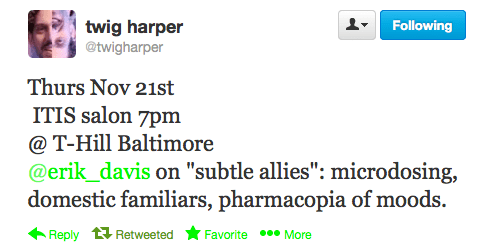
Author-scholar Erik Davis, who’s contributed to Arthur so many times over the years that he has his own category, will be speaking this Thursday at Carly Ptak and Twig Harper’s T-Hill mind/body resource compound in Baltimore.
Don Cherry & The Organic Music Theatre – RAI Studios, Italy, 1976
Well, this is wonderful: 40 minutes worth of Don Cherry and the Organic Music Theatre in 1976, posted over on Twitter by none other than Neneh Cherry in honor of what would’ve been Don’s 77th birthday today. Joyous, spiritual vibes galore.
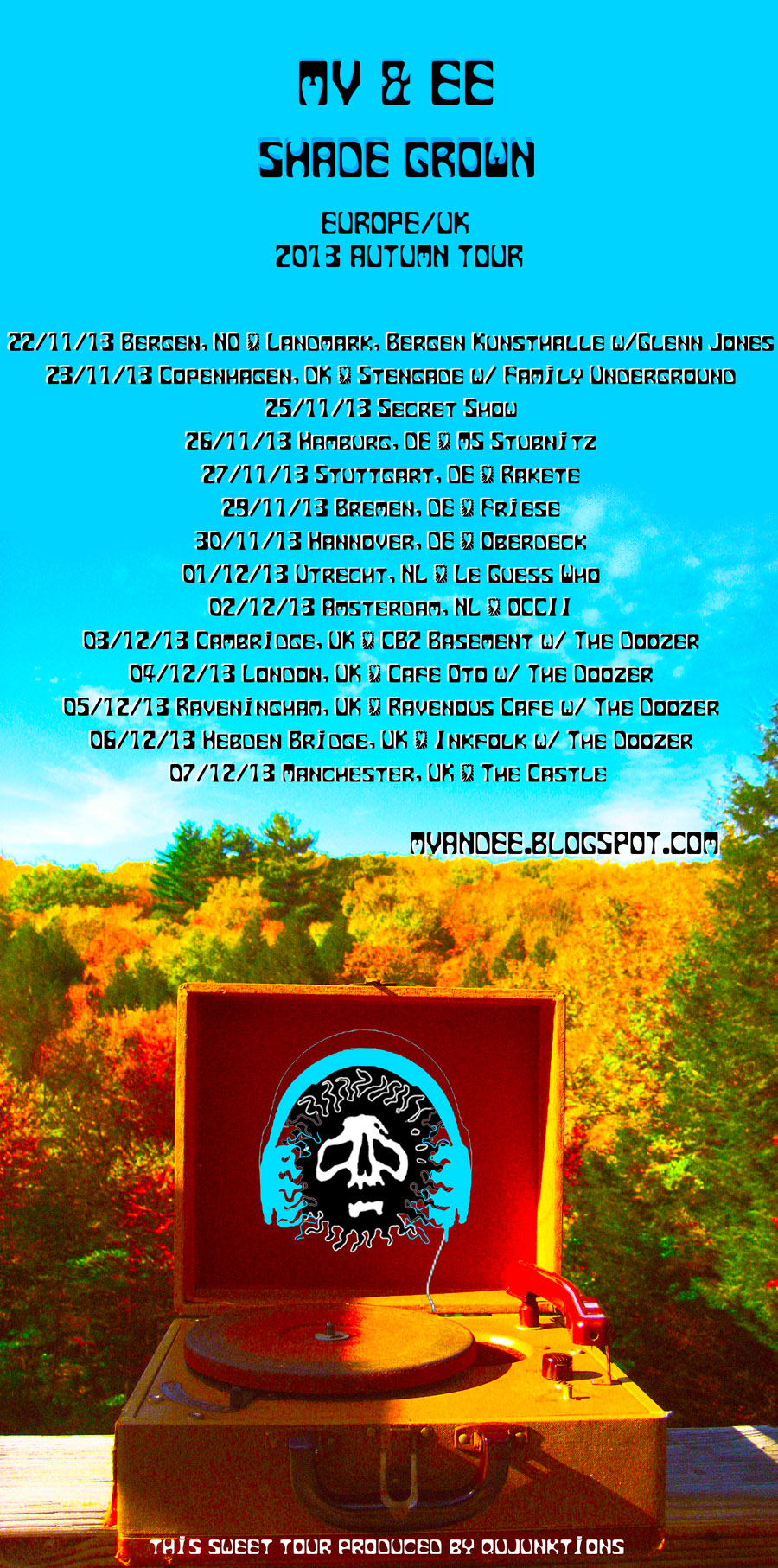
Arthur No. 34coverstars MV & EE are coming to Europe. Dates:
New studio recording “Shade Grown” out now, self-described thusly:
Studio C.O.M.’s from MV & EE have been rare these days with recent rockets being in the form of the most righteous and mighty live excursions into unknown jam galaxies thru song form (dig the heroines, box sets and residencies!). However, time was when the Child Of Microtones sound worlds were exploding with the most unique and highly personalized solar systems of pre-war/post Takoma environs colliding like COMets with black ark pods from the tapers section. On “Shade Grown” sweet new MV & EE are back in that orbit fusing all that they can give and more to keep America beautiful. Go DIY army, this is greenspace…throw away yr armaments and trade the electric mower for headphones. This is perhaps the closest Spectra, Matt & Erika have come to dub, The ONE could get lost in these tunes/jams for many spins. Bring on hyperspace awareness, you could be in yr very own room beyond inside out and feel all they are right beside you, just like spectrasound wanted you to be.
Special guests/skypilots from the good ol’ Golden Road: Jeremy Earl (Woods), Michael Flower (Vibracathedral Orchestra), Matt Lajoie (Herbcraft), Doc Dunn, Muskox, Paulie G, Rafi Bookstaber, Carson “Smokehound” Arnold, Rongoose (Blueberry Honey/Causa Sui/Sunburned Hand Of The Man).
After 20+ years of near-fatal drug & alcohol abuse (thankfully culminating with intensive but successful rehab), AARON FREEMAN (aka Gene Ween) was left in a dire financial situation. All proceeds will go directly to Aaron, as he continues down the path toward creative freedom and personal health.
These demos represent the final writings and music of Gene Ween, before he departed and the inner FREEMAN emerged. On that note, we have received a two word personal statement from Aaron: “stay tuned.”
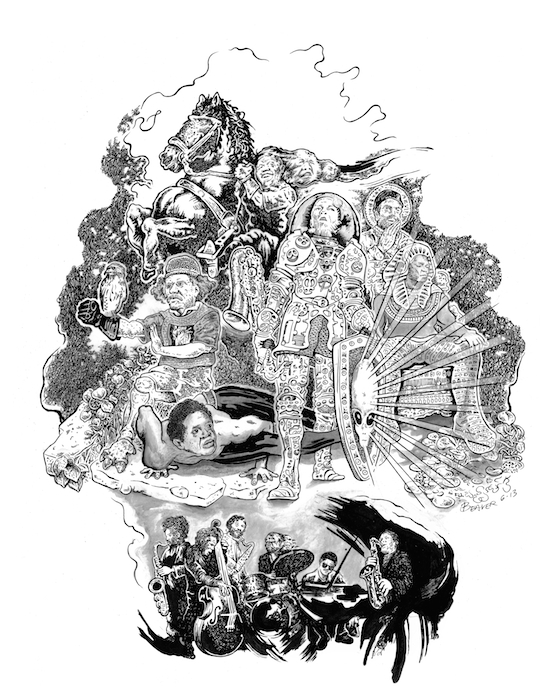
Artwork by BEAVER. Top: ASTRAL PLANE (L to R): Pharoah Sanders, Jimmy Garrison, Elvin Jones, John Coltrane, Donald Garrett, McCoy Tyner. Bottom: MATERIAL PLANE (L to R): Sanders, Garrison, Garrett, Jones, Tyner, Coltrane.
GIANT STEPS by STEWART VOEGTLIN
DISCOGRAPHY, 1965-1967 A Love Supreme Recorded Dec ‘64/released ‘65 The John Coltrane Quartet Plays Recorded Feb 65/May 65/March 65 released ’65 Transition Recorded May/June ‘65 released ‘70 Kulu Sé Mama (+Sanders, Garrett, Butler, Lewis) Recorded June 10-16/65 released ‘67 Ascension Recorded June 28/65 released ‘66 Sun Ship Recorded August ‘65 released ‘71 First Meditations Recorded Sept 2/65 released ‘77 Live in Seattle (+Sanders; Garrett) Recorded Sept 30/65/released ‘71 Om (+Sanders; Brazil) Recorded October ‘65 /released 68 Meditations (+Sanders; Ali) Recorded Nov 65/released 66 Interstellar Space Recorded Feb. ‘67/released ‘74 Expression (Sanders, Ali, Alice Coltrane) Recorded Feb. ‘67 & March ‘67/released ‘67
Forty-eight years ago the classic John Coltrane Quartet—along with tenor saxophonist Pharoah Sanders, and multi-instrumentalist Don Garrett—played a gig at a small Seattle club called the Penthouse. The show—130 minutes, professionally recorded, released later as Live in Seattle—came three months after the release of Coltrane’s monumental Ascension, two months before the leader’s penultimate farewell, Meditations. Standards and originals are played. Ponderous intros are atomized by ecstatic solos. Notes dissolve into noise. Noise dissolves into pure sound. Themes struggle within a framework so volatile it shares more likeness with a riot than music. Whether you choose to believe rumors the players gobbled up LSD before hitting the stage doesn’t change opinion turned fact: this quartet could summon chaos like no other. That night in Seattle, Coltrane & Co. ground away at reality and its tyranny of time until any semblance of form surrendered to the void.
Live in Seattle didn’t arrive at a pivotal moment. It was the pivotal moment. Coltrane had undergone a sort of gale force ideation; let himself go to creativity. He behaved more like a speedfreak archivist at the time than leader of the world’s most cataclysmic quartet. Recorded incessantly. In studio. Remotely. Pecked away at graphic scores. Scribbled down ideas. Gave sparse but impassioned instruction to players en route to studio or gig, establishing structure in the moment, assembling by chance, intuition, power. Live in Seattle was the final push towards the symbolic rebirth Coltrane had begun working towards with A Love Supreme in 1964. It’s Coltrane himself in an almost monastic light, striving for purity, elation, elegance, exaltation. His breath and its vehicle not of this earth, but of something we know not what. A Love Supreme is the undeniably practiced and ceremonial unification of the quartet. Live in Seattle its mindful and unceremonious dissolution. It’s the sound of the classic quartet coming completely apart at its core.
That night in Seattle the rhythm section either bashed away in protest, or stood agitatedly indifferent to Coltrane and Sanders, their horns a screaming phoenix struggling to get off ground with the weight of the universe in its talons. Bassist Jimmy Garrison, pianist McCoy Tyner, and drummer Elvin Jones surely tear through the set. But only Garrison sounds truly sympathetic, willfully adapting to Coltrane’s vision still in transition, shelving simple bass walks in lieu of strumming, plucking, coloring what sounds at times like blood ritual with strange flamenco and orchestral figures. Tyner alternately stomps and sprints up the keys, pointlessly competing with Jones who switches between raucous swing and athletic white noise. Ingredients are there. Forces in opposition. Each player pulling the music into a place he’s more comfortable with. Had it been a rock band it would’ve been salted with operatic whining and ego-oriented arguments that served no true end. All the quartet was doing was shaping its new sound. Crafting aesthetic. Loudly becoming. Here, within Live in Seattle, lies the set of directions for that sound, more cosmogony than loose aggregate of aped trope.
THIS is the main gig of Arthur contributors Stewart Voegtlin and Beaver. Via 20 Buck Spin …
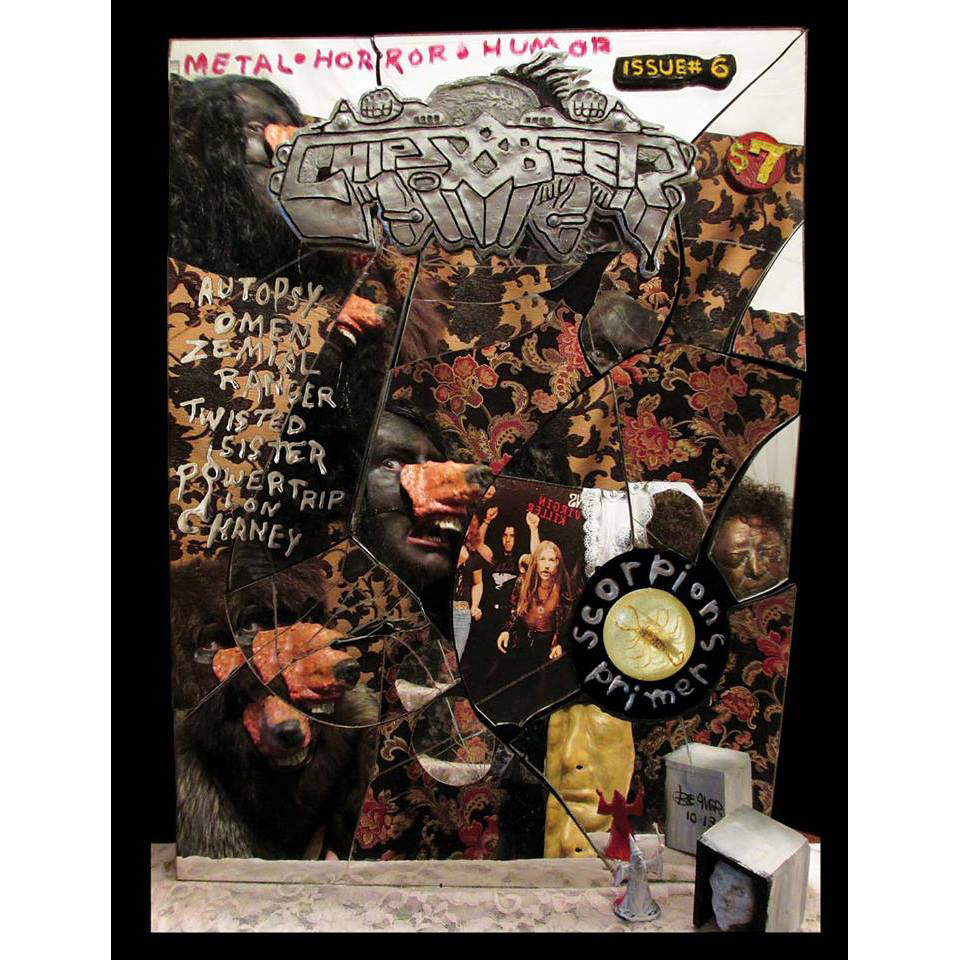
CHIPS & BEER THE MAGAZINE #6
Read Dawn: Chips & Beer Mag #6 features all the usual bizarro features, rantings and ravings from the most loved writers in the Heavy Metal Pantheon. Interviews with some band called Scorpions, a guy named Uli Jon Roth and another named Herman Rarebell. Not to mention Omen, Ranger, Autopsy, Zemial, Power Trip, Chris Bruni, incredibly thoughtful think pieces on the Twisted Sister Documentary, The Bad News Bears, Lon Chaney and other panty wetting fun. 128 pages. Welcome to the party pal.
A full-page piece of artwork by Leif Goldberg was published in Arthur No. 9, back in March 2004. Here’s a new interview with the great transnaturalist, now living in Vermont…
Q: Can you describe your artistic process a little?
A: It’s called the hollow frog approach. You hollow out a frog and then climb inside. Try to see through the frog’s eyes. Then, wish very hard that you were a salamander that could always change to bend around its surroundings. Listen like a deer, for shifting timbres from the earth’s crust, and move carefully. When quiet, plot the bee’s course, mapping out the sweet spots. Arrive like airplanes on autopilot at La Guardia. Dial it in and let it happen.


 Arthur Magazine