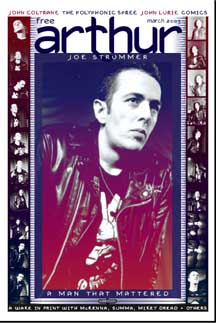
A MAN THAT MATTERED: Joe Strummer, remembered (and interviewed) by Kristine McKenna (Arthur, 2003)

A MAN THAT MATTERED
Joe Strummer was a spectacular, inspirational human being

Text: Kristine McKenna
Photography: Ann Summa
Design: W.T. Nelson

Originally published in Arthur No. 3 (cover dated March 2003), shortly after Joe’s untimely death on December 22, 2002.


When the Clash first burst on the scene in 1977 I dismissed them for the same reason I’ve always hated U2. Their music struck me as humorless, self-important political blather that wasn’t remotely sexy or fun. Definitely not for me. Nonetheless, being a dedicated punk I had to check them out when they made their Los Angeles debut at the Santa Monica Civic on February 9th, 1979, and what I saw that night changed my mind—just a little, though. As expected, Mick Jones came off as a typical rock fop who clearly spent far too much time thinking about neckerchiefs and trousers. Joe Strummer, however, was something else. With the exception of Jerry Lee Lewis, I’d never seen anyone that furiously alive on stage. Legs pumping, racing back and forth across the stage, singing with a frantic desperation that was simultaneously fascinating and puzzling, he was an incredibly electric presence.

At the press conference following the show that night, L.A.’s ranking punk scribe, Claude Bessy, jumped up and snarled, “This isn’t a press conference—this is a depressing conference!” (Jeez, tempers always ran so high during that first incarnation of the punk scene—who knows why the hell our panties were in such a twist!) I remember that Strummer looked genuinely hurt by the comment. Mind you, he was a working class Brit so he wasn’t about to start sniffling in his sleeve, but he didn’t cop an attitude either. I was touched by how unguarded and open he was—and I was certainly impressed by the mans vigor. I wasn’t surprised when I subsequently learned that Strummer ran three marathons without having trained at all. His preparation? “Drink ten pints of beer the night before the race and don’t run a single step for at least four weeks before the race.”
That first show at the Santa Monica Civic didn’t transform me into a Clash fan, but Strummer interested me, so when the band showed up in 1981 in Manhattan, where I was living at the time, I decided to see what he was up to. The Clash had booked a nine-show engagement at Bond’s, an old department store on Times Square in Manhattan, and this turned out to be not a good idea. The place wasn’t designed to handle the crowds the band drew, and the engagement turned into a nine-day stand-off between the band and the fire marshals. I attended three nights in a row and can’t recall them ever actually making it to the stage and performing. But then, that was business as usual during the glory days of punk, when gigs were forever being shut down, aborted, abruptly canceled. This was political theater, not just music, and nobody embodied that idea more dramatically than the Clash.

Cut to June 14 of the following year and I finally saw the Clash succeed in a completing a full set at the Hollywood Palladium in Los Angeles. By then, I’d finally begun to appreciate the breadth and fearlessly experimental nature of the Clash’s music, and Strummer was at the peak of his powers as a showman at that point. The huge hall was packed, and it was as if Strummer was a maestro conducting this undulating mass of sweaty people, with the mysterious power to raise or lower the pitch at will. Boots, beer bottles and articles of clothing flew through the air, people leapt on stage, leapt back into the arms of their friends, Strummer stood at the microphone stoking the fire, and somehow managed to keep the proceedings just a hair’s breadth short of total chaos for two hours. It was a commanding display from a man who clearly knew his job and knew his audience.

Following the break-up of the Clash in 1985, Strummer charged head-on into a busy schedule of disparate projects. He acted in several independent films and composed six film soundtracks, including one—for Alex Cox’s lousy 1988 film, Walker—that was remarkably beautiful. I wrote an admiring review of the score for Musician Magazine, and a few months after it was published Strummer was passing through L.A. and he invited me to lunch in appreciation for the supportive words. We were to meet at a Thai restaurant on Sunset Boulevard, and though I was nervous on the way there, he put me at ease the minute we met. Strummer was such a genuine person that it was impossible to feel uncomfortable around him—I know it sounds corny, but he truly was a man of the people. He was funny and generous in his assessments of people, but he didn’t sugar coat things either–he had no trouble calling an asshole an asshole when it was called for. The thing that ultimately made Strummer such a spectacular human being, however, is so simple that it barely seems worth mentioning: he was interested in people. He wanted to hear your story and know what was going on in your neighborhood, he asked how you felt about things and was an empathetic listener—he paid attention! The other thing I immediately loved about him was that he was an enthusiast and a fan.

Just how big a fan he was became clear to me a few months later when he guest hosted a radio show I had at the time on KCRW. My show was at midnight on Saturday, and KCRW’s office is hard to find, so our plan was to meet behind the Foster’s Freeze at Pico and 14th at 11:00 P.M. He roared into the parking lot exactly on time in a car with four pals, and the lot of them tore into the record library at the station looking for the records on Strummer’s play list. His plan was play all the records that shaped his musical taste as a teenager in the order that he discovered them, and the show he put together was equal parts history lesson and autobiography. Included in the far-flung set were tracks by Sonny Boy Williamson, Lee Dorsey, Captain Beefheart, Bo Diddley, Hank Williams, and loads of fabulous, rare reggae and dub. His loving introduction to the Beach Boys’ “Do It Again” brought tears to my eyes. Several fans crashed the studio when they heard him on the air and realized he was in town, and he welcomed them all. It was a wonderful night. He had fun too, and as he thanked me and said goodnight, he kissed me on the cheek and I blushed.

Strummer spent the next ten years struggling to re-start his career post-Clash and stumbling repeatedly. “The only thing that got me through was sheer bloody-mindedness—I just won’t quit!,” he told me when I interviewed him in October of 2001. We were talking on the occasion of the release of his second album with his five man line-up, the Mescaleros, Global A Go-Go, which was rightfully hailed as the best work Strummer had done in years. He was happy with the record, and when I saw him perform at the Troubadour a few weeks after we spoke, he seemed happy in general.
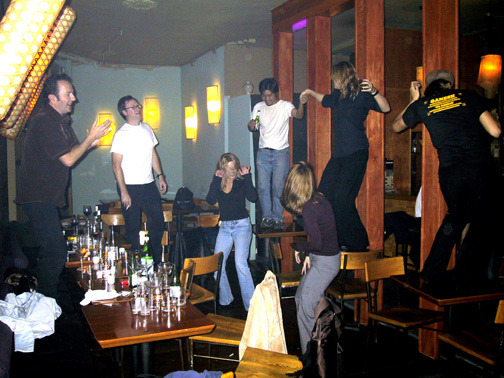
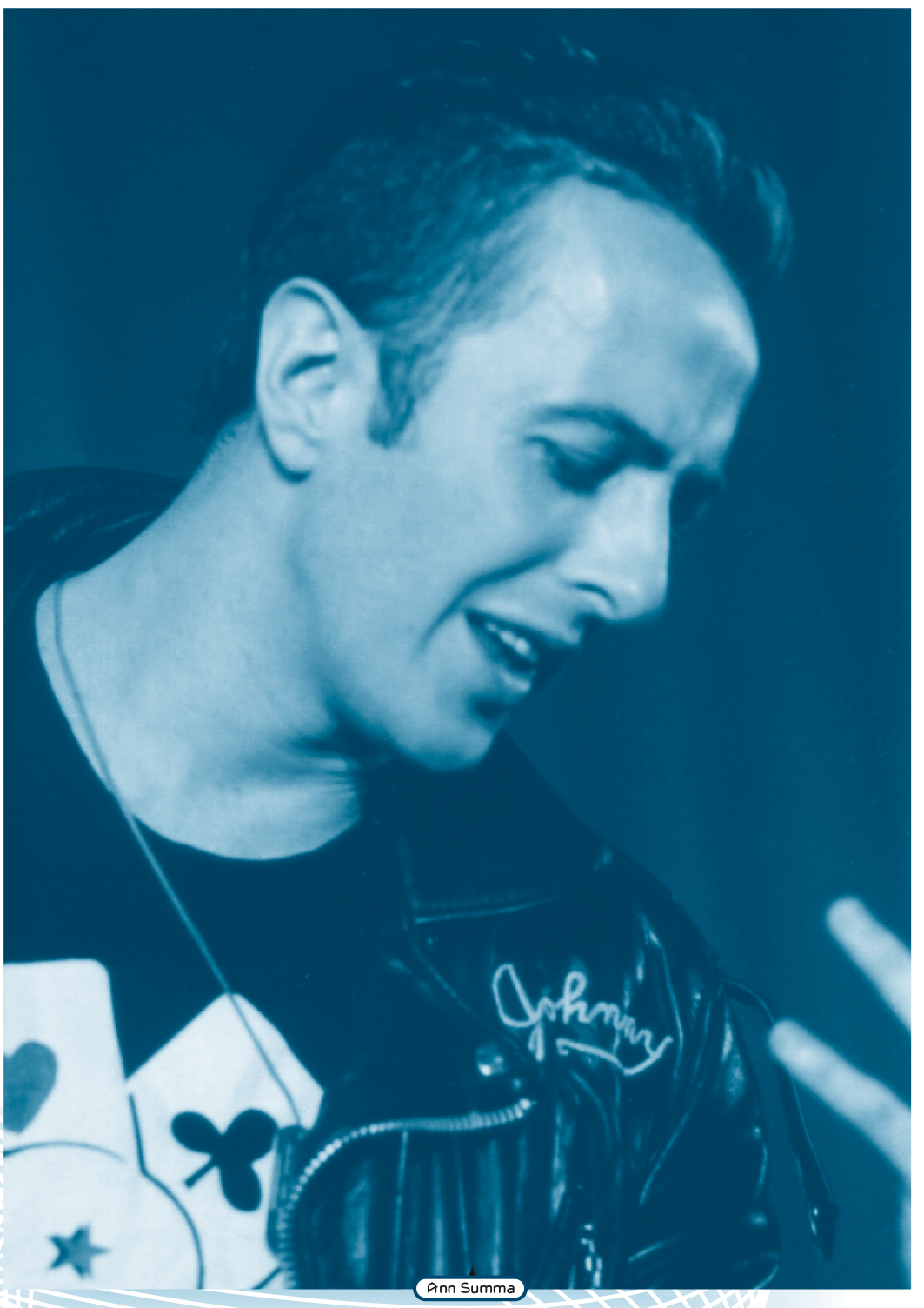
Above: Joe Strummer leads an impromptu dancing-on-the-tables moment at a restaurant in New York City, sometime in the late ’90s. (Photo courtesy Chris from Hellcat/Epitaph.)


“I’ve enjoyed my life because I’ve had to deal with all kinds of things, from failure to success to failure again,” Strummer told a journalist from Penthouse Magazine in 2000. “I don’t think there’s any point in being famous if you lose that thing of being a human being.”

That’s something that was never a danger for Strummer. During that last interview (printed below), I asked him what the great achievement of punk rock had been, and he replied, “it gave a lot of people something to do.” I loved the complete lack of self-importance in that answer, however, this isn’t to suggest that Strummer ever broke faith with punk. “Punk rock isn’t something you grow out of,” he told Penthouse. “Punk rock is like the Mafia, and once you’re made, you’re made. Punk rock is an attitude, and the essence of the attitude is ‘give us some truth.’

“And, whatever happens next is going to be bland unless you and I nause everything up,” he added. “This is our mission, to nause everything up! Get in there and nause it out, upset the apple cart, destroy the best laid plans—we have to do this! Back on the street, I say. Turn everything off in the pad and get back on the street. As long as people are still here, rock’n’roll can be great again.”

Thank you Joe for bringing us the good news.

* * * * *

The following conversation with Strummer took place in October 2001, on the eve of his final U.S. tour during the winter of 2001-2002.

Arthur: You say the great achievement of punk rock was that ‘it gave a lot of people something to do.’ What was its great failure?

Joe Strummer: That we didn’t mobilize our forces when we had them and focus our energies in a way that could’ve brought about concrete social change—trying to get a repressive law repealed, for instance. We’re stuck in a kind of horrible holding pattern now, and it seems to me that the only way to change it is if we get hipsters to stay in one place long enough to get elected. The problem is that no hipster wants to get elected.

Arthur: I saw the Clash several times during their U.S. tours of the late ‘70s and early ‘80s, and I remember the sense that something profoundly important was at stake at those shows, that they were about something much larger than pop trends. What was at stake?

Joe Strummer: In the rush of youth you assume too much—and so it should be—but we felt that the whole machine was teetering on the brink of collapse. Some amazing things went down in Britain during the ‘70s—the government decided they could disempower the unions by having a three day week, for instance. Can you imagine that? Monday morning you wake up, and suddenly there’s only a three day week, from Monday to Wednesday. There were garbage strikes, train strikes, power strikes, the lights were going out—everything seemed on the brink, and looking through youthful, excitable eyes it seemed the very future of England was at stake. Obviously, that’s very far from the feeling these days, when everything’s pretty much smugly buttoned down.

Continue reading

Opening May 7 – Oxenrose & Arthur present "Scala Naturae:" New Works by Tahiti Pehrson in San Francisco

Arthur is delighted to sponsor “Scala Naturae,” a show of exquisitely crafted paper sculptures by Tahiti Pehrson opening on May 7th at Oxenrose. In the past, Pehrson has developed album art for Devendra Banhart (covers of White Reggae Troll and Lover) and several t-shirts for friend Joanna Newsom, as well as comissioned portraits for XL recording artists (M.I.A., Peaches, and Dizzee Rascal, among others), and designs for a variety of skateboarding companies including Toy Machine, Blood Wizard and Familia.

On top of all these projects, Pehrson devotes his time to cutting away at his insanely detailed sculptures, made almost entirely of paper with some metal supports. Want to see? Check out this giant cake (real life dimensions: 4ft x 6ft). Something tells me that these pieces shine in their true glory when seen in person; you really have to get up close to experience the full effect of light and shadow interacting within the many crevices, shapes and openings. So if you’re in the Bay area, dig out your magnifying glass — and head over to Oxenrose to lose yourself in the tiny intricacies of Pehrson’s magical paper world.

On view May 7th – June 30th, opening Thursday, May 7th 7:30 – 10:30PM with a live performance by Kings & Queens
Oxenrose Salon (For directions, go here.)
448 Grove St. / San Francisco, CA 94102
Free admission

Get to know more about Pehrson’s artwork and lifestyle in this interview.

Above: Neptune’s Daughter, a 4-layered paper sculpture by Tahiti Pehrson

Today's Autonomedia Jubilee Saint — LEWIS HILL


May 1 — Lewis Hill
American pacifist, founder of Pacifica radio network.

May 1, 2009 HOLIDAYS AND FESTIVALS
*Mayday
* Wiccan Beltane
*Traditional Fertility Fesitval
*World Labor Day
*Ancient Roman Floralia, Festival of the Goddess Floralia. Grand processions in England including “Jack-in-the-Green,” milkmaids, Morris dancers, Robin Hood and his Merry Men.

ALSO ON MAY 1 IN HISTORY…
1776 — Order of the Illuminati founded in Germany by Adam Weishaupt.
1830 — Irish-American labor radical Mother Jones born, Cork, Ireland.
1847 — American emancipationist Henry Demarest Lloyd born.
1881 — Mystical Christian evolutionist Teilhard De Chardin born, Auvergne, France.
1890 — American utopianist Albert Brisbane dies, Richmond, Virginia.
1893 — World’s Columbian exposition opens in Chicago;
Jane Addams’ purse snatched at opening ceremonies.
1916 — Chicago Herald becomes first newspaper to call the new music “Jazz.”
1919 — Pacifica radio founder Lewis Hill born, Kansas City, Missouri.
1933 — Christian anarchist Catholic Worker founded, New York City.
1965 — Vanguard musical performer Spike Jones dies.
1992 — Two days of rioting in the aftermath of the Rodney King police brutality trial leave 38 dead, 1500 injured and half a billion dollars in property damage,
in Los Angeles, California. Preparations made for military occupation.

Excerpted from The 2009 Autonomedia Calendar of Jubilee Saints: Radical Heroes for the New Millennium by James Koehnline and the Autonomedia Collective

BULL TONGUE "TOP TEN #3" by Byron Coley & Thurston Moore

TONGUE TOP TEN #3 – April 27, 2009

lightfront

1. Easily the best-looking LP we’ve had the pleasure of grappling lately is Light by Reiko and Tori Kudo, issued by Siwa. Reiko and Tori are best known for their work with Maher Shalal Hash Baz, but this stuff is even more casual, diffuse and haunting. Mostly just piano and female voice, the sound has an elegance and mystery that makes our veins wiggle. It’s like some sort of otherworldly cabaret, beamed in from Planet X. And while the music is available now as a CD, the LP version is just incredible—a wooden box, with nine separate compartments, each containing a printed booklet with lyrics. Quite unbelievable, even for Siwa, which has long set a tough-to-match standard for packaging. Hats off to the label’s Alan Sherry and all who sail with him.

bree

Bree


2. Just got a couple of fine new books by the great Cleveland poet, Bree. The bigger of the two (although printed in a wee small format) is was chicken trax amidst sparrows tread (The Temple Inc). This one collects a bunch of Bree’s fantastic prole poesy and uses it to sorta set the scene for a long prose piece about asshole blood. Amazing stuff. There’s also if i cld a body slam on her own imprint, Green Panda Press. This one’s a slim, folded sheet with six “peace poems” (one of which is purely visual). What makes them “peace poems,” we can only guess, but they’re boss and loud, which seems like a good thing. It should be noted that Bree is also hosting the Tres Versing the Pandapoetry festival in Cleveland on May 8-10, this year, which should be an excellent place to be.

willielane

Willie Lane


3. Great new guitar record out by William “Willie” Lane, called Known Quantity (Cord Art). Willie lived up here in Western Mass. for a good long while and was involved in lots of weird musical shit. Not much of it got proper documentation, however, although Child of Microtones did issue a fine CDR, Recliner Ragas , a few years back. Anyway, Willie moved down to Philadelphia a couple of years ago, and we get a chance to hear him now and then when we’re down there, or he chooses to hit the road with one of the MV & EE traveling carnivals. But his solo work has always been amazing and rare. Well, not so rare this week. There’s this new LP, and it was recorded throughout 2006-2008, and is a total blast. Willie’s mostly solo (save for some licks by Samara Lubelski) and his playing ranges from Wizz Jones power-pluck at its cleanest to Michael Chapman electro-smear at its phasingest. But Willie knows his stuff cold and this instrumental slide through the gates of Neverland is one of this year’s great rides.

brookingsdbgcoffeeshpelston

Duplex Planet editor David Greenberger and poet Ernest Noyes Brookings at Dunkin Donuts, Jamaica Plain, MA. Summer 1985 photo by Stephen Elston


4. First new issue in a long time of David Greenberger’s vastly entertaining magazine, Duplex Planet. Issue 184 doesn’t revolve around a central theme, but details various conversations David had with the residents at senior centers in East L.A. My favorite is the one with a woman who claims to be the 23rd of 24 children in her family, and also to be a great-great-grandmother. There’s no earthly way to know if she’s full of shit or not, but it’s nice to read her thoughts. Greenberger has a gentle way of probing the memories of these folks that is funny, sad and surprising—sometimes simultaneously. His work is always cool. The same is true of his sometimes collaborator, longtime pal, Terry Adams . Adams, a founding member of NRBQ as well as a legendary Sun Ra collector, has a new CD called Holy Tweet (Clang!).

holy_tweet

Primarily recorded as a trio date with Tom Ardolino and Scott Ligon, the vibe is like a stripped down version of the Q Mothership—rolling bones of uniquely shaped, instantly recognizable goodtime roots pop whatsis that transcend boundaries of “mereness” by a mysterious propulsive force. The stuff is always just off-base enough to keep our interest thoroughly poked (especially as the first zephyrs of spring beckon us to the hill towns beyond). Sometimes it’s enough to just enjoy.

Mats Gustafsson


5. Mats Gustafsson has ten of the busiest fingers in all of Sweden. And yes, his primary focus is record collecting. But he does a few other things and he does them well. Three recent albums attest to this (lord knows how many record he has released since we last met) and they also map a width of style-ass as impressive as it is bounteous. First is The Vilnius Implosion (No Business), which is a solo work for baritone saxophone, slide saxophone and alto fluteophone. What the latter of these two instruments look like is best left unmentioned, but the sounds are swimming! The music (recorded in concert in Lithuania) is explosively sculptural—three-dimensional blocks of sound bursting through sheets of reality as though it was all a crepe paper curtain. That’s the first side, the flip has longer, grouchier masses of tongue flex, approaching jazzic concepts at times. Lovely! Then we have Mats G Plays Duke E (QBICO), a one-sided LP with Mats playing nearly-straight versions of several Ellington tunes on tenor, enlivened by primitive vocls and raw, live electronics. Parts are sweet enough to play for yr grandma, others will just make her ass bleed. The final piece is a split LP with Dutch pianist Cor Fulher on Narrominded. Fulher uses some extended techniques to take his piano sounds into vast regions of new, and Gustafsson is equally adept at squeezing sounds from his sax that are beyond the ken of most of his peers. Using rolling sequences of tongue-clacks, overblowing, breath-splatter, he ends up doing things, making sounds, that seem impossible. But Mats is more than up to the task. Amazing shit.

6. Hisham Mayet is one of the geniuses behind the Sublime Frequencies project, which is attempting to document many strands of ecstatic global culture before they are bulldozed into oblivion by Western hegemony. His efforts have been prolific and inspired, and his latest DVD, Palace of the Winds, is no exception. It combines snippets of performance footage with long shots of Saharan landscape in motion, and various other shots of the sun-smacked towns and people of the region.

Less tripped out than some of his other films, this one is carried along by the amazing guitar music of Group Doueh, Group Marwani and others. As beautiful as any foot.

Continue reading

May 9: Chhandayan's 10th Annual All-Night Concert of Indian Classical Music in NYC

Highlights from Chhandayan’s 9th Annual All-Night Concert of Indian Classical Music


One of the many wonderful things about getting a bit deeper into Indian Classical music is learning about the way ragas work better when they’re played at specific times of the day and night. E.g. When things get hectic after lunch here on Arthur’s Atwater Campus, we’ve learned to put Nikhil Banerjee’s Afternoon Ragas – Rotterdam 1970 on blast so we can keep things in focus.

So when there’s an epic Indian Classical jam like Chhandayan’s 10th Annual All-Night Concert of Indian Classical Music going down in New York City, you know it’s gonna be awesome ’cause this is how these nocturnal ragas are meant to be experienced: All through the night and into the woozy early hours of the AM. It’ll be just like sweating through the wee hours to the oonce-oonce-oonce except instead of extended trance breakdowns and all the hands in the air there’ll just be a collective sense of silent elation as Utpal Dutta “goes for it” with a wild 4am tabla solo. Plus you’ll probably feel a lot less shit come dawn. Please note: Sleeping bags and mattresses are prohibited.

Ready to get pumped? WFMU is previewing the show this Saturday, May 2 from 6-9pm on Rob Weisberg’s Transpacific Sound Paradise. For more Indian ragas we’d also like to direct your attention to the outstanding archives of now-silent audioblog The Magic of Juju. Likewise, the Pandit Pran Nath album that Babcock hipped us to back in early March is still available for download over at Big States.

What: Chhandayan’s 10th Annual All-Night Concert of Indian Classical Music
How much: Tickets range from $25-$100
When: May 9th 7pm – May 10th 6am
Where: The New York Society for Ethical Culture
2 W 64th Street, New York, NY 10023
More info: http://www.tabla.org/

Today's Autonomedia Jubilee Saint — FELIX GUATTARI

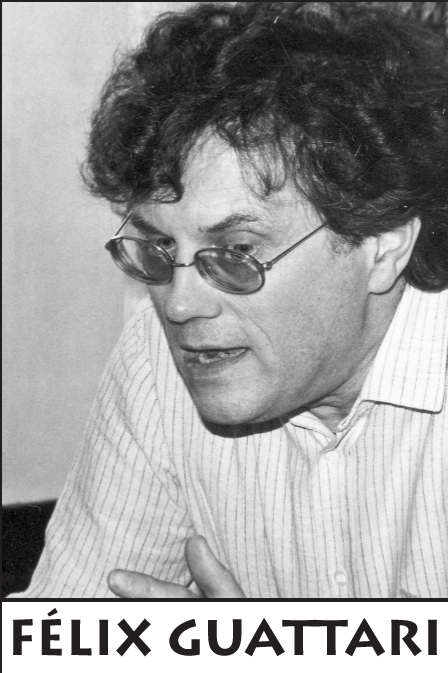
April 30 — Félix Guattari
Innovative anti-theorist of Capitalism and Schizophrenia.

APRIL 30, 2009 HOLIDAYS AND FESTIVALS
*Beltane Eve.
*Walpurgisnacht. Witches, warlocks and demons hold revels in Harz Mountains. Whole towns rush into streets, making as much noise as possible. Church bells ring, bonfires are lit. In British Isles, a scapegoat is chosen by lots and burned; hobby horse parades are held, chasing evil away until Midsummer’s Night.

ALSO ON APRIL 30 IN HISTORY…
1771 — American utopianist leader Hosea Ballou born, Richmond, New Hampshire.
1803 — Louisiana Purchase negotiated with France at four cents per acre.
1844 — Thoreau accidentally burns 300 acres of forest near Concord, Mass.
1930 — Radical anti-psychiatrist, anti-capitalist Félix Guattari born, Paris, France.
1945 — Nazi Fuhrer Adolf Hitler most probably commits suicide, Berlin, Germany.
1975 — Saigon falls to Communist forces, ending long American war in Vietnam.

Excerpted from The 2009 Autonomedia Calendar of Jubilee Saints: Radical Heroes for the New Millennium by James Koehnline and the Autonomedia Collective

Today's Autonomedia Jubilee Saint — MAYA DEREN

April 29 — Maya Deren
Visionary filmmaker, convert to Haitian voudoun.

APRIL 29, 2009 HOLIDAYS AND FESTIVALS
*Feast of the Secret Masters.

ALSO ON APRIL 29 IN HISTORY…
1894 — Jacob Coxey’s protest Army of the Poor reaches Washington, D.C.
1917 — Visionary filmmaker, ethnologist Maya Deren born, Kiev, Ukraine.
1945 — Italian partisans turn Ezra Pound, traitor, over to American army.
1951 — Viennese philosopher Ludwig Wittgenstein dies, Cambridge, England.
1980 — Suspense film director Alfred Hitchcock dies, Los Angeles, California

Excerpted from The 2009 Autonomedia Calendar of Jubilee Saints: Radical Heroes for the New Millennium by James Koehnline and the Autonomedia Collective

May 28: Dublab Presents All-Night Ambient Music Happening in Big Sur (CA)


Dublab has done it again! California’s favorite non-profit radio collective has been bringing choice, culturally responsible programming to the Los Angeleno airwaves for around ten years now, but its mission to foster “the growth of positive music, arts, and culture” takes place both on the air and off. Among the many live events on the Dublab calendar this Spring, the TONALISM mini-fest in Big Sur on May 28th is bound to knock your socks off– or at least lull you into a smiley, sound-drunk dream-state.

A description of TONALISM from the Dublab family:

Inspired by La Monte Young’s “Dream House” as well as the work of musicians and composers such as Terry Riley, Yoko Ono and John Cage, Tonalism combines harmonious textures with visual elements to create an atmosphere where the audience is encouraged to bring pillows, cushions and sleeping bags to lay down, listen and watch for an extended period of time. DJs, live musicians and VJs play and perform throughout the night; starting at sunset and ending at sunrise. Complimentary tea and water are provided to all who attend.

ON THE REDWOODS STAGE:

Live Performances by:
Windy and Carl (Kranky)
Pharaohs (members of Languis and Big Swell)
Matt Baldwin / Inner Beauty
Lyonnais
White Rainbow (Kranky)
Nudge (Kranky)

DJ Sets by:
Obrian System (very special guest)
frosty (dublab)
Jimmy Tamborello (Dntel, Postal Service, dublab)
Part TIme Punks DJ Michael Stock
Andy Cabic (Vetiver)
Katie Byron (dublab)
Nanny Cantaloupe (dublab)
Turquoise Wisdom (dublab, Small Town Talk)
matthewdavid (dublab, Leaving Tapes)

Visuals by:
Matt Amato (The Masses)

ON THE CANYON STAGE:

Performances Curated by Carlos Niño for dublab:
Mia Doi Todd
Carlos Niño & Jesse Peterson
The Nick Rosen/Brian Green Duo
The dublab Drone-Dreamers
DJ Cool Chris of Groove Merchant
GB
Life On Earth! (of Dungen)
and Special Guests

Set Design by:
Katie Byron

TONALISM
Thursday, May 28, 4:20 pm – 5:00 am
Henry Miller Library
Highway One, Big Sur, CA 93920
$20, all ages (does not including venue fees)
Complimentary tea will be served throughout the night.
Bring pillows, blankets, beanbags, sleeping bags, cushions, lay down and listen.
There will be a fire pit and heat lamps but make sure to bring warm clothes because it gets cold at night.

Buy tickets


La Monte Young and Marian Zazeela’s “Dream House”, Mela Foundation, Tribeca, NYC. Find out more about La Monte Young and the Mela Foundation here.

Blaster Al Ackerman & the Hellishness of High School and/or Throbbing Gristle

You are the entity.

This world is full of folks (like me) who are too scared to be dumb or gross or fun, no matter how smart they are. On the other hand, blessings on the head of Blaster Al Ackerman, a writer, painter and correspondence artist who has produced a massive body of work, much of it untrackable due to his pervasive use of pseudonyms (and, for that matter, anonyms) one of which you, Arthur reader, will find in your own home in the form of the song “Hamburger Lady,” the best song by the rock band Throbbing Gristle. I’ll save the long story of Mail Art that brought about this happenstance for another day, though.

What’s important to know for now is that Ackerman has been producing a lot of text and image huzz for the private consumption of a handful of huzz-hufferers, and its taken form of a handful of side-splitting books (The Blaster Omnibus, Let Me Eat Massive Pieces of Clay, I Taught my Dog to Shoot a Gun and, most recently, Corn and Smoke among them), earning him a place in some circles as the contemporary equivalent of Poe. If you have not previously encountered his writing or drawings, we highly recommend that in advance of the short interview that follows you familiarize yourself with his work, at the least, with his recent text at the Lamination Colony site, “Eel Leonard’s Class Prophecy” and/or the free downloads of his spoken-word LP masterpiece I Am Drunk.

Also, in advance of the exchange that follows, it is worth knowing that as a young person in Texas the 50s, Ackerman became absorbed by the world of pulp fiction and attempted to become a writer, although during the pulps’ waning years he only got published in romance magazines. He did, however, strike up a correspondence with science fiction writer Frederic Brown. In the 60s, he worked as a children’s TV show writer and in a carnival before going to Vietnam as a Medivac and then working in burn wards in U.S. hospitals. In the early 70s, he got heavily involved with Mail Art, ultimately centering around David Zack and Istvan Kantor with whom he co-generated the Neoist banner of 80s pranks, plagiarism, art and multiple identity. Through the 80s and 90s, he published frequently in magazines like The Lost and Found Times (edited by frequent collaborator John M. Bennett) and the Shattered Wig Review (edited by Rupert Wondolowski)

Q: I know you were a fan of the rhythm and blues singers of the 50s as a young person in Texas. Could you tell us a little about those concerts and how they might have shaped you?
Ackerman: The first R&B concert I ever attended was probably the greatest. It took place at the Municipal Auditorium in downtown San Antonio, Texas. This was in the very early 50s and admission was only $4 or $5! A true bargain, especially when you consider who all was on the bill. An unbelievable line-up consisting of Chuck Berry, Fats Domino, Frankie Lyman, Little Richard and “Mr. Please Please Please Himself” James Brown. Big Joe Turner (the Boss of the Blues) was the headliner, which seem strange today, especially considering the talent on hand but back in the early 50s Joe Turner was the most prominent name.
San Antonio was a heavy pachuco town so audience participation ran high with many seat cushions slashed; there was also wholesale bopping and vicious horseplay on the railing of the balcony upstairs and frequent injuries from falls.
Through it all, I might add, speculation ran rife over the burning question: “Is Frankie Lymon a hermaphrodite?!” (In rock circles in the early 50s this was one of two questions which engaged the brains of all true R&B fans; the other being “Is Brenda Lee a midget?”)
Anyway, I would have to say that in my experience the only other R&B shows that ever came close happened a few years later at the “Dars” Miller in Austin, Texas, when Bo Diddley and Bobby Blue Bland appeared, the crowd became so worked up that they locked the security guards in a closet, took their guns away and fired them off into the air while Bo stayed on stage and got down with “I’m a Man.” Too much.

Q: What’s the best job in the carnival, job-gratification-wise?
Ackerman: Running the Duck Pond Ride and sleeping down by the river in your duck mask, if you go in for that sort of thing.

Q: Once a person finds his way into an artform, he or she begins, over time, to recognize the mistakes or foolishness of those who preceeded him or her in that form. I wonder, once you’d gotten into mail art, in which ways did you think that Ray Johnson had slipped, a little or a lot?
Ackerman: This is a hard one, especially when you realize how I idolized Ray. And so while it’s true that Ray fell victim on occassion to a certain loquaciousness, especially in the later years, I prefer to remember when he was right on target such as the time when Art Forum was asking for an important statement and Ray came out with, “Every time I walk down the street, the little birdies go tweet-tweet-tweet.”
Really, though, in Mail Art, the real “slappage” comes when you’re on tour and you stop by somebody’s keen little house in Tulsa or Louisville and you’ve been slugging the vodka in the backseat for 3 or 400 miles so that you find upon getting into their guest room that you’re overflowing the bowl and ruining an expensive carpet and priceless antiques. What then?

Q: In Frederick Brown’s story “Come and Go Mad,” there’s long repetition of the colors, “the red and the black,” and it’s left open to interpretation, to say the least. Any thoughts on that passage?
Ackerman: I would guess that Fred was figuring that the name Stehndhal would pop into your mind, comme pour troutes les simmiennes?

Q: What’s your favorite L. Ron Hubbard story about?
Ackerman: Just about anything–uh, just about anything L. Ron wrote before WWII is worth your attention. My own big favorite is “Fear,” a classic from a classic 1940 issue of Street & Smith’s Unknown magazine. “Fear” is available in paperback today so I would greatly urge every literate person to check it out and if you happen to be illiterate, why get a friend to read it to you. You’ll be glad you did.

Q: (Bonus Question) Fill in the blanks: Answering these questions gives me a feeling of both ____ and _____.
Ackerman: To paraphrase John Berndt when he was shimmying across the plains of India, “Answering these questions gives me a feeling of both Spanish Fly and Salt Peter.”