DEMOCRACY IN FLORIDA – UPDATE

Local TV report – “Sales of guns are on the rise in Florida” …

And, from the Oct 28, 2008 New York Times…

Jacksonville Journal: Sense of Unease in Some Black Voters

By SUSAN SAULNY

JACKSONVILLE, Fla. — For weeks now, James Jones has been extra courteous in traffic and at the gas station because he has an Obama sticker on the back of his truck. “Something like that might make a difference for Barack Obama,” Mr. Jones explained. “I’m not taking a chance.”

Mr. Jones, a black warehouse worker, bought campaign signs for his yard and made sure his family had valid voter registration cards. He and his wife cast their votes 10 days early to avoid last-minute problems at the polls.

So imagine Mr. Jones’s disappointment this week when he got word of a rumor making its way around his humble southeastern part of town — that early voting is nothing more than a new disenfranchisement scam, that early votes are likely to be lost and never counted.

“I went to the library where I voted and I said, ‘Ma’am, I heard rumors that early voting is dangerous, is that true?’ ” Mr. Jones, 47, said he had asked an election worker. “She said: ‘It’s pretty well safe. I wouldn’t worry about it.’ ”

But in conversations with about a dozen Jacksonville residents in cafes, outside churches and at their homes over three days, Mr. Jones and many of his black neighbors worry anyway, unable to put aside the nagging feeling that somehow their votes will not be counted.

Wounds have not healed here in Duval County since the mangled presidential election of 2000, when more than 26,000 ballots were discarded as invalid for being improperly punched. Nearly 40 percent of the votes were thrown out in the predominantly Democratic-leaning African-American communities around Jacksonville, a reality that has caused suspicions of racial bias to linger, even though intentional disenfranchisement was never proved.

Now, in a show of early election enthusiasm, more than 84,200 people have already voted in Duval County, surpassing the number of early votes cast in the last presidential election. Added to 33,800 absentee ballots collected so far, the numbers show that 22 percent of registered voters cast their ballots as of Oct. 27, county election officials said.

But amid excitement over Mr. Obama’s historic candidacy and the chance that the country might choose an African-American president within a matter of days, there is an unmistakable sense of anxiety among blacks here that something will go wrong, that victory will slip away.

“They’re going to throw out votes,” said Larone Wesley, a 53-year-old black Vietnam veteran. “I can’t say exactly how, but they are going to accomplish that quite naturally. I’m so afraid for my friend Obama. I look at this through the eyes of the ’60s, and I feel there ain’t no way they’re going to let him make it.”

Mr. Wesley refuses to vote early. “I don’t believe the machines work properly in general,” he said, “and they really don’t work properly when they think you’re voting for Obama.”

Mr. Wesley’s wife, Paris, disagrees and thinks the best thing she can do is get to her polling place before Nov. 4. “I want to go early so that if I see and hear anything that’s not in keeping with the rules and regulations, I can make a call,” she said. “As far as faith in the system, I don’t have faith in the system. I just pray we have people in the polls who will be honest and watchful.”

Some things have not changed since 2000: Florida is still a battleground. Mr. Obama and Senator John McCain, the Republican nominee, are in hot pursuit of the state’s 27 electoral votes, which could prove crucial for victory.

Other important things have changed. In 2004, there were only minor glitches. Duval County has done away with its old confusing ballot and upgraded its scanning machinery. It also has a new elections supervisor, Jerry Holland, who has reached out to blacks and earned their respect.

The skepticism about early voting is confounding to many officials because it is intended to make voting easier and more accessible, and was recently promoted in Jacksonville by Mr. Obama’s wife, Michelle Obama.

Mr. Holland said that the number of people, including blacks, who had turned out to vote early showed that misgivings were not widespread. Of the 84,273 residents who had voted as of Sunday, more than 30,900 were black.

“Obviously, we’ve come a long way since 2000,” Mr. Holland said. “For some people, it may have taken eight years to rebuild confidence. For others, it might take another election cycle. The goal is to keep building confidence one voter at a time.”

He added: “We will have record numbers. It may be feasible to get 50 percent of our voters before the election.”

Still, suspicions linger that something — faulty machines, misread ballots, mysteriously lost votes — will deny Mr. Obama some of the support that he has.

“I vote in a predominantly minority area,” said Monica Albertie, 27, a health care executive. “I worry about getting there and all of a sudden the electricity doesn’t work. Anything can happen. I know that sounds silly, but these are real concerns. We have a record of getting excited, then being disappointed. You get paranoid. What if the bus system shuts down that day?”

Ms. Albertie said she was “on the fence” about early voting, because “I don’t want my early vote to get lost.”

Her friend Susan Burroughs, who is also a health care executive, said she planned to vote early but felt “queasy.”

“You know, you don’t want to get too excited because it could go in just the opposite direction,” Ms. Burroughs said. “You read the papers here, and you know, there was something wrong with the machine over here, they lost the votes over there, they had to recount votes. That makes a lot of people leery.”

“My queasiness is that we shouldn’t become too comfortable with the polls showing he’s ahead,” she said. “It means nothing until you cast your vote, and the tally is in.”

Mr. Jones also expressed a sense of queasiness.

“I feel good, and I don’t feel good,” he said. “I’m thankful to God that this is happening in my lifetime, that I get to see it. But I’m not ready to celebrate anything. This could be a very tricky time for us. I don’t trust the polls. And the state of Florida in the past has had a lot of crooked things going on.”

Today only: classic MAD MAGAZINE artwork at MOCCA in NYC

ex-mad.jpg

MAD Magazine Contemporary Art Treasures

One Day Only: October 29, 2008 10 am to 5 pm

The Museum of Comic and Cartoon Art – MoCCA – and Heritage Auction Galleries are pleased to present a one day showing of “MAD Contemporary Art Treasures: The Most Classic Original Art” from MAD Magazine.

On view will be 36 pieces of iconic artwork from the early years of MAD Magazine for the first time to the generations of readers that learned humor and satire from the skillful art and parody of MAD’s creators. Included are 12 classic covers, which, in the words of legendary MAD publisher Bill Gaines represent “the heart and soul of MAD Magazine.”

“This is a trove of the most iconic MAD covers and specialty art from some of the magazine’s greatest illustrators,” said Jared Green, Vice President of Business Development at Heritage. “These covers made Alfred E. Neuman a celebrity. His notoriety is owed in large part to these featured artworks by Norman Mingo, Kelly Freas, Jack Davis, Bob Clarke and Richard Williams.”

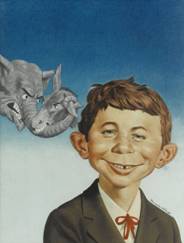
All of the art features MAD’s mascot, Alfred E. Neuman. Of special note is MAD Magazine #30, which depicts Alfred with a Democratic donkey and a Republican elephant; MAD #30 is especially important as it marks the first official appearance of Alfred E. Neuman on a cover of MAD, setting the standard for decades to come. Also on view are MAD Magazine #126, featuring Alfred as Uncle Sam, MAD #181, featuring Alfred as George Washington; and MAD #243, a masterful Richard Williams’ cover featuring Superman reading MAD Magazine.

This one day show is a preview of Heritage Auction Galleries’ November 2008 Vintage Comics & Comic Art Signature Auction.

Museum of Comic and Cartoon Art
594 Broadway, Suite 401
New York, NY 10012

Tel. 212-254-3511

Tuesday – Saturday: 12 – 5
Thursday: 12 – 6
Closed Sundays

General Admission: $5


"THE ASTRONAUT OR THE GANGSTER": GRANT MORRISON ON SUPERMAN, THE ENLIGHTENMENT, HUMANISM AND THE MAGIC WORD

From a new interview with Arthur No. 12 cover star GRANT MORRISON, over at Newsarama:

Grant Morrison: … I see Superman in [his recently completed All-Star Superman comic book series, drawn by Frank Quitely] as an Enlightenment figure, a Renaissance idea of the ideal man, perfect in mind, body and intention.

A key text in all of this is Pico’s ‘Oration On The Dignity of Man’ (15c), generally regarded as the ‘manifesto’ of Renaissance thought, in which Giovanni Pico Della Mirandola laid out the fundamentals of what we tend to refer to as ’Humanist’ thinking.

(The ‘Oratorio’ also turns up in my British superhero series Zenith from 1987, which may indicate how long I’ve been working towards a Pico/Superman team-up!)

At its most basic, the ‘Oratorio’ is telling us that human beings have the unique ability, even the responsibility, to live up to their ‘ideals’. It would be unusual for a dog to aspire to be a horse, a bird to bark like a dog, or a horse to want to wear a diving suit and explore the Barrier Reef, but people have a particular gift for and inclination towards imitation, mimicry and self-transformation. We fly by watching birds and then making metal carriers that can outdo birds, we travel underwater by imitating fish, we constantly look to role models and behavioral templates for guidance, even when those role models are fictional TV or, comic, novel or movie heroes, just like the soft, quick, shapeshifty little things we are. We can alter the clothes we wear, the temperature around us, and change even our own bodies, in order to colonize or occupy previously hostile environments. We are, in short, a distinctively malleable and adaptable bunch.

So, Pico is saying, if we live by imitation, does it not make sense that we might choose to imitate the angels, the gods, the very highest form of being that we can imagine? Instead of indulging the most brutish, vicious, greedy and ignorant aspects of the human experience, we can, with a little applied effort, elevate the better part of our natures and work to express those elements through our behavior. To do so would probably make us all feel a whole lot better too. Doing good deeds and making other people happy makes you feel totally brilliant, let’s face it.

So we can choose to the astronaut or the gangster. The superhero or the super villain. The angel or the devil. It’s entirely up to us, particularly in the privileged West, how we choose to imagine ourselves and conduct our lives.

We live in the stories we tell ourselves. It’s really simple. We can continue to tell ourselves and our children that the species we belong to is a crawling, diseased, viral cancer smear, only fit for extinction, and let’s see where that leads us.

We can continue to project our self-loathing and narcissistic terror of personal mortality onto our culture, our civilization, our planet, until we wreck the promise of the world for future generations in a fit of sheer self-induced panic…

…or we can own up to the scientific fact that we are all physically connected as parts of a single giant organism, imagine better ways to live and grow…and then put them into practice. We can stop pissing about, start building starships, and get on with the business of being adults.

The ’Oratorio’ is nothing less than the Shazam!, the Kimota! for Western Culture and we would do well to remember it in our currently trying times.

The key theme of the ‘Dark Age’ of comics was loss and recovery of wonder – McGregor’s Killraven trawling through the apocalyptic wreckage of culture in his search for poetry, meaning and fellowship; Captain Mantra, amnesiac in Robert Mayer’s Superfolks; Alan Moore’s Mike Maxwell trudging through the black and white streets of Thatcher’s Britain, with the magic word of transformation burning on the tip of his tongue.

My own work has been an ongoing attempt to repeat the magic word over and over until we all become the kind of superheroes we’d all like to be. Ha hah ha.


TOUR OF THE YEAR: JULIAN COPE'S "JOE STRUMMER MEMORIAL BUSKING TOUR"


title1.png
JULIAN COPE / BLACK SHEEP
Joe Strummer Memorial Busking Tour
October 27th – 29th 2008 C.E.

2980060968_fd4a181e7d.jpg

In keeping with the theme of Julian Cope’s new album BLACK SHEEP, which advocates direct action and civil protest, the Archdrude and several of his musicians will – on Monday 27th October – embark on a 3-day-long busking tour of UK cultural centres. Accompanied by singer/guitarists Acoustika and Michael O’Sullivan, Universal Panzies leader Christophe F., and Black Sheep strategist Big Nige, Cope will commence the tour at 10 am at the site of ancient law hill Swanborough Tump in the Vale of Pewsey, and conclude on Wednesday 29th in front of the famous Carl Jung Statue in Liverpool’s Mathew Street. The entire action is dedicated to Joe Strummer, whose 1986 Clash busking tour was the inspiration. The Future is Unwritten!

Monday 27th October
Swanborough Tump (Vale of Pewsey)
Although nowadays ploughed down to barely a cropmark, this once proud law hill formerly known as Swinbeorg was a Bronze Age ancestral barrow employed for hundreds of years by local people for sorting out disputes and enforcing new legislation. It was here in 871, just two months after becoming King of Wessex, that the future King Alfred the Great met his elder brother King Aethelred I on their way to fight the invading Danes. Each swore that if the other died in battle, the dead man’s children would inherit the lands of their father King Aethelwulf.

Eddie Cochran Memorial (A4, Chippenham)
On April 16th 1960, the Ford Consul private taxi carrying Eddie Cochran and Gene Vincent from South Wales to London’s Heathrow Airport crashed at the foot of Rowden Hill, on the outskirts of Chippenham in Wiltshire, badly injuring Vincent and killing 21-year-old Cochran. As the only first generation rock’n’roller to die on English soil, the site of Cochran’s death has long been a place of pilgrimage for freaks across the world. In 1994, Cope’s youngest daughter Avalon was born just 200 yards from the crash site, in a room in the westernmost wing of Chippenham’s Greenways Hospital.

Armenian Genocide Memorial (Temple of Peace, Cardiff)
Cope’s long love affair with Armenia began in the early ‘90s with his studies of George Gurdjieff, the Biblical legends of Noah’s Ark upon Mt Ararat and his fascination for the country that embraced Christianity two decades before Ancient Rome. In 2003, Cope visited Armenia’s Tsitsernagaberd Genocide Monument, in the country’s capital Yerevan; a site dedicated to the millions who were force marched then driven into caves and suffocated by Turkish soldiers in the early 20th century. Turkey’s stubborn refusal to acknowledge its misdeeds (and its subsequent annexation of the whole of W. Armenia) have left Armenia’s psychic wounds open for a century now, which is why Cope believed that this Cardiff monument – paid for and erected by Wales Armenia Solidarity – was such an essential and symbolic place of pilgrimage on the tour.

Tuesday 28th October
Thomas Carlyle Statue (Chelsea Embankment)
The feisty Scottish essayist, Thomas Carlyle, is celebrated on this Busking Tour because of his enduring classic works, Heroes and Hero Worship and Sartor Resartus, both of which have hugely informed Cope’s trip. The first mentioned contains an astonishingly erudite overview of the life and times of Oliver Cromwell and Odin, moreover Carlyle was the first white author to give a useful and open-minded account of the life and work of the prophet Mohammed.

Wat Tyler Memorial (Blackheath)
In 1381, Wat Tyler led the Peasants’ Revolt, still one of the most extreme civil insurrections in the history of these British Isles. The revolt originated in Kent, where Tyler’s troops took Canterbury then proceeded to London, via Blackheath, which has long been associated with the insurrection on account of the famous sermon made to the army by renegade Lollard priest John Ball.

Emily Pankhurst Statue (House of Lords, Victoria Tower Gardens)
In order to represent Cope’s relentless championing of Women and Women’s Rights, there could be no heftier symbol than the matriarch and leader of Women’s Suffrage, Emily Pankhurst. Lest we forget that it is only since 1918 that women in the UK have had the right to vote.

Winston Churchill Statue (Parliament Square)
Cope felt it essential to visit Churchill’s statue, in Parliament Square, on account of his belief that it was only Churchill’s singular nature and half-American upbringing that allowed him to recognise the enormity of what would be lost in British democracy had he not continuously petitioned Parliament against the evils of Hitler’s Nazism, most especially at a time when such acts were considered only as war mongering.

Karl Marx’s Grave (Highgate Cemetery)
On this tour of centres that celebrates democracy and events ingrained in popular culture, Cope considers that it was only fitting that London’s stint should conclude at the grave of Karl Marx, the revolutionary German Jew whose philosophies and political theories lie at the very heart of modern democracy. As the words engraved upon Marx’s tomb remind us: “The philosophers have only interpreted the world in various ways – the point however is to change it.”

Wednesday 29th October
King’s Standing (nr. Birmingham)
Five days before the first pitched battle of the English Civil War, King Charles I addressed his army from atop a Bronze Age barrow that had long been used as a law hill, and was located at the foot of Birmingham’s Barr Beacon, that area of the Midlands’ primary law summit. The barrow thereafter became known as King’s Standing, and the village which grew up around it is known to this day by the same name: Kingstanding. As a long-time English Republican, Cope chose this site as the place that signified the very beginning of Charles I’s decline and, ultimately, his demise.

Site of the Peterloo Massacre (Manchester)
On August 16th, 1819, the huge crowd of 80,000 people, which had gathered in Manchester’s St. Peter’s Field to protest about the price of bread due to the unfairness of the new Corn Laws, were brutally attacked by cavalry fresh from the Battle of Waterloo who’d been sent to police the situation. With over 700 injured and 15 dead, the incident became known as the Peterloo Massacre and led to the forming of the Manchester Guardian.

CG Jung Statue (Liverpool)
Carl Jung’s statue in Liverpool has long been associated with Cope, due to his continued championing of Jung’s philosophies and the peculiar coincidence of the statue’s marble having been brought to Liverpool in the car of Donato Cinicolo, who photographed Cope for the cover of his 1984 LP FRIED. Jung famously called Liverpool ‘the Pool of Life’ just before his death in 1961.


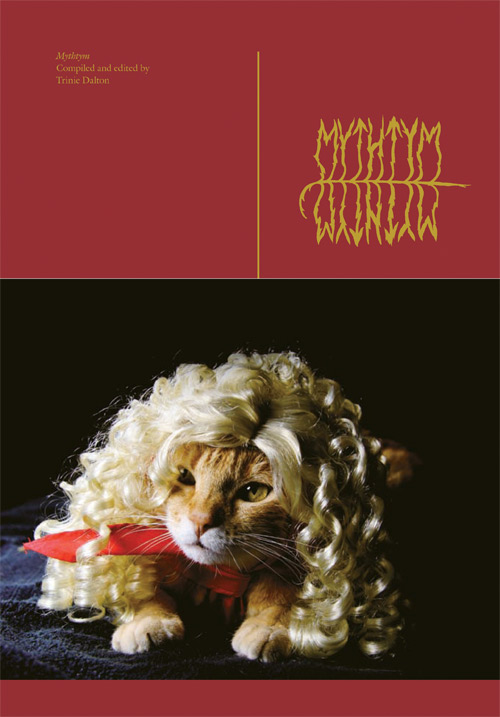
NEW TRINIE DALTON BOOK DETAILS…

productimage.jpg


MYTHTYM
Compiled and edited by Trinie Dalton

Hardcover
5” x 8.5”
204 Pages
Full Color
$30.00

“Trinie Dalton has long made popular zines on variety of subjects. She brings together artists, musicians, critics, novelists and cartoonists in one gorgeous stew. MYTHTYM compiles the best work from her previous zines on Werewolves, mythical beings, and the natural world. But best of all, this volume includes an entirely new, 100-page body of work on the theme of mirrors. This new section will investigate the mirror as a symbolic object in horror stories. The metaphorical mirror within the scope of mental illnesses such as schizophrenia. The metaphysical implications of mirroring, especially in the ancient world of alchemy. Reflective surfaces. Disco. The mirror’s role in psychedelic, symmetrical art. The first mirrors to emerge in primitive cultures, and the roles they played in early mythologies. Mirrors as scrying tools. It can branch out from there, into light, rainbows, death, vampirism, magic. Not restricted legally to mirrors by any means. In fact if it were all about mirrors that would be too many mirrors.

“Contributors include: Aurel Schmidt Folkert De Jong Takeshi Murata Jim Drain Andrew Leland Aura Rosenberg Sue De Beer Leif Goldberg Matt Greene Francine Spiegel Derek McCormack Jesse Bransford Shamim Momin Amy Gerstler assume vivid astro focus David Altmejd Sammy Harkham Rachel Kushner Marnie Weber Bjorn Copeland Paper Rad

“About her zines, Trinie Dalton has said: ‘I don’t want my books to be cliquish, but at the same time I don’t see them as communal free-for-alls. Of course, many people I invite to participate are my friends, and are friends with each other, but I deliberately include not only established artists and writers but also young people who are relatively unknown in their field. The idea of introducing and contextualizing artists by hanging their art on the same wall is a fundamental one in the art world. To me, my zines are literary/art/music history anthologies, following the group-show or salon style. They’re like parties on paper, and I want to be an exquisite host.'”


THE ART OF THE LONG INFUSION

“Nut in Pocket”
By Nance Klehm

originally published in Arthur No. 31 (Oct 2008)

SEED TIME
Out there, out of doors, it’s between leaf and root time. It’s seed time. In autumn, plants put their efforts into reproducing themselves via seeds, both bare and covered with delicious flesh. Right now it’s time to collect these offspring—juicy apples and pears for cider, seeds to grow next year’s harvest with, and nuts and berries to make healing infusions from.

Here are some seeds to collect before winter settles in:

amaranth seeds
burdock burs
hackberry berries
juniper berries
kentucky coffeetree seeds
lamb’s quarters seeds
rose hips
queen anne’s lace
yellow dock seeds
sumac berries
hawthorn haws
aronia berries
hazelnuts
walnuts
grapes
pawpaws
persimmons
elderberries
pears and apples (for cider…)

Each of these seeds has practical medicinal uses, which you can research on your own. But if you want the full-on benefit from the plants you decide to put in your body, you have to allow the plants to help you.

Long infusions, which are like concentrates, are an easy way to allow plants to do their work on you. You don’t need to use bagged herbal tea or other plant materials from a store to make an infusion. Nor do you have to buy it in bulk. Instead, you can forage, gathering plants that grow wild in our cities.

When you collect from a plant, do it on a dry day. Try to find more than a few and collect from them in a way that won’t damage them. Don’t rip or tear; instead, make clean pinches or cuts with a knife, your fingers or some pruning shears. Take only a few leaves/seeds/fruits—no more than 10% of any individual plant—as it is important that the plant you are collecting from is allowed to thrive and regenerate itself, even if it is considered a ‘weed.’ Plants are generous by nature with what they have to offer. When you are done, thank the plant. Maybe give it a drink from your water bottle. Because that plant is going to help set your liver or blood or mental attitude right. And that is pretty generous of it.

HOT & COLD
When you return home, dry the plant material in paper bags. Drying medicinal weeds is all about allowing air to circulate around the leaves and protecting them from light. Paper bags are perfect for this as they will not trap moisture. Don’t put too much material in any single bag—remember, the air has to be allowed to circulate. I like hanging them upside down in small bundles in my dark and dry pantry, but that’s just me.

When you’re ready to make an infusion, grab a healthy (no pun intended) handful of dried herb and put it in a quart glass jar. Glass is a must—it is stable and neutral. Now pour hot water over it all, until full, and screw on the lid. You use a lid so the volatile oils stay in the brew instead of being released into the air. Of course, that aroma can be enjoyable and part of healing, and will have your home or office smelling terrific.

Let it brew for at least 30 minutes to as long as several hours. You will need to do some research here. Some plant materials have chemical compounds and minerals that require a longer steeping time to get them to release into water. Roots and bark are two examples of this, but certain leaves fit this bill too.

Also, some plants require cold water instead of hot water. Seeds and fruits, for example, require cold water. I also usually steep these longer, often setting my jar up the night before, having a nice sleep while my infusion makes itself and then waking the next day to drink it at room temperature or warming it up with a low flame (stay away from that microwave, yuck!) or even drinking it iced.

Continue reading

THE FIRST FREE BIKES

“SIGNS OF CHANGE” DUTCH PROVO EVENT!
Friday, October 24, 2008, 6-8pm
Premiere screening of Dutch Provo Footage and book release of Richard Kempton’s PROVO: AMSTERDAM’S ANARCHIST REVOLT (Autonomedia, 2008)

This film will be shown in the larger context of Josh MacPhee and Dara Greenwald’s SIGNS OF CHANGE exhibit, a survey of ephemera from social movements ranging from the 1960s til now.

There is a suggested donation of $5.

Check it out here:
http://www.exitart.org/site/pub/exhibition_programs/signs_of_change/index.html

Location:
Exit Art, 475 10th Ave, NYC

Speakers include:
Jordan Zinovich, Lindsay Caplan, and Janna Schoenberger

About the Book:
Provo staged political and cultural interventions into the symbolic and everyday spaces of Holland from 1962-1967. In this first book-length English-language study of their history, Richard Kempton narrates the rise and fall of Provo from early Dutch “happenings” staged in 1962 to the “Death of Provo” in 1967. This is the fourth book Autonomedia has done on
Dutch social movements.

About the Video:
This compilation of Provo footage, newly translated and subtitled by Janna Schoenberger and Dennis de Lange, includes scenes from the early happenings, Dutch political life, and interviews by key members of Provo–including an interview held with Robert Jasper Grootveld on his houseboat in Amsterdam.

About the Speakers:
Jordan Zinovich has been associated with Autonomedia since 1986, and is currently a senior editor. He has been working on Provo for years, and since 1997 has been going repeatedly to Amsterdam to meet with members of Provo. He will discuss the renaissance of Provo going on today.

Lindsay Caplan is a member of the Autonomedia editorial collective, and a doctoral student at the Graduate Center, CUNY. Her research focuses on the intersection between art, aesthetics, and social action–an arena in which Provo is an essential and exciting example.

Janna Schoenberger is a doctoral student at the Graduate Center, CUNY. She received her master’s degree in Art History from Utrecht University in the Netherlands where she lived for three years. She is currently working as a translator for the upcoming exhibition “In and Out of Amsterdam 1960-1975” at the Museum of Modern Art.