
Courtesy B. Tamkin!
FREE BIKE MOVEMENT ON COLLEGE CAMPUSES GROWS…
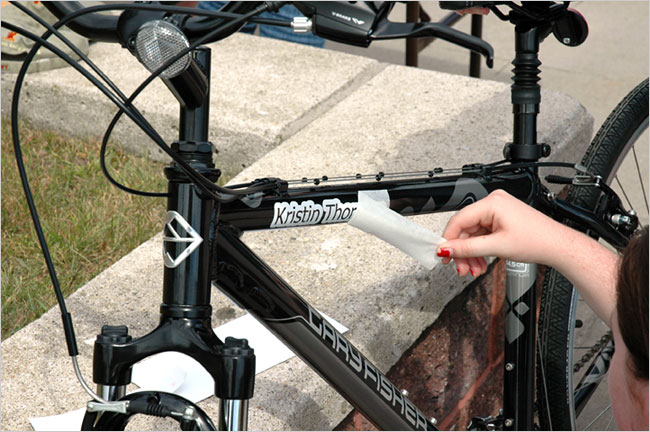
The University of New England bikes are personalized. Free or subsidized bike programs at colleges have had mixed success.
With Free Bikes, Challenging Car Culture on Campus
By KATIE ZEZIMA
The New York Times – October 20, 2008
BIDDEFORD, Me. — When Kylie Galliani started at the University of New England in August, she was given a key to her dorm, a class schedule and something more unusual: a $480 bicycle.
“I was like, ‘A free bike, no catch?’ ” Ms. Galliani, 17, a freshman from Fort Bragg, Calif., asked. “It’s really an ideal way to get around the campus.”
University administrators and students nationwide are increasingly feeling that way too.
The University of New England and Ripon College in Wisconsin are giving free bikes to freshmen who promise to leave their cars at home. Other colleges are setting up free bike sharing or rental programs, and some universities are partnering with bike shops to offer discounts on purchases.
The goal, college and university officials said, is to ease critical shortages of parking and to change the car culture that clogs campus roadways and erodes the community feel that comes with walking or biking around campus.
“We’re seeing an explosion in bike activity,” said Julian Dautremont-Smith, associate director of the Association for the Advancement of Sustainability in Higher Education, a nonprofit association of colleges and universities. “It seems like every week we hear about a new bike sharing or bike rental program.”
While many new bike programs are starting up, some are shutting down because of problems with theft and vandalism. The program at St. Mary’s College in Maryland was suspended because bikes were being vandalized.
“Ours was one that was totally based on voluntary taking care of the bike,” said Chip Jackson, a spokesman for St. Mary’s, “and I guess that was maybe a tad unwise. So the next generation of this idea will have a few more checks and balances.”
At Ripon, and the University of New England, officials say that giving students a bike of their own might encourage them to be more responsible. Ripon’s president, David C. Joyce, a competitive mountain biker, said the free bike idea came in a meeting about how to reduce cars on campus.
The college committed $50,000 to the program and plans to continue it with next year’s freshmen. Some 200 Trek mountain bikes, helmets and locks were bought, and about 180 freshmen signed up for the program. “We did it as a means of reducing the need for parking,” Dr. Joyce said, “but as we looked at it from the standpoint of fitness, health and sustainability, we realized we have the opportunity to create a change.”
The University of New England here in Biddeford had a similar problem — too many cars, not enough space and a desire to make the campus greener. So it copied the Ripon program, handing out 105 bikes in the first week of school. Because of the program, only 25 percent of freshmen brought cars with them this year, officials said, compared with 75 percent last year.
“We felt the campus could devolve to asphalt parking lots, and a lot of people didn’t want that to happen,” said Michael Daley, head of the university’s environmental council and a professor of economics.
The bikes are marked with each student’s name.
“I don’t have to fill it with gas, and it doesn’t hurt the environment,” said Kaitlyn Birwell, 18. “With a car, you need a parking permit, gas, and it breaks down. I’m a college student and don’t have the money for that.”
Michelle Provencal, 18, said she hopes her bike will help her avoid a dreaded side effect of being a college freshman. “Maybe instead of gaining the freshman 15 I’ll lose it,” Ms. Provencal said.
When Mercer University in Macon, Ga., asked for donations of old bikes, it received 60, which are being fixed up and painted orange and black, the university colors. Forty are available for weeklong rentals, and Mercer has organized mass rides to downtown Macon, about three miles away, to promote the program.
“A lot of students haven’t ridden a bike since middle school or even younger, but when they get back on it their faces light up,” said Allan J. Rene de Cotret, director of the program. “So why not leave your car parked where you live or back home with your parents and ride your bike around campus?”
Emory University has partnered with Fuji Bikes and Bicycle South, a local bike shop, to provide 50 bikes that can be rented at no charge at six spots on campus. Students can also buy Fuji bikes at a discount and receive a free helmet, lock and lights from Emory.
Students, faculty and staff can go to a rental station, show their Emory ID and check out bikes. The program plans to add 70 more bikes and four checkout points in the next year. In addition, about 150 bikes have been sold through the partnership in the past year, said Jamie Smith, who runs the program, called Bike Emory.
“We like the idea of bolstering the cycling culture here,” Mr. Smith said, “and ultimately it supports alternative transportation.”
Bikes at some campuses were treated as toys rather than transportation. Others were difficult to maintain or were not used.
“The kids weren’t taking care of the bikes, leaving them wherever instead of parking them in the bike racks,” said John Wall, a spokesman for Juniata College in Huntingdon, Pa., which eliminated its two-year-old bike-sharing program this year. “The other problem was that the bikes weren’t the greatest to begin with. They were donated by Wal-Mart, and others were rehabbed. They had also been out in the weather. It just didn’t work out.”
The elements are a concern at other universities as well. More than 150 students at the University at Buffalo signed up for a city bike-sharing program that has drop-off points on campus, but it suspends service from November to April.
“It’s hard to maintain all the bikes during winter, and usage drops dramatically,” said Jim Simon, an associate environmental educator at Buffalo.
Here at the University of New England, officials wonder what will happen when snow starts falling, but they are looking toward bike-sharing programs in cities like Copenhagen and Montreal as proof that they can work in the cold.
St. Xavier University in Chicago this month is unveiling the first computer-driven bike sharing system on a college campus.
Students can wave their ID card over a docking port. The port is attached to a rubber tube, which can be used as a lock and opened by entering an access code. Students must enter the bike’s condition before it can be unlocked. The system is used in Europe, but with credit cards.
The first 15 minutes are free, and users pay 60 cents for each additional 15 minutes, or $2.40 per hour. All 925 resident students automatically become members through their ID cards. The system was intended to be environmentally friendly, with solar panels powering the ports.
A tracking system similar to G.P.S. will keep tabs on the bikes.
“You can’t throw it in Lake Michigan,” said Paul Matthews, the university’s vice president for facilities management, “because we’ll know if you throw it in Lake Michigan.”
"Let's Go Shopping!" by Zina Saunders

While McCain describes the economy as “cratering,” the Republican Party has spent more than $150,000 on his running mate’s wardrobe and hair.
Sarah Palin, billed as the populist voice for Joe Six-Pack and Soccer Moms struggling to pay the monthly bills, has been running through an average of $18,000 a week to look the part of a VeePee.
MAGIC(K) IN THE STREETS: Applied Magic(k) column by the Center for Tactical Magic (Arthur, 2008)
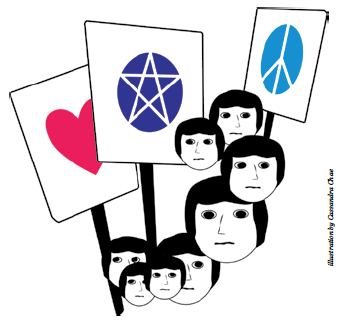
An Open Invocation
by The Center for Tactical Magic
illustration by Cassandra Chae
originally published in Arthur No. 31 (Oct 2008)
“Magic(k) works.” This declarative statement was recently hurled in our direction with a cautionary tone rather than a celebratory one. The sender of the warning was concerned that we didn’t take magic(k) seriously enough; that we were advocating its use willy-nilly like some sort of fun, new fad. But fear not. Although we don’t believe that fun and magic(k) are at odds with one another, we are nonetheless advocating its use very pointedly and with much consideration. And we are advocating its use precisely because it works.
As we’ve said in the past, one of the primary reasons why people don’t engage in magic(k) in the first place is out of a sense of dismissal. They dismiss magic(k) because they doubt it will produce results; and, they dismiss magic(k) because they fear it will produce results. Indeed, much of the bullshit that fertilizes the grand magic garden reeks of these airs of dismissal. Occult conspiracy theorists will even tell you that such bullshit is built up to protect the fruit from those who would dare set foot in the garden at all. Layers and layers of foul fluff and rotten rhetoric are woven into a formidable pile of vapid New Age-isms, Hollywood cheese, religious warnings, and occult elitism.
Continue readingTONIGHT – FREE, ALL-AGES Doug Aitken happening with White Rainbow, Lichens, Arp in NYC
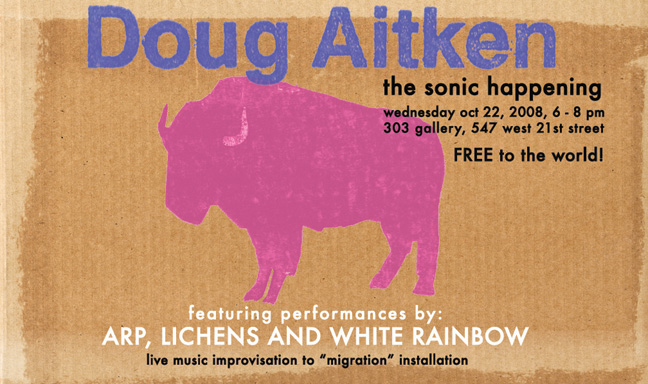
Doug Aitken: ‘sonic happening’
Featuring performances by White Rainbow, Lichens and Arp
Wednesday Oct 22, 2008 6-8pm
303 Gallery at 547 west 21st street
“the sonic happening (migration)”
In conjunction with Doug Aitken’s current exhibition, 303 Gallery is pleased to present a special viewing of Doug Aitken’s film based installation “migration”. For this event the artist has turned off the film’s soundtrack and invited the musicians Lichens, White Rainbow and Arp to create live improvisational scores set to the work.
Doug Aitken currently has concurrent installations at 303 Gallery’s two spaces. The performance, event, and ‘happening’ have been integral elements in his work. Aitken has organized ‘happenings’ in Los Angeles, New York, Basel, Manchester and Philadelphia.
In Lichens, wordless vocals are looped into curtains of drone, adding acoustic and electric guitars, percussion and other effects to create alternately thick and delicate works. Lichens has recorded and released two full-length LPs, “The Psychic Nature of Being” and “Omns”. In addition his work appears in the score of the film “migration”.
Portland-based White Rainbow, has released 7 full length albums since 2000. Creating morphing soundscapes that alternately reference minimalism, eastern prayer musics and trance ritual, White Rainbow weaves a unique web of sound meant to interact directly with its environment. He also provides the score to Aitken’s installation “to give it all away.”
Arp is the most recent project of Alexis Georgopoulos, a San Francisco-based artist, writer and musician brought up in France, Greece and the United States. As Arp, he released 2008’s “In Light”, an album recorded almost entirely live, and meant to serve as a bridge between the natural and electronic worlds.
“Migration” is included in the 55th Carnegie International exhibition “Life on Mars” where the piece is projected on the museum’s façade through January 2009. Aitken has also had solo exhibitions at the Museum of Modern Art, New York, ARC Musée d’Art Moderne de la Ville de Paris, the Serpentine Gallery, London, Kunsthalle Zurich, Switzerland, Kunsthaus Bregenz, Austria and Tokyo Opera City Art Gallery, Japan. Aitken’s newest book “99 cent Dreams” was published in 2008 by Aspen Art Museum following his solo exhibition there, and his artist’s book “Write In Jerry Brown President” will be published by the Museum of Modern Art, New York in October 2008.
303 gallery
525 west 22nd street
new york, ny 10011
t. 212 255 1121
http://www.303gallery.com
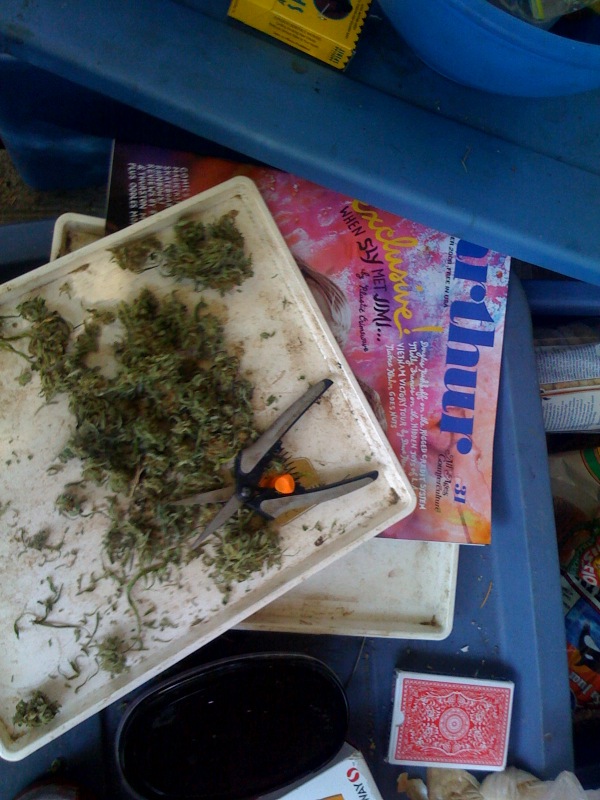
TRIMMING PAY: photo sent to Arthur HQ by anonymous harvester
"BREAK UP THE CONCRETE": Chrissie Hynde, Devo and Dan from the Black Keys at Obama/Democrats benefit in Akron – Oct 17
(Not the best sound…)
(Not the best video…)
McCain-Palin's useful idiots

Jason Waller, left, in an Obama mask, and Elazbeth Waller as Gov. Sarah Palin while Senator John McCain talks in Concord, N.C., on Saturday. Photograph by Carolyn Kaster/Associated Press
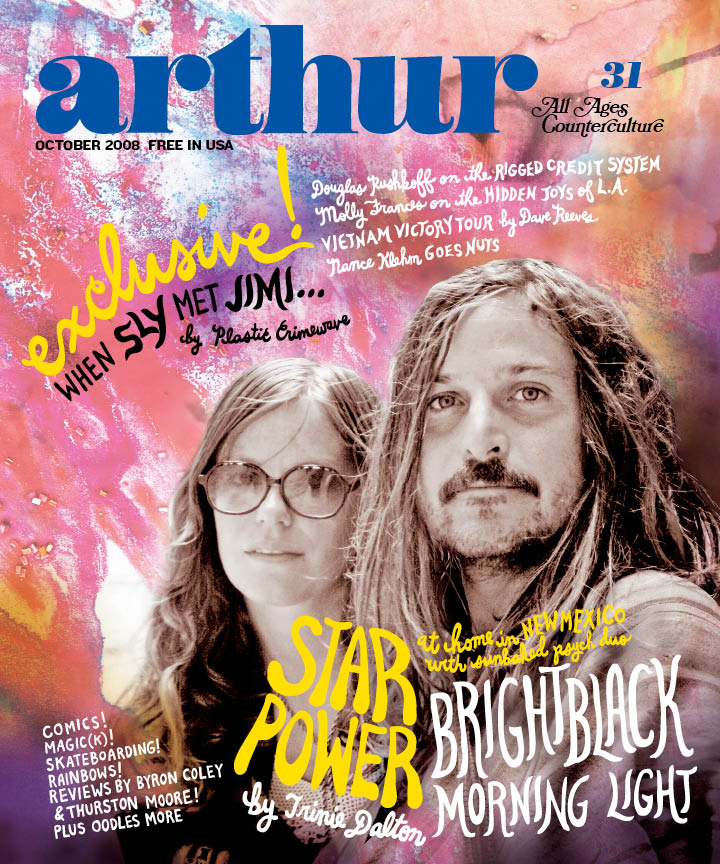
“KEEPING IT LOCAL”: Trinie Dalton visits BRIGHTBLACK MORNING LIGHT (Arthur, 2008)
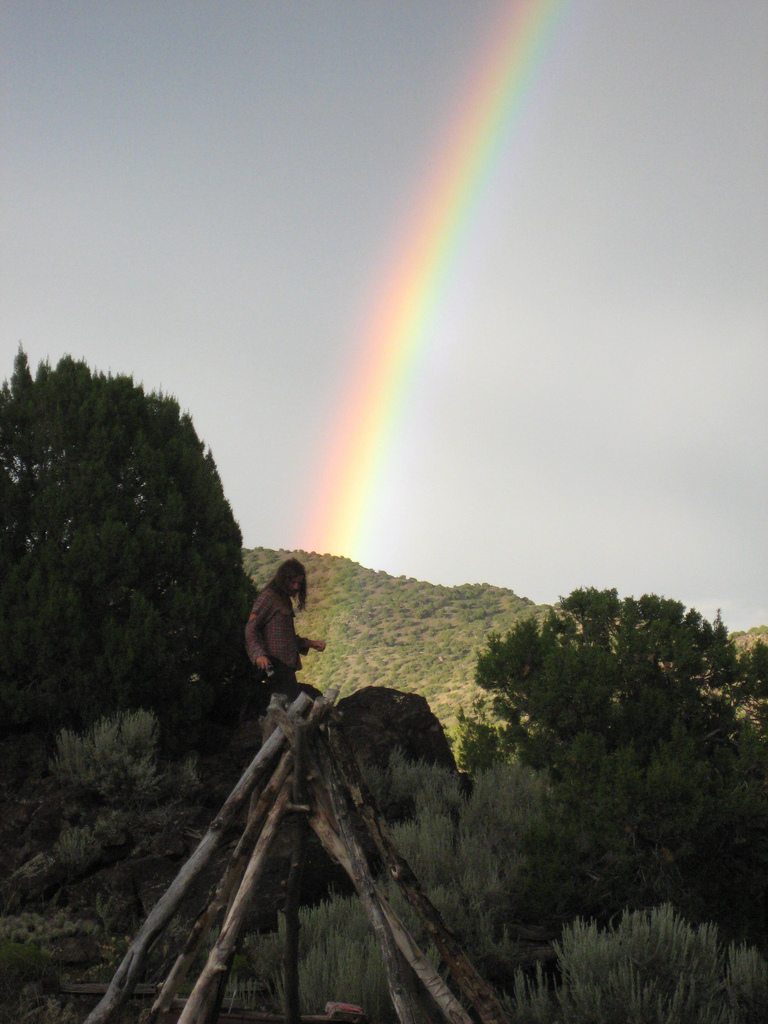
Nabob, photographed by Trinie Dalton
KEEPING IT LOCAL
Two transplants from the Heart of Dixie who went west to the land of mesas, pueblos and geodesic domes, Rachael Hughes and Nathan Shineywater have found a way to thrive beyond society’s mad dash to survive. Trinie Dalton travels to New Mexico to meet BRIGHTBLACK MORNING LIGHT, and hear their stunning new album in the pair’s natural habitat.
originally published in Arthur No. 31 (Oct 2008), with photographs by Lisa Law
Leaving Brightblack Morning Light’s northern New Mexico deep wilderness enclave, I finally get their obsession with the local AM radio. The daily monsoon moves in as I fly down the hill from their town in my red rental car. Mexican cumbia, a variation of the upbeat Colombian pop music, sounds interplanetary crackling through the fuzzy AM distance. I imagine it transmitting from some far off Mexican star, a star I’d like to visit. Crank the cumbia, see what it can do in a storm. Brightblack Morning Light’s Nabob Shineywater says AM is like Sun Ra. Yesterday morning, just after I’d arrived, we were hiking up a wash and Nabob asked, “Who are we to say Sun Ra wasn’t from another planet?”
The sky gets dark as wind kicks up. With the first lightning crackle and boom, the radio shorts and cumbia cuts out—quiet for a moment, then back up, hissing, scratched, and damaged. Have I blown the speakers? Has the radio station’s tower been struck? Each lightning bolt slicing vertically down the flat horizon causes more disruption. Nabob also mentioned that in Los Alamos, scientists recently disproved Einstein’s theory that light travels fastest. Radio waves now win that contest. Two days after the anniversary of the Pueblo Revolt of 1860—a big deal in these parts—thunder means the obliteration of human sounds. Recognizable dance beats are exchanged for something Frankenstein-ish: a live, electric orchestration so weird and marvelous it could only have been invented by Nature, the omnipresent force in this sandy region.
Continue readingRecently discovered delights in L.A. and elsewhere, by Molly Frances (Arthur, 2008)
Originally published in Arthur No. 31 (Oct 2008)
Recently Discovered Delights
by Molly Frances
1. Nite Jewel
This one-woman act has been haunting nightclubs around Los Angeles and beyond this summer, dropping nocturnal transmissions and electro dust into the atmosphere. Accompanied by her bubbling synthesizer and deep tunnel beats, Nite Jewel would make the perfect house band on the mothership that’s going to take us all away from this place. myspace.com/nitejewel
2. Raymond Chandler
What a different city Los Angeles would be without the mythology of Phillip Marlowe and the many shadows cast by Chandler’s noir mysteries running through its city streets. Fall’s a good time to revisit these stories of an honest man lost in a sea of corruption.
3. Avocado with poppy seeds
Slice an avocado, add lemon, and roll in a generous heap of poppy seeds. Exotic.
4. Semina Culture: Wallace Berman and His Circle by Michael Duncan and Kristine McKenna (2005)
You will never get tired of looking at this book. This catalogue from the 2005 traveling exhibit spans the years of mid-’50s to early-’60s beatdom, when an artistic and literary utopia formed around the mysterious figure of artist Wallace Berman and his arts and literary journal Semina. You couldn’t find it on newsstands or in bookstores; most of its few hundred copies were mailed by Berman to friends and peers. The book not only reproduces all nine issues but is a Who’s who of West Coast bohemia.
5. Walking really far
Walk for two hours in any direction and see where you end up. Maybe you are missing something. Maybe you will find it.
6. Velaslavasay Panorama
The North Pole is tucked right into South Los Angeles. Go and see. It’s hidden in the second floor of the beautiful Union Theater. Take yourself to the endless horizon. panoramaonview.org/
7. Flying Lotus, Los Angeles (Warp)
The 17 tracks on FlyLo’s second record seem to flow without beginning or end, stacking dusty samples, sandpaper beats, and washy synths into a collage as dense and sticky as an august afternoon in Van Nuys. You’re stuck in traffic, the sun is in your eyes, a jackhammer echoes an unsteady rhythm in the distance, your radio suddenly plays all its stations at the same time. For a second it all makes some kind of sense.
8. The Late Show (1977, dir. Robert Benton)
Lily Tomlin, Art Carney, a lost cat, blackmail, murder and endless hijinks, set in Los Angeles. Nutty and Noir, this Robert Altman-produced mystery features an incredibly stylish Tomlin as an aimless but charming eccentric and Carney as a cranky over-the-hill detective with one last fight In him. Don’t get the idea that this is one of those awful detective spoofs, it’s actually one of the most perfect movies you’ve never heard of, covering all genres, emotions, and hairstyles. You will laugh many times.
9. Cold brewed coffee
Impress your friends with a rousing pitcher of iced coffee. You will be known throughout many wide and concentric circles for being a dark brewing lord and master of the bean. No one will know how easy it is for you with your cold brew coffee bucket. You grind a whole can of coffee with 9 cups of water and it sits for 12 hours and then you have a pitcher of low-acid coffee that tastes amazing for two weeks. Everyone will love you and want to be your friend. You can buy the cold toddy brewing kit they sell in stores or make your own. It’s off the grid.
10. The Baroque Music station on 1.fm
When one’s radio breaks down, you can discover amazing things that were once hidden right under your nose. Lurking within the Classical Radio tab of that iTunes thing is an endless stream of this amazing music that restores your faith in civilization. It only occasionally loses its affirmative power when interrupted by a commercial for under-eye circles.
11. Raw vegan whipped cream
Soak 1 1/2 cups of raw walnuts (or raw cashews) in water for two hours…then get rid of the water and put the nuts in a blender with 1/2 cup fresh squeezed orange juice and two tablespoons maple syrup (a few drops of almond extract optional) This recipe is from Juliano’s UnCook Book (Regan Books,1999)—good recipes, really bizarre self-portraits.
12.Griffith Observatory
Despite multi-million-dollar renovations during recent years, the main attraction at Griffith is still the view of the twinkling metropolis below. Go at dusk to watch nature and culture collide to form a gold and purple ooze that stretches from the mountains to the sea. Breathtaking.
13. Sylvia Robinson “Pillow Talk” 7-inch single
Found this scratchy 45 in a box at the back of a thrift store in Joshua Tree. Before masterminding Sugar Hill records, Robinson recorded music as ‘Sylvia’ and wrote this song for Al Green. He turned it down because it was too dirty so she recorded it herself and it hit number one on the charts in 1973. With breathy talk vocals, hi-hat swoosh, and sugary string and electric piano arrangements, it’s a fine specimen of the early disco sound that was forming around Philadelphia and other East Coast cities at the time, and is a naughty stepping stone between Serge Gainsbourg/Jane Birkin’s Je T’aime and Donna Summer’s Love to Love You Baby in the history of simulated orgasm on wax. The flipside sounds like it comes from an earlier, more wholesome time period but is an equally luscious track with a piano-heavy girl-group sound.
14. Jumping on a trampoline
Up and then down. Do it again. Jumping cleanses your cells and lymph nodes and increases your immunity. Up with people.
15. Making your own amazing salad dressing in one minute
Combine cold pressed organic olive oil (a lot), lemon, honey and stoneground mustard. This tastes better than anything you can buy. There is room for error. Salad dressing is very forgiving. Raw sage honey sweetens the deal.
16. Too Late For Tears (1949, dir. Byron Haskin)
All the pleasure of knowing a dangerous femme fatale, none of the risk. 1949 Los Angeles in glorious black and white.
17. Okra
If you slice a piece of okra crosswise, it reveals a circle of five perfect hearts formed from the fibers. I never loved okra, but now that I know it loves me, I’m coming around.
18. Show Cave
This art gallery/performance space in the Echo Park district of Los Angeles has been forming its own hybrid aesthetic out of the goo of contemporary life in its past year of existence. Exhibitions have exciting names like Beast Heat, Glitter and Doom and Survivors of the White Plague. Show Cave also offers a stage to emerging musical talent (see #1). www.showcave.org
19. Low Motion Disco, Keep It Slow (Eskimo)
In one room a synthesizer slowly throbs; in another a band rehearses outtakes from an unrecorded Royal Trux session. In a third room someone is playing records from their parents’ collection. There’s an empty bottle of purple syrup on the floor. The windows to this house are open and there’s a cool breeze that blows down from the mountains. You’re listening to these sounds mingle from down on the street. It sounds like a perfect mix that shouldn’t work at all. It’s too slow to dance to but it’s kind of funky. This is supposedly taking place in Switzerland.
Molly Frances lives in Los Angeles and makes music in Terminal Twilight.
 Arthur Magazine