
ARTHUR BEST OF 2007 LISTS No. 1: Alan Bishop of SUBLIME FREQUENCIES
Alan Bishop – Best of 2007:
1. The Ascension of the great Charles Gocher Jr. to the outer zones (February 19, 2007)
2. ‘Holy Mountain’ Soundtrack Debut Release–Alejandro Jodorowsky Box set (ABKCO)
3. Hayvanlar Alemi (Turkey) ‘Super’ (two-song self-released download single)
4. Porest ‘Live at Worm in Rotterdam’ (November 2007)
5. Los Siquicos Litoralenos (You Tube videos)
6. Queen Shmooquan ‘Live at Rendezvous Lounge Seattle’ (October 2007)
7. ‘Waking Up Scheherazade: Arabian Garage Psych Nuggets’ LP (Ali Baba)
8. Climax Golden Twins ‘5 Cents A Piece’ LP (Abduction)
9. Sir Richard Bishop ‘While My Guitar Violently Bleeds’ LP (Locust)
10. ‘Roots of Chicha’ CD (Barbe’s Records)
11. Vintage Pulchritude website
12. Master Musicians of Bukkake ‘Live in Portland at the Someday Lounge’ (July 2007)
13. Ennio Morricone ‘Agent 505 Todesfalle Beirut/IL Successo’ CD (GDM)
14. Michael Flower/Chris Corsano ‘The Radiant Mirror’ LP (Textile Records)
15. Factums LP (Silt Breeze)
ALAN BISHOP is a founding member of the late Sun City Girls and a partner in the sensationally great world-trotting Sublime Frequencies label, which was profiled at length by Brandon Stosuy in the still-available Arthur No. 18 (Sept 2005).
Tonight in the Santa Cruz Mountains…

All Ages!
$10.00 Advance (will call)
$12.00 @ the door on Sunday night
Tickets and info at folkyeah.com
MAGMA report on French TV, 1979
ARTHUR for everybody else.
If you are one of the 120,000+ readers who enjoys Arthur for free, please consider helping someone less fortunate to have the same privilege in 2008…

PRISONERS
In lieu of a proper education system America has instituted a special school for people of color called prison. Students learn a lot in prison, but are propagandized solely by corporate media, whose rotten message grows even more virulent in the nightmare that is life inside. As a consequence, Arthur regularly receives pleas from these captives to provide them with an untainted diversion at least.
Over two million people — one out of every 142 Americans — is now in prison. Almost 500,000 Americans are in jail for drugs-only offenses, and if they try to go to a record store or coffeehouse or nightclub to pick up a copy of Arthur, they will be shot and bit by dogs. These starving minds have got to get Arthur sent to them in a warden-approved manner, which costs thirty dollars a year. With your kind donation, Arthur will be able to give a lucky prisoner and their cellblock a free one-year subscription.
Provide a beacon for a guy who got caught today.
PUBLIC LIBRARIES
America’s public libraries are criminally underfunded. You can probably guess why. When you buy a subscription to Arthur on behalf of a public library, you help to expand the public’s consciousness while also providing vital financial support to the magazine itself, enabling it to continue its mission. Not too shabby for 30 bones.
MEDICAL MARIJUANA DISPENSARIES
Because people waiting for their medicine deserve something better to read than High Times.
Graciela Iturbide at the Getty

Mujer ángel, desierto de Sonora, México
Graciela Iturbide, 1979
Gelatin silver print

Tuesday, January 8, 2008, 7:00 p.m.
Getty Center, Harold M. Williams Auditorium
Photographer Graciela Iturbide discusses her work with Roberto Tejada, professor of visual arts at UC San Diego. This program will be conducted in Spanish with simultaneous translation into English available.
“Graciela Iturbide (born in 1942) is one of Mexico’s most accomplished and fascinating photographers. Iturbide began her career photographing everyday life in Mexico City. But, like her mentor Manuel Álvarez Bravo, she was curious about the country’s culture outside the capital. The exhibition The Goat’s Dance: Photographs by Graciela Iturbide (on view December 18, 2007–April 13, 2008 at the Getty Center) presents the stunning results of her explorations of diverse Mexican and Mexican-American groups, including indigenous communities in southern Mexico, outsider immigrant groups in East Los Angeles, and those struggling at the U.S.-Mexico border.”
Info:
http://www.getty.edu/art/exhibitions/iturbide/events.html

Thank you Bob

Click here for “Theme Time Radio Hour” Season Two archive…
art by jaime hernandez!
back in stock from K Records, and, unfortunately, more relevant than ever

A Toast to Shane


Shane MacGowan of the Pogues turns 50 today. From The Guardian:
The Pogues recorded five albums together before MacGowan was sacked in 1991 because of his drinking… Over the next decade he immersed himself in a cocktail of wine, gin and tonic, long island iced tea, port and martini and put together a new band, Shane MacGowan and the Popes. He collaborated with The Jesus and Mary Chain and Nick Cave – and continued to take drugs.
His girlfriend, Victoria Mary Clarke, was once called to his house to find blood gushing from his mouth after he had tried to eat volume three of The Beach Boys’ greatest hits.
“[Shane] had become convinced that the third world war was taking place and that he, as the leader of the Irish republic, was holding a summit meeting in his kitchen between the heads of state of the world superpowers, Russia, China, America and Ireland,” she wrote in the Guardian. “In order to demonstrate the cultural inferiority of the United States, he was eating a Beach Boys album.”
“WILLPOWER TO THE PEOPLE!”: Applied Magic(k) column by the Center for Tactical Magic (Arthur 27, Nov. 2007)
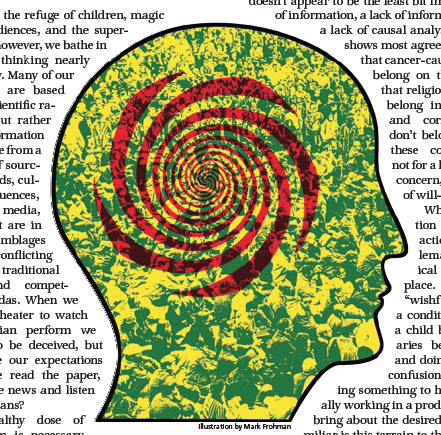
WILLPOWER TO THE PEOPLE
by the Center for Tactical Magic
Art direction by Molly Frances and Mark Frohman
printed in Arthur Magazine No. 27 (November 2007)
Cognitive scientists use the term “Magical Thinking” to describe a lack of causal reasoning. According to them, the belief in superstitions, lucky charms, and rain dances often falls into this category. But the term can be applied to any situation where one makes judgments based on a cause-and-effect rationale that wouldn’t hold up under scientific scrutiny. Simply put, magical thinking is (from a cogsci perspective) the analytical by-product that occurs when your hopes, fears, desires, prejudices, and beliefs take over your decision-making.
Child psychologists often use the term slightly differently. For a child, magical thinking often refers to conditions in which the cause and the effect are disassociated. For example, the kid sees you grab a remote control from the table and hears the stereo turn on, but doesn’t yet understand that the two actions are related. It is primarily this aspect of magical thinking that stage magicians rely on when performing illusions. In feats of magical reverse engineering, a good magician will think about a desired effect to be produced, and then work backwards to plan the method. The success of the effect is then greatly enhanced by the magician’s ability to conceal the method from the audience. In essence, the magician returns the audience to a state of child-like perception where causes and effects are distant strangers. Some embrace this sense of wonderment while others resent the inflicted feelings of naiveté. Yet, it should be noted that while such magical thinking evokes a child-like sense of the world, it does not limit us to childish behavior.
It would be easy to believe that magical thinking is merely the refuge of children, magic show audiences, and the superstitious; however, we bathe in magical thinking nearly every day. Many of our decisions are based not on scientific rationale but rather on information we receive from a variety of sources – friends, cultural influences, mass media, etc. And many of these sources are in fact assemblages of conflicting truths, traditional bias, and competing agendas. When we enter a theater to watch a magician perform we expect to be deceived. But what are our expectations when we read the paper, watch the news, and listen to politicians?
Continue reading Arthur Magazine