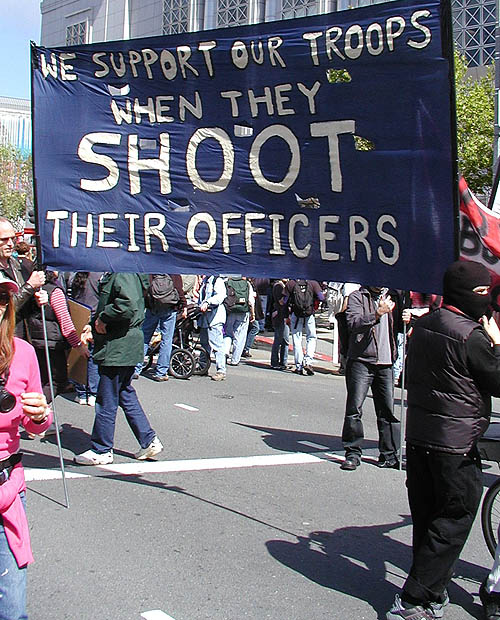
Republicans, Democrats: two flavors of the Corporate Business Party.

Democrats Get Late Donations From Business – New York Times

October 28, 2006

By JEFF ZELENY and ARON PILHOFER
WASHINGTON, Oct. 27 — Corporate America is already thinking beyond Election Day, increasing its share of last-minute donations to Democratic candidates and quietly devising strategies for how to work with Democrats if they win control of Congress.

The shift in political giving, for the first 18 days of October, has not been this pronounced in the final stages of a campaign since 1994, when Republicans swept control of the House for the first time in four decades.

Though Democratic control of either chamber of Congress is far from certain, the prospect of a power shift is leading interest groups to begin rethinking well-established relationships, with business lobbyists going as far as finding potential Democratic allies in the freshman class — even if they are still trying to defeat them on the campaign trail — and preparing to extend an olive branch the morning after the election.

Lobbyists, some of whom had fallen out of the habit of attending Democratic events, are even talking about making their way to the Sonnenalp Resort in Vail, Colo., where Representative Nancy Pelosi of California is holding a Speaker’s Club ski getaway on Jan. 3. It is an annual affair, but the gathering’s title could be especially apt for Ms. Pelosi, the House minority leader, who will be on hand to accept $15,000 checks, and could, if everything breaks her way, become the first woman to be House speaker.

“Attendance will be high,” said Steve Elmendorf, a former Democratic Congressional aide who has a long list of business lobbying clients. “All Democratic events will see a big increase next year, no question.”

While business groups contained their Democratic contributions to only a handful of candidates throughout the year, a shifting political climate and an expanding field of competitive Congressional races has drawn increased donations from corporate political action committees.

For the first nine months of the year, for example, Pfizer’s political action committee had given 67 percent of contributions to Republican candidates. But October ushered in a sudden change of fortune, according to disclosure reports, and Democrats received 59 percent of the Pfizer contributions.

Over all, the nation’s top corporations still placed larger bets on Republican candidates. But at the very time Republicans began to fret publicly about holding control of Congress, a subtle shift began occurring in contributions to candidates, particularly in open seats.

“We keep fighting up until the last minute of the last day,” said William C. Miller, vice president for political affairs at the U.S. Chamber of Commerce, carefully measuring his words to remain positive about the Republicans’ chances. “But when the smoke clears on Nov. 8, there are certainly going to be lots of opportunities for us to get to know the new freshman class.”

An analysis by The New York Times of contributions from Oct. 1 to 18, the latest data available, shows that donations to Republicans from corporate political action committees dropped by 11 percentage points in favor of Democratic candidates, compared with corporate giving from January through September.

Republicans still received 57 percent of contributions, compared with 43 percent for Democrats, but it was the first double-digit October switch since 1994. “A lot will hold their powder for now,” said Brian Wolff, deputy executive director of the Democratic Congressional Campaign Committee. “But after the election, we will have a lot of new friends.”

Even before the election, many new contributions were funneled toward open races, like the Eighth Congressional District in Arizona. The Democratic candidate, Gabrielle Giffords, received checks of $5,000 each from the political action committees of United Parcel Service and Union Pacific. Lockheed Martin split the difference, donating $3,000 to Ms. Giffords and sending the same amount to her Republican rival, Randall Graf.

Until October, Lockheed Martin, the giant military contractor, had been following its pattern from recent elections of giving about 70 percent of contributions from its political action committee to Republicans. But Lockheed Martin’s generosity shifted in the first half of October, with Democrats receiving 60 percent of donations, or $127,000.

While Republicans and Democrats are feverishly soliciting contributions until Election Day, campaign finance reports filed this week provide a window into the final days of a raucous midterm election campaign. The analysis of 288 corporate political action committees, which have contributed more than $100,000 this election cycle, found that at least 65 committees had increased their ratio of contributions to Democrats by at least 15 percentage points, including Sprint, United Parcel Service and Hewlett-Packard.

A notable exception to the flurry of last-minute giving is Wal-Mart.

“We had a two-year strategy to build up relationships with Democrats,” said Lee Culpepper, the vice president for federal government relations at Wal-Mart. “This wasn’t something that we decided in August that we needed to do and we ran out helter-skelter to try to do it.”

One sign of fresh interest in the prospects of Democratic Congressional races came one morning this week when more than 100 lobbyists crowded into Democratic Party headquarters on Capitol Hill. Over Dunkin’ Donuts and coffee, the executive director of the party’s Congressional committee, Karin Johanson, delivered a private briefing on the race to a sea of unfamiliar faces, despite spending 30 years in politics.

“People are excited,” she said later in an interview. “It was, by far, the best attended one ever.”

As some young Republican lobbyists fled Washington to spend the final days working on too-close-to-call races in Ohio or Pennsylvania, their senior counterparts stayed behind to begin studying prospective members of the new freshman class. Even if Republicans hold control, the next Congress will almost certainly include at least a handful of moderate Democrats who defeated Republicans and will be looking for allies in the corporate world.

Peter Welch, the Democratic candidate for Vermont’s single House seat, has already been telephoning some members of the Washington business lobby, offering an opportunity to begin a good relationship if he wins election. Never mind that his Republican opponent, Martha Rainville, has received a host of endorsements from the business community.

“The real story of the 2006 contributions is what happens in the early phase of 2007, with a change in party control,” said Bernadette A. Budde, senior vice president of the Business-Industry Political Action Committee. “There will be proverbial meet-and-greets all over town so we will have a sense of who these people are.”

Many of these meet-and-greet sessions will have a dual purpose: political action committees will offer contributions to help candidates wipe away debt their campaigns accrued during the race.

Spending in the midterm election campaign is forecast to reach $2.6 billion, according to the Center for Responsive Politics, including $1 billion from political action committees. While many business groups have been eager to appear as if they have been handily contributing to Democratic efforts, it was not until this month that the trend became apparent enough to quantify beyond party leaders or prospective committee chairmen.

Democrats who are not in tight races — or even standing for re-election in some cases — have seen their contributions increase more than some of those facing the most competitive contests. That is an easy way, lobbyists say, for political action committees to increase the share of their Democratic contributions, a percentage that is carefully tracked by party leaders when they reach the majority.

Representative Adam Smith of Washington, who leads a coalition of centrist Democrats, said he has detected a friendlier relationship with the business community in recent months, a welcome change from years of Republican rule when “Democrats were basically frozen out in every way.”

“I hope that the new Democratic majority will take a more open and cooperative approach,” Mr. Smith said in an interview. “I hope there won’t be a sense of, ‘Oh, you gave too much money to Republicans, so we’re not going to talk to you.’ ”

Fela Kuti Day 2007

Oct 28
2 – 6pm
Leimert Park

Afrobeat Down
Wanlov & The Broken English Band
Isaac Sundiata – Afrodicia Poetry
Sandra Iszadore Queen of Afrobeat

Authentic Nigerian Cuisine from Veronica’s Fufuland
FREE Admission


Humour abounds amid Lagos chaos

By Kieran Cooke
BBC News, Nigeria
Broadcast on Saturday, 28 October, 2006 at 1130 BST on BBC Radio 4.

Nigeria is Africa’s most populous country and has the potential to be one of the richest, but has been plagued by corruption since independence in 1960. But as our correspondent found on a visit to the sprawling city of Lagos, there’s another side to life – the unfailing humour with which Nigerians confront the trials of daily living.

It happened as the aircraft was about to lift off. A muffled explosion followed by a grating, turbulent sound, rather like a dishwasher gone berserk.

We were flung forward as engines were reversed, brakes slammed on.

The ornate red hat of the podgy man next to me went flying down the cabin, closely followed by a pile of newspapers, a handbag and, the most strange sight of all, a carton of washing powder.

My friend Ibim, a local journalist intent on showing me what she called “the real Nigeria” far away from Lagos, grabbed my thigh in a blood-stopping clasp. We came to a halt, slightly skewed, not far from the end of the runway.

What was most impressive about the incident at Lagos airport – besides the split second decision making of the pilot – was the behaviour of those on board.

No screams, no tears. A shrugging of shoulders – and then, chuckles and laughter.

“You see,” said Ibim. “We Nigerians can take anything.”

It is as if locals combat the haphazard, often frightening world they inhabit with bellyfuls of humour.

“Welcome to Nigeria, the happiest country in Africa” says the sign at the airport – while another carries a more worrying message – “Mind the Roof”, it says.

We limped back to the terminal. The pilot – he had a Russian accent – announced that there had been what he called a “bird strike”.

It must have been some bird. After inspection, one of the two engines was found to be more or less wrecked.

Lagos is one of those places where you wonder just how anything manages to function. It is a city of, well, no-one is entirely sure of the population, but estimates vary between 13-15 million.

Built on a swamp and a series of islands, it is sinking. There is no mass transit system, no proper sewage network, drinking water for only a small portion of the city, and a power supply that is more off than on.

All this in a country which is one of the world’s biggest oil producers but where the majority live in poverty. Nigeria recently celebrated 46 years of independence. Reading the newspapers was a sad business.

“Where did we go wrong?” they asked. Education and health systems which were among the best in Africa, in shambles.

For years the state coffers have been pillaged by the privileged few: again the figures vary widely, but there is no doubt billions of pounds have “gone missing” from state funds over the years.

And yet – amid all the chaos, the potholes and the blackouts – there is a vibrant energy about Lagos, a sense of living on the edge and again, that humour.

Sit in a Lagos traffic jam and look at the dented, people-crammed yellow buses that limp and belch their way round the city.

All seem to have messages elegantly written on them.

“Such is Life” says one. “No Tension” says another – horn blaring.

And – painted on the side of a particularly rusty, blue-smoking, smashed-up-looking bus, my favourite, thought provoking, message: “The downfall of man is not the end of his life.”

In 1991, the capital was moved from Lagos to the far more orderly, new city of Abuja in the centre of the country. All over Lagos there are the abandoned, ugly hulks of what were once central government offices and ministries.

But each weekend officials scurry back from Abuja to this sinking city by the sea, seeming to crave its chaos and its madness.

Such is the state of Lagos traffic – it is not unusual for people to spend six hours a day getting to and from work – that many people do not go shopping, rather the shops come to them.

You can buy everything you need from hawkers who patrol the queues of buses, cars and trucks.

Need a curtain rail? No problem, just wind down the car window.

A mirror? Your groceries? A book, chair or a lampshade? It is all there, in the midst of the choking traffic. One man even had armfuls of toilet seats on offer.

One of the more important roadside industries is the manufacture of formidable looking iron doors and gates.

The wealthy of Lagos live in fortresses – high walls topped with rolls of razor wire. Armed guards. Surveillance cameras.

But then, there is the other side of life. One of the most vibrant music scenes in Africa. Churches of every description side by side with mosques. A strong literary culture.

Back at the airport there is an announcement.

“The replacement aircraft is being serviced” said a cheery voice. “You’ll be on your way just as soon as we’ve put the plane back together again.”

Ibim and I – and the other passengers – collapsed in fits of thigh-grabbing, shoulder-thumping laughter.

We did get there in the end.

NEW THRIZZLE!

This coming Friday, October 27th, there will be a release party for the new issue of Michael Kupperman’s masterpiece of modern humor, TALES DESIGNED TO THRIZZLE (#3).

It’s at Rocketship, the most excellent comics store located at 208 Smith Street in Brooklyn, between 8 and 10 PM. Beer and wine will be served.

Progress toward achieving "Idiocracy" in America – update

Washington Post

The Year Of Playing Dirtier
Negative Ads Get Positively Surreal
By Michael Grunwald
Washington Post Staff Writer
Friday, October 27, 2006; A01

Rep. Ron Kind pays for sex!

Well, that’s what the Republican challenger for his Wisconsin congressional seat, Paul R. Nelson, claims in new ads, the ones with “XXX” stamped across Kind’s face.

It turns out that Kind — along with more than 200 of his fellow hedonists in the House — opposed an unsuccessful effort to stop the National Institutes of Health from pursuing peer-reviewed sex studies. According to Nelson’s ads, the Democrat also wants to “let illegal aliens burn the American flag” and “allow convicted child molesters to enter this country.”

To Nelson, that doesn’t even qualify as negative campaigning.

“Negative campaigning is vicious personal attacks,” he said in an interview. “This isn’t personal at all.”

By 2006 standards, maybe it isn’t.

On the brink of what could be a power-shifting election, it is kitchen-sink time: Desperate candidates are throwing everything. While negative campaigning is a tradition in American politics, this year’s version in many races has an eccentric shade, filled with allegations of moral bankruptcy and sexual perversion.

At the same time, the growth of “independent expenditures” by national parties and other groups has allowed candidates to distance themselves from distasteful attacks on their opponents, while blogs and YouTube have provided free distribution networks for eye-catching hatchet jobs.

“When the news is bad, the ads tend to be negative,” said Shanto Iyengar, a Stanford professor who studies political advertising. “And the more negative the ad, the more likely it is to get free media coverage. So there’s a big incentive to go to the extremes.”

The result has been a carnival of ugly, especially on the GOP side, where operatives are trying to counter what polls show is a hostile political environment by casting opponents as fatally flawed characters. The National Republican Campaign Committee is spending more than 90 percent of its advertising budget on negative ads, according to GOP operatives, and the rest of the party seems to be following suit. A few examples of the “character issues” taking center stage two weeks before Election Day:

· In New York, the NRCC ran an ad accusing Democratic House candidate Michael A. Arcuri, a district attorney, of using taxpayer dollars for phone sex. “Hi, sexy,” a dancing woman purrs. “You’ve reached the live, one-on-one fantasy line.” It turns out that one of Arcuri’s aides had tried to call the state Division of Criminal Justice, which had a number that was almost identical to that of a porn line. The misdial cost taxpayers $1.25.

· In Ohio, GOP gubernatorial candidate J. Kenneth Blackwell, trailing by more than 20 points in polls, has accused front-running Democratic Rep. Ted Strickland of protecting a former aide who was convicted in 1994 on a misdemeanor indecency charge. Blackwell’s campaign is also warning voters through suggestive “push polls” that Strickland failed to support a resolution condemning sex between adults and children. Strickland, a psychiatrist, objected to a line suggesting that sexually abused children cannot have healthy relationships when they grow up.

· The Republican Party of Wisconsin distributed a mailing linking Democratic House candidate Steve Kagen to a convicted serial killer and child rapist. The supposed connection: The “bloodthirsty” attorney for the killer had also done legal work for Kagen.

· In two dozen congressional districts, a political action committee supported by a white Indianapolis businessman, J. Patrick Rooney, is running ads saying Democrats want to abort black babies. A voice says, “If you make a little mistake with one of your hos, you’ll want to dispose of that problem tout de suite, no questions asked.”

· In the most controversial recent ad, the Republican National Committee slammed Rep. Harold E. Ford Jr. (D-Tenn.) for attending a Playboy-sponsored Super Bowl party. In the ad, a scantily clad white actress winks as she reminisces about good times with Ford, who is black. That ad has been pulled, but the RNC has a new one saying Ford “wants to give the abortion pill to schoolchildren.”

Some Democrats are playing rough, too. House candidate Chris Carney is running ads slamming the “family values” of Rep. Don Sherwood (R-Pa.), whose former mistress accused him of choking her. And House candidate Kirsten Gillibrand has an ad online ridiculing Rep. John E. Sweeney (R-N.Y.) for attending a late-night fraternity party. “What’s a 50-year-old man doing at a frat party anyway?” one young woman asks, as a faux Sweeney boogies behind her to the Beastie Boys. “Totally creeping me out!” another responds.

But most harsh Democratic attacks have focused on the policies and performance of the GOP majority, trying to link Republicans to Bush, the unpopular war in Iraq and the scandals involving former representative Mark Foley and former lobbyist Jack Abramoff. That is not surprising, given that polls show two-thirds of the electorate thinks the country is going in the wrong direction. And studies show that negative ads can reduce turnout; Democrats hope a constant drumbeat of scandal, Iraq and “stay the course” will persuade conservatives to stay home on Nov. 7.

It is harder for Republicans to blame out-of-power Democrats for the current state of Washington, but they are equally eager to depress Democratic turnout and fire up their conservative base. One GOP strategy has been raising the specter of House Minority Leader Nancy Pelosi, a San Francisco liberal, becoming speaker; for example, Rep. John N. Hostettler (R-Ind.) is airing radio ads warning that a Democratic victory would allow Pelosi to “put in motion her radical plan to advance the homosexual agenda.” Then again, Hostettler’s opponent, Democrat Brad Ellsworth, has accused him of promoting the sale of guns to criminals, “including child-rapists.”

Some of this year’s negative ads are more substantive, reprising a successful Republican strategy from 2002 and 2004: portraying Democrats as soft on terrorism. For example, Rep. Nancy L. Johnson (R-Conn.) has an ad lambasting her opponent for opposing Bush’s efforts to conduct wiretaps without search warrants. A host of Democrats have been accused of trying to “cut and run” in Iraq — including House candidate Tammy Duckworth of Illinois, who lost both legs in Iraq.

The RNC has raised eyebrows with an ad consisting almost entirely of al-Qaeda videos starring Osama bin Laden and his top deputies. There is no sound except the ticking of a bomb before the final warning: “These are the stakes. Vote November 7th.” John G. Geer, a Vanderbilt professor who has written a book defending negative political ads, said he told a well-connected Republican friend in Washington that the ticking-bomb ploy seemed like a desperation move. The friend e-mailed back: “John, we’re desperate!”

“Look, the electorate is polarized, the stakes are large, and neither party has much to run on right now,” Geer said. “You can expect to see some pretty outlandish ads.”

The “pays for sex” ad against Kind in Wisconsin — along with a similar one aired against Rep. Brad Miller (D-N.C.) — may be the most extreme. It says Kind spent tax dollars to study “the sex lives of Vietnamese prostitutes” and “the masturbation habits of old men” and “to pay teenage girls to watch pornographic movies with probes connected to their genitalia.” Cue the punch line: “Ron Kind pays for sex, but not for soldiers.” The Wisconsin Republican Party denounced the ad, and several TV stations refused to air it, but that only got it more attention. It is the centerpiece of Nelson’s Web site: “This ad is so powerful, a sitting U.S. Congressman threatened TV stations with legal action if they dared to play it.”

Kind joked in an interview that he has been paying for sex ever since he said “I do.” But on a more serious note, he said Nelson’s attack ad is typical of modern politics, in which desperate candidates can attract media coverage and rally their base with distortion. He opposed the amendment in question — as did many Republicans — because he does not think Congress should interfere in peer-reviewed NIH studies, not because of any interest in teenage genitalia. That particular study, incidentally, had nothing to do with teenagers.

“Man, it’s a crazy system, and it’s getting worse every year,” Kind said. “We rip each other to shreds, and then we’re all supposed to come back to Washington and try to work together. It’s a hell of a way to elect representatives.”

At least it is clear who is responsible for Nelson’s ad: Nelson. The Playboy ad bashing Ford, on the other hand, is a typical product of the attack politics of 2006. Its beneficiary, GOP Senate candidate Bob Corker, called it “tacky” but said he cannot do anything about an RNC ad. Even RNC Chairman Ken Mehlman said he is powerless to stop it; it is an “independent expenditure” of the RNC, out of the committee’s control. He doesn’t seem too upset about it, though. Corker has been rising in the polls since it started airing.

Experts say that in the past, negative ads were usually more accurate, better documented and more informative than positive ads; there was a higher burden of proof. Stanford’s Iyengar thinks that is still true for candidate-funded messages, which now require candidates to say they approved them. But it is not true when the messages are produced by political parties, shadowy independent groups or partisans posting on YouTube.

“You’re going to see more of this sensational, off-the-wall stuff,” Iyengar said. “If you get people disgusted, they might withdraw from politics, and that’s the real goal these days.”

ARTHUR EMAIL BULLETIN No. 0057

“COMMAND PERFORMANCE”

The Arthur Magazine Email Bulletin

No. 0057

October 26, 02006

Website:

http://www.arthurmag.com

Comments:

editor@arthurmag.com

Hey gang,

1. TONIGHT IN BROOKLYN…

Thursday, October 26

Peeesseye

Magik Markers

Suishou No Fune (on tour from japan)

at

Northsix, 66 North Sixth Street, Brooklyn, ny

http://www.northsix.com/

Doors at 8pm * Peeesseye plays first at 9pm 

2. TONIGHT IN ECHO PARK

Encounter various Arthur personages trying to adjust themselves to a post-Arthur Nights world at…

The Echo Park Social(ist) & Pleasure Club

tonight (October 26, 2006) and every Thursday night

9:55pm-close

at

Little Joy 

1477 Sunset Blvd in Echo Park

FREE

21 & up

Arthur DJs will play music for all those assembled.

3. SATURDAY IN CRENSHAW….

FELA KUTI DAY 2006

Saturday, October 28, 2006, 2-6 PM

Afrobeat Down

Wanlov & The Broken English Band

Isaac Sundiata – Afrodicia Poetry

Sandra Iszadore Queen of Afrobeat

Authentic Nigerian Cuisine -from  Veronica’s Fufuland

FREE

At Leimert Park in Los Angeles 

www.Afrodicia.com

4. SUNDAY IN FAIRFAX…

MACROMANTICS 

Sunday, October 29 6pm

at FAMILY – 436 N. Fairfax Avenue L.A. 90036

(new culture outpost across the street from Cantor’s in Fairfax district, co-curated by Sammy Harkham [!], selling recordings, books, arts, comics, zines!)

“A special instore performance from the awesome Australian female rapper, Macromantics. She just signed to Kill Rock Stars and has gotten nominated for some big time music awards, so come and see her before she blows up big and doesn’t take our calls anymore. Beyond that, she puts on a hell of a live show.”

More info:

http://www.familylosangeles.com/blog/2006/10/this-sunday-macromantics-live_24.html

5. RIGHT NOW ON YOUR COMPUTER…

You can hear Brightblack Morning Light live on the BBC Radio One online till Sunday when they take the music stream down (or move it somewhere else):

http://www.bbc.co.uk/radio1/robdabank//index.shtml

6. 77 MILLION PAINTINGS FOR FREE.

In conjunction with Rykodisk, Arthur is giving away (5) copies of Brian Eno’s latest release, “77 MILLION PAINTINGS.” The first 5 people to use their email powers to send a message to dalasie@arthurmag.com with the words “ENO GIVEAWAY” in the subject header will get a copy of the Limited Edition “77 Million Paintings,” which features an exclusive interview DVD in which Eno discusses his creation of the 77 Million Paintings software, the next evolutionary stage of his exploration into light as an artist’s medium, and the aesthetic possibilities of generative software. The “77 Million Paintings” program creates a constantly evolving, slowly changing “light painting” on the screen of your computer or TV with a virtually infinite number of variations accompanied by the music of Brian Eno. This deluxe package also includes a 52-page book featuring an extensive essay by Eno. To summarize: the “77 Million Paintings” package contains

• Limited Edition, numbered, deluxe packaging

• Exclusive interview DVD

• Hard-bound, 52-page book featuring an extensive essay by Brian Eno covering his career as a visual artist, fully illustrated with previously unseen images

• Bonus “generative software” disc playable on Mac or PC  

7. DELTA AIRLINES: MAKING DARK TIMES EVEN DARKER. 

From Chris of Philadelphia-based music band Espers:

“friends, especially musicians, please take a moment to read my rant about delta airlines. this was a very sad and alarming experience.

“espers went to LA over this past weekend to play a festival [Arthur Nights]. we flew out via delta airlines. usual policy states that you can carry a guitar on if it is in a soft case, as it will fit into overhead bins. we fly 10+ times a year for shows and carry on 2 acoustics, 2 electrics. sometimes we have to assure folks that it is ‘cool,’ as the agents at the very front gates can be unaware that it is ok to carry on, but it always works out. we always confirm this when tix are purchased as well as day of flight via phone call. we did all of this with delta.

“when we departed philadelphia, they had concerns but let us carry the instruments through security and left it to the discretion of the actual flight crew. this happens frequently and the flight crews are always accomodating and very helpful with stowing the guitars. basically, if there should be 100% no room, they ‘pink tag’ the guitar as they would a baby carraige and walk it down from boarding gate and hand-pack it in an area that isn’t back w/ the usual stuff. they unload and deliver by hand at the boarding gate upon exiting the plane.

“so

at LAX they would not even let us enter the terminal. this is all prior to going through the scanners, etc., right at the front desk for delta where you check in. we were told that the folks at the desk would have to clear it. so we went back and the agent said we’d have to buy a seat for a guitar. i asked to speak to the manager on duty and he came down and said that the only option was to check it in and put it under. i explained that we travelled many, many times per year via air and this had never been the case. he said ‘it is a dark world these days and policy like this is a result of it

‘ and refused an alternative. he also let me know that it was my choice to deal with him or security depending on how i ‘wanted to go about this..’  Meg, the owner of the guitar was in tears as she handed it to him and said ‘you really have no problem destroying a guitar??’ he said he would walk it himself to the plane, he put the pink tag on it and said it was indeed ensured for up

to $2500.

“on the plane, the crew noted that we should have been able to carry it on. in the delta terminal we noticed 2 other folks w/ guitars in soft cases that had cleared check in.

“the guitar did not get delivered at the boarding gate in philly. it came off of the belt with a large hole in it. this is the guitar that meg recorded the espers albums with, her solo work, plays live, etc.

“when we went to the office to flip out and make the claim, they said that it might not be ensured due to the fact it was in a soft case. we explained to them that policy stated it must be in soft case to carry on and told them our whole ride. they stated the policy like this:

– you CAN carry in instruments as long as they fit in the bins. they recommend soft cases to ensure this for larger instruments.

– guitars are too big.

– this policy is due to room concerns, not security.

“even the folks in the baggage dept were with us, stated that the policy was very grey and unclear. we experienced inconsistency from person-to-person, city-to-city within the delta organization. had there been firm practice, we would have happily obliged with proper cases and planning.

“musicians should avoid this airline at all costs. they were TERRIBLE and i’d hate to see this happen to other folks. please spread the word around and i apologize for the typos that are like all over the place in the above dispatch.

onward!

coots.”

Hairy fishnuts,

Arthur Tenderness Junction Operatives

Philadelphia – Los Angeles – New York

Wayne Kramer on joining THE SUN RA ARKESTRA at Arthur Nights last Saturday…

from waynekramer.com ….

Brother Wayne (foreground) as guitarist on stage in full regalia with Juini Booth (left, stand-up bass) and the entire Sun Ra Arkestra.

MY NIGHT AS A TONE SCIENTIST

In the half-between world,

Dwell they: The Tone Scientists

In notes and tone

They speak of many things…

The tone scientists:

Architects of planes of discipline

Mathematically precise are they:

The tone-scientists

(Sun Ra)

Brazilian percussionist Elson Nascimento called last week and invited me to sit in with The Sun Ra Arkestra under the direction of Marshall Allen. They were Saturday night’s ArthurFest headliners, a four-day music festival held here in Los Angeles and curated by Arthur Magazine.

Was I thrilled? That’s putting it mildly. I have had a long-time admiration for the work of Sun Ra and his merry band of intergalactic explorers. Still do today.

I was first exposed to them in the 1960s with their ESP Disc, The Heliocentric Worlds of Sun Ra and others. Those records – and the fact that John Sinclair booked us on a concert co-headlining with them at the Community Arts Auditorium at Wayne State University in Detroit – changed the way I would think about music for the rest of my life.

We continued to perform on concerts with The Arkestra over the next few years and I came to spend some time with Sun Ra himself. His ideas about Art, Music and culture helped form my own. In the Modern Age, with the resurgence of interest in the MC5, we have been able to reconnect with The Arkestra for concerts in London, New York and Los Angeles.

Although Sun Ra and some of the other founding members have gone on to Saturn, the band continues to travel the space ways under the able leadership of alto genius Marshall Allen. Many of the players on the band have long-time membership and the spirit remains completely intact.

So when I got the call, it was as if I was at once being asked to enter into a fifth dimension of my own past and future.

When I arrived at the gig, I took some good-natured kidding from the musicians about the traditional black suit and tie I was wearing. (I had just come directly from a TV studio where my current project, The Lexington Artists Workshop Ensemble, had performed a couple of numbers for the Hep C Awareness Telethon.)

I was informed that, in order to perform with The Arkestra, I would need to be outfitted with the appropriate space uniform. No problem. I put on the dark blue sequined robe and matching headwear with joy.

When I asked Marshall what numbers I should play on he said, “Play it all. Just be ready, because there is no way to know what might happen.” This has been my personal attitude for years and here it was being conferred on me by one of the masters. Was I ready? Yes, brother! I have been waiting for this night all my life.

I was talking in the dressing room with trumpeter Fred Adams about the music Sun Ra composed and left to them. He told me they have just scratched the surface on the mother load of unrecorded material. Marshall talked with me about the dilemma of having so much music and so little time to perform it.

I’m not someone who goes for the ritual of a group hug or prayer before a performance, but when I was told to “join-up” right before time to play I was honored to be included. This wasn’t a religious rite, but an invocation to recognize together who we were and what we were doing right then and there. That we were about to “create music for a better world. On this planet and all other planets!” And that we were all, “Sun Ra”.

I took the stage with the players and never felt more proud to be an artist punching in on the job.

The music was expansive. We played inside and outside the forms. Some tunes I could grasp the basic 16-bar II-V-I structure and others were way too difficult to attempt. I was standing next to bassist Juini Booth and could read some changes from his charts but often they came just too fast and furious for me. Other tunes were deep, deep space grooves that I locked into and worked as relentlessly as I could.

This kind of playing takes a great deal of concentration and my sore wrists reminded me of it later. Marshall was so gracious in granting me a few solo passages. For me, this was Heaven. Of course there were interludes of music that some might call “free music,” although this is a misnomer. When and how you play in this context is anything but free. This is about discipline, not freedom, which was one of the principles at the core of Sun Ra’s philosophy.

Marshall was a consummate bandleader in directing us through these sections. He was very clear and confident about what he wanted and when he wanted it. The Arkestra played, danced and sang and the audience enjoyed every minute of it.

Arkestra guitarist, David Hotep is a master chordist and I was trying to keep up, but it was like trying to catch a comet.

Dave Davis on trombone showed his great enthusiasm for music throughout the set, along with baritone saxophonist Rey Scott. As usual, drummer Luquman Ali drove the band with cosmic precision. The final notes played were a joyful exchange between Marshall Allen and tenor saxophonist Yahya Abdul-Majid.

Before I realized it, we had played for an hour and 30 minutes and it was time to go. We had traveled the space ways from planet to planet and returned to earth, all the better for it.

Sometimes it just doesn’t get any better.

Check it out: http://www.elrarecords.com/band.html

Wayne Kramer, Los Angeles. 10.23.06

LATimes' Ann Powers on Arthur Nights

October 24, 2006 Los Angeles Times

CRITIC’S NOTEBOOK
Diversity is king at Arthur Nights
The counterculture magazine’s musical blowout packs a restorative punch with its sheer eclecticism.

By Ann Powers, Times Staff Writer

Something strange happened to this critic’s ears on the journey home from this weekend’s Arthur Nights concerts at the Palace Theatre downtown: they pricked up. Every song flowing out of the car radio sounded fresh and full of potential. Forty acts sampled over three long evenings should have produced exhaustion, but instead the pageant was restorative, thanks to music that kept raising questions about what it means to make music at all.

This most ambitious public event so far from the Los Angeles-based countercultural rag Arthur showcased artists whose work is au courant enough to give rise to many irritating catchphrases — drone-rock, orch-pop, psych-folk.

Single-minded concertgoers might have found their specialty and clung to it. For fans of punky women rockers there were the Heartless Bastards, Be Your Own Pet, Effie Briest. Mystic song-spinners included Josephine Foster and Mia Doi Todd. There were knowing elders (Michael Hurley, Ruthann Friedman, the Watts Prophets), and brain-melting noise generators (Charalambides, Om). Hip-hop was the great absence felt; otherwise, the field was fertile.

This eclecticism allowed for unforeseen connections. What did Kyp Malone, the singer with the semi-ambient art-rock group TV on the Radio — who delivered a sweetly improvisational solo set Sunday, proving his talent beyond the sonic manipulations of his band — have in common with Jemina Pearl, the teenage screamer with the endearing punk revivalist quartet Be Your Own Pet? What might Marshall Allen, the 82-year-old custodian of jazz saint Sun Ra’s Arkestra, which closed out Saturday with a bang, say to Becky Stark, the dubiously wide-eyed chanteuse who performed with the Living Sisters upstairs at the same moment? The answer has to do with challenging frameworks, from pop songwriting to artistic identity itself.

On Friday, the duo Charalambides exemplified the Arthur Nights style of inquiry. Strumming instruments forcefully to produce resonating echoes, once-married duo Tom and Christina Carter raised a wall of intoxicating sound scaled, like ivy, by Ms. Carter’s almost ambient vocals. This beauty held dissonance in its hand, revealing the echoes within folk songs and the softer turns within minimalist noise-rock.

The Living Sisters, featuring Eleni Mandell and Inara George along with Stark, produced a more comfortable sound, crooning ballads that would suit a Martin Scorsese soundtrack. But the group’s slyly satirical performance was far more David Lynch. Dressed in matching sequined disco dresses, having fun with synchronized dance moves, the Living Sisters seemed like a joke — until they broke into those lovely songs, languid with harmonies, and blurred the line between making fun of the past and longing for it.

The Fiery Furnaces, led by the siblings Matthew and Eleanor Friedberger, smudged different lines by playing most of the new album “Bitter Tea,” as one long song. Propelled by the Talking Heads-like rhythms of percussionists Bob D’Amico and Michael Goodman, and guitarist Jason Loewenstein, with Eleanor intoning her brother’s lyrics like a Shakespearean dame and Matthew raising the dust of his prog and pop influences on his keyboard, the Fiery Furnaces seemed more like a “new music” ensemble than an “indie-rock” band. It’s the point of the Arthur scene to put such labels in quotes, as free-thinking musicians move determinedly between them.

The four-day festival did have some problems. The lovely, decaying Palace proved dubious for amplified music; as happens in many old theaters, a lot got lost in the rafters. Upstairs, quieter acts were challenged by chattering drinkers in the back. Some artists, including the dynamic veteran spoken-word ensemble the Watts Prophets, boldly overcame the technical difficulties. Others, such as the folk revivalist Josephine Foster, did not. “The harp and I are not making love tonight,” Foster murmured before giving up on that instrument during her disjointed set. It can be hard to get intimate with your own talent in a large, echoing room.

Despite these problems, Arthur Nights showed that the pop underground is still digging up and mulching old assumptions. The noisily brilliant rock band Comets on Fire made the perfect final statement. Its guitar turmoil, maddened by heavy drums and the sound loops produced by Noel von Harmonson’s vintage Echo-Electronics device, swept the crowd into a time-and-space tunnel where California psychedelia met English heavy metal, New York No Wave and Seattle grunge.

After such a trip, whose ears wouldn’t pop?

Variety on Arthur Nights, Oct 19

Variety
Arthur Nights
(Palace Theater; 1,967 capacity; $24, one night; $80, four night pass) Presented by Spaceland and Arthur Magazine.

Performers: Devendra Banhart, Bert Jansch, Espers, Buffalo Killers, Jackie Beat, Axolotl, Grouper, Yellow Swans, Belong, Numero Uno DJs. Reviewed Oct. 19, 2006. Also (with different line ups) Oct 20-22.

By STEVEN MIRKIN
You have to hand it to the publishers of Arthur Magazine. The (more or less) monthly [solidly bimonthly, actually-Ed.] is not only one of the most interesting reads out there — a consistently surprising mix of truly underground music, politics and art — but in a little over a year (with an assist from local club Spaceland) they’ve become a force on the Los Angeles concert scene, staging three multi-stage festivals that impress with their almost impossibly broad and well-chosen line-ups.

Arthur Nights is their latest offering, and the four-day event (held on two stages in the somewhat decrepit grandeur of downtown’s Palace Theater) once again covers a wildly eclectic range of music, with Thursday’s opening night line-up focusing on the “freak folk” movement the magazine has championed. As Noah Georgeson, producer and guitarist for headliner Devendra Banhart told the young and rapt aud, “We’re seriously laid back.” The evening’s three most intriguing main stage acts — Philadelphia psychedelic folkies Espers, guitar legend Bert Jansch and Banhart — rarely raised their voices or pushed the tempo, but each managed to make a distinct and satisfying impression.

With Meg Baird and Helena Espvall’s wispy, ethereal harmonies, Espers often has an eerie, otherworldly beauty. Their songs (from their most recent album “II” on Drag City) build slowly, almost imperceptibly, turning freer and more psychedelic as they go on; stretched out, they reach for a raga-like transcendence. At other times, when Greg Weeks adds his voice and plays the recorder, the songs sound like a stranger Jefferson Airplane crossed with touches of Fairport Convention and the Stooges.

They were followed by Jansch, who played the most satisfying set of the evening. His captivating mix of traditional folk and modern styles hasn’t changed much — the songs on his latest, “Black Swan” (Drag City) sound timeless. His playing looks almost effortless, but lattice-like interplay between his finger-picking and the movement of his left hand on the fret-board creates a cascade of notes is so sweeping, the counterpoint of melody and accompaniment so intricate, it’s hard to believe that the sounds are coming from one man.

Jansch was warmly received — members of the aud even whooped and applauded when he changed tunings on this guitar. A good deal of the credit for Jansch’s revival can be laid at the feet of Banhart. Jansch repaid the compliment and joined Banhart for two songs during the latter’s set, and “My Pocket’s Empty” had a focus and energy that was missing from most of the headliner’s set.

Banhart is an intriguing figure: with his long hair and beard he could have stepped from a late ’60s Laurel Canyon photo, and the early portion of the show, with three guitars and four-part harmonies, didn’t stray too far from folk cliches. But his music has a much broader reach, although the often feckless presentation blunts his ambition.

With his quivery, high-pitched vocals and Georgeson’s squirrelly guitar, the music often feels like a less jazzy version of Tim Buckley’s “Happy/Sad” (or, in the case of “Heard Somebody Say,” John Lennon’s “Oh My Love”), with Banhart presenting himself as a shamanistic seducer. In “At the Hop,” he wants his lover to “pack me your suitcase/cook me in your breakfast/light me with your candle/wrap me with your bones.”

The latter part of the set, when he stands up and straps on an electric guitar, starts to move further afield, as the music takes on touches of reggae, rock and, in a cover of Caetano Veloso’s “Lost in the Paradise,” bossa nova. But the entire set feels too meandering and laden with ideas that are too coy for their own good, including bringing up a member of the aud onstage to perform and an impromptu imitation of Al Jolson.

As might be expected from an Arthur evening, there were other styles of music to explore. Buffalo Killers opened the main stage perfs with a set of well worn, if well-played sludgy blues rock; an update of ’70s dinosaurs Mountain or Cactus. But they could surprise with a cover of Neil Young’s “Homegrown.” In the upstairs loft (accessible by an ancient manually operated elevator or a twisty staircase right out of a ’40s film noir mystery) Axolotl played an intriguing mix of tribal sounds with treated guitars and Grouper — a man [Actually, Grouper is a woman-Ed.], a guitar and a fuzz box — initially sounded like a noisy blare but his layers of feedback slowly built to something quiescently lovely.