Mark Swaney on the History of Magic Squares

16 FEBRUARY 2004

from

http://www.netmastersinc.com/secrets/magic_squares.htm

Mark
Swaney on the History of Magic Squares

4 9 2

3 5 7

8 1 6

This is a magic square of
order 3 (three numbers to the side of the square).  If you add up
any row, column, or diagonal, it sums to the same number, 15.  There
are magic squares of order 4, 5, 6, etc.


    See this link for a listing of magic squares of order 3 through 11:

   My friend Mark Swaney has been working on the history of Magic Squares and has said yes
to my passing on some of his preliminary results with the following warning:

“You gotta tell them tha

it’s just ripped hot off the neurons, and may have a detail or two out

of place. I’m reading all this stuff and then roaring off an epistle. Later,
I always think I should have done it differently, but what the hell? Also,
I find that I like to write a lot of text when I’m feeling radioactive.”


The history of magic squares
is murky, mysterious, and has not been well researched by academics. Consequently
the claims are contradictory, and in some cases exaggerated. Very little
is known about the origin of magic squares. Next to nothing is known about
the movement of the idea of a magic square before about 1300 AD. Three
cultures are known to have created magic squares, the Chinese, the Indian,
and the Arabic. In each culture they were viewed as having supernatural
properties….

China

The first magic square in
history was created in China by an unknown mathematician, probably sometime
before the first century AD. Called the Lo Shu square, it is a magic square
of 3 that was said to have  appeared on the back of a turtle that
came up out of the river. Lo Shu supposedly means “river map” and the story
of the appearance of the turtle had to do with a sacrifice to the river
god. Right from the beginning we are seeing an essentially mathematical
construction combined with the supernatural. I have not found an analysis
of the story of the turtle and the Lo Shu square from the point of view
of folklore or mythology that would shed more light on the story. The Lo
Shu square is later associated with the floor plan of a mythical palace,
that of Ming’tang. Again, this is fragmentary, I have seen a diagram that
shows the floor plan, but no explanation as to what the thinking about
the square was, why it was used as a floor plan for a palace, or other
information to flesh out the picture. The Lo Shu square is also connected
to the I-Ching, though there is no explicit plan of correspondence that
I know of. The oldest documents that refer to the Lo Shu square are ambiguous,
but one reference lists a Shu Ching in 650 BCE who makes a reference to
the “river map” which may be the magic square of 3. In 500 BCE, and 300
BCE, the river map is mentioned, but no explicit magic square is given.
In 80 AD Ta Tai Li Chi gives the first clear reference to a magic square.
In 570 AD Shuzun gives an actual description of a magic square of 3. Not
until 1275 do we hear of the Chinese making squares of order larger than
3. Norman Biggs says that this is because the Chinese regarded the Lo Shu
square as an object of the supernatural, rather than as an object of human
curiosity, and it was therefore not a subject for study. 

India

We find the first magic
square of 4 in the first century in India by a mathematician named Nagarajuna.
This is all that I know at the moment about the early development of the
magic square in India. However, India is the birthplace of much superior
mathematics, and was advanced in other areas of combinatorics at an early
date. I would be surprised if it did not eventually turn out that India
has an older tradition involving magic squares. Still, this approximate
date is interesting for other types of analysis. The next known date in
the Indian development is an 11th or 12th century Jaina inscription that
includes a magic square of 4. This particular magic square of 4 has unusual
properties not found in other magic squares before that time, and the whole
class of squares having these properties is called “Jaina squares”, including
squares of order larger than 4. I have no information on the document,
why it includes the magic square, or what connection it has to the Jaina
religion in medieval India. Much remains to be explained. 

Islam

The first magic squares
of 5 and 6 appear in an encyclopedia in Baghdad about 983 AD by Ikhw’n
al-Saf’ Ras’il, though several earlier Arab mathematicians also wrote about
magic squares. How it came to pass that the Arabs acquired knowledge of
magic squares is unknown. It is not known if they invented them separately
or if they were introduced to them by another culture. Biggs assumes that
the Arabs got the idea from the Chinese, though he doesn’t know how the
connection was made. I think it far more likely that the Arabs got magic
squares from the same source that they got decimal arithmetic, namely India.
The Arab Jihad of the 7th century succeeded in conquering portions of India,
and the Arabs absorbed a great deal of Indian mathematics and astronomy.
It is known that many other aspects of combinatorial mathematics passed
from India to the Arabs in this way. Al-Buni was an Arab mathematician
that worked on magic squares and also believed in the mystical properties
of magic squares, though no details on this number mysticism are available.
Al-Buni did his work on the squares about 1200 AD. Sources have also referred
to the Arabs using magic squares in making astrological calculations and
predictions, again no details are given. The association of the squares
with astrology and the heavens appears to be original with the Arabs, but
again, much is unknown concerning the Indian tradition. 

Europe

It is from the Arabs that
the West finally receives the idea of magic squares. In 1300 Manual Moschopoulos,
a Greek Byzantine scholar, writes a mathematical treatise on the subject
of the magic squares. Moschopoulos’ book builds on the work of Al-Buni
who preceded him. Western authors are quick to point out that Moschopoulos
treats the squares in a purely mathematical way in contrast to the mystical
ideas of the Arabs. Moschopoulos is generally considered to be the first
westerner to know of the squares. A mistaken attribution of knowledge to
Theon of Smryna in about 130 AD has continued to be cited, but the “square”
in question is definitely not a magic square, being just a natural square. 


    After
Moschopoulos, in the 1450’s Luca Pacioli of Italy worked on magic squares
and owned a large collection of examples of magic squares. With Pacioli
we come to the doorstep of the known Western mystical tradition concerning
magic squares. What Pacioli himself believed about the squares I don’t
know, but in the 1480’s Italy was to see the birth of the Renaissance which
revolutionized European thinking. Marsilio Ficino wrote about and propounded
a school of magic based on his translations of thd Hermetic documents that
were at the time believed to be as ancient as Moses. Pico Della Mirandola
wrote the “Nine Hundred Theses” – much of it based on the translations
of older Jewish Kabbalistic texts. Artists like Albrecht Durer eagerly
absorbed the new perspective painting based on the mathematical developments
of Della Franscisca, who was popularized by the later books of Pacioli. 


    In about
1510 Cornielius Agrippa, that problematical character, wrote “De Occulta
Philosophia” in which he expounds on the powers of the magic squares, and
supplies examples of them in the orders 3- 9. This book became famous throughout
Europe and was very influential until the counter-reformation and the witch-hunts
that followed. Most what is commonly thought of about Agrippa is the result
of the witch-hunts and propaganda, i.e. he was a sorcerer, he was in league
with the devil, etc. The truth about Agrippa and his book is much more
complex than that, and in the explanation of Agrippa’s book we get the
first inkling of a detailed worked out system of mysticism concerning magic
squares. However, though we find out some details about the squares in
their role as supernatural devices, we are still left with conflicts and
unanswered questions.


   In 1514
Albrecht Durer made his famous woodcut “Melancholia I,” which features
a magic square of 4 on the wall behind the “brooding genius” that became
the archetype of all the “thinker” type sculptures in later years. The
reason for the magic square of 4 being included in the woodcut has been
analyzed by the authors of “Saturn and Melancholy”. Briefly, the square
of 4 is the square of Jupiter. The planet jupiter was considered beneficial
and was associated with the “sanguine” humor. Even today we speak of someone’s
being “jovial” at a party. Durer’s brooding genius
suffers from melancholia, which we call depression, and the square of Jupiter
was thought to bring down the influence of the planet Jupiter, thereby
helping to cure the depression. 

The Squares and the Planets

This is an example of the
theory of magic propounded by Marsilio Ficino. Ficino’s magic is a kind
of sympathetic magic where objects, colors, sounds, etc. are all categorized
as to what “influences” they excite. Ficino’s influences come primarily
from the planets, the Sun, Moon, Mercury, Venus, Mars, Jupiter, and Saturn.
The magic is aimed at “drawing down” the influence or power of specific
planets in order to accomplish some end, such as protection from disease
or a psychological cure. In this magic we see the role of the squares as
being the mathematical archetypes of the planets themselves. As each square
has a set of characteristic numbers, these numbers then also carry the
influences of the various planets. In this way certain numbers can be said
to be “Solar” or “Lunar” numbers.


    In this
system, for our study, the important issue to understand is how the particular
planets come to be associated with particular squares. More than one source
has it that the correspondences between the squares and the planets were
the invention of Agrippa himself.  The description of Agrippa and
his book by Francis Yates makes it appear that Agrippa made no original
contributions to magical theory in his book, but merely collected the thought
of others. Other sources simply say that the Arabs assigned the squares
to the planets. David Fidler in his book “Jesus Christ, Sun of God” says
that the arrangements came from the Babylonians. The ancient system of
cosmology had 7 planets, each in a concentric shell that rotated around
the earth. The Babylonians believed that the closest planet was the moon,
followed by Mercury, Venus, the Sun, Mars, Jupiter, and Saturn. They placed
the order of the squares such that the smallest squares were associated
with the farthest planets, thus Saturn is 3, Jupiter is 4, etc. This relationship
is important for several reasons, but the one reason that is most striking
is the fact that the system assigns the square of 6 to the sun. By making
this assignment, the system is made to resonate with one of the most ancient
of numerological systems, namely that of the Sumerians. It was the Sumerians
with their Solar worship and their sexigesimal counting system that firmly
fixed the hours of the day at 24, sun nominally rising at 6:00AM and setting
at 6:00PM, and who gave us the still used 360 degree circle. The association
of the number 6 with the sun is a very ancient western tradition. Pythagoras
on account of numerical theory called 6 the first “perfect” number. In
view of these facts, the magic square of 6 with a sum total of 666 must
have made quite an impression even in the 14th century,
the earliest
date that modern conventional scholarship will allow a western knowledge
of magic squares.


    – 

Mark Swaney, January, 2000

Note from someone else:

See if you can find out
anything about the psycho-spiritual/brainwashing disciplines [Hasan i Sabah’s]
Assassins used, would you. Maybe the same methods were used in working
with the squares, a la the Rabbi of Damascus and his Kabbalistic system
for meditating on the squares.

Mark Swaney writes: 

The really interesting thing
about Sabah for our studies is that in addition to being a military genius,
he was also known to be a scholar. The organization he created, the Hashishim,
or Assassins, was a “Masonic” military organization. By the way, the words
Assassin and Hashishim and Hashish are all thought to be corruptions of
Sabah’s first name, Hassan. The Assassins were in essence Kamikaze’s. They
were trained to strike an enemy and not escape, but stay and fight to the
death. So you can see why these people were so feared.


But the organization was not solely based on military/political adventures.
That’s the mystery. Sabah was known to have amassed a large library
in his fortress. He was known to have had an interest in mathematics, and
to have encouraged the study of mathematics and philosophy by his followers.
The
Assassins practiced initiation rites, and had strict grades of hierarchy,
so that modern historians have described them as “Masonic” in nature. Sabah
and the Assassins also had intriguing contacts with the Crusaders that
I am now trying to find out more about. All this is hugely interesting
for all the obvious reasons.


The initiation rites are the probable source of the story about Sabah’s
use of drugs to fool initiates into thinking they had gone to heaven when
in reality they were only in Sabah’s garden. This story was written by
Marco Polo who passed through the area of the Eagle’s Nest 150 years after
Sabah and the Assassins. There is no other documentation to back it up,
and so it must be taken with a grain of salt. Personally, I think that
no matter how much hash someone ate, it is very unlikely that they would
wake up after falling asleep and think themselves to be in heaven. But
the available evidence does indicate that the Assassins practiced some
form of discipline that may have bordered on modern theories of mind control.
Another example of Sabah’s

prescient inventions.

    After
the Mongols conquered the Eagle’s Nest in the late 13th century, the Assassins
and the Ismailis in general declined from any power in the political sense.
The Mongols burned the library at the Eagle’s Nest, so no books by Sabah
or the Assassins survive today. The whole essence of the organization built
by Sabah rested on obedience, faith, and above all else, secrecy. We should
not be surprised that a great deal of the knowledge of the Assassins was
lost. We should also keep in mind that secrecy was one of the hallmarks
of the gnostics and other early mystery cults.


“BROWN ACID FOR THE TODDLER SOUL.”

Bright colors, silly jokes:
A moment from “H. R. Pufnstuf,” one of the Sid and Marty Krofft series
being shown on TV Land.

 The Evil Geniuses of KiddieSchlock

By EMILY NUSSBAUM

February 15, 2004 Sunday New York Times

Have you ever thought you
liked a terrible song just because you remembered it, mistaking mere recollection
for actual nostalgia? That’s the way it is for me and “H. R. Pufnstuf.”
I thought I had fond memories of the show until I had a chance to see it
again, to hear the shrieks of an angry Witchie-Poo (the actress Billie
Hayes in a ketchup-red wig), to be assaulted by swirling Day-Glo colors
and a Freudian plot featuring a talking flute. Turns out that when I was
7, I had really, really bad taste.


    Then
again, maybe that’s the glory of being 7 years old: there are no clichés,
and the crassest riddles rock your world. The brighter the colors, the
better the set design. This was the evil genius of Sid and Marty Krofft
˜ the Canadian-born 70’s TV hucksters whose invariably short-lived Saturday
morning series included “H. R. Pufnstuf,” “The Bugaloos,” “Electra Woman
and Dyna Girl,” “Sigmund and the Sea Monsters,” “Land of the Lost” and
the
deeply strange “Lidsville.”
They weren’t making shows that parents
could watch with their kids. They were making shows that kids could watch
alone, while severely addled by Cap’n Crunch. In another league entirely
from the witty Muppetry of “Sesame Street” or the gentle pleasures of Mr.
Rogers and “The Magic Garden,” the Kroffts dished up a swirl of psychedelia,
vaudeville and cheesy production values that might be described as brown
acid for the toddler soul.


    A marathon
of the Krofft series runs this Tuesday, from 8 to 11:30 p.m. on TV Land,
culminating in a variety show featuring the Brady Bunch performing “Proud
Mary.” And if the marathon won’t win any awards for educational value,
it reaffirms that the Kroffts were to children’s television what Joe Eszterhas
is to the erotic thriller: schlock auteurs with a vision. To an adult,
the Krofft jokes might seem fairly idiotic, like an endless comic routine
featuring an owl asking, “Who?” (Or foolishly offensive, like an Indian
tree saying, “They not call me redwood for nothing!”) The plots made little
sense, and just when things seemed to have reached their lowest ebb, a
character would burst out into a song like “Oranges Poranges.” 

   But there was
some sort of guiding Krofft aesthetic ˜ a bonk-on-the-nose entertainment
value. Most often, there was a grossly cute monster, created by propping
a puppet head on an actor: H. R. Pufnstuf; the one-toothed, googly-eyed
Sigmund; or Chaka in “Land of the Lost.” There was a crush-inducing child
hero, like Johnny Whitaker in “Sigmund,” Jack Wilde in “Pufnstuf” or the
adorable Kathy Coleman of “Land of the Lost.” There was a scary shrieking
villain ˜ frequently a Phyllis Diller-like mean old lady vamping around
and stomping her feet. Most Krofft shows centered on an alternate universe
like Lidsville, Living Island, Tranquility Forest or the prehistoric wormhole
in “Land of the Lost.”


    That
people left their children alone with these shows is either a shameful
indictment of our culture or encouraging evidence of the resilience of
young brains. From an adult perspective, “H. R. Pufnstuf” is the weakest
of the bunch, if only because Pufnstuf himself is so hard to look at, with
his big pumpkin head and creepy giggle. “The Bugaloos”
is a lot more fun, a fantasy of a super-groovy British pop band consisting
of four low-key bugs: Joy, Harmony, Compassion and IQ. The winged Bugaloos
live in Tranquility Forest (“the last of the British colonies”), singing
their truly addictive theme song and battling their nemesis, Benita Bizarre
(Martha Raye). 


   “Sigmund and
the Sea Monsters” had a similar laid-back appeal, with its mellow seaside
surfer ambience. “Electra Woman and Dyna Girl” was a cheesy Batman rip-off
with a feminist undercurrent. And “Lidsville” gets points for sheer
insanity, set as it was in an alternate universe inhabited by talking hats
˜ a typical conceit for these shows, which were filled with imagery that
would be right at home in 60’s drug comic books.

    
The best of the Krofft series is probably “Land of the Lost,” which had
insanely bad special effects but a premise with genuine fantasy appeal.
A family of three (the mop-topped forest ranger dad, Marshall, his tight-trousered
son Lynn and the young Holly, with her blond braids, overbite and excessive
spunk) are white-water rafting on “a routine expedition” when they’re pulled
into a whirlpool ˜ a vortex into another dimension, one in which Claymation
dinosaurs roam the earth. They are forced to build a new life, with only
their homesteading skills and the companionship of the Wookie-like Chaka.
The villains are Sleestaks: hissing lizard monsters who lurk in caves,
fondling magical glowing crystals. As a child, I found this show terrifically
exciting, despite its slow pace ˜ and frightening as well.

    
It would be nice to say that the Krofft productions had a rough and anarchic
genius, that they were punk rock to “Sesame Street’s” Beatles. But the
truth is, they were more like “Beatlemania.” Long before “Teletubbies”
and “Boobah,” the Kroffts were happily demonstrating the very thin line
between a child’s innocent imagination and the deepest neurological damage. 

THE CHAMPAGNE UNIT.

An Absence in Alabama

As Bush’s military service
re-emerges as an issue, here is what we know˜and don’t know 

  By MARK THOMPSON and JAMES CARNEY 
Posted Sunday, February
8, 2004


Time Magazine

From the start, Bush’s military
record shows evidence of favoritism, beginning with the way he won a coveted
spot in the Texas Air National Guard in May 1968˜a time when nearly 300
Americans a week were coming home in body bags. “I’m saying to myself,
‘What do I want to do?'” Bush told a Texas interviewer in 1989. “I think
I don’t want to be an infantry guy as a private in Vietnam. What I do decide
to want to do is learn to fly.” 


After graduating from Yale, Bush leaped to the top of a 500-man Texas Guard
wait
list, despite scoring poorly on a pilot aptitude test. At the time, Bush’s
father was a G.O.P. Congressman from Houston, and Ben Barnes˜who was speaker
of the Texas House in 1968˜testified in 1999 that he had put in a good word for Bush with Guard officials at the request of a Bush family friend. Bush got into the Texas Guard’s “champagne unit” (along with the sons of other Texas politicians, like John Connally and Lloyd Bentsen) and was trained to fly the F-102 Delta Dagger. After spending more than a year in training, Bush was obligated to report for duty one weekend a month at Houston’s Ellington Air Force Base, protecting the Gulf Coast of the U.S. from aerial attack.

“No one used political influence to get him into the Guard,” Walter B.
(Buck) Staudt, Bush’s commanding officer in the Texas Guard, insisted last
week. “He passed all the tests, did all the stuff that’s required. I thought
he was a success.” 


    The Texas
Guard immortalized Bush’s first solo flight in an F-102, issuing a press
release at the time celebrating the patriotism of the freshly minted jet
jockey. “George Walker Bush is one member of the younger generation
who doesn’t get his kicks from pot, hashish or speed,” it began.
Bush
got all the high he needed, it continued, flying the F-102. “I’ve always
wanted to be a fighter pilot, and I wouldn’t want to fly anything else,”
the 23-year-old Bush said. 

    But the
thrill soon wore off. Bush spent two years flying part time with the Texas
National Guard and then in May 1972, he headed to Alabama to work for six
months on the unsuccessful Senate campaign of family friend Winton Blount,
who had resigned as chairman of the U.S. Postal Service to seek the seat.
Bush applied to perform “equivalent” service with the Alabama National
Guard during the campaign. But Bush, a self-admitted carouser in his younger
days, apparently played some hooky: no official record of his Alabama service
has ever surfaced. Because the Alabama Guard did not fly F-102s, Bush
accepted “non-flying status” in Montgomery, according to Texas Guard records.
And because he was not flying, he elected not to get his annual flight
physical, which forced the Guard to bar him from flying.
…


    Bush
returned to Houston after Blount lost his Senate race in November 1972.
But there is no official record that Bush performed Guard drills during
the next six months. In May 1973, Bush’s superiors in Houston wrote that
they could not give Bush his annual evaluation because he had “not been
observed at this unit during the period of this report”˜from May 1, 1972,
to April 30, 1973.
Also in May 1973, the Texas Guard issued two “special
orders” directing Bush to report for duty. Over the next three months,
Bush returned to his original Texas Guard unit and crammed in 36 days of
active duty, apparently fulfilling the Guard’s demands. In October 1973
he received an honorable discharge˜nearly eight months early
˜so
he could attend Harvard Business School. 


   Senator John
Kerry, the Democratic front runner, received an early discharge from military
service too˜because he had earned three Purple Hearts, a Bronze Star and
a Silver Star during 11 months in Vietnam. 

˜With reporting by Douglas
Waller with Kerry

U.S. Nixes Subpoenas Against Protesters

12 FEBRUARY 2004


By THE ASSOCIATED PRESS

Published: February 10,
2004


Filed at 6:14 p.m. ET


DES MOINES, Iowa (AP) —
Federal prosecutors withdrew a subpoena Tuesday ordering Drake University
to turn over a list of people involved in an antiwar forum in November,
as well as subpoenas ordering four activists to testify before a grand
jury.

    Brian
Terrell, leader of the Catholic Peace Ministry and one of the four, told
a crowd of about 100 cheering people outside the federal courthouse: “We
made them want to stop, and we have to make sure they never want to do
this again.”


   The U.S. attorney’s
office had no immediate comment on why the subpoenas were withdrawn just
one day after federal prosecutor Stephen O’Meara issued a statement acknowledging
an investigation was under way.


    O’Meara
said the focus of the probe was alleged trespassing at the Iowa National
Guard headquarters in Johnston that happened while a protest against the
war in Iraq was taking place nearby on Nov. 16. He said the protest, in
which 12 were arrested, was not the problem.


    The antiwar
forum at Drake University was held the previous day.


    Al Overbaugh,
a spokesman for the U.S. attorney’s office, said the investigation was
not over, but he would not comment further.


    As part
of the probe, prosecutors had served a subpoena last week asking the university
to turn over the names of participants in the forum.

    It also
requested campus security records about the forum, sponsored by the Drake
chapter of the National Lawyers Guild, which included sessions on nonviolence
training and the Iraq war.


    Drake
was preparing legal motions to fight the subpoena when Steve Serck, a lawyer
representing the school, received word it had been dropped.


    “We
would have argued that it chilled the First Amendment rights of free speech
and free association of our students,” he said.


    Civil
liberties advocates welcomed the withdrawals, but said troubling questions
remain. The Iowa Civil Liberties Union pledged to file legal motions
and “use other avenues” to find out why the subpoenas were served in
the first place.


    “If
it was just a trespassing investigation, why seek the membership records
of the National Lawyers Guild?” asked Ben Stone, executive director of
the ICLU. “If this was an attempt to chill protests
through the aggressive policing of a run-of-the-mill crime, we’ve got a
serious problem in America.”

“Exploitation is the price of cheaper food, says Oxfam”


By Cahal Milmo

09 February 2004

The
Independent

 Global retailers, includingBritish supermarkets are, systematically inflicting poor working conditions
on millions of women workers to conduct price wars and feed ever-rising
consumer expectations of cheap produce, Oxfam said yesterday.


A study of employment conditions in 12 countries which supply items from
jeans to gerberas to international brands such as Walmart and Tesco found
that the largely female workforce in many suppliers is working longer hours
for low wages in unhealthy conditions and failing to reap any benefit from
globalisation.


    Women
in developing countries are estimated to occupy between 60 and 90 per cent
of the jobs in the labour-intensive stages of the clothing industry and
the production of fresh fruit and vegetables destined for supermarket shelves
in Europe and America.


    Oxfam
claims the buying policies of the new breed of global retailers as they
use competition between suppliers as far apart as Thailand and Kenya to
demand lower prices and increased efficiencies have resulted in imposing
worsening labour conditions on those at the bottom of the supply chain.


    Kate
Raworth, the report’s author, said: “The majority of workers performing
these tasks – picking fruit, sewing garments, cutting flowers – are women.
But rather than their work providing the income to lift their families
out of poverty, these workers are commonly hired on short contracts or,
with no contract at all, they have no sick leave and their insecurity and
vulnerability is reinforced. Exploiting the circumstances
of vulnerable people, whether intentionally or not, is at the heart of
many employment strategies in global supply chains.”


The campaign was launched yesterday by Minnie Driver, the Oscar-nominated
British actress, in Cambodia, where workers are paid little more than £35
a month to make garments for major sports brands.

    
Oxfam said its research in countries such as South Africa, Bangladesh,
Colombia, Honduras and Thailand found that women workers were expected
to juggle the traditional responsibilities of housekeeping and child rearing
as well as bringing in an extra income.


    As a
result they were exploited by employers who expect them to perform “low
skill” jobs at maximum efficiency. While many were receiving the minimum
wage from suppliers, the income was still not enough to cover basic needs,
Oxfam claims.


    In Bangladesh,
98 per cent of the workers approached by Oxfam were receiving the legal
minimum. But its level was set in 1994 and the price of staple foodstuffs
has doubled since.


In Morocco, staff in garment factories supplying Spain’s El Cortes department
store chain were expected to work up to 16-hours a day to meet orders placed
with seven days’ notice but are paid barely half of the overtime they accumulate.


   The market
is dominated by large companies which act as “gatekeepers” between developing
countries and lucrative western markets, according to the report.


    Retailers
now hold “internet auctions” for suppliers to submit the lowest bids for
contracts and place “same-day” orders for fresh produce to be packaged
and shipped within 24 hours, placing extra burdens on female pickers and
packing workers.

    Extra
costs, such as the specific packaging ordered by most UK supermarkets for
fruit, are also passed on to farmers whose margins in turn are so tight
that they have to pass on the financial burden to their workforce, it is
claimed.


    In South
Africa, the export price for apples has fallen 33 per cent since 1994.
In Florida the real price paid for tomatoes, picked by women immigrant
labourers, has dropped by a quarter since 1992 while the price paid in
supermarkets by consumers in America has risen by 43 per cent.


    The study
highlights Tesco, Britain’s biggest and most profitable supermarket, which
also sells in 10 other countries, as being among retailers which allegedly
pass on costs without paying more for the end product.

“All the people in the Funk community who thought I’d faded into oblivion, that’s not true. I am in full effect.” —PEDRO BELL 1994 interview


 P-FUNK (Pedro Bell Interview)
(From Roctober #11, 1994) 
No band has had more outrageous looks, costumes, masks, shows and grooves than Funkadelic and the other bands in their family (Parliament, Bootsy’s Rubber Band and the rest). And after George Clinton, the man in charge, no one else left a more indelible mark on the space age crazoid imagery associated with the best Funkadelic music than cover artist Pedro Bell.  
In 1971 Pedro was a young man kickin’ around college radio, hearing (and “borrowing”) the new records that were dropping, when Funkadelic’s “Maggot Brain” came in. As soon as he heard it he knew he’d found the sound and contacted the band. He did local promotion and flyers for them and when they came to their first Chicago show to a packed mixed race house at the University of Chicago’s Mandel Hall he met the band and was soon doing the colorful, freaky, futuristic raw, marker and mixed media collage-heavy cover art for albums for all the Funkadelic and George Clinton solo LP’s from “Cosmic Slop” (1973) to “R&B Skeletons in the Closet” (1986). In addition to that artwork, he’s tried his hand at animation, screenwriting, comic books and his own music. Currently of his many musical projects the one he’s most excited about is Tripzilla, which will be released as soon as a label can meet his artistic terms-a gatefold vinyl edition to display is artwork is a necessity! 
A score or so after that original historic P-Funk set, Roctober’s Jake Austen, Randy Lancelot and James Porter sat down in the cafeteria in Mandel Hall and talked about his glorious history. Without further ado, let’s let the Bell ring out… 
RETURN OF THE CRAZOID 
ROCTOBER BRINGS ARTIST EXTRAORDINAIRE PEDRO BELL BACK TO THE SCENE OF THE CRIME WHERE HE FIRST MET FUNKADELIC 
Jake Austen: This issue is going to be about masks. I want to hear about your space age masks and designs.
Pedro Bell: Well, masks-masks…it’s funny you should mention masks, because the last Funkadelic album, called “By Way Of The Drum”, I designed a mask for that, it’s a combination of low tech and high tech. It’s never been released. “By Way Of The Drum” was actually the world’s oldest unpublished Funkadelic album. I started in 1982, I finished in 1989, it hasn’t been released yet. 
Randy Lancelot: There was a promotional 12″ that had the song “By Way of the Drum” released about 1989 or 90. 
PB: Yeah, but it was released without their permission. It was a standard (no art) sleeve. 
JA: Were you into comic books when you were a kid? 
PB: Well comics, I really couldn’t get a lock on those because my Mama wasn’t into having — she was one of those types where it’s said, “No comic books.” So, if I left a comic book in the living room or the kitchen, it got trashed, so I never did get that full lock on comics. But, uh, the first comic type thing that I was exposed to was some ads by this car customizer called Big Daddy Roth. And one of the artists he was bringing up was Robert Williams, who got
his own reputation later. So at that point it was the underground comics. So my influences were the later ’50s and ’60s, Big Daddy Roth and Mouse… 
JA: Rat Fink. 
PB: Right, Big Daddy Roth designed him. I had teachers in high school told me my style was, uh, Salvador
Dali, but I didn’t know anything about him until after, when I checked out to see what was happening with him. 
JA: But where are you coming up with these album covers? Were they telling you what to do? 
PB: No, I designed all that stuff. Pull out “R & B Skeletons In The Closet” (by George Clinton). Here’s a typical example of how something like this would come about. I heard from some of his Powertoylah boys about the George Clinton thing, and because they had these little legal battles between me and Capitol, he said why don’t you do this: they don’t never seem to complain about what you do on the back of the album, so why don’t you make the front real clean and safe, and you stretch out and go crazy on the back. So I said yeah, OK. So instead, I just said, I’ll make a parody of a clean album. And that I did. So once I made up what I was gonna do, I just went automatically. Clinton didn’t know anything about what I was doing until I was finished with it. When he did see — sometimes he doesn’t see the album until after its printed — but he did see, and his one and only thing he had done was the circle (around George’s face) was in color, and he had them do it in black and white. 
James Porter: I’m curious about the cover of “Hard Core Jollies” . . . is that woman giving birth? 
PB: (laughs) Awww, man… 
JP: That’s the way it looks to me. 
PB: Yeaaahhh . . . wellll. . . 
JP: This lady’s in the bathtub and she’s got this little child’s head pokin’ out. 
PB: Ah, that was merely an angle coincidence. That was something a lot more scandalous. 
JP: Really scared me when I was a child. 
JA: Did you ever do a straight comic book? 
PB: Ah, got one now. Actually it’s a compilation of what I call the Artusi Tribe. The main man for that is Seitu Haiden. It’s called, “Ain’t that a Blip” and it’s going to be published later on this year. 
JA: Are the album covers mostly painting, colored pencils . . . 
PB: Most of them are markers. Some of this is ink. I’ll use anything. 
JA: What do you have going through your mind when you turn these people into these space-age freakazoids? 
PB: Drugs! Drugs! Basically Funkadelic was like the alterego to Psychedelic. Funkadelic is like a Shock Theater, Thriller, Twilight Zone kinda tangent. You know, aliens make it always crazoid, out the box, I guess to sell more units. 
JP: There were a lot of rock bands at the time exploring the dark horror movie side of psychedelia, like Alice Cooper, but it seems like Funkadelic always had to go to the extreme. 
PB: That’s it, you know. I was following orders. 
RL: Did you ever get to tour, or did you just deal with them when they were in town? 
PB: I was asked a few times to tour, but I’d seen enough of that chitlin circuit back in the early days, and I didn’t see anything cool about going from town to town, strange food, strange wenches and all that. I’d go out to L.A. or Detroit to see a show, but a full-blown tour, there’s nothing fun to me about that. 
JA: George Clinton’s put out two really bad album covers in a row. What’s he going to do about it? 
PB: Well both of them were on Paisley (Park, Prince’s label). Well there was a concept, which I am going to reuse, for “The Cinderella Theory.” It was actually going to be a combination robotic-photographic combination. And George had done his part as far as the photography, and I’d done my part, and then somewhere in Paisley Park, the Purple One said no. 
JA: Now that Paisley Park has been dropped by Warner Brothers, where does that stuff stand now? 
PB: George doesn’t have any shortage of sources. Somebody in Detroit’s setting up some kind of label. Somebody said Uncle Jam’s label’s coming back. 
JA: Are you going to have input? 
PB: Parliament Funkadelic is the next one coming out by me. It’s called “Dope Dogs.” They have to use Parliament Funkadelic because they lost the right to use Funkadelic as a stand alone name. 
JP: Speakin’ of which, there was a real wack Funkadelic record that George Clinton had nothing to do with called “Connections and Disconnections.” 
PB: There was nothin wack about that! That album was Baaaad! 
JP: Sorry, sounds like Gap Band outtakes to me. Keep expecting someone to say, “Oops Upside Your Head.” 
PB: In relationship to “Electric Spanking of the War Babies” that was out at the time, no contest. The material on there was far superior to official Funkadelic. Tell you a little scandal that went down. When Warners found out about this they went to George’s face saying what’s this group claiming to share the name, and Clinton said, “Well there was some paper, but it was in a foreign country.” Well the foreign country turned out to be Canada. Which turns out trademarks and registrations Canada is not considered a foreign country. What happened when Warner Brothers found out that Clinton didn’t have any legal power, they said, we’re just gonna have a strong promotional campaign. So they came out with a 45 of this (with a sleeve) that was in color, which was kind of unusual, because 45s were starting to wind down as far as doing it like that. And Warner Brothers paid me to do an editorial about the other Funkadelic, and the title was, “Will the real Flunkadelic Shut the Flunk Up.” Then they turned around and did me a serious injustice on a little money matter, so to make up the difference I was approached by LAX records, the other boys, so they paid me to do the rebuttal to the editorial I wrote. 
RL: Did you use the same name? 
PB: No, I made up an alter ego, but they knew it was me. But like I said, compared to “Electric Spanking,” no comparison. Now there were some tracks that were not on “Electric Spanking” originally supposed to be a two-album set, but anyway, somebody was obviously on the pipe. I got a few tracks that weren’t on the final version, and they’re better than the garbage that was on that. They could have sent that straight to tje bargain bin. 
JA: You crack on the back of one of those George Clinton solo albums, “Use Pedro Bell art, or it’s straight to the bargain bin.” But all those solo Clinton’s went straight to the bargain bin. That’s where I got mine. 
JP: Even though they had “Atomic Dog.” 
PB: Last I heard — everyone and they mama know that bad boy went gold, but Capitol swears to this day . . 
JA: that “Atomic Dog” is not gold!?! They must just not want to pay you guys, thinking you’re more trouble than you’re worth. 
PB: “They” — Clinton and company — make that distinction. 
JA: Hey, it’s a family, you can’t . . . 
PB: Yes I can — disavow myself. Everyone knows I’m a mercenary. Once upon a time, yes, terrible as it may seem, KISS approached them as far as having me do something for them. 
RL: KISS approached Funkadelic and wanted you to do something? 
JA: And they wouldn’t let you? 
PB: Well, they gave them some story that they couldn’t find me or that I busy or something, and I don’t appreciate that. Cause they would’ve paid. In fact, I don’t know what they were tripping about, if they woulda hooked that up, oooohhhh…
JP: P-Funk would have been bigger. 
PB: Right! 
JA: Those KISS people would start buying these records. Do you know what record it was? 
PB: No, but it was when they was still slammin’ on the charts. 
JP: Amongst Black kids, the same people who liked Parliament liked KISS, so if only it could have gone
the other way around. PB: It would have helped. 
JA: Finally, what do you want to tell the people about Pedro Bell? 
PB: All the people in the Funk community who thought I’d faded into oblivion, that’s not true. I am in full effect. I will be doing things for all levels for ’95 — I will be all the way live. 

ROCTOBER #11/THE HISTORY OF MASKED ROCK N ROLL (FALL 1994) OFFSET, 52 PAGES, 2 COLOR HEAVY STOCK COVER BY SLINK MOSS 
 CONTENTS: 
“PUNK’NHEAD” COMIC BY JAKE AUSTEN 
“ROCKIN ACE” COMIC BY SLINK MOSS 
WAYMON TIMBSDAYLE REVIEWS 
PREHISTORY OF MASKED ROCK N ROLL BY ANNA SCOTT AND JAKE
AUSTEN 
BLACKFACE BY NAJUMA STEWART 
“THANK YOU MASK MAN” BY GENTLEMAN JOHN BATTLES LUCHA LIBRE, THE MASKED MARVEL, THE PHANTOM BY KING MERINUK (W/ ILLUSTRATION) MONSTER ROCK N ROLL 
SUNGLASSES AT NIGHT, MASKIN’ IN THE MOVIES, MASKIN’ IN
THE 60S, 70S, 80S, 90S, RON HAYDOCK COMIC BY JOE CHIAPETTA 
BANANA SPLITS BY JAMES PORTER 
KIM FOWLEY INTERVIEW 
MASK MAN AND THE AGENTS COMIC BY JOHN PORCELINNO 
PEDRO “FUNKADELIC” BELL INTERVIEW 
GLAM, KISS BY BRIAN CALVIN 
BLOWFLY COMIC BY JASON MITCHELL ORION BY KELLY KUVO 
BLACK LONE RANGER, SKIMASK INTERVIEW 
MUMMIES/PHANTOM SURFERS INTERVIEW 
BLACK METAL BY THINNING-THE HERD 
FUCKERS COMIC BY JASON HELLER 
GOBLINS 
BONUS: ORIGAMI MASKED BAND TOY BY JEROME GAYNOR 

https://roctober.rocks/

COURTESY IAN CHRISTE!

A History of the Kibbo Kift

A History of the Kibbo Kift 

by Professor LP Elwell-Sutton, Chief Executive Officer, Kibbo Kift Foundation


On August 18, 1920, a group of young men met in a London hall to formalise the foundation of a new movement to be known as the Kindred of the Kibbo Kift. The aims of this movement had been written down two months earlier in the form of a seven-point Covenant, which ran as follows:Open Air Education for the Children. Camp Training and Naturecraft.
Health of Body, Mind and Spirit.
Craft Training Groups and Craft Guilds.
The Woodcraft Family, or Roof Tree.
Local Folk Moots and Cultural Development.
Disarmament of Nations – Brotherhood of Man.
International Education based on these points.Freedom of Trade between Nations.
Stabilisation of the Purchasing Power of Money in all countries.
Open Negotiations instead of secret treaties and diplomacy.
A World Council.

The Founder-Leader and moving spirit of this new movement was the 26-year old John Hargrave, who at this time was still Commissioner for Woodcraft and Camping in Baden-Powell’s Boy Scout Movement founded in 1908, though his temerity in challenging the establishment earned him “excommunication” from that body in the following January. The son of an artist and Quaker, Hargrave had joined the newly-founded Boy Scouts at the age of 14, and had progressed rapidly in the movement, writing a series of articles and pamphlets that showed his early recognition of the importance of the open-air life. His first book, LONECRAFT (based on the work of the Lonecraft camps, which he started in 1912), was published in 1913, and was intended to encourage boys who were too distant from organised scout troops to become “Lone Scouts” – a theme that must have been near to his heart, stressing as it did the importance of the individual standing on his own feet. Increasingly he was to feel that this close contact with the reality of the earth was missing from the official movement. His ideas were further reinforced by his experiences as an RAMC sergeant in the Gallipoli and Salonika campaigns (he was invalided out in 1916). In 1919 appeared his first major work, THE GREAT WAR BRINGS IT HOME, in which may be found the seeds of all his future thinking. “The Great War brings home that our great disorganised civilisation has failed,” he wrote, and called for Outdoor Education and Open Air Camps, a programme of regeneration. “Only a few under our present system will be able to carry out such a training,” he concluded. “But, never mind – Let us at any rate have the few, and hope that by their example others will follow the lead.” The prescriptions were detailed and wide-ranging; present day followers of the Maharishi’s cult of Transcendental Meditation will be surprised to find in this book written more than sixty years ago “a chapter on Yoga – the art of meditation”, in which Hargrave anticipates, but with ice-cold logic, the teachings that have now become so popular in a woollier form.
 

Procession of Kibbo Kift children at the annual Althing

Though these ideas were further developed in his novels, notably YOUNG WINKLE (1925), the formation of the Kindred of the Kibbo Kift gave him the chance to put them into practice. As can be seen from a reading of THE CONFESSION the purpose of the Kibbo Kift Kindred was to train a body of men and women who, having drawn apart from the mass, would fit themselves to act as a catalyst on a corrupt and directionless society and lead it back to health and wealth. The movement was firmly rooted in English tradition and indeed might rightly be described as the only genuine English national movement of modern times. But this did not mean that Kibbo Kift teaching was applicable only to England. Kibbo Kift ideas and Kibbo Kift branches took root and flourished in Scotland, in Holland, Belgium, even in Russia. The influence of Hargrave’s views and methods on the German youth movement of the twenties has been acknowledged by several authorities.
 

A Kibbo Kift Camp – early 1920s
The aims and ideas of the Kindred are fully described in THE CONFESSION OF THE KIBBO KIFT, and the main purpose here is rather to outline the subsequent development of the movement from 1927 onwards. During the years that culminated in the publication of THE CONFESSION, John Hargrave had been growing in stature as a novelist and artist, and had also solved the practical problem of earning a living by taking employment as a copywriter and lay-out draughtsman in a London advertising agency. It was the head of this firm who in 1923 set Hargrave’s fertile mind moving along a new track by putting him in touch with another thinker whose ideas were to influence world events. Hargrave himself wrote later, “I was introduced to C.H. Douglas by a very erudite student of Social Credit, who suggested I should call at his home in Fig Tree Court, London. This I did. He was a little reluctant at first, but on hearing from whom I came and that I wanted to ask a few questions on Social Credit, willingly gave me an interview.”
Probably neither of the two men at the time realised the fateful nature of this interview. Major C.H. Douglas (then in his forties was a retired army engineer who, round about the time that Hargrave was writing his first major book, had published a series of tautly composed, even obscure, articles in the weekly New Age, which set out to show that the root cause of all economic and therefore social problems was a shortage of purchasing-power, and that this shortage was caused by a flaw in the pricing system that ensured that there could never be enough money in the hands of consumers to buy all the goods produced for sale. Hence arose the tragic absurdity of “Poverty in the midst of plenty”. Douglas showed clearly that this “gap” existed because money was treated as a commodity to be bought and sold, and therefore to be kept in short supply by the banking system which had a monopoly of its creation and issue. Instead, he and his followers argued, it should be looked on as representing the National Credit, and allowed to increase step by step as real wealth increased. This increment was not to be regarded as the property of any individual or group whether worker or employer but, because it arose out of the inherited knowledge and expertise of the whole community – the “increment of association”, belonged to all and should be shared by all.
Douglas’s second major innovation was the recognition, years before the arrival of cybernetics, computers, silicon chips, that the modern revolution would be the replacement of human labour by machines. “Unemployment” was inevitable; it was not therefore to be feared as a problem, but welcomed as an opportunity, the opportunity to free man from wage-slavery. The solution was the National Dividend, a living income paid to every man, woman and child, whether employed or not, and financed out of the national credit – in other words, the Wages of the Machine. These theories came in due course to be known as Social Credit. Hargrave saw immediately that here might lie the clue to something that had been troubling him. How was it possible for men and women enmeshed in the modern urban life of “getting and spending” to break away into the free, open-air life that for him was the only healthy one? As long ago as 1915 Hargrave had been alerted to the irrelevance of money to real wealth, when on the scorching Suvla Bay beaches he saw a man, with a glass of precious drinking water, refuse a sovereign for it. Now, it seemed, he had found someone else who, from quite a different angle, had come upon the same truth, and had found the answer. Now it was possible to see the way into the Machine Age. Hargrave began to study Social Credit, and urged his Kinsmen to do the same. Many were reluctant to do so; what had economics to do with the outdoor life? But others were able to follow him along this new path. All the same, when Hargrave wrote THE CONFESSION, in 1927, he still found it politic to omit the disturbing words “Social Credit’ even though the economic passages in this book are clearly recognisable to any Social Credit advocate, and indeed that at the 1927 Al-Thing (National Assembly) of the Kindred in June the seven-point Covenant was amended to incorporate Douglas’ Social Credit.
 
Booklet
Social Credit Booklet by Hargrave 

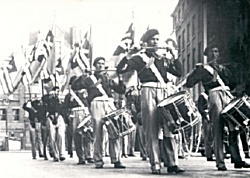
The adoption by the Kibbo Kift of Social Credit as official policy presaged fundamental changes in its organisation and methods. On January 3, 1931, Hargrave spoke at the Annual Kinfest, showing how it was the duty of the Kibbo Kift to break the power of the money-mongers. Parliament was useless, and the people themselves lacking hope and courage; but they would follow the Kin if the Kindred could show “that absolute, that religious, that military devotion to duty without which no great cause was ever brought to a successful issue.” In this speech Hargrave mapped out a new road not only for the Kindred of the Kibbo Kift, but also for the Social Credit Movement, which up to that time (and indeed long afterwards outside the membership of the Kindred) had limited its activities to the formation of “study-groups”. This passive introverted technique was helpless against the almost total boycott of Social Credit by press and wireless, but from now on Social Credit was to be taken on to the streets, to be brought to the people directly. The next few years saw the fashioning of the Kindred into a new type of human political instrument, still based on the principles and ideals of the Kibbo Kift, but now placing Social Credit in the forefront of its aims. The Kibbo Kift “habit” was replaced by a simplified uniform (the “Green Shirt”), and a disciplined paramilitary technique with marching, drums and banners cut through the barrier of suppression and brought the message direct to the people. The basic principles of Social Credit were pared down to the Three Demands:
Open the National Credit Office!
Issue the National Dividend!
Apply the Scientific Price!

Corps of Drums
The Green Shirt Corps of Drums.
These were tough years for the Kindred and the newly-joined Green Shirts. They found themselves exposed not only to the jeers and misrepresentation of the “media”, but also to the open violence of the extreme left (the Communists) and the extreme right (the Fascists). At the same time the Green Shirts showed their community with the victims of the “Economic Crisis” by joining, and often leading, hunger marches, demonstrations by the National Unemployed Workers Movement, public mass meetings in London’s Trafalgar Square, Coventry’s Corn Market, Birmingham’s Bull Ring, as well as street corner meetings and local marches in cities and towns throughout the country, Astonishingly, these activities gained them the hostility, not just of rival political groups, but even of sections of the Social Credit movement, who seemed to regard such conduct as undignified and in some way sullying the purity of the Social Credit message.

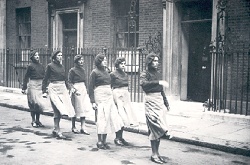
Green Shirts on the March
Women Green Shirts marching in Downing Street
In 1935 the time seemed ripe for a further change. Without abandoning its “direct action” techniques, the Green Shirt Movement, spurred on by its growing popularity with the public, as well as by the overwhelming victory of William Aberhart’s Social Credit Party in the Canadian province of Alberta, decided to enter the orthodox political field by changing its name to the Social Credit Party of Great Britain; by this action they made it impossible for any bogus Social Credit party to arise in Britain. Then, in a lightning three-week campaign, the SCP candidate for South Leeds in the General Election of November 1935 gained nearly 4,000 votes – an astonishing result for a new and untried party.
But new shoals loomed ahead. The Abdication Crisis of 1936 threw British politics into chaos. On January 1, 1937, the Public Order Act came into force, banning the wearing of political uniforms – a measure ostensibly aimed at the Fascist Blackshirts, but which also conveniently (for the authorities) struck at the Social Credit Party, increasingly seen by the Money Power as the real danger to their established order. And in September 1939 war broke out and scattered the membership to the four corners of the world. For the next six years all overt political activity ceased.
 
Green Shirts in Birmingham
Green Shirt demonstration in Birmingham

Hargrave himself was far from idle during these difficult times. In 1935 he had published his great novel SUMMER TIME ENDS, a dramatic kaleidoscope of English life and attitudes, exposing the insanity of the contemporary social-economic system, the hypocrisy of politicians and financiers, and the helpless apathy of the “man-in-the-street”. In 1937 he perfected the first version of his Automatic Navigator for Aircraft (the “moving map” device , which was destined thirty years later to be installed in Concorde and thereafter in many other fast-moving military and civil planes, but for which the talented inventor was never to receive a penny in recognition. During the winter of 1939-40 he published two more important books, a study of Montagu Norman, Governor of the Bank of England, and a crushing expose of the feebleness of Britain’s wartime propaganda. For thirteen years from the spring of 1938 he wrote an unbroken series of weekly “Messages” to all members of the Party which served to hold together the “hard core” of the movement. In 1944 he became aware of his possession of the power of healing by radiation from the hand, and for many years thereafter he held meetings for healing and achieved many remarkable results both publicly and privately.


With the ending of the war and the return of members from national service the time had come for the revival of the party’s activities. But the situation in Britain was not favourable to the propagation of unorthodox ideas. A war-weary electorate sought refuge in passive acceptance of a paternal “Labour” government happy to relieve them of personal responsibility. Under Hargrave’s leadership the Social Credit Party, still robbed of its visual appeal and without access to the “media”, strove to break through the prevailing political apathy. A National Social Credit Evangel sought to re-create the emotional appeal that had previously been achieved through the pageantry of the uniforms, banners and drums. The development of “solar propaganda”, the formation of the Agriculture and Husbandry Group with the message “Britain Can Feed Herself’, even Hargrave’s unsuccessful candidature in the 1950 General Election, showed that there was still much vitality in the movement, small though it had now become. But the tide of affairs was against them, and on April 29, 1951, an extraordinary meeting of the Party resolved “to dissolve as an organisation.”
So passed into history a movement that came within an ace of changing the whole course of Britain’s political and social life. The Kindred of the Kibbo Kift no longer exists as an organised body. Hargrave’s Green Shirts no longer march through the streets with drums playing and banners flying; the Social Credit Party has not contested an election since 1950. But the ideas and ideals of the Kindred remain as alive and vigorous as ever, and many in all walks of life acknowledge the debt they owe to their early training in the Kibbo Kift and the Green Shirts.
The re-issue of THE CONFESSION after fifty years is sufficient evidence of its enduring vitality.


COURTESY: ANDREW M.

WORSE THAN APARTHEID SOUTH AFRICA.

Human Rights in Israel/Palestine   

From OccupiedPalestine.org 

September 29, 2003 

Jon Elmer, FromOccupiedPalestine.org:
Three Jewish settlers from the West Bank settlement of Bat Ayin were convicted
on [17 September] of plotting to bomb a Palestinian girls school in the
East Jerusalem neighbourhood of At-Tur, as well as a hospital. Judges said
that scores of school children would have been slaughtered if the attack
had not been foiled. Back in April a group calling itself Revenge of the
Infants hurled grenades into a high school in Jenin, injuring 29. Can you
discuss the threat of Jewish settler terrorism?

Jessica Montell, B’Tselem
– Israeli Information Center for Human Rights in the Occupied Territories:
Over the past three years we have seen an increase in violence against
both Israelis and Palestinians in the Occupied Territories. It seems that
as part of this intifada, people on both sides are taking the law into
their own hands and committing acts of violence against the other community.


    From
a human rights perspective, we are more concerned with the response of
the Israeli authorities, and the responsibility of Israel to enforce the
law and to punish people who violate the law. The Israeli authorities are,
on the whole, much more lenient toward Jews who break the law – including
acts of violence – than they are toward Palestinians. 


The intensive investigations, arrests, interrogations, and prosecutions
in the case [of the settlers from Bat Ayin], stand in stark contrast to
what we see as very lax law enforcement against the routine violence by
settlers toward Palestinians. 


    We‚ve
issued three reports in this intifada, and several before that, about the
lax law enforcement [toward settlers]. The findings are that in contrast
to incidents of violence by Palestinians, where law enforcement is extremely
severe – to the point of collective punishment and violations of the human
rights of innocent Palestinians – in the case of violence by settlers,
the Israeli authorities tend to be overly forgiving. They turn a blind
eye, and do not take enough measures to protect Palestinians and their
property.

 Elmer: In B‚Tselem‚s
report Land Grab (2002), you conclude: “Israel has created in the Occupied
Territories a regime of separation based on discrimination, applying two
separate systems of law in the same area and basing the rights of individuals
on their nationality. This regime is the only one of its kind in the world.”
Is that not a textbook definition of apartheid?

Montell: Apartheid has symbolic
value because of the South African context. You can draw plenty of similarities,
and you can also see lots of differences between apartheid South Africa
and Israel‚s occupation of the West Bank and Gaza Strip. I think the word
apartheid is useful for mobilizing people because of its emotional power.
In some cases, the situation in the West Bank is worse than apartheid in
South Africa.
For example, the roads network in the West Bank,
where Jews are allowed to travel on roads that Palestinians are not allowed
to travel on, or the separation fence, which Palestinians call the Apartheid
Wall.


    I
was recently at a conference with John Dugard, who is now the Special Rapporteur
of the UN Commission on Human Rights for the Occupations Palestinian Territories,
and is originally from South Africa. He was (jokingly)
offended that apartheid was being maligned [by its comparison the Israeli
occupation].
In South Africa you didn‚t have apartheid on the roads,
you didn‚t have walls being constructed?


   There are,
however, clear similarities between apartheid South Africa and Israel‚s
policies in the West Bank, and over the past three years they have become
even clearer as the separation has intensified. Every
area of life – legal rights, benefits, privileges, allocation of resources,
the justice system, criminal prosecution – now has two separate tracks,
one for Israelis and one for Palestinians.

Elmer: Current figures estimate
that over 6,000 Palestinians are now in prison, roughly a quarter of whom
are in “administrative detention” without charge or trial. Can you discuss
Israel‚s policy of illegal detention and the violations of human rights
therein?

Montell: Our figures are
4,000 or 5,000 people in prison, and about 700 people in administrative
detention.
Administrative detention has been used by Israel since the
beginning of the occupation in 1967, and even earlier. It is a remnant
of defence regulations in the British Mandate period, when even Jews, such
as Menachem Begin and others in the Jewish movement, were put in administrative
detention by the British. 


Beginning with the first intifada in 1987, Israel used administrative detention
on a massive scale, with up to 5,000 people in detention – without trial,
and with no allegations against the person that they have committed an
offence. It is supposed to be used as a preventative detention; if they
know that you are about to commit a crime, they put you in detention to
in order to prevent that crime.


Obviously, this is hugely problematic: on what basis do I know you are
about to endanger security? Also, given that all the information against
you is secret, there is no meaningful way that the detainees can appeal
their detention. People are detained for a six-month period, and the period
can be extended indefinitely. So we have had people
in detention for five years with no charge, no trial. 

Elmer: In North America the
term Œhuman shield‚ is generally used pejoratively to discredit international
solidarity activists whose passports allow them a certain protection and
level of humanity that the Palestinians are clearly denied by Israeli soldiers.
But the term means something far more shocking in the Israeli army‚s lexicon.
Here is one soldier‚s testimony: “Before searching a house, we go to a
neighbour, take him out of his house, and tell him to call for the person
we want. If it works, great. If not, we blow down the door or hammer it
open. The neighbour goes in first. If someone is planning something, he
is one who gets it.” (Operation Defensive Shield: Soldiers’ Testimonies,
Palestinian Testimonies, B‚Tselem journal, p. 10) Can you discuss the IDF‚s
use of the so-called “neighbor procedure” and the use of Palestinians as
human shields?

Montell: Beginning with Operation
Defensive Shield we got testimonies from Palestinians that we initially
thought were not credible, given that they were so shocking: physically
using people as shields, forcing them to walk in front of soldiers, even
resting a rifle on their shoulder, hiding behind them when going into houses?
Together with six other human rights organizations, we petitioned the High
Court of Justice. As a result of this appeal the State said that [the IDF]
would cease using human shields, with the exception of what they call the
“neighbor procedure,” which they refuse to give up, and remains before
the High Court. 


The “neighbor procedure” is when a Palestinian is recruited to do various
sorts of missions for the army, such as to go knock on the door of a neighbour
and say that the army is here and if you don‚t come out they are going
to shoot at you, or blow up your house. What the army claims is that Palestinians
volunteer for these missions ˆ perhaps if it‚s a family member, to prevent
the house from being demolished. It is clear that if a Palestinian volunteers
to get their son out of the house before it is demolished, they are free
to do that. That is different than, in many cases, what the soldiers‚ testimonies
show.


Despite [the military‚s] declarations before the High Court that this is
only done on a volunteer basis, we continue to take
testimonies from Palestinians, even after the decision of the High Court,
of people being used in the original definition of human shield ˆ as a
shield to protect [soldiers] from gunfire, as well as in the neighbour
procedure
. 

Elmer: Another concern about
Israel‚s blatant violations of civilian protections that B‚Tselem has addressed
is the use of live ammunition to enforce curfew. In one four-month period
you cite at least 15 Palestinians killed by live ammunition used to enforce
curfew: 12 of those 15 were children, and the eldest, 60 (Lethal Curfew:
The Use of Live Ammunition to Enforce Curfew, October 2002). Can you comment
on this?

Montell: We have not been
able to receive official confirmation from [the IDF] that the use of live
ammunition to enforce curfew is in fact the rules engagement being given
to soldiers. All we know are the consequences. This connects to two problems
we have identified in general about the rules of engagement. Number one,
it does not appear that soldiers are being given written rules of engagement,
[such as] open-fire regulations.


This is in contrast to the first intifada and during the Oslo years when
soldiers carried around a little booklet that said when they were allowed
to use rubber bullets, when they were allowed to use live ammunition, the
rules for apprehending a suspect, the rules of stopping someone at a checkpoint
ˆ all of these things were very regularized. 

    What
we have taken from testimonies from soldiers is that all of these regulations
apparently are conveyed to soldiers orally from Commanders who have themselves
received their orders orally ˆ so what you have is a broken telephone.
It is not clear that what the higher-up levels of the army and the Judge
Advocate General have determined to be the rules of engagement are in fact
what is being carried out in the field. 


[The second problem] has to do with accountability. Contrary to the situation
prior to this intifada when the Judge Advocate General opened a military
police investigation into every case of a Palestinian killed by the IDF,
today that is not the case, and the vast majority
of Palestinians killed go uninvestigated.
So what that means
is that there is no learning a lesson from previous tragedies.


Now this is aside from, say, assassination cases where they intentionally
want to kill the person. I think in the vast majority of cases, and there
have been over 2000 Palestinians killed since the beginning of this intifada,
there is no intent to kill Palestinians. I don‚t think that the IDF has
an intentional policy to kill unarmed, innocent Palestinians, and yet we‚re
talking about over 2000 people killed.


    So then
the question is: what lessons are being learned in order to prevent these
tragedies, accidents and needless deaths from happening in the future.
The fact that they are not investigating these cases thoroughly indicates
that they are not learning lessons – it‚s extremely severe negligence when
you look at the number of people killed. 

Elmer: Does B‚Tselem have
a position on the Israeli assassinations? 

Montell: Assassinations are
one of the more complicated cases, because it gets into the grey area of
the definition of this conflict from the point of view of international
humanitarian law. Israel defines the conflict as an armed conflict short
of war, which is a meaningless definition because war is armed conflict
– they are the same from a legal perspective. In an armed conflict obviously
combatants are legitimate targets: that is the case with IDF soldiers,
and that is case with combatants on the Palestinian side. 

    
From B’Tselem’s perspective, it’s clear that the entire situation in the
West Bank cannot be defined as an armed conflict. There may be isolated
incidents of clashes that reach the level of an armed conflict, but most
of what the IDF is doing in the Occupied Territories is normal policing
functions: carrying out arrests, staffing checkpoints, and other sorts
of functions that are police functions under international law. Even in
the case of an armed conflict, who [is considered] a combatant on the Palestinian
side is a very complicated legal issue. 


    Certainly
the way the assassinations are currently being carried out, using massive
firepower in very densely populated areas, with a very large number of
innocent civilians killed in the course of the assassination, is unacceptable.
And there is a big question mark about the way Palestinian targets are
chosen. 

Elmer: Because it is clearly
political leaders that are being targeted, especially of late – Ismail
Abu Shanab? 

Montell: Right, it‚s political
leaders and the leaders of military wings of Hamas, people who Israel itself
no longer claims are on their way to carry out assassinations. It‚s also
not clear that Israel could not arrest these people if it wanted to. In
area A of Palestinian cities it would be a much greater threat to civilian
lives to launch a campaign to arrest people, but in some cases we know
that people have passed through IDF checkpoints in the days or weeks prior
to their assassination, and at least in these cases Israel could have arrested
them if it wanted to. 

Elmer: Escalating from „ticking
bombs‰ to „ticking infrastructure‰?

Montell: Right. 

Elmer: The so-called separation
fence will annex significant parts of the West Bank to Israel, while leaving
tens of thousands of Palestinians on the west side of the fence between
the fence and the Green Line, and thousands of Jewish settlers on the east
side. That doesn‚t seem much like separation.

Montell: Very few Palestinians
will be living on the west side of the barrier. As of Stage 1, between
12 and 13,000 Palestinians live in the villages to the west of the barrier.
The main problem is Palestinians who are living in enclaves entirely surrounded
by the barrier, often cut off from their farmland, and all of the problems
of freedom of movement for Palestinians who need to cross back and forth.
That‚s another 70-75 thousand just in the first stage that has already
been constructed.

    
Again, as you said, it‚s not a barrier that is separating Israel from Palestine
along the 1967 border. And that‚s primarily because of the presence of
settlers and settlements in the Occupied Territories, many of whom have
launched their own lobbying campaign so that individual settlements will
be included to the west of the barrier. As a result, Palestinians are either
living in enclaves, or are themselves on the wrong side of the barrier. 


At this point we‚re all in suspense about the future stages of the barrier
– whether or not it will include Ar‚iel and other settlements, and equally
significantly [the route of the barrier] in Jerusalem, which is obviously
a very densely built up urban area. The fence is apparently just going
to go right down the middle of a street, separating the neighbourhood of
Abu Dis [for example], separating a family from their daycare, grocery
store, doctor, work and everything else. So it‚s a really devastating measure.


And again, contrary to Israel‚s claim that it can always be moved and that
it‚s not permanent, it is in fact a fairly massive structure being built
at a huge cost to the Israeli economy, and something that is not easily
going to be moved. My fear is that we will be living with the implications
of these bad decisions made by the government in terms of the route of
the fence for a very long time to come.

Elmer: Can you describe the
physical presence of the wall?

Montell: In most areas of
construction it‚s not a wall, but a series of measures about 60-100 meters
wide. It starts with an electronic fence in the middle that will sense
anyone touching or trying to tamper with it, then a series of roads on
either side including a trace road and a patrol road, followed by a barbed
wire fence and then a trench. So even the amount of land taken for the
actual construction is very significant.


    In a
few places, on the west side of Qalqiliya, and then going through Abu Dis,
it is actually a massive concrete wall up to four meters high. So again
it‚s a very large structure taking up a lot of land, costing a lot of money,
and not easily moved.

Elmer: Predictions are always
problematic, but what does B‚Tselem see the future holding for Palestinian
human rights, given the apparent death of the Road Map peace process and
the escalation of the conflict?

Montell: To the extent that
the armed conflict continues, it‚s clear that civilians are the main ones
paying the price. That‚s true on the Israeli side with Palestinians mounting
suicide bombings and other attacks that primarily target Israeli civilians,
and it‚s also true on the Palestinian side, where the civilian population
is really paying an unbearable price ˆ the restrictions on movement that
are devastating all aspects of Palestinian life, and obviously the destruction,
injuries and deaths. At this point we are stuck in a cycle that Israelis
and Palestinians are not able to get out of. It‚s clear that without
a very concerted effort by the international community, which until now
has not been forthcoming, there isn‚t a lot of optimism in terms of the
short-term future. 

——————

Jessica Montell is the Executive
Director of B‚Tselem, The Israeli Information Center for Human Rights in
the Occupied Territories.

Jon Elmer is a freelance
journalist currently reporting from Israel-Palestine and is the editor
of FromOccupiedPalestine.org.