Solo acoustic take on song from astonishing forthcoming album, The Gathering.
More: http://arbouretum.blogspot.com
More more: Thrill Jockey Records

Solo acoustic take on song from astonishing forthcoming album, The Gathering.
More: http://arbouretum.blogspot.com
More more: Thrill Jockey Records
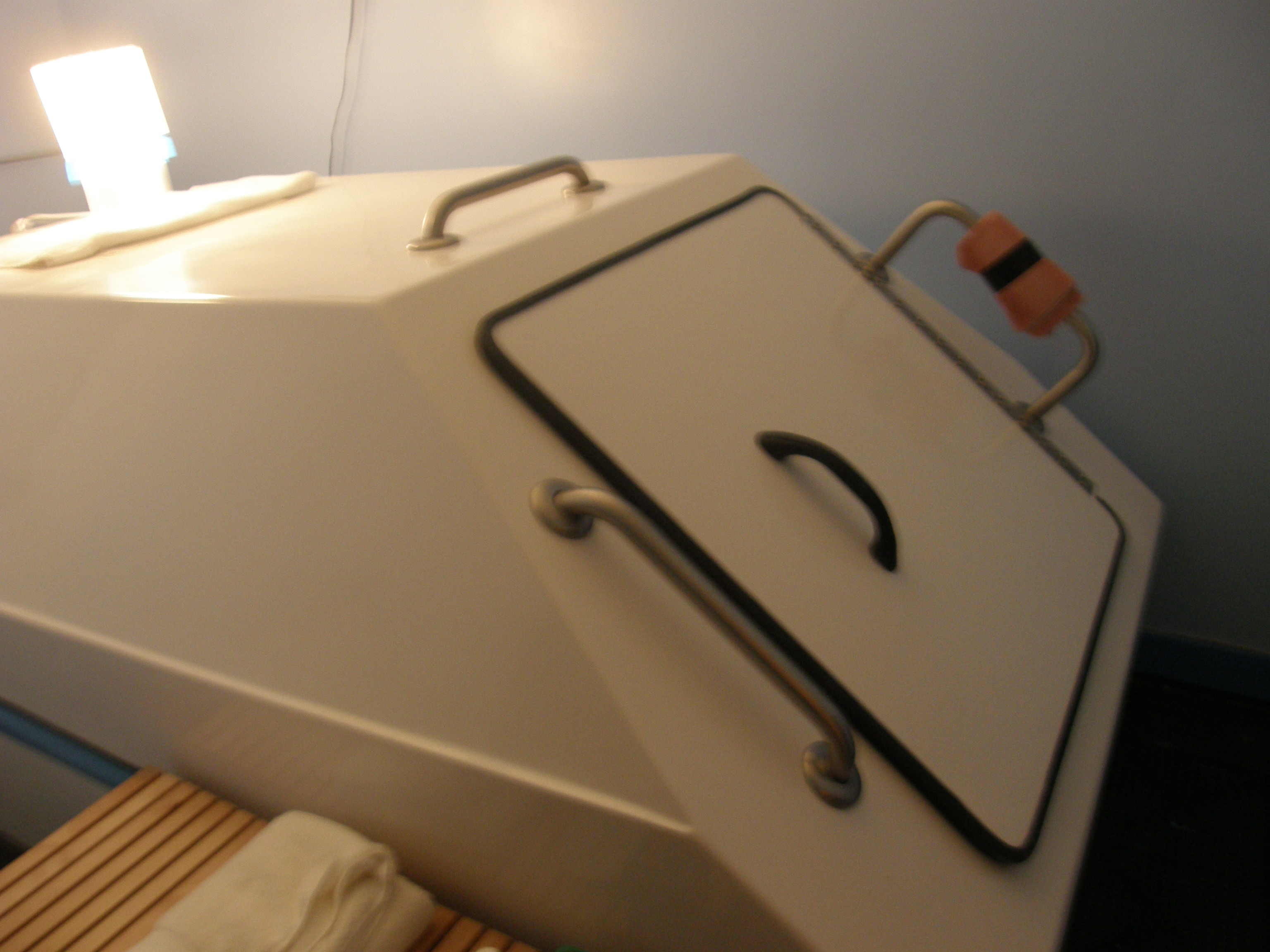
As a follow up to my last article on floatation tanks, I recently sat down to talk with Christopher Messer, one of the founders of a new floatation center, called Float On in Portland, Oregon. A veteran of the floatation tank experience, Christopher believes the longer you experience sensory deprivation the deeper it goes. Since he has been floating and building his own tanks since 1977, he had a lot to say when I spoke with him on New Year’s Eve. Here are some highlights.
Does the law of diminishing returns apply to floating?
It’s an endurance thing. The longer you float the more you’re in Theta waves. And the more lucid you’re going to get. This is the same thing the Buddhist monks are trying to do. But this is it without falling asleep and getting the rap on the shoulder with a stick. When there is no external stimulation the internal mind has to take over. I’ve done a 13 hour float, and it just keeps going and going. Thought goes away, identity goes away. It’s about effortless doing.
I hate technique. The tank is all physiological. You’re autonomic nervous system takes control. 98% of everything you think about is repetitive anyway. You don’t need it. If you were on a deserted island for long enough thought would go away. The minute thought stops, presence takes over. The tank kills thought without effort, without technique. Our whole culture is based on technique.
So thought just becomes unnecessary, like flippers on land?
Thought knows that the minute it stops, presence takes over and thought dies. And thought will do anything to stop that. That’s why the tank is so perfect, you can’t directly get rid of thought. It has to leave without effort. It’s like a surrender, but don’t make it into a technique. Our whole culture is about becoming – you gotta get to the next level, “I got to get the degree, I got to get the house . . .”. Well good luck with that, cause it’s just made up anyway! The only time you’re truly happy is when you’re just being.
What would a culture look like where everybody floats?
That’s my dream. Our culture is about change from the outside-in. But you change it from the inside-out and it’s going to work. It’s funny, remember the Skylab in the 70’s, after the Apollo missions? They had these Americans out there floating in space, and they’d have Russians come out. But sometimes guys would be alone for weeks at a time. And mission control would call them and tell them to do stuff. Well, mission control found that they would do the tasks slower and slower. And then mission control would tell them to do stuff and they wouldn’t want to do stuff. And then mission control would call them and tell them to do stuff . . . and they would turn off the intercom!
You get space happy. It’s called break off point. Same with the U2 spy planes. They’d be up there on the edge of space. Close to zero gravity. And they would just lose interest in earthly things. They would stop believing in nationalism and just say – oh, well there’s the planet.
The floatation tank is still a fairly new device. Do you think people are going to come along and try to attach different techniques and codified ideas to the experience?
Well, it started out very scientific. But it very quickly became a mystic experience.
So yeah, people have used different techniques with floating: cyber vision, listening to learning tapes, holosync stuff. You can add on things, but personally I don’t like that. There’s nothing better than nothing. It’s so simple.
For millions of years we were just hunters and gatherers. We are not built for all of this. Language and time and self. That’s all brand new phenomena. When thought first came in, people thought they were hearing voices. Language started as a way to warn people. “Hey! There is a mountain lion behind you!” This evolved into language, but somehow along the way identity got involved.
Once you have language you can create an external analog of everything.
Yeah – I’m separate from everything else. I’m better. Then you’re getting into counting, keeping track of stuff, counting what you own. And the rest is history. I think once we got into agriculture that’s when we took a wrong turn.
So it’s New Year’s Eve 2010. What’s the future of floating?
Consciousness just wants to become more consciousness. This is what the tank is doing. There are areas that were once unconscious, and consciousness is saying – I want to be here.
We used to be in the Information age. Now we are in the Communication age. Consciousness is expanding itself. And the float tank fits that perfectly. Floating is just a way to get back to your natural state.
Michel Fiffe is the writer/artist/colorist of Zegas. Between his comics work and building props and costumes for Broadway, Michel has also interviewed many of his cartoonist heroes at The Comics Journal as well as writing creator retrospectives on his art blog . He is also currently editing a line of indy back-up stories for Image Comics’ flagship title Savage Dragon.

PUBLISHER’S NOTE: You can download this ‘lecture’ as a convenient text-only PDF for $2.00, payable via PayPal, credit card or debit card.Click here to go to the order form. A link containing the PDF will be emailed to you upon payment.
“Freeman House is a former commercial salmon fisher who has been involved with a community-based watershed restoration effort in northern California for more than 25 years. He is a co-founder of the Mattole Salmon Group and the Mattole Restoration Council. His book, Totem Salmon: Life Lessons from Another Species received the best nonfiction award from the San Francisco Bay Area Book Reviewers Association and the American Academy of Arts and Letters’ Harold D. Vursell Memorial Award for quality of prose. He lives with his family in northern California.”
That’s the bio for Freeman off the Lannan Foundation website. We would add that earlier in his life, Freeman edited Innerspace, a mid-1960s independent press magazine for the nascent psychedelic community; married Abbie and Anita Hoffman at Central Park on June 10, 1967 (see Village Voice); and was a member of both New York City’s Group Image and the San Francisco Diggers.
This piece was first published in 2002 in River & Range.

photo by Jim Korpi

GHOST IN THE SYSTEM
by Freeman House
for John Bennett,
the good dentist
On our raw homestead in the Coast Range, Nina and I were attempting to domesticate a half-acre at the edge of ten acres of upland coastal prairie. We had knocked up a six-foot chicken wire fence, all we could afford at the time, to keep out the many deer that browsed our prairie. The deer had a taste for the new strawberry bed and the young climbing roses we had planted along the fence line. The fence served little purpose but to delay the deer for a week or two until they had discovered how easily they could leap over the strange enclosure. Once they had defoliated the roses and mowed the strawberry plants, they would move on to nibble at the broccoli and lettuce, ever curious. We cut scrap two-by-fours into three-foot lengths and nailed them onto the fence posts at an angle upward and outward, stapled a couple of runs of baling wire around their top ends. The deer stayed on their side of the fence, until, inevitably, someone left a gate open overnight. Without fail one deer would wander in and rediscover her love of rose leaves. We would chase her out in the morning, flapping our arms and yelling. The deer would panic and throw herself against the fence in one place after another until she found the open gates and bounded off. Early on, we assumed that the panic we had instilled would teach the deer a lesson in territory, and that they would avoid our little oasis of green in the summer-dry California prairie. But deer are evidently quickly addicted to rose and strawberry leaves. Once these treats had been rediscovered, the same deer and her cohorts would examine our fence for weaknesses with the intensity of a junkie searching for a connection. Once we saw a doe flat on her belly wriggling under the chicken wire where it lifted nine inches off the uneven ground. For a few years, then, our garden yielded venison at irregular intervals.
The deer were not the only ones who looked on us as new arrivals who were provisioners of exotic snacks. They were the only one of our co-inhabitants on the prairie who shared themselves with us, however; we never developed an appetite for the moles and gophers and raccoons and ravens and quail and slugs who fed freely on our young gardens and orchards. We grew accustomed to the yowling nightly squabbles between the skunks and raccoons over our compost pile. (The skunks would generally win first access. The raccoons didn’t like their stinging spray any more than we did. The raccoons would back off until the skunks had taken their fill and then take their turn at the luscious kitchen garbage, after which they would move on to the strawberries which would have been ripe enough for us to pick on the very next day.)
But we adapted. We planted our artichokes in wire cages to protect them from gophers, having discovered yet another addictive relationship between the ubiquitous soil dwellers and the sweet roots of young artichoke plants. We captured raccoons and skunks in Have-a-Heart traps and trucked them to locations where we thought they might be happier. We covered our newly planted winter gardens with bird netting because the tender seedlings emerged from the ground at about the same time large families of young quail fledged and ranged the dry August prairie with enormous appetites for young greens. We planted more than we needed, coming to understand that if the other residents of the prairie were going to share their habitat with us, we would have to reciprocate by sharing our garden with them. The only alternative to such reciprocity would be to pursue the logical extension of the notions of human control and exclusively owned property. We would have to dig our whole garden area to a depth of two feet or so, cover the subsoil with welded wire to exclude the gophers and moles before putting the soil back to grow our now-secured vegetables and fruits. We would have to build concrete walls sunk an equal distance into the ground and extending eight feet into the air to keep out the raccoons and skunks and foxes and bobcats and deer. Then we would have to cover the whole area with some kind of mesh to keep the fruits and berries safe from a whole sky full of birds. Our fantasies stopped just short of erecting gun towers at the corners of the concrete enclosure. Reciprocity seemed a preferable choice to such a logical demonstration of our singular rights to this corner of prairie.
After seven or eight years, we were providing a lot of our own food, and were becoming comfortable with our new relations. Then, during one particularly dry late summer, some new critters showed up. The new vegetarian was nocturnal, and for a period of several weeks, invisible. But the damage it was doing to the garden and young orchard was dramatic and it had the potential for being terminal. Continue reading
The Black Keys in Arthur No. 2 (May 2003), by Peter Relic: read it
The Black Keys’ singer-guitarist Dan Auerbach talks matzo ball soup in Arthur No. 13 (October 2004): buy it at the Arthur Store
Wade Davis: wikipedia
Latest book: The Wayfinders: Why Ancient Wisdom Matters in the Modern World
Sunday, January 23, 2011, 1:30 PM – 3:00 PM: Wade Davis lectures at Bowers Museum (Santa Ana, CA)
from: http://spectregroup.wordpress.com/2011/01/06/if-no-ones-watching/

‘Anti-Genocide Paparazzi’
http://www.satsentinel.org/maps
http://www.satsentinel.org/reports
“…In what may be the most ambitious project of its kind, the United Nations and human rights advocates in the US are turning to satellite images and the Web to monitor the border between northern and southern Sudan, as the south prepares for a referendum on Jan. 9 that could split the country in two. The concern: If the referendum in southern Sudan supports independence for the oil-rich, largely Christian region, the country once again could dissolve into a brutal civil war. By combining on-the-ground reports with a nearly daily review of commercial-satellite images, the project’s participants say they hope to head off potential large-scale human rights abuses, should a conflict break out.

“We want to let potential perpetrators of genocide and other war crimes know that we’re watching,” said Clooney, a co-founder of Not on Our Watch, a human rights group funding the effort, in a statement. “It’s a lot harder to commit mass atrocities in the glare of the media spotlight.” National intelligence services in the United States and for other major countries are widely acknowledged to have access to more-detailed images than remote-sensing companies can provide. But those images tend to remain classified and out of the public spotlight. The new effort announced Wednesday – the Satellite Sentinel Project – will post its images on a publicly available website, in hopes of mobilizing public opinion in ways that pressure governments to respond to any abuses the effort detects…”

kA is the project of Brooke Hamre Gillespie (The Holy Experiment) and Santiparro Alan Scheurman (Santiparro,) two earthbound celestial beings who together create joyous, transcendent songs that lift the spirits, allowing them to soar through forests and fields, over oceans, up through the clouds and into the ever-expanding universe, where the planets are always singing. In between songs, the pair stops to reflect…
Brooke: That song came from the forest of Michigan. A lot of these songs come from the forest of Michigan.
Alan: Not just the forest, but the fire, the trees…
Brooke: The stars, all the animals… the purple beetle!
Alan: The spiders…
Brooke: The spiders. The spider water!
Alan: And the dragons.
Brooke: And the real dragons!
kA live on Arthur Radio from Arthur Radio on Vimeo.
In recent months, kA traveled to the West Coast to perform in an Alice Coltrane Tribute concert organized by friend Kyp Malone (Rain Machine). Alongside playing shows, they both lead ceremonies and music circles at Golden Drum, a Greenpoint, Brooklyn-based healing center whose practices are rooted in traditions of indigenous medicine healers from around the world.

STREAMING: [audio:http://www.arthurmag.com/magpie/wp-content/uploads/2011/01/Arthur-Radio-kA.mp3%5D
DOWNLOAD: Arthur Radio Transmission #33 w/ kA 10-23-2010
Timeline…
Continue reading

Coming next week: Who Knows What Tomorrow Might Bring, the second volume in Arthur’s digital download mixtape series.
The cover photograph is by KEVIN BAUMAN — http://www.100abandonedhouses.com
Who Knows… is quite different from Blackout, the first volume in Arthur’s digital download series (which is available now as a pay-what-thou-wilt download starting at $4.20—info here.).
More details soon.

A legendary live Robert Fripp & Brian Eno bootleg recording known as “Air Structures” is now available as a legitimate release—Fripp & Eno, May 28, 1975, a three CD-length digital download, direct from Fripp’s DGM label.
Notes from the DGM site:
Notes
These show notes are written by long-standing Frippertronics expert and unofficial archivist, Allan Okada, whose help in the restoration of this concert has been invaluable.This historic recording documents an extremely rare and classic performance of a mysterious collaborative tour from two of the most creative and fascinating figures in rock. It is one of the most rewarding live recordings this writer has ever heard. For any fan of ‘No Pussyfooting’ or ‘Evening Star’, this live recording is of epic significance and thanks to the efforts of Alex Mundy, is now also comparable in audio quality, by synchronizing the most complete and best (by a mile) available live bootleg recording with Eno’s stage tapes recently discovered. This tour also represents a turning point for both artists, about to enter new frontiers professionally and personally: Eno as an ambient music pioneer and Fripp’s re-emergence as a “small, mobile, intelligent unit”.
Here is the lead up to this 5th of a 7-show European mini-tour. Fripp just recently disbanded King Crimson at a point which many would describe as their artistic pinnacle. Eno also recently parted ways with Roxy Music at a similar juncture and then aborted his first and only extensive solo tour after only a handful of shows, due to a collapsed lung. Fripp & Eno live in concert? What would they do? All the shows in Spain and France were, not surprisingly, accompanied with unrealistic fan expectations, hoping for a presentation of ‘21st Century Schizoid Man’ combined with ‘Baby’s on Fire’ perhaps? What this audience got was something entirely different. The programme was largely improvised and totally instrumental. Adding to the event’s unorthodoxy was the absence of all conventional stage lighting. The sole illumination was provided by Malcolm LeGrice’s colour saturated and looped short film ‘Berlin Horse’ projected behind the two shadowy figures on stage, visually mimicking the music. The result was an unprecedented live performance format, years ahead of its time. It was also mind-boggling to most of the unsuspecting 1975 audience, yielding wildly different reactions. Reportedly about half the shows on this tour were also plagued with some sort of major technical hazard, stemming from the venue, the PA or the duo’s stage equipment. In Saint-Étienne, the audience went as far as booing the duo off the stage! Fortunately for us here, this Paris Olympia performance was technically flawless and from a musical standpoint, incredibly inspired.
Starting with the pre-recorded primordial drone ‘Water on Water’, the duo eventually walks on stage. Fripp begins playing through the “Enotronic system” (since Eno, not Fripp operated the tape machines on this tour). It’s important to note that at this time, the mechanics of the Revox tape delay system was a mystery to the guitarist. This must have surely added a heavy dose of Eno’s “idiot glee” to the entire proceedings. Fripp moves this piece into uncharted territories with short volume pedal sweeps of lunacy before detaching from the delay system and beautifully soloing over the familiar backing loop of ‘Swastika Girls’. Very astute listeners will detect the unrealized main theme from King Crimson’s ‘Blue’ off the top. An intermission has the audience treated to Eno’s seminal ‘Discreet Music’ before the duo return to the stage with another improvised loop morphing into the now familiar ‘Wind On Water’ landscape. The sublimely serene ‘A Near Find in Rip Pop’ follows with Fripp soloing over a beautiful, strummed guitar piece (from the ‘Evening Star’ sessions) enhanced with synthetic animal screeches utilized months later on Eno’s ‘Zawinul/Lava’ track. Then just as you feel relaxed, Eno’s loop changes to something akin to a gigantic, looming dark cloud as Fripp hits the distortion pedal and fires off some solos of truly monstrous intensity. Eno gently takes the proceedings back down to Earth again by introducing the now infamous ‘Evening Star’ backing loop over which Fripp treats us to yet another wonderful solo before leaving the stage again, while ‘An Iron Frappe’ continues to envelop the crowd. The duo reappears for the final ‘Softy Gun Poison’ complete with tapes of sinister laughter and mysterious chatter (foreshadowing moments of Fripp’s upcoming ‘Exposure’), before leaving the stage for the last time, while (the then unknown) ‘An Index of Metals’ terrorizes the bewildered audience as they exit the venue. All in all, this lucky Paris audience was treated with the entirety of both classic albums as well as enough new material to constitute a third. As a bonus, we are also presented with Eno’s stage tapes in pure format including Test Loops from the sound check. What more could you ask from a live recording? Absolutely essential listening.
 Arthur Magazine