T-Model Knows Better: an advice column by life coach/musician T-Model Ford (Arthur, March 2004)

Originally published in Arthur No. 9 (March, 2004)


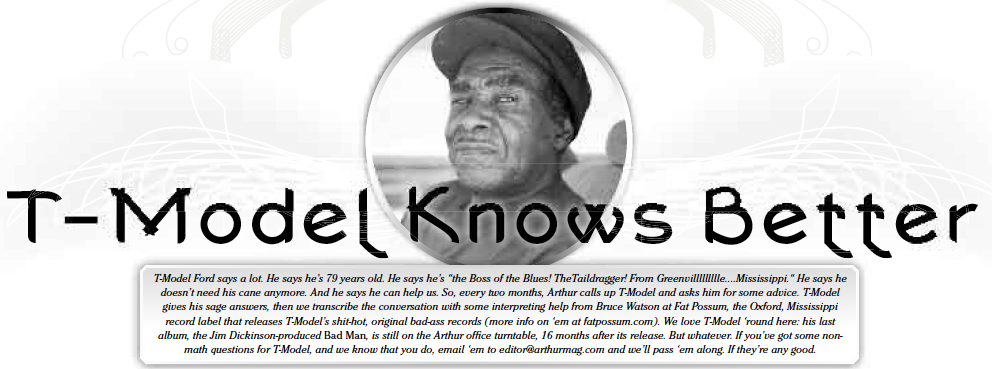
T-Model Ford says a lot. He says he’s 79 years old. He says he’s “the Boss of the Blues! TheTaildragger! From Greenvillllllllle….Mississippi.“ He says he doesn’t need his cane anymore. And he says he can help us. So, every two months, Arthur calls up T-Model and asks him for some advice. T-Model gives his sage answers, then we transcribe the conversation with some interpreting help from Bruce Watson at Fat Possum, the Oxford, Mississippi record label that releases T-Model’s shit-hot, original bad-ass records (more info on ‘em at fatpossum.com). We love T-Model round here: his last album, the Jim Dickinson-produced Bad Man, is still on the office Arthur turntable, 16 months after its release. But whatever. If you’ve got some non-math questions for T-Model, and we know that you do, email ‘em to editor@arthurmag.com and we’ll pass ‘em along. If they’re any good.

Arthur: What if you find out that an old friend of yours has been saying bad stuff about you around town. Telling people that you do business with, that you’re no good.  What should you do?

T-Model: Just let him talk, don’t have nothing to do with him. They’ll find out! That’s the way I do. They talk about me, I just let ‘em talk. But when they need something, they gotta come to ME. 

But what if you were a younger man? You know how younger men get upset: they wanna settle it with a fight. Is that a bad way to go?

Well, you got to study that yourself. Just don’t associate with ‘em, that’s the way I do. They talk about me, I don’t associate with ‘em. Then when they come running, want to talk, I say: “Well when you had a chance, you didn’t take it, so forget about it.” That’s the way I do. 

Have you always been that way? Or did you handle stuff differently when you were younger? 

No, I’ve been that way all my life. I go friendly with people if they friendly with me. If they ain’t friendly with me, I go my way and they go theirs. You take me, when I go to go somewhere around here, I get in my car by myself. I don’t be ridin’ with nobody. Can’t be nobody speaks… If they TELL somethin’, it won’t be me, it’ll be them, making up somethin’, to try to get up somethin’. That’s the way it do here. 

You ever seen a fight in a bar?

Yeah, I have seen a fight in a bar. And I have fought in a bar. 

You have? But you sound like a peaceful man.

Well, the man was pickin’ at ME! He about six foot tall, went snatching my cigarette — at that time I was smokin’ — snatched that cigarette out of my mouth, and come back to start it to me, and I met him. And I said, “Man, what you trying to do? Are you trying to start somethin’ with me?” He made a pistol break. That’s all he remember. 

You didn’t walk away.

No.

You stood up for yourself.

I thought he gonna get up but he couldn’t. It take a good-hearted person to stand up what I be standing up under, a good one. Yes indeed.

When two men don’t get along, do you think they should go to court to settle their differences then? Or should they just let it go. 

I just let it go. Go on about my business, and tell ‘em, don’t follow me. 

HOW LOUD WERE THE MC5 REALLY? Wayne Kramer, John Sinclair, Ted Nugent and Leigh Stephens (Blue Cheer) weigh in (Arthur, 2004)

“FEEEEEEEEEEEEEEEEEDBACK”

The MC5 were unbelievably intense live. They were also very, very loud (but not as loud as Blue Cheer). Wayne Kramer, John Sinclair, Ted Nugent and Leigh Stephens of Blue Cheer offer testimony to Jay Babcock.

Originally published in Arthur No. 9 (March 2004)


“Loudness was a big part of the concept,” says MC5 manager/chief theorist John Sinclair. “Our concept, as I remember, was that if you gave yourself up to the music, then the loudness wouldn’t just go through your EARS, it would go through your entire body. And if you were to immerse yourself in the sound, it wouldn’t hurt you: it would just THRILL you…

“But you could never get loud enough with those damn sound systems! It was always tough for us. You didn’t use the amplification on the amps in those days: you just amplified the singer. You didn’t mic the drums, you didn’t mic the guitar cabinets. Club owners, show promoters, teen center directors? They HATED it. The authorities hated it. They couldn’t understand why it had to be so loud. They would pull the power, threaten not to pay.”

Eventually the MC5 gained a following that allowed them to play larger local venues where they could do their thing better. Louder.

“The MC5 was the first band in Detroit to get their hands on the new line of Vox amps from England, these Super-Beetle amplifiers,” remembers Wayne Kramer, one of the MC5’s two guitarists. “They were real 100-watts amplifiers: true power. They had these gigantic speaker cabinets with four twelve-inch speakers and two metal high-frequency horns in them. No one had ever heard anything this loud before. We ratcheted the level up, we raised the bar considerably. This was when the MC5 was leaving the scale of a club band, a teen dance band, a local community center gig band, and going up to the next level, where we were playing the Grande Ballroom. That was the first place we could play them loud enough to get enough to get a good tone and didn’t clear the room. So the next step was the Marshall amplifiers, and they were, I don’t know how you quantify it, but they were twice as loud. You had twice as much speaker all of a sudden, and an even more powerful amplifier, so you’re pushing twice as much air.”

“The technology for amplifiers was progressing faster than for the sound systems,” says Sinclair. “So you go from Super Beetles to Sunns to Marshalls. The guitars would get louder and louder, heh heh heh. The singer would always be struggling to be heard in that mess.”

“There was no such thing as monitors, so we never heard ourselves sing—ever,” says Kramer. “Venues didn’t provide PA’s in those days. And the PA system would lag so far behind the guitar amplification system that it was ridiculous. So, you had to carry your own PA.  We built three or four PA systems! We had some money coming in, and we’d meet a friend of a friend who was an electronics genius. And what he’d say is, ‘What you guys need is 12 of these XL-77 amplifiers’ and we’d give the guy a pile of money and he’d come back with this big monstrosity that would catch on fire. Oh well, that wouldn’t work. And then the next guy would come along and say, ‘No what you need is these new Crown amplifiers.’ Okay, let’s try those. 

What was the point of all this? Why the need to be so loud?

“I think it was just a thing of, I need MORE: the teenage fascination with power,” says Kramer. “This was a chance to make sure that everybody in the area had to listen to ME. It’s all about ME and MY guitar playing. I even had a guy who came down and hooked up some high-frequency industrial metal horns to go on top of my amp to make it even more brutally loud.”

“Ah, feedback,” says Sinclair. “I loved feedback. Ohhhh man, that was part of the MC5’s stock in trade. Feeeeedback. Yes! Loud! Penetrating! Well, you know, the social milieu then, everything was so numb. So you wanted to feel something. And the loudness was part of it. That would make you FEEL. I think I can characterize part of our outlook that way. Ha ha ha. We were trying to shake people up. The goal was to make them feel something, to make ‘em enter a new world. Ha! And drop some acid if possible. Heheh.” 

It was a point of pride for the MC5 that they were louder than every band local band they played with… Bob Seger, the Stooges, and, of course, Ted Nugent and the Amboy Dukes.

“We kicked their asses, hundreds of times,” says Sinclair, gleefully. “We did! We loved it. They would come up pale.”

“As far as street fuck you-ness goes, they definitely had us,” admits Nugent. “There was an energy to the 5 that was nothing short of mesmerizing. It was their uninhibitedness and the fact that they focused on the sheer unadulterated middle finger quality of all their music. Where the Amboy Dukes, we wanted to make rhythm and blues songs. Really emulated the Young Rascals and Stax and Volt and Motown and James Brown and Sam & Dave and Wilson Pickett. So we were playing those kind of things. Even though the MC5 came from the same genre, really, cuz they would play It’s A Man’s World by James Brown and they’d play Papa’s Got a Brand New Bag and those kind of songs, but they’d already figured out how to just do it unlike the original black artists. They just did it like white idiots. So they were whiter than we were.”

“We’d got even louder because we started using two amplifiers on each instrument, and that was the point where it was too much,” says Kramer. “But that was the point where I knew… Well, let me tell you how I knew. Blue Cheer had come to Detroit to play at the Grande Ballroom. And they used two hundred-watt Marshalls on their guitar, two hundred-watt Marshalls on their bass. It was TOO loud. I was out in the audience, and the place was kinda empty. It was kinda exacerbated by the fact that they weren’t very good. They really just droned on. There was no dynamic to it, it just droned, but it droned at a level that was like a 747 in your face.”

“The MC5 didn’t reach the levels of volume we did,” recalls Leigh Stephens of Blue Cheer. “I really don’t know in decibels how loud we were, [but] we were louder than anyone we ever played with, not that that is necessarily a good thing. We were going for… Just the overwhelming pushing of air. If the speakers blew your hair around, it was loud enough. Hey we were kids, we thought that was cool.”

“Blue Cheer were incredibly loud,” says Sinclair, “louder than we were, but not as…gratifying. They weren’t as interesting musically, I didn’t think. But, loudness was a huge part of their aesthetic. It was pretty much what they had to offer. Ha! Nice people, though.”

“Just because something is loud doesn’t mean that it’s powerful,” says Kramer. “Intensity doesn’t come from volume. Intensity comes from focus, from the application of dynamic. So I knew when I heard Blue Cheer have two 100-hundred watt Marshalls that it was too loud. And we had two guitar players in our band, so we [had to have been] twice as loud as they were. I remember when we played in Boston once, this was at the point where we were into our two 100-watt Marshalls-each and I had people that I knew coming around who really wanted to listen to the band but they had to go stand outdoors! That’s too loud. We went through a phase when we were too loud. Too fuckin’ loud. Cleared the room. Caused people pain.”

Sinclair: “If you stood there and tried to listened to it with your ears, it would hurt. It would be ‘too loud.’ I lost some top end standing there in front of the MC5 there for a couple of years every night. But I still hear pretty good, for an old person. 

“I don’t want to hear nothing that loud now, though! Ha ha ha. Not anymore.”

##

Liars’ Angus Andrews talks about misguided angst and paranoia through the ages with Jay Babcock (Arthur, 2004)

HISTORY REPEATS ITSELF

Liars make it witchy (again). Jay Babcock finds out why.

Originally published in Arthur No. 9 (March 2004)


Liars boiled up in the midst of New York City’s earliest 21st century underground rock resurgence, when the same style-era of music — angular guitar-driven art-funk circa 1979 a la Gang of Four/Public Image Ltd./Pop Group, etc.– was simultaneously revived by several bands within miles of each other. The whys are tricky but they can also be a distraction from considering what really matters: How was the actual music? How were the performances? Did you witness something that moved you…moved you in the head, moved you in the heart, moved you in the shoulders and in the hips? In other words was this electroclash or was it something significant?

Whatever it was, Liars seem to have been the most defensive about observations that the music they and these other bands was slavishly derivative.

“That was brought up a lot, and we had not heard the Pop Group,” acknowledges Angus Andrews, on the phone one recent morning from his home in the New Jersey woods. “We went to England and someone gave us a CD of it and we listened to it and we got really depressed about it.

He laughs. Why was it depressing?

“It was all these ideas that we had that now we couldn’t do! I dunno. I listened to them once, then. Didn’t really get that much into it. Maybe it was just because…you start rejecting all these influences that people tell you that you have.”

And so, apparently resentful at being categorized, resentful at being lumped in with a herd of copycatters, resentful perhaps even towards the authority represented by the categorizing itself, Liars made a strategic redirection.

Continue reading

HIDE THE BEER: Some advice from Sue Carpenter on running a pirate radio station out of your own apartment (Arthur, 2004)

HIDE THE BEER

Some advice from SUE CARPENTER about running a pirate radio station out of your own apartment.

Originally published in Arthur No. 9 (March 2004)


It terrified my parents, amused my friends and inspired the DJs who got involved, but for me, squatting on a piece of prime FM real estate was simply a challenge—to change a system I did not like and break the mold of my overly ordinary, and earnest, existence. Here’s what I learned in the three years I was on air in Los Angeles:  

1. Don’t let a puny record collection and a laughable knowledge of music think you can’t program a radio station better than the guys who are paid to do it. 

I only owned a couple dozen records when I built a radio station from scratch and began broadcasting from my bedroom. I didn’t know much about music. I just knew what I liked—and that was exactly the problem. The only music I knew was what I heard on the radio, and most of that was over-produced shlock that was over hyped and then over played. In the ‘60s, commercial FM DJs relied on their own ears to pick music. Now it’s one-size-fits-all formats programmed by suits and spun by monkeys. There’s a lot of great music out there. If you don’t know what it is, there are plenty of people who do who’d be more than happy to clue you in.

2. Just because you’re serious about what you’re doing doesn’t mean you should lose your sense of humor. 

When I went on the air in 1995, all of the other micro radio operators in the Bay Area were broadcasting politics, not music. As a lefty liberal, I was sympathetic to their causes. Pro-environment, anti-establishment and generally angry around the edges, I’m sure I would have learned a lot had I listened to their programs. But I didn’t. After tuning in once, I tuned back out, turned off by their overly earnest discussions. Heavy subjects don’t need a heavy hand. Lightening up with humor doesn’t mean taking the subject lightly. 

3. Don’t marry your own plans. 

I had a very specific idea of how I wanted the station to sound when I started it. I wanted it to sound like college radio only better. My station wouldn’t just play indie rock—it would play only the indie rock I liked. Of course that plan was contingent on getting a bunch of DJs who shared my musical taste, which was possible. I just had to decide if that was the real purpose of unlicensed radio: to impose my musical preferences or to allow the DJs to make those decisions themselves. I decided on the latter and, in the end, wound up with programming that was far more interesting and enlightening than anything I could have dreamed up on my own.

4. If you open your private home to a public activity, prepare to be unwelcome in your own living room. 

Volunteering at a pirate radio station, DJs are prepared to encounter certain things: shoddy equipment, a limited music library, unwelcome visits by the police or FCC. But no one was ready to see the station manager wandering the premises in a baby blue bathrobe and filthy pink slippers. The sight of a freshly showered woman combing out her hair and doling out advice was a little much for some people. 

5. If you’re a woman, most people will have a hard time believing you run the show, especially when mechanics are involved. 

Whether they work as managers, programmers or DJs, lots of women hold powerful positions in radio. It’s easy to understand what they do because the stations that employ them most likely existed before they got there. But when I tell people that my radio station started with me, a motherboard and a soldering iron and grew into a round-the-clock operation staffed with more than a hundred DJs, it’s hard for them to believe.  Radio stations aren’t inherently masculine, but starting one apparently is. 

6. Never keep your refrigerator stocked, especially with beer. 

DJs get thirsty.


Sue Carpenter’s 40 Watts From Nowhere: A Journey Into Pirate Radio is published this month by Scribner’s. It is her first book.

MAKING GHOSTS WALK IN PUBLIC: the role of Brion Gysin’s Dream Machine in the consciousness exploration of the ’60s, by John Geiger (Arthur, 2003)

Making Ghosts Walk In Public

Explained: the role of the legendary stroboscopic Dream Machine in the consciousness exploration of the ‘60s. 

by John Geiger

Excerpted from: Chapel of Extreme Experience: A Short History of Stroboscopic Light, Flicker and the Dream Machine. Copyright © 2003 John Geiger. Published by Soft Skull Press. Reproduced by arrangement with the publisher. All rights reserved.  This excerpt published in Arthur No. 7 (Nov., 2003)


On December 21, 1958 Brion Gysin, a painter and writer, and at the time a resident of Beat Hotel in Paris, momentarily and unexpectedly entered the place where, in Aldous Huxley’s words, “the visual merges with the visionary.” 

Gysin was traveling by bus from Paris to an artists’ colony on the Mediterranean. As the bus passed through a long avenue of trees Gysin, closing his eyes against the setting sun, encountered “a transcendental storm of color visions.” He recorded the experience in his journal: “An overwhelming flood of intensely bright patterns in supernatural colors exploded behind my eyelids: a multi-dimensional kaleidoscope whirling out through space. I was swept out of time.” The phenomenon ended abruptly as the bus left the trees. “Was that a vision? What happened to me?” asked Gysin. The flicker experience recalled the first films he had seen as a child in Alberta in the 1920s, films using the often explosive silver halide base which gave a “magic light to the film, a flickering shimmer cut stroboscopically by the frames of each image.” Gysin immediately wrote William S. Burroughs, a close artistic collaborator, with an account of his fall out of rational space. Burroughs replied portentiously: “We must storm the citadels of enlightenment. The means are at hand.” The means, Gysin determined, would be to develop a machine to harness the visionary potential of flicker, a device that would make illusory experience available at the flick of a switch: a Dream Machine.

Once he understood the scientific explanation for his random encounter with flicker (an explanation provided in physiologist W. Grey Walter’s 1953 book The Living Brain), Gysin determined to find a way to mechanically reproduce the effect in a manner that could be mass produced. He saw in flicker the potential for human advancement. Gysin discussed it with Ian Sommerville, a mathematics student at Cambridge University and young boyhood friend of Burroughs’. Somerville had a genius for electrical improvisation, and indeed had a unique relationship with the electrical current: his thin blonde hair often stood up as if a charge ran through it, he was not fond of water and found rain oddly menacing. Gysin wanted to find a way, he said, to “make the ghosts walk in public.” 

Continue reading

SHAKE THAT STICK!: A word on magic(k) wands (Arthur, 2008)

Shake that Stick! (A Word on Magic(k) Wands)

Applied Magic(k) column by the Center for Tactical Magic

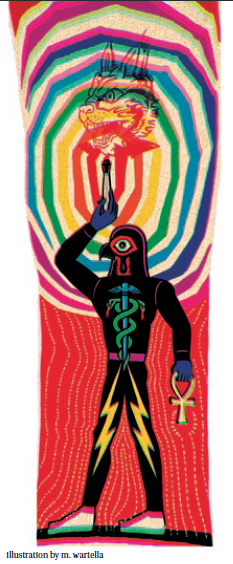
Illustration by M. Wartella

Originally published in Arthur No. 28 (March 2008)


Shorty don’t believe me? 

Then come with me tonight

And I’ll show you magic

(What? What?) Magic (uh huh uh huh)

I got the magic stick

– 50 Cent

It doesn’t matter whether you survey stage magicians, witches, or a screaming horde of pre-pubescent Harry Potter fans, the magic wand is perhaps the most encompassing symbol of magic. Equally at home in the white glove of a dapper, tuxedo-wrapped conjuror or in the clenched fist of a cackling old crone, the magic wand immediately summons a magical mood. While such depictions are still commonplace in pop culture, most folks are of the opinion that magic wands are vestiges of a bygone era.

It’s certainly true that magic wands have been around for a long, long time. Some of the earliest known examples belong to Egyptian magicians and priests from the 2nd Century B.C.—more than four thousand years ago.But for anyone who’s sat around a campfire and raised the glowing tip of a fire-kissed stick into the night sky, it’s not hard to imagine that our ancestors have been waving magic wands through the air for a good many millennia.

Over the years, wands have played a variety of roles: instruments for measurement, props for illusions, scepters for governance, and, as 50 Cent can attest, as phallic symbols noted for their procreative ability. As tools for healing we see their continued use in the hands of Reiki practitioners; however, the connection to the healing arts goes way back. The ancient Greeks, for example, used the rod of Asclepius (featuring a snake coiled around a stick) to represent medicine; a tradition still carried on by today’s medical professionals.  Ironically, the rod of Asclepius is often substituted with Mercury’s wand (two snakes forming a double helix around a winged staff), which traditionally represented both commerce and thievery, two traits often associated with the contemporary medical establishment. 

Performing magicians have employed wands in their performances for at least the last few hundred years. Waved over top hats and ornamented boxes, wands have frequently added an air of mysterious theatrics while assisting the magician in feats of misdirection. Similarly, wands in the form of scepters have also appeared in the hands of governing leaders. In this case, they can be seen either as symbols of constituent power or as fancy, but ultimately useless baubles that will never yield the positive results one hopes for. And the same could be said of the scepters.

Continue reading

Mobilizing Vehicles for Change: “Applied Magic(k)” column by the Center for Tactical Magic (Arthur, 2007)

Mobilizing Vehicles for Change

Applied Magic(k) column by the Center for Tactical Magic

Originally published in Arthur No. 26 (Sept. 2007)

Much of magic(k) is an attempt to augment our natural abilities; to provide us with a supernatural physicality to overcome the obstacles of the material world. Nowhere is this more evident than in our efforts to move our bodies and our belongings from one place to another. Even some of the most famous illusions in stage magic have focused audience attention on bewildering levitations and miraculous transpositions. From the ingenuity of our ancestors who recognized the unique properties of rolling discs and floating hulls, to more mystical means of mobility such as broomsticks and flying carpets, we often underestimate the magic(k) of re-location. The banality of modern transportation not only distances us from our point of departure but also from the journey itself. Too easily we forget that vehicles are equally the means of conveyance and the agents of transmission. 

Let’s face it. Rarely do automobiles function like ordinary tools used to simply accomplish the task at hand. Quite the contrary. Low-riders, hot rods, and pimped out SUV’s merely begin to scratch the enamel that glosses over our collective obsession with the means of transportation. Beyond the mods and custom accessories, motor vehicles themselves become points of departure, rather than the mere carriers of goods and bodies.  With names like Cougar and Jaguar, Bronco and Mustang, Thunderbird and Skylark, cars and trucks are transformed from mere technologies into totemic objects imbued with a sense of power and identity. The Cherokee and Navajo are equally stripped of any real identity as a people and forced to participate in a fetishistic masquerade. Mercury and Saturn are likewise invoked. Even Mazda shares a name with Zoroaster’s divine King of Light, the likely religious precedent for benevolent monotheism (Persia, 7th Century BC). If we look beyond the gods and planets, we see the Astro, Aerostar, and Nova (which translates in Spanish to “doesn’t go”). And let us not forget American Motor Company’s subcompact Gremlin which scratched its way into 1970s obscurity along with its ’80s offspring the Spirit. Indeed, the magic(k) of transportation lies buried deep in a veritable scrap yard of consumer manipulation, hollow fantasy and a lost sense of adventure. But we can salvage something of worth from amidst the rot.

Just as the introduction of the great iron horse changed the way travelers perceived time and distance, so too are our senses manipulated by contemporary forms of locomotion. No one can deny that we experience the world differently when we ride in a glammed-out gas-guzzling behemoth, a compact beater, or on a two-wheeled dream machine powered by our own two legs. And fewer are denying the material effects of our choices as well. Even the vestigial cynics of global warming—folks like G.W. Bush and some CEOs in Detroit—are finally acknowledging the links between climate change and fuel consumption. Perhaps this has something to do with an unpopular war that consumes nearly 400,000 barrels of oil per day just for military usage alone (approx. 144 MILLION barrels a year). Or maybe, when automakers like Ford post record losses (nearly $12.7 BILLION) they’re finally forced to reckon with the dissatisfaction and/or guilt of the consuming citizenry. Either way, we seem to be moving in the right direction, although we’ve still got a long way to go.

Technological innovations can carry us into a future either golden or grim depending on how they shape our realities. We trust enough in the laws of physics and the intelligence of engineers to ensure our confidence in the ability of a great hulking chunk of metal to float speedily though the clouds and deliver us to our chosen destinations. And rarely do we account for the great paradox of travel: our simultaneous conveyance across thousands of miles of sky while cramped practically motionless in the same small airplane seat wedged between two snoring salesmen. With the exception of the occasional trip to the toilet, we go absolutely nowhere. Yet, when we disembark several hours later we find ourselves in another land far from home. Logically, of course we understand how this happens. However, for all intents and purposes it wouldn’t really matter if the airplane were actually a sci-fi teleporter that took five hours to program once you were inside of it. In fact, it’s almost too easy to imagine a futuristic teleportation station where travelers get crammed into small seats in stuffy cabins with meager entertainment options and crappy snacks as they wait for hours for the operators to adjust all the right settings to get everyone to the proper destination.

Fortunately, we’ll probably never have to endure that bleak future. According to a de-commissioned research document funded by the US Air Force in 2004, the possibilities for teleportation are limited and fairly undeveloped. (see “Teleportation Physics Study” by Eric Davis, Federation of American Scientists) Limited, mind you; not “impossible,” “improbable” or even “non-existent.” Although the report does rule out Star Trek-style teleporters as an option, it suggests the need for additional research in psychic teleportation, worm-hole manipulation, quantum entanglement and extra-dimensional travel. It also cites Chinese studies claiming that children have been used in double-blind and triple-blind laboratory tests to successfully teleport a variety of small objects including radio transmitters, chemically-sensitive paper and live insects. Sound too weird to be true? Maybe. But the fact that the USAF actually funded the research is not the least bit in doubt since their spokesmen have publicly commented on the study in major news media. But before you get too excited, experts largely agree that we’re a long ways away from any practical applications of such theoretical physics. Still feeling a bit eager? If so, ask yourself if a teleporter truly existed, would the auto industry or Big Oil welcome it with open arms? Would it be turned into public transportation, or would it be restricted to those who could afford it at a premium? Would it be a public domain technology or would it be limited to the military for covert use long before the public was even informed?

Don’t misunderstand. Our aim here is not to promote a conspiracy theory about the secret existence of bizarre military technology. After all, why wander down a murky alley of speculation when we can cruise a stretch of established fact. Take for instance the Pentagon’s newly released “Active Denial System (ADS).” If the strangeness of the aforementioned teleportation study caused you a minor meltdown, this one’ll really fry your brain. Literally. The ADS is a giant heat-ray mounted on a military Hummer that is intended for use as mobile crowd control by beaming out a silent, invisible wave that heats up people’s skin up to half a kilometer away. This futuristic sci-fi vehicle is already developed and ready for deployment in situations where people might ordinarily be subjected to water cannons, tear gas, pepper spray and/or rubber bullets. If you thought Hummers were repulsive before, just wait until they start showing up at your local peace rally. Like most military technologies that eventually steer their way into the consumer marketplace, Raytheon is also manufacturing a commercial model they call the “Silent Guardian.” Care to invoke a “Silent Guardian” for your next birthday party, BBQ or bar mitzvah? We called Raytheon to inquire about the purchase price (in dollars, not souls) but their “business relations development associate” has yet to give us a fixed number.

The illusion of technological neutrality is left stranded by the wayside when we consider how the vehicle so often predetermines the nature of the voyage. Just as a train is limited to travel only where the tracks lead, so too can we predetermine some of the future destinations of society based on its machinations. While technology and magic(k) enhance our abilities to navigate a variety of terrain, they are not always free to embark on the path of our choosing. As such, it’s important to develop the right vehicle for the right journey, both literally and metaphorically. 

A vehicle for change does not need to be complicated. All that is required is a bit of consideration regarding where you want to go and how you might go about getting there. Obviously if you’re trying to get to a city 300 miles away, riding a tricycle isn’t the easiest way to go. Hitchhiking, jumping a train, driving, riding, or flying generally tends to be more expedient. But if the destination is less concrete, then the mode of transportation may not be so obvious. Look for existing forces that are already flowing in the direction you want to go, and harness them for the ride. The right vehicle for the right journey might just be a remote-controlled car, a smokescreen, a bicycle-repair clinic, or the rolling thunder. But it probably isn’t a giant heat-ray mounted on a Hummer.

Continue reading

INTO THE HANDS OF SATANUS: A Look at Les Vampires, Feuillade’s second masterpiece, by Erik Morse (Arthur, 2008)

Into the Hands of Satanus

A look at Les Vampires, Feuillade’s second masterpiece

by Erik Morse

Art direction by Mark Frohman and Molly Frances

Originally published in Arthur No. 28 (March, 2008)

(See main article: REIGN IN BLOOD: The secret mark that French pulp villain Fantômas left on the Twentieth Century)

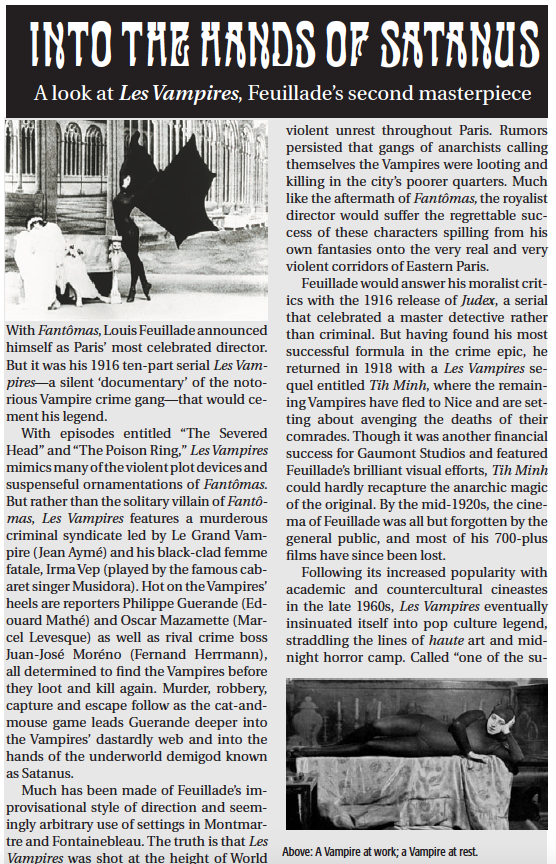
With Fantômas, Louis Feuillade announced himself as Paris’ most celebrated director. But it was his 1916 ten-part serial Les Vampires—a silent ‘documentary’ of the notorious Vampire crime gang—that would cement his legend. 

With episodes entitled “The Severed Head” and “The Poison Ring,” Les Vampires mimics many of the violent plot devices and suspenseful ornamentations of Fantômas. But rather than the solitary villain of Fantômas, Les Vampires features a murderous criminal syndicate led by Le Grand Vampire (Jean Aymé) and his black-clad femme fatale, Irma Vep (played by the famous cabaret singer Musidora). Hot on the Vampires’ heels are reporters Philippe Guerande (Edouard Mathé) and Oscar Mazamette (Marcel Levesque) as well as rival crime boss Juan-José Moréno (Fernand Herrmann), all determined to find the Vampires before they loot and kill again. Murder, robbery, capture and escape follow as the cat-and-mouse game leads Guerande deeper into the Vampires’ dastardly web and into the hands of the underworld demigod known as Satanus.

Much has been made of Feuillade’s improvisational style of direction and seemingly arbitrary use of settings in Montmartre and Fontainebleau. The truth is that Les Vampires was shot at the height of the World War I when many of Paris’ streets were abandoned. Surely Feuillade was aware that filming where he did would add to the strange tension and sense of dread that permeates these films; after all, he utilizes many more exterior tableaux than before. Whether purposeful or accidental, there is a feeling of miasma that infuses Les Vampires as it teeters from one violent sequence to the next, from desolate alleys to secret passageways, from hand-mirror reflections to living paintings.

So intent was Feuillade in fabricating a ‘natural’ exaggeration of the criminal world—where every corner and crevice promised dangerous secrets—that it would not be hyperbole to call Les Vampires an opera of hermeneutics; or, to borrow a term usually reserved for literature, an opus of magical realism. It makes sense that the serial is a favorite of Spanish Surrealist director Luis Bunuel and nouveau vague auteur Alain Resnais, who interpolated the malleable concept of reality with fantasy in much of their works. The French government temporarily banned Les Vampires for fear of it inciting copycat crimes and violent unrest throughout Paris. Rumors persisted that gangs of anarchists calling themselves the Vampires were looting and killing in the city’s poorer quarters. Much like the aftermath of Fantômas, the royalist director would suffer the regrettable success of these characters spilling from his own fantasies onto the very real and very violent corridors of Eastern Paris. 

Feuillade would answer his moralist critics with the 1916 release of Judex, a serial that celebrated a master detective rather than criminal. But having found his most successful formula in the crime epic, he returned in 1918 with a Les Vampires sequel entitled Tih Minh, where the remaining Vampires have fled to Nice and are setting about avenging the deaths of their comrades. Though it was another financial success for Gaumont Studios and featured Feuillade’s brilliant visual efforts, Tih Minh could hardly recapture the anarchic magic of the original. By the mid-1920s, the cinema of Feuillade was all but forgotten by the general public, and most of his 700-plus films have since been lost. 

Following its increased popularity with academic and countercultural cineastes in the late 1960s, Les Vampires eventually insinuated itself into pop culture legend, straddling the lines of haute art and midnight horror camp. Called “one of the supreme delights of film” by noted American critic Jonathan Rosenbaum and named one of the Village Voice’s “100 Best Films of the Century,” Feuillade’s greatest achievement continues to hypnotize horror and crime enthusiasts with its magical realism. It has also inspired any number of remakes and tributes, including Olivier Assayas’ 1996 film Irma Vep and a series of porno films by smut director James Avalon. A collection of the ten serials was made available on VHS with English subtitles in the mid-1990s but it was only with the 2005 Image Pictures 2 DVD set, which includes new tintings, intertitles and score, that Les Vampires has received the treatment it deserves. (Les Vampires is also available to view in its entirety on Google Video—thank you, Internet!)

Les Vampires remains a bellwether of early French cinema, elevated beyond mere spectacle to art—a concept Surrealist/provocateur André Breton recognized when he called Feuillade’s second and last masterpiece, “the reality of this century. Beyond fashion. Beyond taste.”

ALL-AGES DIALOGUES Part 8: Shannon Roach of the Vera Project (Arthur, 2006)

The ALL-AGES Dialogues: A conversation with Shannon Roach
by Jay Babcock

In 2006, I spoke by telephone with Shannon Roach, executive director of the Vera Project in Seattle, for a piece on all-ages philosophy/history/yadda yadda. The piece kept expanding, so much so that it looked like it would have to be published as a series across multiple issues of Arthur. Some of the interviews ended up getting published; unfortunately this one didn’t, basically due to internal Arthur chaos in 2006-07. Anyways, in the spirit of better-late-than-never, here is a slightly edited transcript of our conversation. — Jay Babcock

Previously in this series:
Interview with John Sinclair (MC5 manager, activist, poet-historian)
Interview with Chuck Dukowski (Black Flag, Chuck Dukowski Sextet)
Interview with Calvin Johnson (K Records, Beat Happening, Dub Narcotic Sound System)
Interview with Greg Saunier (Deerhoof)

Interview with Will Oldham

Interview with Jim Ward (At the Drive-In, Sparta)

Interview with Shannon Stewart (Vera Project, All-Ages Music Project)

Shannon Roach: I’ve been involved with the Vera Project since September of last year, of 2005, as a staff member, but I went to the first show that Vera ever had, in January 2001. It’s a big part of the music community here in Seattle. That first show was the Murder City Devils, Botch and the Blood Brothers. It was really fun.

Arthur: The Vera Project has moved around, right?

It’s the name of the organization, not a particular space. It’s named after an organization called Vera in Gronigen, Holland. The Vera over in Europe is a community center that’s over a hundred years old and its focus is on the popular arts: music, film, visual art. And it’s truly all-ages: people from the entire community participate in it. Totally government-funded. Things are a little different in Europe, you know. (laughs) The idea of Vera came from that. James Keblis and Shannon Stewart, who you talked to, they did a study abroad over in Holland and found out a lot about the Vera Project and then brought those ideas back here, and filled a specific need in Seattle, which was for all-ages music. 

Why was it needed?

Well, there was a law called the Teen Dance Ordinance (TDO) here in Seattle that prohibited people under 21 from going to see live music with people over 21. So audiences under 21 …the venues had to have a lot of insurance. It was basically illegal for people under 21 to see live music. So there really wasn’t much of an all-ages scene here, which is kind of crazy because Seattle is known for its music, it’s totally culturally rich in music. When I was younger, I couldn’t go to see live music shows. I had to go up to Vancouver or down to Portland, leave the city to see some music. A little nutty. The TDO prohibited young people from seeing music so there was really a need here in Seattle for a place for that outlet, for young people to see and to play music.

Vera initially did shows out of a union hall called the Local 46, a huge union hall. Every show that Vera had, volunteers and staff came in and set up a PA system. They would have to take all of the folding chairs down from the union meeting, set up the PA system, run the show and clean everything up and set all the chairs back up exactly like they were for. Like 500, maybe more. It was huge. That was a fine space.

Vera also did some shows out of a theatre over in the international district called the Theatre Off Jackson. It was a good space, it was a little bit smaller, and it was also a theater so it was set up to be a little more acoustically sound and conducive to music. In 2003, Vera found a space in downtown Seattle on 4th Avenue. That was also an old theatre, the Annex Theater. It was really cool, this old building that was probably going to be torn down sometime soon and Vera moved into it as is, and the whole community came together to help build out the venue, helped to put together the sound system, do a bunch of construction in there to make it safe for people. So then for the first time the Vera Project had a home, and it just totally exploded from there, because it makes it a lot easier to have shows. So there were MORE shows available. And then ot also expanded to have an art gallery, a silkscreen studio and night tech classes, and all kinds of community events that were a little more difficult to put on before. 

Who gets booked there? Bands that normally play bars, or bands that are on a completely different circuit?

Both. The thing is, Vera has really great shows. I don’t know if you’ve been to the website, looked at some of the bands that have played, but there’s a good mix between established bands that are gonna draw really, really well and then also it’s a place where people who are getting established can come and play. So there are some shows that there’s gonna be a line around the block and people are gonna be turned away. And there are other shows that are smaller and more intimate. It runs the gamut really. We get national and international touring artists, and then we get local people as well. 

Door price?

Never more than ten dollars. That’s part of Vera, really, is for it to be an accessible space so that people can afford to come there. It’s a small capacity, the stage is low, there’s all these opportunities for young people to be involved in everything from stage management to being a sound assistant to taking tickets at the door to helping book, so it provides people with direct access to artists with makes it a little bit unique.

It’s run as a non-profit?

Non-profit, yeah. It became a non-profit in 2001. Our space on 4th Avenue was slated to be demolished and so we thought that we were going to have to vacate. One of the things that’s really important to Vera is to be in a central location where people from all over the region can access us. That’s a little bit easier said than done. It’s really hard for a non-profit to find an affordable space in downtown Seattle. Our shows don’t make a whole bunch of money because we don’t have alcohol there and the ticket prices are intentionally affordable. So the Seattle Center offered us a space there, it’s this big conference room, a long-term lease, a really affordable price. It’s called the Snow Kwami Room. The Seattle Center is where the Space Needle is. It’s a big city-owned property where there’s a big basketball stadium, the Space Needle, the children’s museum, the science center, it’s one of those big huge fun municipal campuses. So it doesn’t really have the street cred a space in the middle of downtown would have but at the same time it’s still downtown Seattle, and it’s easy to get to, and the cool thing about it is we get to build up this conference room into our own space. We’ve gathered up a whole bunch of people to help us come up with concepts for it, and we’re working with architects and construction people to turn this huge 6,500-square foot conference room with linoleum floors and fluorescent lights into a venue and an art gallery, silkscreen studio, recording studio, all kinds of stuff. It’s going to be really nice. It’s very ambitious. But it’s also, in the 4th Avenue space, what I hear a lot from people who use it, is that once they had a place to call home, everything, all the opportunities expanded for everybody, no matter what they were interested in, it really did help for the Vera Project to expand. And so having a place where we can stay for a while and grow into it is going to really benefit a lot of people for a lot of years to come.

The shows, do you run them earlier than a show in a nightclub would be?

They usually start around 8pm and are done by midnight. 

Weekend matinees?

Not very often. Usually we’ll only do a weekend matinee if it’s a performance that we can’t get any other time that’s really exciting. It’s nice to have a nightlife for all-ages. It’s so important. 

Urban kids don’t have garages. They NEED a place to go and play music and see music. It’s so important. It’s part of their culture. It’s so ridiculous for them not to be able to participate in it.

I think a big part of our success too is “No booze — no drugs — no assholes.” That really helps for the whole community to say, Yeah that place is okay. And the nonprofit model really helps too.

ALL-AGES DIALOGUES PART 7: SHANNON STEWART of The All Ages Movement Project (2006, Arthur)

The ALL-AGES Dialogues: A conversation with Shannon Stewart
by Jay Babcock

This interview was conducted by phone in late summer 2006, as part of a series of conversations I was doing with various folks regarding the history of all-ages, philosophy/ethic of all-ages, the state of play of all-ages, yadda yadda.

If I remember correctly, when we did this interview Shannon was exiting her position at Seattle’s legendary Vera Project—where she was co-founder, program director and talent buyer—to start a new advocacy organization called the All-Ages Music Project. In 2010, she published In Every Town: An All-Ages Music Manualfesto, described as “part-history, part how-to,” with a foreword by Kimya Dawson.

This conversation shoulda been published long ago but stuff kept going awry and we didn’t get it in the mag. My apologies to Shannon, and to the readers. Hopefully this piece will be of use to present-day readers. — Jay

Previously in this series:
Interview with John Sinclair (MC5 manager, activist, poet-historian)
Interview with Chuck Dukowski (Black Flag, Chuck Dukowski Sextet)
Interview with Calvin Johnson (K Records, Beat Happening, Dub Narcotic Sound System)
Interview with Greg Saunier (Deerhoof)

Interview with Will Oldham

Interview with Jim Ward (At the Drive-In, Sparta)

Arthur: What do you think happened to all-ages shows? Why did so much music become restricted to the over-21 crowd?

Shannon Stewart: Well, you have to look at the relationship of the music industry to alcohol. That’s the easiest answer to it. Those things are easily tied. Since the drinking age in this country is 21, therein lies your answer. Because those industries have become co-dependent, or I guess the music industry has become co-dependent on alcohol at least in terms of spaces. 

When did that happen, though? Because it wasn’t always that way.

That’s probably something I’d leave up to you to answer. I think it’s changed with the drinking age and the tightening liquor laws and the rules about youths not being able to be in a bar at all even if they’re not drinking. Every state has a different poilicy on that. Up in Washington State, until about four years ago, young people just couldn’t go into bars at all. It sort of loosened up a few years ago so that you can have separated areas, so there can be like an all-ages area and there can be a big wall or else some sort of rented gate system where you can herd up all of the drinkers sort of like cattle behind the all-ages area, and have all-ages shows that way. But still the venues are losing a lot of money because a lot of the ticket sales go to guarantees, and they’re trying to pay their bills on the bar sales, which is why I think there’s a burgeoning movement of nonprofit all-ages venues. 

Tell me about that.

There’s a lot of different versions of it. Like one version of it would be the teen center that the city starts to try to bring youth in and engage them in a way that’s meaningful to them that is moderately successful depending on who’s running it. There’s a ton of them. The old firehouse in Redmond, Washington, which is actually—when you talk to Shannon Roach you can ask her about that, because she used to work there. And in the Midwest there’s a bunch of them. Usually in affluent areas where the taxbase is such that it’s not inconceivable that the city would spend the money on a music space for teenagers. That’s sort of the bottom line of it. 

The other spaces that are getting the most momentum behind them are spaces like The Smell [In Los Angeles], these fly-by-night, making-it-up-as-we go-along but somehow they’re still existing ten years later even though it seems like every time you go there, they should be gone [chuckles] or be on their way down or something. The other ones around the country are the K Cafe Collective in San Diego, and ABC NO RIO in Manhattan, and Gilman’s in Berkeley. Those are the ones that have managed to scrape by for decades and have been really influential, I think, in this generation of new all-ages organizations, which are a lot more younger people forming collectives and starting their own spaces out of makeshift places and art galleries and stuff like that. If you ask a lot of those folks who influenced them, a lot of them will reference these old punk institutions that I mentioned before. They find out about them through D.I.Y./internet. 

The final piece of that are spaces that are becoming big non-profit institutions, and communities that maybe started out with a small gaggle of people working to just put on their own shows but had some really savvy business people involved who were like, ‘We should get money for this’ and then secured foundation grants and federal/state/local money in order to make their space sustainable. The Vera Project is an example of that. AS220 in Providence, Rhode Island is an example of that. The Neutral Zone in Ann Arbor, Michigan. They’re generally between 200 and 500 capacity, which is about the size of your average competitive music club in urban areas. 

In suburban areas of major metropolitan cities there’s not so much a feeling of competition from other clubs because I think a lot of times people will just do two shows. So artists will have two shows, a 21 & up show and it’ll be at a bar in the city and then they will have an all-ages show and it will be on the outskirts in the teen venue. 

What kind of pressures, if any, are these spaces under from surrounding communities? 

The pressures from the surrounding community depend on how conservative they are. They are real and a lot of those spaces have to fight for their funding, and are usually really under-staffed and have to fight. Also there’s pressure to be sort of your conventional youth program with terms of supervision and rules and regulation about how you’re supposed to interact with youth. That definitely impedes the organic nature that goes hand-in-hand with being part of the show-going culture. And there’s so many rules about who can be a volunteer and who can’t be a volunteer and what age you have to be to go there. And how money gets handled, and dealing with the cash basis that artists need to deal with is really, really hard. There are a million little tiny things that get in the way that people have to weigh out—the pros and cons of either being affiliated with the city and having some security in your facility and your funding source versus being totally on your own and not having to deal with all those little regulations. 

In the older DIY institutions in the country, the issue is just one of staying relevant and staying young and connected to the constituents that are looking for all-ages places to go and see shows and being able to also stay solvent and keep track of financial records and keep an accurate archive/history of what’s happened there. All that stuff is really challenging because most of those spaces are organized all-volunteer, collectively run, with the exception of ABC NO RIO… well I guess Gilman now has a coordinator too, but ABC NO RIO has a director of the space that actually is in charge of doing that administrative stuff now, but that’s fairly recent. 

There is something that is totally fine about the culture of all-ages shows: that is, you get a lot of energy from young people who gather and get together and do their own thing for a while and burn out and it’s over. That is a huge piece of the all-ages music scene: spaces can come and go. It’s kind of okay because people pass through that time of their life, like you come and go through youth too, and so like at your point in time when you’re a young person going to shows there will be a space, and then it dies off about the time you’re old enough to go to bar shows, and then another space will bubble up and it’ll do the same thing. I don’t think that’s necessarily healthy or fair, especially to the spaces that really do want to survive but just can’t make it, but I also think it’s just something that is the natural cycle of space, and youth music stuff.

You’ve said you think all-ages spaces are going to be increasingly hip-hop–oriented.

I don’t have statistics to back it up, but just looking at the changing demographics of generations…of the young generation of the United States right now and what has been becoming more popular over time, I would go as far as to theorize that the majority of youth are into hip-hop in one way, shape or form. As they get older and want to go to shows and be part of the hip-hop music scene, they need outlets. A lot of spaces that are just putting on indie rock bands that appeal to the 30-year-old bearded guys or whatever aren’t necessarily doing it for them. I think definitely in cities and urban areas there’s a movement towards youth organizations that focus on hip-hop. I’d go so far as to point out that there’s actually a generation called the hip-hop generation and that’s very much about how young people in the US today are really interested in hip-hop and that’s a big part of their cultural identity. I think that’s going to start to take over all-ages music spaces as years go by.

What about these all-ages ‘emo places,’ what do you think about those?

This is just me personally but I really associate a lot of those emo places with the suburban teen centers for some reason. I see a lot of those kids coming out of these affluent areas where they happen to have pretty cool parents that empower them to use their garage as practice spaces. That could just be a gross generalization on my part but that’s how I’ve experienced it this far. 

There’s the Chain Reaction in Anaheim, the Showcase Theatre in Corona…? I assume there’s a bunch of those all over the country?

I don’t know if there’s a bunch of those. I’d say it definitely is region-specific. I think that some spaces have these ‘Bbig! All-ages! Venues! We are the hottest all-ages venue in this city!’ and sometimes those are emo and sometimes they’re are metal and sometimes they’re ska and sometimes they’re punk. I don’t know how long the Chain Reaction has been around but I sort of see those as part of the come-and-go spaces in some ways. I guess I’m just not versed in emo. It does seem like there are a ton of those shows because it is really popular with a certain section of the youth population but in terms of spaces that are explicitly emo…

The door price at all-ages show is still generally low, right?

There’s a few reasons for that. One is that some really foundational people in the all-ages movement—if we are to say there is one—set it up that way. Like Ian Mackaye or whatnot, with the $5 door, $8 record cover. There is the economic reality that in a lot of these areas, youth don’t have disposable income but there a lot of places where there is a healthy rock all-ages scene, you’re actually dealing with people who do have disposable income. Whether or not the ticket prices need to be a lot lower than your average 7 or 8 dollar show that I would go and see, or probably $10 now, if I wanted to go and see a show in San Francisco, I don’t know if it has to be lower. I think it really depends on the economic climate that you’re in. 

My project is looking at pretty much commercial-free spaces, nonprofits and collectives and whatnot, that are doing all-ages shows that have a big youth-run component: either they have all staff that are people under 25, or they have youth membership with voting power, or they have some piece of high-level youth involvement in their governments and running the organization. I’m looking at where these spaces exist and where they don’t exist and why. And the importance of having a space that is somewhat commercial-free and a cultural space for youth to come together and have their part in the music scene, and have a place to build community with one another. I’m almost looking at the civic engagement piece of that: if young people have a space like that where they’re engaged in, where the artistic medium is culturally relevant to them, then they’re likely to build skills and tools and relationships that help them start their own things on the outside, and also get involved in their community and become community leaders. That was definitely a piece of the Vera Project and I’m sure Shannon [Roach] will talk to you more about that. I’m looking at these venues like churches of young people that are secular.

Youth autonomy zones. Chuck Dukowski was saying it was very important to him not that youths have their own space but that there’s a space in which all ages can mingle, because otherwise the younger ones don’t benefit from the wisdom and experience of their elders, and the elders don’t benefit from the energy of the youth.

I would just temper that statement, which I absolutely 100% agree with, with also the notion that because most of our spaces in this country are set up to cater to adults, it’s important that all-ages spaces have a priority to catering to youth, just to combat that feeling that you get when you’re a young person and you walk into a space that’s full of adults… that feeling that you don’t really belong there, you don’t feel welcome there, you’re not really being treated like you belong there. I think the emphasis on youth, on having a high level of youth involvement is really important in all-ages spaces, just to combat that general societal problem. I am not a fan of cut-off ranges of ages, like ‘we only serve 13 to 19 year olds’ because I think exactly what Chuck said: there’s a disconnect between what it means to be an adult that has lifestyle that’s maybe a little different from what you think or what you’re told it’s supposed to be.

There are lots of communities that have been segregated by age. It might not be geographic, though. I’m going to go to this convention tomorrow, the national hip-hop political convention, and I really want to network with other folks that are gonna be there and probably a lot of that networking will take place in bars. But I am bringing someone who is 18. And it’s just a problem of I want her to be able to network with me, but there’s this cultural phenomena of adult organizers that you go to bars to do this, with because that’s a sort of set-up space for you. Youth don’t have that. Or, there is no place where it just naturally is both.