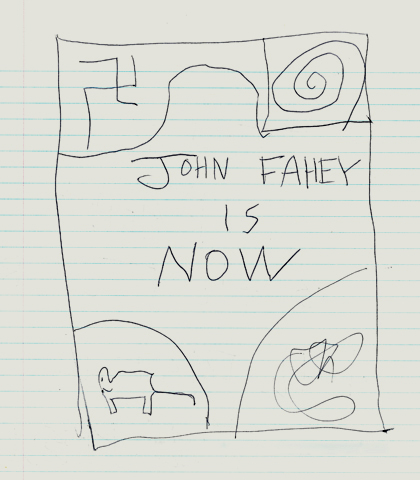
Sketch by John Fahey circa 1998 for potential homepage for johnfahey.com
The paintings of John Fahey July 10 – September 12, 2010
Presented by John Andrew and AVA
Legendary guitarist and iconoclast John Fahey is best known for his adventurous catalog of music. From 1959 until the time of his death in 2001 Fahey released upwards of 40 albums exploring the territory of blues, classical, hillbilly, spirituals, folk, musique concrete, rock, and noise. He was a figure like none other, a true visionary. In 1959, long before the term “independent label” hit the mainstream, he self-released his first album by pressing up 100 copies and selling them at the local gas station where he worked (shortly thereafter forming his own independent label Takoma Records). Lesser known is the fact that he was a fantastic writer in addition to being a hyper productive and explosive painter toward the latter portion of his life. This summer, AVA and John Andrew are extremely pleased to present the furiously beautiful paintings of John Fahey.
Pulling inspiration from the ‘French Primitive’, untutored painters, Fahey often referred to his music as ‘American Primitive’. The same alluring, raw, roots, mysterious, power, grit, obscure, industrial, ambient, epic, and tranquilizing aesthetics that one finds in Fahey’s music and his writings are equally present in his paintings. The 90’s proved to be a decade of regeneration for Fahey. Though he struggled with certain health problems, he was brimming with experimentation. Collaborating with noise artists and improvisational performers of the alternative movement, Fahey began to channel a new outlet for experimentation which included his return to painting; a bent he abandoned when he took up the guitar.
Fahey’s works are evocative of action painters and abstract expressionists. He painted on found poster board and discarded spiral notebook paper. His painting studio floated from motel bed to motel bed and eventually ended up on the bed of his rental home in Salem, OR; occasionaly painting with anti-freeze in the garage. He worked with tempera, acrylic, spray paint, and magic marker.
A selection of larger works (22” x 28”) will be on display in the Front Room of AVA in addition to a few select smaller works of varying dimensions. AVA and John Andrew would like to thank Melissa Stephenson for opening up her collection to this show and enabling the works to be available for purchase.
A series of sound collage works, spoken word, explorative / home recordings, and comedy all performed by John Fahey will be transmitted on the outside of AVA (as part of the Exterior Sounds series) during the course of the exhibition.
John Andrew is a New York based artist who has presented two shows at AVA. This show is a fulfillment of a Portland, OR art show he was originally organizing with Fahey in 1998.
Summer hours: Thursday – Saturday, 12pm – 6pm and by appointment
AVA 34 East 1st Street New York, NY 10003
Subway: F,V train to 2nd Ave / 6 train to Bleecker
I interviewed Bobby Seale (official site) in person in Oakland for Vibe Magazine, on a commission by Peter Relic, who was editing the front section of Vibe that year. I think the transcript runs to 12,000 words. The published Q & A was about 700 words. There’s lots of great stuff in here about Black Panther Party history and philosophy, Bobby’s times in prison, barbecue and so on, after we get done with talking about what he’s up to at the moment…—Jay Babcock
Bobby Seale: I’m out here [in Oakland] for David Hilliard. David Hilliard is running for City Council, 3rd district, to mount a real student involvement and people’s involvement-type of campaign for him to win that particular political office. It’s all about the continuing progressive Old Left-radical politics today. We want to get these students involved in this campaign to teach them techniques and methods of the old Black Panther party campaign, Old Left radical politics, progressive politics. To teach students that they gotta take over, that they have to be part and parcel of this kind of stuff, they gotta take seats over all over this country and this is gonna set an example for that. That they’re the ones who have to begin to understand the need to control, run these political institutionalized functions whether they’re city council, county seats, state legislative seats, etc., and make laws, legislation and policy that reflect the real true human liberation of the people, the empowerment of the people, whether you’re black, white, blue, red, green, yellow, polkadot, we don’t care. We’re progressive. In the 1960s we were an ALL power to ALL the people. We didn’t care what you were.
People think we were just a strict so-called xenophobic-type Black power organization. Not true. If people look and know our history…as an African-American group of young people who were part of a young intelligentsia of the 1960s, what we evolved were some of the most profound progressive politics that emerged out of the Black community: to set up coalitions, working face-to-face coalitions with all our white left radical friends, with all the young Hispanics, young Puerto Ricans with the Young Lords organization or the young Mexican-Americans Chicano brothers and sisters with the Brown Berets and the Cesar Chavez farm labor movement. We had a working coalition with that organization. AIM—American Indian Movement—we worked directly with. All the young Asians, young Chinese and Japanese worked with us, like the Red Guard out of Chinatown. Young Chinese students and young Japanese. In fact, of all those ethnic groups, it was always a few of each one of those ethnic groups that actually literally joined our Black Panther Party. I’m just saying that, that’s the kind of progressive, “All power to the People” politics that we put into the ’60s. We crossed racial lines even though we were able to be an African-American community organization that ran our own organization without any intellectual or offbeat, abstract, academic dictates. We REFUSED to allow for that, because our concept and our method was putting theory into practice. Learning as we did.
And we want to show the youth—when I speak today—we want to show the youth that if you participate, I want you to sign up for this campaign because it is not about just a political seat, it’s about another kind of movement, moving into this Y2K period…it’s not necessarily about the continuing, old politics as usual of the Democratic and especially the right-wing conservative Republican politics… There’s the Green Party, there’s the Constitutional Party, etc. so on. For instance David is running his total non-partisan, there’s no political party per se mentioned here in terms of being listed on the ballot. So. We’re saying there are multi-thousands of these seats. You talk about 50,000? or are you talking 500,000? …duly-elected seats in the United States of America, especially on the local level. And this campaign is not the last of this era, it will be another one evolving.
For instance in Winston, North Carolina, used to have a chapter of the Black Panther Party there. The Party was over, what, in the late ’70s and early ’80s? What in effect happened was the former Party members ran for political office. Larry Little, the former Deputy Chairman down there, won a councilmanic seat that represented that poor low-income African-American community there. And since then, for 26 years, it’s always been a former Black Panther connected to that seat. The people will not allow anybody else. If you weren’t in the former Black Panther Party organization in Winston/Salem, North Carolina—they call it , the old other conservative council members call that particular seat “the Panther seat.”
In other words you have to remember those young Black Panther Party people, young students and others, they put together a free ambulance program for the people. They put together a free health clinic with a free pharmacy program which all chapters and branches did. They put together free breakfasts for children programs that served those people in that community. So those people never forgot that. They remembered that. These are tangible programs. This was not rhetoric, this was not talk. So this is what I’m saying.
So we have various examples of former Party members still in political office like Bobby Rush, who was an alderman there in Chicago for 12 years and then became a Congressman. We have Michael McGee in Milwaukee, he is still a councilman up there representing a heavy electoral group of the African-American community.
What a lot of people forget is this is really the politics of the Black Panther party. Even though we had a lot of shootouts and a lot of battles with the police attacked us, when the politicians would send their law enforcement agencies in on us, even though J. Edgar Hoover and all these guys were out to smash us, try to terrorize us out of existence, they killed 29 of my people in this country, particularly in the year 1969. 14 policemen wound up getting killed in those attacks. They attacked our offices, they attacked our homes and we vowed to defend ourselves. Cuz in our sense, all we were doing was defending our Constitutional, democratic, civil, human rights: one, to organize the people, political electoral community power…
People used to say “you’re outside the System.” You can’t be outside of something that’s oppressing you. You have to get right into the middle of it, change its structure, change its direction, change the laws, change the policy to serve the empowerment really and truly of the people. And THAT’s the kind of politically revolutionaries we were in the 1960s.
“I’m fascinated by Kenneth Anger’s use of color and his ability to transform a film into a three-dimensional texture, a fabric of images in movement,” explained Angela Missoni. This is how she introduced her decision to entrust the Missoni F/W 2011 campaign to one of America’s most famous authors and directors of avant-garde cinema.
Anger — a hyperactive octogenarian who loves working in the wee hours of the night and at dawn using sophisticated instruments such as the RED digital camera that has the characteristics of a classic 35 mm camera – flew in from Los Angeles to film the campaign in Sumirago that involved all the members of the great Missoni family. They are the stars of this campaign that was conceived as a series of superimposed and overlapping portraits. Vogue.it presents a preview of this film: a vibrant and impalpable evocation of unique patterns, patchwork motifs, stitches, knits, and styles, it is a symbolic weave as ephemeral as a dream.
“The images of Juergen Teller for the S/S 2010 campaign reflected and portrayed our everyday family life,” said Angela. “Kenneth Anger’s experimental approach and his narrative style, on the other hand, transformed the new campaign into a sublimation of our world.” The style of this ad campaign that verges on art clearly reveals the taste of this Californian filmmaker, who directed the films “Fireworks”, “Puce Moment” and “Scorpio Rising”, wrote successful books such as “Hollywood Babylon” dedicated to the secrets, manias, perversions and scandals of early Hollywood film stars, and is a favorite of young fans. Included in the 2006 edition of the Whitney Biennial of New York, he currently works with some of the most important international galleries of contemporary art and enjoys much popularity today.
A man of few words, this fascinating former actor who still takes care of his appearance first filmed the settings for his film “Missoni”: mostly locations near bodies of water in the Sumirago countryside and part of Rosita and Ottavio’s garden. For the indoor sequences, he built a set in the Council Room of the Sumirago Town Hall, a basement room with a vaulted ceiling. The mood of the film and the poses and movements of Margherita, Jennifer, Angela, Rosita, Ottavio, Ottavio Jr. and all other family members are reminiscent of Sergei Parajanov’s “The Color of Pomegranates”, a 1968 film that inspired Anger to create his Chinese box-style storyboard.
The intertwining and blending of moods, micro-plots, and situations make his “Missoni” a dream of a film within a film, a surreal dreamy interaction of spaces, faces, gestures, clothes, and costumes with different ages and narrative tempos. “Before he left,” said Angela, “he gave my mother, with whom he became fast friends, a film award he recently received.” To the question, “What did he leave you?” she answered with her usual humor, “Twenty-five wigs!” In Anger’s film, the wigs appear in a minimum part and are worn by Margherita, the protagonist with Jennifer of a project that will enchant, document, but not illustrate fashion.
The film expresses Missoni’s sophisticated choice and desire to amplify the role of images, making them a communication means and not an end, instruments for personal forms of appropriation and interpretation.
Lane Milburn was born in Lexington, KY and studied Painting at the Maryland Institute College of Art. He currently lives in Baltimore, MD. He is currently at work on a long science fiction graphic novel that is coming along in fits and starts. His new book DEATH TRAP is available from Sparkplug Comics (http://www.sparkplugcomicbooks.com/) or directly from Lane at: http://closedcaptioncomics.blogspot.com/2010/03/death-trap-has-arrived.html
Jesse McManus was born in 1986 and grew up in Minneapolis. After snatching a BFA in Chicago, he ventured Eastward to hug chums and learn lessons. Alas, it was a swift stint, as he’s now bound for Portland, where his heart will expand and he will smile again. Today he is job-hunting, to avoid his Mother’s cupboard, where the groaning ghosts of childhood bite toes and snap pens.
What can bring us past this knowledge, so that you will never wish our life undone? For if ever you wish it so, then I must wish so too, and lovers yet unborn, whom we are reaching toward with love, will turn to this page, and find it blank.
Earthship n. 1. passive solar home made of natural and recycled materials 2. thermal mass construction for temperature stabilization. 3. renewable energy & integrated water systems make the Earthship an off-grid home with little to no utility bills.
Biotecture n. 1. the profession of designing buildings and environments with consideration for their sustainability. 2. A combination of biology and architecture.
“Made from used tires, discarded bottles, cardboard, Styrofoam and other waste materials, Mr. Reynolds designs and builds these homes to be essentially energy self-sufficient. Earlier this month, Mr. Reynolds and two builders went to Haiti intending to survey the area to see how they could help. “There was nothing but tents, nothing but cleanup,” Mr. Reynolds says of what he saw in Port-au-Prince. Instead of just surveying the city, Mr. Reynolds and his team ended up building. A non-governmental organization called Grassroots United had gotten Haitian children to collect tires and plastic bottles from the tent camps. Mr. Reynolds himself had one arm in a cast because of rotator cuff surgery, and the two builders with him both got sick from the water and heat. “The three of us were worthless, pretty much,” he says. But 40 locals, ranging in age from four to 50, built an earthship in just four days under his guidance. “They had nothing to do. They were all eager to learn, and it turns out all the skills we could do, they could do.” The earthship, just 120 square feet, is made of 120 tires packed with dirt – such tires are the main building blocks of any earthship. Designed to be earthquake- and hurricane-resistant, the Haiti earthship is not completely finished. Mr. Reynolds plans to return in October to add plaster to the exterior and a screened-in veranda with flush toilets, as well as outfit it for solar energy and water collection. He hopes the home will be used as a prototype for more in Haiti, an example of what’s possible. Earthships could be a boon for a place like Haiti, says Mr. Reynolds, where even the capital city has little infrastructure like sewage or electricity. “The most substantial thing I saw down there was a plywood shack,” he says. When he returns to Haiti in October, he plans to find a site where he can build a small village of earthships. “It doesn’t have to be in the city because there is nothing in the city anyway,” he says of the lack of infrastructure. “These buildings would provide their own power, their own water, their own sewage (systems).” Most important, Mr. Reynolds says, is a sense of empowerment instilled in those who helped. “They built the building!” he says. “The real thing that shows it’s possible for them to do it is that they did it.””
Q: Where did you get the idea to use trash?
A: Walter Cronkite did a piece on clear-cutting timber in the Northwest. Even in 1969, he predicted massive deforestation would result in wood scarcity and would affect our oxygen levels, things that have become big issues today. Charles Kuralt did another piece on beer cans being thrown all over the streets and highways. So I started playing with beer cans and trying to make them into building blocks. It was a way to kill two birds with one stone. I later decided to try a different material and thought of the mountains of discarded tires that can be found everywhere. Pack them with dirt and they will store energy. Plus they’re strong and resilient, so I built an entire house out of them. I went on to add photovoltaic panels, windmills, water collection and onsite sewage treatment.
Q: And you went overseas with your ideas?
A: For a while… I went wherever there was a desire to use my ideas. After the earthquake and tsunami in 2004, an architect [from the Andaman Islands in the Indian Ocean] that lived right in the middle of the disaster saw our Web site and asked us to come. Their whole community was just wiped out. We paid the local kids to bring us bottles, and we built a house out of them that collects its own water. We gave the plans to the engineers.
“A sustainable home must make use of indigenous materials, those occurring naturally in the local area. For thousands and thousands of years, housing was built from found materials such as rock, earth, reeds and logs. Today, there are mountains of by-products of our civilization that are already made and delivered to all areas. These are the natural resources of the modern humanity. These materials and the techniques for using them must be accessible to the common person in terms of price and skill required to use them. The less energy required to turn a found object into a usable building material the better. This concept is also called embodied-energy.
The Primary Building Block: Rammed-Earth encased in Steel Belted Rubber: The major structural building component of the Earthship is recycled automobile tires filled with compacted earth to form a rammed earth brick encased in steel belted rubber. This brick and the resulting bearing walls it forms is virtually indestructible.
Aluminum Cans and Glass/Plastic Bottles: These ‘little bricks’ are a great, simple way to build interior, non-structural walls. Aluminum can walls actually make very strong walls. The ‘little bricks’ create a cement-matrix that is very strong and very easy to build. Bottle can create beautiful colored walls that light shines through.
Resilient: Earthquakes are an issue in many parts of the world. Any method of building must relate to this potential threat. Since earthquakes involve a horizontal movement or shaking of the structure, this suggests a material with resilience or capacity to move with this shaking. Brittle materials like concrete, break, crack and fracture. The ideal structural material for dealing with this kind of situation would have a ‘rubbery’ or resilient quality to it. This kind of material would allow movement without failure.
Low specific skill requirements: If the materials for easily obtainable housing are to be truly accessibly to the common person they must, by their very nature, be easy to learn how to assemble. The nature of the materials for building an earthship must allow for assembling skills to be learned and mastered in a matter of hours, not year. These skills must be basic enough that specific talent is not required to learn them.”




 Arthur Magazine