

Tag Archives for Arthur Magazine
GOD BLESS JELLO BIAFRA (Arthur, 2005)

Originally published in Arthur No. 14 (January 2005)
Photography and art direction by W.T. Nelson
God Bless Jello Biafra
The inspirational former Dead Kennedy and veteran punk gadfly talks with Sorina Diaconescu about what to do when the going gets grim.
Is there anybody better suited to comment on the absurdities and contradictions of America today than Jello Biafra—musician, activist, performer, poet, indie entrepreneur, First Amendment champion, scathing satirist and all-around radical artist that has inspired generations of young ‘uns the world over?
Here’s a man who at the tender age of 20 formed his first band, the visionary hardcore punk outfit Dead Kennedys, and was born anew as a frontman with a peculiar, quivering bark and a stage name contrived to invoke “plastic America and its overseas results.”
A legit icon of West Coast punk rock rebellion, the dude has withered blows that would have broken the hearts and the bones of the baddest motherfuckers out there. All the more, he did it with a big, lopsided grin smudged on his face, and an extended middle finger proudly pointing skyward.
Jello is now 46—which means he occasionally says things like, “you know, I’m not Iggy Pop and I’m not Henry Rollins, and I’m working my ass off trying to get in better shape and compensate for my age.” But his goal, as stated over the years, remains the same: “to kick over the apple cart of corruption.” While his avenues of expression have shifted back and forth between music and spoken word one thing is for sure: he can still provoke and enlighten, as his latest collaboration, with legendary iconoclasts Melvins, Never Breathe What You Can’t See, amply demonstrates.
Interviewing Jello is predictably fraught with intensity and drama but also deeply inspiring and laugh-out-loud hilarious. Time has not mellowed him. He’s still the same character we punk rock kids grew up loving: an articulate guy with a boundless imagination filled with ideas sick, funny and violent enough to score him enemies like Tipper Gore (who pretty much pegged her “Parental Warning” stickering campaign on his work) and the D.A.s’ offices in L.A. and San Francisco: In one of L.A.’s most notorious First Amendment lawsuits of the ‘80s, Jello and a cast of co-conspirators were charged with peddling obscene material to minors via sleeve art for the DKs record Frankenchrist. (The jury hung, the charges were dismissed, and even the D.A. who pursued the case in court eventually admitted to the press that his son “adores Jello and he plays his music all the time.”)
Continue readingREIGN IN BLOOD: The secret mark that French pulp villain FANTOMAS left on the Twentieth Century, by Erik Morse (Arthur, 2008)
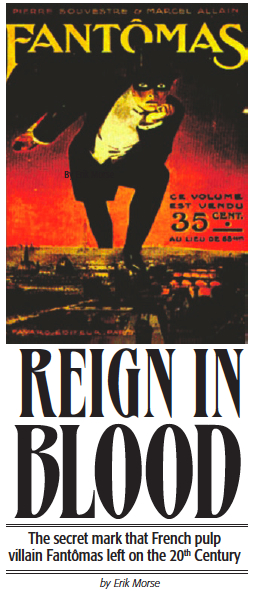
REIGN IN BLOOD
The secret mark that French pulp villain Fantômas left on the Twentieth Century
By Erik Morse
Art direction by Mark Frohman and Molly Frances
Originally published in Arthur No. 28 (March, 2008)
Early in 1911 popular French publishing house Fayard released the first of 32 monthly serial novels of Marcel Allain and Pierre Souvestre’s Fantômas. Subtitled ‘A Shadow on the Guillotine,’ this ultra-violent pulp tale recounted the exploits of the eponymous master villain as he reined blood and magick upon the boulevards of Paris. Pursued by police inspector, Juve, and his journalist sidekick, Jerome Fandor, Fantômas slaughters members of French high-society indiscriminately before stealing away with their wealth and, often, their very identities—in his travels between the Dordogne and Paris, Fantômas dispatches the Marquise de Langrune, her steward Dollon, Lord Beltham, Princess Sonia Danidoff, the famed actor Valgrand and a passenger liner full of travelers en route to South America. When Fantômas, alias Etienne Rambert, alias Gurn, is apprehended by Juve at Lady Beltham’s villa, he is brought to trial at the Palais de Justice, found guilty of murder and condemned to the guillotine. However with the aid of his mistress, Fantômas steals away from his Santé prison cell and fills the vacancy with an unsuspecting look-a-like who is left to the blade. When Juve discovers the ruse, he proclaims, “Curses! Fantômas has escaped! Fantômas is free! He had an innocent man executed in his place! Fantômas! I tell you, Fantômas is alive.”
Within months of its February debut, the Fantômas serial became a pop smash with the reading public, profiting no doubt from the French public’s unquenchable thirst for violence, mayhem and pulp. At 65 centimes a copy, sales for each volume reached easily into the hundreds of thousands. American poet and Fantômas enthusiast John Ashbery contends that the real success of the serial was its transcendence of class, education and sex, from “Countesses and concierges: poets and proletarians; cubists, nascent Dadaists, soon-to-surrealists. Everyone who could read, and even those who could not, shivered at posters of a masked man in impeccable evening clothes, dagger in hand, looming over Paris like a somber Gulliver, contemplating hideous misdeeds from which no citizen was safe.” Such was the popular reaction to the Fayard publication, Marcel Allain would later recall, with some hyperbole, “The adventures of Fantômas have surpassed those of the Bible.”
Nearly a hundred years later, we can see the frightening metastasis of the master of crime’s “brand”—from his beginnings amongst the Right Bank sophisticates who released him upon the world, to the marauding gangs plundering and murdering in his name, to the sacrificial cults who would congregate at the witching hour to reenact his sins. His trangressions—bold, fiendish and inexplicable—were the narratives of nightmares. Fantômas captured the imagination of his admirers and extended his influence through the artistic genealogies of Europe, leaving a catechism of excess, debauchery and violence to a brood as varied as Pablo Picasso, Andre Breton, Jean Cocteau, Georges Bataille, Alain Robbe-Grillet, James Joyce, Guillaume Apollinaire, Robert Desnos, Jean Marais, Alain Resnais, René Magritte, Francois Truffaut; and the Mike Patton-Buzz Osbourne-Trevor Dunn-Dave Lombardo art-rock superband of the same name. In their major contributions to the century, the words and deeds of France’s supreme villain pullulate still more revolutionary achievements and still darker crimes.
Here, in this extended fait-diver, is the unedited, uncensored and untold history of the criminal of the century.
Continue readingD.I.Y. MAGIC book by Anthony Alvarado
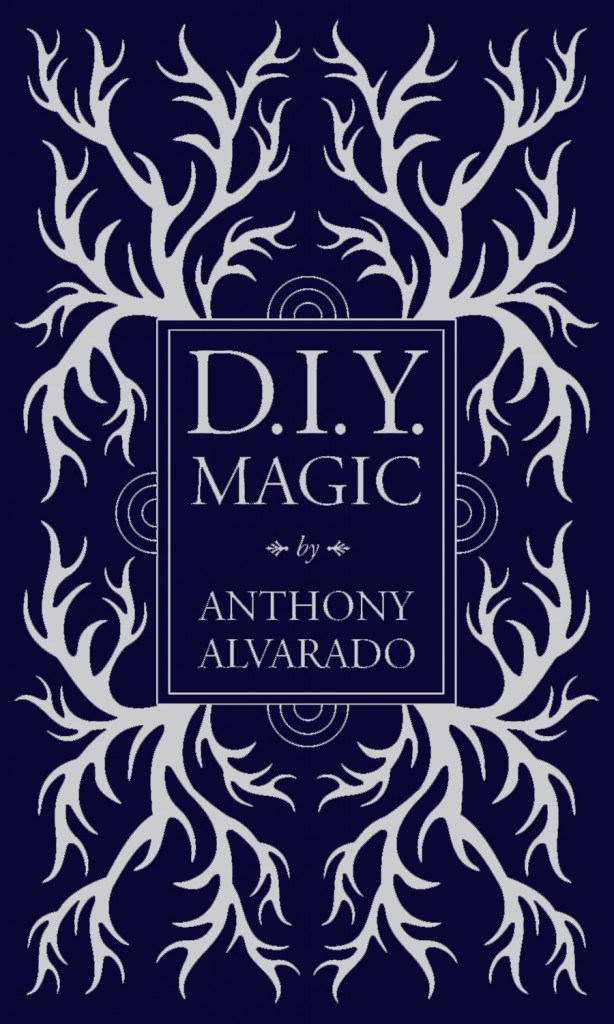
D.I.Y. MAGIC by Anthony Alvarado
40 b&w illustrations, cover design by Lord Breaulove Swells Whimsy
First edition letterpress silver foil cover limited to 1000 copies, 176 pages, 5″ x 8″, $13.95
Shipping $5.30 US, $11 INTL, $8 CANADA
Now available to order
What is magic? It is the fine and subtle art of driving yourself insane! No really, it is just that. It is a con game you play on your own brain. It is the trick of letting yourself go crazy, and when it’s done right, the magus treads the same sacred and profane ground where walks the madman…
We can read descriptions of myths, of the practices of shamans, but the descriptions we might read by a Pentecostal believer, or a voodoo practitioner ridden by the loa, will be meaningless to us unless we have already been in the state they describe. These are wholly subjective experiences.
If you take these many practices, from across countless fields, cultures, religions, modes of being and systems of ritual (hypnosis, song and dance, duende, speaking in tongues, enchantment, faith healing, divination, out of body experience, sweat lodges, drumming, yoga, drugs, fever and on and on), we find that we are really talking about the same thing: a state where the mind lets go of the normal way of being and is opened up to an experience of existence as a whole that is bigger and without time. These states are all really different forms of the same thing, or if not the precisely the same thing, then near and adjacent territories in a realm that lies parallel to this one, reachable by many means.
In short, rather than advertise this as a book of magick, it could just as well have been labeled a book of psychology hacking. Or a cookbook. Think of it as jail-breaking the iPhone of your mind. Teaching it to do things that its basic programming was never set up for. Advanced self-psychology.
Featuring over 40 b&w illustrations by: Lala Albert, Farel Dalrymple, Ines Estrada, Maureen Gubia, Kevin Hooyman, Dunja Jankovic, Aidan Koch, Jesse Moynihan, Luke Ramsey, Ron Rege Jr. & more!
“What makes this book vastly different from many other books on magic is that there’s no doubt in my mind that the author has actually done the things that he says he has. What’s more is that he has derived a great deal of pleasure and meaningful experience from the doing. And, so will you.” – Aaron Gach, Center For Tactical Magic
“Anthony Alvarado has concocted a cookbook for vivid living: poetry that’s lived rather than written. His “spells” are actually practical suggestions by which the reader may coax the extraordinary from the everyday—and from themselves.” – Lord Breaulove Swells Whimsy, author of The Affected Provincial’s Companion
“Few books are as immediately useful as this delightful, inspirational tips ‘n’ tricks tome. I’m having a backyard betel nut party in five minutes and everyone’s invited!” -Jay Babcock, editor of Arthur Magazine
Read some of the original articles on Arthur Magazine that inspired this book: http://www.arthurmag.com/contributors/diy-magic-by-anthony-alvarado/
Thanks for all the poetry.

I want to thank all the wonderful poets who allowed us to post their poetry on Arthur while I was the Poetics Editor. I had a wonderful time reading the work and comments and helping bring a poetic flavor to the content posted here. Many people asked me how I was chosen for this position and I tell them it was my resume. When asked to provide more color I refer them to my resume which I’ve posted here.
Thanks to everyone for a great ride into the world of Arthur poetry.
Travis Catsull
Continue readingEDDIE DEAN: Recently Discovered Musical and Sundry Delights (Arthur, 2008)
Originally published in Arthur No. 30 (July 2008)

Recently Discovered Musical and Sundry Delights
By Eddie Dean
Chango Spasiuk, free concert at the Millennium Stage, Kennedy Center
“I refuse to look like an old woman knitting,” said tango great Astor Piazolla, who broke tradition by always playing his bandoneon while standing. And here’s Chango Spasiuk, another Argentinian bandoneon master, sitting in a chair onstage with his instrument slinking over his knees draped with—a QUILT. But the wild-eyed, long-haired son of Ukrainian immigrants by way of Misiones province looks more like Rasputin than a knitter, like he’s ready to ambush the black-tie Bushcovites gathering down the red-carpeted Hall of Nations at another gala benefit for the masters of war. This isn’t the city music of Piazzolla. This is chamame, a down-home country music like the kind you’d hear at a backwoods wedding in northern Argentina when everybody’s had too much vino tinto and a summer storm’s brewing and the bride and groom have fled the scene. Spasiuk’s chamame has his own touches, a Marc Chagall-fiddler and “cajon peruano” percussionist. His bandoneon is a magic box that breathes, stirring the stilted, conditioned air inside the Kennedy Center, as the chandeliers weep and even the ushers prick up their ears, while outside the Potomac River turns into the coffee-hued, snaking Rio Parana. After the show, Spasiuk talks about his influences: “My father was a carpenter and musician who played at local dances and parties, and my uncle was a singer. I grew up listening to the music from the region of the rivers, the folk music, the polkas and the shotis, and chamame is the strongest color of this mestizo music. I didn’t become a musician after I saw or heard music being played on TV or in a movie or on a stage. Music was everywhere, in every social situation. My music is an utterly happy music but at the same time melancholic and sad.” His favorite musician, he says, is Beethoven.
Magnificent Fiend, Howlin Rain (Birdman/American, 2008)
The Black Crowes have been trying to make a record this good for 20 years, and these young bucks nail it right out of the shoot. Horns of plenty, and heaping helpings from the bottomless well of deep groove. As Greg Allman sang, “The road goes on forever.”
Country Music Originals: The Legends and the Lost by Tony Russell (Oxford Press, 2007)
You’ve already heard about Jimmie Rodgers and the Carter Family, now meet their kinfolk, the thousand-and-one tongues of pre-Nash Trash hillbilly music: Seven Foot Dill and his Dill Pickles, South Georgia Highballers, Bascam Lamar Lunsford, Red Fox Chasers, Dr. Smith’s Champion Hoss Hair Pullers. They’re all here looking alive as you and me. Old-time music fiend Tony Russell came from England to travel the dusty backroads and knock on many a screen door to find the stories behind the mysterious names emblazoned on the old 78s. The meaty bios are salted with rare photos and period illustrations, such as a Depression-Era newspaper ad for a $3.85 Disston Hand Saw (“Mirror polish, striped back, beautifully etched, Applewood handle, fully carved”) of the sort played by Highballer Albert Eldridge, whose expert bowing “produced a sweet otherworldly humming that anticipates the oscillating electronic sounds of the Theremin.” Seems like it’s always Brits like Russell and Dickens and D.H. Lawrence with the keenest insights into the old, weird America.
Death Comes for the Archbishop by Willa Cather (Vintage, 1990)
Before Sam Peckinpah and Cormac McCarthy, the Spanish-American Southwest had Willa Cather to make an epic of its bleak and beautiful landscape. Instead of horse rustlers and outlaws, the male-bonding celebrated in this novel is the friendship between a pair of French Catholic priests out to save souls in mid-19th-century New Mexico. They’re not just packing Bibles and rosary beads, though, they’re packing heat: “‘You dare go into my stable, you [blank] priest.’ The Bishop drew his pistol: ‘No profanity, Senor. We want nothing from you but to get away from your uncivil tongue.’” Gimme that old-time religion, it’s good enough for me.
The U.S. Navy Band Brass Quartet show at Rockville Town Center
Good to hear the tuba out in the open. A century ago, it was the original Miami Bass, and it can still get to the bottom like nothing else. Except Bootsy.
BLACK HOLE WHITE MAGIC by Chris Ziegler (Arthur, 2006)
Originally published in Arthur No. 25 (Winter 2006)

White Magic: Meanwhile, outside the city gates…
Black Hole White Magic
By Chris Ziegler
Reviewed:
Sunn O))) & Boris
Altar
(Southern Lord)
White Magic
Dat Rosa Mel Apibus
(Drag City)
I had Altar complete in my head before I ever heard it: Sunn O))) and Boris together to make the heaviest thing ever, an album that would burst cochlear membranes and the confines of three-dimensional spacetime. Modern music’s two most immovable objects: what would happen when they met? Maybe nothing—in fact, hopefully nothing, and Altar would be pure void, a subatomic drone that would go beyond Sunn O))) and Earth and Flood to the low slow B-flat hum NASA heard coming from a black hole around the same time Sunn O)))’s White 1 came out. “A million billion times lower than the lowest sound audible to the human ear!” NASA said, complete with exclamation point. That was the true sound of the universe, and if any humans could play along, well, here they were: two bands with discographies so colossal that you couldn’t deploy anything less than three syllables per adjective without feeling cheap and weak. (Cyclopean? Titanic? Hephaestean?) NASA called this new science “black hole acoustics” and that was the best explanation yet—better than the New York Times’ cutesy ‘heady metal,’ anyway.
But Altar is the un-heaviest. Six or seven minutes into opener “Etna” (played in the spirit of the volcano that will devour Sicily) presents the riff-vs.-drone grappling match the collaboration demanded, and it is satisfactorily hephaestean. Last year’s Black One and Pink anticipate these moments—Pink’s intro “Parting” especially, though Boris drummer Atsuo rarely pushes a straight 4/4 rock beat, instead mating drums to drone with a rush/recede dynamic that must have cheered the Coltrane students in Sunn O))). Black hole acoustics is science for space and gravity and not amplifier athleticism, though, so credit to Boris and Sunn O))) for Altar’s sidewise moves. Sunn O))) provokes orgasm and Boris melts minds—we know that and so do they, so let’s improv something else.
“Sinking Belle (Blue Sheep)” is probably the songiest thing to ever bear a Sunn O))) stamp; Internet drones are straight-facedly calling it “folk pop” and while that’s a bit broad, it’s … understandable. Earth’s Hex had passages of twilight-zone quiet and “Sinking Belle” collects them together: reverbed piano that blooms and dissolves like ink into water with Jesse Sykes (singer from Seattle’s Sweet Hereafter) sounding like Nico at her frowniest, or actually sounding a lot like Sybille Baier, another dissipated ‘60s teuton-chanteuse. After that is “Akuma No Kuma,” an all-synth-no-guitar track (with Joe Preston growling through a vocoder) that fits the fire-and-fog Blade Runner opening, and after that the desolate “Fried Eagle Mind,” a wave of tube tone washing over Boris guitarist Wata’s ghost vocals. “Blood Swamp” has to float back home: rumble finally turns to roar as Soundgarden’s Kim Thayil gets a guitar to sound like something that breathes mud—or blood?—to stay alive. A hephaestean finale, sure, but not the truncated concussion both bands favor. There is clear-to-cloudy precedent for everything on Altar in the million billion minutes of discography belonging to Boris and Sunn O))), but it’s softness as much as the UNNNNNNNNNNNNNNNNNworgworgUNNNNNNNNNN we’ve known and absorbed. Three songs into Altar, the album start to float. Heavy is light.
* * *
I would hate to just bluntly ask White Magic if they actually believe in magic—too obvious, too impolite. But even a lump like me can tell that Mira Billotte’s songs about trees and wine and sun and sea refer to more than just a holiday fit for Fairport Convention. White Magic sings one thing and secretly means another, or several secret other things aligned in symbolic harmony. The band put a labyrinth on the back cover where they could have put a map. So I can’t say I wasn’t warned.
Billotte and a new set of supporters—including partner Douglas Shaw, Jim White from Dirty Three, Tim DeWit from Gang Gang Dance and noted New York percussionist Tim Barnes—built White Magic’s first full-length Dat Rosa Mel Apibus around her famously agile voice and the cascading piano melodies she plays to match Bert Jansch’s precision fingerpicking. Rosa is gentle on solemn guitar-and-voice songs like “Katie Cruel” (also covered by probable White Magic inspiration Karen Dalton) and “What I See,” but spins into psychedelic experiment like the sitar raga on “All The World Went” and the dub/reggae arrangement (and production!) for finale “Song of Solomon,” which is almost an Althea and Donna song until the accordion starts pumping toward climax. That’s a dizzy finish to a record that begins with a single piano note, and a happy release for the ideas half-hatched on 2004’s Through The Sun Door EP.
Billotte’s voice is (as always) a bird in flight, and she writes lyrics in careful camouflage, packing love songs and lonely songs with loaded notions of sleep and night and sun and light. It’s potent imagery that just begs projection from the listener. One verse of “Hold Your Hand In The Dark” and I was convinced we’d read the same Philip K. Dick essay: he said, “Sleepers awake!” and she sings, “You’ve been sleeping well, my friends/sleeping well/but if you wake, it may be too late.” Her tense mention of hands in chains and waiting in secret are from a particular idea Dick had about … well, too much of this might put this review to sleep. Different listeners discover different things.
Maybe that means Billotte is just writing easy absolutes—like everyone else, she loves love and dislikes… chains? But of course not. That seven-petaled rose on the cover is too close a copy of a Rosicrucian engraving; the translated title “the rose gives the bees honey” was a line used by alchemists to distinguish the search for spiritual truth from the search for worldly gain, and on Rosa’s second song Billotte sings, “Gone was our need for the things of this world/all we had was love.” Rosa feels full of these century-to-century connections. Hidden in this post-Pentangle piano-psych record is something ferociously righteous. White Magic believes in good research.
“A Better Way to Cool Off” by Molly Frances (Arthur, 2006)
Originally published in Arthur No. 23 (July 2006)

The New Herbalist
By Molly Frances
“A Better Way to Cool Off”
As spring fever’s eager blossoming inevitably withers into the summertime blues, we seek quick relief among the abundance of icy blended concoctions that our advanced civilization offers us. Unfortunately, though that iced coffee provides a momentary respite on a balmy day, it will also quickly return you to a state of dehydration and turn up the heat of your internal thermostat.
The ingredient for the most soothing and refreshing of summer drinks is probably already growing in your garden. For a deeply cooling drink, brew up a tasty pot of mint tea.
A handful of the fresh herb plucked from your garden and tossed into a carafe of hot water will have you living the good life in no time at all. Be sure to include the stems of the plant. This tea may be served cold as well, but resist the temptation of pulling out your blender. Frozen drinks and ice cream will hold heat in your body and freeze digestion. To really keep extra cool this summer, avoid your freezer and enjoy your summer beverages without ice.
For a truly sublime experience, serve your friends a pot of Atay bi Na’na’. Made from boiling water, fresh mint, a small amount of green tea and honey to taste, Morocco’s most popular drink is consumed all day long. Usually served in ornate silver pots and small decorated glasses, it is customary for three servings to be offered by the host, who pours the tea from a distance of up to several feet above to aerate the brew and show off his skills. Practice this before the guests arrive.
In addition to its cooling properties, Mint tea settles the stomach and digestive disorders, eases migraines, and helps draw out infection upon first signs of a sore throat. The powerful antiviral properties of peppermint are due to its main active ingredient, menthol oil, which opens and heals sinuses, bronchial tubes, and vocal chords. It is also said to create a mentally stimulating and relaxing vibration that reduces stress and anxiety.
So what have we done to deserve this magical leaf? As the legend goes, Hades, god of the underworld, was busted by his wife Persephone in mid-frolic with a hot young wood nymph named Mintha. Persephone, who had been somewhat rudely snatched down to the underworld by Hades in the first place, was in no mood to overlook this infidelity and stomped the little nymph underfoot, transforming her into the plant we know today as Mint. In a gesture of atonement to Mintha, Hades would endow the plant with its sweet and unmistakable aroma.
Persephone may have extinguished Mintha in the flesh, but her spirit has lived on in this most promiscuous of plants. There are few lands that the wildly propagating mint has not traveled to, and few cultures that she has not seduced. As 16th century herbalist John Gerard declared, “The smelle rejoiceth the heart of man.” From Egyptian temples to Roman baths, Mint has been used for all varieties of healing and pleasure. The Pharisees even paid their taxes with it, as revealed by this scolding from Jesus: “Woe to you, Pharisees! You tithe mint and rue and every edible herb but disregard justice and the love of God.” Ouch!
While perhaps more prized for its pleasure-inducing than medicinal properties, the mint julep has been the preferred drink of the Southern Aristocracy. Accept nothing less than fresh mint, water, sugar, and Kentucky bourbon. As one of its key proponents, S.B. Buckner, Jr. warned in 1937: “A mint julep…is a ceremony… a rite that must not be entrusted to a novice, a statistician, nor a Yankee.” He instructs, “Go to a spring where cool, crystal-clear water bubbles from under a bank of dew-washed ferns. In a consecrated vessel, dip up a little water at the source. Follow the stream through its banks of green moss and wildflowers until it broadens and trickles through beds of mint growing in aromatic profusion and waving softly in the summer breezes. Gather the sweetest and tenderest shoots and gently carry them home.”
As Mintha clearly gets around, she has crossbred into hundreds of varieties including chocolate mint, basil mint, ginger mint, Persian mint, Corsican mint and Pineapple mint. All this intermingling frustrated one ninth-century monk, who declared, ” I would rather count the sparks in Vulcan’s furnace than count the varieties of mint.” The most popular forms are spearmint and peppermint, the former most often used in cooking but the latter more medicinally potent.
As Buckner proclaimed, “bury your nose in the mint, inhale a deep breath of its fragrance and sip the nectar of the gods.”
BAD GUYS: JOHN PATTERSON on “The Road to Guantanamo” (Arthur, 2006)
Originally published in Arthur No. 23 (July 2006)
Bad Guys
The Road to Guantanamo is a thoroughgoing demolition of the lies and unlimited incompetence of Powell, Bush and Rumsfeld says John Patterson
“We are Americans. We don’t abuse people who are in our care.” Thus spake Gen. Colin Powell in reference to the United States’ grotesque and immoral confinement of “unlawful combatants” at Guantanamo Bay in Cuba. Those remarks would have been news to the prisoners who committed suicide there recently, but also to the three kidnapped and incarcerated young Britons of Pakistani descent known as the Tipton Three—if they’d had access to news of any sort at Gitmo. It turns out that, having also been deprived of access to lawyers, the Red Cross or even their own families, the Tipton Three knew as little of the outside world for two-and-a-half years as the outside world knew of the goings-on inside Guantanamo’s gruesome Camp Delta.
Not any more. Thanks to co-directors Michael Winterbottom (24-Hour Party People, In This World) and Mat Whitecross, the Guantanamo genie is forever out of its bottle. Using interviews with the three men, who were finally released from Gitmo in March 2004, interspliced with harrowingly persuasive recreations of their journey to Guantanamo via Pakistan and Afghanistan, and of their terrifying experiences in US military custody, The Road To Guantanamo constitutes the first corroborated witness account of America’s Gulag to stand a chance of being widely seen in the United States, whose populace has hitherto seemed disturbingly content to snore its way through the progressive dismantling of its Constitution.
The shattering experiences of Ruhal Ahmed, Asif Iqbal and Shafiq Rusal – which included being abducted by Afghanistan˙s Northern Alliance and sold to US Forces as Taliban members (for a cool $10,000-per-head bounty—this is where our money is going?), solitary confinement, torture, 5-on-1 beatings, hoods, shackles, blinders, sensory deprivation and being witness to extrajudicial murders—make for a thoroughgoing demolition of the lies of Powell, Bush and Rumsfeld. American viewers, long accustomed to our child president˙s characterization of Gitmo inmates as “bad guys,” may find themselves asking how their own military could be so fascistic, so cruel and, most dispiriting of all, so fucking stupid.
Named for the West Midlands town where they grew up, the three young men flew to Pakistan, the home of their parents, to attend the wedding of one of their number, but also to enjoy a holiday in their land of origin, in the aftermath of 9/11. Foolishly, they took a side-trip into Afghanistan, where they were caught up in the US bombing of Taliban bases and cities, and then captured in the confused retreat from Kunduz.
Accused of consorting with Bin Laden and the Taliban, the Three in fact had watertight, easily verified alibis. Two of them were—and how hard is it to check this out?—on police probation in Tipton for petty criminal acts, the other had a full-time job. That wasn’t enough for their captors, gut-wrenching proof that American military xenophobia extends not merely to hated enemies, but also to valued allies. Unlawful combatants: meet unlimited incompetence.
The imagery confronting us in The Road to Guantanamo suggests that the United States has abandoned its sanctimoniously proclaimed fealty to such secular gods as Jefferson, Madison and Hamilton, only to replace them with Orwell, Kafka and Koestler. Two years of nonstop torture, interrogation and physical abuse—stress-holds, strobelights, earsplitting death-metal, enforced silence, isolation cells —strongly recall Gestapo or KGB information-gathering techniques, Room 101, Darkness at Noon. All that is lacking are electrodes, waterboards and clocks striking 13. And Big Brother? He’s already here. Learn to love Him.
AT HOME, AT WORK, AT PLAY: A listener’s guide to Sparks’ first 20 albums by Ned Raggett (Arthur, 2008)

Originally published in Arthur No. 29 (May 2008) (which also featured a lengthy interview with the Maels)
At Home, At Work, At Play
A listener’s guide to Sparks’ first 20 albums by Ned Raggett
There aren’t many recording artists in their fourth decade of recorded work whose new albums consistently merit not only attention but, more often than not, a round of applause. But Sparks were an unusual band from the start, so perhaps, perversely, their virtually unprecedented no-fade career arc is to be expected. The full story of the musical partnership of brothers Ron and Russell Mael is worthy of a thick book or two (or at least a really good documentary), but the basic body of their musical work—20 studio albums preceding their newest, the forthcoming Exotic Creatures of the Deep—can at least be talked about here. Not all are front-to-back classics, some may not even be keepers, but the standard of excellence is so high, the continuous artistic risk-taking so audacious, and the number and range of artists they’ve inspired in the last 35 years so vast—from Queen to Morrissey to Pet Shop Boys to Faith No More to Bjork to Franz Ferdinand—that even the rare misstep deserves examination. Onward, then…
SPARKS (1972)
Though L.A. performances and a number of demos helped get the initial word out about their distinctly unusual take on pop and rock—the demos still for the most part unreleased, though noted Sparks freak Morrissey has showcased a couple here and there over the years via compilations and show intro tapes—it was the self-titled debut album that first brought the Maels and company into the public eye.
Getting Todd Rundgren as producer was key. Probably no one else in America had both the relatively high profile to get the recording ball rolling and the artistic appreciation for the curious yet compellingly catchy pop the Maels and their band were creating. Balanced between a whimsical fragility and a dramatic rock punch that stacks up to any proto-metal group of the era, it’s not merely the tension between the sides that makes Sparks’ first album so memorable, it’s the fact that it’s so instantly enjoyable.
If, as the story goes, opening track “Wonder Girl” was a hit in Montgomery Alabama and nowhere else, it wasn’t because it couldn’t be hummed. It can. The band’s whole approach can be heard in this single song: the intentional use of a cliché in the title, Russell’s sweet-with-a-twist-of-sour singing (then and now, one of the most uniquely beautiful vocals in modern pop), Ron’s sprightly keyboards and lyrics which are sunny only if you’re not listening closely. But it’s also a tour de force of production—listen to the crisp hits of Harvey Feinstein’s cymbals and the almost electronic smack of the beats. On the rest of Sparks, songs change tempo on a dime, harmonies swirl in and out of nowhere, strutting rock snarling melts into boulevardier swing, with the monstrous album closer “(No More) Mr. Nice Guys” rocking just as hard as the similarly-titled song by Alice Cooper that it predates. The sense of theatricality so integral to Sparks is already present, but this is as far away from the inanities of such ‘rock’ Broadway efforts as Rent as you can get—and thank heavens for it. The whole shebang really is art rock without apology.
Note: This album was released under the original band name of Halfnelson, with the brothers then switching to Sparks after the prompting of their then-manager/label head Albert Grossman, who was convinced this was the key to success. There have been stranger solutions.
A WOOFER IN TWEETER’S CLOTHING (1973)
In some ways A Woofer in Tweeter’s Clothing is the first album redux. Unchanged lineup, same number of songs, and the first song on the album is, again, about a girl. But this time the stakes were a little higher:
Oh, no! Bring her home and the folks look ill
My word, they can’t forget, they never will
They can hear the stormtroops on our lawn
When I show her in…
Imagine that being sung by Russell with an almost sweetly diffident air over a chugging rhythm, with a chorus that soars down to the backing pseudo-Col. Bogey whistles and you’ve got “Girl From Germany,” one of the wickedest songs ever. From there Woofer’s could do whatever it damn well pleased, and did. Beergarden polka singalongs crossed with minimal drones that transmute into a rapid roll of drums, frenetic high-speed instrumentation and a mock Mickey Mouse-style letter-by-letter cheerleader/gangshout for the titular character, “Beaver O’Lindy.” A tune called “The Louvre” sung, but of course, in French, sounding—at least initially—like a random 1968 Beach Boys number drop-kicked across the Atlantic, trailing sparkling keyboards in its wake. A concluding song, “Whippings and Apologies,” begins like Stereolab warming up for a 20-minute freakout and then keeps stop-starting—including a great fake ending —so Russell can discuss the situations a tender-hearted sadist must face. “Do-Re-Mi”—yes, THAT “Do-Re-Mi,” from The Sound of Music, not one of the lyrics changed, turns into a high-speed gallop halfway through the second repetition of the words and gets even more over the top after that point. Nearly the whole album is so insanely fractured, and once again, so astonishingly catchy, that it’s hard to know what to highlight.
At the heart of the album lies “Moon Over Kentucky,” the only song bassist Jim Mankey wrote for the band (with Ron sharing the credit), and arguably the landmark of the first incarnation of Sparks. It’s all five members at their most dramatic, with the opening piano and wordless vocals given a steady, darker counterpoint with Mankey’s bass. This gets contrasted with verses shot through with a nervous keyboard rhythm, Feinstein’s rolling drums and a snarling riff that sounds like a Tony Iommi line delivered in two seconds. Russell yodels like a lost ghost somewhere in the woods and the end result feels like what Nelson Eddy and Jeanette Macdonald would have done if James Whale had directed one of their films, down to the horror-movie organ final flourish.
KIMONO MY HOUSE (1974)
What to say about an album that endless amounts of musicians openly refer to as a touchstone? The one that was Bjork’s first record she bought with her own money (“My mum and my stepdad didn’t like it and I did, so that was my statement.”), the album that turned Morrissey into the massive fan he is (“Ron Mael’s lyrical take on sex cries out like prison cell carvings. It is only the laughing that stops the crying. Russell sings his words in what appear to be French italics, and has less facial hair than Josephine Baker.”), the album with the cabaret-rock-opera sound that Queen, who were opening for Sparks at the time, would appropriate immediately? Where to begin? Easy—the beginning.
It starts, not like a thunderclap, but like a gentle shimmer of spring rain, a keyboard figure easing up in volume step by step. Then a voice zooms in, almost but never once tripping over itself at high speed, building up to the briefest pause, and then: “This town ain’t big enough for both of us!” A massive pistol shot rockets across the speaker range. “AND IT AIN’T ME WHO’S GONNA LEAVE!” The full band kicks in and it is all OVER. And it’s only just begun.
Kimono My House shouldn’t have been; had Ron and Russell decided not to take the chance they did in moving to London and signing to Island Records after initial UK appearances before the release of Woofer turned out splendidly, it wouldn’t have been. They did, and “This Town Ain’t Big Enough For Both of Us” crashed into the UK Top Five in early 1974 and what had been a low-key pleasure for some turned into pop star mania. Tales of suicides happily singing down to girlfriends in the still-living world, celebrations of the most exclusive genealogical background ever (concluding with “Gonna hang myself from my family tree”) and specifically uncelebratory non-holiday carols were suddenly all the rage. The lunatics hadn’t taken over the asylum, but their observers were genii at portraying their foibles in entertaining form.
The new backing band—guitarist Adrian Fisher, bassist Martin Gordon and drummer Dinky Diamond—weren’t necessarily as outré as the first, but as a crackerjack combo, perfectly in tune with the over-the-top glam hysteria of the day, they were essential. “This Town” is just one example of many songs displaying Ron’s ever-increasing compositional talents—consider other smash U.K. singles like “Amateur Hour,” with its quick, ascending main guitar line completely working against the typical descending rock melodies of the time and place, or “Talent Is an Asset,” a music-box riff accompanied by hand-clapping and foot-stomping rhythms celebrating the young life of one Albert Einstein. If Ron’s keyboards often times seemed drowned in the mix of the songs that he himself wrote, they weren’t absent—the organ adding further beef to the mix of “Here in Heaven,” the combination barrelhouse R&B swing and cabaret glow on the concluding “Equator.” Perhaps the album’s most emblematic song was “Hasta Manana, Monsieur,” with its lovely piano melody at the start and Russell’s bravura extended vocal break towards the end … oh, and the words too:
Leaving my syntax back at school
I was thrown for a loss over gender and simple rules
You mentioned Kant and I was shocked
You know, where I come from, none of the girls have such foul tongues.
And that was just one verse.
PROPAGANDA (1974)
Propaganda—featuring the band’s first outright classic album cover, showing the Maels as bound and gagged kidnap victims—was a logical follow-on from Kimono, much as Woofer’s had continued onward from the debut. The producer remained the same. The backing band jiggled a bit, with Ian Hampton replacing Martin Gordon on bass and Trevor White starting to handle the guitar. (Queen’s Brian May alleges the Maels tried to persuade him to join them by proclaiming his band were “washed up”—which makes that group’s Sparks-like breakthrough hit “Killer Queen” all the more eyebrow-raising.) Otherwise Sparks kept up the same glam-rampage approach. But here, everything was more in sync then ever.
The album begins with something new—an a cappela performance from Russell, his overdubbed singing providing wordless melody and rhythm as well as words, packing wartime slogans, militaristic imagery and that thing called love into about 20 seconds. Then a stentorian delivery from the full band heralds “At Home At Work At Play,” whose combination of volume, giddiness, hyperspeed melodies and Sparks-trademarked tempo shifts and pauses is clear evidence that by this time Sparks had come pretty close to being sui generis. Even songs like “BC,” which on this album feels just a touch like a “typical” Sparks number, would be utterly atypical for practically anyone else.
There’s a winsome jauntiness on Propaganda at points, musically if not necessarily lyrically, almost as if Ron and Russell were creating World War II vaudeville singalongs for their temporarily adopted home country. “Reinforcements,” playing around again with ideas of love and/as war, almost begs a high-kicking chorus line to back Russell on stage. In a different vein entirely is a power ballad of the most arch sort, “Never Turn Your Back On Mother Earth,” which has it all: strings, heroic guitar solo, a lot of background echo (check out the drums at the end!), Ron on what must be harpsichord, and a beautifully alien mid-song break where Russell sings in fragile tones over heavily flanged violins. On the lyrical front, Ron’s eye for the knowing cliché in the title again reigned supreme—besides “At Home At Work At Play,” we get “Thanks But No Thanks,” “Something For the Girl With Everything” and the concluding “Bon Voyage.” And then there’s “Achoo,” probably the only song in existence with a sneeze as its title. And even if it isn’t, it’s definitely the only one that starts, “Who knows what the wind’s gonna bring when the invalids sing.”
INDISCREET (1975)
Indiscreet ended up being the conclusion of Ron and Russell’s first run of hit UK albums, as well as their English residency. If nothing else, they wrapped it up in style, working with an emblematic producer of the era—fellow US expatriate Tony Visconti, whose collaborations with T. Rex and David Bowie helped define the times as much as anything. It turned out to be an inspired combination as Visconti’s ear for orchestral arrangements, familiar from T. Rex’s many singles, was in top form. The result is a rich sounding album, a big-budget effort that doesn’t sound overblown.
The band personnel remains essentially the same from Propaganda, though songs like the opening “Hospitality on Parade”—part neo-Gilbert and Sullivan triumph, part hypnotic proto-Suicide drone—suggest that the Maels were starting to feel that their band was holding them back creatively as much as they were crucial to their success. That tension shoots through the entire album, with more conventional rock-band compositions contrasting sharply to such songs as the merry 1930s kick of “Without Using Hands” or the wonderfully energetic big-band recreation of “Looks, Looks, Looks.” “Under the Table With Her” is that tendency in excelsis, with string and flute accompaniment as the sole musical element to match one of Russell’s most elfin vocals.
That said, the Sparks instinct for pop smashes in their own particular vein remains strong. There’s the careening blast of “Happy Hunting Ground”—the mid-song dropout to just drums and vocals is sheer pleasure and opening single “Get In the Swing” is an everything-and-the-kitchen sink affair with a marching band strut, band majorette whistles, a message from God to his creations and the memorable line “Well I ain’t no Freud, I’m from LA.”
The sleeper hit, though, has to be “Tits”—a thematic sequel of sorts to the previous album’s “Who Don’t Like Kids,” but which, in its slow unfolding musical drama, resembles the epochal “Moon Over Kentucky,” shot full of sequins. For all the celebrations of the female bosom in pop music before and since, this is probably the only one narrated by a married man complaining over an increasing number of “drinks that are something warm and watered down” about how the presence of a kid alters a certain dynamic in their household:
 Arthur Magazine