What can bring us past this knowledge, so that you will never wish our life undone? For if ever you wish it so, then I must wish so too, and lovers yet unborn, whom we are reaching toward with love, will turn to this page, and find it blank.
Welcome to Energy Free-spirited Little Wings tunesmith Kaisle Feeled’s coastal introspection experience. Text and photos by Erik R. Bluhm. Art direction by W. T. Nelson.
Originally published in Arthur Magazine. No. 13.
Malibu, California June 2004—I stumbled into their camp by following a small trail up from the beach. Rows of rocks were laid out in some places like arrows pointing the way. On top of a small bluff it sat, a geometrically-shaped brown paper structure about the size of a delivery van. As I walked up, the paper door was pushed aside and a deeply-tanned young man emerged. I immediately recognized him as Kaisle from the record jackets. He wore sandals, a fringed vest made of the same paper as the tent and no shirt.
“Grow,” he greeted. “Welcome to Energy.”
The two of us sat on a Navajo blanket that was set out on the grass to observe the ocean below. We were joined by two others who Kaisle introduced as Arrak, tall and bearded, and Nice Chichen, an attractive young woman in braids and a mini-poncho.
“I met these two at a folk club north of Morro Bay,” explained Kaisle, slowly tracing an arc in the air between Arrak sitting Indian-style at his side and Nice Chichen who was offering a platter of cold lentils and kelp salad. “They began an intricate interpretive dance as I was performing. Very expressive. We decided to move south together.”
Originally published with photography and design by W.T. Nelson in Arthur No. 18 (Sept. 2005)
They Are Afrirampo Oliver Hall encounters Osaka’s number one freedom paradise rock duo.
When Oni and Pikachu arrived at the Smell in downtown Los Angeles there was nothing about them that suggested the powers they would soon deploy on stage. Certain performers have a way of carrying themselves in venues that tells you not to approach them unless you have something important to say about the sound system or how many drink tickets they get, and Afrirampo, despite looking road-weary, and dressed down in floral prints with naked faces, held themselves with that kind of authority. Not that it stopped (male) fans from approaching the two, or the band from receiving them graciously. But they did not look like the creatures you’d expect to see after reading any of their press: sex demons, noise futurists, musical athletes, punk sibyls who, when asked for their favorite three albums of all time responded, “1. AFRIRAMPO 2.AFRIRAMPO 3. AFRIRAMPO”. . .
young Japanese girls rock duo from Osaka JAPAN! Naked rock!!!!! Naked soul!!! Red red strong red dress!! Freeeeeeeeedam paradice rock! Jump! With improvisation. Sooo fantastic & wild performance!
Afrirampo’s recording career began with A (not to be confused with A’, presumably to be read “A-prime,” a collection of early recordings), a shrieking garage-thrash record with guitar, drums and two girl voices; if the music on this record has any antecedents, it’s the startling moments of weirdness and the playful, conspiratorial spirit of the ealry ‘80s Swiss female punk band Kleenex/LiLiPUT, who, like Afrirampo, enjoyed letting music wreak havoc with familiar vowels. Afrirampo’s latest release, Kore Ga Mayaku Da on John Zorn’s Tzadik Records, is similarly playful but more elaborate and scary, like classical theater. I interviewed them around the corner from the Smell, before they were in costume and makeup; a little over an hour later, their set came to a close with the crowd bearing Pikachu from the stage to the front door as Oni took over the drums and sang Sayonara! Sayonara!
My intention was to interview Afrirampo at the bar behind the Smell on Main, but as we turned from Harlem Alley onto Third Street, Oni exclaimed, “Japanese food!” They had identified something that would relieve their homesickness: a plain burger restaurant with a marquee-style menu behind the counter, sparsely decorated with objects whose strangeness I wouldn’t have noticed if Oni had not been so taken with them.
“I like frogs,” she said, pointing to the giant ceramic vase in the shape of two frogs on the counter. There were plastic pieces of fruit spread out like a rebus on the shelves in one wall and a painting of two ballerinas in a dance studio hung opposite.
“Looks like Japanese,” said Pikachu.
“European,” said Oni. They seem to contradict each other often in conversation in this breezy way, just as one of them will suddenly, frighteningly take over a song in the middle of a performance. When I asked them how music in Japan, especially in their hometown Osaka, is different from music in America, Pikachu frowned, “It’s the same!” “Very different,” said Oni. “Especially in Osaka, like underground scene? Noise? Strong, and also more deep, especially in Osaka, for now. Interesting, more than America.”
Oni seems to love the words “strong” and “deep,” referring, for example, to Keiji Haino, Acid Mothers Temple and the older generation of out Japanese musicians they’ve played with as “deep, deep, crazy old guys.” Despite these connections, Afrirampo does not see itself as a noise band. When I tried to argue that American noise aesthetics have more in common with Japanese noise’s love of pure sound than the conceptual abstractions of European, industrial noise, they seemed to think I am calling them a noise band.
“Not only noise music,” said Oni.
“Actually, not noise music,” said Pikachu.
“Strange music,” said Ono.
“I want to know more about strange music of America,” said Pikachu.
“…Commercialism has completed the destruction of the spirit of devotion to Art, the spirit of real participation in the performance. The public comes to it in search of sensation rather than prepared to experience life as and through Art. The greatest need perhaps of the New Art is a new public; the greatest need of the Artists is a consciousness of their true relationship with their public. The Artist has ceased to consider himself a provider of Spiritual Food, an arouser of dynamic Power; he has ceased to consider his position an ‘office,’ himself as an officiant. He thinks but of expressing himself, but of releasing forces which he cannot handle within himself. Why such releasing? He does not care to consider. He does not face deliberately and willingly his spiritual duty to the Race. Thus he does not attempt to mould the Race, to gather around his work the proper public for this work. He sells his wares. He is no longer a Messenger of life, attracting by the very example of his own living, human beings to the Message of which he is the bearer.” (Dane Rudhyar, 1895-1985)
“So it is almost inevitable that over the next few years, as labor markets struggle, the humanities will continue their long slide. There already has been a nearly 50 percent drop in the portion of liberal arts majors over the past generation, and that trend is bound to accelerate. Once the stars of university life, humanities now play bit roles when prospective students take their college tours. The labs are more glamorous than the libraries.” (David Brooks, New York Times, June 7, 2010)
One Man Goofing: A visit with legendary Zen humorist Henry Jacobs by Joel Rose
Once a week, Henry Jacobs drives to a community center near his house in Marin County, California to play ping-pong with his neighbors. But it’s ping-pong with a twist: Jacobs, a natural righty, insists on playing with his left hand. “I don’t know if I’m as good,” he says. “But I sure have a lot more fun, because I can surprise myself. With my right hand, I never surprise myself.”
The 82-year-old Jacobs has been playing left-handed ping-pong every Monday night for the last seven years. At first, he says, the neighbors were skeptical. But they’ve gradually come around and started playing with their off-hands, too. Jacobs recently started filming interviews with his fellow left-handed ping-pong players for a documentary. “I envision it mainly for the Third World,” he says, and for a second it’s hard to tell whether he’s joking or serious. “The motive is to try to clean up the rather ugly image [of Americans] in the last 50 years or so,” culminating with the present conflict in Iraq. Jacobs says he wants to offer an alternative view of American culture, and ping-pong is the perfect vehicle because of its popularity around the world. “The economics of it are pretty basic. A paddle which you could make out of banana leaf or whatever,” he deadpans. “It’s not about wiping out the planet. It’s about a simple activity called ping-pong.”
Jacobs sees the new documentary—which doesn’t yet have a title—as a kind of sequel to The Fine Art of Goofing Off, the series of animated television programs he worked on in the early 1970s. He says he’s filmed eight or nine interviews so far. Instead of shooting them head on, Jacobs had his subjects invent tasks to perform. (“One guy is fixing an electric lamp. Another guy is diddling around with some paintings.”) The point, says Jacobs, is they’re involved in what they’re doing, even while they’re talking out loud about ping-pong. “They’re not forced keep trying to remember all the points they wanted to make,” says Jacobs. “They can stop talking and get the screw-driver in the right place. It takes the pressure off to constantly be producing something useful and intelligent.”
And of course, “all this will be edited mercilessly. So you’ll only get little pieces of anything.” This, says Jacobs, was point of The Fine Art of Goofing Off: “Never do something so long as to bore someone.”
Originally published in Arthur No. 11 (2004), with photography and art direction by W.T. Nelson…
NOAH’S ART When artist Noah Purifoy died this past March, he left behind a remarkable desert masterwork.
by Kristine McKenna
Noah Purifoy was born in Snow Hill Alabama in 1917. By the time he died this past March in a fire at his home in Joshua Tree, California, he’d traveled many roads and re-invented himself several times.
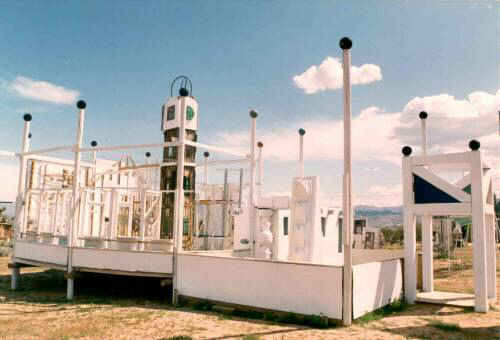
For a Southern black man of Purifoy’s generation, being an artist wasn’t a readily available option, but Purifoy was a man of remarkable vision and patience. It wasn’t until he was 48 years old that he really got rolling as an artist, but by the time he died 38 years later he’d created a body of work of formidable power. Purifoy was a populist artist, a Surrealist, and a sculptor, and his masterpiece is a parcel of land in Joshua Tree which he landscaped with dozens of massive assemblages. Fashioned largely from scavenged materials, this dazzling environment was created without the help of assistants or interns; Purifoy was a lone wolf, and it was his joy to wake before sunrise and work in the early morning hours under an open sky, before the heat of the day settled in.
The tenth in a family of 13 children, Purifoy was the child of farmers who lived in Birmingham from 1920 until 1929, when they resettled in Cleveland. At the age of 22 Purifoy earned a teaching credential, but his teaching career was interrupted by World War II, which prompted him to enlist in the army in 1942. He was stationed in the South Pacific for three years, and after returning from the war, he earned a master’s degree in social work. He then landed a job at the Cuyahoga County Department of Social Services in Cleveland, where he worked from 1950 to 1952.
Purifoy passed through Los Angeles during the war and he’d always had a hankering to return, so in 1952 he relocated to Southern California. He spent the next two years doing social work at an L.A. county hospital, but the work didn’t suit him. In 1954 he enrolled at Chouinard Art Institute, where he earned a degree in 1956, and he spent the next eight years working in various capacities as an interior designer.
In 1964 Purifoy’s interest in civil rights led him to collaborate with musician Judson Powell and educator Sue Welch in the creation of the Watts Towers Art Center, a community outreach program in South-Central L.A. The next year he found himself in the eye of the hurricane of America’s racial conflict when the Watts riots erupted outside his door. It was at this point that Purifoy finally found his voice and sense of purpose as an artist; Purifoy scavenged three tons of material from the ashes of the Watts uprising and used them to create “66 Signs of Neon,” a massive group show of works created from the Watts’ debris that traveled to nine university galleries from 1966 through 1969.
The show was deemed an enormously successful marriage of art and social protest, but Purifoy found the politics of the art world distasteful, and in 1970 he turned his back on art altogether. Seventeen years later Purifoy’s longtime friend, artist Debbie Brewer, offered him permanent lodging on the land she owned in Joshua Tree, and it was then that Purifoy again felt the itch to make things.
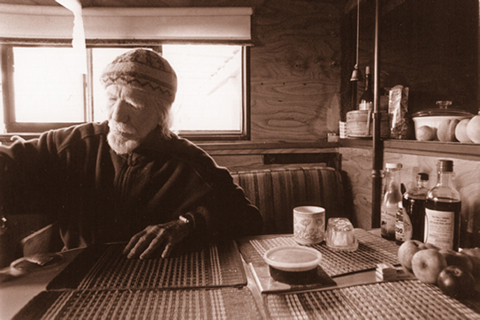
I visited Purifoy at his place in Joshua Tree in August of 1995, and I remember my morning with him fondly. I arrived at sunup and we spent a few hours roaming the land, while Purifoy mused on the marvelous sculptures that seemed to stretch as far as the eye could see. By 10:30 it was time to get out of the sun and we retreated to the seriously air-conditioned mobile home where Purifoy lived. He prepared lunch, which is to say, he removed nearly everything from his refrigerator, set it all on a small card table, and offered it to his guest. He was a generous and gracious host. I assembled a sandwich, he poured himself a glass of wine, and we talked for a while. These are a few things he told me.
CHILDHOOD As a child I wasn’t conscious of racism, but I was aware something was going on. Once, when I was five, my mother was taking me to the store and there was a parade in the street. People had hoods on, and when I asked my mother what was happening she said, “That’s the Ku Klux Klan.”
I had good parents who tried to protect me from the trauma they knew I’d encounter soon enough, and they encouraged me to go to school. So in 1939 I earned a teaching credential—not because I wanted to be a teacher, but because that was the only thing accessible to me then. I majored in history and social studies but never taught either—I ended up teaching shop at a school in Montgomery, Alabama.
FROM SOCIAL WORK INTO ART In the early ‘50s all my friends were social workers and they were horrible people. They thought they owned the earth because they doled out a few dollars to poor people, so one day I just up and quit. Later that same day I was driving and I happened to pass Chouinard Art Institute, and I dropped in and told them I wanted to enroll. This wasn’t something I’d been thinking about – I went in totally on a whim, but they admitted me because I was colored.
I was the worst student in the whole school. I refused to draw, because I felt that I had something and that if I learned to draw I’d be dead because I’d end up making oil paintings, which wasn’t what I was after. I’ve never been satisfied with little things that hang on the wall and I wanted to find my own way in art. I wasn’t making art then but I was posing as an artist. I wore a beret and spent lots of time drinking wine, eating cheese, listening to music and talking to people, and didn’t take any of it too seriously. I was seriously concerned about civil rights though, and I had a dialogue going with some people who shared my feelings about change that had to come.
THE WATTS UPRISING I was in the middle of it but I wasn’t afraid. I thought it was great because it was overdue and it turned out to be a goldmine for me. I collected three tons of debris from the riot and began making art out of it. I was searching for my own idea and had been studying the Dada movement and how it had reversed the whole concept of art, and the debris from the riot is what finally launched me on my own course. From 1965 to ’69 I made lots of work, and I sold it as fast as I could make it. I was also reading philosophy then and was knocked out by [Martin] Heidegger and [Edmund] Husserl. I was looking for methods of problem solving because I had lots of problems, and I was able to alter my behavior because of those two philosophers. They were great thinkers who went into areas most people dare not go.
DROPPING OUT I dropped out of the art world because I was disappointed in art. I perceived art as a tool for change, and when I started the program in Watts I saw art as a potential savior. But the dropout population there increased rather than decreased, and the art I was making started to become formulaic and too easy. I was never interested in earning a lot of money. I wanted art to be a means of answering questions like ‘what is growth?’ ‘What is change?’ Life isn’t worth living unless the individual is pushing to understand more, and art stopped being useful to me in that pursuit.
THE WORK A lot of the stuff I use to make artwork I buy from a recycling place near here and it’s a horrendous cost—I spend a lot of money on materials. In 1994 a local paper ran a story on me, so I also get lots of calls from people who say ‘I’m cleaning out my garage. Why don’t you bring a truck over and take what you want?’
There’s no ecological message behind my use of recycled materials—I use them because that’s what’s available to me. People occasionally comment on how hard it must it must be living out in the desert by myself, but this is a breeze compared to many things I’ve been through. The most difficult period of my life was when I was a young adult. I was raised in the church and as a teenager I found myself in conflict about sex and religion. I gave up religion—and leaving the church didn’t hurt me at all.
DEATH Sometimes I wish I had a savior because I don’t know what happens after death, but I do know I don’t believe in heaven. I recently made a series of works called ‘Desert Tombstones,’ and while I was working on them I thought a lot about death. It’s been said that if you don’t accept death as an equal part of existence you’re in for trouble somewhere down the line. I’d never given much thought to any of this because I thought I’d live forever, but I’ve come to realize that’s not the case. That may have something to do with why I push myself so hard now to finally get the work out that’s always been in me.







 Arthur Magazine