PLAYING TO THE FORGOTTEN: Why Johnny Cash went to Folsom Prison to make a live record, by Michael Streissguth (Arthur, 2004)

Originally published in Arthur No. 12 (September, 2004)…

PLAYING TO THE FORGOTTEN

Why JOHNNY CASH went to Folsom Prison to make a live record, as told by Michael Streissguth. Photography by Jim Marshall

Excerpted from Johnny Cash at Folsom Prison: The Making of a Masterpiece by Michael Streissguth. Copyight © 2004 by Michael Streissguth. Reprinted with permission of Da Capo Press.


You’re starting fresh. We don’t even care what you’ve done. You act like a man here, we treat you like a man. You get stupid with us, we get stupid back. And if you don’t understand what that means, that means if you want to start fighting with us, then we’re going to start fighting back with you. And we’ll kick your ass. 

—Folsom Prison guard to newly-arrived Folsom inmates. 

Although Jimmie Rodgers uttered grizzly murder ballads in the 1920s and dozens of others had before and after him, very few artists of Johnny Cash’s stature recorded hit songs in the 1950s with lyrics as brazenly violent as I shot a man in Reno/Just to watch him die. Nor did any artist sound as if he or she could have pulled off the bloody deed. The Kingston Trio won a country and western Grammy in 1958 for “Tom Dooley,” yet few could imagine the well-scrubbed young men arriving late for dinner, much less stabbing “her with my knife”; and the honey-voiced Jim Reeves scored a hit with the treacherous “Partners” in 1959, but Gentleman Jim was the song’s Voice of God narrator, well distanced from the gory scene in a miner’s cabin. Cash’s gallows baritone, though, suggested that its owner just might gun down a man—even worse, a woman—and enjoy watching him—or her—squirm. 

“Folsom’s” homicidal line and its interpreter’s sawed-off shotgun delivery birthed a half century of myth, convincing many Americans that the rangy, dark-eyed man from Arkansas had done hard time for shooting a man when he had merely stewed in jail a few nights after alcohol and pill binges. But the myth endured. His audiences clung to it and over the years, Cash came to realize that trading on the myth—his tight association with the criminal world—stirred his audience’s imaginations and pocket books. Nobody bought the myth more willingly than prisoners. “After ‘Folsom Prison Blues,’ the prisoners felt kinda like I was one of them,” said Cash. “I’d get letters from them, some asking for me to come and play.” 

Cash and the Tennessee Two first responded to a striped invitation in 1957, agreeing to play Huntsville State Prison in Texas. At the time, nobody with a top ten hit even considered performing inside prison walls, much less reading a prisoner’s letter. But Cash went ahead with the pioneering show, and although nobody remembers any fanfare around the date, they do remember a soggy day, a makeshift stage, shorted electric guitar and amps, Johnny picking and singing with no mic (and no Luther Perkins on guitar), and dozens of happy, happy men. “By doing a prison concert, we were letting inmates know that somewhere out there in the free world was somebody who cared for them as human beings,” said Cash, years later. 

From Huntsville, Cash courted a long-standing relationship with San Quentin State Prison, California’s oldest and one of its most notorious. When Cash first brought his show to San Quentin on New Year’s Day, 1958, a young man in the crowd convicted for a botched robbery attempt glimpsed his own future. Merle Haggard, who’d been sent up in 1957 for a three-year ride, sat spellbound by Luther’s picking and Cash’s showmanship and demeanor: “He was supposed to be there to sing songs, but it seemed like it didn’t matter whether he was able to sing or not. He was just mesmerizing.” The day inspired Haggard, who would know his own extraordinary career in country music. He channeled the gift of country music tradition from Cash that day, just as Cash had inherited it from the Louvin Brothers on the WMPS radio of his childhood and Ernest Tubb and Jimmie Rodgers and others, but Haggard’s recollection of the show also illustrates what Cash was delivering en masse to the prisoners: diversion, inspiration, solidarity. “There was a connection there,” continued Haggard, “an identification. This was somebody singing a song about your personal life. Even the people who weren’t fans of Johnny Cash—it was a mixture of people, all races were fans by the end of the show.” 

Over the next ten years, Cash logged some 30 prison shows, forgoing compensation but developing a hardened anti-prison sentiment. He witnessed the ravages of prison life in his audience, read about them in letters from prisoners, and heard about them from Rev. Floyd Gressett, Cash’s pastor in California, who frequently counseled imprisoned men. An image of life wasted by incarceration, now based on observation rather than a movie, took form in Cash’s mind. 

Continue reading

Peter Relic on the “sound consciousness” of Joe Higgs’ reggae classic, Life of Contradiction (Arthur, 2008)

Contradictory Victory: Bigging Up Joe Higgs’ Reggae Classic “Life Of Contradiction”

by Peter Relic

Posted Apr 3, 2008 on the Arthur blog at Yahoo


The first thing that grabs you is the title: Life Of Contradiction. In the roots reggae world where Rastafarianism ruled, righteousness and preachy absolutism—and even Rasta’s red-gold-green primary color scheme—all seem to insist that there is one true way to do things, one true way that things should be. Thematic subtlety, and the admission of the validity of alternate viewpoints, are pretty thin on the ground (though to be fair, such single-mindedness is one of reggae’s greatest sources of strength).

Simply put, contradiction doesn’t spring to mind when listing the music’s top topics. As a result, Joe Higgs’ 1975 album Life Of Contradiction, newly and impeccably reissued by the ever-attentive Pressure Sounds label, is an LP whose nuanced vision makes it stand out within the pantheon of reggae classics.

Higgs was a music biz veteran by the time he recorded Life Of Contradiction for Chris Blackwell’s Island Records label in 1972 (its release was delayed a further three years until rights reverted to Higgs, who issued himself it in Jamaica and the U.K). As a youth in the early 1960s, Higgs and Roy Wilson formed the r&b duo Higgs & Wilson, voicing numerous hits for Edward Seaga’s WIRL label, including the shining gospel number “The Robe.” The duo went on to record Higgs’ superlative compositions for the likes of Coxsone Dodd and Duke Reid, including “There’s A Reward,” a track Higgs would re-record a decade later for Life Of Contradiction. But in the time-lapse between those two renditions, Higgs made a crucial contribution to Jamaican music, one that sealed his status as a primary architect of the island’s best-loved act.

“The Wailers weren’t singers until I taught them,” Higgs is quoted as saying in Reggae: The Rough Guide, referring to his time mentoring the then-green group in the kitchen of his Trench Town home.

“It took me years to teach Bob Marley what sound consciousness was about, it took me years to teach the Wailers.” The claim could be considered self-aggrandizing were it not for the fact that Higgs alone was qualified to take the place of Bunny Livingston when Bunny preferred chilling in Jamaica to joining the Wailers on a 1972 U.S. tour. And, of course, the splendid evidence of this album.

Continue reading

“There’s More to the Song Than Meets the Ear” by Jay Babcock (Arthur, 2007)

There’s More To The Song Than Meets The Ear

by Jay Babcock

Posted Thu Nov 1, 2007 in Arthur’s blog on Yahoo


“You proved to the world what can happen with a little bit of love and understanding and SOUNDS.” – Jimi Hendrix at Woodstock at the peaceful three-day festival’s close

Following up the earlier post on the subject, a few more reflections on Radiohead’s In Rainbows end run around the existing music industry…

There’s a good case to be made that music is humanity’s oldest form of communication, its earliest artform. For the tens of thousands of years that homo sap has wandered the planet, always in groups, sitting round campfires every night, music has been present only when three things were present: performer, listener and peace. Outside of the solitary performer-listener—call him the Lone Whistler—music was necessarily a social, peaceful activity—an occasional but integral part of the sound of being alive in the world. It was something that even seemed trans-human, in that animals made sounds that sounded like music to us (birdsongs, doghowl choirs, etc). The songs could be old, or new, or both, but they only existed in one moment: the here-and-now. They grounded us with each other.

If this sounds too abstract, try this thought experiment. Imagine if machinery suddenly stopped working—the grid goes down, batteries don’t work, oil’s stopped up. We’re back in the Paleolithic. Where and when would you hear music? You’d only hear it in-person. That is the way we humans have successfully lived for 99% of our history on this planet. It turns out you really did have to be there. You wouldn’t encounter music otherwise.

Furthermore, in this scenario, which likely obtained across the 100,000 years of human history, and which is still present in some surviving first people cultures on Earth, music accompanied times of peace. Yes, there is music that accompanies combat or suffering—warsongs, field labor songs—but Music seems to be a quality of human culture that flows most and fullest and most pleasantly in peacefulness—in that existential moment of fundamental non-aggression between performer and listener. We break bread together, we smoke together, we reason together, we goof together, and we make music together.

For all of this time, then, there was more to music than meets the ear. But the communication technology manufacturing revolution of the last 150 years has changed everything. The transmission of sound across time (through recording playback machines) and space (through electric communication—telephone, radio, internet, etc.) is the new norm. It is the way music is experienced by most humans, most of the time. And with it comes a detachment from the here-and-now, a detachment from the act of music’s production itself, and of course some kind of detachment from other humans altogether. Music used to shorten the space between us. Today, most of the time, for most of us, music actually widens the gap.

Music is no longer an emblem of peace, something we pretty much only encounter when in peace with others. We now encounter it everywhere, all the time, as a disembodied fact. This lessens our incentive to be in peace with each other, and in peace with our environment—music is no longer one of the sweet rewards for having found a way to get along with each other. In food terms, we’ve traded organic sweets for industrial sugar. The result is the same: cavities. Society rots as we enjoy a second-hand lifestyle of cheap highs.

The coming end of the global music industry’s physical infrastructure, hastened by Radiohead’s recent selfish action, which will only make it even harder for our best musicians to do their work, needs to be seen in this moral, or at least historical, context. Does music as free, disembodied computer file close the gap between humans—and between humans and their environment—or does it further widen it? Does it bring Music any closer to the temple of peace? Doubtful. The so-called digital revolution is not just killing the music industry—it’s killing Music herself, by reducing and degrading our experiences with her, by removing almost all of the social, physical and analog aspects of music that have been so historically beneficial to human well-being. Her grace lost, her gifts abused and cheapened, Music does survive, here and there. But you’re less likely than ever to encounter her essence. What have we lost? Well, you’ll know when you feel it—and I bet you won’t be alone with your iPod when it happens.


Jay Babcock is editor/owner of Arthur Magazine.

“A twilight world of magick without a New Age sugar-coating, and darkness without Goth cliches”: John Coulthart on a particular variety of recent British electronic music (Arthur, 2007)

An Invitation to the Electric Seance

by John Coulthart

Posted Dec 14, 2007 on the Arthur blog at Yahoo


At precisely 20:02 on the 20th February, 2002 (20/02, 2002 in the UK date system), nine people gathered at the banks of the River Thames where it passes the Greenwich Observatory at 00 longitude, the world’s Prime Meridian. They were there to perform “a mass for palindromic time,” “to celebrate and to devastate, to perform an act of chronological terrorism, strike a blow to the heart of the Great Wyrm time” as one of the participants, Mark Pilkington, described it. If use of the word “terrorism” seems ill-advised it should perhaps be remembered that the Greenwich Observatory was the site of a genuine bomb attack by a French anarchist in 1894, an event which inspired Joseph Conrad’s 1907 novel, The Secret Agent.

The 2002 ritual is one of the more striking manifestations of a largely unobserved current of inspiration running through the margins of British electronic music in recent years. A loose network of musicians have been following similar paths of interest or obsession, paths that frequently end up in places where ritual, magick and paranormal occurrence are the spur for musical invention. Themes and reference points include weird tales and ghost story writers (especially some of the names that influenced HP Lovecraft), psychogeography (or the physical examination of the psychic qualities of our cities), renegade science, and nostalgia for half-remembered (or mis-remembered) films and television, typically science fiction and horror. These groups are eager to use their work to lift the veil on the mundane and shine a light into occluded zones. What they’re delving into might be called “occulture” (for want of a better term), “occult” meaning hidden, and it’s with hidden, forgotten or secret arts that occulture concerns itself.

Continue reading

THE SUMMIT AWAITS: Peter Relic on Ellen Allien’s “BoogyBytes, Vol. o4” (Arthur, 2008)

RUNNING WITH THE ALLIEN

A New Mix Of Beats To Make You Run For The Hills

by Peter Relic

Posted April 28, 2008 in Arthur’s blog on Yahoo


In 2006 LCD Soundsystem released 45:33, a Nike-sponsored iTunes download specifically designed to last the length of a workout. Its headphone-friendly beats projected an arcing ebb-and-flow fully compatible with, say, hauling ass in a perspiration-wicking outfit on your programmable treadmill. Not that James Murphy ever used it for that purpose.

In its conception and execution, 45:33 implied the creation of a micro-genre: dance music made for working out instead of for the dancefloor. Of course, maybe the genre already existed. What, you never heard of maximum impact minimal techno? Intelligent disassociative cardiocentric endorphin house?

Anyway, the good news for iPod-addicted workout junkies is that the best runner’s soundtrack since 45:33 is upon us: BoogyBytes, Vol.04 mixed by Berlin beat moll Ellen Allien. Even if the iPod still behaves way too much like a wonky Intellivision controller. And nothing will ever beat having someone drive alongside you blasting the Chariots Of Fire theme out their car window.

The running time of Allien’s mix is 1:06:08, a full ligament stretch longer than LCD’s aerobic festivities. While Allien’s mix comes with no particular designation for ideal use, the accompanying one-sheet states: “The bass drum is not set into the foreground as it is not intended to dominate the feelings of the listener.” It’s cerebral listening (what Berlin techno isn’t?) but Allien’s selections all originate from some inner charge, rather than being barrages of external force. Kinda like if a cheerleading squad did their routines sotto voce.

I took the mix for a test run on a five-mile stretch of the Josephine Saddle towards Strawberry Peak in the Angeles Crest Forest–one of those places that L.A. haters would be gutted to learn is only a 20-minute drive from Hollywood.

The initial quarter mile is a hopscotch scrabble across the bed of a waterfall-fed stream. The static and breathy Kraut-talk of Agf’s “Liniendicke” comes first in the mix. No beats yet. It’s as the trail proper picks up that the pulse of Vera’s “In The Nook” kicks in. The path is über-narrow, the ascent equally steep. A take-off tone crescendos into a steady ponging pulse. The music demands a steady stride and soon I’ve gained enough elevation to be afforded a view. What began as an overcast morning is breaking up, sunlight flaring purplish green tints across the scrubby chaparral. Gorgeous. A few minutes of running later I’m navigating a crumbly ledge dropping off to a dark rocky pool hundreds of feet below as the byte-diced voice in Sozadams’ “Eyes Forlon” quips “What kind of sh*t is that?” Excellent question.

Running downhill can be tougher than going up, but when the trails drops off to cross the stream the momentary respite is welcome. Then the uphill begins again. This is the second, more gradual half of the climb. Nevertheless as the circuitous path spools upward it’s hard to get a sense of distance gained. Long minutes pass. Lizards skitter underfoot. Goldenbush blooms multiply. Hamstrings announce their stress. The chant “Music is improper!” (from the Friendly People track of the same name) brings some well-timed comic relief.

With its black oaks and snowy peaks, the Angeles Crest offers a wonderfully varied landscape. A little bit Andes, a little bit Appalachia. The blinkered darkness of Sascha Funke’s “Double Checked” shares a seam with the pep-club handclaps of “Withdrawl” by Gaiser. As in nature so goes the mix, its diversity maintaining a strong sense of congruity. Now running close to the hour mark, I’m hoping the percussive pops I’m hearing are coming from my headphones and not my kneecap. When I finally see the top of the tree-line, I’m convinced that the mountain top is around the next switchback.

Of course it isn’t. Before me stands a cliff wall cross-hatched by the fading path. Nevertheless this is the last push, the summit awaits, and the bass-line from Kassem Mosse’s “A1” insists put your back into it!

At the top, hikers rest atop a concrete obelisk. Finally I reach them. The last track, Little Dragon’s “Twice,” arrives with optimum timing. It’s a gorgeous piano ballad to begin with, but Allien has twerked out a new beat-free intro to the song, an unadorned wash of sculpted tones. As it fills my head I spy a thread-thin trail extension. I scramble up. Another minute and I’ve got to be close to 5000 feet elevation. There’s no one here, nowhere left to go. The temperature drops precipitously as a cold mist whips away all visibility. A moment later the fog passes. A gorgeous panorama is revealed, rays of ragged light shifting across the dozen interlocking vales below. It’s gotta be more sublime any light show in any nightclub ever. Little Dragon’s Yukimi Nagano sings her weary but soul-refreshing hymn, repurposed here by Ellen Allien as a reminder: Live to run another day.

Peter Relic is a poet, journalist, trombonist and contributing editor to Arthur Magazine.

PLAYING DEAD: Ed Halter on how protest is entering the (video) game of war — plus, a brief history of video games and the Pentagon (Arthur, 2006)

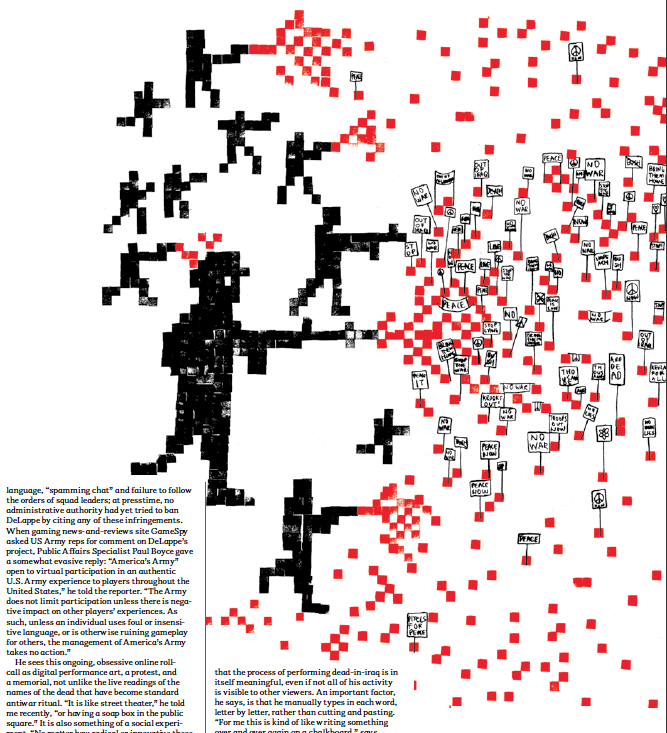
Playing Dead

How protest is entering the (video) game of war

by Ed Halter

Illustration by Geoff McFetridge

Art direction by Yasmin Khan and Michael Worthington

Originally published in Arthur No. 23 (July 2006)


Like millions of others around the world, Joseph DeLappe spends multiple hours each week logged into online multiplayer games. His current game of choice is America’s Army, the squad-based tactical shooter produced and promoted by the real US Army as a tool for PR and recruitment efforts. America’s Army has been available for free download from AmericasArmy.com since July 4, 2002, and in its three-plus years of existence has developed a devoted global following; if nothing else, it has successfully enhanced the Army’s brand by associating it with something engaging, cutting-edge and youth-friendly. Millions of users who might not otherwise have a personal connection to the American military have found one through playing the game: they’ve gone on missions based on realistic contemporary scenarios, learned to fight together using official Army protocol and rules of engagement, and even had the chance to play alongside real US soldiers, who signal their participation via exclusive insignia worn by their online characters. While deadly and chaotic wars in Iraq and Afghanistan fill the headlines and TV screens, with reports as intimately gruesome as HBO’s Baghdad ER, America’s Army has provided a counter-image of the military that is as idealized as a textbook, as thrilling as a Hollywood movie, and as addictive as any commercial video game around. It is a paradoxical media object, mirroring its eponymous nation’s own divided consciousness: a game that celebrates realism through a carefully constructed fantasy that omits more than it reveals. In America’s Army, characters don’t end up with brain damage, missing limbs or post-traumatic stress disorder, or have to deal with an administration that sent them to a war that most back home don’t support, and then slashed their veteran’s benefits to boot—because none of that would be any fun at all, compared to the high-adrenaline, deep-strategy game-time of make-believe battle.

DeLappe, however, chooses to play the game rather differently than most. His virtual warfighter—whom he has named “dead-in-iraq”—logs onto America’s Army and simply stands there and does nothing. DeLappe nevertheless takes part in the game in other ways. Drawing from publicly available rosters of US casualties in Iraq, DeLappe types out the names of killed servicemembers into the game’s text message chat window, entering one name per line. For example, during one of DeLappe’s missions of virtual conscientious objection, some fellow America’s Army players saw this appear in their text message scroll as they organized for battle:

[US Army] dead-in-iraq messaged: JONATHAN LEE GIFFOR, 20, MARINES, MAR 23, 2003

[US Army] dead-in-iraq messaged: JOSE ANGEL GARIBAY, 21, MARINES, MAR 23, 2003

[US Army] dead-in-iraq messaged: DAVID KEITH FRIBLEY, 26, MARINES, MAR 23, 2003

If his dead-in-iraq character gets killed in battle or is voted off the server by fellow gamers (a procedure typically employed with players who aren’t taking the game seriously and thereby inhibiting others), DeLappe logs back on at another time and continues where he left off. He started this text recitation in March 2006, and by the middle of May had typed out the names of over 350 war casualties. He’s inputting the names chronologically, from the first casualty onward, and intends to type out a complete naming of the military dead. DeLappe says he will continue this online memorial until there are no more names to memorialize—in other words, until the war stops producing American corpses in uniform (and at the time of writing this article, that means he has more than 2100 names to go). So DeLappe has found his own way to play America’s Army, creating an experience that owes less to Quake than it does to the Quakers.

Continue reading

Mike Patton’s “Carne Crude Squarciata Dal Suono Di Sassofono” (Arthur, 2005)

COME ON IN MY KITCHEN

What Mike Patton learned in his days of toil at Benihana’s

Originally published in Arthur No. 16 (May 2005)


Few working vocalists have done as much with their vocal chords as ex-Faith No More frontman Mike Patton. In the years since that Bay Area bizarro rock band’s demise, Patton has built an impressively wide-ranging C. V., including collaborations with jazz composer John Zorn, Japanese noisegod Merzbow and hip-hop concept squad the Handsome Boy Modeling School. His latest projects to see release through Ipecac Recordings, the post-genre label he co-founded and co-owns, are Suspended Animation—a bonkers 30-track tribute to the month of April by his band Fantomas (featuring members of Slayer, Mr. Bungle and Melvins)—and the battle album, General Patton vs The X-ecutioners, featuring turntablists DJ Rob Swift, Grandmaster Roc Raida and DJ Total Eclipse. For his turn in the Arthur kitchen, Patton selected a dish that was featured on his record of futurist recipes Pranzo Oltranzista: Musica da Ravola per Cinque (Banquet Piece for Five Players), released on Zorn’s Tzadik label in 1997. The tracks were instrumental but had sounds associated with cooking and eating—chopping, slicing, chewing, etc.—while the booklet contained recipes. Says Patton, “This is one of my favorites.”


Carne Crude Squarciata Dal Suono Di Sassofono

(tr. “Raw meat torn by saxophone blasts”)

Cubes of beef marinated in rum, cognac and white vermouth are served on a bed of black pepper and snow. Each mouthful is separated by saxophone blasts blown by the eater himself.

Have a Cup of Brendan Benson’s Tea (Arthur, 2005)

Come On In My Kitchen

Have a Cup of Brendan Benson’s Tea 

Originally published in Arthur No. 15 (March, 2005)


It’s nice to know that the meticulous and charming nature of Brendan Benson’s songwriting carries over to his kitchen as well. Thanks to the track “Tea” on his debut album, letters from die-hard Japanese fans are usually coupled with a bag or two for Benson’s boiling. His latest album, Alternative to Love, is out March 22 on V2. Here’s how to make the perfect cup of tea, as told to Ben Cass.

What you’ll need

Water: This is the most important ingredient. It should be clean, but not loaded with chlorine or other such additives. I take it from the tap, but I’m fortunate to live in a city which boasts a premium grade drinking water. Others may not be so lucky and therefore should substitute using bottled water (just remember: no Coke or Pepsi products, as they undergo a heavy treatment process and are stripped of all character. I recommend Evian or Volvic). Water has flavor, however subtle it may be, and a little of that “regional essence” in the water is a good thing when making tea. If you dislike the taste of your tap water, you might try letting it stand or “mellow” in a clean glass for an hour prior to boiling, thereby allowing the detergents to evaporate and the particles to settle. Pour the water into your kettle, taking care to not disturb the sediment.

A kettle: I have the electric variety which I like very much. You may also use the stovetop variety. I don’t recommend using a cooking pot as it only provides for a poor aesthetic. Attention to such detail is critical in the tea-making process.

Tea bag: I’ve chosen to use the tea bag over the teapot for our purposes. Although the teapot method is more desirable, the tea bag will do just fine as long as it is of the highest quality. Twinnings, Red Rose and Lipton, contrary to popular belief, are not teas suitable for drinking at any time by any man. Avoid these brands at all costs. Ideally your tea should be purchased somewhere in the UK from an ordinary grocery store. Brands such as PG Tips and Tetley are good. Barry’s is a wonderful tea but not as common. If it’s not convenient for you to travel abroad to buy tea then I suggest you search the Internet. I’m sure there is a service from which you can order tea from the UK. Yet another option is to buy Tetley “British Blend” bags if you can find them. Nothing else will do.

Milk and Sugar: Your tea must contain milk in order for it to be deemed proper.  Milk neutralizes the tannic acid found naturally in tea. Cream should never be used. Organic, 2% milkfat is ideal; whole milk may be used, but often eclipses the delicate flavor of the tea. Skimmed milk should be avoided. If you are lactose intolerant perhaps you might try an herbal tea (which I personally despise) instead, but under no circumstances should lemon be used as a substitute. Sugar, on the other hand, is an option which you may choose to forgo. I take a little sugar to excel and enhance the effects of the tea.

What to do

Bring water to a rolling boil and let stand for 30 seconds. Swish a little in your cup to warm it and pour it out. Drop the tea bag in and pour the water gently over the bag. Let steep, undisturbed for exactly four minutes. Do not stir. Use a small spoon to remove the tea bag, letting the water drain from the bag. Do not squeeze the bag and do not let the spoon remain in the cup, as it conducts precious heat and will prematurely cool the tea. Add sugar if you’d like, then milk. Stir and enjoy.

Some thoughts about tea: Tea has been enjoyed for centuries throughout the world by the elite and affluent as well as pauper and common man alike. For this reason, I believe its reputation should be upheld, its tradition maintained and the very ceremonious and calming properties, for which it is so loved, preserved.