May 15th – Book Launch for Arik Roper's "Mushroom Magick" at Gavin Brown's enterprise in NYC

Arik Moonhawk Roper (a longtime Arthur contributing artist) will be celebrating the launch of his new book Mushroom Magick this Friday in New York. In creating this book, Roper has added his own indelible mark to the long history of mushroom art, presenting over 90 of his original portraits of hallucinogenic species of mushroom alongside educational writings by friends and scholars Erik Davis, Daniel Pinchbeck and Gary Lincoff. Learn more about and see images of Roper’s richly water-colored illustrations of these mysterious fungi in this blog post.

Be warned: If you are not wary of the importance of the mushroom’s existence on earth, after reading this book you will no doubt be conscious of the fact that fungi are communicating with our world in ways that are nothing less than mind-blowing…

Friday, May 15th, 6-8pm (on view through May 30th)
Gavin Brown’s enterprise
620 Greenwich St. / New York, NY 10014
Free admission

New Wolves in the Throne Room EP

Malevolent Grain

We’re going to go out on a limb here: Olympia, WA’s Wolves in the Throne Room are easily the pre-eminent American eco-black metal band.

For those not already in the know, there’s been a emergence in the black metal world of a sort of “shoegaze” sound — much celebrated by indie rock nerds around the globe — found on albums from old hands like Enslaved as well as relative newbies of the nascent American black metal scene (see famous Alhambra, CA shut-in Xasthur). WITTR make such dark, My Bloody Valentine-style raging guitar buzz sounds from time to time, as well as switching between cookie-monster style grunt-growling and near-operatic arias of sometimes-singer Jamie Meyers. Plus they apparently live on an off-the-grid farm in the countryside. Arthur columnist Erik Davis talked to them about this for Slate back in 2007. Check out his interview here.

Where most Scandinavian black metallers are obsessed with, say, the outcome of 10th Century battles between Vikings and German Christian colonizers, WITTR are more concerned with pagan/environmental themes, adding a decidely fresh take on subjects usually dealt with in far more pastoral sonic palette. Epic jams like “I Will Lay Down My Bones Among the Rocks and Roots” and “Hate Crystal” are rife with brutal imagery — just imagine the soundtrack to an especially grim Derrick Jensen lecture, perhaps?

Add all these things up and you’ve got a black metal band that you can actually talk to non-black metal people about, without having them suggest you take your conversation over to their younger World of Warcraft obsessed sibling.

Wolves in the Throne Room’s excellent new EP Malevolent Grain was released this weekend on vinyl, with a CD version soon to come. Check it out at the WITTR online store. New album Black Cascade due out later this spring.

More WITTR after the jump …

Continue reading

“IT’S COMING DOWN, BABY!”: Sir Richard Bishop interviewed by Erik Davis (from Arthur, 2007)

Originally published in Arthur No. 27 (Dec 2007)

bishop.jpg

It’s Coming Down, Baby!
Erik Davis catches up with SIR RICHARD BISHOP—gypsy picatrix, ex-Sun City Girl and guitarist extraordinaire
Illustration by John Coulthart

Superlatives can be lame, but Richard Bishop is one of the few post-punk guitarists who came of age in the 1980s to have achieved the incendiary prowess of a true Guitar God. Though largely unknown outside the underground, Bishop plays and improvises with an uncommon and original power. He can tantalize in a myriad of styles, he has a global jukebox in his head, he can shatter the walls of sleep and chaos, and he can turn on a dime. He loves the guitar and mocks it: he plays like an absurdist and a romantic at once. He studies the occult and travels the Third World fringe and you can hear it. He plays guitar to save himself and fails in the endeavor and you can hear it. He can scare the shit out of you sometimes, and he can make you giggle and grin.

For decades Bishop played with his brother Alan and the Charlie Gocher in the Sun City Girls, where his ferocious and inventive exploration of psych-rock, punk spew, idiot jizz, Indo-Arabic fantasias, and jazzbo abstraction was often shadowed by the madcap antics, acerbic lyrics and general air of arcane weirdness that surrounded that impossible act. Gocher passed away in February this year at the age of 54, and the Girls are no more.

But over the last half decade, Bishop has also been playing and recording solo instrumental music as Sir Richard Bishop, and the effort is really starting to flower. This year SRB released two great albums. While My Guitar Gently Bleeds features three long pieces that triangulate his essential territory as an improviser: a North African arabesque, a noisy electronic nightscape, and a modal neo-raga on the tantric tip. Polytheistic Fragments is a more accessible and varied work, featuring a dozen tunes that also stretch into Americana, gypsy rag and Lennon-McCartney charm. As always, the recordings are packaged with strange and mystic images that speak to Bishop’s longtime study of esoterica.

Earlier this fall Bishop toured with labelmate Bill Callahan. I called him while he was taking a break in Seattle.

Continue reading

“SLOW DOWN”: Erik Davis’s “The Analog Life” column (Arthur, 2008)

Originally published in Arthur Magazine No. 32 (Dec 2008)

“The Analog Life”
by Erik Davis

Illustration by P.D. Hidalgo


SLOW DOWN


Is it really so horrible to imagine the planet down-shifting for once?

You can hardly blame anyone for feeling the fear and panic that helped drive October’s near financial meltdown. Scanning the headlines or the newsfeeds, our eyes greeted a steady pulse of bummer lingo. “Global Recession.” “Great Depression.” “Financial Collapse.” Serious words for serious times. But there was another phrase I kept stumbling across, less apocalyptic certainly but still delivered with a grim fatalism, that struck me differently. The economy, we were warned, was showing signs of a significant slowdown.

Slowdown? I don’t know about you, but I could use a bit of a slowdown right about now. Take things easy, not run around so much, maybe poke around the garden and restring that guitar. Hold a neighborhood potluck, learn emergency response, can some tomatoes. I haven’t finished rebuilding the office, and haven’t even cracked The Man Without Qualities.

OK, I am being a little facetious. After all, “slowdown” describes the debilitating stuttering of capitalism’s endless Big Bang-like expansion, an enormously powerful wave of transformation that in some manner or another floats almost all of our boats. If this immense flow of nested feedback loops, production networks, and capital flows starts to slow, then things don’t just mellow out. They start to fall apart, like a Chinese acrobat—scratch that, American acrobat—whose spinning plates lose their momentum and inevitably fall to the floor even as the poor fellow keeps his balance. That means families get pushed into poverty, small businesses close, poor folks grow desperate and rich folks even more selfish and mean.

Continue reading

Is the “planetary consciousness” of neotribal psytrance gatherings just window dressing for the same old hedonism?

Art by Hye Jin Lee

Trance Planet
by Erik Davis

originally published in Arthur No. 31 (Oct 2008)

Idanha-a-Nova, Portugal

This August, around 25,000 people hauled their kits and caboodles down a long hot narrow road in the middle of the Portuguese nowhere to camp like migrants along the shores of a lake not far from the Spanish border. They made the trek to attend Boom, a biannual electronic dance music festival that has grown into a large and successful event that eschews corporate sponsorship and keeps its roots in the underground alive. There were all sorts of people at Boom, but the dominant vibe of the weeklong festival was neotribal: a rave-inflected millennial florescence of hippie shit like long hair, fashion exotica, hardcore psychedelia, trance dancing, healing arts, and pagan-ish New Age mysticism with an apocalyptic thrust. There were chai shops and vegan grub vendors and massage centers and drug information booths, plus four music stages that provided everything from cheesy breakbeats to live world fusion to ambient driftworks. But the core genre was psytrance, an intense and sometimes unnervingly trippy form of electronic dance music whose pulverizing, brain-synching and monotonous beats that embody a ferocious psychedelic aspiration that makes dancing at Boom as much a ritual as a party.

Continue reading

Against iPodiphilia: Or, Cory Doctorow’s way of listening to music is freaking Erik Davis out (Arthur, 2008)

Art: M. Wartella

THE ANALOG LIFE: a column by ERIK DAVIS

“Archive Fever”

(originally published in Arthur No. 30, July 2008)

Last month Paul Miller—the avant-garde DJ, musician and theorist who always appends his name with “aka DJ Spooky that Subliminal Kid”—finally released a collection of essays he has been editing for ages on digital and sampling culture, called Sound Unbound. It’s a cool book, and I’m not surprised. I first met Paul at the Village Voice in the early 90s, when I recognized the voodoo vévé for Legba that appeared on one of his stickers. Over the years, his DJ mixes, thoughts, and restless career represent a lot of what I continue to love about digital culture. Paul is relentlessly interconnected and multi-disciplinary, refuses to be locked into one career identity or scene, and restlessly moves between worlds. He thinks and acts like he spins, an endless collage that draws equally from high and low, here and there, old and new.

All this is reflected in the book, a somewhat amorphous but fascinating collection of essays by musicians (Steve Reich, Brian Eno), techies (Bruce Sterling, Jaron Lanier), edge academics (Ron Eglash, Manuel De Landa), and nomads like me. I contributed an essay I wrote over a decade ago called “Roots and Wires,” about dub music, polyrhythm, the African diaspora, and their digital mutation into drum’n’bass. (Today I would talk about dubstep, though I would be rather less enthusiastic.) In retrospect, I realize that my desire to uncover both the spiritual roots of the dub virus and its futuristic implications was another version of my concern with understanding the rapport—and conflict—between the digital and the analog, coding strategies that are also metaphors for much larger processes of understanding and experiencing culture and the world.

I like roots with my wires, but that’s not always how it goes. How much digital and analog can diverge was starkly brought home to me in the foreward to Paul’s book. The short piece was written by Cory Doctorow, a tireless electronic freedom fighter who writes science fiction and posts frequently at the popular group blog BoingBoing. The stark part came a few paragraphs into the piece where, after explaining that he can’t work without music, Doctorow describes how he manages the 10,000 tracks he keeps in iTunes:

“I’ve rated every track from 1 to 5. I start every day with my playlist of 4- to 5-star music that I haven’t heard in thirty days, like making sure that I visit all my friends at least once a month…After that, I listen to songs I haven’t rated, and rate them. Then it’s on to 4- to 5-star songs I’ve heard fewer than five times, total. I don’t want random shuffle: I want directed, optimized shuffle.”

There is no other way to say it: this vision of listening to music blew my mind. It seemed so alien to my way of listening, so alienating in general, that I had to write a column about it to figure out the source of my freaked-outedness.

Some caveats first. One is that Cory Doctorow seems like a prince among übernerds. His Boing Boing posts about the ongoing intellectual property wars are always sharp and informative, and they help insure that the website remains an exuberant if sometimes goofy bastion of old school counter-cultural net values. I haven’t read Doctorow’s SF, but I do admire what he does with it. For one thing, he gives it away for free online—as pure a gesture of ethical culture a professional author can make. And his new book, Little Brother, is a piece of tactical genius: a young-adult near-future novel about a group of kids in San Francisco who use a variety of real-world hacking and encryption tools to take on the Department of Homeland Security in an era of civil liberties crackdown. Lifting a page or two from Encyclopedia Brown, Doctorow includes actual tips and technologies so that kids reading the novel can get their cyberactivist groove on right away.

My other caveat is that listening to recorded music is a matter of pleasure, and it seems silly to spend much time worrying about other people’s pleasures. I think its fine to judge music, and to judge other judgments as well—part of the enjoyment of music for many of us is the pleasure in discussing it, describing it, even arguing about it, although I believe the depth of those conversations are not weathering the Internet well. In any case, it’s hard to overturn the core wisdom of chacun à son gout. Doctorow clearly enjoys music, and I enjoy the enthusiasm. But his pleasure also seems deeply bound up with the process he has created to manage, filter, and tag all those MP3s. This is where we part ways, because all this algorithmic fiddling seems less like listening to music that doing something that, for most of us, is much less fun: data-processing.

Here’s the nub: the more we deal with recorded music in the form of digital files, the more that music takes on the characteristics of data, and the more its specific qualities as music melt into that multimedia torrent of bits that keep us chained to our screens. From a new media perspective, this breakdown sounds kind of cool and futuristic, and it certainly opens up new possibilities of expression and intervention. But I’m not sure these transformations really support deep and engaged listening. Amidst the endless brouhaha over downloading and the radical shake-up of the music market, we have yet to come to terms with this massive transformation in the culture of collecting and engaging recorded music.

Recordings have always been a form of data of course. The music itself can be quantified by wonks as a species of information, while covers and labels come printed with all sorts of words and numbers. Vinyl hoarders face issues of organization as well as physical storage, while the records not yet in one’s collection are also forms of data that hover around your music. Collectors of, say, deeply obscure R&B singles trade lists of recordings so obscure that even almighty Google does not know they exist. But recordings become much more data-like once they go digital. With the severing of music from vinyl discs, magnetic tape, and increasingly compact discs, recorded music does not transend the body but takes on a new one—a body furnished by binary code, the new vehicle of song.

The simple equation of these new bodies is more for less: more tracks cost less money and require much less storage. At the same time, collections always expand to fill all available space—hard discs fill up as reliably as physical bookshelves do. As the capacity of digital memory increases—in inverse proportion to its price—our compulsion to gather bits is compounded, and we hoard. I held off from mp3s so long that I missed the great Napster potlatch, but when I did start hunting and gathering I could not stop, and amassed hundreds of gigabytes in a very short period of time. This is just my experience, but it is hardly unusual. Once touched with archive fever, the forest grows more important than the trees, and the forest keeps growing.

It grows in part because our field of attention is constantly being seeded with information about further recordings, which are themselves multiplying like mad. Your older sister or Spin or the cool guy at the record store has been replaced with a myriad of online environments designed to expose and communicate commentary or links or streams directly to fans: social networks, listservs, collaborative filters like Pandora, online stores with samples, emusic, the blogosphere, myspace. Behind a lot of this proliferating metadata—information about information, in this case, musical information—is the urge to share. This is cool, but it doesn’t necessarily have much to do with listening. Music becomes a chip in a game—a sign rather than a sound, or even—in the case of closed file-sharing communities that demand uploads—an entrance fee. Perhaps the cultural Darwinists are right, and music is just a selfish gene—restless sonic DNA seeking to reproduce itself within this dank hothouse environment of copying and transmission. But I think the aptness of this evolutionary metaphor says more about the environment than the thing itself.

Within this environment, our collections take on the sprawling hairiness of the databases that everywhere process and capture our lives and labors. We are inevitably faced with the problem of organizing, managing, and processing the material, not to mention figuring out a way to extract pleasure from it. Every music fan becomes her own sysadmin. I often ask people how they deal with their mp3s, and am amazed with the ingenious and obsessive systems of rating, tagging, categorizing, and file shuffling that some develop. Others throw up their hands, resist the endless fiddling that technology demands, and allow the mysterious algorithms of the Apple corporation to determine the programming on their portable radio stations. Because I court synchronicity, this is often my method. Doctorow’s system, in this light, is ingenious, as it balances the need to process (rating tunes), and to enjoy, and to enjoy in a quasi-controlled, quasi-random manner that maximizes the efficient delivery of pleasure.

But there’s the rub, at least for me. The efficient delivery of pleasure is not what I want out of listening to music. In fact, the technical cult of efficiency, of developing algorithms to maximize pleasure, is part and parcel of the calculating, over-processed and data-saturated world that I turn to good music to escape, to interrupt, or to buffer. I don’t want to listen to what Heidegger, in his famous essay “The Question Concerning Technology,” called a “standing reserve.” What bothered Heidegger was not machines themselves, but the way that machines turn everything into a reserve of potential usefulness. Once you create a hydro-electric dam, then the rushing stream that inspired poets or musicians or hippie trippers becomes, inevitably, a “standing reserve” of power, another item in civilization’s immense calculus of extraction.

While all music collections can be seen as standing reserves in a sense, the dynamics of digital collections invites that number-crunching calculus much more intimately into the heart of the experience. When I review records, I am sometimes forced to assign a rating, and I understand the value of such consumer guidance. But if I tried to rate every single track as I listened to it, I would feel like a foot-soldier of the machine, because one of the core moves of the machine is to quantify quality, to take fuzzy values and translate them into numerical values. Listening itself becomes processing rather than process, an endless taxonomical twitch mediated by yet another window on yet another screen. And not even a very useful one at that, at least according to my own hedonic calculus. A lot of my favorite music bugged me or flew over my head the first half dozen times I listened to it, while a lot of the pop gems that instantly floated my boat lost their glamour after two or three listens. How do you rate that?

In a way I envy übergeeks like Doctorow. They take the bull by the horns, and tweak the systems that other übergeeks have developed to manage the glorious excess still other übergeeks have helped create. Their engines of musical discovery and pleasure seem like crisp, smoothly oiled machines, controlling the uncontrolled, managing the mania. I look at my collection and my listening habits and just see a big fucking mess. My stereo is in a room without computers, where I love listening to vinyl I still buy because it sounds better and is really fun to shop for. But I don’t have any room for it so it seems kinda stupid too. I am way too lazy and cheap to do lossless rips of the thousands of CDs I have. Besides, even though these pieces of plastic hog my office, I prefer to have my digital memory externalized in a three-dimensional world of objects and colors and images. But of course now I also possess lots of burned CD-Rs and tons and tons of mp3s, which reside on various pods and drives split between my office, my car, and my home. I don’t know where to begin and where to end, but somehow, lumbering around like a dinosaur, I am blessed with an abundance of marvelous encounters.

WHERE THE SIGNAL DECAYS: Erik Davis on the spiritual difference between digital and analog television (Arthur, May 2008)

“Tube Toss” by Erik Davis

from Arthur Magazine No. 29/May 2008

Last month I ditched my old 17-inch Sanyo TV and bought a big flat acronym—a Samsung LNT2653H LCD HDTV to be precise. My main motivation was visual hedonism. Though I don’t watch a ton of movies, I am something of a cineaste, having gone to college in the days when a decent sized campus like ours might boast a dozen film societies. Until recently, I fed my Janus jones in repertory cinemas, while at home I watched lighter fare—B movies or anime or leeched HBO shows. But rep cinemas are dying, even in a deeply mediated town like San Francisco, and I am simply not willing to squint any longer at letter boxed DVDs. I wanted a screen with an aspect ratio, if not a size, worthy of The Man From Laramie or Kagemusha. And so I entered the cacophonous purgatory of Best Buy to check out the wares.

I’ve always found TV shops kind of disturbing. It’s something about having all the machines simultaneously replicating the same program, like a flickering clone farm. But what really spooked me out this time was an immense split screen that was designed to demonstrate some Samsung feature called Auto Motion Plus 120Hz. On deck was the last Pirates of the Caribbean movie, a product that will also get you thinking about clones. On the right, you had the “normal” image, which looked like a somewhat tinny and pointilistic film—HDTV’s reasonable digital echo of the silver screen. But the Auto Motion Plussed image on the left was so lifelike and three-dimensional that it destroyed any sense of film at all. It was as if the screen was no longer an enchanted mirror, but a telepresence window onto a Hollywood sound stage where an overpaid babe in a costume was stumbling around with some dumb props hoping the CG guys would make it all make sense.

In his much-reproduced essay “The Work of Art in the Age of Mechanical Reproduction,” written in 1936, Walter Benjamin saw cinema as the paradigm of a new kind of technological media that would undermine the traditional “aura” of art, the semi-sacred quality of being that once infused individual works of creative genius. Looking at Keira Knightly’s makeup flake into the empty air of Auto Motion Plus, it was suddenly clear to me that we still have some aura left to lose: the analog aura of film itself, an aura that has a great deal to do with the complex chemical processes which give certain film stocks and eras an unmistakable timbre. This is the sunset of cinema, folks, a blazing analog dusk, and it is giving way to a digital night that is full of data and noise and still can’t really get the blacks right.

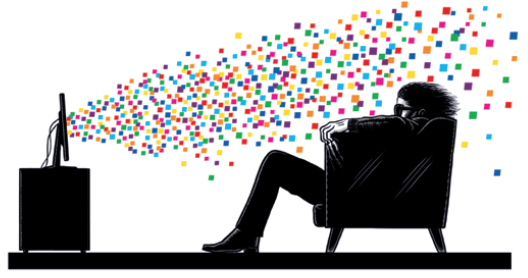
Then all the screens around me started throwing footballs in unison, and it started to make sense. The future screen, the future TV, is not about cinema but about simulating presence, a carnal ultrafidelity that’s good for sports, and reality TV, and porn. I must have had low blood sugar or something—box stores do this to me—but a vague apocalyptic dread descended upon me, as I imagined these home theaters invading millions of homes and literally sucking the life out of them, like phantasmic vampires, or digitally remastered portraits of Dorian Grey. Screens that grow more lifelike in exact proportion to the ontological exhaustion of the world outside, a world flattened and set groaning under the weight of us, our distractions, our hunger for figments. A verse from the book of Ezekiel welled up from the depths: “Son of man, hast thou seen what the ancients of the house of Israel do in the dark, every man in the chambers of his imagery? for they say, the Lord seeth us not; the Lord hath forsaken the earth.”

That said, as long as we are stuck in our chambers we might as well get some good imagery on the wall, which is why I shook myself out of my apocalyptic fugue and continued to shop. But what to buy? If I were a rich guy with a big house I’d definitely buy one of the big LCD HDTVS with Auto Motion Plus (for the…sports). But I share a small apartment with a lovely lady who doesn’t really watch or want a television at all, and who certainly does not want one lording over our wood-paneled living room with all the warmth and grace of an MRI machine. So I bought a 26-inch LCD with good stereo sound to keep in the office. That night I emailed the Pilkdown Man in London, and mentioned the TV’s “unfortunately small” size. “Wow,” he wrote back, “we’ve entered a world where a 26″ telly is small.” I felt like an idiot.

We are not a cable household, which means that when we watch TV, we watch it the old fashioned way: by sucking analog signals from the sky with a cheap V-shaped antenna stuck on top of the set. Though this method may strike you as Paleolithic, old school aerials are still the signal suckage method of choice for roughly 20 million American households. These include folks who can’t be bothered, people who can’t afford cable or satellite, and cranks like us who don’t want all that shit lurking just one remote away, ready to strike. Whoever we are, a great sword of Damocles now hangs in the airwaves over our heads, or rather, over our sets. Because as of February 17, 2009, the FCC has proclaimed that the entire analog broadcasting system, known as NTSC, will be permanently retired to make way for all-digital television. Without digital tuners, our old analog TVs are nothing more than monitors.

The United States is by no means paving the way here. Some European countries have already left analog behind, and pretty much everybody is signed up to make the switchover. The main reason for the change, of course, is money: manufacturers get to sell new-fangled sets, TV stations have the possibility of creating a number of new revenue streams, and the government gets to auction those tasty, wall-penetrating frequencies previously occupied by NTSC. One of the first things the government will do with that cash is to turn some of it over to local artists, pirate radio crews, and media activists who are being empowered to create innovative noncommercial programming and micobroadcast it over the freed-up channels—which after all are a public resource, like the national parks—to help prepare local communities for the imminent collapse of postmodern America.

JUST KIDDING! Actually, some of that auction money—up to a billion and a half dollars—will be used to cover the cost of a conversion program that will allow owners of analog TVs to continue to use their rigs. If you want to, your household can call up the National Telecommunications and Information Administration (Orwell anyone?) and demand up to two $40 coupons for digital-to-analog converter boxes to extend the life of your tube. Of course, the government stands to earn much more from auctioning off the spectrum, and their pals will do quite well selling the converters, so don’t feel like we’ve gone socialist or anything.

For the rest of us, broadcasters are promising a new magical world of digital television, because, after all, digital is “better.” Because my Samsung picks up both NTSC and digital signals, I can tell you that the quality of a strong digital transmission is definitely richer. But as usual, digital is not a standard but a sword that can be wielded with widely varying degrees of finesse. In order to make more money, broadcasters can choose to compress their digital channels in order to pack more services into the available bandwidth—including, possibly, other stations that would be sent over the same digital channel. The more you compress, the more lame artifacts are destined to spooge up your screen. If you already use the Internet to liberate movies and TV shows from the evil grip of copyright holders, you will know what I mean: the splotchy walls, the stuttered time-slips, the eruptions of Cubist ectoplasm.

The spiritual difference between digital and analog, it seems, is clearest where the signal decays. A weak analog signal is often bathed in snow, and its fuzzy “ghosts” can not only be tolerable and even charming, but can still be reasonably enjoyed way out in the boonies. Millions of earthlings have had ecstatic TV experiences watching World Cup matches on 13 inch TVs with crap reception. The relative smoothness of analog noise makes it simply easier for the mechanism to receive signals and for our eyes to make sense out of faces in the clouds. Ghosts like it, because ghosts like organic things. Digital signals, on the other hand, decay with neither grace nor charm. Instead, as the signal weakens, it swiftly passes over what is known as the “digital cliff”: a sharp, jarring plunge into jagged visual noise followed by zippo.

Cathode ray tubes are strange devices: evacuated glass teardrops outfitted with what amounts to a ray gun, blasting electrons at an array of glowing phosphors that, in color TVs anyway, look like psychedelic Op-Art. Sending phantasms invisibly through the air to dance across the surface of these crystal balls has always been a somewhat necromantic act. But if we are going to talk of analog ghosts, we need to talk of analog corpses: the millions of old school TVs that are now being sacrificed to the landfill lords of forced obsolescence. Plenty of people will get their hands on converters, of course, but plenty more will just toss out their CRTs and dive, like me, ever deeper into the digital wave. The guy who runs Electronic Recyclers, one of the largest e-waste recyclers in America, thinks that roughly 80 million analog sets will get tossed out over the next year or two. According to a back-of-the-envelope calculation, that’s just under a million and a half tons of TV—a mass that surpasses the weight of the Twin Towers. And that’s not to mention the amount of lead oxide in the glass. Let’s just say I hope outfits like Electronic Recycler are ready to get their hands dirty.

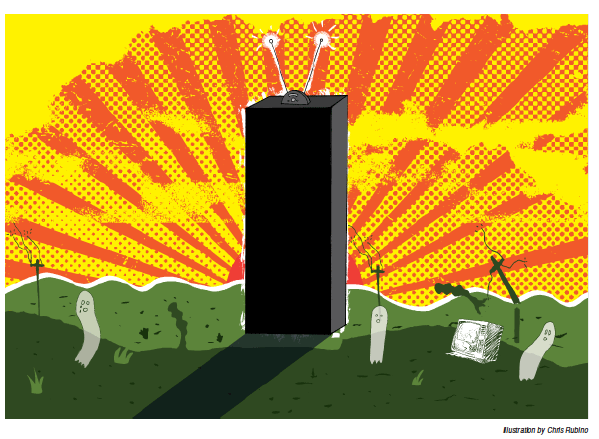
I just left my Sanyo on the street one night and it was gone by morning. In San Francisco, the street still giveth and taketh away. But a relic of the boob tube remains. Because we don’t have cable, we still need to use an antenna to pick up the terrestrial digital broadcast signals. So there sits my home theater: a sleek, if modestly-sized Samsung LNT2653H, looking like the monolith from 2001 laid on its side, topped by a pair of bent aluminum rabbit ears, duct-taped to the back of the set, flashing its peace sign at the principalities of the air.

ERIK DAVIS is a writer, fingerpicker and speaker who lives in San Francisco. His last book was The Visionary State: A Journey Through California’s Spiritual Landscape. Nearly all of his published articles can be found on his website, techgnosis.com, where he regularly posts on music, religion, technology and other abiding mysteries.


Green Hermeticism

Green Hermeticism: Alchemy and Ecology


Peter Lamborn Wilson, Christopher Bamford, Kevin Townley
Introduction by Pir Zia Inayat-Khan
ISBN: 9781584200499
Book (Paperback)
Lindisfarne Books
$25.00
6 x 9 inches
224 pages
September 2007

“In Alchemy, there is an injunction to quicken, or revive, the dead, which is illustrated by a dead tree growing verdant again. That is exactly what this wonderful and rare work does in awakening human consciousness to its Divine potential and Ultimate Destiny. Art thus helps Nature to achieve its ideal Perfection. The authors must be congratulated for their insightful words. I wholeheartedly recommend reading it again and again, and again.” —Stanislas Klossowski de Rola, author Alchemy: The Secret Art and The Golden Game: Alchemical Engravings of the Seventeenth Century

“Environmental solutions today are largely technical, but the planetary crisis is also a crisis of soul—or better yet, of the Imagination. Too tricky for religion, too poetic for reductionist science, Green Hermeticism reheats a prophetic imagination still in love with the material world—a new alchemy of ancient nature.” —Erik Davis, author, The Visionary State: A Journey through California’s Spiritual Landscape

“Just when you felt numb and disenfranchised, thinking the world had become bleak and dead, along comes this rare, much needed book to remind us that there is still some sanity, depth, and creative energy percolating up from the heart of Reality. Thank God (and the Goddess Nature) for this smart and inspiring breath of fresh air! Green Hermeticism is where the wasteland ends—and where the world becomes re-enchanted with genuine living thought that goes beyond superficialities. It’s a rare pleasure to be in the presence of living minds who actually know something wonderful and have not been deadened by the opiates of capital or the tenure track. Very highly recommended.” —David Fideler,publisher (Phanes Press) editor (Alexandria), author of Jesus Christ, Sun of God and translator of Love’s Alchemy: Poems from the Sufi Tradition (with Sabrineh Fideler)

“The publication of Green Hermeticism has the sense we so rarely get, of a genuine moment in cultural history. It is not just the eloquence of its authors’ knowledge and arguments or that they are showing us, once again, the depth and range and beauty of alchemy, and the Hermetic tradition, and what Peter Lamborn Wilson calls Romantic Science. Nor is it even the links they establish between the Hermetic tradition and ecology, and the value of a science that perceives the world as alive rather than a machine. What makes this work significant is the sense that it shows us how we can use these ideas and knowledge to create a genuine counter to destruction and despair, an alchemy of our politics as well as of our spirit.” —Rachel Pollack, author of 78 Degrees of Wisdom: A Book of Tarot

“Green Hermeticism reminds us that the art of the Great Work is to enter more deeply into the dynamic and practical wisdom of the universe, which is our laboratory, where work and prayer combine. When we engage with the All, we know ourselves to be one kindred with all in the viriditas—God’s greening power—where body, soul, and spirit honor each other.” —Caitlín & John Matthews, authors of Walkers Between the Worlds: The Western Mysteries from Shaman to Magus

Hermeticism, or alchemy, is the ancient, primordial mystery science of nature through which people in all times and places have, for the sake of world evolution, sought to unite Heaven and Earth—divinity, cosmos, earth, and humanity, as a single whole. Selfless, intimate, dedicated to healing and harmony, Hermeticism has accompanied and sustained every religious epoch and revelation. It may be found in all historical cultures, from the traditions of India and China in the East to the Judeo-Christian West. It could even be said that Hermeticism is the primal cosmological revelation and the common ground of all spiritual traditions.

Nevertheless, in the great revival of mystical, esoteric traditions and practices during the last century, Hermetic tradition—in fact, Nature herself—has been largely ignored. Today, when the Earth seems most under attack, Green Hermeticism is especially appropriate. The book explores not only the ancient Masters’ inner science, but also their science of Nature.

During spring and summer 2006, Pir Zia Khan convened a series of gatherings to begin to unfold the contemporary meaning of ancient, sacred science for our time. Green Hermeticism is a partial record of that meeting. Peter Lamborn Wilson, explores the many ramifications of the alternative worldview offered by Hermeticism; Christopher Bamford provides a broad historical overview of the tradition from the Ancient Mysteries to contemporary manifestations of the alchemical tradition; while Kevin Townley brings a practical dimension to the gathering teaching the preparation of herbal elixirs and demonstrating that cosmology and philosophy can become a truly healing path for the Earth.

Green Hermeticism is necessary reading for anyone seeking a spiritual and cultural path for the healing of the current ecological and cultural crisis.

Peter Lamborn Wilson (b.1945) is a scholar of Sufism and Western Hermeticism and (under the pseudonym “Hakim Bey”) a well-known radical-anarchist social thinker. His books include Sacred Drift: Essays on the Margins of Islam (City Lights, 1993) and Escape from the Nineteenth Century and Other Essays (Autonomedia, 1998).

Christopher Bamford is the editor in chief of SteinerBooks and its imprints. A Fellow of the Lindisfarne Association, he has lectured, taught, and written widely on Western spiritual and esoteric traditions and is the author of The Voice of the Eagle: The Heart of Celtic Christianity and An Endless Trace: The Passionate Pursuit of Wisdom in the West. He has also translated and edited numerous books, including Celtic Christianity, Homage to Pythagoras, and The Noble Traveller (all published by Lindisfarne Books). HarperSanFrancisco included an essay by Mr. Bamford in its anthology Best Spiritual Writing 2000.

Kevin Townley has been a lifelong student of Western Hermeticism. Early on in his studies, he was drawn to the writings of Dr. Paul Foster Case and has been a member of the Builders of the Adytum (B.O.T.A.) for eleven years. Kevin is currently the Vice President of LPN- USA, an esoteric organization dedicated to the study and practice of Qabalah and Laboratory Alchemy. His studies have led him around the world seeking original Rosicrucian and alchemical texts, as well as individuals who practice this royal art. He is the author of The Cube of Space: Container of Creation (Archive Press, 1993) and Meditations on the Cube of Space (Archer Books, 2002).

Pir Zia Inayat-Khan is the spiritual leader of the Sufi Order International (established by Hazrat Inayat Khan in London, 1917) and founding director of the Suluk Academy, an esoteric school in upstate New York. His initiatory heritage integrates the sacred transmissions of the Chishti, Suhrawardi, Qadiri, and Naqshbandi lineages within a post-denominational, inter-spiritual goal. Pir Zia holds a master’s degree in religion from Duke University.