NATURE WILL BE THERE TO DELIVER: An invitation to communicate with plants

An invitation to communicate with plants

text and photos by Nance Klehm

adam's pine

painting by Adam Grossi

Six years ago, I had my first loud and explicit communication from a plant. It was a pine tree that called to me—an 800-year-old pine in Ireland. It was encompassed in a buttery halo, rhythmically puffing pollen smoke signals from its multitude of male flowers. Its fecundity pulled me to it. I put my hand on its deeply flaked bark and it held me. I could not move my hand and didn’t want to. It poured itself into me, filling me like a river. “Oh, I see,” I told it silently. The strength of its flow made me start to cry.

Learning to listen to trees led me to hear other plants as well. And talking back to them. I found that some plants pulse, while others stream: their flows are different frequencies, strengths and textures depending on the plant’s species, its health and its age. Plants are networked batteries; trees are pneumatic tubes and portals.

Recently I asked a few people to sit with a plant that they’ve been “noticing.” The people I asked are sensitive people, but not experienced with plant communication. This is what they shared with me…

Continue reading

Sun Oct 25, Chicago: SEEDY SUNDAY with Nance Klehm, others

This just in from Nance:

seedy sunday is THIS SUNDAY!

it’s autumn and seedy business is all around us!
you’ve been growing and now it’s time to swap seeds!
sooooo…
__________________________________
sunday OCT 25th, 3-8pm
SEED ‘SWAP N STORE’ potluck!
—————————————-
please bring your home grown, viable seeds that you have gathered, stories about growing, and
a beverage or dish to share!

THE SEED ARCHIVE
2446 south sawyer avenue
chicago 773.762.0277

***for more info about seed saving***
http://www.salvationjane.net/seedarchive.php

"In an undisclosed storage area in Chicago, Nance Klehm has a hidden stockpile of human excrement…"

From a piece by Eric Smillie in Good Magazine:

In an undisclosed storage area in Chicago, Nance Klehm has a hidden stockpile of human excrement. When the 1,500-gallon stash finishes its two-year composting cycle next summer, it will be soil as rich as any you could buy at the store—a gardener’s black gold. If it’s discovered by the authorities before then, it’ll be deemed hazardous and removed. The hoard belongs to Humble Pile Chicago, a conspiracy of 22 people Klehm has rallied to help.

Credit her childhood on a farm in northwest Illinois: Klehm is a self-made food and soil consultant who thinks we need to close the nutrient loop when it comes to a sustainable source of fertilizer. “It’s hard to find safe soil for planting in the city,” she says. “Most of what you get is stripped from someplace else; we’re stealing it from one place and trying to enrich another with it. It’s nuts.”

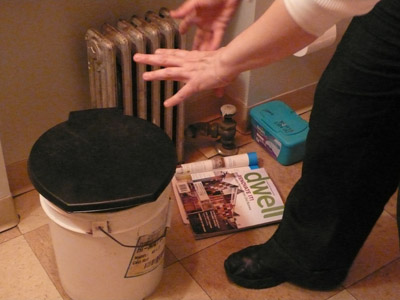
She decided years ago to collect more than kitchen scraps, and built herself a dry toilet to catch her “humanure.” “My bucket is front and center in the bathroom at this point, while my flushie is just a book stand,” she says. She started Chicago’s Humble Pile to increase her yield. Participants had simple orders: Do your business in buckets, cover with sawdust, and fill large garbage cans for Klehm to cart away (while avoiding landlords).

For Nicole Garneau, 39, a performance artist and teacher, taking part was easy. “I could do it without ever leaving the comfort of my home,” she says. When her full barrel was ready for pickup, she’d boldly leave it out in front of her co-op building with a sign that read, “Nicole’s shit, do not open.” No one did.

She’s now eagerly awaiting the return of her portion of the pile, which she plans to nonchalantly fold into her co-op’s box garden. By then it will bear no evidence of her dastardly deed—it will look, in fact, like any old humble pile of soil.

To join the Chicago Humble Pile, visit http://spontaneousvegetation.net/humble-pile/

Dear Weedeater: Is canning worth the hassle?

Dear Weedeater,
Help! I went crazy this year and started a tomato garden in the backyard! I dunno what it was, the sight of Michele Obama pulling up lawn grass and planting a garden at the White House or the cutie at the nursery who helped me pick out some heirlooms and beefsteak starters? Anyways, one thing led to another, somehow my little backyard thing went crazy, I didn’t get hit by the East Coast blight thing yet (perhaps I speak too soon?), and now I’ve got way way WAY too many ripening tomatoes. It’s ridiculous. I’d give them away except all my neighbors’ gardens are overflowing with tomatoes too. Somebody mentioned canning my extras, but that seems…um, hard and… I dunno, Nance. Is it worth the trouble? —Newbie in New Jersey

Nance Klehm says:
No need to mince words on this one, the answer is totally ‘yes.’ There is no such thing as too many ‘love apples’! Unless you have loads, the gift outweighs your total energy out: $20 of canning jars plus two hours or less of your time (or even much less if you have a friend helping), plus some good music to chop and simmer to = the best sauce, tomato juice, salsa, whatever. Your tomatoes will speak to you for all the dead of winter…

Comments or questions regarding this post should be posted in the “Comments” section below

Nance Klehm website: spontaneousvegetation.net

MAKE YOUR OWN SOIL from your poop: Nance Klehm's "Humble Pile Chicago" project

From In These Times

sawduster

A bushel of sawdust and a low-tech composting toilet used for compost collection.

Your Crap, Our Compost: Squat and the earth shall grow
.
By Sisi Tang

In These Times

Poop. 


A generally fecal-phobic society reacts to the thought with a mix of snickering interest and fearful aversion, all dispatched in a single flush. But Nance Klehm, 43-year-old urban forager and grower, transforms human excrement into nutritious soil one bucket at a time. 


Klehm’s Humble Pile, a local do-it-yourself human waste composting project, introduces a backyard alternative to the machine-churning, power-draining waste-processing facilities tucked away in remote locations. 


“I’m not treating it chemically. I trust microorganisms to do it for me,” Klehm says. 


In early 2008, Klehm sent letters and humorous surveys to households in six Chicago neighborhoods, calling on potential participants to help “transform waste into fertility, pollution into resource, and isolation into connection.”

With no need for “Compost 101” instruction, complex machinery, electricity or water, Humble Pile asked its 22 volunteer “nutrient loopers” to opt for dry buckets with snap-on toilet seats when nature calls. 


Continue reading

Pix from Philly urban forage with Nance Klehm in Fishtown – Aug 9, 2009

Nance’s next public urban forages will be:

September 13, Lincoln Park, Chicago – meet at nature museum
October 11, Jackson Park, Chicago – meet at osaka garden tea house (this is a potluck – please bring something simple and wild to share)
3-5pm rain or shine
$10-$20 donation
Nance’s website: spontaneousvegetation.net

Here’s some pics and text about the August 11, 2009 Philly forage by Jennifer Kates on Flickr at:
http://www.flickr.com/photos/alligatorateher/sets/72157621993729204/

And here’s some sweet pics by Evan T. Wells from the Philly forage:

NanceKlehm01

NanceKlehm04

Continue reading

How to deal with mosquitoes, by Nance Klehm

BUILD A HOME FOR BATS!
nance klehm

Q: Mosquitoes are attacking me. What should I do?

To start, two simple lists –

What Attracts Mosquitoes:
– dark clothing and dark foliage
– lactic acid and sweat (from your exercising or a very balmy evening)
– flowery or fruity fragrances
– CO2 (uh oh)
– moist places in general

What Drives Them Away, or at least stops them from finding you:
– smoke
– light clothing
– clean, aseptic fragrances/essential oils such as: clove, geranium, cinnamon, rosemary, lemongrass, cedar and the infamous citronella
– bats!

Little brown bats are the most common bat in temperate North America. I see them darting overhead at dusk in most city parks in most cities. Consider building a bat house or three in your neighborhood! For plans and more info, check out Bat Conservation International at batcon.org

Continue reading

HUMAN-INCUBATED YOGURT—a how-to by Nance Klehm

Human-incubated yogurt
by Nance Klehm

(you can imagine the why-for. this is the how-to.)

procure roughly one quart of raw milk if possible from any healthy lactating animal. if you don’t have connection to an animal, grocery store vitamin d whole milk (unfortunately homogenized and pasteurized) will do. it’ll need to do. you will need no more than a quart’s worth as a larger amount will make the process less comfortable.

you will also need to have a spoonful of room temperature yogurt saved from your last batch or some beautiful homemade yogurt from a wonderful armenian/egyptian/iraqi/greek/bulgarian/etc. grocer or neighbor. this is essential.

one half hour or so before going to bed, pour the milk into a saucepan and heat it gently and slowly, stirring all the while until it reaches 110 degrees. you do not want it forming a skin.

pull the pan off the heat and gently and slowly cool the milk to 90 degrees by just allowing it to lose heat.

drop your spoonful of room temperature yogurt into a jar and pour in the warm milk. screw on the lid and shake the jar once. wrap the jar tightly into a soft wool sweater and climb into bed alone or with animal or human companion. tuck jar against your skin. keep it as close as possible. hug or snuggle the jar: body heat is what allows the culture to educate the milk to become yogurt. bacteria colonize in the constant heat of your body/ies.

come morning, you should have a quart of human-incubated yogurt.

Nance Klehm on swine flu hysteria, Four Thieves Vinegar, organic anti-virals and flu foes

sloppykiss

MAY DAY! : “LEANING IN” TO OURSELVES, OUR WASTE AND OUR OTHERS
by Nance Klehm

Last week, in response to the swine flu outbreak, Mexico City managed to close its shop doors and empty its streets of 20 million folks. That’s darkly impressive, but consider this: Mexico City, which once was an island, and whose main environmental pressure has been flooding, has also advised its residents to do frequent hand washing—a simple task made difficult because one of the main fresh water pipelines shut down before the outbreak, affecting a quarter of the city’s population. This is not the first drastic water rationing for this populace, nor will it be the last.

With a high level of street culture where informal interactions are inexhaustible and richly layered—in my deepest belly, I xoxox Mexico City even though I usually come out bruised after a prolonged stay—I can’t help but ask how are we “lean in” when social distancing becomes policy, however temporary.

zabaleen

In Egypt, pigs are not only a food source for the non-Muslim population, they are the “clean up crew,” an integral part of the solid waste disposal system in major cities. In Cairo, pigs are mostly handled by the Zabaleen (Arabic for “garbage people”). The Zabaleen (pictured above) are landless farmers and pig breeders, Coptic Christians who migrated to the city 50 years ago from northern Egypt and became the unpaid grassroots garbage collectors of the city. The 60,000 or so Zabaleen make their living absorbing and sorting Cairo’s waste. Raw materials such as steel, glass, plastic, etc. are resold and other materials are repaired, reused or burned as fuel. Their low-tech, metabolic system means that 80-90% of what they collect is reused, recycled or otherwise returned to the economy.

The Zabaleen keep pigs in apartment courtyards, where they are fed food and other waste. The pigs’ waste is used for fertilizer. Pigs also are used for food.

At the start of this year, Egypt hired foreign multinational contractors to manage Cairo’s waste stream, replacing the Zabaleen and existing systems. The result has been higher disposal fees and a much lower recovery/recycling rate of materials.

Why would a country hire a transnational at a high cost when they have for decades had a highly effective grassroots labor of an indigeonous group do it voluntarily?

To make matters even worse for the Zabaleen, Egyptian goverment officials have responded to swine flu hysteria by ordering the slaughter of the nation’s 300,000 pigs…

* * * * *

In light of all this panic around a possible “pandemic,” my seed-saving pal Damon recently reminded me of an herbal anti-viral elixir, the historic anti-plague remedy called “Four Thieves Vinegar.” The story of this remedy, distilled from many versions, goes like this: In France, during the bubonic plague of the early 1600s, poor mountain folk were hired as gravediggers to dig mass burial pits. Thieves made busy looting homes of dead families. It was a few individuals from both of these groups who had the herbal knowledge of anti-virals, putting them to use in warding off the deadly virus. It is said that a few surviving thieves who were captured for their crimes were released when they shared the elixir’s recipie with the authorities.

HOW TO MAKE “FOUR THIEVES VINEGAR”

Using a quart jar or larger vessel, gather equal parts of dried or fresh thyme, peppermint, rosemary, sage, and lavender, a teeny bit of clove if you’ve got it, and, if you’re a believer in the stinking rose, add some garlic. Pour enough of your homemade fruit scrap or cider vinegar to just cover the herbal material. Put a lid on tight and keep the vinegar some place you pass every day, like near your coffee maker or bed, so you can shake or stir it once or more a day. Do this for as many days as you can. Six weeks is the optimal tincturing time. Strain liquid from the plant material and drink a teaspoon several times daily; wipe down skin and surfaces with it for disinfection; or do both as you feel necessary.

DEALING WITH VIRUSES

Viruses do not contain the enzymes that are needed to live, so they need to have host cells. Those could be in a plant, or an animal or even a bacteria. Without a host, viruses die.

Many of the plants in this remedy are anti-virals – others are also anti-bacterial and/or anti-fungal – I’ve included a full list of easily forageable and cultivatable anti-viral and flu foe plants below.

I’ve taught you how to make fruit scrap vinegar (“Breaking it Down” Weedeater column in Arthur No. 32) and Molly Frances has talked about the uses of apple cider vinegar in Arthur. If you have some of that around then use this as a base. If not , make some so you always have some on hand. Vinegar is so healthy and antiseptic, not to mention delicious, it behooves you to always have some around.

As per my conviction, I only include plants that are easily forageable, cultivated or available in any neighborhood store, urban or rural. This is a decent list but not an inclusive list. I encourage you to do more research around anti-virals and the listed plants.

ANTI-VIRALS

Aloe Vera—Wound healer extraordinaire that is also anti-bacterial, anti-inflammatory and when the juice is drunk, helps repair digestive track and soothes ulcers. Always have this plant or a leaf on hand.

Eucalyptus—You lucky Californians! The oil from this common weedy tree is also anti-bacterial and anti-fungal. It breaks up and expels mucous, relieves congestion and cools fevers.

Garlic—The ubiquitous garlic is antiseptic, anti-bacterial, anti-parasitic, anti-fungal, immune-stimulating and anti-protozoan. Growing garlic is easy… try it!

Ginger —Yummy and fairly easy to find, ginger is anti-bacterial, anti-fungal, diaphoretic, anti-spasmodic, circulatory stimulant, anti-arthritic, anti-inflammatory and more. Can also be used in baths to warm the body and promote sweating.

Hen of the Woods – Forageable mushrooms -Yummy!

Lemon—Again this is a ‘forageable’ for the Californians… Lemon helps fight infections and stimulates immune system

Shiitakes – Easy to grow indoors. Investigate this!

Thyme—Chases mucus from the body. Thyme is antiseptic, antibiotic and anti-microbial.

Wildflower Honey – In its original undiluted state, there is no shelf lfve for honey. If you don’t keep bees, or know someone who does, work on either of these relationships this season. Honey is anti-biotic and anti-inflammatory; it’s an immune stimulant; it’s anti-carcinogenic, a laxative, a cell regenerator, and it’s anti-fungal… etc.!

FLU FOES

Clove— Anti-bacterial, anti-septic, anti-microbial, bactericidal. Useful for infectious diseases and respiratory infections. This is something you pick up off a grocery shelf. Invaluable painkiller. I have used this on tooth and gun aches with huge relief.

Common Sage—wonderful for throat and upper respiratory infections.

Hyssop—This is most delicious as a tea. It relieves congestion, cough, sore throats and the constant beautiful blooms makes bees deliriously happy.

Juniper—Anti-bacterial, anti-fungal, antiseptic. Useful for upper respiratory infections, urinary tract infections, candida, salmonella, e. coli… Good to burn tby our dry toilets… Forageable.

Oregano—This common culinary herb is an anti-infectious agent and an immune stimulant. Who knew? Easy to grow too.

Peppermint—Fights infections, relieves congestion, clears sinuses – yum-yum and so easy to grow.

Rosemary—Anti-fungal, anti-bacterial, anti-parasitic. Also for respiratory infections. I love to bathe with this plant. The steaming of this plant also helps relieve migraines. Forageable for you west coasters.

Walnut –A bitter as heck blood cleanser, anti-inflammatory an anti-parasitic. Forageable.

Western Red Cedar – Binds wounds, helps on clearing lungs, diarrhea and an antifungal. Forageable.

Wormwood—Here is my friend Artemesia again, though not the common weedy one. It’s her cultivated cousin of yore…. Wormwood is anti-malarial, anti-bacterial, anti-fungal and anti-inflammatory. In public gardens and therefore forageable with discretion.