BERT JANSCH will perform Thursday, October 19 at Arthur Nights

“As much of a great guitar player as Jimi [Hendrix] was, Bert Jansch is the same thing for acoustic guitar…and my favourite…” –Neil Young

“At one point, I was absolutely obsessed with Bert Jansch. When I first heard that LP [1965], I couldn’t believe it. It was so far ahead of what everyone else was doing.” –Jimmy Page (who recorded Jansch’s ‘Blackwaterside’ as ‘Black Mountain Side’ with Led Zeppelin)

“He completely re-invented guitar playing and set a standard that is still unequalled today… There are people playing guitar who don’t even realise they’ve been influenced by him one step removed.” –Johnny Marr

Bert’s new album The Black Swan comes out in the USA and Canada on Drag City on October 17. Producer Noah Georgeson (Joanna Newsom, Devendra Banhart) worked with Bert on the record, as well as a number of guests including Devendra Banhart, Beth Orton, Otto Hauser (Espers, Vetiver), Helena Espvall (Espers), Kevin Barker (Currituck Co.), Paul Wassif and Adam Jansch. The album has been receiving fantastic reviews across Europe, including 5 stars from Mojo magazine.

Bert will play Thursday, October 19 at Arthur Nights at the Palace Theatre in downtown Los Angeles. Other performers on the two stages that night include Devendra Banhart, Espers, Belong, Jackie Beat, Buffalo Killers, Yellow Swans, Grouper and Axolotl. Click here for ticket info.

TAV FALCO AND HIS UNAPPROACHABLE PANTHER BURNS will perform Friday, October 20 at Arthur Nights.

Excerpts from “Inside the Invisible Empire: My Travel with Rock ‘N’ Roll Legend Tav Falco and His Unapproachable Panther Burns” by Richard A. Pleuger (Arthur 21, March 2006):

Gustavo ‘Tav’ Falco was born into Italian roots in Gurdon, Arkansas, a sleepy railroad town between Little Rock and Texarkana, east of the Interstate on Highway 67. While driving through rural Arkansas in his 1964 Ford Thunderbird, the sight of the train tracks just outside of Bluff City, Memphis brings him back to his childhood:

“I was living out in the backwoods between Gurdon and Whelan Springs, Arkansas, a whistle stop on the railroad where the cannonball freight ran through it, way in the backwoods and not much bigger than Panther Burns in Mississippi.

“When a steam train came through, it covered the whole town in black smoke, you couldn’t see anything. It was like a fantastic mist that transported you into the netherworld of the imagination and the unconscious.

“Even today, the whole essence of the Panther Burns is to stir up the dark waters of the unconscious mind. That’s why we’re here. You can have a party, you can have sex, you can find your husband or wife—all this happens at Panther Burns shows. You can get spaced out. You can get drunk. You can lie on the floor, get stomped on. You can intermingle with the races, you can dance your ass off. But the essence of it is: stir up the unconscious mind.”

Childhood experience inspired young Tav to become a brakeman on the Missouri-Mississippi railroad, not unlike Jimmie Rodgers, the great country singer of the 1920s. In fact, in the beginning Tav and his band were billed in Memphis as Tav Falco, the Beale Street Blues Bopper and The Unapproachable Panther Burns. Later he changed it into Tav Falco, the Steppin’ Breakman and the U.P.B.

Tav: “The brakeman separates and couples the cars together. He climbs up on the car and sets the big round handbrake. He gives hand signals when to do what. A very romantic job.”

Tav Falco: “Around the turn of the last century—1900 or so—they started clearing more land for the cultivation of cotton and other crops around the Mississippi River. These big piles of trees and bush were left there to be burned later. And the animals that were living in these areas—foxes, bears, rabbits—had no place to go.

“There was this wild cat, a panther, who was very cunning and howled all night. Faced with the destruction of his own habitat, the panther started to raid the farmers’ chicken coops. The animal became a general nuisance. They tried to hunt the panther down, but he eluded their traps.

“One night the farmers ran the animal into a canebrake, a stand of wild cane bamboo growing there, and they set the canebrake on fire. The shrieks of the panther were so intense that it was unforgettable. The location became known from then on as The Panther Burn. In essence, it was a symbol for the downfall of the last vestige of frontier America and the onset of European civilization in the South. And this is were we derived the lore of the Panther Burn.”

….

Tav always collaborated musically with his idols. Beside playing with Chilton, Charlie Feathers and James Luther Dickinson, he had blues singer Jesse Mae Hemphill (a.k.a. Shewolf) and the marching drummers of Napoleon Strickland’s Cane Fife Band heavily destabilizing the already raucous rendition of “Bourgeois Blues” on his band’s debut album, 1981’s Behind the Magnolia Curtain. But despite the band’s impressive collective pedigree, Panther Burns was not about musical virtuosity, it’s about an aesthetic.

“To this day I regard myself more as a performer than a musician,” Tav told me in 2002. “It takes a special individual to play in the Panther Burns. You can’t just plug a musician into this music. To play this music is hard work for musicians, but easy for an artist. I would rather work with someone who’s got more of a philosophical orientation than sheer musical virtuosity to display in the band. I’m looking for something ineffable.”

On a cool late summer night in 1986, I went to see Tav Falco unleash his unique blend of rockabilly and country blues in a club down on Broadway. Sporting a big black curly pompadour, Tav proved to be an even more powerful performer than I could have imagined. He drove his group the Panther Burns, in his own words, like “the last steam engine train on the tracks that does nothing but run and blow.” The power of the music propelled the crowd into other realms of fierce, ritualistic reality. During the a hypnotic rendition of “Jump Suit,” Tav proclaimed: “Panthermen and Pantherwomen, this is the Invisible Empire!” The audience then stormed the stage to sing along.

Tav Falco and the Unapproachable Panther Burns perform Friday, October 20 at Arthur Nights. Click here for ticket info.

"Everything Louder Than Everything Else" by Joe Gross

Oct. 2, 2006 Austin Statesman

Everything Louder Than Everything Else

Have the loudness wars reached their final battle?

By Joe Gross

“You listen to these modern records, they’re atrocious, they have sound all over them. There’s no definition of nothing, no vocal, no nothing, just like — static.” —Bob Dylan in Rolling Stone magazine

The ranting of a cranky old man? Perhaps.

One man’s opinion? Hardly.

In August, an open letter from a music industry executive on the state of commercial compact disc mastering and manufacturing was sent to an industry tip sheet/e-mail list run by a music pundit named Bob Lefsetz.

The letter was written by Angelo Montrone, a vice president for A&R (the folks who scout and sign music acts) for One Haven Music, a Sony Music company.

“There’s something . . . sinister in audio that is causing our listeners fatigue and even pain while trying to enjoy their favorite music. It has been propagated by A&R departments for the last eight years: The complete abuse of compression in mastering (forced on the mastering engineers against their will and better judgment).”

This compression thing has been a topic of discussion among audiophiles and music fans for nearly a decade. But hearing a music industry executive cop to it was pretty unusual.

The letter was almost immediately reprinted online in audio discussion forums.

“The mistaken belief that a ‘super loud’ record will sound better and magically turn a song into a hit has caused most major label releases in the past eight years to be an aural assault on the listener,” Montrone’s letter continued. “Have you ever heard one of those test tones on TV when the station is off the air? Notice how it becomes painfully annoying in a very short time? That’s essentially what you do to a song when you super compress it. You eliminate all dynamics.”

For those already confused, Montrone was essentially saying that there are millions of copies of CDs being released that are physically exhausting listeners, most of whom probably don’t know why their ears and brains are feeling worn out.

He continued, citing an album that proved very popular with Austinites.

“Just to prove that the ‘super loud’ record has no correlation to actual sales, when we mastered the first Los Lonely Boys record I went to the session and specifically told our mastering engineer NOT to make this a loud record. Could it be that a record that actually had dynamic range could compete? Two and a half million records and a year of constant airplay of ‘Heaven’ confirmed my suspicion. Loud records are for the birds.”

Loud records? Can’t you just turn it down? Well, yes and no.

Let’s say you go to the store to buy a CD, a brand-new CD of a popular rock band. The group is your favorite, you’ve been looking forward to this CD for some time. You have the band’s other recordings, you’ve seen them live, perhaps you’ve even heard the new songs once or twice at a show.

You buy the CD. You take it home and throw it in the CD player. You couldn’t be more excited as it starts to play.

But something weird happens as you listen to it. You like the songs, but you don’t really want to listen to it for very long and you’re not entirely sure why. You take it off. A few minutes, later you put it back on. Same thing happens: You like the music, but you still want to take the CD off. It’s more than a little weird.

Condolences. You are officially a casualty of the loudness wars, the ongoing competition among bands, labels and A&R folks to make ever-louder albums.

• •

Artists, recording engineers and record companies have been trying to make the loudest possible record since the dawn of 78 rpm technology back in the early 20th century.

When 33 1/3 rpm and 45 rpm became the industry standard, engineers strove to make those records as loud as possible as well, often using something called compression during the mastering stage.

Compression means squeezing the dynamic range of an audio signal, usually to boost the perceived volume of a song or performance. Compression works on recorded music the way MSG works on food: It makes everything sound more more. Used with discretion in the recording stage (and even in the mastering stage) it’s an invaluable tool for recording engineers.

The idea was the greater the perceived volume of the record, the more attractive the sound would be to the listener. Which meant more attractive to potential DJs, which meant more airplay, more exposure and more sales of the record.

But there were literal physical limitations to this process when vinyl was the primary recording medium — the music’s dynamic range was naturally restricted by the medium itself. During mastering, you could only compress so far; if the sounds were too extreme, the needle would pop out of the groove.

With the advent of compact disc technology in the early 1980s, almost all of this went out the window, as CDs lacked the physical limitations of vinyl.

In theory, this was a good thing. The dynamic range of CDs was far larger than vinyl, and could closer replicate the highs and lows of actual performance. But something else happened.

For the past 10 or so years, artists and record companies have been increasing the overall loudness of pop and rock albums, using ever increasing degrees of compression during mastering, altering the properties of the music being recorded. Quiet sounds and loud sounds are now squashed together, decreasing the recording’s dynamic range, raising the average loudness as much as possible.

As Jerry Tubb at Austin’s Terra Nova Mastering puts it, “Listening to something that’s mastered too hot is like sitting in the front row at the movies. All the images are in your face.”

This is why the reissued X album ‘Los Angeles’ (see story at right) sounds louder at the same volume as the old version, why you turn the 2005 X album down and still hear music, parts that are supposed to be quieter and louder, up front and buried in the mix, at the same time.

For some of you, this difference might be hard to notice at first. Consider yourselves lucky. For some of us, hearing this sort of mastering is like seeing the goblet between two faces in that classic optical illusion — once you perceive it, you can’t unperceive it. Soon, it’s all you can see — or hear.

• •

Erik Wofford is a producer and mastering engineer in Austin at Cacophony Recorders. He’s worked on albums by such local bands as Explosions in the Sky, Zykos and Voxtrot, and finds the loudness wars exhausting to deal with.

“Over-compressing stuff gives everything a flatness,” he says. “If loud sounds are the same as quiet sounds, you’ve destroyed any excitement or natural dynamics that the band creates.”

We’re sitting with Wofford in Bruce Robison’s Premium Recording Service studio, listening to various CDs old and new, running them though the ProTools computer software and looking at their relative loudness. The studio has a woody, ’70s vibe. You can totally see Fleetwood Mac recording here (which seems fitting for a man related to the Dixie Chicks). It seems a weirdly inappropriate place to talk about the limitations of modern pop music.

We’re looking at the wave forms generated by a number of modern albums. Sound waves should look like what they’re called: waves, with sharp peaks and valleys. But the music we’re looking at is all peak. It’s like looking at a butte or a brick.

“These square waves are a very unnatural occurrence,” Wofford says. “It sounds wrong to the ear. You can’t hear detail.”

There are all sorts of metrics usable to measure loudness, but the Root Mean Squared (RMS) number is a reasonably useful one. It’s a measure of average sound level. A smaller RMS number means higher average level; i.e., minus 10 dB RMS is 2 dB louder than minus 12 dB. The maximum RMS value is zero.

Here’s the weird part. In the early to late ’80s, most pop records averaged around minus 15. (The peak level we see for the old version of “Los Angeles” is minus 14.4 dB RMS.)

Now, modern CDs average at around minus 12 to minus 9 dB. Average.

When a soundwave squares off, something called “clipping” can occur. Clipping in the digital realm means digital distortion, which different CD players handle different ways. Some just won’t play that frequency, resulting in loss of dynamic range (you’re literally not hearing the whole song). Some digitally distort, which is quite an unpleasant, static-like sound indeed. Some really old CD players skip the song entirely.

There’s plenty of clipping on the contemporary songs Wofford and I look at; a red light goes on and stays on the screen when a song clips. Christina Aguilera. Red Hot Chili Peppers. Mastodon. Brick, brick, brick. Clip, clip, clip.

Wofford sighs. “Clipping should just be forbidden,” he says. “You used not to be able to turn a redbook CD (the CD from which all others are made) into a manufacturer with clipping on it. That’s not true any more.”

Thanks to folks on the Internet, there are lists of famously loud CDs. The Red Hot Chili Pepper’s 1999 album “Californication” is a notorious example. It clips constantly, and the title track peaks at a whopping minus 5.6 dB, which was really uncomfortable for almost everybody.

That Los Lonely Boys CD Montrone was so proud of? The song “Heaven” averages at around minus 12.5 dB, and peaks at minus 8.9, completely reasonable for modern records.

But the song “Diamonds,” on the band’s new album “Sacred,” clips throughout, averaging at about minus 8.9 dB, peaking at minus 7.7 db RMS.

“I wasn’t able to go to that mastering session for the second one,” Montrone says from his New York office. “The first record came out when I was with Or Music (the label that released the first Los Lonely Boys album before being acquired by Sony). I wasn’t as involved with this new one. I wish I had been.”

Who knows if consumers are sick of the band, or the songwriting isn’t up to snuff or it has something to do with that louder sound, but “Sacred” thus far has sold about 185,000 copies, and continues to drop on the Billboard albums chart.

• •

So why aren’t more people noticing this sort of thing? One word:

lifestyle.

We listen to music in completely different ways than we did 20 or 30 years ago. For most people, music is listened to on the go, in cars, on headphones while running, on computers at work. Music has to compete with the sound of your car’s engine, has to punch through the background noise of street traffic or a loud office.

“Ours is a culture of competition,” Wofford says. “Maybe labels think the music has to be super aggressive, super bright, like a kid screaming in a supermarket, to get your attention.”

The idea is that louder recordings automatically sound better on low-quality reproduction systems, but this isn’t really true in practice. MP3 players such as iPods have their own compressors and limiters, further reducing the dynamic range of recordings, as do computers. A CD doesn’t have to be mastered loud; the iPod can make it as loud as everything else it plays.

This is especially true of radio, which, in order to make sure that every song played has a uniform loudness, uses its own compressors and limiters. The idea that a sound has to be mastered loud to be noticed on the radio is just false.

“It’s a myth,” Tubb says. “Actually, a really loud CD might sound worse on the radio after being fed through a station’s processors. (This is what Montrone was talking about with “Heaven.”)

This is why the Christina Aguilera song “Ain’t No Other Man” (average RMS: about minus 8.4, peak: minus 6.3), which sounds OK-to-irritating on the radio or an iPod, sounds like you are being punched in the face on a real stereo system.

• •

Yet, bands keep asking for it. That rustling you hear is the mastering community shrugging its shoulders.

“Ours is a service business,” Tubb says. “If that’s what the client wants, I try to explain the trade-offs in clarity. In reality, we’re just trying to accommodate requests from labels or A&R guys or the artists themselves. They’ll walk in with a handful of CDs and say, ‘I want it to be as loud as this one.’ The last five years it’s gone absolutely mad.”

“Ask any mastering engineer which they prefer,” Wofford says, “Something that’s super-compressed or not compressed. But they keep their mouths shut about it if they want to keep working.”

“It becomes part of (a mastering engineer’s) reputation,” Montrone says. “Suddenly, you become known for your really loud records. Unless you specify that you don’t want it to be loud, they just make it loud. It’s become the standard now.

“And it’s infected other steps in the chain,” Montrone continues.

Mixing engineers often make spec mixes of songs to try and win the bid to mix a particular song or album. “Mixing engineers will turn in spec mixes of tracks that they just slam the heck out of because they think that will get them the gig,” Montrone says. “And they’re not wrong.”

So we’re at the chicken-or-egg stage. Is it changing the way we listen to music, or because the way we are listening to music has changed?

• •

Here’s the punch line: The brain can’t process sounds that lack a dynamic range for very long.It’s an almost subconscious response. This is what Montrone was talking about when he mentioned the TV test tone.

“It’s ear fatigue,” Tubbs says, “After three songs you take it off. There’s no play to give your ears even a few milliseconds of depth and rest.”

Alan Bean is a recording/mastering engineer in Harrison, Maine. He’s a former professional musician and a doctor of occupational medicine.

“It stinks that this has happened,” he says. “Our brains just can’t handle hearing high average levels of anything very long, whereas we can stand very loud passages, as long as it is not constant. It’s the lack of soft that fatigues the human ear.”

This is part of the reason that some people are really fanatical about vinyl. “It’s not necessarily that vinyl sounds ‘better,’ ” Bean says. “It’s that it’s impossible for vinyl to be fatiguing.”

And yet, record companies wonder why consumers are buying less of them.

“I definitely think it’s a contributing factor,” Montrone says. “People have a lot of entertainment options. If listening to music is not a highly enjoyable experience, we’re just giving people another reason not to purchase the stuff.”

Of course, that’s the weird part: Consumers may not know why they are buying fewer CDs or listening to them less or are perfectly happy with low-def MP3s from the Internet.

“That’s the big ‘too bad’ about all this,” Bean says: The music is not necessarily at fault.

• •

The story of popular music is a materialist one — as playback technology has changed, so has the music.

The LP could hold about 50 minutes of sound (25 minutes a side) if you really squashed the grooves together. As a result, most albums came in at about 40 to 45 minutes. CDs can hold about 80 minutes of sound, and artists have filled them up; the majority of major label pop CDs are an hour or more. The rule seems to be, if you can do it, you should do it.

So it is with mastering: We can make it incredibly loud, so we should make it incredibly loud. Though there is talk in the mastering community of universal mastering standards, it’s still just talk.

Again, there is, of course, an element of subjectivity to all this. It is entirely possible that anyone younger than 18 reading this has no idea what we’re talking about. They may not bother to buy CDs anymore, such is the availability of MP3s single downloads. To them, popular music has always been hyper-compressed, square-wave stuff, able to punch through background noise with a single snare drum hit, clipping all over the place.

To them, one can say only: You don’t know what you’re missing.

X: A study in volume vs. loudness

Without getting technical, it’s probably important here to define the difference, for our purposes, between “loudness” and “volume.” (It’s also important to recall that this all gets very relative very fast and that many would argue that there are few true absolutes involved.)
When we talk here about volume, we’re talking about the thing which you can control with the knob on your stereo or iPod or boombox.
When we talk here about loudness, we’re talking about your perception of a sound at any particular volume.
For example, if you listen to the 1988 CD version of the album “Los Angeles” by the noted roots-punk band X, you have to turn it up to a certain volume to enjoy it. Turn it down low and much of the music vanishes, which is what you might expect when you turn something down.
Now listen to the 2005 CD remaster of the same album. At the same volume as the first version, the songs seem to jump out of the speakers more. The quiet sounds sound almost as loud as the guitar sounds. Turn it down, and you can still hear the quiet sounds almost as well as the louder sounds. This is because the CD has been remastered to bring it more in line with contemporary CDs, which are often mastered louder than ever.
As one employee at a local record store put it, “When we put in older CDs into the CD changer to play in the store, you can’t even hear them.”
Can’t you turn it up?
“Not really,” he said. “Because then the newer CDs would be incredibly loud at the new volume. So we don’t even play older CDs in the store that often.”
—Joe Gross

‘If the loudness wars struck the art world’

On the Web site prosoundweb.com, Atlanta rock guitarist Lee Flier imagined a set of remastered masterpieces. Reflecting the sonic damage of pumping up the sound on modern CDs (lost subtleties at the high and low ends as everything gets louder in the middle), the original Mona Lisa and ‘American Gothic’ paintings become posterized cartoons of themselves. For examples, see Flier’s posting at recforums.prosoundweb.com.

Marijuana may help stave off Alzheimer’s

Reuters
Active ingredient in pot may help preserve brain function

Updated: 1:31 p.m. PT Oct 5, 2006

WASHINGTON –

New research shows that the active ingredient in marijuana may prevent the progression of the disease by preserving levels of an important neurotransmitter that allows the brain to function.

Researchers at the Scripps Research Institute in California found that marijuana’s active ingredient, delta-9-tetrahydrocannabinol, or THC, can prevent the neurotransmitter acetylcholine from breaking down more effectively than commercially marketed drugs.

THC is also more effective at blocking clumps of protein that can inhibit memory and cognition in Alzheimer’s patients, the researchers reported in the journal Molecular Pharmaceutics.

The researchers said their discovery could lead to more effective drug treatment for Alzheimer’s, the leading cause of dementia among the elderly.

Those afflicted with Alzheimer’s suffer from memory loss, impaired decision-making, and diminished language and movement skills. The ultimate cause of the disease is unknown, though it is believed to be hereditary.

Highly recommended: "FREE PRESS"

“Taking its collective name from the wartime “underground press” of Europe’s anti-Nazi resistance, the publications examined here were all members of the Underground Press Syndicate (later renamed the Alternative Press Syndicate), founded in 1967 so that member papers could freely share and reprint material. This utopian model resulted in an explosion of alternative publications worldwide as every small start-up had access to the work of soon-to-be famous writers, journalists, artists, and graphic designers. Among the notable figures whose work has appeared in these pages are Hunter S. Thompson, T. Coraghessan Boyle, Ken Kesey, R. Crumb, Art Spiegelman—to name only a few. The underground press documented everything from politics and art to film and fashion. Among the publications featured here are The Los Angeles Free Press (persecuted by the Nixon-era FBI for its antiwar views), The East Village Other (the first to adopt a psychedelic layout), Interview (founded by Andy Warhol and the first to feature homoerotic imagery), The Chicago Seed, Oracle, and The Berkeley Barb (famous for one cover showing a young man with a chain around his mind). The ideas unleashed in these now vintage publications continue to reverberate through society and influence public discourse and graphic design in the form of today’s ‘zines and online blogs.

“Jean-François Bizot founded the French underground magazine Actuel in 1970. Barry Miles was a central figure of ’60 counterculture and is the author of many books on the subject.”

"Edible Estates is an attack on the American front lawn and everything it has come to represent."

THIS thursday / october 5th / 8-10pm / EDIBLE ESTATES headquarters & workshop opens at MACHINE PROJECT / screening of the new VIDEO / distribution of the how-to-propaganda BROCHURE / garden readings by LESLEY STERN

THIS sunday / noon-2pm / phil ross & marina mcdougall present The GARDEN OF FORKING PATHS / stephanie rioux presents her WORM COMPOSTING UNIT / EDIBLE ESTATE EVENTS at machine project every sunday in OCTOBER…

Edible Estates

A reading room and lecture series at Machine Project. Organized by Fritz Haeg
September 29th – October 29th

Schedule

10.05.06 / Thursday / 8 – 10pm / #01 OPENING RECEPTION including a screening of the new Edible Estates video, free brochures and garden readings by Lesley Stern

10.08.06 / Sun. / noon – 2pm / #02 ENDLESS GARDENING! Phil Ross & Marina Mcdougall vists from San Francisco to tell us about The Garden of Forking Paths. Stephanie Rioux presents her worm composting unit.

10.15.06 / Sun. / 2 – 4pm / #03 VERY SLOW FOOD! Presentations by Evan Kleiman, chef & host of KCRW’s “Good Food,”and Lakewood Edible Estate owner Michael Foti and a screening of ‘The Future of Food’ organized by Slow Food L.A.

10.20.06 / Fri. / 7 – 9pm / #04 GARDEN POETRY!

10.22.06 / Sun. / 2 – 4pm / #05 MASTER GARDENERS UNITE! A presentation by Yvonne Savio, the director of the Los Angeles Master Gardening Program. We will also be joined by master gardeners, who will tell us their stories of teaching people how to grow their own food and spreading urban agriculture.

10.29.06 / Sun. / 2 – 4pm / #06 CLOSING RECEPTION & STORIES FROM THE FRONT LINE! Closing party & presentations by those who have embarked on similar front yard edible and vegetable landscaping endeavors including Robby Herbst, Louis Marchesano, Daniel Marlos, Melissa Thorne, Kimberly Varella.

Edible Estates is an attack on the American front lawn and everything it has come to represent.

Edible Estates reconciles issues of global food production and urbanized land use with the modest gesture of a domestic garden.

Edible Estates is an ongoing series of projects to replace the American front lawn with edible garden landscapes responsive to culture, climate, context and people.

Edible Estates is a practical food producing initiative, a place-responsive landscape design proposal, a scientific horticultural experiment, a conceptual land-art project, a defiant political statement, a community out-reach program and an act of radical gardening.

Our Lawn
Why do we dedicate so much land to a space with so little function that requires the consumption of so many precious resources and endless hours of maintenance while contaminating our air and water?

The American front lawn is almost entirely a symbolic gesture. Exactly what it represents has shifted from its ancestry in English estates to today’s endless suburban carpet of conformity. Originally manicured by grazing animals, an ornamental sweeping lawn would occupy otherwise valuable farmland surrounding a manor estate, demonstrating the owner’s wealth while keeping the production of his vegetable garden out of view. In this tradition, today’s American lawn has become the default surface for any defensible private space. An occasional lawn for recreation can be a delight, but most lawns are only occupied when they are being tended.

The lawn devours resources while it pollutes. It is maniacally groomed with mowers and trimmers powered by the 2 stroke motors responsible for much of our greenhouse gas emissions. Hydrocarbons from mowers react with nitrogen oxides in the presence of sunlight to produce ozone. To eradicate invading plants it is drugged with pesticides which are then washed into our water supply with sprinklers and hoses dumping our increasingly rare fresh drinking resource down the gutter. Of the 30 commonly used lawn pesticides, 17 are detected in groundwater and 23 have the ability to leach into groundwater sources. The lawn divides and isolates us. It is the buffer of anti-social no-mans-land that we wrap ourselves with, reinforcing the suburban alienation of our sprawling communities. The mono-culture of one plant species covering our neighborhoods from coast to coast celebrates puritanical homogeneity and mindless conformity. Lawns cover 30 million acres of the United States while 349 million acres are used for crops.

Our Food
Meanwhile at the grocery store we confront our food. Engineered fruits and vegetables wrapped in plastic and styrofoam, cultivated not for taste, but for ease of transport, appearance and uniformity, then sprayed with chemicals to inhibit diseases and pests that thrive in an unbalanced ecosystem. Organic farming accounts for less than 1% of the United States agriculture output. The produce in the average American dinner is trucked 1,500 miles to get to the plate. We don’t know where our fruits and vegetables came from or who grew it. Perhaps we have even forgotten that plants were responsible for this mass-produced product we are consuming.

This detachment from the source of our food breeds a careless attitude towards our role as custodians of the land that feeds us. Perhaps we would reconsider what we put down the drain, on the ground and in the air if there was more direct evidence that we will ultimately ingest it.

The Edible Estates Initiative
Edible Estates proposes the replacement of the American lawn with a highly productive domestic edible landscape. Food grown in our front yards will connect us to the seasons, the organic cycles of the earth and our neighbors. The banal lifeless space of uniform grass in front of the house will be replaced with the chaotic abundance of bio-diversity. In becoming gardeners we will reconsider our connection to the land, what we take from it and what we put in it. Each yard will be a unique expression of its location and of the inhabitant and their desires. Valuable land will be put to work.

The Edible Estates project will be implemented in 9 cities in the United States over the next 3 years. An adventurous family in each town will offer their typical suburban front lawn as a working prototype for the region. They will dare to defy the sweeping continuity of their neighborhood’s green lined streets. Working together with the family and additional helpers the front lawn will be removed and replaced with an edible landscape. This highly productive garden will be designed to respond to the unique characteristics of the site, the needs and desires of the owner, the community and its history and especially the local climate and geography.

Each of the 9 regional prototype gardens will be sponsored by a local art institution and developed in partnership with a horticultural or agricultural research organization. Each garden will be planted in the spring and the first season’s growth will be documented and displayed as a public exhibition.

A booklet will be produced specifically for each town and distributed for free. It will communicate to residents how they may go about replacing their lawn with an Edible Estate. The booklet will include listings of local nurseries, fruits and vegetables that are recommended for the region, native plants that are edible, local businesses that may assist with the labor and maintenance, basic gardening principals and further reading resources. This information will be assembled with the help of local specialists and also be available on the internet.

With the modest gesture of reconsidering the use of our small individual private yards, Edible Estates takes on our relationship with our neighbors, the source of our food and our connection to the natural environment.

Robert Anton Wilson Needs Our Help

from DOUGLAS RUSHKOFF:

I hope people I’ve inspired with my work would band together to help me out in my later years if I needed it. Which is at least part of the reason why I’m sending what I can to support cosmic thinking patriarch Robert Anton Wilson, whose infirmity and depleted finances have put him in the precarious position of not being able to meet next month’s rent.

In case the name doesn’t immediately ring a bell, Bob is the guy who wrote Cosmic Trigger – still the best narrative on how to enter and navigate the psycho-spiritual realm, and co-wrote the Illuminatus Trilogy, an epic work that pushes beyond conspiracy theory into conspiracy practice. Robert Anton Wilson will one day be remembered alongside such literary philosophers as Aldous Huxley and James Joyce.

But right now, Bob is a human being in a rather painful fleshsuit, who needs our help. I refuse for the history books to say he died alone and destitute, for I want future generations to know we appreciated Robert Anton Wilson while he was alive.

Let me add, on a personal note, that Bob is the only one of my heroes who I was not disappointed to actually meet in person. He was of tremendous support to me along my road, and I’m honored to have the opportunity to be of some support on his.

Any donations can be made to Bob directly to the Paypal account olgaceline@gmail.com

You can also send a check payable to Robert Anton Wilson to
Dennis Berry c/o Futique Trust
P.O. Box 3561
Santa Cruz, CA 95063.

Albini.

“The Plumber”

Steve Albini on Touch and Go, the Stooges, and how his analog work ethic is faring in the digital age

by BOB MEHR

September 29, 2006 Chicago Reader

It’s been more than two decades since guitarist and recording engineer Steve Albini emerged as the gadfly of the midwestern rock underground. In his 20s he led the notoriously abrasive, crowd-baiting bands Big Black and Rapeman, but he’s since mellowed considerably — though his current outfit, Shellac, is hardly warm and cuddly, at 44 he no longer goes out of his way to make himself a lightning rod for controversy. His reputation as an iconoclast persists, however, and he remains the sort of public figure folks either love or hate. “There are specific people who have a bee in their bonnet about me,” Albini says. “I can’t do anything about that. I trust the bands and people I work with every day — the ones that know me on a personal level and actually know me as opposed to the image of me — they have the real perspective. If those people thought I was a jerk, then I’d feel bad.”

Albini can afford to brush off his critics: It’s been nearly a decade since he opened Electrical Audio in its current location, on Belmont near the river, and his studio has weathered both the end of the 90s alt-rock boom and the spread of cheap digital home recording. Despite Albini’s notorious refusal to install a digital rig at Electrical, this has been one of his busiest years yet at the studio — he’s scheduled to complete more than 40 projects by the end of December. Shellac has just finished recording a new LP, and this week Albini starts work on a comeback album by proto-punk icons the Stooges.

The forthcoming Shellac record, the band’s first since 1000 Hurts in 2000, will be called Excellent Italian Greyhound — originally what drummer Todd Trainer would say to his dog instead of “good boy,” it was quickly adopted by the band to refer to anything praiseworthy. “If you’re familiar with our stuff you probably won’t be surprised,” Albini says. “I guess Todd has a cowbell now, so that’s new.” Touch and Go has tentative plans to release the album in early 2007, and the band has a couple spring shows planned for the UK, which may turn into the nucleus of a European tour.

Albini has been playing in Shellac with Trainer and bassist Bob Weston for 14 years, and calls it “absolutely my favorite thing in the whole world to do” — though he’s quick to point out that he still considers it a hobby. The studio is his job, and he puts in an average of 300 days a year as an engineer. In 2006 his work has appeared on releases by Canadian roots band the Sadies, Sicilian art punks Uzeda, power-pop legends Cheap Trick, and even the Lovehammers, the group led by Rock Star: INXS runner-up Marty Casey. He’s not a fan of every act he records, but he’s looking forward to working with the Stooges, who he calls one of his all-time favorite bands. The re-formed lineup includes three original members — Iggy Pop, Ron Asheton, and his brother Scott — along with Minutemen bassist Mike Watt and Fun House saxist Steve MacKay.

Albini has never met any of the Stooges — so far he’s just had a couple phone conversations with them — and only knows Watt casually. “I got a call out of the blue from Ron Asheton,” he says. “They basically expressed a desire to set up and play live. We’ll see how that goes. I’ve yet to see the reconstituted Stooges, but by all accounts they’re playing like champions.” In a recent Spanish-language interview, Iggy says hiring Albini was something Ron pushed for, in part because Albini has said he arrived at a lot of his ideas about recording by listening to Fun House. Iggy also praises Albini’s no-nonsense blue-collar approach, comparing it to a plumber’s.

One rumor that’s been following the project is that Jack White will play on the disc or produce it, but Albini has heard nothing either way. “I really have no idea. . . . There may be a point where an Edwardian carriage pulls up in front of the studio and Jack White and his footmen step out,” he says. “By the way, I’ve never used the word ‘footmen’ in conversation before.”

Electrical Audio, like most full-service studios, has suffered as digital recording has gotten cheaper and more accessible. But because it’s still primarily an analog facility, it continues to attract musicians who don’t see the two methods as interchangeable. (Albini’s rep doesn’t hurt either, and even people who don’t care what kind of tape they use agree that the rooms sound great.) The studio hosts digital sessions for outside engineers, but Albini has never used Pro Tools himself. “I wouldn’t even know how to turn it on,” he admits. “It would be like asking me to translate a Chinese poem.” He claims he’s never encountered a situation where the use of analog tape was the problem, and he’s not about to fix what isn’t broken. “Many of our peer studios that have slavishly followed the fashions in recording have either gone broke or run themselves into the ground,” he says. “So I don’t see any indication that we’re doing things wrong.”

Electrical is far from broke, but over the past few years it’s lowered its fees repeatedly to stay competitive as the demand for pro recording declines. Albini says that when he arrived in Chicago in 1980, the average daily rate for a comparable studio was between $1,000 and $2,000; at Electrical the top room rate is currently $600 a day, down from a peak of $850. “To survive under those conditions requires a different mind-set,” he says. “You can’t treat a studio as a pure business venture. You have to treat it as something you’re doing for its own sake. The same is true for indie labels: they’re a viable business, but only just. So having a punk-rock mentality — doing as much as you can yourself and keeping things as cheap as possible so it doesn’t have to be expensive for the bands — is the approach we take.”

Every one of Albini’s bands has released records on Touch and Go, the indie label run by Corey Rusk, and two of them — Shellac and Big Black — played at the label’s 25th-anniversary party earlier this month. Albini is generally loath to indulge in nostalgia (during Big Black’s mini set he commented, “You can tell it’s not something that we had a burning desire to do”), but he’s long been a vocal cheerleader for Touch and Go and helped persuade Rusk to move the operation to Chicago in 1986. For Albini the Touch and Go celebration was a reminder of why he’d invested so much of himself in underground music to begin with. “Seeing Scratch Acid again, seeing Killdozer, seeing the Didjits — all of the reconstituted bands were as good as in their heyday,” he says. “And even though those bands were dissimilar to one another, they were still comrades in this cultural movement.

“There’s nothing cornier than grandpa music scenester saying, ‘Back in my day, things were so much better,'” he continues. “But to see all those bands that really got me super excited about music in the first place, and seeing them in full flight again, made me realize I wasn’t a fool back then.”

The “punk-rock mentality” that guides both Electrical Audio and Touch and Go has been vindicated by time, and Albini takes great satisfaction in that. “When we started, everyone was rather adamant that you couldn’t do things the way we wanted to. That it would be impossible to run a record label without contracts or more professional accoutrements. Everyone said it would be impossible to run a recording studio that catered to a punk-rock client base because they don’t have any money and they’re not reliable, or whatever,” he says. “I like the fact that Touch and Go and Electrical Audio have proven that all those people who thought they knew best were wrong. Not just that they were wrong to offer their opinion, but that they were wrong, period. It’s quite gratifying to realize you were smarter than all the people who were telling you you were gonna fail.”

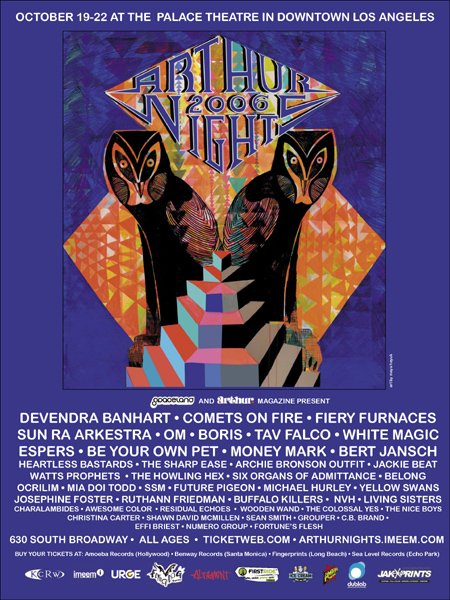
ARTHUR NIGHTS (2006)

Poster by Maya Hayuk.

(Late booking, not on poster: KYP MALONE (TV on the Radio) solo set)


INS & OUTS ALL NIGHT * ALSO CHECK OUT CLIFTON’S CAFETERIA FOR AFFORDABLE AMERICAN FOOD FARE AND A DECOR THAT WILL GIVE YOU A CONTACT HIGH — OPEN ONLY TIL 9PM *

GOOD AFFORDABLE FOOD TOO, RECORDS AND BEAUTIFUL HANDMADE CLOTHES PLUS MORE ON THE FOURTH FLOOR


THURSDAY, OCT. 19, 2006 [stage/schedule is lost, sorry!]

DEVENDRA BANHART
a special performance to close the current cycle

BERT JANSCH
first US visit in 8 years from the ex-Pentangle musician–a guitar hero to Neil Young, Jimmy Page, Johnny Marr and countless others–his new album just got 5 stars from Mojo magazine

ESPERS
gorgeous psychedelic folk-rock from Philly co-ed ensemble

JACKIE BEAT
singing spirit guide to Silver Lake scene queens

BELONG
ambient post-My Bloody Valentine fog-throb duo from New Orleans, spotlit in Arthur 23

BUFFALO KILLERS
lumbering, melodic rock ‘n’ roll from Cincinnati bros featuring former members of Thee Shams

YELLOW SWANS
psychedelic Bay Area agitnoise peacegrunt duo

GROUPER
Bay Area neo-ambient noiselady — ‘some of the most ethereal and powerfully heavy-lidden sounds this side of Brian Eno and Arvo Part’ says Mojo

AXOLOTL
San Francisco drone/noisefella

PLUS:
DJ sets by Dublab rats, Brian Turner (WFMU) and The Numero Group


FRIDAY, OCT. 20

7:20 MAIN HALL

AWESOME COLOR

awesome garage-mantra rock in a Stooges/Spacemen 3 ancestor worship mode

7:30 FIFTH FLOOR

SEAN SMITH

Berkeley-based fingerpicking acoustic guitarist in the great John Fahey-Robbie Basho tradition, part of the Imaginational Anthem tour 

8:05 MAIN HALL

THE HOWLING HEX

He was a prime mover in Pussy Galore and Royal Trux… a brilliant solo career and now his latest project, The Howling Hex… guitarist/genius Neil Hagerty in harmolodic prog-jazz-rock-whatsit flight 

8:15 FIFTH FLOOR

CHRISTINA CARTER

Texan matriarch of the current avant-folk-psych scene, and member of Charlambides, in solo guitar and voice set, part of the Imaginational Anthem tour

8:55 MAIN HALL

HEARTLESS BASTARDS

walloping Ohio rock trio led by wailer/guitarist Erika Wennerstrom–second album just out on Fat Possum

9:05 FIFTH FLOOR

FORTUNE’S FLESH

features ex-Starvations members; “Cockroach’s larvae stage of death doo-wop”

9:45 FIFTH FLOOR

TALL FIRS

mellowside trio on Thurston Moore’s Ecstatic Peace record label

9:55 MAIN HALL

BE YOUR OWN PET

Nashville teenage action-punk quartet led by firecracker vocalist Jemina Pearl

10:30 FIFTH FLOOR

SHAWN DAVID MCMILLEN

“Soporific, glazed” (sez ‘The Wire’) Texas psych, part of the Imaginational Anthem tour

10:50 MAIN HALL

TAV FALCO & THE UNAPPROACHABLE PANTHER BURNS

Charlie Feathers, Alex Chilton, Rural Burnside and more…The truly legendary ‘Dorian Gray of Rock ‘n’ Roll’ from Memphis–admired by rock n roll luminaries like Spiritualized’s Jason Pierce, The Cramps and The Black Keys–in his first L.A. appearance in a decade!

11:15 FIFTH FLOOR

CHARALAMBIDES

beyond-rare L.A. perf by co-ed twin-guitar psych/dream duo on the brilliant Kranky label

12midnight MAIN HALL

BORIS

Japanese doom/rock/blissout superpower trio in performance ahead of the Halloween release of their devastating new album-length collaboration with dronekings Sunn0))) 


Saturday October 21

4:00-on FOURTH FLOOR

SCHOOLHOUSE DROP-INS: “Visit the geodesic tent as the 9 Sundown Schoolhouse residents present projects to partake in, forums for engagement, acts of interaction, thoughts for collective inquiry and general happenings.”

4:20 MAIN HALL

RESIDUAL ECHOES

Stomping West Coast high-energy rock attack unit who blew us away at loast year’s ArthurFest.

5:10 MAIN HALL

FUTURE PIGEON

galactic dance-dub heroism from local ensemble 

5:30 FIFTH FLOOR

WOODEN WAND

mercurial, provocative, prolific folk-rock dude in a solo turn 

6:10 MAIN HALL

WATTS PROPHETS

righteous word jazz elders 

6:25 FIFTH FLOOR

NVH/BEN CHASNY

noize proj from Comets on Fire’s echoplexist/drummer Noel Von Harmonson and guitarist Ben Chasny

7:10 MAIN HALL

MONEY MARK

always imaginative keyboardist/music man–best known for co-writing work with Beastie Boys 

7:10 FIFTH FLOOR

MIA DOI TODD

L.A. singer/instrumentalist on guitar, vocals and harmonium

8:05 FIFTH FLOOR

RUTHANN FRIEDMAN

Folk singer-songwriter, a real child of the ‘60s canyon scene, introduced at Big Sur Folk Festival in 1967 by Joni Mitchell –She wrote “Windy” and so much more–now returning to live performance at age 62!–she lived the ’60s and she remembers it 

8:10 MAIN HALL

SIX ORGANS OF ADMITTANCE

apocalyptic free-mind guitar & voice from Ben Chasny 

8:55 FIFTH FLOOR

MICHAEL HURLEY & JOSEPHINE FOSTER

Hurley is a legendary mellow bard with a hint of wry 

Josephine – you gotta hear this woman sing! “She’s a genius” – Joanna Newsom

9:10 MAIN HALL

WHITE MAGIC

long-awaited return of Mira Bilotte’s NYC-based unclassifiable folk band, new album out next month; this perf will feature Dirty Three drummer Jim White!

10:10 MAIN HALL

OM

return of Bay Area metal trance/mind expander duo who laid peacewaste at this spring’s ArthurBall

11:00 FIFTH FLOOR

LIVING SISTERS

joyous acoustic trio featuring Inara George, Eleni Mandell & Becky Stark (Lavender Diamond), with special guest VAN DYKE PARKS 

11:20 MAIN HALL

SUN RA ARKESTRA

11-piece Arkestra still going deep, now led by the great Marshall Allen 

~12:30am MAIN HALL

NUMERO GROUP DANCE PARTY

“Misplaced soul/funk hits” dance party DJed by the 20th-century pop archaelogists of THE NUMERO GROUP label from Chicago… They’ll be spinning throughout the day, with special sets before and following the Sun Ra Arkestra….


Sunday, Oct 22 

4:40pm in the Main Hall

SSM

John Szymanski, David Shettler and Marty Morris –rawk n roll from Deeetroit on the Alive label

5:30pm on the Fifth Floor

C.B. BRAND

local cosmic California country rock

5:30pm in the Main Hall

THE NICE BOYS

grade-AAA glam rock from Birdman recording artists

6:15pm on the Fifth Floor

THE COLOSSAL YES

Comets on Fire’s Utrillo’s brilliant piano pop proj 

6:20pm in the Main Hall

THE SHARP EASE

Paloma Parfrey-led liberation rockers featured in current issue of Arthur 

7:05pm on the Fifth Floor

CHUCK DUKOWSKI SEXTET

L.A.’s own… featuring Ms. Lora Norton – Vocals, Mr. Chuck Dukowski – Bass (Black Flag), Mr. Lynn Johnston on Horns, Mr. Milo Gonzalez – Guitar, Mr. Tony Tornay – Drums (Fatso Jetson)

7:10pm in the Main Hall

ARCHIE BRONSON OUTFIT

sharply shaped rock music from new English four-piece

7:55pm on the Fifth Floor

EFFI BRIEST

all-female experimental/noise combo

8:05pm in the Main Hall

KYP MALONE

extremely rare solo set from the TV on the Radio singer-guitarist–he’s flying in from the Darfur benefit show in Philadelphia

8:55pm on the Fifth Floor

OCRILIM

solo electric guitar hotwork set from prog-metal-avant maestro Mick Barr 

9:15pm in the Main Hall

THE FIERY FURNACES

justly acclaimed thrill-a-minute brother-and-sister-led clever combo, gifted with pop sense, improvisational chops and conceptual ambition

10:45pm in the Main Hall

COMETS ON FIRE

Quite possibly Earth’s greatest living rock ‘n’ roll band–see present issue of Arthur for more details

DJ sets by Dublab rats and Brian Turner (WFMU)