“How is a heritage turkey different from its factory farm counterpart? What is a Blenheim apricot and why should we preserve it for posterity? How can we all enjoy local, affordable, and sustainably produced food? The answers will be apparent at the first Slow Food Nation, a celebration of American food organized by Slow Food USA for May 1-4, 2008 in San Francisco.
“San Francisco is poised to be at the center of a movement with global implications. Experts such as Alice Waters and Michael Pollan, author of The Omnivore’s Dilemma, are anchoring the task force planning the four-day celebration, which will embody the values of the Slow Food movement and illustrate how food and agriculture form a complex global tapestry of cultural, political, and environmental issues. In addition to education through taste, the event will offer a wide range of activities for all ages, including talks, forums, workshops, and films that will teach people the importance of preserving traditional foods and production techniques—and alert them to the broader implications of their eating choices.
“A marketplace of over two hundred farmers and artisans from across the country will showcase the range of traditional American foods. Attracted by the simple pleasures of the table, participants will leave having learned how American food production affects global issues, including greenhouse gas emissions, childhood obesity, famine in the developing world, and the disappearance of the small farmer. Attendees will emerge with a broad-based vision of the life-enriching benefits of a sustainable approach to food and life, as well as the tools and personal connections to implement that vision.”
Let the Kids In Too: A History of All-Ages, Part II By Jay Babcock
For whatever reason, it wasn’t until earlier this year that I realized the best music events in Los Angeles were missing something really crucial: people under 21. That is, under-21s—let’s call them ‘kids’—are routinely excluded from seeing of-the-moment bands and old masters, in relatively accessible and human-sized settings, at an affordable price. These kinds of shows almost always happen in over-21 bars; or in tiny clubs, in sketchy environs, late on schoolnights. Occasionally they happen in Clear Channel/Live Nation-managed venues—amphitheatres, sports arenas, football fields—but even there it takes heavy change ($65 to see The Mars Volta open for the Red Hot Chili Peppers at the 18,000-capacity Forum?!?), and most of the time all you get is an accountant’s idea of spectacle. Put simply, kids today are deprived of the formative live music experiences that previous generations of human beings—of almost all cultures, from here back to the cave days—experienced as a matter of routine. Music: intimate, intense, performed as something deeper than mere commerce, and received by the community of listeners in the same way.
If music succeeds in connecting to kids today, it is in spite of the music industry, not because of it. How do we know this? Because that’s what some of us have experienced for ourselves, and, more importantly, because that’s what those who came before us tell us—see the comments by blues-jazz scholar/poet/MC5 manager John Sinclair in Part I of this series, published last issue, and see the following conversation with a punk rock legend…
A SESSION WITH CHUCK DUKOWSKI
Chuck Dukowski played bass and wrote several key songs for seminal American punk rock band Black Flag in the late ’70s and early ’80s. Besides being (to quote the writer James Parker) the “attitude engine” of Black Flag, Dukowski played an integral role in the day-to-day operations of California-based SST, the independent record label that was arguably the most artistically and culturally significant label of the ’80s; besides Black Flag, its roster included the minutemen, Husker Du, Meat Puppets, Opal, Saccharine Trust, Screaming Trees and Soundgarden. Today, Chuck rocks the nation as bassist in the Chuck Dukowski Sextet, an acid rock/freakout four-piece featuring his wife Lora, his son Milo, and legendary L.A. reedsman Lynn Johnston.
Arthur: What were the first shows that you attended?
Chuck Dukowski: The very first ones were giant arena concerts. Long Beach Arena in particular. And then shortly subsequent to that, movie theaters being used as the venues that could hold in the hundreds. You’d see bands like Little Richard, Captain Beefheart, Spirit … bands that weren’t filling the arenas. They were all-ages, no booze involved.
Arthur: Was there a rule about where Black Flag would play?
CD: We tried to play all-ages venues as much as possible. Because ultimately, we could play to 3-4,000 people in all-ages here in Los Angeles as early as 1980. We’d play to that many people, and turn around and play a place with an age limit, and we’d be cutting the audience to 250-300—a huge difference.
Arthur: What about outside of Los Angeles?
CD: In the beginning of my touring in Black Flag in the late ‘70s and the early ‘80s, there were quite a few states where the drinking age was 18. And so you’re playing Ohio, where the drinking age is 18, and there’s piles and piles of piles of people there. Once you get to 18, it’s harder to differentiate [laughs], and so things open up. It’s harder to tell the difference between a 17-year-old and an 18-year-old or a 19-year-old, so they kind of let everybody in who wasn’t obviously young, really young, say, 13. But yeah, if you were 16, you were probably getting in.
Arthur: So they were essentially over-16 shows. Now, when the national drinking age was raised to 21 in 1984, bands had to make a choice about which audience to play to: the over-21 bar scene, or the all-ages situation. And nightclubs could outbid all-ages venues to hire bands, so bands would end up playing there to the degree that they needed—or wanted—the guaranteed money.
CD: I can remember booking artists at SST. The bars would have a small room, 200 people, and be able to offer bands thousands of dollars to be there because they could figure on selling so much alcohol. Booze is the vice, the crack, of the live entertainment world. Look what’s happened to jazz. It’s moved into supper houses. They’re technically all-ages, but those places can be expensive situations to get into, which limits that music’s audience to the people who are affluent enough to become part of that. I think it’s rough for young people to get involved in that. At least the punk rock scene and all the offshoots has some more open-ness and more alternative venues, and anybody can play anything. Places like the Smell and Il Corral in Los Angeles today, where anybody can go and hear all kinds of music too. Ultimately, the more vital music is happening in the more open-ended situations. When I play an all-ages show these days, there’s more people there than if it weren’t all-ages, and they’re more involved and open to what we’re doing. They’re people who are interested in learning new things, not just getting what they had yesterday.
Let the Kids In Too: A History of All-Ages, Part One by Jay Babcock
After this spring’s ArthurBall, someone posted to our website saying, “Hey, how was Growing? I really wanted to see them, but I’m only 17.” Now, if anyone needs to see Growing—a drone duo who are making a very challenging, contemplative sound right now, not unlike the first Fripp & Eno album—it’s a 17-year-old: talk about raw material for a formative experience. And yet, he—or she—was denied, because ArthurBall was an 18 & over event. Which meant that I was partly to blame.
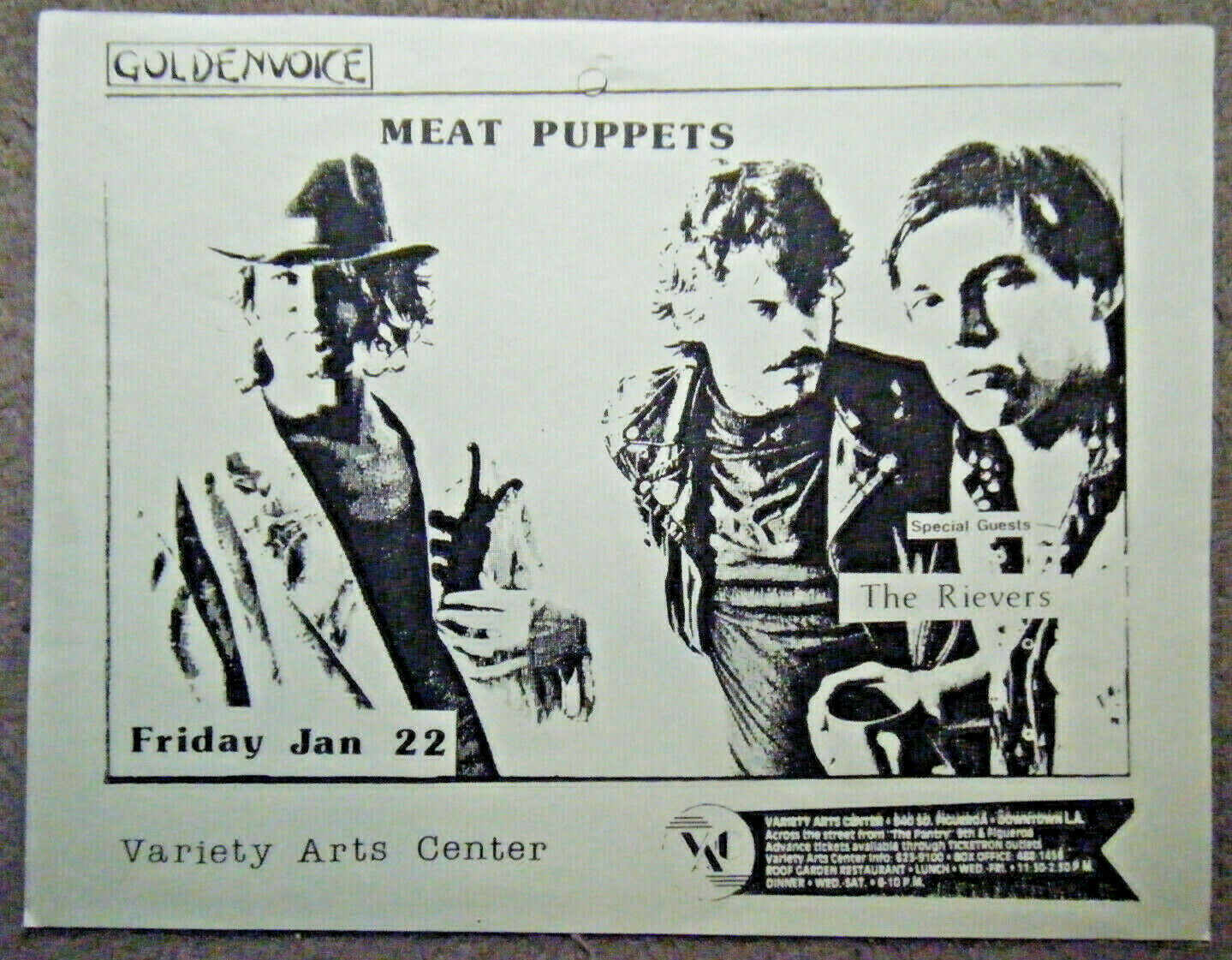
That wasn’t a happy thing to realize. I’d been 17 once. I still haven’t recovered from my own formative experience back in 1988 when I saw the Mirage/Huevos-era Meat Puppets at Variety Arts Center in L.A. I was a teenaged square amidst 1500 freaks of the universe at a cheap, all-ages gig headlined by true goners: enduring the Kirkwood brothers’ 20-minute encore cover of the Beatles’ “She’s So Heavy” left a much deeper, richer impression on my tender, gradually opening mind than seeing U2 and the Pretenders at the Coliseum a couple months before. That was a painfully loud, stage-managed spectacle, a queasy mix of overwhelming power, machine precision and mass audience; the pajama-clad Meat Puppets, on the other hand, were… well, they were fun. They operated on a scale that was recognizably human. They seemed genuinely off-the-cuff, in-the-moment, willing to misfire. Their single stage prop, a pair of Playboy bunny ears spontaneously draped on a microphone, resonated with me in some deep, pleasantly weirdifying way. That Meat Puppets show pointed to a way out: a different way of leading one’s life—of embracing your idiosyncrasies and weird visions and interests rather than suppressing them. It was like some beautiful rite of passage, an initiation into art and imagination and other people—a sideways welcoming into a more creative, fertile, vibrant, rich way of being. Years later, I’d find out that, of course, I wasn’t the only one who’d undergone such an experience: almost everyone I know who is involved with music as a performer or enthusiast or whatever can point to some bizarro show that changed their life when they were a teenager, that lit up new paths.
I wonder if that kind of experience is readily available anymore to those who want it. I mean, the Mars Volta are amazing, but you have to pay $65 to see them open for the Red Hot Chili Peppers at a basketball arena. Growing are cool, but Arthur Ball is 18 & up. And so on. The sad truth is that although exciting music is regularly performed all over L.A.—at backyard barbecues and loft district rent parties, dive bars and supper clubs, nightclubs and art galleries, high school football games and homecoming dances, city parks and Sunday morning church services, street corners and subways, outdoor amphitheaters and baseball stadiums—maybe the only time when a good number of people of all ages can gather together to witness quality music, at an affordable price, with a good sound system, is when an artist plays an in-store set at Amoeba Music on Sunset Boulevard. Kudos to Amoeba for providing this basic public service to arts-starved Angeleno teenagers, of course—it’s more than the public schools and mainstream broadcast media do—but surely it’s not a positive indicator of a culture’s health when the best venue for all-ages music is a record store. ‘Dancing in the aisles’ should mean something more than grooving politely in the Used Funk/Soul section as cash registers ring in the distance.
We lose something as a society when we don’t allow our youth to experience music—by which I mean real, living, breathing music, as opposed to commerce-driven pop—in a decent, accessible, affordable, relatively intimate setting where music is given the opportunity to be truly experienced as music. Something has gone wrong here. But what has happened, exactly, to get us to this point? And is it just Los Angeles, or is it nationwide? What can we do about it? What did they do in the past?
I decided it was time to call John Sinclair.
During the 1960s, John Sinclair founded the Detroit Artists Workshop, managed the MC5, headed the anarchist White Panther Party and got thrown in jail for 10 years for giving two joints to an undercover cop. He was freed after serving two years due to the intervention of John Lennon, who wrote a song for him and appeared at a 15,000-plus arena rally to bring attention to Sinclair’s case (check out the “The US vs John Lennon” documentary for more details). He is a renowned poet, scholar, deejay and journalist, and at 64, still a towering presence. We talked about all-ages shows outside a brandname coffeeshop in Culver City over half-finished crossword puzzles.
John Sinclair: Here’s a point I want to make about this right off: This whole ‘age’ thing is a function of the whole white American culture—it isn’t a universal thing. When I was coming up, you had no congress with anyone more than two years older or two years younger than you, unless they were your brother and sister. You had no congress with adults, with anybody but your own age peers. Everything you did was around that; we were alienated from all the others.
Now, I grew up listening to blues and R&B on the radio in the Fifties. I’m not into country music. I avoided it like the plague. I came from a farming community, and I didn’t want no part of that! Once I heard black music on the radio, I wanted to be where those people were. They were having a lot more fun than anybody I knew, and then when I started going to their dances. It was a beautiful thing. They had big shows in Flint, Michigan. Rhythm and blues shows. I saw everyone that came to Flint between 1955 and 1960. I went to these rhythm and blues shows and there’d be 3,000 black people and 20 white kids who were music freaks and liked to dance. The thing that hit me the hardest about these shows was that there were people of all ages there: little kids, grandmas, and most of the crowd was young adults who were older than us. The teenagers like us were only a stratum. There were people in their 60s, people in their 40s, the finest women you’d ever seen in their 20s just dressed to the nines, red dresses and shit. Knock your eyes out. And there’d be little kids running around and it was no big deal. And the people who wanted to have a drink, they had a flask in their pockets. If they wanted to smoke a joint, they had a joint. It was just like going to a different planet. It was so much hipper. And they were also so accepting. It wasn’t like you would be nervous about being there. They’d let you have your fun, you’d dance with the black girls. It was just like being in heaven for me, man. Because where I lived, I hated everything.
Friday, February 23 *BAM Brooklyn Next Festival:* *Angela Jaeger + Byron Coley*
Angela Jaeger and Byron Coley: NOUVELLE VAGUE…JAMAIS!
*Angela Jaeger* and *Byron Coley* met at Hampshire College in 1977. Both flush with excitement from the incipient punk movement, Jaeger’s trajectory carried her through a series of musical groups in both New York and London (Stare Kits, Drowning Craze, PigBag etc.), Coley’s into a world of underground journalism (NY Rocker, Forced Exposure, Arthur).
Tonight they summon the spirit of the period through records, eyewitness testimony and memoirs. Angela will read from her extensive punk diaries, which are currently being shaped into book form; Byron will read from The Moisture of Diapers, a bilingual collection due soon from Montreal’s l’Oie de Cravan. The records they play will not be chosen by committee!
8:00 p.m.; $10
718.330.0313. ISSUE Project Room, 400 Carroll Street, Brooklyn, NY 11231.
*Directions*
Brooklyn-bound F / G trains to Carroll St. 2.5 blocks from stop (between Bond & Nevins)
15 minutes from 2nd Ave. F stop 10 minutes from Metropolitan Ave. G stop
Brooklyn-bound R train to Union St. Walk 3 blocks west; left onto Nevins; right onto Carroll
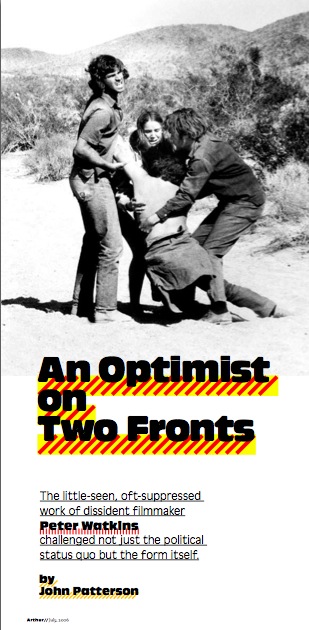
The little-seen, oft-suppressed work of dissident filmmaker Peter Watkins challenged not just the political status quo but the form itself
By John Patterson
In the late 1960s, a series of British filmmakers arrived in the United States who all offered new and vivid ways of looking at America with freshly peeled eyeballs. John Boorman turned Los Angeles into a Pop-Art, Technicolor Alphaville in 1967’s Point Blank; Dick Lester (the expatriate American director who hadn’t been home in 17 years) and his cameraman Nicolas Roeg fell to earth in acid-laced San Francisco, whose discontents they depicted (in 1968’s Petulia) far more bleakly than did the habitués of Haight-Ashbury; “Swinging London” chronicler and beat-documentarian Peter Whitehead captured exploding America between the Tet Offensive and the early ‘68 Primaries in his poetic but hardly-seen The Fall; Peter Yates transformed the look of the urban crime thriller a year later in Bullitt; and John Schlesinger offered a sleazy, misanthropic look at America’s urban flotsam in Midnight Cowboy.
None however, produced so searing and angry a denunciation of the New World as Peter Watkins did with 1971’s faux documentary Punishment Park [pictured above], with its invocations of political concentration camps on American soil, police death-squads executing activists and dissidents, and the media’s inextricable complicity in both. Whereas most of the other newcomers’ visions were welcomed, Watkins’ was rejected out of hand. Punishment Park played for four days in Manhattan. PBS said outright that they would never show it. And so it vanished into a twilight world of occasional campus screenings—usually with Watkins in attendance—before vanishing utterly for 35 years. Apparently 1971 was the wrong time for an Englishman to diagnose, however sagely, the discontents of Vietnam-era America.
Time has either been very kind to his films or very cruel to us, by making the world so ugly and violent that Punishment Park‘s recent re-release on DVD has occurred in the most propitious environment imaginable. Abu Grahib and Guantanamo are fresh; the Patriot Act and the NSA wiretapping program hang menacingly over us all; war is back with a vengeance, and dissent against said war has metastasized, along with a profound disgust for the complicity of the corporate media in all the doings of Dubya. Where critics roundly abused the film—when they were not ignoring it—back in 1971, many are now roused to feel that Peter Watkins’ vindication may be at hand. And with the gradual release by New Yorker Films of nearly all his major works over the last year, Watkins can finally be reassessed—or assessed for the first time—on his own terms.
Watkins seems to have been born fully-formed as an artist. He studied at Oxford and the Royal Academy of Dramatic Arts, becoming interested in radical politics and cinema. His second short film, a full-scale reenactment of the Budapest uprising of 1956, was shot entirely on the placid streets of his hometown of Canterbury. It won him a place at the BBC where his first commission, in 1964, was an adaptation of historian John Prebble’s revisionist account of the Battle of Culloden in 1746.
Culloden, which saw the defeat of Bonnie Prince Charlie’s invading army by King George II’s brother—known ever after as “Butcher Cumberland”—was the last battle fought on British soil, between two armies composed of aristocratic officers and feudally indentured English troops and Scottish clansmen. Watkins twisted the material by allowing his collective cast of performers to address the camera directly, to tell their own bitter stories and even, on occasion, to reach out and tell the crew to get the fuck out of the way. Watkins is narrator, providing context, facts and figures, and the future destinies of the participants, outlining class relations between Generals and cannon-fodder. In the brutal aftermath of the rout, the British regulars are seen hacking women and children down on country roads and beheading the dead. Culloden is a no-budget masterpiece of mocked-up war footage that puts Saving Private Ryan’s opening half-hour to shame (in addition to his other talents, Watkins is a world-class director of kinetic action footage). Culloden was also made in full awareness of what was beginning to unfold in Vietnam. It pulled no political punches, but its ecstatic critical reception was offset by angry complaints from right-wing MPs and military figures.
The fact that Culloden, with its heavy emphasis on political revisionism, was made for the documentary department of the famously “objective” BBC is indicative of certain tensions inherent in Watkins’ approach to drama. His next film, The War Game, was a fake documentary, albeit using realistic scenarios and public information about the likely effects of a nuclear attack on southern England, but was made within the Plays Department of the BBC, a cauldron of radical productivity that David Thompson, with little exaggeration, has dubbed “the Last Studio” (it also produced pioneering ’60s and ’70s work by Ken Loach, Dennis Potter, Steven Frears and Mike Leigh, among dozens of other filmmakers).
At 48 minutes, The War Game was too hot for the BBC, and even more so for the politicians of the time. Using available statistics and government documents, Watkins showed that Britain, faced with the possibility of atomic warfare, had settled for the illusion of security in its aftermath. Watkins illustrated the effects of nuclear firestorms, mocked duck-and-cover safety drills (a child’s eyeballs melt down his face), and finished his highly unnerving polemic with the nightmarish image of British bobbies interning political protesters and mercy-killing the victims of radiation sickness with a bullet. The corporation pulled it before broadcast, claiming it was too disturbing for the public. Although it won that year’s Best Documentary Oscar (the closest Watkins ever came to mainstream success) The War Game was not shown on British TV for another quarter-century, during which period it was established that it had in fact been suppressed for political reasons, not matters of taste—just as Watkins had always claimed. In addition Watkins had stood athwart the line separating fiction from documentary—it is the necessary place to be for an artist denouncing the latter as merely a variation on the former—and this only added to the discomfort of the powers that be.
A brief and unhappy flirtation with Paramount Pictures produced Privilege (1967), an intermittently successful satire on rock-n-roll as a means of codifying dissent (it features the GI rock band The Monks playing “Onward Christian Soldiers”!) before Watkins left England for Scandinavia, his base for most of the next decade. There he put together The Gladiators (a/k/a The Peace Game, 1969), perhaps his weakest film, in which wars between nations are settled by small bands of warriors on an internationally broadcast TV show. Privilege never really found an audience, and The Gladiators was not widely shown, though both received some respectful reviews.
After failing to put together a project about the Little Big Horn in Los Angeles, Watkins found the backing for Punishment Park. Filmed in the Mojave Desert in 1970, under the wide, black shadow cast by Kent State, the Chicago 7 Conspiracy Trial, the illegal bombing of Cambodia, and the insidious process by which the Nixon White House sought to arrogate ever more power unto itself, the movie showcases as well as any of Watkins’ films the essential method which has served him so well over his career.
Unfolding in a half-speculative, half-satirical timeframe that one might call “the recent future,” Punishment Park takes elements from the contemporary political ether, stretches them to their plausible limits and then builds a searing, sun-scorched drama within that context. It is 1973. The Clampdown on political dissent has already occurred, under the draconian terms of the anti-communist 1950 McCarran Security Act. Interned dissidents are transported to the Bare Mountain National Punishment Park. When guilt is established, defendants have a choice: a lengthy prison term or Punishment Park. The latter requires a group of prisoners to cross 50 miles of desert without food or water. Survivors can go free; more likely they will die of dehydration or be shot by organized bands of police, highway patrolmen and National Guardsmen.
Watkins cuts between the grueling desert ordeal—think: Survivor with real guns and bloodshed—of the condemned prisoners, and the show-trial of the next batch, which is consciously modeled on the proceedings against the Chicago Seven. As always, the cast is collective, not focused on individuals. All the actors are amateurs, cast for the proximity of their political views to those of their characters: words and opinions are their own. Antiwar activists, feminists and union organizers play the prisoners. Right-wingers, cops, and political “moderates” play the judging panel and the murderous enforcers of the last shreds of the law.
With this 360-degree environment in place and the figures within it all set to run and play and suffer and die, Watkins adds his distinctive pseudo-documentary overlay. All the major media companies are here to film all proceedings in Punishment Park. Watkins, as in all his films, acts as narrator and interviewer, and is always behind the (usually handheld) camera, eliciting raw anger from the prisoners and blithe and arrogant fuck-you-so-whats from their uniformed oppressors (the camera was operated by Joan Churchill, who has since worked extensively with Watkins’ fellow BBC alumni Nick Broomfield. Cinematographer Haskell Wexler says he lit the tent scenes for Churchill.) As the ordeal in the sun becomes ever more blood-soaked and viciously punitive, Watkins’ “objectivity” steadily dissolves and he is finally reduced to screaming, “Stop it, you fucking bastards!” as, within sight of the prisoners’ objective—an American flag—troops methodically beat and massacre the last few remaining prisoners.
No one makes it. (This is a Peter Watkins movie.)
Watkins’ films always fight on two fronts: against the political status quo, obviously, but also, and perhaps more importantly, against the media itself, its owners, its place in the political economy, and its formal and cultural shortcomings. In his early work, he merely made the process of filmmaking evident to the viewer, but after his experience with The War Game, the craven nature of conventional media coverage and broadcast institutions became one of his overarching themes. He has since worked to overthrow conventional ideas about running times—his antinuclear epic The Journey (1987) lasted 14 hours—and notions of who is qualified to make movies—his Strindberg biopic The Freethinker was written, performed, photographed and edited by a Swedish high school class Watkins was teaching in 1994. Subsequent experiences have only deepened his antipathy toward the institutional media, which has sometimes hobbled his career in TV. After all, if one of the cornerstones of your aesthetic and political method is an abiding distrust of, and contempt for, the very mechanisms by which your work will be made available for public examination, you may soon find that the phone stops ringing. It’s a testament to Watkins’ stubbornness and determination that he ever made another film again.
Watkins addressed the issue in his most personal and lyrical film, Edvard Munch, a polemical biography of the pioneering Norwegian Expressionist, made for Oslo television in 1973 and released to international acclaim in 1975 (naturally, its backers hated the film and did whatever they could to stymie its success). Here was an artist identifying totally with his subject: like Watkins, Munch refused to countenance any limit or compromise to his bleak vision, no matter how much insult and false recrimination he endured from the artistic establishment of his time. This intense sympathy between biographer and subject may also explain why Edvard Munch is among the greatest portraits ever created of an artist’s life and work
In the lean years between such projects, Watkins has established a parallel persona as a media theorist at his website (http://www.mnsi.net/~pwatkins/), decrying the prevailing hierarchical media approach he has dubbed the Monoform. He condemns the topdown imposition of political conclusions, the absence of any entry-point for the passive, excluded spectator, and the reliance on optimistic, hero-centric narrative forms, as well as the institutional corruption and dishonesty of most state-backed or corporate media outlets. It is a coherent, compelling and highly persuasive diagnosis, but one feels it would require a revolution to bring it all down.
Which brings us to La Commune (Paris 1871) which alongside Edvard Munch is probably Watkins’ masterpiece. Six hours long, filmed entirely in swooping SteadiCam takes lasting up to 15 minutes, it attempts nothing less than a recreation of the revolutionary Commune that ruled Paris in the aftermath of France’s defeat in the Franco-Prussian War. This story is still so incendiary that most French schools simply do not address it in history lessons, and Watkins is anxious to show how those in poverty and deprivation were able, with no outside help, to articulate and put into practice many of the revolutionary ideals—feminism, equal pay, popular democracy, free state (i.e., non-religious) education for all, collectivism, etc.—that would sustain the political Left throughout the century to come.
The result is perhaps the purest embodiment of Brecht’s theories of Epic Theater ever committed to film (Brecht himself once wrote a play called Les Jours de la Commune for his Berliner Ensemble). Deliberately adding the creative anachronism of two TV news teams—one right-wing (and disconcertingly like Fox-News) and another that’s politically engaged with the communards—Watkins puts the innards of the filmmaking and newsgathering machinery on full display, and while we are never allowed to forget that we’re watching a manufactured, albeit committed polemic, he also enables us to feel great anguish when these flawed, but optimistic utopian idealists are finally massacred, in their tens of thousands, by Monarchist troops in a Parisian park—another Punishment Park.
Before this happens however, Watkins has also made us feel—through endless discussion, argument, violence and peacability—the sense that it is possible and desirable to tear the old world down and rebuild it anew, according to fresh and equitable precepts that encompass the dignity and worth of every man and woman. Such radical ideals have been eroded and scorned into meaninglessness of late, and Watkins’ great achievement is to make them intoxicating once again. And, to answer Watkins’ critics, that is not what pessimists do. It is what optimists strive for.
Somewhere deep in his despair, Peter Watkins, a man who truly has no home but the struggle, is an indefatigable optimist. His work awaits you. Seize it with both hands, because it will change you, and it will make you want to change everything else.
BOMB POP Born in war-torn Sri Lanka and bred in London, rising star M.I.A.’s pop instincts, radical consciousness and proudly pan-ghetto sound have no easy origin. As the defiant singer/MC explains to Piotr Orlov, it’s both where she’s from and where she’s at. Cover photo by W.T. Nelson.
“The mask is the face.” – Susan Sontag, “On Style”
“I don’t have a side, I’m spread out but I’m a mile wide/I got brown skin but I’m a west Londoner, educated but a refugee” – M.I.A., “MIA”
What, if anything, do we look for in a “pop” star worth supporting? Or more to the point, what are we willing to put up with, besides some gratuitous chart-topping populism and the 15-minutes of media-saturated intrigue, of course? Do we have any right expecting pop stars—not to be confused with musical artists whom luck, trends, circumstance or one great tune propels towards the mainstream—to influence a greater cultural conversation? Pop is, after all, the most powerful global transmitter of ideas in the information age, receiving over the past fifty years equal credit for the democratic tilt of history (Ted Turner’s comment that Western cultural export helped bring down the Berlin Wall) and civilization’s moral decline (Elvis, Madonna, Gangsta Rap, et al.). So, what effect can be brought about by a beautiful young woman whose looks and dance moves, globally minded outlook, state-of-the-art sonics, and spirited attitude recall any number of recent kiddie-pop models—yet whose life experience is based not on driving-towards-stardom dreams and Mickey Mouse Club auditions, but a mix of Third World civil war fatigue and immigrant struggles, Western art-school opportunity and hip-hop generation rebellion, independent experience and mod cons?
Meet Maya Arulpragasam, a 28-year-old Sri Lanka-reared, London-educated singer/MC with the stage-name M.I.A., who is approaching her pregnant pop moment, that inexplicable period when a confluence of fates—real and manufactured, critical and social, art and market—align to create sensations, and, at times, freak cultural anomalies and paradigm shifts. Since late 2003, she’s released a steady stream of dancehall-meets-hip-hop-meets-pop singles (“Galang” and “Sunshowers” being the most prominent) and one mix-tape (“Piracy Funds Terrorism, Vol. 1,” co-produced by Philly DJ wunderkind Diplo), blowing up via underground and Internet delivery systems (MP3 bloggers adore her), setting record companies frothing trying to pick up the rights to her debut album, Arular. (One succeeded: The album has just been released by the indie XL, but will soon be worked by Interscope.)
“Nor is it to be thought that man is either the oldest or the last of earth’s masters, or that the common bulk of life and substances walks alone. The Old Ones were, the Old Ones are, and the Old Ones shall be… They walk serene and primal… They walk unseen and foul in lonely places where the Words have been spoken and the Rites howled through at their Seasons. The wind gibbers with Their voices, and the earth mutters with Their consciousness. They bend the forest and crush the city, yet may not forest or city behold the hand that smites…. Man rules now where They ruled once; They shall soon rule where man rules now. After summer is winter, and after winter summer. They wait patient and potent, for here shall They reign again.” — from “The Dunwich Horror” by H.P. Lovecraft
It begins in an ancient temple, or a temple that certainly looks antediluvian, deserted except for a young man who lays upon the floor, insensate. He wakes slowly. Dressed in raggedy homespun, he looks like an androgynous gutterpunk, circa 960 A.D. The temple is wide and long, bounded on both sides by columns hewn from rock. At one end of the temple, on a stone bier at the top of a short flight of steps, lays a young woman, sleeping a deathless fairy-tale sleep. Or dead, perhaps, awaiting burial. Indistinct voices speaking no known language can be heard, faintly when you (as the young man) approach her, and though nothing is clear, your purpose seems obvious and instinctual: wake the girl, somehow. Her resting place is at the end of the temple open to the vast countryside, and the light that comes from the outside is hazy and autumnal, golden.
You are, inevitably, armed. Your arsenal includes, and will only ever include, a plain sword and bow and arrow. The sword is, of course, magic: when you hold it aloft in the sunlight, it seems to collect the light, grabbing sunbeams from the air and focusing them into a bright beacon. You discover that if you experiment with turning in certain directions, the formerly disparate and scattered beams tend to form into a focused, single beam. The only other living thing in the temple is a horse, which allows you to mount it. Being no dummy in the ways of video games’ enchanted objects, you decide to aim your horse in the direction the beams collect. Your trip is untroubled. The verdant but quietly desolate and melancholy countryside seems to number only you and your horse as living inhabitants. The scent carried on the wind would be, if you could smell anything, narcotic and mournful, an opiate of burning, fallen leaves and other dying things.
The beams of light lead you to a cliff face that, if it could, would drop to its knees and beg you to climb it, so you do after a bit of trial and error experimentation, driven by a strange sense of purpose and obligation to the sleeping girl, feeling that at the top of this cliff, something awaits. This is important, you think. And then you are there at the top of the cliff, and it is there that you finally see it: standing at least one hundred feet tall, the minotaur-thing strides back forth across the length of a small valley. It doesn’t drip blood from its fangs, snatch cows from a fleeing herd and toss them into its mouth like popcorn, or even open its mouth to spray great gouts of fire at an unfortunately located village. It simply walks back and forth carrying a great club, looking as if it was born equally of stone, metal and flesh, possessing the ground it strides as befitting a godlike force of nature, and you know, with a heavy heart, that your task is to use your basic tools of war to achieve the impossible: the destruction of this beautiful behemoth before you. The first part of the destruction is an academic puzzle: how do you scale such a thing and find its weaknesses? And once you find its weaknesses, how do you humble it and then slay it? And once you do this impossible thing, you know that you cannot rest, and that the girl sleeping in the temple cannot wake, until you find the other towering creatures, Colossi, titans, Old Ones, whatever they are, and destroy their terrible beauty as well.
And that’s it. There’s no expository dialogue explaining the plot in the comically serious jargon as common as air in the videogame world. There’s no attempt to set your Quixote-esque pursuit of the ever-larger and ever more fancifully rendered Colossi in the rigid frame of good versus evil or right versus wrong, as the conventional wisdom of storytelling demands. You simply are, and your quest simply is. It is, quite simply, an extraordinarily exhilarating and confoundingly beautiful experience. And this is a videogame, for pete’s sake: a heavy, heavy videogame full of weird wonder, atavistic dread and thrillingly bizarre, avant-garde leanings.
In fact, at times Shadow of the Colossus feels more like an epic-length stoner rock record than a videogame.
A history of the free, alternative, counter-culture and underground press, 1965-75
Gavin Brown’s enterprise at PASSERBY
436 W. 15th Street,
New York, NY 10011
February 2 – March 7, 2007
((((free))))
“An exhibition of the world’s most radical living papers from a time when the press took risks and voiced opinions….
“Celebrating the heyday of alternative magazine publishing in Europe and America… More than two hundred original copies, as well as reproductions of these seminal and obscure publications, whose influence reverberates through culture, politics, and society.
“Covering politics, revolutions, evolutions of the planets, freak-outs, love-ins, support of green politics, gay liberation, power to the people, the peace parties, protests, the Panthers, peyote, LSD, pot, fiction, music, poetry, prose, prayers and more. Publications include: Actuel, Avatar, Berkeley Barb, Berkeley Tribe, Black Panther Papers, Digger Papers, Door, East Village Other [EVO], The Fifth Estate, Freep, Grabuge, Hobo-Québec, International Times [it], Los Angeles Free Press, The Oracle, The Organ, Other Scenes, OZ, Rat, The Realist, Re Nudo, Rolling Stone, The Seed, Ann Arbor Sun
After the big Drawn & Quarterly slideshow comics jamboree starring Gabrielle Bell, Anders Nilsen and Kevin Huizenga at Skylight Books (7pm!), come on down for an evening of unprogrammed music, spirits and healthy celebration at
The Echo Park Social(ist) & Pleasure Club
Thursday, Feb 8
and every Thursday night
10pm sharp
at
LITTLE JOY
1477 Sunset Blvd in Echo Park
((( free )))
21 & up
presented by ARTHUR Magazine and L.A. Record
Tonight’s deejays:
10pm-1100pm: Wendy Higgs
1100pm-1200am: Astrid (Winter Flowers)
1200am – close: Maximilla & Guy (Entrance)
And tonight’s friendlier bartender will be none other than Arthur Magazine’s “Do the Math” pundit Dave Reeves. Say hi to Dave, especially if you’re a lawyer.
New issue almost ready,
People de la Arthur
Los Angeles // Nevada City // Northampton // Bushwick // Laramie



 Arthur Magazine