

Yearly Archives for 2008
Found friday morning on a sidewalk in Atwater Village

Looked like the poor girl (fella?) had swallowed rat poison.
LES BLANK films TONIGHT (fri) at CineFamily in L.A. Fairfax district

Friday, March 14th @ 7:30pm
SERIES: LOCAL FLAVOR:
LES BLANK’S FOOD FILMS
Les Blank Program Two:
Werner Herzog Eats His Shoe
The most unlikely inspirational film ever made documented the results of a bet between iconic German filmmaker Werner Herzog (subject of Blank’s classic 1982 documentary Burden of Dreams) and his student, Errol Morris (he’s since fulfilled Herzog’s prophecy tenfold, becoming the quirky visionary documentarian responsible for Fast, Cheap & Out of Control and The Fog of War). The Cinefamily would like to confirm that, yes, the time has come for you, finally, to watch Werner Herzog eat an entire shoe, because life is short, and it is marvelous, and a fancy chef cooked the shoe in duck fat first.
Directed by Les Blank, 1980, 20 min
A Well-Spent Life
Blank’s perfectly sweet, laconic portrait of genius bluesman Mance Lipscomb is one of the director’s most satisfying morsels: his lens alternates, with stunning care, between slices of the guitarist’s unmatched musical skill and pastoral philosophies, and his marvelously funny, gentle home life. Come see why there’s no question as to what made this Kurt Vonnegut’s all-time favorite film. Directed by Les Blank, 1972, 44 min
Garlic Is As Good As Ten Mothers
Worshipers of the stinking rose couldn’t dream of a more sacred celluloid altar to the olfactory and gustatory beauty (or maybe just… undeniable power) of everyone’s favorite vampire-repellant. Those who scour the internet for hot food-on-food action will revel at Blank’s joyous homage to the colorful culture that surrounds culinary rapture.
Directed by Les Blank, 1980, 51 min
MORE INFO at silentmovietheatre.com
U.S. Senate hit by ghost mob
CALLING ALL GHOSTS
by The Center for Tactical Magic
Originally published in the “Applied Magic(k)” column in Arthur Magazine No. 25/Winter 02006
Ghosts are unwieldy subjects to contend with. It’s as if their ephemeral nature predisposes them to be barely tangible topics of research. The vast majority of evidence used to support the existence of ghosts is subjective: first-hand reports and eyewitness accounts. Despite the fact that forensic science, cultural geography, physics, and parapsychology all suggest that any given area is inscribed with the residue of that area’s history, the hard data on hauntings remains inconclusive.
To make matters hazier, the definitions of ghosts often swirl together with religious beliefs and philosophical assumptions. For example, if we define ghosts as being the spirits of the departed, we are stating clearly that we believe in life-after-death and some notion that separates body and spirit. Whether this notion is Cartesian dualism, Egyptian ka, Polynesian mana, or the yin-world spirits of Taoism, the assertion is that the individual is not indivisible. At the very least we are forced to accept the idea that the self is multiplicitous.
This shouldn’t be such a leap. At any given moment a person can be characterized by many different activities that s/he engages in: mechanic, musician, anarchist, lover, gardener, cyclist, etc. A person doesn’t think of him/herself as a mechanic when s/he’s in the garden, although s/he also doesn’t stop being a mechanic. We are many things to many people in many spheres of activity – simultaneously. But still we remain ourselves. On the most basic level, we live multiplicitous lives every day.
And when we go to sleep at night, it doesn’t end there. Our dreams continue to embroil us in action-adventures that would surely leave us breathless and exhausted if it weren’t for the simple fact that our bodies barely participate in all of the fun. If there is any sort of universal logic that can be applied as a subjective proof for the insubstantiation of the self, it is the simple fact that we all dream, whether we remember it in the morning or not.
To be clear, dreams don’t prove that ghosts are real. Nor does it prove that ghosts are the spirits of dead people. Rather, the travels we undertake when our eyes are closed simply suggest that a meaningful disembodied existence can occur. Even if we dismiss dreams (and ghosts) as immaterial and inconsequential, anyone who has ever experienced a nightmare won’t deny the fact that these visions can cause acute physical and psychological sensations in our waking lives.
But what are ghosts exactly? The incorporeal dead hanging out amongst the living? Reflected light? Psychosis? Atmospheric anomalies? Holographic messages from the future? Alien lifeforms? Osama’s latest WMD (Weapon of Mental Distortion)? Whatever they are, ghosts, like magic(k), pop up, in one form or another, in nearly every culture on the planet, and have been described in legends, myths, and stories throughout history. A popular Chinese attitude towards ghosts is voiced in the age-old expression, “If you believe it, there will be, but if you don’t, there will not.” According to legend, the saying was penned by a scholar named Zhuxi (Song Dynasty, 960 – 1279). Now Zhuxi was such a strict non-believer that he decided to write an essay about the non-existence of ghosts. But, lo and behold!—a ghost showed up to convince him otherwise. The ghost made such a lucid argument, that Zhuxi was forced to reconsider his thesis. In fact, it’s actually the ghost that is credited with authoring the aforementioned expression, and Zhuxi merely wrote it down.
Whether we believe in ghosts as actual paranormal phenomena, or as manifestations of mass cultural imagination, we can agree on some fundamental characteristics of ghosts. For starters, it’s significant to note that many such manifestations consistently take the form of people, or exhibit seemingly conscious behaviors. This could be similar to looking skyward and seeing faces in the clouds; however, there’s one major exception. When we let our minds drift in the cumulo-nimbus we also tend to see things like bears in bathtubs, and inverted Lay-Z-Boys. And we don’t hear ghastly tales of glowing gaseous forms resembling anything quite so banal, or cute and cartoony. Instead, we are most often presented with accounts of haunting encounters that evoke horror, sorrow, fear, anger, remorse, passion, and purpose. Ghosts emerge from the shadows; from dark corners; from forgotten and abandoned recesses. Regardless of whether or not these phantoms are psychological projections or external paranormal phenomena, it’s clear that our collective response to these apparitions is apprehension, angst, and anxiety.
Generally speaking, there are two dominant types of ghost stories: lost love, and grave injustices. The “lost love” category encompasses all of those apparitions who wait endlessly for lovers to return, or visit their living loved ones for comfort, counsel, and last condolences. In the second category, the vast majority of ghost stories hover around a central theme of grave injustices yet to be rectified. Murder. Torture. Betrayal. The plight of this sort of phantom is one of paradox; it seeks to rest in peace, yet refuses to quit the struggle until things have been set right. While the crimes of the past still linger at the site of a haunting, the ghost’s job is to make sure we, the living, don’t ignore it. Their refusal to let injustices be forgotten manifests in a form of spiritual civil disobedience. From silent vigils to shrieks and moans to outright property destruction, these ghosts are paranormal protestors bearing witness to a world gone woefully awry. In their quest for peace, the phantoms that haunt us defy the laws of the material world in acts of otherworldly anarchism. Offering spiritual resistance to the complicit affairs of everyday life, these insurgent souls have little regard for the rules and boundaries that restrict the world of the living.
They defy even gravity itself. Moving through gates and walls, no barrier restricts their attempts to resolve the inequities that torment them—and consequently us. After all, it is the apathy of the living that drives them to disturb the peace, because they cannot rest until the conflict is, once-and-for-all, addressed and resolved. There is no moving on. Not until unsavory events are properly put to rest.
It’s this kind of dissenting spirit that needs to be channeled today. Even Senator Specter (R-PA), whose position on most policies is rather ghoulish, could not sit idly by when faced with the recent legislation surrounding Guantanamo Bay detainees. Like all hauntings, the degree of uncanniness is quite remarkable. It’s only too fitting that the Chairman of the Senate Judiciary Committee be named Specter. And perhaps even more appropriate that he should take issue with the United States’ recent dissolution of habeas corpus (meaning quite literally “(You should) have the body”). Dating back as far as 1305, and included in Article 1 of the U.S. Constitution, habeas corpus is one of the oldest and most celebrated guarantees of personal liberty. It grants individuals the right to question their detainment and challenge the government on the legality of their imprisonment. By killing habeas corpus, the clock on civil liberties is set back more than seven centuries to a time when judicial courts were simply a king and his dungeons. No wonder Mr. Specter is voicing his disapproval.
The haunting of society by the ghosts of our collective past resonates within a present that continues to manifest grave injustices. Generation after generation, the abuse of power materializes in a reoccurring nightmare, claiming countless victims—collateral damage in a battle to maintain hegemony. Doomed to repeat the tragedies of the ages, these lost souls insinuate their desires and anxieties into the world of the living. Each step of the way, these energies inform our thoughts, our dreams, our actions—indeed, every aspect of our existence. Ghosts are an unsettling reminder that the crimes of the past have not yet been resolved. Refusing to quietly fade from consciousness, they demand that their howls be heeded. The residues of injustice permeate the physical, psychological, and parapsychological landscape, inscribing the present with desperate warnings and demands for reconciliation.
Perhaps it’s time for the living to start paying attention to the stirring in the shadows. These aberrations in space, time, and freedom remain inscribed in mind, spirit, and social body, awaiting their release through the discovery and recovery of our own self-determining forces. Can the righteous spirits of the past truly join forces with the living to achieve peace and justice? If you believe it, there will be, but if you don’t, there will not.
EXERCISES
Through methods of divination, channeling, investigation, experimentation, and active engagement, we can invoke those that seem most experienced in dealing with past inequities—ghosts. Here are a few experiments in magic(k) to get you started. As always, please let us know how it goes by emailing to: goodluck at tacticalmagic dot org
1. Summoning ancestral spirits for guidance and inspiration is an age-old practice re-popularized in the ’70s through Milton Bradley’s mass production of the Ouija board. But you don’t need to jump on eBay to get a piece of the action. Make your own walkie-talkie to the spirit world by covering any smooth surface with the letters of the alphabet, numbers 0-10, and the words, “yes,” “no,” “unclear” and “goodbye.” Use another object that glides easily over the surface as your planchette, or pointer. A shot glass, serving spoon, or cell phone will work okay. A generic board will likely attract a general audience. For the best results, craft your set-up with a righteous spirit in mind using items and symbols that the spirit might find appealing. If, for example, you wanted the counsel of Nathan Hale, draw the board on a copy of the Patriot Act. For Harriet Tubman, try replacing the planchette with a broken handcuff. Grab a few friends, dim the lights, and place your fingertips lightly on the planchette. Then, invite the spirits, and begin your supernatural conspiring.
2. The problem with ghosts is not that they won’t shut up, but rather that it took death to get them to speak up in the first place. Is it fear of death that keeps us from voicing our dissatisfaction with the world of the living? Or fear of life? Fortunately, there’s no need to wait for that last breath to start haunting places. Form your own ghost mob and venture out to haunt sites of known social injustices. Banks, police stations, recruitment centers, and chain stores are but a few potential targets. From large-scale occupations by friends in Halloween gore to quiet insertions of tape recorded whispers and groans, a ghost mob can embody suppressed fears and desires whilst banishing the specters of social control.
3. Encounters with ghosts are said to increase during times of social crises and the post-trauma periods immediately following. Most notably, research suggests that more people see ghosts (or at least report them) in wartime and during post-war transitions. If this assessment is accurate, we should expect a barrage of ghost sightings related to Katrina, Afghanistan and Iraq. We are sincerely interested in studying this trend. If you have had paranormal experiences that you feel are related to social crises, please let us know by emailing us at: socialhauntings at tacticalmagic dot org
ABOUT THE AUTHOR: The Center for Tactical Magic is a moderate international think tank dedicated to the research, development and deployment of all types of magic in the service of positive social transformation. To find out more, check out tacticalmagic.org
Moko the bottlenose dolphin rescues beached whales
NZ dolphin rescues beached whales
BBC- Wednesday, 12 March 2008, 11:31 GMT
A dolphin has come to the rescue of two whales which had become stranded on a beach in New Zealand.
Conservation officer Malcolm Smith told the BBC that he and a group of other people had tried in vain for an hour and a half to get the whales to sea.
The pygmy sperm whales had repeatedly beached, and both they and the humans were tired and set to give up, he said.
But then the dolphin appeared, communicated with the whales, and led them to safety.
The bottlenose dolphin, called Moko by local residents, is well known for playing with swimmers off Mahia beach on the east coast of the North Island.
Mr Smith said that just when his team was flagging, the dolphin showed up and made straight for them.
“I don’t speak whale and I don’t speak dolphin,” Mr Smith told the BBC, “but there was obviously something that went on because the two whales changed their attitude from being quite distressed to following the dolphin quite willingly and directly along the beach and straight out to sea.”
He added: “The dolphin did what we had failed to do. It was all over in a matter of minutes.”
Mr Smith said he felt fortunate to have witnessed the extraordinary event, and was delighted for the whales, as in the past he has had to put down animals which have become beached.
He said that the whales have not been seen since, but that the dolphin had returned to its usual practice of playing with swimmers in the bay.
“I shouldn’t do this I know, we are meant to remain scientific,” Mr Smith said, “but I actually went into the water with the dolphin and gave it a pat afterwards because she really did save the day.”
RIP Gary Gygax

repost from Captain Zorikh’s Media Blog
A father is gone.
The world that we in the fantasy fan community enjoy, one in which wizards and warriors, elves and dwarves, magic and monsters and yes, dungeons and dragons are common parlance owes a great deal of debt to the man who placed a dragon in a wargame.
When I was 11 year old I had heard of D & D, but had never actually seen the game. Then someone in school brought out the three books and the half-dozen dice and started a campaign. That was it. Everyone in 7th and 8th grade was hooked. Every spare moment of time was taken up by D & D adventuring. Eventually this expanded into Traveler, Boot Hill, Gamma World, Time Tripper, Car Wars, and more games that I can remember. In that school being what we would call today a “geek” or “dork” was cool. It was hip. Social status was based on being the first one to have a new game, or the best game that week.
We designed our own character sheets. We drew up our own characters. We created our own gods and monsters. “The Emperor” was the All-Powerful-Force of Evil (yes, inspired by Empire Strikes Back), “Enigma” was the All-Powerful Force of Good (from the Micronauts comic book, I think). I thought of creating an All-Powerful Force of Neutrality, but kept on going back and forth on it. My character got turned into a Gollum and stretched out to 7 feet tall on a rack. Someone created an assassin with an atomic bomb. Someone else tried to use a saving throw when the bomb went off.
We drew maps. We designed weapons. We collected miniature figures and placed them on graph paper. We designed dungeons. We collected dungeon modules and dice. Our imagination was stoked and our social interactivity was very, very high.
When I left that school and moved to a public high school, I found the social situation there very different. I never was able to get back into gaming, though I still collected everything about Car Wars for some years (as I was a big fan of post-apocalyptic movies like The Road Warrior). Eventually I found the Society for Creative Anachronism and was able to live a historically-based, live action version of D & D, and for a time sneered at those who rolled dice to gain their skills, while I actually worked for it.
I never saw more than a few minutes of the D&D cartoon, but I followed the comic strip advertisements in the backs of comic books in the early 1980’s. When the Dungeon and Dragons movie finally came out, I was very excited. For decades there had been films and TV shows that, to one degree or another, I felt were trying to bring the D&D world to life, and I, in turn, had tried to turn those movies into games (you can see a list that includes many of those movies at http://www.geocities.com/historicalmovies). Now someone was actually going to make that movie for real. The movie was poor, but fun. Though the acting was uneven, the writing corny, and the Wayans brother character the most politically incorrect ethnic stereotype since JarJar Binks, it was great to see all the swordfighting, the flying dragons, and lets admit it, Thora Birch in those fantasy costumes.
There was a sequel to that movie, however, Dungeons and Dragons, the Wrath of the Dragon Gon, that finally did it right. A team of adventurers was assembled to go on a quest to retrieve a magic item and save the kingdom. Each character represented a different race or class of character. There was problem-solving, trap avoiding, magic using, and exciting battle action, sometimes all at the same time. Characters of differing alignments had to learn to work together. Some did not make it, but those who did found they had grown and gained skill, treasure, or power. Gygax was interviewed in the “special features” of the DVD of that film, and admitted that he was happy with the way that film turned out.
Although he lost control of the game and company that he founded, he kept active in the industry, and obviously loved creating games. Role playing games have brought many of us together, given us a common social bond, and in many cases, enabled us to get valuable life experience. Though some make the joke about how D&D geeks are socially atrophied nerds who can’t deal with the real world, it has given many lived, and our culture, a richness and vitality, a passionate escape, a source of pleasure and cause for social gathering that the world would be poorer without.
Now the father of those games is gone, and we are poorer without him.
Captain Zorikh
http://www.captainzorikh.com
http://www.bigapplecon.com

Jose Saramago in NYTimes August 02007
“I’m not delivering any news if I tell you the world is a piece of hell for millions of people. There are always a few who manage to find a way out, humans are capable of the best as well as the worst, but you can’t change human destiny. We live in a dark age, when freedoms are diminishing, when there is no space for criticism, when totalitarianism — the totalitarianism of multinational corporations, of the marketplace — no longer even needs an ideology, and religious intolerance is on the rise. Orwell’s ‘1984’ is already here.”
DEEP LISTENING retreat with Pauline Oliveros
“The Quiet Music Ensemble Ltd and Deep Listening Institute Ltd present the 18th Annual Deep Listening Retreat, facilitated by Pauline Oliveros, Ione, and Heloise Gold. It takes place in Cork, Ireland between June 29th and July 4th as part of the Quiet Music Festival.
“Deep Listening is an approach to sound, listening and performance developed by composer, performer, and theorist Pauline Oliveros. Deep Listening Retreats are open to anyone interested in exploring and expanding their experience of and relationship with sound. Through their focus on community, healing, well-being, and creativity, Deep Listening retreats are of particular interest to musicians, art/music therapists, dancers, theatre practitioners, meditators and visual artists interested in expanding their practice through sound. Visit www.quietmusicensemble.com to find out more or to book a place. Booking is open until April 28th.”
courtesy Will Swofford!
Tonight – John Zorn improv night/benefit for The Stone
3/8 Saturday at The Stone in NYC
8 and 10 pm
John Zorn Improv Night—A Stone Benefit
John Zorn (sax) Elliott Sharp (guitar) Jim Pugliese (percussion) Lukas Ligeti (drums) Ha-Yang Kim (cello) Anthony Coleman (piano) Wu Fei (guzheng) Reuben Radding (bass) Ikue Mori (laptop) and special guests
TWENTY DOLLARS
“The Stone is a not-for-profit performance space dedicated to the EXPERIMENTAL and AVANT-GARDE.
“There are no refreshments or merchandise at The Stone. Only music. All ages are welcome.
“There are no advance ticket sales.
“All admissions are at the door prior to each performance.”
THE STONE is located at the corner of avenue C and 2nd street
Arthur presents STEVEKDANCEPARTY and THICKET tonight (Sat) in Brooklyn
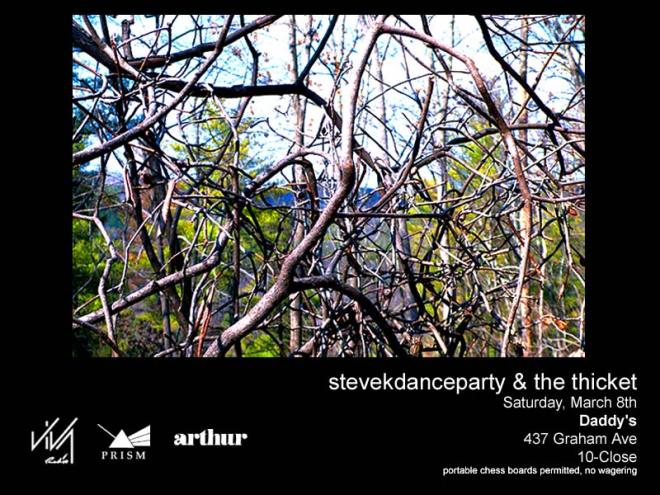
This Saturday, March 8th
Daddy’s
437 Graham Ave
Brooklyn, NY
3rd stop on the L
10pm-Close
FREE
SteveKDanceParty
Special Guest: The Thicket (www.viva-radio.com/thethicket)
The Thicket is a smattering of styles, from brittle neareastpop and handbag trintrunce (you know) to “everything and the kitsch ‘n’ sync” (P. Relic). Technicolor glazedreams & Angela Merkel backrubs.
 Arthur Magazine
