Adrianna Amari's Prayer for the Morning Headlines and the Uses of Grief

prayerslideshow-005


From Ian Nagoski:

“The strong emotions and social disruption engendered by death have always given grief a potential for politicization, whether it finds its voice in the laments of village women, the gay poet’s elegy, or the war memorial.”
-Gail Holst-Warhaft, The Cue for Passion: Grief and Its Political Uses (Harvard, 2000)

During the 90s Adrianna Amari was photographing statuary in Baltimore cemeteries, where she discovered images of foundational human experiences – sorrow, loss, myth, memory, the need for tradition and ritual, and the interconnection of sky, earth and weather with man-made craft. Her empathic photos waited through a series of personal meetings with mortality in her own life until meeting Father Daniel Berrigan, the poet, peace activist and Catholic priest who famously napalmed draft files outside of a draftboard near Baltimore in 1968. Amari suggested to Berrigan the publication of a volume of his selected poetry in juxtaposition with her images. When he agreed, she writes that she noticed that she “had unknowingly been taking pictures for his poems all along.”

The result was published in 2007 by the student-run Apprentice Press (also in Baltimore) as Prayer for the Moring Headlines: On the Sanctity of Life and Death. It’s an extraordinary collection melding the most deeply personal, immediate, overwhelming and little-talked-about feelings of grief with a broad view of which acknowledges the value of all of that seemingly chaotic intensity in justifying and reordering the world – in art, politics, social change and the day-to-day interpersonal action. Howard Zinn describes the subject of it in his introduction to the book as, “life and death, the prayer that comes with commitment, the hope that comes with resistance, the visions of a world where peace and justice prevail.” Inspirational and core stuff to find in a graveyard.

Berrigan’s “You Finish It: I Can’t”

The world is somewhere visibly round,
perfectly lighted, firm, free in space,

but why we die like kings or
sick animals, why tears stand
in living faces, why one forgets

the color of the eyes of the dead–

okay already with the mardi grass, cash, ash

I’ve just toured one of the asphalt strips which girdle our great country and would like to say that nobody is illegal, unless nobody is Mexican or has a couple of pounds vacuum wrapped in the back of the truck under a bunch of hammers.

Along the way I was reminded that Indian reservations are awesome places to get the essential weapons and fireworks one needs for Mardi Gras by providentially breaking down at Bush Brothers Truck stop in Jamestown, New Mexico (exit 39 off I-40) that has all your personal items like tear gas, switchblades and this EYEGOUGE KITTY.

urdefense_2041_14475888

A weapon whose sheer cuteness means you might get it through the metal detectors.

MAKE EM SAY “ME OOWW!”

Remember, ladies, the eyes are the other balls.

We broke down again in Weatherford, Arklahoma, where we were punished with 3.2 beer. Impossible to get drunk on. I will not describe this horrid church town or the stinking vindaloo of the hotel room.

Nor will I mention the tow truck driver who upon seeing our California plates kept trying to get us to “break out the joint” even there were obvious Christians mulling about.

new orleans

images-2

The first night in New Orleans, I apparently went to go see a band called “Tirefire” in Metarie.

TIREFIRE GETS DOWN
TIREFIRE GETS DOWN
milano-stiletto-blue

Tirefire were opening for one of the “eyehategod” guys’ side projects (I’ll find out what it as called later. Evil army? I dunno, my notes are too bloody) where I stabbed myself in the hand with my newest of a dozen milano switchblades I have owned over the years to assuage my condition.

These knives have a malfunctioning safety mechanism which encourages a “pocket pop” when the owner is doing something like getting jostled in a room full of sweaty freaks. In the short useful lifetime of the spring this design flaw allows these evil little spikes to poke more holes in people than a jail full of three-peckered soccer hooligans. (It’s in Wales, I think).

Continue reading

Dwarves were always popular

From “The Beer Tombs of Egypt” by Chris O’Brien over at Fermenting Revolution: The Beer Activist Guide to Saving the World:

straining

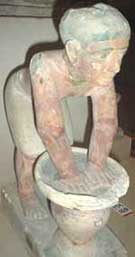
The Cairo Museum features a display case filled with ancient statues of brewers like this one, titled "Woman brewing and straining beer."

Beer was the every day food-beverage of royalty and common folk alike. To go without was considered a terrible impoverishment. According to J.H. Breasted, in Ancient Records of Egypt, Part Four, a Pharaoh named Tefnakhte was once forced to evade attackers for a prolonged period of time. Upon his eventual surrender, he described the hardships of his refuge: I have not sat in the beer-hall, nor has the harp been played for me; but I have eaten bread in hunger, and I have drunk water in thirst. The horror of it all.

The term 'beer-hall' was used interchangeably with the notion of a convivial get-together, a place, or an occasion for beer drinking.

Though it was drunk routinely for nourishment, beer was also a catalyst for exceptional banquets and good times. Entertainment during a beer-hall consisted of storytelling, music of flutes, oboes and harps, singing and recitation. Dancing and acrobatics were performed by scantily dressed young women. And according to an account in Ancient Wine, a book by Patrick McGovern, 'Dwarves were always popular,' as were wrestlers.

Herodotus, considered the world's first historian, described such a scene in his Histories II:

When they have finished eating, a man bears round a wooden figure of a dead body in a coffin, made as like the reality as may be both by painting and carving, and measuring about a cubit or two cubits each way; and this he shows to each of those who are drinking together, saying: "When thou lookest upon this, drink and be merry, for thou shalt be such as this when thou art dead." Thus they do at their carousals.

Ethan Miller (Howlin Rain, Comets on Fire) starts a download blog…

dsc021041

Ethan Miller (featured on Arthur No. 24 cover) writes:

INTERNATIONAL PSYCH WARRIORS, SAVAGE JAMS, BROKEN ROCK & BATTERED SOUL COMP! UP ON NEWLY UNLEASHED HOWLIN RAIN BLOG!

Hello Friends! I have got my blog up and running and it will serve you with music, Bootlegs and live material from Howlin Rain and beyond as well as pictures, rants, and general good dope. To prove that this blog is not simply some cracker ass bullshit about my feelings or the music industry or the price of gas I have cut right to the chase and posted a devastating International psych comp that was compiled for me by the legendary promoter/agent/business man/international psych scholar John Fitzgerald. One mind-crushing heavy jam after the next. You are sure to enjoy! I will continue to post Howlin Rain songs and complete live shows for download on the blog in the near future. visit:
http://silvercurrant.blogspot.com/

“Twice a day for the last 32 years”: DAVID LYNCH on meditation, by Kristine McKenna (Arthur, 2006)

Originally published in Arthur No. 20 (January 2006)…


The Whole Enchilada

David Lynch was 27 years old and depressed. Then he started meditating…

By Kristine McKenna

In person, David Lynch bears only the vaguest resemblance to the image most people have of him. He is, of course, an artist of extreme complexity, but he’s not a weirdo, and the people who work with him adore him because he’s respectful and appreciative of their contributions to his art.

Lynch has been working under the radar on his latest film, Inland Empire, for quite a while; it commenced principal photography two years ago in Lodz, Poland, and features Polish actors Karolina Gruszka and Krzysztof Majchrzak, along with Laura Dern, Jeremy Irons, Harry Dean Stanton and Justin Theroux. It will be his first digital film, but it won’t be his last as he loves the freedom digital affords. “Film is over for me,” declares Lynch, who’s thus far handled the financing of Inland Empire, which is being produced by his longtime partner, Mary Sweeney.

I’ve been interviewing Lynch semi-regularly for 25 years now, and each time I see him I’m struck by his ability to retain the best parts of his personality; he remains an enthusiastic, open and very funny man, and he never fails to tell me something useful and inspiring. I spoke with him this past summer, ahead of his fall speaking tour of universities to promote the work of the new David Lynch Foundation for Consciousness-Based Education and World Peace…

Arthur: You’ve said in the past that your daily meditation practice is what enables you to maintain such a high level of creativity. What was going on in your life at the point when you were able to commit yourself to meditation?

David Lynch: I was 27 and I was in the middle of the first year of Eraserhead and things were going great. I had this unbelievable place to work—the stables at AFI—I had all the equipment I needed, I had people helping me, I had money to do it, and it was like a dream come true, yet I wasn’t happy. That saying ‘happiness comes from within’ started making sense to me and meditation seemed like a good way to go within. I’d always thought yogis sitting cross-legged in the woods were wasting their time, but I suddenly understood that all the rest is a waste of time. Meditation is the vehicle that takes you to the place where you can experience the unified field and that’s the only experience that lights the full brain. It’s a holistic experience and it’s not a foreign place—it’s a field of pure bliss consciousness and it’s the whole enchilada. People think they’re fully awake when they wake up in the morning but there are degrees of wakefulness, and you begin waking up more and more when you meditate, until finally one day you’re fully awake, which is the state of enlightenment. This is the potential of every human being and if you visit that unified field twice a day, every day begins to feel like a Saturday morning with your favorite breakfast, it’s sunny, and you’ve got the whole weekend ahead with all your projects that you’re looking forward to doing.

There are many types of meditation; why did you pick transcendental meditation?

I lucked into it. My sister was doing it, then one day she mentioned it to me and I don’t know why—maybe it was the sound of her voice and the time that I heard it—but bang! I said I’ve gotta have that. Transcendental Meditation is the way of the householder in that it allows you to stay in the world. Some people like the recluse way and want to go into the cave, and there are mantras that will take you right out of activity and put you into that cave. But transcendental meditation is a way of integrating these two worlds and activity is part of it. It’s like dipping a white cloth into gold dye; you dip it and that’s meditation, then you hang it on the line in sunshine and that’s activity. The sun bleaches it until it’s white again, so you dip it and hang it again, and each time you do that a little more of the gold stays in the cloth. Then one day that gold is locked in. It isn’t going anywhere no matter how violent the activity, and at that point two opposites have been united at a deep level. In the west people think yeah, like I’m really gonna give up my dental practice and go to the cave, but you don’t have to quit dentistry. Meditate before you go to work and you’ll start liking the people that come in and you’ll start getting ideas about dentistry. Maybe you’ll invent something and get into the finer points of a cavity and honing that bad boy. Things get cooler.

If you were running the world, what’s the first thing you’d do?

I’d get people going on consciousness-based education. Stress levels in children are going way up and there are so many bad side effects to stress. Kids are on drugs, they’re overweight—they are not happy campers and being a kid should be a beautiful thing. Kids take to meditation like ducks to water. The so-called knowledge we try to cram down their throats is useless and that’s why there are things like cheating—it’s all a bunch of baloney. It’s a sick, twisted, stupid world now. It’s ridiculous.

What’s America’s problem?

It’s locked in an old, ignorant way of thinking. Things are pretty low right now but lots of people are working to enliven that field of unity in world consciousness. John Lennon described meditation as “melting the iceberg,” and when that heat starts coming up some people love it, but it can be too much for some people and they fly apart. So, it’s gotta come up gently—it has been coming up pretty gently, too, but the bunch running the show here in America are working overtime in a negative way.

How did you interpret 9/11?

You don’t get something for nothing and America’s been up to a lot of nasty business for a long time. But Maharishi [Mahesh Yogi, founder of the Transcendental Meditation movement] says instead of fighting darkness you should just turn on the light, so let’s turn on the light and start having fun.

What makes you angry?

There’s an increasing amount of censorship in America and that is not a good sign. It really makes you wonder what’s going on with this country.

Is man on the road to extinguishing himself?

No. Quantum physics has verified the existence of the unified field and Vedic science understands how it emerges—in fact, Vedic science is the science of the unified field. There’s a whole bunch of trouble in this world but the way to get out of it is there; just enliven that field of unity. It sounds like magic but it’s science—it’s the real thing and the resistance to it is based on fear. But it’s not something to be afraid of—it’s us.

Your beliefs are deeply optimistic, yet many people find darkness in your work; how do you explain that?

Films and paintings reflect the world and when the world changes the art will change. We live in a world of duality but beneath it is unity. We live in a world of boundaries but beneath it it’s unbounded. Einstein said you can’t solve a problem at the level of the problem—you gotta get underneath it, and you can’t get more underneath than the unified field. So get in there and water the root then enjoy the fruit. Water that root and the tree comes up to perfection. You don’t have to worry about a single leaf if you get nourishment at that fundamental level.

More thoughts on Touch and Go's exit from manufacturing and distribution

Which independent/autonomous labels will be able to ramp up their digital sales quickly enough to ride out the effects of the accelerating retailer/distributor implosion? That is the real question now.

More info on the evolving disaster from Greg Kot at the Chicago Tribune, who has been doing the best reporting on this that I have seen. Read Kot’s latest here. Excerpts, and a bit more, after the jump.
Continue reading

C & D on great overlooked music of 2008… NEIL HAMBURGER "Sings Country Winners"

C & D: Two dudes grappling with the big issues from a secret location somewhere in the Lower East Side…


dc363
NEIL HAMBURGER

Sings Country Winners
LP/CD available direct from Drag City

Three Piece Chicken Dinner
The Recycle Bin
Please Ask That Clown To Stop Crying
Jug Town
How Can I Be Patriotic (When They’ve Taken Away My Right To Cry)
At Least I Was Paid
Thinkin’ It Over
Garden Party II
Zipper Lips Rides Again
The Hula Maiden

C: American funnyman Neil Hamburger finds the money to indulge his deepest country-and-western crooner wishes. Let’s watch…

D: Well one thing’s for sure: there’s another man in black in town. And he isn’t too happy.
C: [thinking] More like the man in light black. He’s taking no prisoners–cuz he can’t catch anyone!
D: [spills his GnR Dr. Pepper]

D: Not too bad. I would say it’s pretty good, in addition to being the usual pretty bad.
C: Well done, Hamburger! [smugly] To coin a phrase.

This building exists!

project1046_high

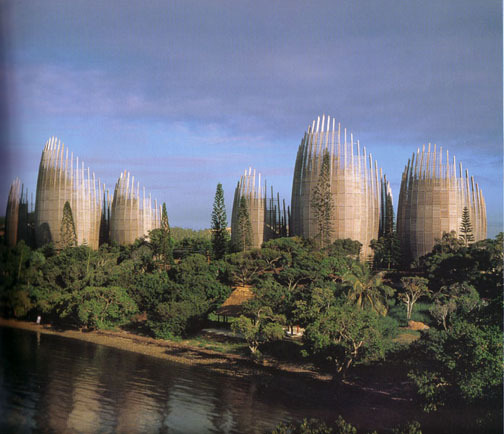
Centre Culturel Tjibaou (Jean Marie Tjibaou Cultural Center)


Rue des Accords de Matignon, Tina, BP 378
98845 Noumea
New Caledonia

Renzo Piano Building Workshop 1998

The Centre Culturel Tjibaou, dedicated to Jean-Marie Tjibaou who died in 1989 while leading the fight for his country’s autonomy from the French government, is devoted to the cultural origins and search for identity of the native Kanak people of New Caledonia and the South Pacific. In the native tongue of Jean-Marie Tjibaou, pije language, it is also known as Ngan Jila – meaning cultural center.

The Center itself is similar to that of the villages in which the Kanak tribes live; a series of huts (or case in French) which distinguish the different functions and hierarchies of the tribes (les tribus) and a central alley along which the huts are dispersed. More specifically, the Cultural Center is composed of three ‘villages’ made up of ten ‘Great Houses’ of varying sizes and functions (exhibition spaces, multimedia library, cafeteria, conference and lecture rooms). The ‘Great Houses’ are linked by a long, gently curving enclosed walkway, reminiscent of the ceremonial alley of the traditional Kanak village…

(hipped to this via Lord Whimsy)