
Monthly Archives for June 2009
Ustad Ali Akbar Khan, 1922-2009
From The Hindu:
Sarod maestro Ustad Ali Akbar Khan died in San Francisco, U.S., on Friday after a prolonged kidney ailment, according to a family friend here.
Khan, 88, died at his music centre, according to Rabin Pal, secretary of sitarist Pandit Ravi Shankar.
Mr. Pal said he was informed about the death by the Ustad’s family in San Francisco.
Khan’s secretary here Ashish Roy said the maestro, who was on dialysis, was ailing for over four years and his condition deteriorated in the last four months.
A recipient of Padma Bhushan and Padma Vibhushan, the Ustad was a colossus in the world of Indian classical music for the last five decades. He is survived by his wife Mary, three sons and a daughter.
Hailed by violinist Yehudi Menuhin as ‘the greatest musician in the world,’ Khan had many firsts to his credit in taking Indian classical music to the west. He was admired by both eastern as well as western musicians for his brilliant compositions and his mastery of the 25-string instrument.
The illustrious son of Ustad Alauddin Khan was the first to cut a long play record of Indian classical music in the U.S. and to give a sarod recital on American TV.
The Ustad was also the first Indian musician to receive the MacArthur Foundation Fellowship in 1991. He was nominated for Grammy Awards five times between 1970 and 1998.
Born on April 14, 1922 in Shibpur village of Comilla district, now in Bangladesh, Khan took up music at the age of 3, learning vocal music from his father and percussion from his uncle, Fakir Aftabuddin.
His father trained him in several other instruments too, but he decided to concentrate on sarod and vocals.
Khan gave his first public performance in Allahabad at the age of 13 and made his first gramophone recording in Lucknow when he was in his early 20s. He became the court musician of the Maharaja of Jodhpur and continued for seven years until his patron’s death. The state of Jodhpur bestowed upon him the title ‘Ustad.’ At the request of Menuhin, Khan visited the U.S. in 1955 and performed at the Museum of Modern Art in New York.
He founded the Ali Akbar College of Music in Kolkata in 1956. In 1965, he began teaching in the U.S. and later opened a branch of his college there and in Switzerland.
Opening tonight: BASIL WOLVERTON at Gladstone


Basil Wolverton
Curated by Cameron Jamie
515 West 24th Street, New York
June 20 to August 14, 2009
Opening: Friday, June 19th from 5.30-7.30pmGladstone Gallery is pleased to announce an exhibition by American graphic artist and cartoonist Basil Wolverton curated by Cameron Jamie. Basil Wolverton submitted his first cartoon for publication in 1925 when he was only sixteen and remained an active cartoonist from the 1940s through to the 1970s. His unique and humorously grotesque drawings reveal both his fantastic wit and inventive technique, once famously described in LIFE Magazine as the “spaghetti and meatball school of design.”
Wolverton had no formal training as an artist, creating his own style that distinguished him from the other cartoonists of his generation. As he said, “I know I draw things that look like all kinds of organs and glands, it is like the monkey which, if he pounded away for a million years, might accidentally type out the ‘Star Spangled Banner’ lyrics.” Generations of artists including Peter Saul, Ed Ruscha, Robert Williams, Jim Shaw, Mike Kelley, and Cameron Jamie have been influenced by his meticulous technique and pictorial freedom, in addition to its undeniable impact on numerous cartoonists from R. Crumb to Drew Friedman.
This exhibition includes a wide spectrum of Wolverton’s work from his earliest drawings published in numerous comic books, including “Spacehawk” and “Powerhouse Pepper,” to his very detailed caricatures, with sculpted and exaggerated features. Perhaps the most famous body of work in the exhibition are his drawings for Harvey Kurtzman’s comic-book version of MAD Magazine from the 1950s. Also included are portraits made for Topps Chewing Gum in the 1960s, which appeared on bubble gum posters and stickers. Wolverton turned to illustrating Biblical themes and events in his later years, represented here by thirteen drawings from the Apocalypse series based on the Book of Revelation. These drawings are regarded among his finest and many of these illustrations were reproduced in Plain Truth magazine.
Born in 1909 in Central Point, Oregon, Basil Wolverton resided for most of his life in the Pacific Northwest until his death in 1978. His work has been published in a variety of magazines and comic books, from MAD Magazine, America’s Humor Magazine, The Portland News, Plop! and Hollywood Today. His work has been featured in Timely Comics, Circus Comics and Target Comics. He also contributed to the Li’l Abner Comic Strip and LIFE Magazine. In 2006, his work was exhibited at The Portland Art Center in Oregon and in 2007 the CSUF Grand Art Center in Santa Ana, California presented a solo exhibition of Wolverton’s oeuvre from the collection of Glenn Bray. The works selected and presented in this exhibition are also from Bray’s private archive/collection.
CALVIN JOHNSON (K Records, Beat Happening) on the importance of ALL-AGES gigs, and the secret history of age segregation in rock n roll

photo: Danielle St. Laurent
“What’s Wrong With Having Fun?”
A History of All Ages: A conversation with Calvin Johnson
by Jay Babcock
Calvin Johnson is the founder of Olympia-based K Records. He was in Beat Happening, Halo Benders and Dub Narcotic Sound System, and recently toured the USA in tandem with Ian Svenonius. His influence on underground American music in the last 25 years is enormous; read more about him at wikipedia.
I spoke with Calvin by telephone in early 2007, following on an interview I did with former MC5 manager/poet/historian John Sinclair, published in Arthur No. 24, in which we tried to figure out how rock n roll music went from being an all-ages thing to what, all too often, it is today: age-segregated. Calvin had some ideas about that…
Arthur: Where did you see your first shows?
Calvin Johnson: I was going to some stadium shows. When I was 12 I saw Paul McCartney & Wings. That was in the Kingdome, which is like 75,000 people. I was like, This is different than the Casbah Club in Liverpool. This isn’t the same. I kind of view that as more… Having read this biography of the Beatles and their whole world in Liverpool just seemed really exciting. Very little of that excitement existed in the stadium. And I’m like, Hmm. Something went wrong here. Just shortly after that is when I started reading about punk rock and I recognized that as being within the spirit of that local scene that the Beatles came out of.
It was about two or three years later that I went to my first punk rock show which was… A band from Seattle called The Enemy played here in Olympia. Then I started attending shows in Seattle. There was an all-ages club called The Bird that was in an old warehouse, then it moved into an Oddfellows hall. They had shows twice a month at this Oddfellows hall. That was really exciting.
Arthur: How did age segregation in rock ‘n’ roll music performances start, do you think?
My knowledge is second or third-hand on these things, but in reading rock n roll histories or biographies, it seems like some of those people, like Little Richard, was playing in nightclubs and juke joints that were serving alcohol and they were mostly oriented towards adults, meaning people in their 20s and 30s.
So live music was divided in a demographic way: there were these teen-oriented events and then there were adult-oriented events, and rock n roll was viewed at first as teen-oriented music. It seemed to have been normally in these environments that are dance-oriented—the armory, the school cafeteria, gymnasium, the local union hall—might be rented for these teen events.
When people like Little Richard and Chuck Berry and Jerry Lee Lewis became rock stars, and they were playing at those kinds of shows where there’s 10 or 15 acts on the bill and they each do their one or two songs that are well-known, kids were still trying to dance in the aisle. [in faux announcer voice] “Can’t stop the kids from dancing! They’re dancing in the aisles! Crazy! Bedlam has broken out!”
You look at films like Charlie Is My Darling—the Rolling Stones on tour in Ireland in ‘65—and you see it’s sort of a transition to this more concert-type situation, where it’s not necessarily a dance, kids are still dancing, and the set-up seems so nascent, they don’t have huge P.A.s or amps, they just have their regular amps and drums, little vocal public address system, and it’s …very quaint.
But it seems as though in the Northwest here, there was a circuit more or less of all-ages teen dances, which were held at various either hall-type situations or clubs that catered to teenagers and…
Arthur: How is that different from a sock-hop?
A sock-hop is more like high school dance where people are just dancing in their stockinged feet. It seems like the demographic is what divided things rather than a legal situation. The demographic was, ‘only kids would want to go to that show.’
Arthur: ‘Who else would want to?’
Yeah. It’s difficult to say, because I’m just piecing this all together, I didn’t live through it, but it appears that it had this vibe that as the audience for rock n roll starts to age into the ‘60s, and people were in their 20s and still interested in rock n roll, the focus changed. I blame the Beatles for that, because they created the atmosphere for where every rock band was suddenly Beethoven, and was creating “Great Works.” So it was more like when you go to the concert symphony orchestra and everyone is paying attention in this way and dancing is almost like an insult. It’s not that the Beatles had that attitude, but I think that the way that their music developed, people started to view music that way, and then these more serious prog rock bands came along and people suddenly forgot all about having fun. What’s wrong with having fun?
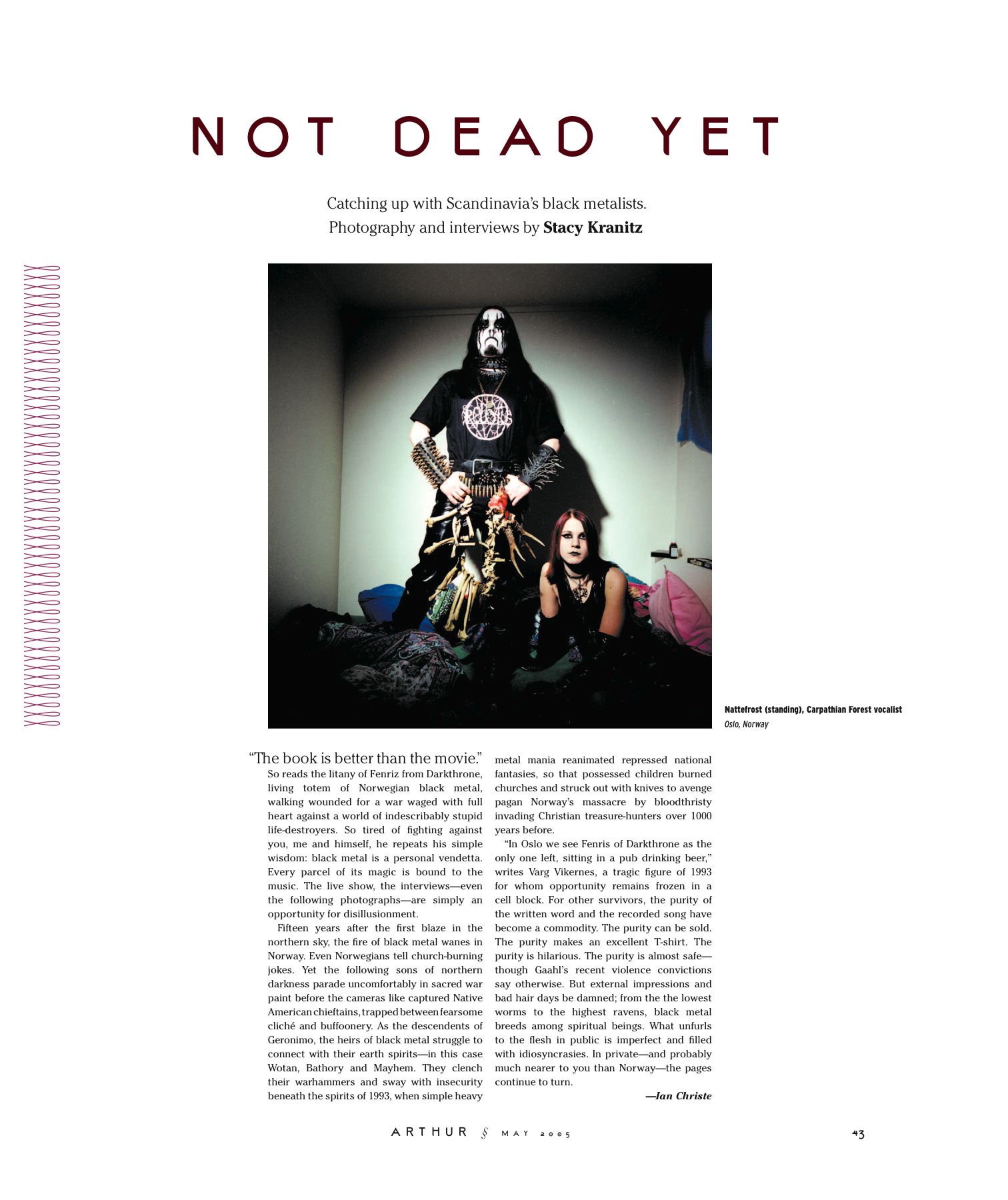
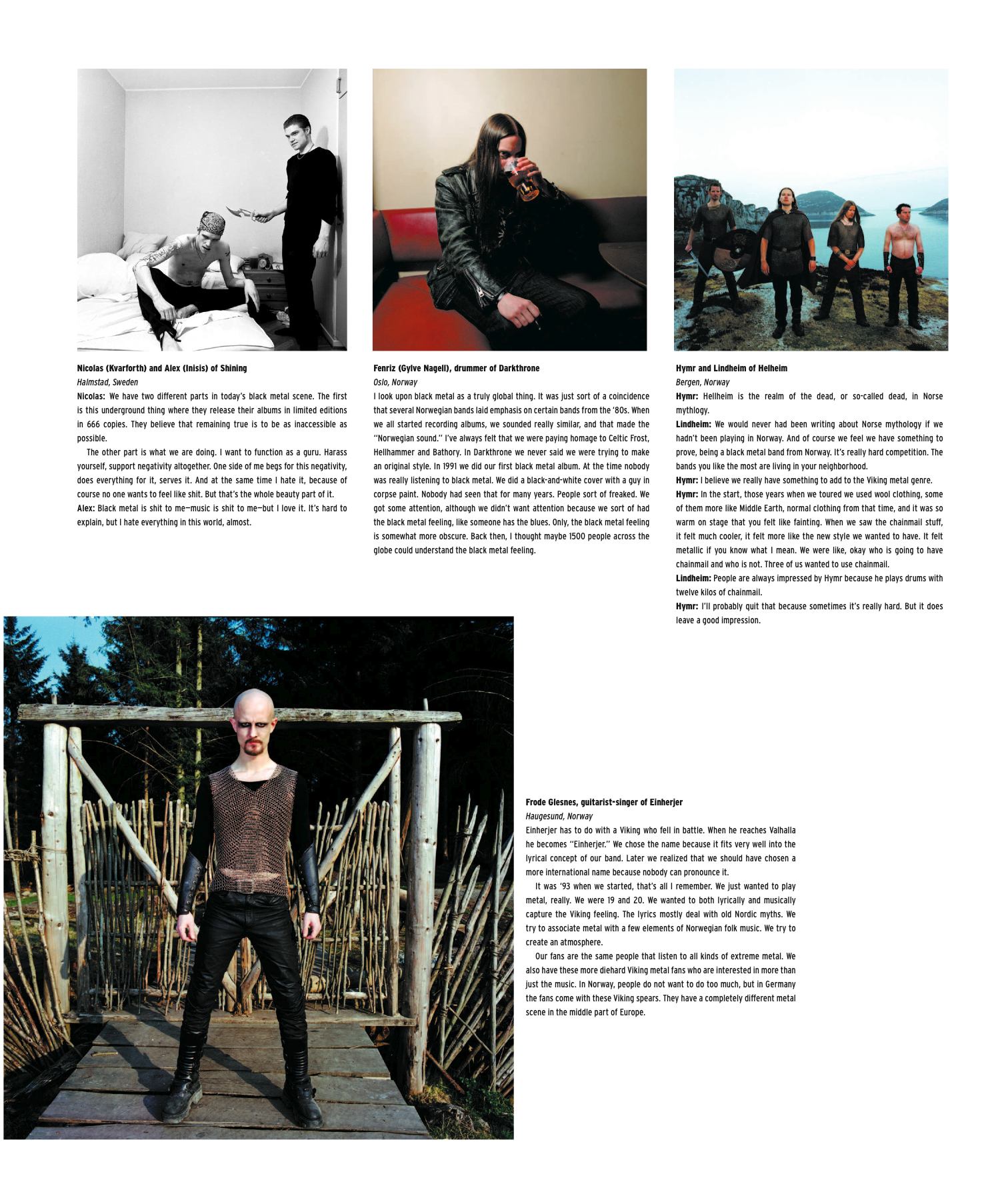
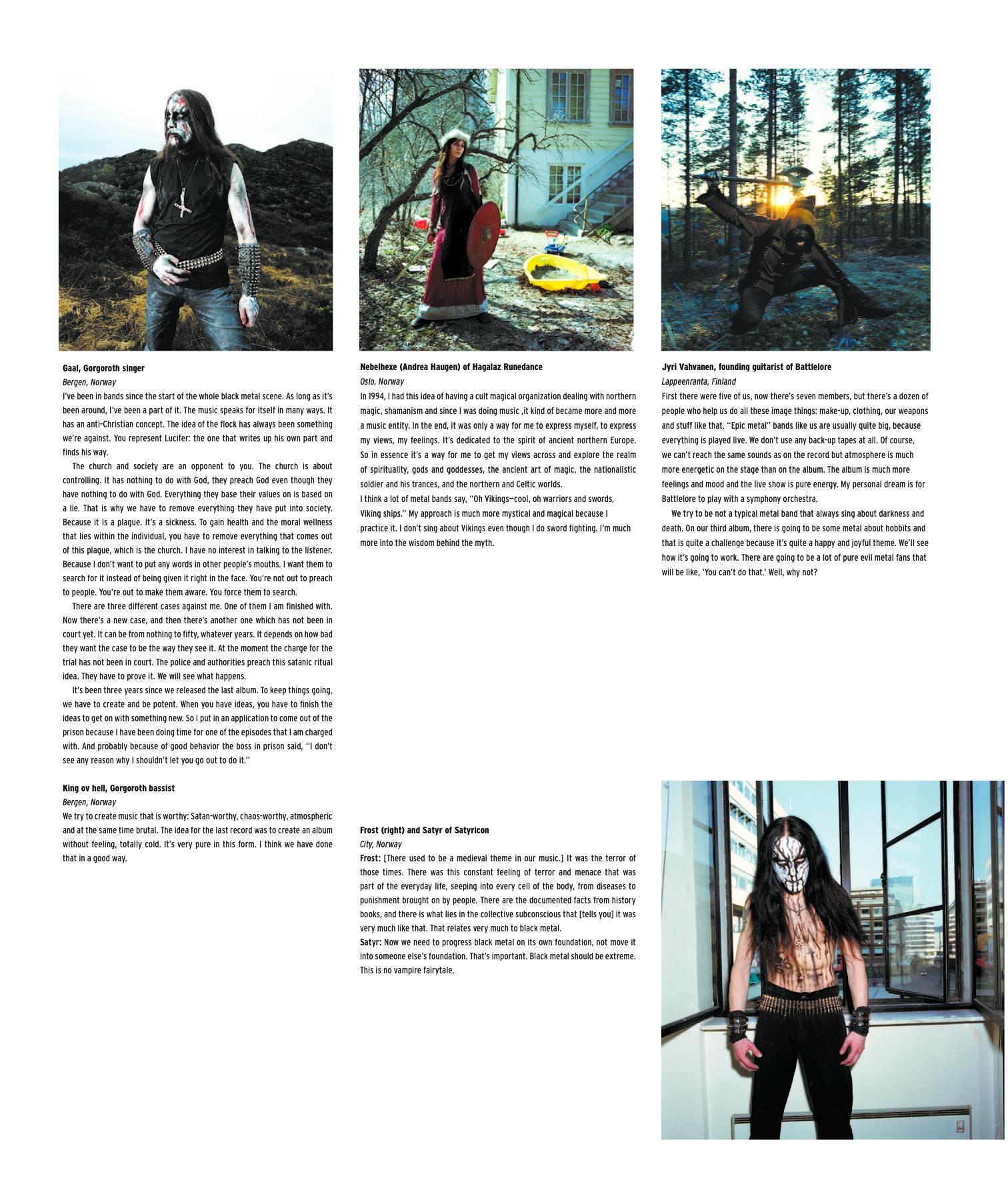
NOT DEAD YET: Catching up with Scandinavia’s Black Metalists, by photojournalist Stacy Kranitz (Arthur, 2005)
A visit with today’s Scandinavian black metalists by photojournalist STACY KRANITZ, featuring King ov Hell and Gaal of Gorgoroth, Satyr and Frost of Satyricon, Fenriz of Darkthrone, Frode Glesnes of Einherjer, Nattefrost of Carpathian Forest, Hymr and Lindheim of Helheim, Jyri Vahvanen of Battlelore, Nebelhexe of Hagalaz Runedance, Mortiis, and Blasphemer of Mayhem.
Sound of the Beast: The Complete Headbanging History of Heavy Metal author Ian Christe wrote the introduction. W.T. Nelson did the design.
This article was originally published in Arthur Magazine No. 16 (May, 2005).

Today's Autonomedia Jubilee Saint — Ali Shariati

June 19– Ali Shariati
Iranian theorist of the interface of Marxism and Islam.
JUNE 19, 2009 HOLIDAYS AND FESTIVALS
*Berkshire, England: Election of the “Morris Mayor”; residents elect a Morris dancer who is carried through town on a flower-trimmed rocking chair, preceded by an ox-head on a long pole, with stops at every tavern to refill the Mayor’s chalice.
*Brazil: Beggars’ Banquets.
*Festival of the Coming Ice Age.
*Juneteenth.
ALSO ON JUNE 19 IN HISTORY…
1756 — 123 British prisoners die in “Black Hole” of Calcutta, India.
1891 — Anti-fascist collage artist Helmut Herzfeld (John Heartfield) born, Berlin.
1912 — Alleged eight-hour work-day adopted for U.S. government workers.
1953 — Julius and Ethel Rosenberg electrocuted for alleged sale of atomic secrets to Russians, Sing Sing Prison, New York.
1977 — Iranian political & spiritual leader Ali Shariati killed, London, England.
Excerpted from The 2009 Autonomedia Calendar of Jubilee Saints: Radical Heroes for the New Millennium by James Koehnline and the Autonomedia Collective
BAKSHI/NOT BAKSHI
via Arik Roper and Peter Relic! And: if you know who made the second clip, let Florian Keller (party-keller@gmx.net) know!
Today's Autonomedia Jubilee Saint — Maxim Gorki

June 18– Maxim Gorki
“Stormy Petrel.” Russian novelist, intellectual force.
Read works of Gorki at Project Gutenberg.
JUNE 18, 2009 HOLIDAYS AND FESTIVALS
*Festival of Invisible Pornography.
ALSO ON JUNE 18 IN HISTORY…
1778 — British troops evacuate Philadelphia as American Colonial forces enter.
1812 — War declared against Britain by U.S.
1914 — Red Week begins, Italy.
1936 — Russian novelist Maxim Gorki dies, Moscow, USSR.
1953 — Egypt declared a republic by the “Revolutionary Command Council.”
1983 — Sally Ride becomes first U.S. woman in space.
1989 — Muckraking journalist I. F. “Izzy” Feiinstein Stone dies, Boston, MA.
Excerpted from The 2009 Autonomedia Calendar of Jubilee Saints: Radical Heroes for the New Millennium by James Koehnline and the Autonomedia Collective
'BLOOD WIZARD' by Skinner
Skinner is one of my favoritest dudes. From his lair of awesome in Sacramento, he’s gained the attention and respect of the underground art world with a series of killer art shows, comics, metal, and animation. Break off a piece of the devil’s lettuce and shred with his latest comic from the abyss, Blood Wizard.


SATURDAY: Blood Transfusion for a Ghost– Frank Haines at Kenneth Anger Exhibit at PS1
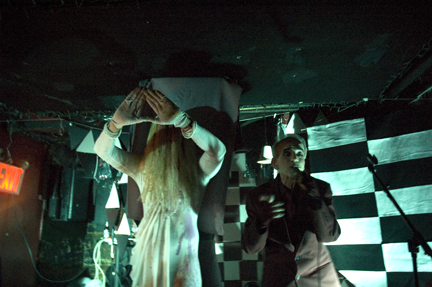
Saturday, June 20, 2009, 7 – 11 pm
PS1/MoMA
In celebration of the summer solstice, Frank Haines has organized an evening of ritualistic, mysterious, and mystical performances, music, film, and spoken word. Four performers—the trio Blanko & Noiry; 16mm filmmaker Rose Kallal and curator Mark Beasley; psychedelic metal band Miracle of Birth; and poet Cedar Sigo— will perform in a different corner of a single gallery. ARP (DFA/Smalltown Supersound) will provide musical transitions between each performance.
In a reference to his artistic relationship to the cult filmmaker Kenneth Anger, Haines borrowed this event’s title from Hugh Kenner’s novel The Pound Era, in which the author notes that Pound “came to think of translation as a model for the poetic act: blood brought to ghosts…essentially creating new life from old texts.” Anger’s current P.S.1 exhibition will be on view throughout the evening.
Ticket information here.
Haines, who currently has a show at the Lisa Cooley Gallery, is a visual, musical, and performance artist. His performances are rare and reportedly not to be missed, filling the entire space with energy in a manner consistent with the occult rituals, such as the gnostic mass, that link Haines with Anger. The performance is $10 and 21+, but it sounds like there will probably be free Grolsch!
httpv://www.youtube.com/watch?v=1CHLsN29AEA
 Arthur Magazine
