
“Blurred + Spacey”: Brightblack Morning Light’s Nabob Shineywater on SANDY BULL (Arthur, 2006)

Originally published in Arthur No. 25 (October 2006)
Blurred and Spacey
By Nabob Shineywater

Sandy Bull
Still Valentine’s Day 1969: Live at the Matrix, San Francisco
(Water)

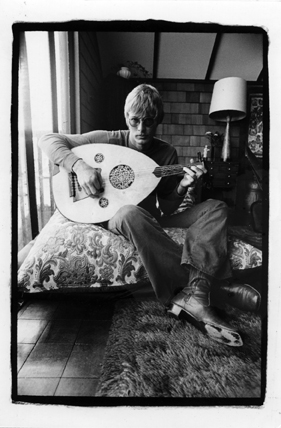
When I was living in Point Reyes, my closest friends became people in their sixties. They would share stories with me as I managed the community print shop. One day I was listening to Sandy Bull, and a visiting Vietnam vet shared a great story with me. One day back in the late ’60s he was riding his bicycle through Mill Valley when he heard very, very loud music. He was able to locate the house it was coming from, and sat on the porch and listened for about three hours. Then the music stopped and he knocked on the door to thank the artist. Two very tall African women opened the door, traditionally dressed and very gorgeous. Then Sandy appeared, and was friendly, but also severely spacey. The house was empty with white walls and carpet. My friend was already familiar with Sandy’s music, and had attended some of the shows in San Francisco that Sandy was doing. He rode away on his bicycle, surprised and happy.

Sandy lived in Berkeley, Mill Valley and Fairfax in the ’60s and his best friend was Hamza El Din, the oudist from Egypt. What a special time these men had together. Hamza had arrived in the United States after opening for the Grateful Dead at the Pyramids. He is best known for his ’70s release Escalay (translated as “The Water Wheel”), which features Sandy playing an ancient beat on an ancient drum. In Escalay, Hamza wanted to translate the feelings of the folks whose role it was to haul water to and from the well. It’s the best cinematic folk music I’ve heard—when you listen to it alone you actually arrive at his homeland. The oud is the most gut-pounding stringed instrument I’ve heard: it sends out depthful waves, resonations that have bass where you wouldn’t expect it.

Still Valentine’s Day 1969: Live at the Matrix, San Francisco is a live album from 1969, and the result of Sandy pushing the limits by using an electric oud through about four different Fender amps, all with heavy reverb and vibrato. I really enjoy the entire collection of songs, and have spent some high times with them lately. The songs feel a little more blurry and druggy than on E Pluribus Unum, the 1968 studio album where a lot of them first appeared. Which I appreciate: I am getting stoned a lot, so I am currently looking for items to reflect that, that I respect. Yet I know he was into the junkier side of drug experimentations. I feel if the tapes were mixed track-by track, that it could expose some more low-end that might be now missing. Sandy had a degree in classical bass; he was highly skilled, and his bass lines are sometimes just as interesting as his oud.

Sandy’s shows are another discussion, but briefly, he wouldn’t play with anyone. So he recorded all the instrumentation on analog tape, and then figured a way to synch up each tape machine. He would then haul this to a gig, press play on everything, then rotate between electric oud and pedal steel. Sandy bootlegs are amazing and even funny, as he was so interesting—Sandy had a great style and it is rumored that William Burroughs saw Sandy and immediately copied his fashion; the Beatles song “Come Together” is actually about Sandy; etc. Anyway, Sandy told obscure funny stories between songs. This release has a small dialogue about the live sound engineer ; the un-mastered version I have actually has a huge wallop of stage feedback due to the lack of understanding by the evening’s sound engineer of just what Sandy was attempting in relation to amplified reverb. The feedback is a painful-sounding slash across the speakers, not interesting at all, and isn’t approved of by Sandy. The same thing regularly happens today in live performance—this realm has not progressed much, and the truth of it is that it’s the fault of people’s stagnant exchange with audio psychedelia. There’s been a lack of progression or maybe a lack of respect for the trade of sound engineering folk.

If you get to know the songs you can actually feel Sandy become elated with tonality as he plays here. Some may think his jams are light, or even beatnik. I think his jams are of the heaviest order, and I believe him to be Northern California’s greatest artist ever because he wasn’t a contrived enterprise. This music is a reflection of what was the norm in NorCal back then. People were learning about the strength of folk culture around the world, and using that knowledge to justify dropping out … and to drop out in colorful, musical ways.

AGAINST EMPTY HISTORY: Steve Berra on the current crisis in skateboarding

What Steve Berra is talking about applies to other essential cultural sites/practices as well. Bookshops. Record shops. Coffeehouses. Magazine publishers. Book publishers. Record labels. And so on…

Excerpts:

“I receive emails almost every single day telling me about another skate shop or skatepark that’s going, or has gone, out of business. I get asked if there’s anything I can do to keep them from closing their doors or if maybe I can build a Berrics to take its place. With the U.S. unemployment the worst it’s been in 26 years, I get job inquiries from all over the country.

“And I want to give them a job. I want to build skateparks for you; I want to help skateshops open. I want skateboarding to survive the way baseball, and football, and basketball do here in America—but without it having to turn into them. Without it losing its autonomy to a board of directors inside big corporations who think the letter X was a label any of us liked because they didn’t understand the principles it was founded upon: principles that drew me to it, and have been carried forth through the years by skateshops and skateparks that existed long before television and mass retailers saw an upside to it.

There’s a war being waged on small businesses. They’re being taxed on both the state and federal levels. They’re over-regulated, outspent and out-advertised by mall stores with deep pockets and empty history. And in the current economic climate, they don’t stand a chance without your support. Without the foundation of these kinds of skate shops, or skateparks, the skateboarding culture slowly dies in your area, and with it, so does skateboarding…

“A system can always estimate how close it is to being revolted against by counting how many smart and willing people it is excluding from participation. And [right now] there are quite a few smart and willing people being excluded from participation. So the Berrics Unified can be considered a revolt, of sorts…”

MORE INFO
Berrics Unified: http://www.berricsunified.com/
Steve Berra: http://en.wikipedia.org/wiki/Steve_Berra

hipped to this by Jesse Locks

Today's Autonomedia Jubilee Saint – HUTCHINS HAPGOOD


NOVEMBER 19 — HUTCHINS HAPGOOD
American author, journalist, anarchist, free love advocate.

NOVEMBER 19, 2009 HOLIDAYS AND FESTIVALS
GROUP RATES FOR GROUP SOULS DAY.         HAVE A BAD DAY DAY.

ALSO ON NOVEMBER 19 IN HISTORY…
1493 — “Christ-bearing Dove” Christopher Columbus “discovers” Puerto Rico.
1915 — Labor organizer Joe Hill executed by firing squad in Utah.
1919 — Italian filmmaker Gillo Pontecorvo born, Pisa, Italy.
1944 — American anarchist Hutchins Hapgood dies, Provincetown, Massachusetts.
1961 — Michael Rockefeller presumed eaten by cannibals, Asmat, New Guinea.

Excerpted from The 2009 Autonomedia Calendar of Jubilee Saints: Radical Heroes for the New Millennium by James Koehnline and the Autonomedia Collective.

Today's Autonomedia Jubilee Saint – MAN RAY


NOVEMBER 18 — MAN RAY
Surrealist photographer, radical social critic.

NOVEMBER 18, 2009 HOLIDAYS AND FESTIVALS
NED LUDD MEMORIAL MACHINE-SMASHING FESTIVAL.

ALSO ON NOVEMBER 18 IN HISTORY…
1789 — Photography pioneer Louis Daguerre born, Cormeilles-en-Parisis, France.
1820 — Nathaniel Palmer discovers Antarctica.
1928 —Mickey Mouse born, Walt Disney Studios, Los Angeles, California.
1952 — French writer Paul Eluard dies, Paris, France.
1975 — Eldridge Cleaver, seven years in exile, returns to U.S. to face charges.
1976 — Surrealist photographer Man Ray dies, Paris, France.
1978 — Jonestown, Guyana: 913 party-goers; Kool-Aid shots main attraction.
1983 — Magic realist painter Ivan Albright dies, Woodstock, Vermont.

Excerpted from The 2009 Autonomedia Calendar of Jubilee Saints: Radical Heroes for the New Millennium by James Koehnline and the Autonomedia Collective.

November 23rd – Film screening of Sandy Bull doc in Greenpoint, BROOKLYN


A documentary screening slash musical showcase in commemoration of the legendary banjo-pickin’, oud-playing folk guitarist Sandy Bull. This lineup will surely satiate the soul of any wayfaring traveler…

Documentary screenings
Oma (16mm short) portrait of Daphne Hellman (Sandy Bull’s mom)
Sandy Bull: No Deposit, No Return Blues (45 min)

Live musical performances
Colin Langenus Acoustic Guitar Orchestra
D Charles Speer
Ramble Tamble

Free admission!

Monday, November 23rd, 8:30pm
18 Java St. / Greenpoint, Brooklyn 11222
(View map.)

Today's Autonomedia Jubilee Saint — Voltairine de Cleyre

de cleryre
NOVEMBER 17 — VOLTAIRINE DE CLEYRE
The original American anarcha-feminist, writer, social rebel.
“Humanity can not be made equal by declarations on paper. Unless the material conditions for equality exist, it is worse than mockery to pronounce men equal. And unless there is equality (and by equality I mean equal chances for every one to make the most of himself) unless, I say, these equal chances exist, freedom, either of thought, speech, or action, is equally a mockery.”
In Defense of Emma Goldman and the Right of Expropriation, 1893.

NOVEMBER 17 HOLIDAYS AND FESTIVALS
CREATIVE ALIENATION DAY. HERE TO GO DAY.

ALSO ON NOVEMBER 17 IN HISTORY
1624 — Mystic philosopher Jacob Boehme dies, Görlitz, Germany.
1637 — American rebel Anne Hutchinson, antinomian, brought to trial.
1734 — John Peter Zenger arrested for libels against colonial government.
1790 — August Möbius, topologist, born, Schulpforta, Saxony-Anhalt, Germany.
1866 — Anarcha-feminist Voltairine de Cleyre born, Leslie, Michigan.
1875 — American Theosophical Society founded.
1896 — Sacramento, California reports first of dozens of sightings of huge myste-
rious airships appearing all over U.S. for the next six months.
1942 — Hobo organizer, cultural drop-out Ben Reitman dies, Chicago, Illinois.
1966 — 46,000 meteoroids fall on Arizona in twenty minutes.
1979 — Russian crackpot astro-physicist Immanuel Velikovsky dies.

Excerpted from The 2009 Autonomedia Calendar of Jubilee Saints: Radical Heroes for the New Millennium by James Koehnline and the Autonomedia Collective.

Chambo's Internet Activity Pages for November 16, 2009

leonids-1833-village-lg


Leonid meteor shower, Marfa, Texas 2008


• ON DARK SKIES AND FALLING STARS
The last time we wrote about a meteor shower here at Arthur, we lived in the middle of the sprawling, light-polluted metropolis of Los Angeles, where the only meteor-like streaks in the sky were the tracer bullets being exchanged between LAPD choppers and some of our gang-banging neighbors. Now we live in Marfa, Texas where we’ll be taking in the Leonid meteor shower — at its peak tomorrow night (that’s November 17) — as it rains across the dark skies of the Trans Pecos from the comfort of our back yard, frosty session brew in hand. Ahhh. Click here and a nerd will tell you where to look for the meteors. [Bad Astronomy/Discover]

• IT WAS HARVEST TIME AGAIN

Speaking of California, it was around this time last year that Arthur columnist Dave Reeves and I were … uh … “camping” on a nearly-destitute drug farm in Northern California. The paranoia, the backwoods misogyny, the nightly “who has the most bullets” shooting contests with the meth-head farmers over the hill … oh the memories. You can read all about it in his story — and look at my pretty, pretty pot pictures on my photo blog — from last year. But did you know that most people don’t have this type of extremely sketched out paranoid experience up on the pot farms? Redheaded Blackbelt writes about some of the less psychotic aspects of growing and trimming with “How long until you earn a million with marijuana and other things you can learn online,” a great jumping-off point for a variety of weed-head shop-talk blogs. And don’t miss the Redhead’s more recent posts, like the one about the time he accidentally sent his kid to school with a memory stick full of marijuana porn. Lotsa nice otter photos there too. [Redheaded Blackbelt]

• BEERS, STEERS AND AFGOOEY SUPER KUSH

Speaking of high quality marijuana, that’s one of the few things that the failed state of California has going for it these days, what with the quasi-decriminalization and all, and it’s definitely something it can hold over the weak produce and harsh sentences here in Texas. Though maybe not for long, as even mainstream Texas magazines are starting to get in line with long-standing Lone Star marijuanauts from Willie Nelson to Gibby Haynes, or at least that’s sure what this “Texas High Ways” (wokka wokka) article from the October Texas Monthly sounds like. [Texas Monthly]

• SPEAKING OF DARK STARS AND FALLING SKIES

We still get email about “Uncle Skullfucker’s Band,” my memoir of spending my high school years as a closet Deadhead, a lot of it looking for pointers on the noisier inheritors of their heavy improvisational legacy, or as Ethan “Howlin Rain/Comets on Fire” Miller put it in a follow-up article, you can listen to a lot of Dead and never “[mistake] it for Fushitsusha, ya know?”

lenningrad2

As it happens, audioblog Mutant Sounds just put this thing up that is more or less the ideal entry point for noise-heads that want to “get” the Dead: It’s the Leningrad Psychedelic Blues Machine doing a 21-minute cover of the Dead’s long-form psychedelic masterpiece, “Dark Star.” The Leningrad Psychedelic Blues Machine, of course, is a Japanese noise-blitz apocalypse supergroup including members of Acid Mothers Temple, High Rise, Mainliner and Zeni Geva, and their version is expectedly rough, rugged and raw in what sounds like a tribute to the best of the crackly, fuzzed-out late ’60s audience recordings out there. [Mutant Sounds]

• WHO WANTS A BODY MASSAGE?

Sorry for the long absence. Shortly after arriving here in Texas our pal Lil’ Earl sent us this GI Joe PSAs video from way back in 2006 and it’s pretty much the only thing we look at when we turn the internet on. “Porkchop sandwiches!

A conversation with Ralf Hutter of KRAFTWERK (May, 2005)

Above: Folk musicians touring the European countryside by bicycle. Photograph Roger-Viollet /Rex Features

The following was originally published in the LAWeekly on June 2, 2005…

Man-Machines of Loving Grace
by Jay Babcock

I like to think (and
the sooner the better!)
of a cybernetic meadow
where mammals and computers
live together in mutually
programming harmony
like pure water
touching clear sky.

—from “All Watched Over by Machines of Loving Grace” by Richard Brautigan

Next Tuesday, German electronic-music pioneers Kraftwerk will perform in Los Angeles for the first time since their now-legendary show at the Hollywood Palladium in 1996. That concert drew an appreciative, astoundingly diverse cross-genre audience: indie-rock nerds and art-school casualties, computer-programming geeks and hip-hop heads, synth freaks and industrial goths, every laptop musician west of the Colorado and — oh yes! — breakdancers. Machines, it seems, had succeeded in uniting humans.

It’s impossible to overstate Kraftwerk’s influence on pop music and culture over the last 30 years, from new wave to hip-hop, electronica to (yawn) Coldplay (who use the riff from “Computer Love” on their new song, “Talk”). We all know Kraftwerk songs — odes to transportation like “Autobahn” and “Trans-Europe Express,” future/now manifestoes like “Man/Machine” and “The Robots” — but it’s in the live context, where the songs are joined to specially designed graphics, that Kraftwerk achieves a purity of all-encompassing vision that secular music rarely touches. It’s all about rapture, and an interaction with — or longing for — a relationship with something other than human.

On the telephone, Ralf Hutter — co-founder of Kraftwerk with Florian Schneider, and now approaching 60 years of age — is helpful and deliberate, like a professor pleased to have a visitor who’s interested in his research on an obscure subject.

Q: There’s a bumper sticker that says “Drum machines have no soul.” Do you think that is true?

Continue reading