“Re-Psychedelica Britannica” by Mark Pilkington (Arthur, 2005)

Originally published in Arthur No. 14 (Jan. 2005)

Re-Psychedelica Britannica
The fungal kingdom is making a bold incursion into British streets markets where, through a curious legal twist, magic mushrooms are openly available for sale. MARK PILKINGTON reports back from a trip to the shops.
Photos by Mark Pilkington
Drawings by Matthew Greene

On the morning of October 3, 1799 a man known only as JS was found wandering in a state of delirium around London’s Green Park, not far from what would soon be Piccadilly Circus. He complained of waves of giddiness, odd flashes of color across his eyes and a cramped stomach. His family suffered the same effects and feared that they were dying. All that is, except their eight-year-old son, Edward, who seemed to find their situation hysterically funny.

A passing doctor, Everard Brande, was summoned to the scene, where JS told him that the symptoms had begun not long after the family had picked and eaten their usual breakfast of wild mushrooms. Intrigued by this puzzling scenario, Brande would write in The Medical and Physical Journal that the family’s condition was caused by the “deleterious effects of a very common species of agaric (i.e. mushroom), not hitherto suspected to be poisonous.”

Family S hold a unique position in history, as the United Kingdom’s first recorded shroomers.

England’s most common indigenous psychoactive mushroom is the Psilocybe semilanceata, known to its friends as the Liberty Cap. Four to eight centimetres tall, nipple-headed and a rich cream colour, following the Autumn rains of September and October they dot our green and pleasant land in their millions. Individually they won’t do anything for you—though veteran shroomers may eat one or two as they pick in a fresh field, claiming that it helps them to spot other mushrooms—but in doses of 20 or more, eaten as is, or brewed in boiling water, the effects can be potent. In fact, they’re more or less indistinguishable from the effects of the 120 or so other psilocybian mushrooms found the world over—including the cubensis and mexicana, which are no doubt familiar to many Arthur readers.

The sight of plastic bag-carrying longhairs bent double, scrutinizing our autumnal pastures for a taste of freedom has been a common one for the past three decades or so. But recently the fungal landscape has taken a dramatic and surprising turn.

About two miles north from where Family JS took their historic trip into the fungal kingdom is Camden Town, a legendary pilgrimage site for punks and Goths the world over. Here the once-thriving Counterculture of independent book and record shops has been firmly superceded by the ever-familiar counter culture of Gap and co. Shifty-eyed, muttering passers-by offer you all manner of illegal substances, but we’ll ignore them and head for one of the many stalls offering an altogether more rewarding—and currently legal—psychoactive experience: magic mushrooms.

Conspicuously moist in unmarked plastic tubs are a range of mycological exotica that would, as little as three years ago, have seemed inaccessible to all but the most adventurous ethnobotanist. Psilocybe cubensis strains from Mexico, Columbia, Peru, Ecuador and Thailand sit alongside the connoisseur’s choice, Hawaiian Copelandia cyanescens, and what’s known as Philosopher’s Stone: “truffles” or sclerotica—underground growths—of the Psilocybe tampanensis or mexicana. Prices are typically £10 ($18) for 10g, depending on what and where you buy. Some stalls now also sell mescaline-containing cacti like San Pedro and Peyote, though these are slower to grow and so more expensive.

The mushrooms’ packaging tends to contain little or no information: the more organized suppliers will include a label identifying the country of origin, alongside a variety of legal warnings, but you won’t find any dosage or storage recommendations and no tripping tips. Only qualified herbalists can legally distribute such information, though most stallholders will answer specific questions and the better stalls display generalized notes about each strain of shroom. However, depending on the psychedelic scruples of a particular stall’s owner, the person selling you your magic kingdom pass may or may not know anything about what it is they are selling.

As well as key locations in London—Camden High St, Portobello Road & Covent Garden being your best bets—the mushrooms’ glittering domain now stretches to an estimated 300 vendors in towns and cities all around the country. Enterprising sorts are also offering online and telephone deliveries to your front door. But for how long?

The legal situation regarding magic mushroom sales is a precarious one. According to the UK’s 1971 Misuse of Drugs Act, the active ingredients of the mushrooms, psilocybin and psilocin, are classified Class A. This places them alongside heroin, cocaine, ecstasy, LSD and speed (if it’s prepared for injection). The maximum sentence for possession is seven years in prison or, for intent to supply, life. This strikingly neo-gnostic approach to drug law is shared by the United States and much of Europe: it’s the mushroom’s soul that concerns the authorities, not its body.
But, because they grow more or less anywhere that sheep and cows shit, including on land owned by the military and the royal family, liberty caps and the other psychoactive mushrooms that grow here—such as the Amanita muscaria, or Fly Agaric—are only considered illegal if they have been prepared. And it’s this word that has proved to be the semantic loophole through which the fungi have taken to the streets.
Continue reading

“The Fifth World and the Hopi Apocalypse” by Daniel Pinchbeck (Arthur, 2005)

Originally published in Arthur No. 14 (Jan. 2005)

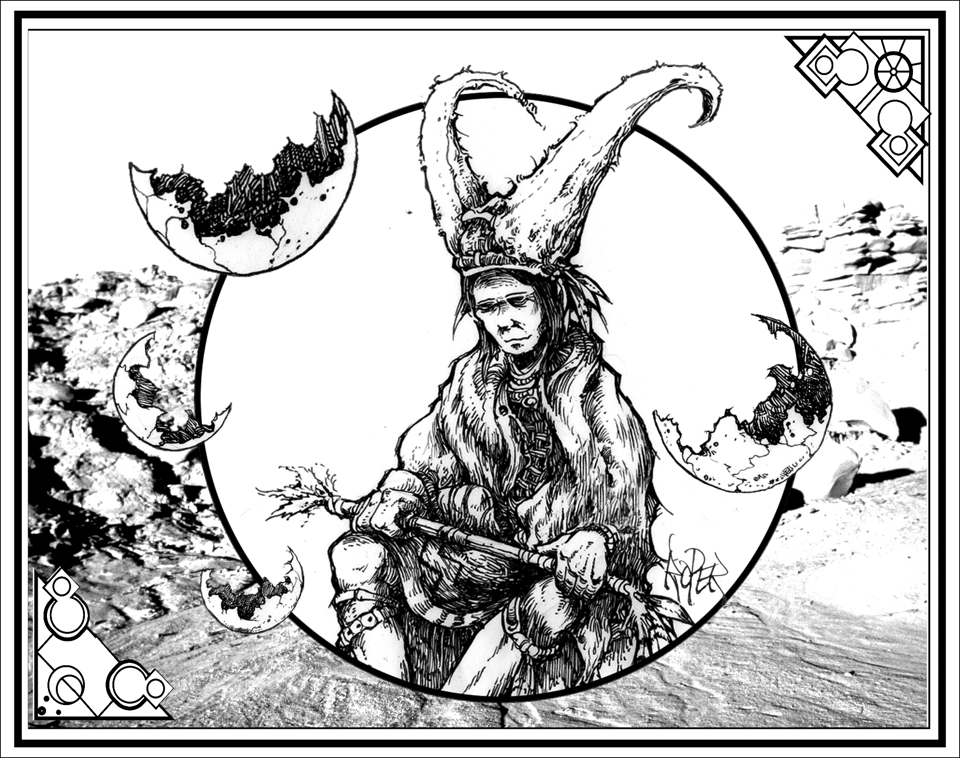
Illustration by Arik Roper

“Here and Now” column by Daniel Pinchbeck

“The Fifth World and the Hopi Apocalypse”

Last summer, I visited the Hopi on their tribal lands in Arizona. The Hopi are thought to be the original inhabitants of the North American continent–this is what their own legends tell us, and archaeologists agree. My initial interest in the Hopi came from reading about their oral prophecies and their “Emergence Myth.” According to the Hopi, we are currently living in the Fourth World, on the verge of transitioning, or emerging, into the Fifth World. In each of the three previous worlds, humanity eventually went berserk, tearing apart the fabric of the world through destructive practices, wars, and ruinous technologies. As the end of one world approaches a small tunnel or inter-dimensional passage —the sipapu—appears, leading the Hopi and other decent people into the next phase, or incarnation, of the Earth.

Of course, most modern people would consider this story to be an interesting folktale or fantasy with no particular relevance to our current lives. Even five years ago, I probably would have agreed with them. However, my personal experiences with indigenous cultures and shamanism convinced me, in the interim, that there is more to traditional wisdom than our modern mindset can easily accept. The Hopi themselves say that almost all of the signs have been fulfilled that precede our transition to the Fifth World. These include a “gourd of ashes falling from the sky,” destroying a city, enacted in the atomic blasts obliterating Hiroshima and Nagasaki, and a spider web across the Earth, which they associate with our power grid and telephone lines. According to Frank Waters, who compiled accounts from 30 Hopi elders in his Book of the Hopi (1963), the current Fourth World will end in a war that will be “a spiritual conflict” fought with material means, leading to the destruction of the United States through radiation. Those who survive this conflict will institute a new united world without racial or ideological divisions “under one power, that of the Creator.”

The 12,000 Hopi live in a dry and dramatic landscape strewn with enormous boulders, resembling the surface of an alien planet. Their towns are clustered on three mesas—high, flat cliffs overlooking vast swathes of desert. Traditionally, the Hopi are subsistence farmers; they work with ancient strains of corn and beans that are, almost miraculously, able to grow in that arid environment. For obvious reasons, water is sacred to their culture—many of their rituals are aimed at bringing rain. Each spring, each well, is precious to the Hopi. While I was visiting Hopiland I attended a raindance in the town of Walpi, on First Mesa. Perhaps 50 men of the town—wearing masks and costumes and feathered headdresses —participated in the dance, which was held in the town’s center. The dancers are dressed as katsinas, the spiritual beings that are thought to control elemental forces. The ceremony is a form of possession trance—the goal is to summon the katsinas to temporarily inhabit the bodies of the dancers. The Hopi believe that their culture can only prosper if they maintain direct contact with the supernatural powers that manifest directly through the natural world.

In his book Rethinking Hopi Anthropology, the Cambridge anthropologist Peter Whitely recalls, with an almost embarrassed reluctance, that during his time with the Hopi in the 1980s, he witnessed repeated demonstrations of their precognitive abilities and their ability to influence natural forces through ritual. He was transfixed by his first visit to a Snake Dance in 1980: “This was no commodified spectacle of the exotic … its profound religiosity was tangible, sensible. Within half an hour of the dance (which lasts about 45 minutes), a soft rain began to fall from a sky that had been burningly cloudless throughout the day.” When he went to see one of his informants, Harry Kewanimptewa, a septuagenarian member of the Spider clan, he would often find that the elder would answer the questions he had intended to ask before he could vocalize them: “I have no desire to fetishize or exoticize here, but this was something about him and some other, particularly older, Hopis that I have experienced repeatedly and am unable to explain rationally.”

I can sympathize with Whiteley’s plight. Since I started exploring shamanism almost a decade ago, I have found myself living in two worlds simultaneously—the world of Western rationalist discourse with its empirical and materialist emphasis, and the shamanic realm of magical correspondences, supernatural forces, dream messages, and synchronicities. The shamanic realm is one in which human consciousness is not an epiphenomenon or dualistic byproduct of a purely physical evolution, but an inseparable aspect of the world, intertwined with reality at every level. It seems that quantum physics has attained a perspective that is similar to the shamanic view, acknowledging a direct relation between the observer and observed.

Continue reading

“Towards the New Edge” by Daniel Pinchbeck (Arthur, 2004)

Originally published in Arthur No. 13 (Nov. 2004)

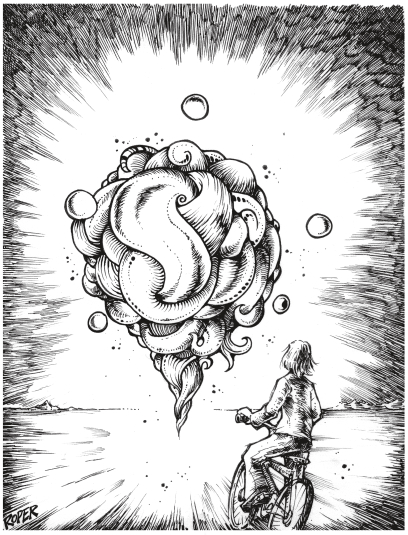
Illustration by Arik Roper

“Here and Now” column by Daniel Pinchbeck

“Towards the New Edge”

A few weeks ago, I attended the annual Burning Man festival, in the Black Rock desert of Nevada, for the fifth year in a row. Burning Man has been called the world’s biggest party, but I don’t even know if I have “fun” at Burning Man in any ordinary sense—being there is incredibly intense, a kind of psychophysical endurance test. Despite the difficulties, I will continue to return as long as it is possible to do so. The gathering acts as an enormous shamanic transformer, constellating new insights and clearing away old junk.

I chose to go to Burning Man instead of staying in New York for the protests surrounding the Republican Convention. My increasing suspicion is that traditional forms of protest, at this point, are only playing into the hands of the security apparatus. The police and military get the opportunity to test out their latest tactics and shiniest gadgets, while the corporate media finds the most incendiary images to broadcast across the US, amping up the anxiety. The catharsis that protesters get from yelling slogans across barbed wire barriers and out of “free speech pens” might be energy that could be more creatively invested in other ways.

As the corporate and governmental superstructure continue a lockstep march towards their own self-destruction, their attempts to pulverize the collective psyche into submission becomes more transparent and overt. Electrical currents of spite and anxiety ripple across our public discourse and private lives. The individual’s refusal to fall into these traps or accept this negative conditioning can be a great liberation. At Burning Man, I kept thinking that the most meaningful political act, right now, is to continue cultivating fearlessness in pursuit of joy. To be fearless, calm, and joyful is to jam a wrench into the “Brave New 1984” technodystopic machinery that is seeking to impose itself on our world.

I consider the current sociopolitical abyss to be a kind of evolutionary tool. The control apparatus of modern society may be functioning as a training ground for a new level of consciousness. Many different thinkers of the 20th century, as well as the prophecies of archaic and indigenous spiritual traditions, have proposed that a major change in human consciousness is imminent. This has been articulated in various ways. Before his death in 1961, the psychoanalyst Carl Jung saw that the “reality of the psyche,” repressed by the modern mentality, would soon become unavoidable. Mankind was being forced to climb “to a higher moral level, to a higher plane of consciousness,” to handle “the superhuman powers which the fallen angels” had dropped into our hands.

The Austrian visionary Rudolf Steiner (founder of Anthroposophy and Waldorf education) claimed that the mission of his life on Earth was to return the knowledge of reincarnation to the West. According to Steiner, individual human beings reincarnate again and again, and the Earth itself passes through successive incarnations. He considered this phase to be the fourth incarnation of the Earth. Steiner thought we are approaching a fifth incarnation, the “Jupiter state,” where humanity would evolve new capacities and reach a new level of wisdom. Actually, it’s not just humanity: according to Steiner, the plant and mineral kingdom would reach a higher level of consciousness during this next incarnation, while humanity would split into several different “human kingdoms,” undergoing different forms of evolution.

The Indian philosopher Sri Auribindo also felt that we were moving towards a new level or intensity of consciousness. In one of his last essays, “The Mind of Light,” he defined this as the “supramental” state. Just as life had self-organized out of matter, and mind had self-organized out of life, consciousness would evolve beyond the obscurations and ignorance of our current condition to attain a level of truth-consciousness, and spiritual awareness, that could not be manipulated or fooled. Aurobindo speculated that our evolution would accelerate exponentially from that point. Once we had reached this supramental state, this truth-consciousness, we would be able to transform our physical reality and our bodies. “Man,” Aurobindo wrote, “is a transitional being.” The powers unleashed by technology might be reintegrated into the psyche, at a higher level of development.

As counterintuitive as it may seem at first, I propose that our current environment, saturated with noise and chaos and fear-mongering, is the necessary background for attaining this supramental condition, for accepting and mastering the reality of the psyche. The new mindset stems from a fearless curiosity and hunger for truth, and a rejection of the cynicism and negative programming foisted upon it by the corporate-controlled media and current power structure. The new intensity of consciousness accepts the reality of psychic and occult levels of reality, denied by modern materialism, but integrates this understanding with a scientific, pragmatic, and empirical approach to existence. As a speaker at Burning Man pointed out, it is not “New Age,” but “New Edge.”

My hypothesis is that at least a portion of humanity attains this level of “supramental” mind – including, as Aurobindo proposes, an accelerated evolution —as we approach the year 2012, prophesied by the Mayans as the end of the 5,125-year “Great Cycle” of human history. Despite current appearances, we are on the verge of a transition into a new intensity of human consciousness that will institute an harmonic and utopian situation on the Earth. This thesis is not mine alone—it is carefully elaborated by Carl Johann Calleman, among others, in his new book, The Mayan Calendar and the Transformation of Consciousness (Bear & Co.). This book supports the basic ideas of the writers Jose Arguelles and John Major Jenkins—a new outsider paradigm is crystallizing.

Continue reading

AUTUMN OF THE PATRIARCHS: James Parker on Richard Meltzer and Mike Watt (Arthur 14/Jan. 2005)

Originally published in Arthur No. 14/January 2005

Autumn of the Patriarchs
By James Parker

Reviewed:

RICHARD MELTZER
Autumn Rhythm
(Da Capo/Perseus)

MIKE WATT
the secondman’s middle stand
(Columbia/RedEye)

It’s Autumn, by God, and I couldn’t be happier. If you’re a writer, it’s the only season: the peak, the prime. Summer flattens you, Winter cramps you, Spring is a mere sizzling of the sex-urge, but Autumn flings open the furnace door to real transformation. On a high November afternoon, with the leaves in a life-and-death whirl and that tossing, brassy light all around, the writer creeps from his/her carapace and partakes in the vortex of Possibility. Out come the old, allergen-loaded sweaters. Yes! On goes the woolly hat, that incubator of thought. Upward fly the—well, I could go on, but the point here is to address our latest bard of the Autumn, the great Richard Meltzer, whose Autumn Rhythm (now out in glorious paperback!), is not so much about crisp weather and fiery trees as it is about Mortality (or mortali-T, as the Meltz, in his demented flippancy, might put it)—age, defeat—the Autumn of our days—“the ‘topic’ at hand: your time… my time… all our times running low, running out, or in any case running.”

Meltzer, in case you’re not sure, is a father of what he calls ‘rockwriting’—Sixties, Seventies, he did it, he lived and typed it, was legendary, boozed with Bangs, tyro’d with Tosches etc etc. He figured in LA punk rock, a great stimulus to the minutemen, had his own terrible band. It’s all in his previous tome, A Whore Just Like the Rest. And now, finding himself “on the cusp of fucking dotage” (his late fifties), Meltzer is taking the long view and using the essay form. He considers his life, and the possible cessation thereof. Is there any more good art to be had from the fact that we’re all, sooner or later, going to be combusted or ploughed under? Certainly there is. Take this: “A couple years ago I started quantifying what a day actually felt like, what its duration as lived existentially was, and the unit day, I surmised, was only four hours long. It now feels about three and a half…. What can you get done in three and a half hours? (Better not piss—that’ll cut it to three.)” Or this, from a piece about Meltzer’s father, touchingly entitled “The Old Fuckeroo”: ‘Of course he LOVED me (and I loved him) and all such nonsense—but that part was maybe the worst of it. A sentimental slob, a ‘40s romantic in desperate need of a compliant LOVE OBJECT, he inflicted his ardor on me in direct proportion to what he wasn’t getting from his wife, assuring me (as often as not) that I was the the most important being in his life. A sensitive little prick, I grieved for the guy in his loneliness…” This is top-notch, ranking with the most exalted literature of fathers and sons. “(And I loved him)”—oh, the brackets say everything.

Like a number of greying punk rock dudes one knows, Meltzer is a cat person. It’s almost a type: the hoary radical, the ex-crazy, childless (Meltzer has declined to Impose “the full slimy wrath of [his] being” on any progeny), spurning most human allegiance but twistedly into his cat or cats, relishing and respecting the fuck-you-ness and complication of the feline. Meltzer writes, at any rate, with unguarded passion about his own aging—dying, in fact—pet-friend. The prose totters pretty close to the sentimental here—“It tears my guts out that I can’t tell him anything he’ll understand ‘bout how come he can’t go outside no more”—but it’s the real man speaking, no question, the same crank who elsewhere demands that we “unplug from the cyber lifeline… it’s a fucking deathline,” and that “Any bar, meantime, where the TV is never off should be NAPALMED.” (hear! hear!)

Meltzer can be an extraordinary comic writer, a real Joycean nutjob, but Autumn Rhythm is—as a rule— sombre, shaded, down. For a freelancer or “writeperson,” reading him in this mode is like having a skull on your desk—the hack’s death’s head, with failure caverned in its eyeholes. Unrich, unredeemed, still pissed at all the mags he ever wrote for, the Meltz will be your memento mori. “May this heap-o-pulp likewise serve as the ur-expression of YOUR vanity. A foretaste of your own aftertaste, of your own extinction.” No laughing matter. Only once does the author uncage the humorist, the Joycean nutter within, in a blinding series of anagrams (with explanations) for “Twentieth Century”: “W.C.T.E: ‘NUTHER ENTITY? (is the Women’s Christian Temperance Enfederation really diff’rent from their Union?)… WET TEN-INCH RYE TUT (medium-size Egyptian novelty bread, after the rain).” Personally, I can’t get enough of this stuff—“NEUTER THE WITTY N.C. (Noel Coward should be desexed, humorless critics contend)”—but I suppose I should stop quoting it. Besides, it’s not all gold dust between these covers. There are “poems”—or at least vertical strands of collapsed prose—in here, mere beermat jottings really. “His life was like a fart…” “if the flies want me/ let the flies have me,” “does my dick have scales?”—yeah, well, okay. Dead-end complacency. Keep typin’em up, Mr. M, if it helps you stay loose… Alright, just one more: “TUNNEY ET IT W/ ‘H’ CERT (Gene followed lobster with a heroin-flavor breath mint).” Ha!

MTV, the “wundaful world-o-videos,” is another of Meltzer’s apocalypses, like the TV bars and the Internet. “When the frigging MINUTEMEN did a vid,” he declares, “you knew it was completely over.” So speaking of the minutemen, and speaking of being completely over, let’s move on to the new Mike Watt CD, which details—really details—a more urgent autumnal event, a most drastic run-in with mortality. the secondman’s middle stand is about serious physical illness (and recovery), and like Watt’s previous contemplatin’ the engine room it takes the form of a punk rock opera, thematically unified, moving in suites. No guitar this time, no Nels Cline or flaming Joe Baiza—on top of the bass and drums is the B3 organ of Pete Mazich, summoning celestial overtones or carousel queasiness as required.

The sickness unto death, for Watt, began in the perineum, that dark notch between balls and asshole. A place of terror: less a place than a space—an eerie, sensate, biologically brooding nothing. Anyway, in 2000 Watt got some sort of explosive abscess right there on his perineum, on the black fulcrum of his being as it were, a boil or saddlesore that blossomed vilely upward and inward and swelled its canker until he quite literally burst, gushing infection through emergency blowholes. Imagine it if you dare, it was an authentic crisis—flashing lights, gurneys, surgery, “38 days of fever,” the mercury climbing in horror and indignation, Watt hovering in half-states, deeply drugged. He almost died. His health and strength were demolished. His recovery was inch-by-inch. “Many geisha boy steps to make the couple of blocks from my pad.” Geisha boy steps—that’s very good.

Fortunately, blessedly, Watt’s philosophy seems to have been a match for this. A proper materialist from his minuteman days, always wrestling with the actual, he was not dismayed to find himself splayed, helpless, reduced, a creature of “pissbags and tubing.” His interest in the conditions, his taste for the basics, prevailed. Adrift for a time in the the unlit precincts of his own body, CURIOSITY got him home. “Dicktube yanked out too/How I laughed when that golf ball bead came thru…” If you’ve ever encountered Watt in person you know that there’s a poetic totality to the man, a density of imagination in which everything—the mumble, the rumble, the word-hoard, the face-bristle, the bong-gurgle, the rumour and squelch of his bass—corresponds. It’s the whole Watt thing, and it feeds the art tremendously: in some respects it is the art. All experience is grist to Watt the mythifier and this here, this bodily drama, is his own “dark wood of error,” his existential pratfall. Can you dig a punk rock opera about a man whose ass exploded? I know you can. Three movements—Inferno; Purgatorio; Paradiso—hell-hot fever, convalescent limbo, the heaven of the healed return. Dante Alighieri hovers palely by, upper lip lengthened in slight disapproval: Watt has customised the Divine Comedy.

“Boilin’ Blazes” gets us rolling, as Watt does some big vomiting—“threw up mah guts”—and succumbs to fever. It’s the beginning of the “hellride,” a derangement of vile organ-blare and bombastic drumming. “Puked to High Heaven”—more vomiting, and the freakout becomes ontological: “In my head, a tightly packed flame…The moment has me seized!” “Burstedman” is the killer track: “Virgil! Beatrice!” cries the patient, as ungodly fluids splatter his “bulkhead.” “A life in the moment, is that what you’ve always wanted, Watt?” he taunts himself, his bass snicker-snacking. “Well here it is!” (Watt’s playing in general on secondman… is, if possible, more bulbous and ruminative than ever.)

Into hospital we go, and Watt gives us—joyously—the wadded dressings, the catheters, the incidental bladder infections, the nitty gritty: “yankin’ it out… and shovin’ it in!” The mood of “Tied a Reed Round My Waist” is… wonder, oddly enough, Pete Mazich’s B3 doing soft throbs of awe as Watt goes swooning under the knife of top surgeon “Doc Hopkins.” “Beltsandedman”—again with the blue-collar metaphors!—is a beautiful evocation of post-traumatic smoothness, clarity of perception, with fuzzed bass-notes lingering and Petra Haden’s harmonies leavening the Watt-growl. See Watt on the back of the CD, pounds lighter, purged and streamlined: the eyes are heavy-lidded but clear, afire, and there’s a sort of rinsed brilliance to the complexion. It all appears to have been quite good for him.

"Dick Captured by KGB" by VOINA

“…The most notorious Voina action was last June, when several members of the group painted a penis on the Liteiny Bridge in St Petersburg. Evading and fighting off security, the 65-meter high image was completed just before the bridge opened, as it does each evening to let ships pass through. The penis ‘erected,’ directly facing the St Petersburg headquarters of the FSB, the KGB’s successor. The group called the artwork Dick Captured by KGB.”

More: The artists who crossed the line: An art group that stages orgies, throws cats at cashiers and has Banksy as a fan has enraged the Russian authorities (The Independent)

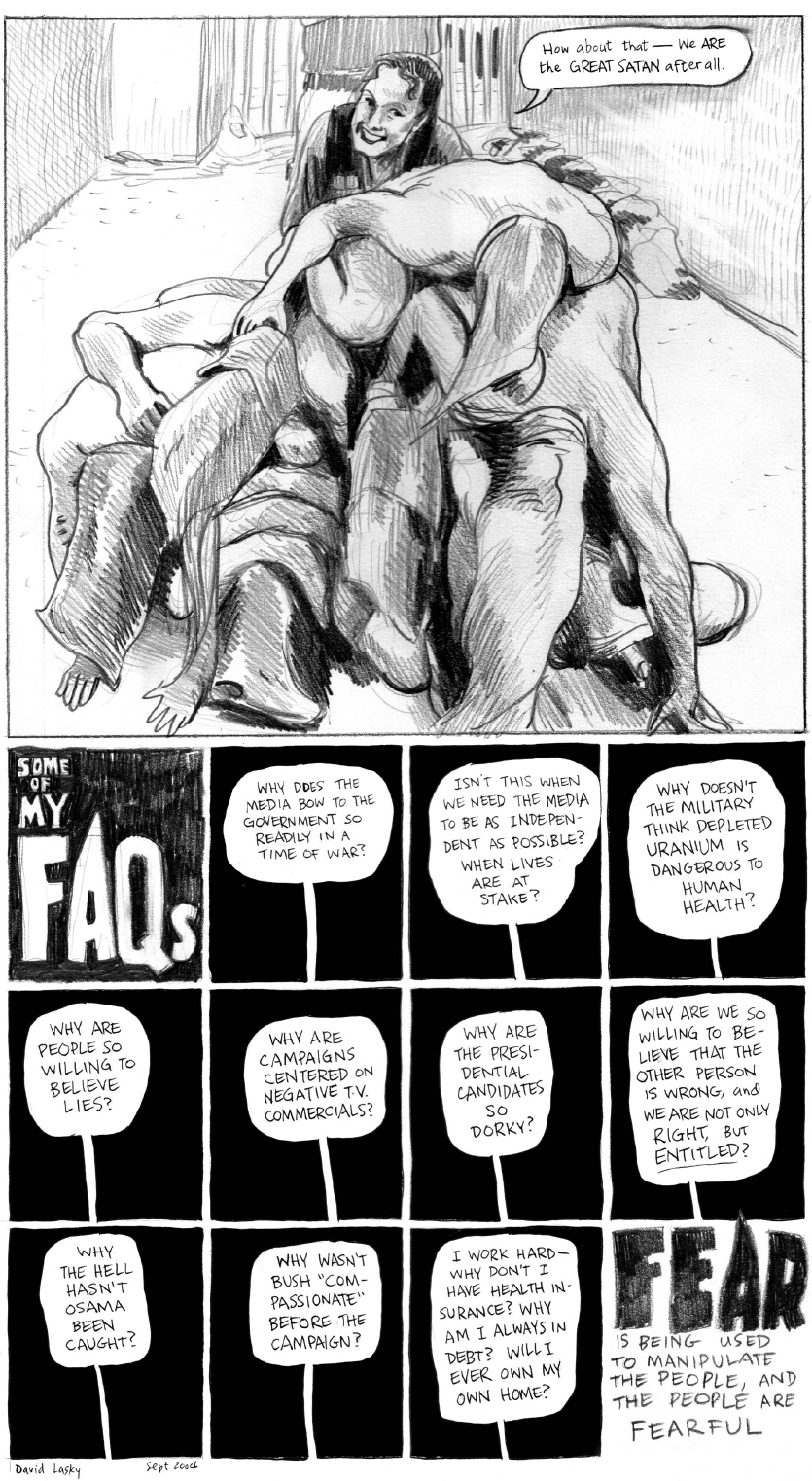
“Some of my FAQs” by DAVID LASKY (Arthur, 2005)

Originally published in Arthur No. 14 (January 2005)

Click image to really enlarge. It’s still not gonna be completely ideal—for that, you’ll have to see the actual magazine (available at the Arthur Store for cheep)—but it’s pretty good.

David Lasky: http://dlasky.livejournal.com/

Arthur’s superb Comics Editor in this era was Tom Devlin.

“Why?” by DAVID LASKY (Arthur, 2004)

Originally published in Arthur No. 13 (Nov. 2004)

Click image to really enlarge. It’s still not gonna be completely ideal—for that, you’ll have to see the actual magazine (available at the Arthur Store for cheep)—but it’s pretty good.

David Lasky: http://dlasky.livejournal.com/

Arthur’s Comics Editor in this era was Tom Devlin.

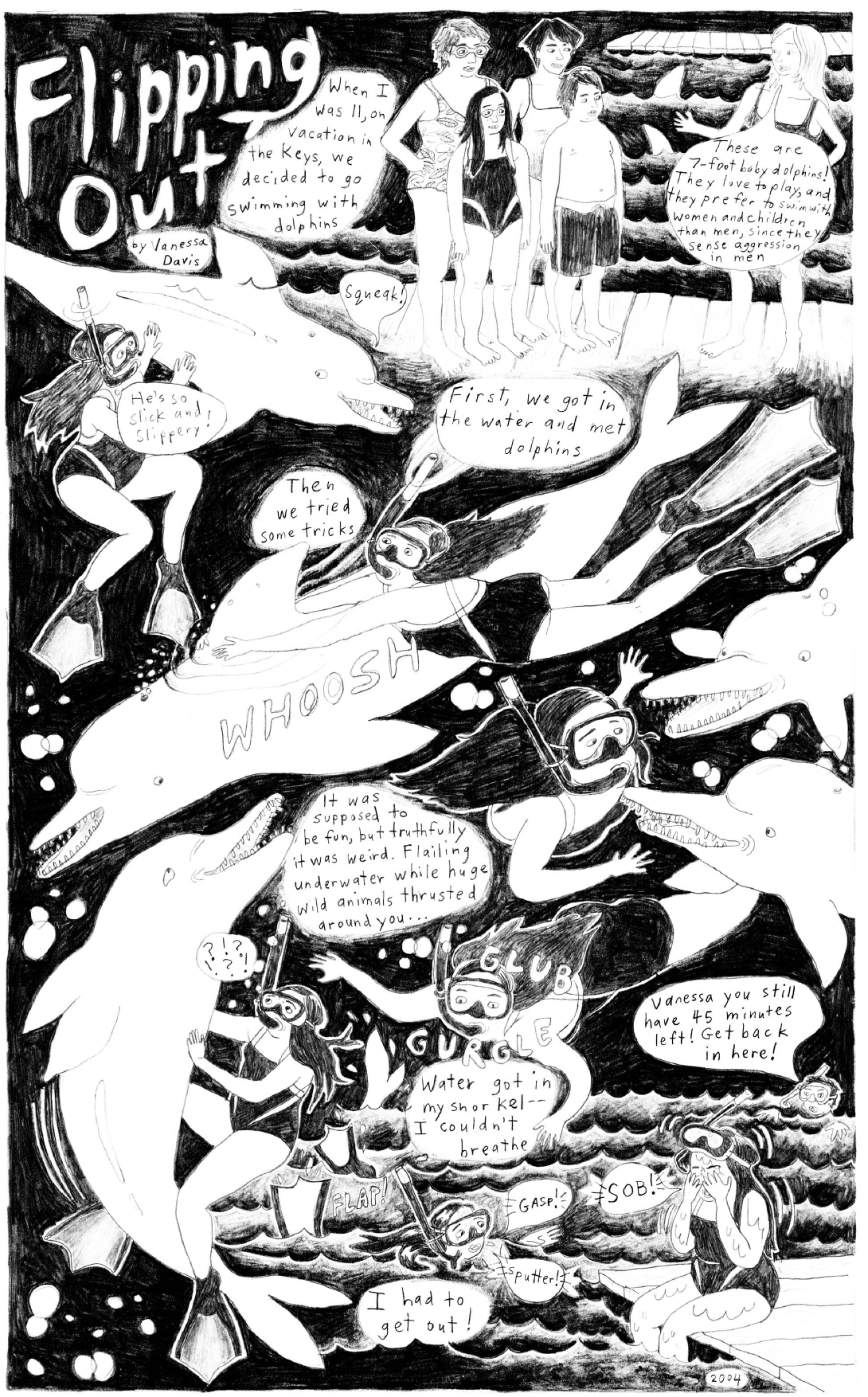
“Flipping Out” by VANESSA DAVIS (Arthur, 2004)

Originally published in Arthur No. 13 (Nov. 2004)

Click image to really enlarge. It’s still not gonna be completely legible—for that, you’ll have to see the actual magazine (available at the Arthur Store for cheep)—but it’s pretty good.

Vanessa Davis: http://www.spanielrage.com

Arthur’s Comics Editor in this era was Tom Devlin.