Daniel Locke 'Spring 09'


Next in the Arthur Comics round-up!
Here is a strip Daniel drew last year called ‘Spring 09‘.

About Daniel Locke:

Daniel Locke is an artist based in London and Brighton UK. He works as an illustrator and teacher, and was a sketch artist on the UK version of the
reality TV show Dating in the Dark. He is currently Artist in Residence at the St Martins project in Islington, London. He used to make videos and
installations, but these days confines himself to comics. His work can be seen at www.daniellocke.com

About Arthur Comics
We are proud to bring you Arthur Comics curated by Floating World. Stop by our oasis, http://www.arthurmag.com/comics, for a leisurely bath in our new interactive format, an exclusive collaboration with GreenerMags / グリーナーマガジン.

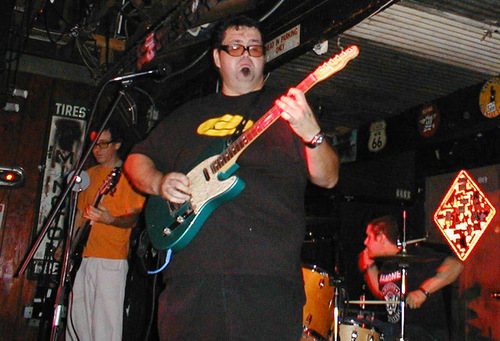
One from the Desert Files: Mario "Boomer" Lalli and FATSO JETSON (2002)

From left: Larry Lalli, Mario “Boomer” Lalli and Tony Tornay

Larger Than Life: Casting shadows with Fatso Jetson
by Jay Babcock

A much shorter version of this piece was published Thursday, Dec 12 2002 in LAWeekly

Look closely at almost any significant rock band’s background—at its deeper, 
hazier context, at its place/space in its particular subcultural zeitgeist—and 
you will find someone who acted, perhaps unwittingly, as a crucial instigator: a 
subtle yet critical link without which the chain would not hold. Led Zeppelin 
had Roy Harper. Nirvana had King Buzzo. And Queens of the Stone Age, arguably 
the best American melodic hard rock band since Cobain exited in self-disgust, 
have guitarist-singer Mario “Boomer” Lalli.

“Boomer has this one quality that I’ve been searching for since the moment I 
saw him, and that is Boomer is un-heckle-able,” says Joshua Homme, the leader of 
the Queens of the Stone Age, who’s been watching Lalli play since he (Josh) was 
14. “There could be a wide array of reasons to heckle Boomer—but it’s impossible when you watch him play. The second he starts to play, when he 
squints his eyes? I’ve never heard anyone go, ‘bleh, shut up!’ I’ve seen people 
not like it, but I’ve never seen anything thrown at him. Nothing. Because you 
believe it. 
       

“It’s for real.”

* * *

Born in 1966 as “Mario” and quickly tagged with the impossibly appropriate 
nickname Boomer, Lalli was raised in Palm Springs, where his parents, a pair of 
opera singers, ran an Italian-themed restaurant called “Mario’s—Where They Sing 
While You Dine” with Mario Sr.’s brother Tullio. At Mario’s, which re-located to 
Pasadena earlier this year after three decades in the low desert, Mario Sr. and 
Edalyn lead the Mario Singers, a small group of performers, most of whom have 
other roles at the restaurant, in belting out two 30-minute shows (three on 
weekends) every night for the diners. (Now 80, the senior Lallis are still 
working/singing every evening, even on Sundays at 9.) [Restaurant’s now closed.—Ed., 2010]

“Our family has had a restaurant there for 30 years,” says Boomer. “For 20 of 
those years it was very successful, and summers off were just party time, just 
great. But now, it’s just changed. There’s a lot of big corporate money doing 
the restaurant thing there, so a unique little place like we had? It’s tough to 
make it work there these days. Our lease was up in the desert and we just 
thought What the fuck, let’s go for it in Pasadena.

“And you know, as great as 
the desert has been for our music, it was a terrible place to play music.”

Since he was 16, Boomer has been doing music in the desert that didn’t exactly fit the format at the family restaurant—or anywhere else.

“We grew up on Aerosmith, but that was fantasyland. Then we saw D. Boon and Mike Watt and the cats in Black Flag and the guys in Redd Kross and Saccharine Trust, and we saw these guys were guys like us! They‘re just dudes. And skateboarding too had a lot to do with it, because it was all about: Find a place. You wanna go skateboard? Find a pool, bail it out. You do all that work, you put effort into it, and then you’ve got this place. 
And that bled over into music.”

Continue reading

Arthur Radio Transmission #17: The Shifty and the Shiftless

Double-click for fullscreen + scroll.

This week’s episode comes slightly delayed, as Ivy Meadows was put behind bars for two days as punishment for doodling an eyeball on an ad in a New York City subway station. Meanwhile, Hairy Painter ventured to his alternate Vermont dwelling, answering the call of fresh, tree-filled air, far away from humming internet hubs and the unpredictable whims of the NYPD. In both locations, Arthur Radio co-hosts are happy to know they can sit back, turn on Transmission #17, and revel in the realization that life on the outside is so, so sweet…

Writer and Arthurhead Gabe Soria on his live DJ Mixtape, “The Shifty and the Shiftless” (@ 55 mins):

This hour of New Orleans music was an attempt to convey the almost
science-fictional collision of alternate universes that co-exist in
New Orleans at any given moment. Punk trad jazz, wheezy sea
shanties, bar rock, in-the-pocket funk, teeth-rattling bounce — it’s all
different, yet all the songs share some weird common genetics. It’s
humid, it’s melodramatic, it’s the sound of a living, breathing,
sweating and completely unique city. Meant to be listened to with an
ice-cold bottle of beer or two close at hand.


Stream it: [audio:http://www.arthurmag.com/magpie/wp-content/uploads/2010/05/New-Orleans-DJ-set-by-Gabe-Soria-5-9-2010.mp3%5D
Download: Arthur Radio #17: The Shifty and the Shiftless w/ Gabe Soria 5-9-2010

This week’s playlist…
Continue reading

A CARRINGTON EVENT

from : http://spectregroup.wordpress.com/2010/05/12/a-carrington-event/

No Longer Geostationary, So Much : Rogue ZombieSats
http://theregister.co.uk/2010/05/03/wayward_satellite/
http://csmonitor.com/Science/2010/0509/Satellite-goes-rogue-threatens-other-spacecraft
“An out-of-control Intelsat satellite that stopped communicating with ground crews last month poses a threat to other satellites as it wanders about 36,000km above the earth. Dubbed Galaxy 15, the satellite stopped responding to ground controllers on April 5. Since then, engineers have sent more than 150,000 commands to the roving craft in an attempt to regain control of it. In what industry officials called an unprecedented event, Intelsat’s Galaxy 15 communications satellite has remained fully “on,” with its telecommunications payload still functioning. The satellite’s manufacturer has said an intense solar storm in early April may be to blame. On May 3, Intelsat will play what as of Friday appeared to be its last card by blasting Galaxy 15 with a more powerful signal intended not to salvage the satellite, but to force it into a complete shutdown. Even if the May 3 action succeeds, Galaxy 15 will remain a problem as it continues to wander the geostationary arc. But it is a problem that satellite operators know how to deal with. Industry experts say there are several dozen spacecraft, sometimes called “zombiesats,” that for various reasons were not removed from the geostationary highway before failing completely. Depending on their position at the time of failure, these satellites tend to migrate toward one of two libration points, at 105 degrees west and 75 degrees east. Figures compiled by XL Insurance of New York, an underwriter of space risks, say that more than 160 satellites are gathered at these two points.”


http://sxi.ngdc.noaa.gov/sxi_greatest.html
Above: A modern solar flare recorded Dec. 5, 2006, by the X-ray Imager onboard NOAA’s GOES-13 satellite. The flare was so intense, it actually damaged the instrument that took the picture. Researchers believe Carrington’s flare was much more energetic than this one.

A Carrington Event
http://geomag.bgs.ac.uk/carrington.html
http://adsbit.harvard.edu/cgi-bin/nph-iarticle_query?bibcode=1859MNRAS..20…13C
http://science.nasa.gov/science-news/science-at-nasa/2009/21jan_severespaceweather/
“The strongest geomagnetic storm on record is the Carrington Event of August-September 1859, named after British astronomer Richard Carrington, who witnessed the instigating solar flare with his unaided eye. Geomagnetic activity triggered by the explosion electrified telegraph lines, shocking technicians and setting their telegraph papers on fire; Northern Lights spread as far south as Cuba and Hawaii; auroras over the Rocky Mountains were so bright, the glow woke campers who began preparing breakfast because they thought it was morning. “A contemporary repetition of the Carrington Event would cause … extensive social and economic disruptions,” the report warns. Power outages would be accompanied by radio blackouts and satellite malfunctions; telecommunications, GPS navigation, banking and finance, and transportation would all be affected. Some problems would correct themselves with the fading of the storm: radio and GPS transmissions could come back online fairly quickly. Other problems would be lasting: a burnt-out multi-ton transformer, for instance, can take weeks or months to repair. The total economic impact in the first year alone could reach $2 trillion, some 20 times greater than the costs of a Hurricane Katrina or, to use a timelier example, a few TARPs.”

Solar Flares and You
http://sxi.ngdc.noaa.gov/sxi_greatest.html
“Lanzerotti became aware of the effects of solar geomagnetic storms on terrestrial communications when a huge solar flare on August 4, 1972, knocked out long-distance telephone communication across Illinois. That event, in fact, caused AT&T to redesign its power system for transatlantic cables. A similar flare on March 13, 1989, provoked geomagnetic storms that disrupted electric power transmission from the Hydro Québec generating station in Canada, blacking out most of the province and plunging 6 million people into darkness for 9 hours; aurora-induced power surges even melted power transformers in New Jersey. In December 2005, X-rays from another solar storm disrupted satellite-to-ground communications and Global Positioning System (GPS) navigation signals for about 10 minutes. That may not sound like much, but as Lanzerotti noted, “I would not have wanted to be on a commercial airplane being guided in for a landing by GPS or on a ship being docked by GPS during that 10 minutes.” Experts who have studied the question say there is little to be done to protect satellites from a Carrington-class flare. In fact, a recent paper estimates potential damage to the 900-plus satellites currently in orbit could cost between $30 billion and $70 billion. The best solution: have a pipeline of comsats ready for launch.”

Space Weather
http://www.scientificamerican.com/article.cfm?id=bracing-for-a-solar-superstorm
“When a large geomagnetic storm happens again, the most obvious victims will be satellites. Many communications satellites, such as Anik E1 and E2 in 1994 and Telstar 401 in 1997, have been compromised or lost in this way. A large solar storm can cause one to three years’ worth of satellite lifetime loss in a matter of hours and produce hundreds of glitches, ranging from errant but harmless commands to destructive electrostatic discharges. But at least our satellites have been specifically designed to function under the vagaries of space weather. According to studies, the magnetic storm of May 15, 1921, would have caused a blackout affecting half of North America had it happened today. A much larger storm, like that of 1859, could bring down the entire grid.”

Previously on Spectre
spectregroup.wordpress.com/2009/09/04/auroral-current/
spectregroup.wordpress.com/2008/03/08/stars-have-weather/
spectregroup.wordpress.com/2007/04/16/solar-flares-and-other-protections/

the 23rd Cycle
http://www.solarstorms.org/S23rdCycle.html
http://www.solarstorms.org/Scommun.html
“The chronicle of telegraph, short-wave, satellite and electrical outages is a major reminder of the constancy of the space weather impact upon human technology.

August 28 – September 2, 1859 – American telegraphists had only a short time to puzzle over atmospheric electricity on their 1000-mile lines when in 1859, the Great Auroras of August 28 and September 4 blazed forth and lit up the skies of nearly every major city on the planet. It was one of the most remarkable displays ever seen in the United States up until that time. These aurora were so exceptional that the American Journal of Science and Arts published no fewer than 158 accounts from around the world describing what the display looked like, the telegraphic disruptions they produced, and assorted theoretical speculations. Normal business transactions requiring telegraphic exchanges were completely shut down in the major world capitals. In France, telegraphic connections were disrupted as sparks literally flew from the long transmission lines. There were even some near-electrocutions. In one instance, Fredrick Royce a telegraph operator in Washington D.C reported that, “During the auroral display, I was calling Richmond, and had one hand on the iron plate. Happening to lean towards the sounder, which is against the wall, my forehead grazed a ground wire. Immediately I received a very severe electric shock, which stunned me for an instant. An old man who was sitting facing me, and but a few feet distant, said he saw a spark of fire jump from my forehead to the shoulder. ”

May 13, 1921 – The prelude to this storm began with a major sunspot sighted on the limb of the sun vast enough to be seen with the naked eye through smoked glass. The spot was 94,000 miles long and 21,000 miles wide and by May 14th was near the center of the sun in prime location to unleash an earth-directed flare. The 3-degree magnetic bearing change among the five worst events recorded ended all communications traffic from the Atlantic Coast to the Mississippi. By 10:00 PM May 15, Washington DC was cut off telegraphically from the rest of the United States. Lines carrying more than 1000 volts of electricity ‘blown out fuses, injured electrical apparatus and done other things which had never been caused by any ground and ocean current known in the past’. The company would probably have to send ships to drag up the undersea cables to repair them. The electrical ocean currents had found the weakest spots in the cable insulation and caused severe damage. Apparently three of the Western Union transatlantic cables were affected. The entire signal and switching system of the New York Central Railroad below 125th street was put out of operation, followed by a fire in the control tower at 57th Street and Park Avenue.

April 29, 1937 – Magnetic storm ‘worst in century. Canada telegraph experiences severe disturbances. [New York Times 4/29 p. 23]

July 6, 1941 – Short wave blackouts during World War II

February 10, 1958 – The Great Aurora colored the skies over Chicago and Boston. In a foretaste of what would become a common, and expensive, problem decades later, the Explorer 1 satellite launched two weeks earlier, suddenly lost its primary radio system. The geomagnetic activity knocked out telecommunications circuits all across Canada, and although it was not visible in the New York area, it was so brilliant over Europe it aroused fears of conflagrations. The Monday storm cutoff the United States from radio contact with the rest of the world following an afternoon of ‘jumpy connections’ that ended with a complete black out by 3:00 PM, although contact with South America seemed unaffected. By evening, radio messages to Europe could occasionally be sent and received. Radio and TV viewers in the Boston area, however, were reportedly having their own amusing problems. For three hours, they fiddled with their TVs and radios as their sets went haywire, at times blanking out entirely, or changing stations erratically. Channel 7 viewers began getting Channel 7 broadcasts from Manchester Vermont, while Channel 4 viewers received ghostly blends of the local Boston station and one in Providence, Rhode Island. Viewers had just finished watching the ‘Lawrence Welk Show’ at 9:30 PM and were preparing to watch a nationally-broadcast TV movie ‘Meeting in Paris’ on Channel 4, or listen to a boxing match. What they hadn’t counted on was that they would get to do both at the same time. During a passionate love scene, the audio portion of the movie was replaced by the blow-by-blow details of the boxing match: “Smith gave him a left to the jaw and a short right hook to the button. — But darling we love each other so much. — A left hook to the jaw flattened Smith and he’s down for the count. — Kiss me again my sweet.” [New York Times 2/12 p. 16, Boston Globe 2/11 p.27]

March 13-14 1989 – Solar storm triggered the Quebec Blackout that affected 5 million people for up to 12 hours. Geostationary satellites, which used the Earth’s magnetic field to determine their orientation, had to be manually controlled to keep them from literally flipping upside down as the orientation of the magnetic field became disturbed and changed direction. Records show that some low altitude, high-inclination, and polar-orbiting satellites experienced uncontrolled tumbling. [New York Times 3/13 p.1 Boston Globe 3/14 p.6, EOS Transactions 11/14 p. 1479]

October 29, 2003 – This Halloween Storm spawned auroras that were seen over most of North America. Extensive satellite problems were reported, including the loss of the $450 million Midori-2 research satellite. Highly publicized in the news media. A huge solar storm impacted the Earth, just over 19 hours after leaving the sun. This is probably the second fastest solar storm in historic times, only beaten by the perfect solar storm in the year 1859 which spent an estimated 17 hours in transit.

November 4, 2003 – One of the most powerful x-ray flares ever detected , it swamped the sensors of dozens of satellites, causing satellite operations anomalies, but no aurora. Originally classified as an X28 flare, it was upgrade by OAA scientists to X34 a month later. Astronauts hid deep within the body of the International Space Station, but still reported radiation effects and ocular ‘shooting stars’. Highly publicized in the news media but produced no aurora. It was also not seen as a white-light flare.”


Sky Update

SpaceWeather.com gives us

SPACE STATION RAINBOW: “On May 12th, the International Space Station passed high over Queensbury, New York, where John E Cordiale was waiting … with a prism. When the bright light of the streaking spacecraft passed through the glass, it spread into all the colors of a rainbow”

and! “…Ready to make your own space station rainbow? Grab a prism and check the Simple Satellite Tracker for flybys.”

Los Angeles, the space station passes over us this weekend so keep your prisms to the sky!

According to the Griffith Park Sky Report: “On Monday, May 17, the ISS makes its best evening pass, crossing the sky from northwest to south-southeast between 8:53, and 8:57 p.m., appearing 53 degrees high in southwest the at 8:56 p.m., P.D.T.”

and! there are planets all over the place too, “The planets Venus, Mars, and Saturn are all bright and easy to see at sunset or shortly thereafter. They are the brightest objects forming a line across much of the sky, from northwest to southeast during the evening twilight. Orange Mars, in Cancer the crab, is close to Leo the Lion’s bright star, Regulus, and yellow Saturn, in Virgo the Maiden, is between Regulus and Virgo’s bright star Spica.

Planet Jupiter is 19 degrees high in the east-southeast at 5:00 a.m., appearing brilliant and with a cream-yellow hue. Use binoculars or a telescope to see its four Galilean satellites.

The waxing crescent moon returns to the evening sky on Friday, May 14. It may then be found 17 degrees to the lower right of Venus, and just above the west-northwest horizon starting half an hour after sunset. On Saturday night, the moon is only 4 degrees to the lower left of Venus, and on Sunday, 8 degrees to the upper left of the planet.”

Space out everybody!

“The best concerts I’ve ever been to”—MARIO CALDATO, JR. on Fela Kuti (1999)

Mario Caldato, Jr. on FELA KUTI
interviewed by Jay Babcock

This short article was originally published in Mean Magazine in 1999 as one of the many sidebar to the massive feature on Fela Kuti (see below for links to the other articles that comprised the feature). Mean’s publisher, Kashy Khaledi, wanted to have contemporary artists of a certain notoriety talk about their admiration for Fela, who we knew would be an unknown, slightly outre quantity for most of the magazine’s readership. These sidebar interviews would be a way in to digging Fela for some of the less-curious readers.

It was a good idea, and easily executed, as there were plenty of Fela admirers ready to testify—including the semi-legendary Mario Caldato, Jr. (aka Mario C.), a producer, multi-instrumentalist, and skilled carpenter, at the time best known for his work on the Beastie Boys’ Check Your Head lp.

I interviewed Mario at his home in late summer ’99…


Q: How did you first come across Fela?

Mario Caldato: One day I heard about this guy Fela coming to town. They just couldn’t stop talking about amazing the guy was. And he was gonna be at the Olympic Auditorium. I was working for a promoter at the time, Milt Wilson, who did Heavy Traffic Productions and was responsible for bringing all these reggae bands from Jamaica directly, and he started doing African shows also. He actually hired me. I rented some DJ turntables and I set up for the opening, you know, they were playing records, and I was there at the show, working the show. I heard all this hype about the guy, but hadn’t really heard his music. I didn’t know what I was in for.

As soon as he came on, the power was just so intense. As soon as they got onstage everybody just got hypnotized…the rhythm, the dancing, the lights and the sound, it just all came together. Unbelievable. A 20-piece band as I recall and 15 dancers. They did four or five songs all night. It was just an experience—I couldn’t stop talking about it. That’s when I started listening to his records and buying em whenever I saw them.

A couple years later, he played at UCLA at Wadsworth…I actually took the Beasties. We were at the studio working on Check Your Head and I told them, hyped em up, ‘This is an incredible show, we gotta go see it.’ It was just an EVENT. We were all blown away. Log drums and talking drums, two bass players, four guitars, horns, percussion… The way he orchestrated and commanded the show was very impressive. I hadn’t seen anybody conduct a show, sing, perform, direct, play keyboards, play horns, play percussion…he even got on the drums, and would go and turn the amps up and down. Creating dynamics, you know? Doing everything!

They’re still the best concerts I’ve been to, as far as overall involvement of audience and just music and dance and everything.


“Fela: King of the Invisible Art”—main article

TONY ALLEN on Fela Kuti, Afrobeat, solo career, more

GINGER BAKER on Fela Kuti

LESTER BOWIE on Fela Kuti

BILL LASWELL on Fela Kuti

BOOTSY COLLINS on Fela Kuti

DAVID BYRNE on Fela Kuti

FLEA and JOHN FRUSCIANTE (Red Hot Chili Peppers) on Fela Kuti

IAN MACKAYE (Fugazi, Minor Threat) on Fela Kuti


Fela! is now playing on Broadway at the Eugene O’Neil Theatre. Info: http://felaonbroadway.com/index.php

Here’s a review of the earlier off-Broadway production of Fela! from C & D’s column in Arthur No. 31 (Sept 2008).

"Like Frank Sinatra and Huey Newton rolled into one" — Ian MacKaye on FELA KUTI (1999)

Ian MacKaye on FELA KUTI
interviewed by Jay Babcock

This short article was originally published in Mean Magazine in 1999 as one of the many sidebar to the massive feature on Fela Kuti (see below for links to the other articles that comprised the feature). Mean’s publisher, Kashy Khaledi, wanted to have contemporary artists of a certain notoriety talk about their admiration for Fela, who we knew would be an unknown, slightly outre quantity for most of the magazine’s readership. These sidebar interviews would be a way in to digging Fela for some of the less-curious readers. It was a good idea, and easily executed, as there were plenty of Fela admirers ready to testify—including Ian MacKaye, a founding member of Minor Threat and Fugazi, and the owner-operator of the Washington, DC-based Dischord Records (which is still in business).

I interviewed Ian by telephone in late summer ’99…


Q: When did you first come across Fela?

Ian Mackaye: I probably first heard him in the early ’80s. There was a deejay here in town that used to play him at shows. I was working at a record store starting in 1983 or ’84 and some of his records came through then, and I was attracted to them because they’re so completely primitive looking…a lot of them had no art at all, they were almost just like 12-inch things… Of course the songs were like 15-20 minutes long, but they were like punk records, so I was attracted to them on an aesthetic level. Then I started listening to them. I really had no idea who he was or what was going on…I thought the music was interesting. I listened to a lot of go-go music here in Washington, and there’s a lot of similarities. Also it had a really organic feel to it which I was always really drawn to.

Somewhere in the mid-’80s, I saw King Sunny Ade, who’s a bit of a lighter version [of African pop], and at least to my knowledge not nearly as politicized…And then I started getting real interested in Fela cuz I was like, ‘This other guy is into some very serious issues.” He seemed way more punk to me. So I had him on the brain. I just started picking up things here and there…I got the biography, Fela, Fela: This Bitch of a Life in London. And in the back of this book they have a discography, and IT BLEW MY MIND how many records he had done. I have seen a FRACTION of those in my life.

I think that anyone who reads that book would just know that this guy was coming from such a totally different place, and he was SO hardcore in what he was doing. I used to tell people that Fela is sort of like Frank Sinatra and Huey Newton rolled into one—he filled stadiums and at the same time was the most aggressively anti-government guy you can imagine. He had the dough and the power to actually really make a stir. He was an originator, an innovator, and he clearly brought a lot of people together in one form or another. He also had a lot of fuckin’ nerve—to leave your mother’s coffin at the gate of the palace…? [laughs in awe]

Q: It puts a lot of things in perspective, doesn’t it?

Mackaye: It definitely does. Some of the most publicly radical American musicians, their great acts of defiance are always these sort of paltry drinking offenses or sexual offenses, hese kinds of things where you’re like, [sarcastically] ‘Okay that’s really radical.’ Fela actually had a political agenda that he apparently was willing to really suffer for.


“Fela: King of the Invisible Art”—main article

TONY ALLEN on Fela Kuti, Afrobeat, solo career, more

GINGER BAKER on Fela Kuti

LESTER BOWIE on Fela Kuti

BILL LASWELL on Fela Kuti

BOOTSY COLLINS on Fela Kuti

DAVID BYRNE on Fela Kuti

FLEA Aand JOHN FRUSCIANTE (Red Hot Chili Peppers) on Fela Kuti


Fela! is now playing on Broadway at the Eugene O’Neil Theatre. Info: http://felaonbroadway.com/index.php

Here’s a review of the earlier off-Broadway production of Fela! from C & D’s column in Arthur No. 31 (Sept 2008).