12 minutes, just astonishing. Via ILM…

12 minutes, just astonishing. Via ILM…

“Freeman House is a former commercial salmon fisher who has been involved with a community-based watershed restoration effort in northern California for more than 25 years. He is a co-founder of the Mattole Salmon Group and the Mattole Restoration Council. His book, Totem Salmon: Life Lessons from Another Species received the best nonfiction award from the San Francisco Bay Area Book Reviewers Association and the American Academy of Arts and Letters’ Harold D. Vursell Memorial Award for quality of prose. He lives with his family in northern California.”
That’s the biographical note for Freeman House on the Lannan Foundation website. We would add that earlier in his life, Freeman edited Innerspace, a mid-1960s independent press magazine for the nascent psychedelic community; presided over the marriage of Abbie and Anita Hoffman at Central Park on June 10, 1967; and was a member of both New York City’s Group Image and the San Francisco Diggers.
This is the fourth lecture in this series. This series ran previously on this site in 2010-11, and is being rerun now because it’s the right thing to do.
This piece was first published in 2002 in River & Range.

GHOST IN THE SYSTEM
by Freeman House
for John Bennett,
the good dentist
On our raw homestead in the Coast Range, Nina and I were attempting to domesticate a half-acre at the edge of ten acres of upland coastal prairie. We had knocked up a six-foot chicken wire fence, all we could afford at the time, to keep out the many deer that browsed our prairie. The deer had a taste for the new strawberry bed and the young climbing roses we had planted along the fence line. The fence served little purpose but to delay the deer for a week or two until they had discovered how easily they could leap over the strange enclosure. Once they had defoliated the roses and mowed the strawberry plants, they would move on to nibble at the broccoli and lettuce, ever curious. We cut scrap two-by-fours into three-foot lengths and nailed them onto the fence posts at an angle upward and outward, stapled a couple of runs of baling wire around their top ends. The deer stayed on their side of the fence, until, inevitably, someone left a gate open overnight. Without fail one deer would wander in and rediscover her love of rose leaves. We would chase her out in the morning, flapping our arms and yelling. The deer would panic and throw herself against the fence in one place after another until she found the open gates and bounded off. Early on, we assumed that the panic we had instilled would teach the deer a lesson in territory, and that they would avoid our little oasis of green in the summer-dry California prairie. But deer are evidently quickly addicted to rose and strawberry leaves. Once these treats had been rediscovered, the same deer and her cohorts would examine our fence for weaknesses with the intensity of a junkie searching for a connection. Once we saw a doe flat on her belly wriggling under the chicken wire where it lifted nine inches off the uneven ground. For a few years, then, our garden yielded venison at irregular intervals.
The deer were not the only ones who looked on us as new arrivals who were provisioners of exotic snacks. They were the only one of our co-inhabitants on the prairie who shared themselves with us, however; we never developed an appetite for the moles and gophers and raccoons and ravens and quail and slugs who fed freely on our young gardens and orchards. We grew accustomed to the yowling nightly squabbles between the skunks and raccoons over our compost pile. (The skunks would generally win first access. The raccoons didn’t like their stinging spray any more than we did. The raccoons would back off until the skunks had taken their fill and then take their turn at the luscious kitchen garbage, after which they would move on to the strawberries which would have been ripe enough for us to pick on the very next day.)
But we adapted. We planted our artichokes in wire cages to protect them from gophers, having discovered yet another addictive relationship between the ubiquitous soil dwellers and the sweet roots of young artichoke plants. We captured raccoons and skunks in Have-a-Heart traps and trucked them to locations where we thought they might be happier. We covered our newly planted winter gardens with bird netting because the tender seedlings emerged from the ground at about the same time large families of young quail fledged and ranged the dry August prairie with enormous appetites for young greens. We planted more than we needed, coming to understand that if the other residents of the prairie were going to share their habitat with us, we would have to reciprocate by sharing our garden with them. The only alternative to such reciprocity would be to pursue the logical extension of the notions of human control and exclusively owned property. We would have to dig our whole garden area to a depth of two feet or so, cover the subsoil with welded wire to exclude the gophers and moles before putting the soil back to grow our now-secured vegetables and fruits. We would have to build concrete walls sunk an equal distance into the ground and extending eight feet into the air to keep out the raccoons and skunks and foxes and bobcats and deer. Then we would have to cover the whole area with some kind of mesh to keep the fruits and berries safe from a whole sky full of birds. Our fantasies stopped just short of erecting gun towers at the corners of the concrete enclosure. Reciprocity seemed a preferable choice to such a logical demonstration of our singular rights to this corner of prairie.
After seven or eight years, we were providing a lot of our own food, and were becoming comfortable with our new relations. Then, during one particularly dry late summer, some new critters showed up. The new vegetarian was nocturnal, and for a period of several weeks, invisible. But the damage it was doing to the garden and young orchard was dramatic and it had the potential for being terminal. Continue reading
n/p at h/q: Popol Vuh – Einsjäger & Siebenjäger (1974) feat inkredible guitar work from Daniel Fichelscher

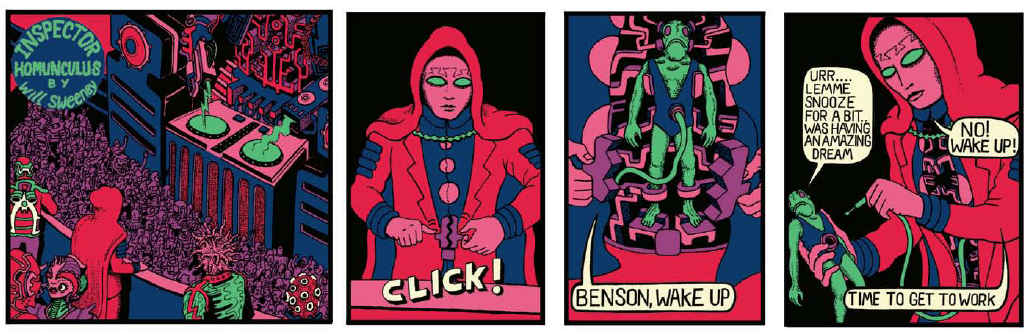
Scene from “Inspector Homunculus” by Mr. Will Sweeney, from Arthur No. 35…

“Freeman House is a former commercial salmon fisher who has been involved with a community-based watershed restoration effort in northern California for more than 25 years. He is a co-founder of the Mattole Salmon Group and the Mattole Restoration Council. His book, Totem Salmon: Life Lessons from Another Species received the best nonfiction award from the San Francisco Bay Area Book Reviewers Association and the American Academy of Arts and Letters’ Harold D. Vursell Memorial Award for quality of prose. He lives with his family in northern California.”
That’s the biographical note for Freeman House on the Lannan Foundation website. We would add that earlier in his life, Freeman edited Innerspace, a mid-1960s independent press magazine for the nascent psychedelic community; presided over the marriage of Abbie and Anita Hoffman at Central Park on June 10, 1967; and was a member of both New York City’s Group Image and the San Francisco Diggers.
This is the third lecture in this series. This series ran previously on this site in 2010-11, and is being rerun now because it’s the right thing to do.
This piece was first published in Orion magazine, May-June 2003. It received the John Burroughs Award for best natural history essay of 2003.
AFTERLIFE: On the great pulse of nutrients that feeds all of Creation
by Freeman House
with photography by Scott Chambers, 1948-2008
The world is our consciousness. It surrounds us.
Gary Snyder
As an industrial fisherman I’ve taken hundreds, perhaps thousands of salmon lives. I’ve also eaten them—roasted over an open fire, poached with dill sauce, smoked on alder wood, and baked with sweet pepper and tomato. I’ve pursued salmon in the wild for livelihood and food, worked with my watershed neighbors to insure their continued presence in my home river, and written books and essays about them. I am in part a man made of salmon, so it doesn’t seem strange to me now to be pondering their lives after death.
For several months, Scott Chambers’ photographs of salmon, dead after spawning on the Starrigavin River near Sitka, Alaska, have been spread out on my worktable, pinned over whatever blank spaces remain on the walls of my office, and perched on piles of books waiting to be shelved. Their undeniable beauty is not enough to explain their grip on my mind.
Continue readingExcerpted from unreleased festival concert film “ArthurFest,” directed by Lance Bangs
As published in Arthur No. 33 (Jan 2013), accompanying the Jack Rose interview…
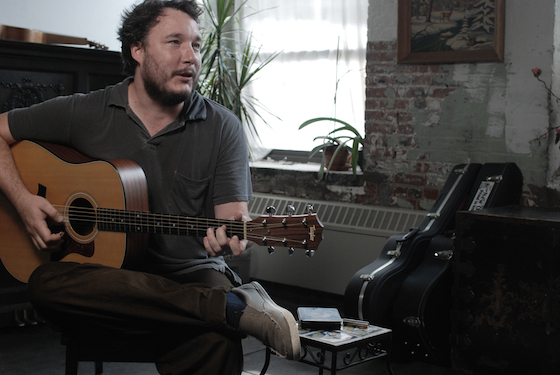
Above: Still from Jack Rose & Glenn Jones: The Things That We Used to Do film/dvd, courtesy Jesse Sheppard and Glenn Jones.
JACK ROSE DISCOGRAPHY
by Byron Coley (with thanks for help from Mike Gangloff & Glenn Jones)
Hung Far Low, Portland Oregon (Klang CDR, 2001)
Doctor Ragtime (Tequila Sunrise CDR, 2002)
Red Horse White Mule (Eclipse ECL-012 LP, 2002)
“Red Horse II” on Wooden Guitar (Locust Music 33 CD, 2003; 2LP, 2008)
Raag Manifestos (VHF #85 CD, 2003; Eclipse ECL-039 LP, 2004)
Opium Musick (Eclipse ECL-026 LP, 2003)
“White Mule” on Golden Apples of the Sun (Bastet BAST-0001, 2004)
Kensington Blues (VHF #92 CD; Tequila Sunrise TS-12001 LP, 2005)
“White Mule III” on Imaginational Anthem (Tompkins Square TSQ0531 CD, 2005)
“Box of Pine” on This Side Up (UK Ptolemaic Terrascope POT-35 CD, 2005)
“Sun Dogs” & “Now That I’m a Man Full Grown” on By The Fruits You Shall Know The Roots (Time-Lag/Eclipse 3LP, 2005)
“Hey Fuck You Rag” on Two Million Tongues Festival (Bastet BAST-0006 CD, 2005)
“Variations on Fleur de Lis/Be The Name of the Lord” on Dream Magazine #5 comp (SWE Dream Magazine CD, 2005)
“Untitled (Parts I & II)” (Tequila Sunrise TS-7002 7”, 2006)
“Cross the North Fork II” on Imaginational Anthem Volume Two (Tompkins Square TSQ1424 CD, 2006)
“Amp” on Less Self Is More Self (A Benefit Compilation for Tarantula Hill) (Ecstatic Peace E#107 2CD, 2006)
Jack Rose (aRCHIVE 28 CD, 2006; Tequila Sunrise TS-12006 LP, 2007)
“How Green Was My Valley/Buckdancer’s Choice” (split with Silverster Anfang) (BEL Funeral Folk ff015 7”, 2007)
“Since I’ve Been a Man Full Grown” on The Great Koonaklaster Speaks: A John Fahey Celebration (Table of the Elements TOE-CD-91 CD, 2007)
“Revolt” on Mind the Gap Volume 68 (BEL Gonzo Circus GC084, 2007)
I Do Play Rock and Roll (Three Lobed TLR-049 CD/LP, 2008)
Dr. Ragtime & His Pals (Tequila Sunrise TS-12007R, 2008)
“Mr. Rose Visits Washington DC” on Meet the Philly Eilte (BEL K-raa-k 7”, 2009)
The Black Dirt Sessions (Three Lobed TLR-066 LP, 2009)
Luck in the Valley (Thrill Jockey 229 LP, 2010)
“Moon in the Gutter” on Rough Trade Shops – Psych Folk 10 (UK Rough Trade COOPR250 CD, 2010)
Unrock Series – 12.11.2009 (GER Unsound UNR-009 CDR, 2010)
As Dr. Ragtime:
“Buckdancer’s Choice/Dark Was the Night, Cold Was the Ground” (Sacred Harp Library 7”, 2005)
“Alap/Flirting with the Undertaker” (Tequila Sunrise TSR-6, 10” 78, 2005)
(compiler) Dr. Ragtime Presents Nice and Nasty (Ecstatic Yod CDR, 2008)
Jack Rose & Jason Bill:
Via St. Louis (Drunken Fish dfr-36 CD, 1996)
Jack Rose & Glenn Jones:
“Linden Avenue Stomp” on The Wire Tapper 17 (UK Wire Magazine CD, 2007)
The Things We Used to Do DVD (Strange Attractors Audio House SAAH058 DVD, 2010)
Jack Rose & the Black Twig Pickers:
Jack Rose & The Black Twig Pickers (Klang Industries 008 LP; VHF #116 CD, 2009)
“Revolt/Soft Steel Prison” (UK Great Pop Supplement GPS28 7”, 2008)
“Shooting Creek/Rappanhannock River Rag” (UK Great Pop Supplement GPS49 7”, 2009)
Jack Rose with D. Charles Speer & Helix:
Ragged and Right (Thrill Jockey 12.42 mini-LP, 2010)
with Ugly Head:
Spoon Knife Fuck (Transparanoia 7” , 1994)
A Bowl of Fever (Transparanoia 7”, 1994)
“These Drugs Aren’t Working” & “Throttled Sleep” on Dixie Flatline (Radioactive Rat CD, 1994)
Silence Is the Mystery of the Future Age (Transparanoia CD, 1997)
with Pelt:
Brown Cyclopedia (Radioactve Rat 333 LP, 1995)
“Big Stick and Little Sweet Play ‘In the Pocket’” (possibly) on With Pure Hell Raying From Our Sacs (no label MC, 1995)
Burning / Filament / Rockets (Econogold Ego-002 CD, 1995)
Snake to Snake (Klang Industries LP, 1996)
Woove Issue Five split with Soma 77 (WUVT-FM 7”, 1996)
Max Meadows (VHF #28 CD, 1996)
Techeod (VHF #36 CD, 1997)
For Michael Hannahs (no label CDR, 1997; VHF #38 CDR, 1998)
Black Florida split with Harry Pussy (Klang Part 3 7”, 1998)
“Zinc Mine” on untitle comp (UK Ptolemaic Terrascope POT-24 7”, 1998)
“Tibetan Ass Hash” on Umlauted Roman Numeral Five (Klang Industries Fifth Anniversary) (Klang 2CDR, 1999)
Empty Bell Ringing in theSky (VHF #43 2LP, 1999)
Rob’s Choice (VHF #54 CD, 1999)
two untitled tracks on Pelt/Pengo/Andy Gilmore Live At The Vilage Gate Carbon CR33 CDR, 2000)
Keyhole (w/Keenan Lawler, Eric Clark) (Eclipse ECL-006 LP, 2000)
Ayahuasca (VHF #62 2CD, 2001)
Houston 2001 (Klang CDR, 2001)
Six of Cups (Klang CDR, 2001)
“The Signal Tower at Murraysville, Pennsylvania” on The Invisible Pyramid (Last Visible Dog 2CD, 2003)
Keyhole II (w/Keenan Lawler, Eric Clark) (Eclipse ECL-017 LP, 2003)
Pearls from the River (VHF #76 CD, 2003)
A Capsized Moment/Paris 3.5.04 (Klang CDR, 2004)
Untitled (VHF #90 CD, 2005)
Skullfuck/Bestio Tergum Degero (VHF #98 CD, 2006)
“Sunflower River Blues” on I Am the Resurrection: A Tribute to John Fahey (Vanguard 79789-2 CD, 2006)
Heraldic Beasts (Eclipse ECL-050 2LP, 2006)
with Pelt/Rake:
United Supreme Council/Oastem! Vibe Orchestra (Eclipse ECL-009 LP, 2001)
with Dredd Foole & the Din:
The Whys of Fire (Ecstatic Yod #49C/FYPC20 CD, 2003)
with Glenn Jones:
“Linden Avenue Stomp” (unique version) on This is the Wind That Blows It Out (Strange Attractors Audio House SAAH024 CD, 2004)
As published in Arthur No. 33 (Jan 2013)…
AH, MAN
A career-spanning conversation with JACK ROSE, American musician, recorded just a few months before he died in 2009
By Brian Rademaekers
When I started covering music in Philadelphia in 2007, my beat—the city’s crumbling post-industrial river wards—felt like a veritable nexus of weird folk and psychedelic experimentation. The Espers clan and their compound, Fern Knight, Fursaxa, and heavy-hitters like Bardo Pond were all there, churning out a storm of beautiful, strange music that seemed in part a product of the ancient, twisted alleyways of Fishtown and Kensington.
Here, Jack Rose was the benevolent, unassuming King—a master set apart from his peers by a massive presence and an indomitable, mystical talent that elevated him from mere musician to magician. He was a dark alchemist, transforming calloused flesh, polished wood and taut steel into the intoxicating, intricate worlds of sound that were his music. Not that Jack — Jack the giant, hulking Virginian — would ever presume to wear a crown; it was just something that he brought into the room with him, disarming all with a humble warmth offset by a blunt, caustic confidence that he wielded like a knife at just the right moments. These days, most of the musicians from that scene are gone from the neighborhood, though none as gone as Jack.
When I first heard Jack’s 2005 album Kensington Blues, I was thunderstruck, lost in awe that such a masterpiece not only existed, but that it was made in my time, by a man whose elbows polished the same bar counters as mine. Listening to Jack’s recordings was great [see sidebar for a complete discography] but best of all was seeing Jack live, spreading his gospel in church halls or little clubs or living rooms and, finally, along the banks of the Delaware River for a summer concert series shortly before he died.
Watching him amble up to his chair with guitar in hand signaled the start of near-religious experience. He would hunch over the instrument, cock his head to the side and, with closed eyes, unleash wild syncopated layers of rhythms, leaving listeners rapt in a sort of devastated trance. Here was this giant bearded man suddenly becoming seamlessly enmeshed in his guitar to create these idiosyncratic spells that were at once as delicate as flowers and as forceful as hurricanes. Seeing that miracle in the flesh, there was nothing else like it in the world. For me, it was like being a jazz freak in the ’40s and living down the street from Charlie Parker.
So began a years-long obsession. I felt compelled to document this genius quietly living in our midst. And Jack obliged. It never seemed to bother him that some reporter from a little local paper was always pestering him, asking for details about a show or politely begging for an advance copy of a record. In that way, Jack betrayed the appearance of a dominating, cocksure master and revealed a man with a very big heart.
My pretext for interviewing Jack in the summer of 2009 was his forthcoming long-player on Thrill Jockey, Luck in the Valley. Jack was elated. He and his wife, Laurie, had just bought a tidy little brick rowhouse a few blocks from the city’s blasted Port Richmond waterfront. He bragged about his new car, a Honda that he loved for its efficiency in carrying his guitars from gig to gig. He raved about a pizza joint he’d found down the street, about how quiet his block was. To him, the Thrill Jockey release was the milestone he’d been awaiting, a culmination of years of hard work and mastery that meant he could finally say he was making good bread on the merit of his music.
For three hours, he let me follow him around the house, tape recorder in tow, as he smoked and poured tea and pulled LPs from his wall of records. He was a man satisfied, a musician reveling in the feeling that his art was finally about to find the place in the world that it deserved.
When Jack died a few months later, I groped through the shock, looking for some way to respond to the ugly, gaping hole that had so suddenly appeared, and decided on transcribing the whole of our conversation from that summer day on Ontario Street. That tape is presented here, and captures Jack in a bright mood at the peak of his career, ruminating on everything from his first lessons to his labor on “Kensington Blues” to the joy of landing the Thrill Jockey deal.
* * *
 Arthur Magazine