Apparently this was Lou’s final appearance onstage. The last few minutes are like some beautiful farewell…
Lou Reed & Antony, “Candy Says,” Salle Pleyel, Paris 6 March 2013

Apparently this was Lou’s final appearance onstage. The last few minutes are like some beautiful farewell…
Lou Reed & Antony, “Candy Says,” Salle Pleyel, Paris 6 March 2013
LOU REED, 71
the easiest heroes are consistent
but the ones who really shape us
are random maniacs
whose work we stumble across
at times in our lives
we desperately need misdirection
and so it was i met the music of lou reed
through a guy named buzz
who’d bought the first velvets album
but didn’t like it
just the way he hadn’t liked the first mothers album
a month earlier
which meant i got each for a buck
there is literally no way to describe
the way that record hit me
i was a ten year old seventh grader
and the first time i played the album
i was transformed into someone else
someone who knew more than my contemporaries
even if i couldn’t quite shake it all out
lou and john and sterling and moe
gave me much more info
than i could understand
but they did it in a way
i loved so intuitively
with music exploding in such amazing directions
it made sense on a molecular level
and through the years i followed lou
good scenes, bad scenes, he put us through it all
but we kinda paid attention
because, after all
this motherfucker
this lou reed
this electroshocked cocksucking bastard
who put out many more lousy records than good
was the father of everyone i’ve ever known
and i never thought he’d die
and i really miss him
more than i ever thought i would
— Byron Coley
The definitive MC5 documentary feature film — two hours — made a few years ago — never released.
The following article on the making of this documentary was originally published in Arthur Magazine No. 9 (March 2004) (available from The Arthur Store) when the commercial/theatrical release of this wonderful, heartbreaking film seemed imminent…
HIGH FIVE
Detroit’s visionary MC5 receive a film tribute that aims to rewrite rock history
By Steffie Nelson
On New Year’s Eve, 1972, the MC5 took the stage at Detroit’s Grande Ballroom, a vast psychedelic venue where they’d held court as the “house band” between 1966 and 1969. Their live shows had been so incendiary, the five band members so arrogant, that even a huge star like Janis Joplin, no slouch in the live department, once refused to go on after them. This gig, their swan song as it were, was sloppy and dispassionate; the ghosts of past glories even more unforgiving than the sparse, cynical crowd. Guitarist Wayne Kramer took off mid-performance to go cop dope, and the MC5 never played again. Kramer and guitarist Fred “Sonic” Smith were 22; singer Rob Tyner and drummer Dennis Thompson were 24; bassist Michael Davis was 26. In the end they’d effectively been “pulled apart by the killer forces of capitalism and competition,” which their manager John Sinclair had railed against, perhaps presciently, in the liner notes to their now-legendary debut album Kick Out The Jams.
The MC5 hold a curious place in rock history. Their ascendance represented a moment in America when art and commerce converged, when all that was vital and visceral was also the pinnacle of hip. As the flamboyant and badass musical mouthpiece of the White Panther Party, the MC5 did embody the soul of the late ‘60s counterculture: one foot in the optimistic past and the other in the disillusioned, deadly future; one hand holding a guitar, the other a shotgun. It’s an irresistible image, one which was unappetizingly co-opted by Levis last spring for a series of T-shirts. A promotional performance in London by the three surviving Five (Rob Tyner suffered a fatal heart attack in 1991; Fred Smith died of heart failure in 1994) was seen by detractors as a final, sad sellout.
The question of whether or not the MC5 failed at the end of the day is much debated in the riveting feature-length documentary MC5: A True Testimonial, directed by David Thomas and produced by Laurel Legler. All parties agree, however, that for a fleeting, incandescent moment the MC5 were “at the center of the yin-yang,” as Michael Davis philosophizes in the film, “and it was our job to keep it going in a positive direction.”
But the proverbial yin-yang was already spinning into darkness, and it took the MC5 with it. Like fireworks on the fourth of July, they rose with a bright, beautiful bang and, as far as mainstream America was concerned, disappeared with a puff of smoke into the night. They were, ultimately, sacrificial – the artistic entity that was the MC5 didn’t survive more than seven years—but their legacy has continually inspired legions of punks, rockers, artists and freaks, who got turned on to their music through word-of-mouth, or more than likely though the persistent echo of a call to arms that rings with timeless resonance: “kick out the jams, motherfucker.”
As David Thomas says, “The people who know, know. The other people don’t get it.” The Chicago-based Thomas and his wife Laurel Legler began working on MC5: A True Testimonial in 1995, spurred on through financial troubles and licensing hassles by sheer love and respect and the determination to do justice to these American legends. As Legler points out, few bands have received this sort of filmic treatment, and if they have their way MC5: A True Testimonial will revise rock history. On the eve of a limited theatrical release and the worldwide release of a nearly four-hour DVD edition of the film (including deleted scenes, complete live performances, interview outtakes and fan testimonials), David Thomas and Laurel Legler are ready to testify.
Continue reading
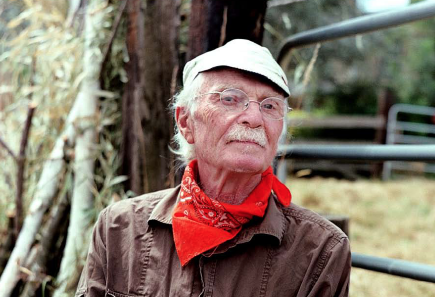
From Michael Hurley:
Those who know of the evils and outrages of Monsanto, biotech agriculture, GMOs… what we’re rallying for is to save our food and our bodies from this sickening plague. I’m collecting songs from songwriters to put together for an instructive record album. Then we’ll have a nice concert and a big fish fry, and cook up the last of the non-mutated salmon and good potatoes and beans.
Mail your contribution here:
Michael Hurley
℅ Arthur Magazine
POB 1307
Joshua Tree, CA 92252
=====
Portrait photo of Michael Hurley by Liz Devine, published in Arthur No. 35 (Aug 2013), which features a gigantic, career-defining 11,500-word article on Hurley by Arthur Senior Writer Michael Hurley. You can buy a copy for $5 from a retailer near you, or order it via mail direct from us.
Saul Landau: official website
Available on DVD, with director’s commentary and other extras, from Microcinema.
A personal portrait of a political phenomenon and a view of the developments since the revolution a mere ten years before, Fidel! gives a rare glimpse into everyday life of the Cuban people and its leader. Whether listening to a complaints at a collective farm, playing baseball with the locals, or discussing Marxist revolution, Castro’s charisma is present in every frame and, like him or not, lends understanding to why so many call him “The Giant.”
Originally published in Arthur No. 34 (April 2013)….

DIAGRAMMING THE DIVINE SPARK
Is there a way to examine the nature of existence at its very foundation? Esoteric mapmaker DAVID CHAIM SMITH say yes—but there’s a price.
by Jay Babcock
I first encountered David Chaim Smith’s remarkable, bewildering work through Pam Grossman’s Phantasmaphile newsletter, a daily email bulletin spotlighting a contemporary or historic personage up to something witchy and beautiful, usually in the visual arts. Smith’s work was particularly striking in its unusual combination of diagrammatic composition, simple media (pencil!?!) and unapologetically rarefied Kabbalistic-Gnostic content. Generally that would be more than enough to warrant further investigation, but it was the work’s difficult-to-grok provenance that intrigued me the most: these pieces looked like plates that could have been included in Alexander Roob’s Taschen compendium of dazzling Medieval alchemical artwork, The Hermetic Museum (alternative title, courtesy of Adam Egypt Mortimer: The Original Face Melter Times A Thousand). They seemed like the kind of work that’s usually brought to light by accident, decades after the a recluse’s death or disappearance (or committal to a mental ward): strange, highly charged devotional work rescued from a trashbin, the details of its artist’s life and practice gone to dust, Iain Sinclair on the case.

And yet, the author of these stupefying drawings is alive and well—David Chaim Smith [above] is a contemporary New York artist with an MFA, a publisher and (until recently) a gallery. Despite living a semi-monastic life, Smith seems eager to engage with a curious public. He has a website. He’s on Facebook. Dig a little and you’ll find a few occultist-oriented podcast interviews and accounts of public talks he’s given in the last few years around the publication of his two books—2010’s esoteric exegesis The Kabbalistic Mirror of Genesis: Commentary on Genesis 1-3 (Daat Press) and 2012’s massive art/text collection The Sacrificial Universe (Fulgur)—and a 2010 gallery show. And now, here he is on the other end of the telephone line in late January, just days after completing his new book, Blazing Dew of Stars, set for publication this springOctober 23, 2013 by Fulgur. A surprisingly garrulous fellow, Smith spoke frankly about who he is, where he comes from and how his day-to-day life and spiritual practice generates such artwork. What follows is a condensed version of our conversation.
Originally published, with additional photos, in Arthur No. 35 (August, 2013).
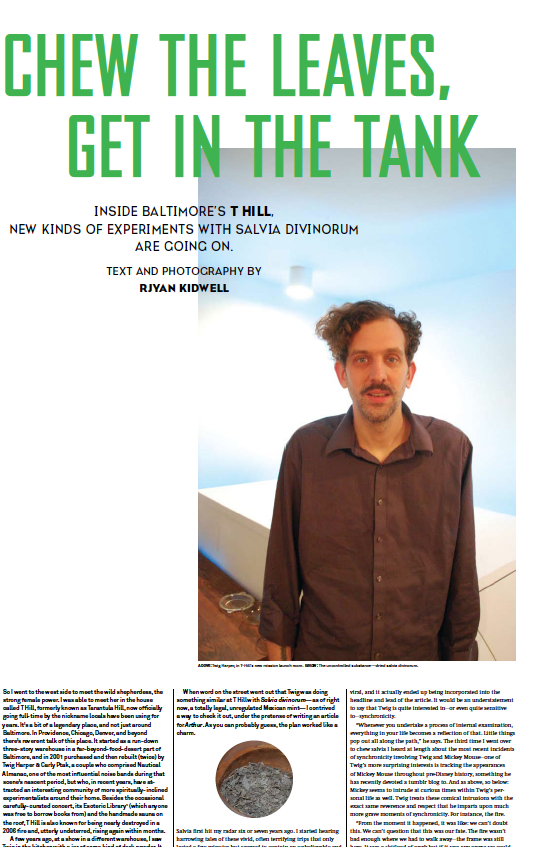

CHEW THE LEAVES, GET IN THE TANK
Inside Baltimore’s T Hill, new kinds of experiments with Salvia divinorum are going on.
Text and photography by Rjyan Kidwell
SO I went to the west side to meet the wild shepherdess, the strong female power. I was able to meet her in the house called T Hill, formerly known as Tarantula Hill, now officially going full-time by the nickname locals have been using for years. It’s a bit of a legendary place, and not just around Baltimore. In Providence, Chicago, Denver, and beyond there’s reverent talk of this place. It started as a run-down three-story warehouse in a far-beyond-food-desert part of Baltimore, and in 2001 purchased and then rebuilt (twice) by Twig Harper and Carly Ptak, a couple who comprised Nautical Almanac, one of the most influential noise bands during that scene’s nascent period, but who, in recent years, have attracted an interesting community of more spiritually-inclined experimentalists around their home. Besides the occasional carefully-curated concert, its Esoteric Library [see Endnote 1] (which anyone was free to borrow books from) and the handmade sauna on the roof, T Hill is also known for being nearly destroyed in a 2006 fire and, utterly undeterred, rising again within months.
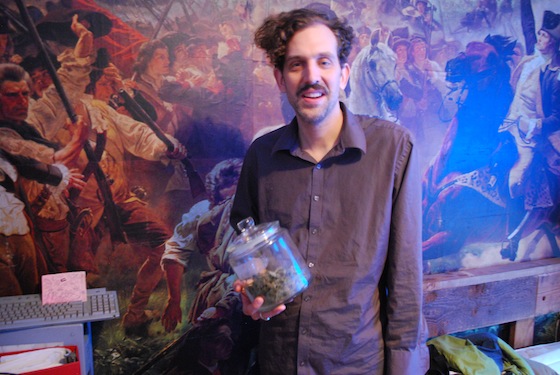
A few years ago, at a show in a different warehouse, I saw Twig [pictured above] in the kitchen with a jar of some kind of dark powder. It turned out to be something called yopo and he was inviting people to try it. Two at a time excited volunteers would sit down beside each other on a couch and inhale the powder. Then, for about five minutes or so, they would be enter some kind of pre-verbal (post-verbal?) state, utterly unresponsive to any attempt by others to communicate with them, interacting with something else none of us could see, but without leaving their seat. Moreover, these reactions seemed unique to each volunteer. I saw two of my friends sit down together—one of them, who I often refer to behind his back as Lord Byron, writhed and contorted as if he were riding an rusty rollercoaster after downing a liter of worms. The other guy barely moved at all, but giggled and smirked adorably, watching something that seemed to be hovering at eye level a few feet in front of him. I’d never seen either of them behave in a way anything like those naked exaggerations of their core personalities. I was impressed. Twig observed everything that happened in an amused but careful way and listened as everybody explained their perspective of the experience afterwards. His genuine curiosity about each person’s trip was clear. Personally, I was way too scared of what strange secret I might myself betray in that strange five minutes, so I didn’t step up to the couch. I’ve always regretted that decision.
When word on the street went out that Twig was doing something similar at T Hill with Salvia divinorum—as of right now, a totally legal, unregulated Mexican mint—I contrived a way to check it out, under the pretense of writing an article for Arthur. As you can probably guess, the plan worked like a charm.
Continue readingOriginally published in Arthur No. 35…
THE BIOPHONIC MAN
Guitarist, composer and analog synthesizer pioneer BERNIE KRAUSE left the recording studio to find that really wild sound. What he discovered was far more profound.
by Jay Babcock
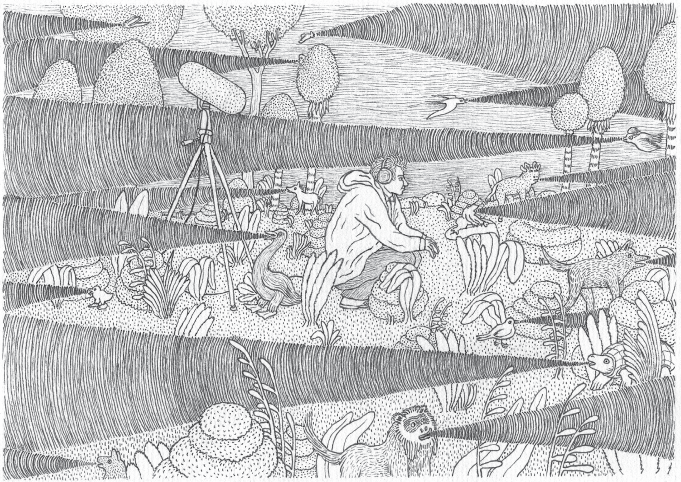
Illustrations by Kevin Hooyman
“…The entity’s life will be tempered with song, music, those things having to do with nature.” — Edgar Cayce, the 20th-century American psychic, from a ‘life reading’ given when Bernie Krause was six weeks old, as reported in Krause’s Notes From the Wild (Ellipsis Arts, 1996)
Has any single person—any entity—ever been better situated to explore music’s Biggest Questions—that is: what is it, what’s it for, why do we like it, where did it come from, why does it sound the way it does—than Bernie Krause?
Check the biography. Born in 1938, Krause grew up a violin-playing prodigy with poor eyesight in post-World War II Detroit. By his teens he had switched to guitar and was making extra money sitting in as a session player at Motown. In 1963, he took over the Pete Seeger position in foundational modern American folk band The Weavers for what would be their final year of performances. He then moved west to study at Mills College, where avant garde composers Stockhausen and Pauline Oliveros were in residence. Soon he encountered jazz musician and inventive early analog synth player Paul Beaver, who was introducing the Moog to psychedelic pop music. They formed Beaver & Krause, an in-demand artistic partnership that released a string of utterly unclassifiable acoustic-electronic albums in addition to doing studio work with adventurous pop musicians (The Doors, George Harrison, Stevie Wonder, etc.) and composing and recording for stylish TV and film projects (The Twilight Zone, Rosemary’s Baby, Performance, etc.). After Beaver’s sudden death in 1975, Krause began to shift his attention towards field recordings of natural soundscapes.
This wasn’t such a great leap. In the late ‘60s, inspired by an idea from their friend Van Dyke Parks, Beaver and Krause had first tried to record outdoor sounds for use on their eco-musical album In a Wild Sanctuary. Now, Krause followed this thread more intensely, traveling to seemingly every far corner of the globe, innovating techniques and utilizing new technology to more accurately capture the sound of what’s left of Earth’s rapidly diminishing wild.
What Krause discovered there, and how it compares to what we now experience in daily life in the un-Wild, is the subject of his latest book, The Great Animal Orchestra: Finding the Origins of Music in the World’s Wild Places, published last year. Writing with a scientist’s precision, an artist’s poetic wonder and a human being’s persistent outrage, Krause tosses in astonishing highlights from decades of field notes (elk in the American West are into reverb; the sound of corn growing is “staccato-like clicks and squeaks…like rubbing dry hands across the surface of a party balloon”; ants sing by rubbing their legs across their abdomens; the fingernail-sized Pacific tree frog can be heard more than a hundred yards away; “You can actually determine the temperature by counting the number of chirps made by certain crickets”; etc.) as he make several interweaving arguments about the aforementioned Big Questions of Music. One thesis is that the sound of animals in a healthy habitat is organized, a sort of proto-orchestra. What follows from this is the startling argument that gives the book its title: our music comes from early humans mimicking the sounds of the soundscapes they were enveloped in—we “transform(ed) the rhythms of sound and motion in the natural world into music and dance… [O]ur songs emulate the piping, percussion, trumpeting, polyphony, and complex rhythmic output of the animals in the place we lived.” And we developed our music(s) not just by imitating animals such as the common potoo, who sings the pentatonic scale, but also by mimicking other natural sounds: in one of the book’s most striking episodes, Krause recalls hearing the church organ-like sound of wind passing over broken reeds in Lake Wallowa in northeastern Oregon. “Now you know where we got our music,” a Nez Perce tribal elder tells him. “And that’s where you got yours, too.”
This past spring, I interviewed the entity Bernie Krause via the far-from-ideal set-up of two speaker phones. Ah well. Following is some of our conversation, condensed by me, and edited with additional thoughts by Bernie via subsequent emails.
Continue readingOriginally published, with a sidebar (“Ten Things That I’ve Learned From the Sufis”), in Arthur No. 35 (August 2013).
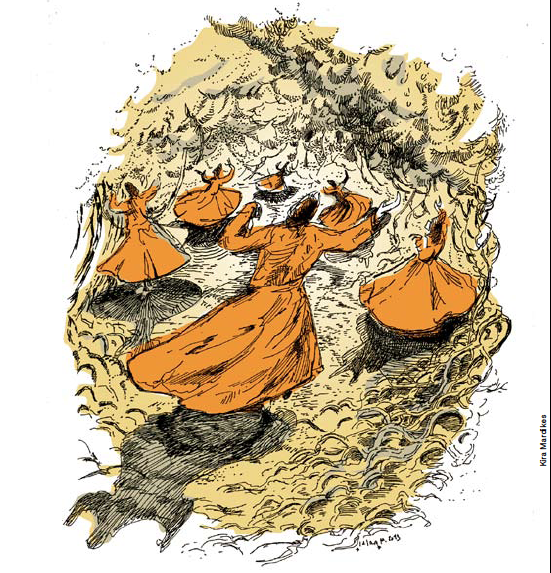
WHAT THE SUFIS TAUGHT ME
Swap-O-Rama Rama founder Wendy Jehanara Tremayne wanted to understand what motivated her life-long anti-consumerism. She found the answer underground…
Illustration by Kira Mardikes
As surely as we inhabit the environment, the environment inhabits us.
— Pir Zia Inayat-Khan
I kept the rubber breathing tube clutched firmly between my front teeth. I probed it with my tongue to make sure that a small movement would not separate me from it. What if a bug above ground crawls in? I’ll have to blow it out. . . or eat the critter.
I didn’t know if I could get out of my earthen grave. The weight of the earth above my naked body prevented me from taking a full breath. When I inhaled, the earth pushed back on my lungs, informing me of my limited capacity. I took small sips of air and imagined the winter woods above as the cold came through the narrow plastic tube. In 30 minutes my partner, Isfandarmudh (“angel of the earth” in Persian), would dig me out of the grave. Then I would bury her.
I turned my attention away from the fear of things that could go wrong. I relaxed my active mind with a long, slow exhale, imagining my skin fading into the earth that pressed against it.
My bones, teeth, and nails conversed with the minerals in the stones and tectonic plates of the earth. The heat in my body reached out to find the molten core of the underworld. I wondered if the bugs that crawled behind one of my ears, under my arm, around the top of a fingertip, and all along my body were taking in moisture from the thin layer of perspiration on my surface. I felt something behind my knee.
I am made mostly of water, I thought as I considered the geothermal waters that filled veins in the earth and made up most of my body, the rain that poured from dark cumulonimbus clouds and saturated the ground from which I myself drank. There is one water on earth, I reminded myself.
From head to toe I felt life wiggle and walk. Don’t panic, Jehanara. This was my new Sufi name. This is what it feels like to host life. Giving up fear to the forces of gravity and the magnetic fields that banded the planet, I knew that I could never overwhelm the massive systems with my worry. I felt no different from a tangled root or a wedge of clay. The grave smelled like mildew and growth.
It was good to be the earth. I reviewed a long history: a singularity split in two, gaseous explosions, a hot lava-covered sphere of volcanic eruptions and shifting plates, a cooler water world, a single cell advancing to more complex organisms: fish, bird, mammal. I was curious. What next?
Life’s lust is life, I thought as I considered that life’s persistence over billions of years has led to me. I felt obliged to use my senses so that this life could know itself.
The feeling of earth that pressed against me from every direction changed my view. I imagined it as a hug. You are loved. That’s what the Sufi teachers said to do if I ever forgot that I was loved: Feel the tug of gravity. In this moment death did not feel definitive. My sense of self expanded to include all time. I remembered the words that I had read in that little book written by a Sufi. Nature is the truest book.
The sound of a metal shovel breaking through the ground above me brought me back. I hope she doesn’t hit me with that!
* * *
Sometime in the mid-’90s I was thumbing through a book by Idries Shah when I noticed a reference to the Freemasons. Shah called them a bastard sect of the Sufis. That got my attention because I had been exploring the occult, and was particularly attracted to the Masons due to their tendency to keep secrets.
I ended up loving Shah’s book (The Sufis, 1971) because it told what a Sufi is by telling what a Sufi isn’t. As I read, I sensed that there was more available in the text than what I was able to read, a code hidden. I was intrigued. Soon I discovered that many Sufi texts are coded — some can be read on as many as seven levels. The level a reader perceives is a match to his or her own tuning, which may change. In this way the writings of Sufis are like barometers.
Continue reading Arthur Magazine