
Author Archives for Jay Babcock
“He was spending as much time now in the Land of the Dead as in Lawrence, Kansas”: Iain Sinclair visits Burroughs
Burroughs shows us how to take refuge from the horrorshow as we near our end….
He was spending as much time now in the Land of the Dead as in Lawrence, Kansas. It was my impression that Burroughs chose this place in order to make that transition smoother; the twinned locations in the end were impossible to separate. Going out for eggs over easy, bacon, toast, coffee – and getting it, his order filled with a smile and a replenished cup – confirmed the fact that he was not yet in hell. …
Apart from an interest in alien abduction (he pays a visit to Whitley Strieber, author of Breakthrough), and sexual encounters of the third kind, Burroughs was most concerned with proving that the dogmas of science were meaningless or totally misguided. He couldn’t accept that nothing moved faster than the speed of light. He spoke of clicking a switch fifteen years ago and seeing lights come on in an unvisited room: today. Changing sets is a simple matter, he explained: Morocco, Martinique, Manchester, context is everything. The taste of a cigarette will do it, even a photograph of the cigarette, visible traces of rent boy saliva. One line from a book by Joseph Conrad will import, or predict, meteorological conditions. You can read yourself into a storm. But you can’t, when you’re asleep, conjure up a decent plate of ham and eggs. The dead are starving, but they can’t eat.
‘I have seen weather magic,’ Burroughs said. ‘I have even performed it. I stopped rain in Seattle.’
— From ‘Dream Science’: an account by Iain Sinclair of a 1995 visit to William S. Burroughs in Lawrence, Kansas, taken from ‘American Smoke: Journeys to the End of the Light’, which will be published by Hamish Hamilton in November, 2013. At the link is the chapter in its unedited (or: “raw state”) form…
Hmm
We’ve been notified that our humble rag is somehow one of four finalists for the 2013 Utne Media Award in the Arts Coverage category. Very generous of the jury. The press release adds:
Winners will be selected by the editorial staff over the next few weeks, and announced in a public ceremony at the Magazine Publishers of America’s Independent Magazine Media Conference in New Orleans on May 20.
So there you go.
NEW BROTHER JT FOR YOUR EARHAIRS
Hot damn. Brother JT of the United States of America returns to rock us after a few eternities in the wilderness of other-investigation. Here is the lead track from his forthcoming album on Thrill Jockey (info here).
Brother JT was featured in Arthur No. 8 (Dolly Parton cover), published several universes ago, with an interview by Jay Babcock and a guide to JT’s discography by David Katznelson. (Copies of this magazine still exist. You can buy one here.)
And, lookout Ma, JT’s started up his TRIPPIN’ BALLS series again. New episode here with guest MIGHTY TWIG HARPER…
ON ANARCHO-OCCULTISM, THIS CAPITALIST PLANET AND COUNTERPOWER (Arthur, 2013)
Here is the entirety of the “Applied Magic(k)” column by The Center for Tactical Magic in Arthur No. 34/April 2013. The illustration below is by Aaron Gach.

Anarcho-Occultism or, A Society Gets All the Magic(k) It Deserves
Like some digital cauldron, our email was all a-bubble this past month with some particularly savory notes. “Do you believe in occult conspiracies?” “How can I meet others who are interested in magic(k) and aren’t batshit crazy?” And, perhaps our favorite of the bunch: “What’s the relationship between magic(k) and anarchy (or anti-capitalism)?” Any one of these questions is worthy of inspiring a volume in its own right; however, we’re going to use a bit of invisible thread to tie them altogether at once.
First off, there’s not one, single relationship between magic(k) and anarchy, in part because there are many different aspects of anarchism and many, many magic(k)s. As a starting point, let’s use some of the principles of stage magic. Capitalism is an illusion. Or, more properly put, it is a system based on illusory means and ends. In the current economic paradigm, corporations increase their wealth through several illusions: by manufacturing and marketing phantom “needs” (i.e., the magician’s “force”), by the engineering wizardry of planned obsolescence (i.e., the use of gimmicked props), by conjuring commodities out of basic necessities (i.e., misdirection), and by manipulating public policy to ensure that would-be costs are mysteriously transferred to taxpayers via so-called “externalities”, often in the form of weakened labor laws, cut-rate resource extraction, government subsidies, and environmental loopholes, to name but a few (i.e., the use of “dupes”). These sleights are but parts of the capitalist repertoire performed in a much larger theater of conflict. The grand illusion is the one that aims to convince the audience that the status quo is the only show in town.
Continue reading“Transcendental adventures in science fiction…” (1974)

MMMM
Here’s one of Kira Mardikes‘ illustrations accompanying an extensive extract from Christian Ratsch and Claudia Muller-Ebeling’s Encyclopedia of Aphrodisiacs in the the new issue of Arthur, spotlighting several aromatic plants thought to have qualities of particular interest to humans engaging in amorous activities…

Housekeeping: Arthur No. 33 (Jan 2013) is nearing sellout
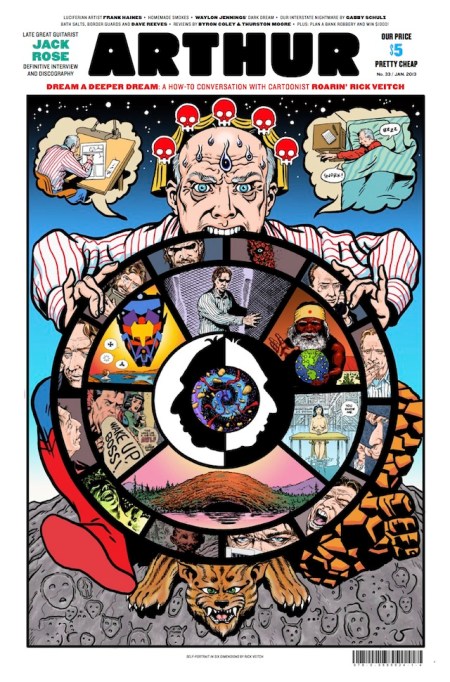
Somehow we’re down to our final fifty copies of Arthur No. 33 (Jan 2013), less than three months after publication. We’ve ceased supplying wholesalers and retailers and will reduce the last of our stock through direct sales to individuals only. Copies are available for $5 plus shipping and handling from The Arthur Store (click here).
Arthur No. 33’s contents include…
Dream a Deeper Dream: A how-to conversation with cartoonist ROARIN’ RICK VEITCH by Jay Babcock. Plus “Cartographer of the American Dreamtime,” an appreciation of Rick Veitch and his work by Mr. Alan Moore. Mr. Veitch’s “Self-Portrait in Six Dimensions” graces our cover.
JACK ROSE: the definitive, career-spanning interview with this late great America guitarist, conducted by Brian Rademaekers just months before his death three years ago. Plus: Jack Rose discography compiled by Byron Coley, and an illustration of a classic Jack Rose pose by Plastic Crimewave.
An illuminating/endarkening conversation with sparkling Luciferian artist FRANK HAINES by Eliza Swann
Stewart Voegtlin on WAYLON JENNINGS’ dark dream, with an illustration by Beaver
Columnist DAVE REEVES on Burroughs, bath salts and border guards, with an illustration by Arik Roper
Columnist NANCE KLEHM on new modes of exchange—and homemade smokes, with an illustration by Kira Mardikes
Cartoonist GABBY SCHULZ explores our interstate nightmare
The Center for Tactical Magic on “The Magic(k) of Money” — and how YOU can win $1000 for planning a BANK ROBBERY!
“Bull Tongue” columnists BYRON COLEY & THURSTON MOORE survey happenings in underground culture, paying special attention to new and archival releases from Claude Pelieu; Spectre Folk; United Waters; Devin, Gary & Ross; Jess Franco; Mick Farren; Chris D.; Donna Lethal; Crystal Siphon; Mad River; Horace; Erewhon Calling by Bruce Russell; Toy Love; The Clean; David Kilgour; The Heavy Eights; Chris Corsano; Joe McPhee; Rangda; Ben Chasny; Sir Richard Bishop; David Oliphant; Brothers Unconnected; 200 Years; Six Organs of Admittance; Gary Panter; Marcia Bassett & Samara Lubelski; Cheater Slicks; Ron House; Above Ground; Vacuum; Max Block; Dead C; Axemen; Hamish Kilgour; Circle Pit; Kitchen’s Floor; Bits of Shit; and Boomgates. Plus a special report on The Ex 33 festival at Cafe Oto in East London, featuring The Ex, John Butcher, Zea + Charles, Jackadaw With Crowbar, Mats Gustafsson, Ken Vandermark, Trash Kit, Steve Beresford, Wolter Weirbos, Valentina Campora, Gabriella Maiorino, Andy Moor, Yannis Kyriakides, Anne-James Chaton, Ad Baars, Jorge Vega, Ian Saboya, Enrique Vega, Tony Buck and Roy Paci.
and the proverbial much much more
THEIR WAR: Black Flag, the First Five Years
A version of this article ran in MOJO’s December 2001 issue — the one with Michael Jackson on the cover. That version was 6,000 words long. What follows is my original 9200-word draft. Also, you might want to check out “Black Flag: A 12-Step Program in Self-Reliance,” a companion piece that I assembled for a special issue of the LAWeekly. There is a bit of overlap between the two, but not too much. If ever there was a band that deserved multiple histories from different angles, it was this one, I think. Enjoy. —Jay Babcock
THEIR WAR
or, Black Flag, 1977-1981.
or, Black Flag: The First Five Years
or, The Making of Hardcore: the problem child of punk rock
by Jay Babcock
“When I first joined Black Flag, I thought I was ready,” Henry Rollins told Mojo recently. “Greg Ginn taught me otherwise.”
During the four years preceding the then-20-year-old Rollins’ entrance as Black Flag’s fourth singer in midsummer 1981, the proto-hardcore punk rock band had already become a formidable musical and subcultural force. They’d looped across North America on epic-length low-budget tours, released a string of full-frontal, open-throttle, dark-humored EPs on their own label, and had become an underground sensation despite ongoing poverty, record industry disinterest, lead singer churn, news media hysteria regarding the violence surrounding the band’s performances and, most ominously, an ever-escalating amount of real-life conflict with local police departments. In those years, Black Flag had perfected a practice-tour-record-24/7/365-Do-It-Yourself work/life ethic that few people–even a young Henry Rollins–were prepared to adopt as their own.
Almost all of the songs on Black Flag’s Damaged–the band’s landmark debut album released 20 years ago this month–were written by Flag founder-guitarist Greg Ginn and/or bassist Chuck Dukowski before Rollins joined the band. It’s a remarkable, uncompromising album. But some would argue that _Everything Went Black_ and _The First Four Years_ — compilations of the band’s earlier recordings featuring vocalists Keith Morris, Ron Reyes and Dez Cadena — may have been even better.
“In my opinion, the finest Black Flag record is The First Four Years,” Rollins himself wrote in Get In the Van, his 1994 Black Flag memoirs. He still stands by that assessment today: “Greg had great work all through the rest of the Flag stuff but there’s something special about that early stuff. There wasn’t anything like it anywhere else. [Singing those songs] was a challenge because they were all great singers and I didn’t think that I measured up, really. I did the best I could.”
This is the story behind Black Flag’s first four years: how a group of self-described “geeky, nerdy beach rats” from Hermosa Beach, California took the punk rock emanating from New York and the UK and reshaped it into something more intense and single-minded. Aggressive, furious, desperate and darkly satirical music. Music completely divorced from fashion moves and art-school pretenses. Music that almost no one was ready for.
*****
LIVING UTOPIA: 1997 DOC ON ANARCHISM AND THE 1936 SPANISH REVOLUTION
Via Dorian Cope …
Living Utopia (The Anarchists & The Spanish Revolution)
Considered a jewel amongst historians and rebel hearts, this documentary made in 1997 about the 1936 Spanish Revolution blends historical accounts of the development of the anarchist movement with first-hand testimonies.
 Arthur Magazine