
“…The most notorious Voina action was last June, when several members of the group painted a penis on the Liteiny Bridge in St Petersburg. Evading and fighting off security, the 65-meter high image was completed just before the bridge opened, as it does each evening to let ships pass through. The penis ‘erected,’ directly facing the St Petersburg headquarters of the FSB, the KGB’s successor. The group called the artwork Dick Captured by KGB.”
Author Archives for Jay Babcock
“Some of my FAQs” by DAVID LASKY (Arthur, 2005)
Originally published in Arthur No. 14 (January 2005)
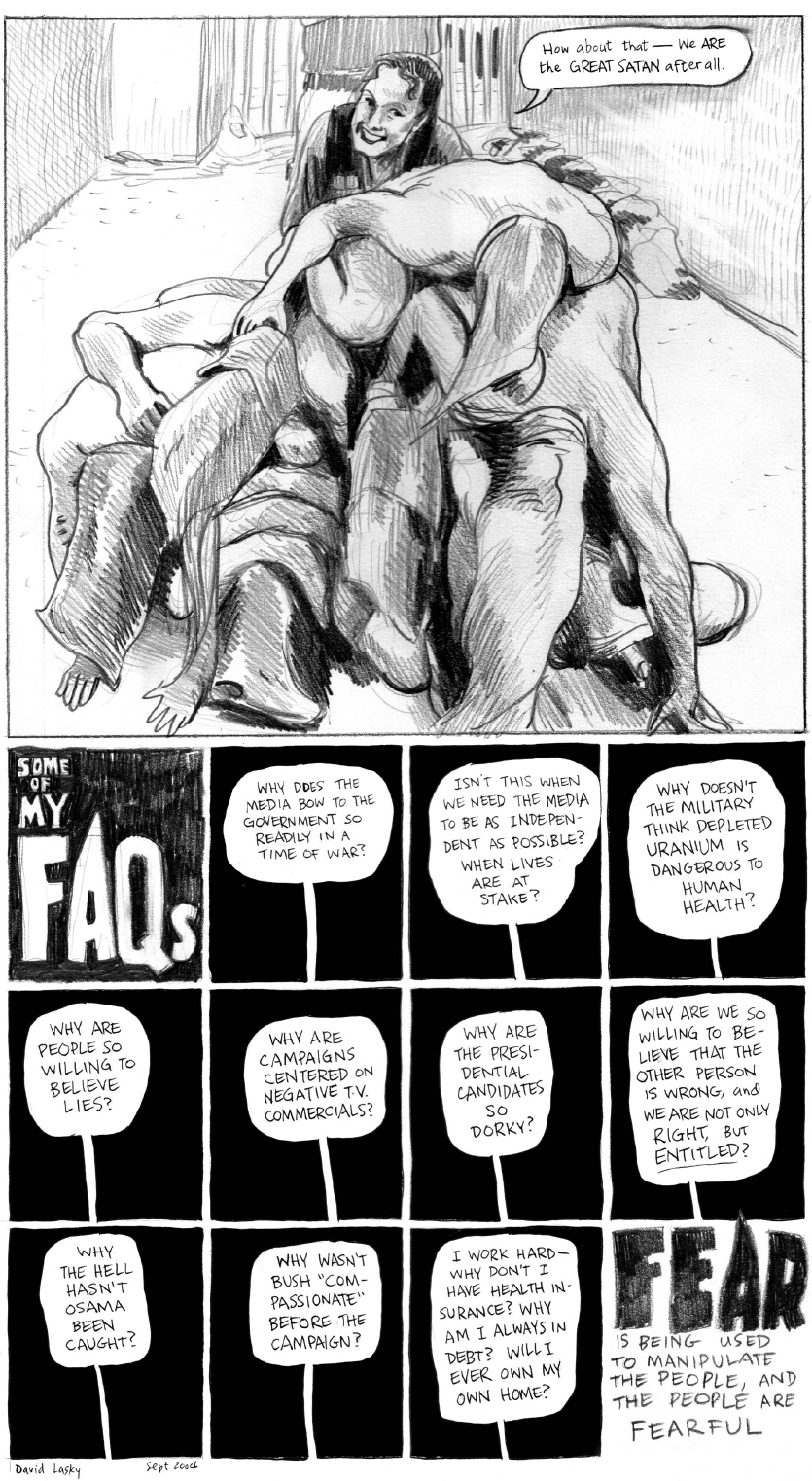
Click image to really enlarge. It’s still not gonna be completely ideal—for that, you’ll have to see the actual magazine (available at the Arthur Store for cheep)—but it’s pretty good.
David Lasky: http://dlasky.livejournal.com/
Arthur’s superb Comics Editor in this era was Tom Devlin.
“Why?” by DAVID LASKY (Arthur, 2004)
Originally published in Arthur No. 13 (Nov. 2004)
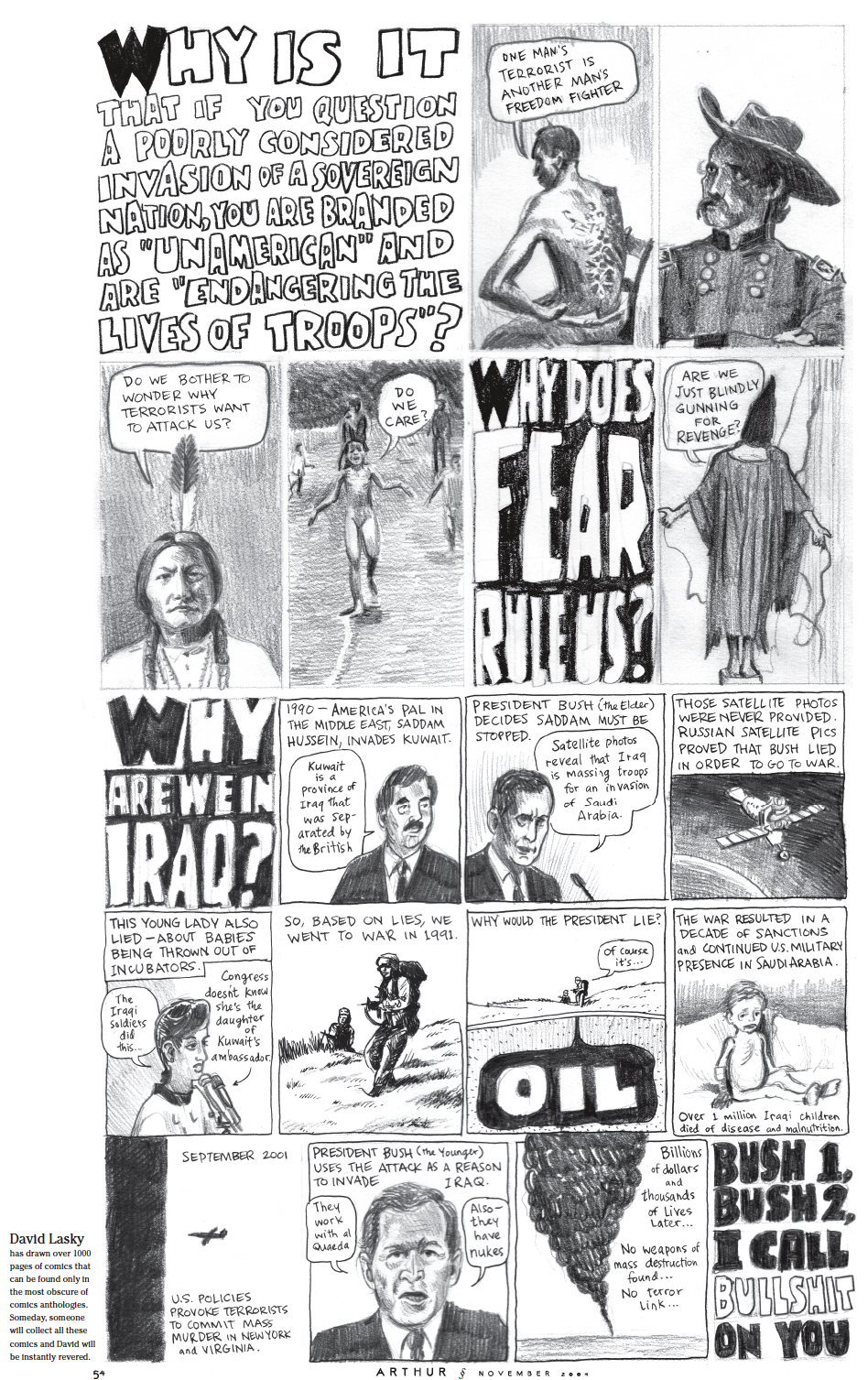
Click image to really enlarge. It’s still not gonna be completely ideal—for that, you’ll have to see the actual magazine (available at the Arthur Store for cheep)—but it’s pretty good.
David Lasky: http://dlasky.livejournal.com/
Arthur’s Comics Editor in this era was Tom Devlin.
“Flipping Out” by VANESSA DAVIS (Arthur, 2004)
Originally published in Arthur No. 13 (Nov. 2004)
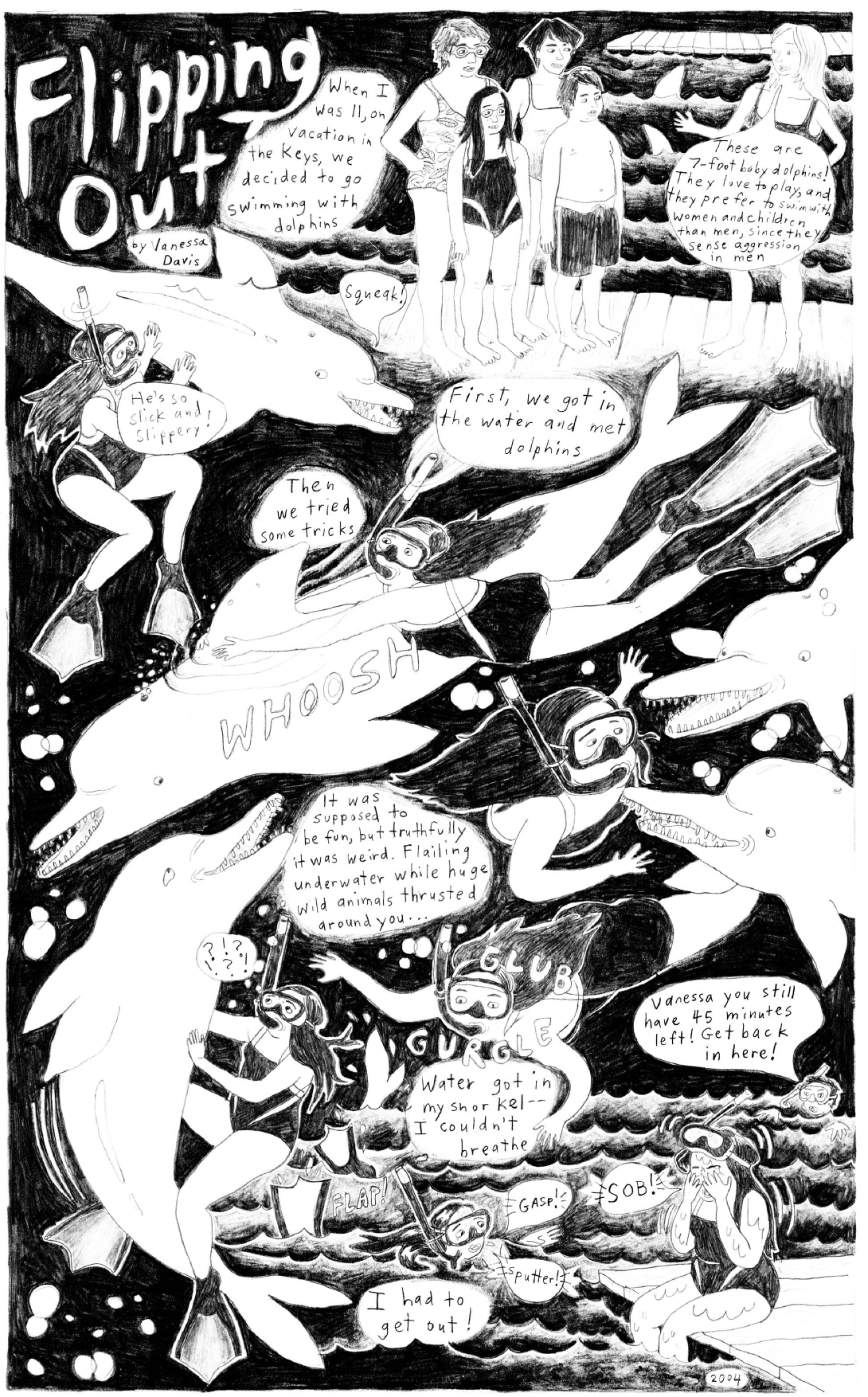
Click image to really enlarge. It’s still not gonna be completely legible—for that, you’ll have to see the actual magazine (available at the Arthur Store for cheep)—but it’s pretty good.
Vanessa Davis: http://www.spanielrage.com
Arthur’s Comics Editor in this era was Tom Devlin.
“I remember high school…” by LEIF GOLDBERG (Arthur, 2004)
Originally published in Arthur No. 9 (March 2004)

Leif Goldberg: http://www.pictureboxinc.com/artists-authors/leif-goldberg
Arthur’s Comics Editor in this era was Tom Devlin.
“Split Rock, Montana” by MEGAN KELSO (Arthur, 2003)
Originally published in Arthur No. 6 (Sept. 2003)
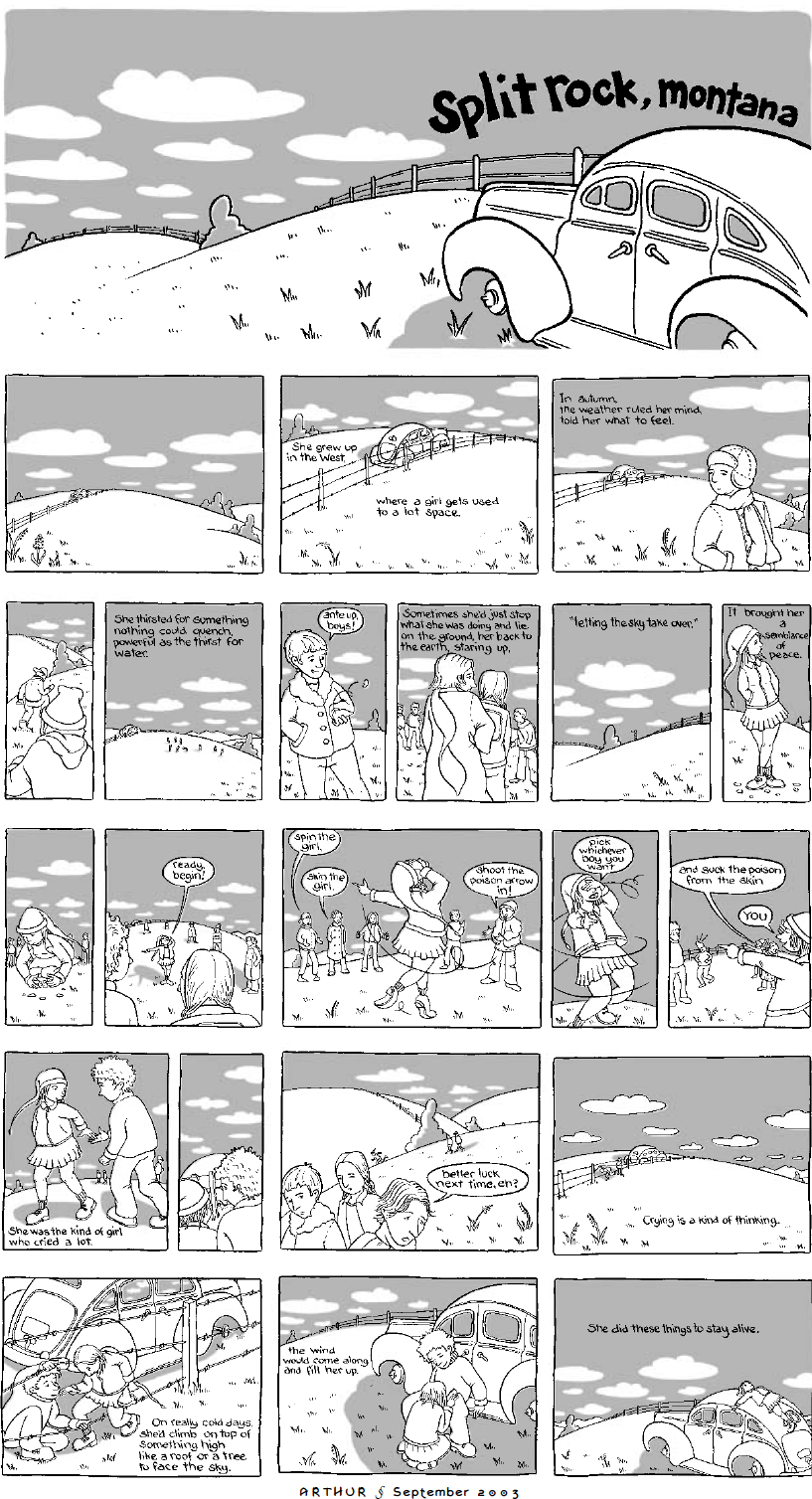
Megan Kelso: girlhero.com
Arthur’s Comics Editors in this era were Jordan Crane & Sammy Harkham.
Comics by SOUTHER SALAZAR (Arthur, 2003)
Originally published in Arthur No. 6 (Sept. 2003)
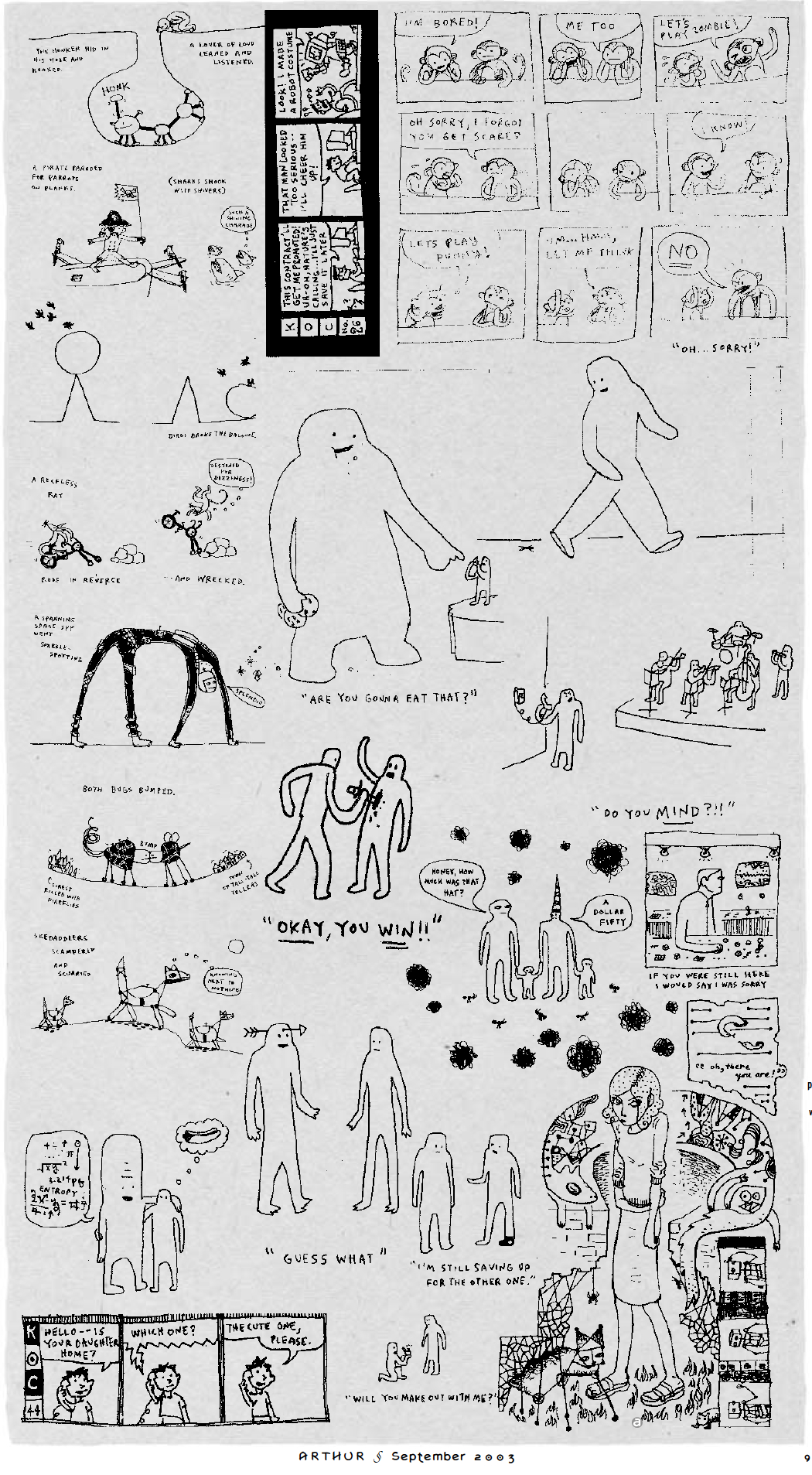
Click image to really enlarge. It’s still not gonna be completely legible—for that, you’ll have to see the actual magazine (available at the Arthur Store for cheep)—but it’s pretty good.
Souther Salazar: southersalazar.net
Arthur’s Comics Editors in this era were Jordan Crane & Sammy Harkham.
COSMIC HARMONIES & WHISTLING: LIVING SISTERS' BOWIE "STARMAN" COVER
BACK IN THE DAZE
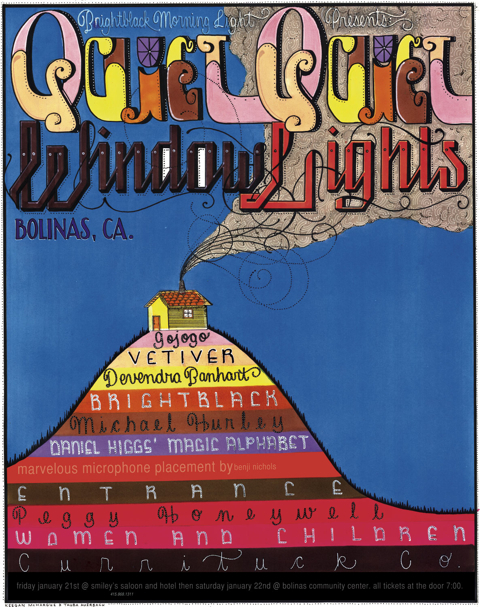
PRESENCE: Lift to Experience’s Josh T. Pearson talks about the Passion [Arthur, 2002]
Originally published in Arthur No. 1 (October 2002)…
One Texan Band, Under God
Lift to Experience, the greatest art-rock band since Sigur Ros, talk about the Passion with Jay Babcock
Josh Pearson, the 28-year-old singer-guitarist-songwriter for the extraordinary Denton, Texas-based art-rock band Lift to Experience, works in a world positively drenched in Judeo-Christian allusion and metaphor. So of course he’s conducting a mid-tour interview on a cel phone from a Manhattan pub called The Slaughtered Lamb.
“Yeah, it’s perfect,” he says, with a chuckle. “It’s like, ‘Where do we go? Oh, there’s a spot.’”
Lift to Experience are in New York City on their first-ever extended tour of America. It’s a tour that’s been a long time coming, in support of a debut album—the audacious, double-CD concept record The Texas-Jerusalem Crossroads—that itself was a long time in gestation. The songs that made it onto the album were originally composed in 1998, after Pearson had moved out to a ranch to work as a farmhand.
“It wasn’t a career move,” he says. “I just needed a place to be alone and not have to talk to anyone, to have enough time where the good ideas could become great ideas. I was alone and isolated and living in this little barn. It wasn’t glamorous, it was just mindless work: shoveling up the shit and taking the horses out to pasture and feeding them hay. It’s real therapeutic working with horses…”
Soon, the songs came. And with them, the concept for the album. No brief summary of The Texas-Jerusalem Crossroads can do it justice, Texas-style or otherwise. The album’s opening, spoken announcement is: “This is the story of three Texas boys busy minding their own business when the Angel of the Lord appeared unto them saying, ‘When the Winston Churchills start firin’ their Winston rifles into the sky form the Lone Star State, drinkin’ their Lone Star beer and smokin’ their Winston cigarettes, know the time is drawin’ nigh when the son shall be lifted on high.’”
Pearson says Texas-Jerusalem is “a concept album about the end of the world, where Texas is the Promised Land—the final battleground in the war between good and evil.” But it’s about more than that. The double-album’s lyrics are full to bustling with freight trains and incoming storms, strange prophets and fallen feathered angels, blood and fool‘s gold. Its protagonists are an ambitious Texas rock band desperate for a smash hit, ready, metaphorically at least, to deal their souls to the devil at Robert Johnson’s crossroads in exchange for material success. But Satan doesn’t show. Instead it’s the Angel of the Lord, announcing “just as was told/Justice will unfold.”
“Don‘t you boys know nothin’?” the angel asks the band, puzzled by the news of imminent holy conflict on Texas soil. “The USA is the center of JerUSAlem.”
Then, the music volcanoes. The rhythm is muscular, spacious, dynamic; the guitar is meditative, gossamer drone parted by noise mass and riff shapes; and the vocals are uniquely full and rich—triumphant yet resigned—sung in a beautiful voice of steady comfort. The lyrics—the metaphors, the literary and contemporary allusions—are relentless and poetic: the simple word ’star’ means, at once, the Lone Star state, the Jewish Star of David, the Christian Star of Bethlehem and, of course, Rock Star. A lot of work was put into this album, obviously. Taking it all in is a dizzying, overwhelming experience.
“It worked out real well with what I wanted to do with the metaphors,” says Pearson. “Texas being the place of last stands, from the Alamo. And Texas being an individual nation in its own, with freedoms that it celebrates that the other states don’t have—it can secede at any time, the only flag allowed to fly the same height as the American flag, that sort of thing, cuz it was a nation before it merged with the States.
“I started writing songs and they were all pointing to a place and then one night, I realized where it was headed. It made itself known. It’s one of those things where your body is just sorta following intuitively. I wouldn’t say you’re channeling it, but you’re trusting in your intuition that it’s headed in the right direction. Sometimes you never know why you’re headed that way, but it works out. All the pieces fall into place.”
* * *
Incredibly, Lift to Experience does the album one better in a live setting.
The first time I saw them was at 7:15 on a Saturday night in a small bar on Sunset Boulevard in Silver Lake. A stained and horned bullskull sat at stage-center; a Texas flag draped over a bass amp. Behind and above them was the bar’s neon-lit sign that read (of course) “Salvation.” As the sun dipped into the smog horizon outside, Lift to Experience began playing to an audience of no more than 100, most of whom were unfamiliar with the band‘s music.
They began suddenly, with almost notice. And they began with a no-vocal, power trio cover of—I shit you not—“Kashmir.” It was intense, immediate, absolutely massive. There was Josh (The Bear) Browning—a bass throbber of burly frame, serious beardage and eyes-closed close concentration; there was Andy Young, a drummer with the build of the sturdiest steakhouse either side of the Rio Grande, leaning forward off the stool Keith Moon-like, switching between mallets, drumsticks and handclaps, his cymbals in perpetual perpendicularity; and there was Josh T. Pearson, a gangly lanky framed, scraggly-haired guitar-vocalist in biker Nudiewear and bracelets, his beaten cowboy hat ringed by thorns.
They seamed straight from “Kashmir” into an instrumental version of their own majestic “Just As Was Told,” without breaking. It was that rare kind of performance that dapples your skin with goosebumps. All the stuff on the album was there: the long builds and graceful a cappella interludes, the churning muscularity and psychedelic overload. We’re talking presence.
Continue reading Arthur Magazine