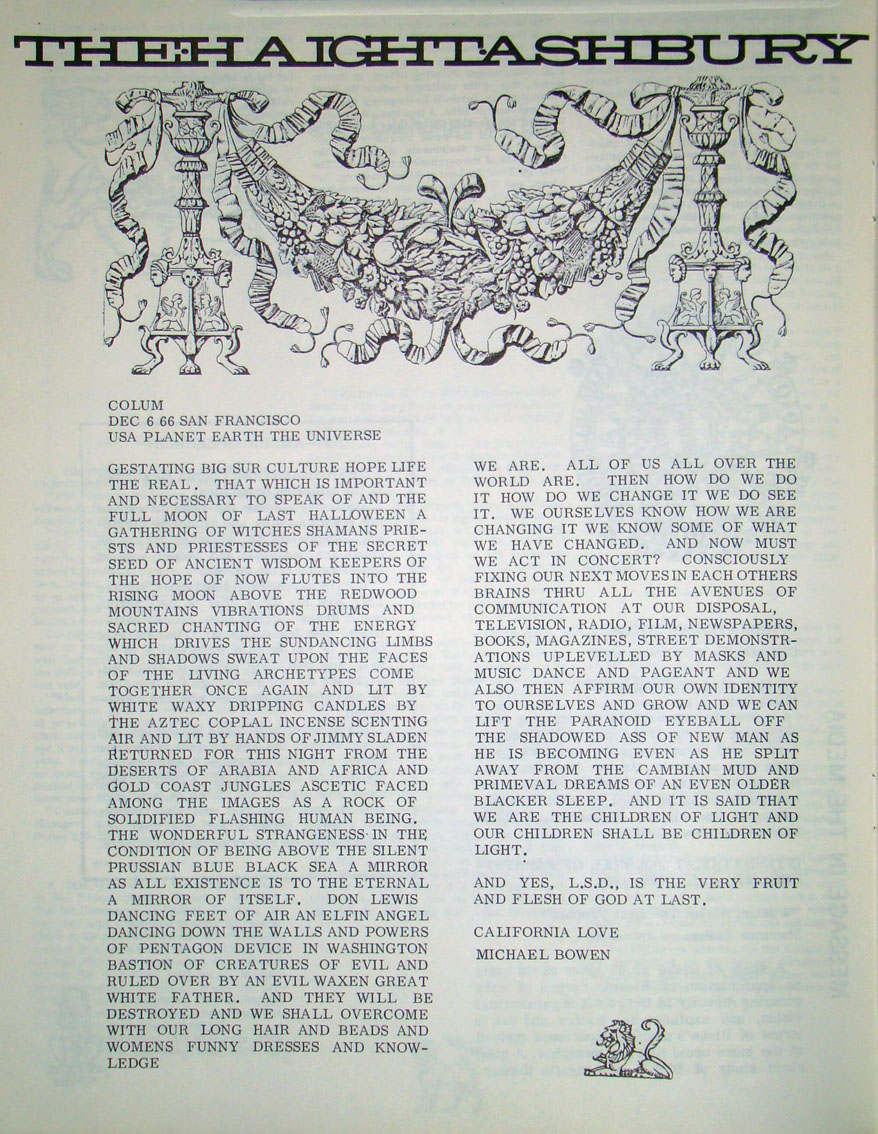
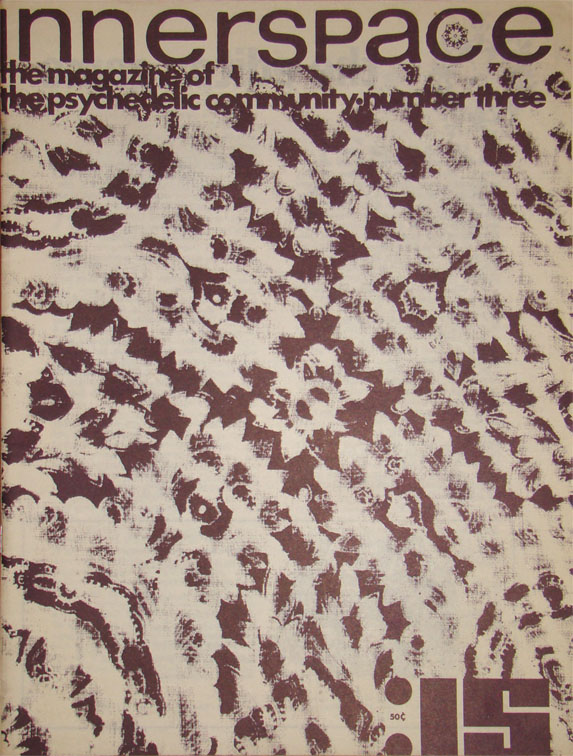
From Innerspace No. 3, scan courtesy of lysergia. Click the image to to see at full size:

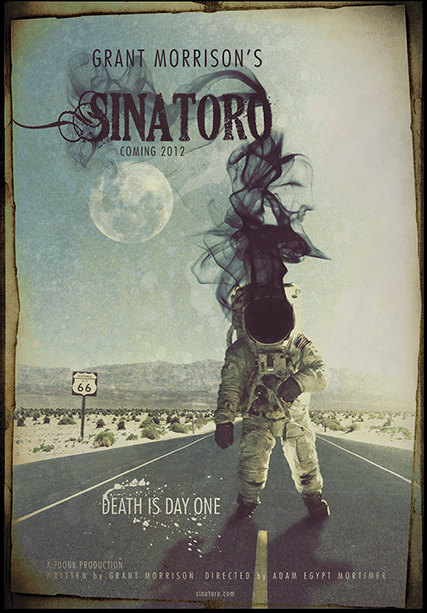
More info: sinatoro.com
Grant Morrison gave a performance at ArthurBall in Los Angeles, Spring 2006. He was featured in an extended interview in Arthur No. 12 (see the cover below, by Morrison collaborator Cameron Stewart).
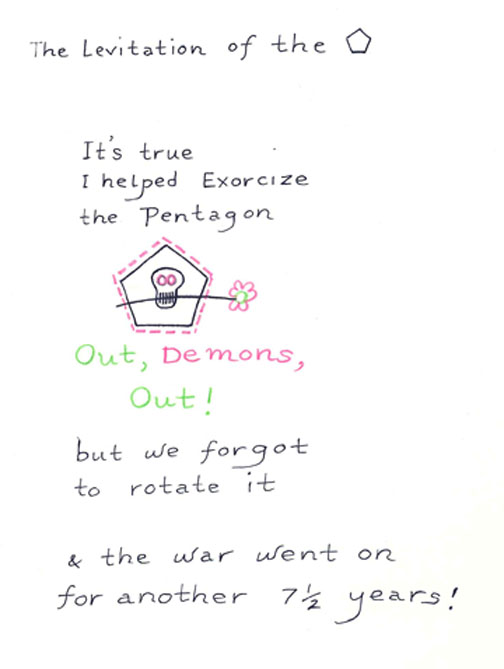
Glyph by Ed Sanders, November 2009
This refers to the Oct. 21, 1967 exorcism of the Pentagon. A 10,000-word oral history of the event, including testimony from Mr. Sanders himself, was the cover feature for Arthur No. 13.
How to Get Lost in Paris on Your Bicycle
– or –
Randonneur Psychogeography
by Anthony Alvarado

That the environment should respond to human thought. That is the core of magic and the oldest dream of mankind.
– The Death of Doctor Island, Gene Wolfe
Tools required:
a bicycle
a map of Paris
Here it is! I will tell you the big secret, what it all boils down to, the heart of the matter. I know, I know, this column is still pretty new and I should probably hold off on bringing out the big guns until later. But I feel (& hopefully acolytes of this periodic grimoire have already experimented with the lucid napping & Ganzfeld techniques, as proscribed in the previous two issues) you are ready to grasp the core issue here; the fundamental concept of magic to which we will return again and again.
That which is below is as that which is above, and that which is above is as that which is below.
That’s it. The quote is from Hermes Trismegestus. Rather then get side-tracked with an investigation into the musty pedigree of the quote (a rabbit trail that too many texts on magic become entangled in) we can take that statement — as above so below, and as below so above – as a jumping off point. On the surface it seems simple enough, almost a tautology. However, like all big truths, it grows in profundity as we approach it, and like Zeno’s arrow we are always only halfway to fully reaching the truth.
This idea of correspondence between the above and the below is of course referring to the link between the self and the world, the microcosm and the macrocosm, the interior/exterior. The accomplished magus is one who realizes that by changing the one, she changes the other. It is as simple and powerful as balancing algebraic equations – what is done on one side must be done on the other.
(In the realm of magic this law is as basic as Newton’s 3rd law of motion, that for every action there is an equal and opposite reaction; it is likewise elegant. Interesting to note that Sir Isaac Newton was himself an alchemist and well familiar with the writings of Trismegestus – even writing his own translation of the Emerald Tablet!)
Now let’s begin with a basic example – if you were to walk around the block with a pebble in your shoe, it would change not only the way you walk, but also the way you think and feel. That’s too obvious perhaps. Let’s zoom out. Picture yourself commuting to work. Do you drive? Then imagine yourself taking the bus. Already take the bus? Imagine if your commute took place by subway or train. Would you like it better, less? If you currently ride the rails, then imagine what it would be like getting there by horse. Now imagine bicycle. Depending on the distance and route you travel daily, some of these means of transport might sound preferable, while others would totally suck. We are affected not only by our environment but by the way we navigate it, and of course it flows the other way around. Take your bicycle for example: what is healthy for us is also healthy for the environment. It is cheap, efficient and contributes 0% pollution – it bears mentioning that at this point in human history if everyone on earth used a bike as their main mode of transportation it just might save the ecosystem of the planet. That is the Macro level. We could also go down one level and talk about what your hometown or city would look like right now if every car was replaced with a bike – no roads, just trails! Picture how that would change the dynamics of day-to-day life. Roads would be replaced with what? Promenades? Parks? Goat trails? The change in infrastructure this would have on everything from grocery stores and markets to shopping and business centers would be beyond revolutionary.
My point is not to rally y’all to tear down urban blight … not just yet … but to consider the ramifications that change on the micro level proportionally affects the macro, i.e. more bikes = less pavement. The equals sign in the previous statement may be thought of as Psychogeography. A term which Guy Debord defined as “the study of the precise laws and specific effects of the geographical environment, consciously organized or not, on the emotions and behavior of individuals.”
Finally, let us consider the profound effects that biking–not driving–has upon oneself: mind, spirit and body. You travel much more slowly on two wheels than four. You notice things. The spirit feels the freedom inherent in self-sufficiency as the body is strengthened rather than atrophied. With this in mind, I present today’s magic spell:
How to Get Lost in Paris Regardless of Where You Are

This experiment works just as well with a group as it does solo. It can of course be done on foot as a flanuer as well. It just depends on how much time you have. Really getting lost on foot, or at least finding yourself in a place you normally wouldn’t be, is hard. It’s easier on a bike since you travel faster. I can get lost on my bike in less than an hour! On foot, it takes all day. This spell will force you to see bits of your macrocosm (ergo yourself) that you are not used to seeing, as you don’t seek them out. If you can become completely lost while performing this spell, then consider yourself an adept – the trick of such magic is to be able to trick yourself.
There is of course a rich history to the art of the flanuer, the on-foot version of this exercise. It is the lost art of sauntering. Also known as going for a stroll. The potency of this magic is verified in that it is illegal – No Loitering signs are the most commonly posted law in the English language. “YOU MUST WALK WITH PURPOSE & DESTINATION; IT IS THE LAW,” sayeth the law. Therefore when riding or walking, we may meander and lolly-gag with mutinous anarchy in our steps. Take the time to experience just the “going” part without the “somewhere”.
For brevity’s sake, this tool for tweaking your psychogeography is focused on the art of the radonneur, which I am going to redefine for my own purposes as “sauntering on a bicycle”. The spell itself is quite simple. Take your map of, say Paris, in honor of the Tour de France (or anywhere where you are not). Now carefully consulting this map, choose a start location and an end location, e.g. the Champ-Elysees to the Eiffel Tower, and use the directions as dictated by the map to navigate your way from where you are, transposing the navigation of another place onto your current location.
Since you aren’t in Paris (if you are, use a map of Paris, Texas) you should hopefully be helplessly lost after a few turns. If not, keep going until you are. The map you choose and the directions are incidental, as long as you try to follow a route that is sufficiently complicated. You can even replace the map method with any number of means, such as rolling dice or flipping a coin at each intersection, or better yet, asking strangers for destinations rather than directions.
With a little bit of practice, you are ready to experience your environment as though you were a visitor. See it not as a place to traverse, but as an environ to explore and experience . . . go as slowly as possible. Unless you’d like to go fast; that’s good too.
* Have a burning question about magick? Email questions to anthony@arthurmag.com for our upcoming Q&A issue.
From audiovisualarts.org:
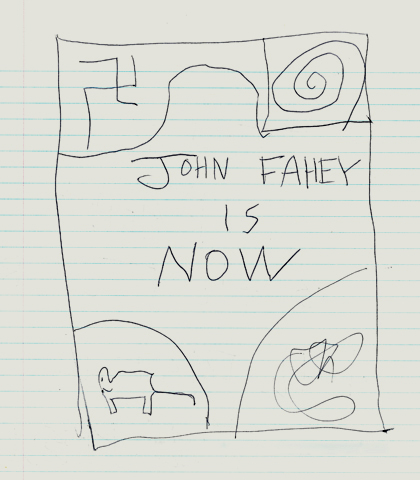
Sketch by John Fahey circa 1998 for potential homepage for johnfahey.com
The paintings of John Fahey
July 10 – September 12, 2010Presented by John Andrew and AVA
Legendary guitarist and iconoclast John Fahey is best known for his adventurous catalog of music. From 1959 until the time of his death in 2001 Fahey released upwards of 40 albums exploring the territory of blues, classical, hillbilly, spirituals, folk, musique concrete, rock, and noise. He was a figure like none other, a true visionary. In 1959, long before the term “independent label” hit the mainstream, he self-released his first album by pressing up 100 copies and selling them at the local gas station where he worked (shortly thereafter forming his own independent label Takoma Records). Lesser known is the fact that he was a fantastic writer in addition to being a hyper productive and explosive painter toward the latter portion of his life. This summer, AVA and John Andrew are extremely pleased to present the furiously beautiful paintings of John Fahey.
Pulling inspiration from the ‘French Primitive’, untutored painters, Fahey often referred to his music as ‘American Primitive’. The same alluring, raw, roots, mysterious, power, grit, obscure, industrial, ambient, epic, and tranquilizing aesthetics that one finds in Fahey’s music and his writings are equally present in his paintings. The 90’s proved to be a decade of regeneration for Fahey. Though he struggled with certain health problems, he was brimming with experimentation. Collaborating with noise artists and improvisational performers of the alternative movement, Fahey began to channel a new outlet for experimentation which included his return to painting; a bent he abandoned when he took up the guitar.
Fahey’s works are evocative of action painters and abstract expressionists. He painted on found poster board and discarded spiral notebook paper. His painting studio floated from motel bed to motel bed and eventually ended up on the bed of his rental home in Salem, OR; occasionaly painting with anti-freeze in the garage. He worked with tempera, acrylic, spray paint, and magic marker.
A selection of larger works (22” x 28”) will be on display in the Front Room of AVA in addition to a few select smaller works of varying dimensions. AVA and John Andrew would like to thank Melissa Stephenson for opening up her collection to this show and enabling the works to be available for purchase.
A series of sound collage works, spoken word, explorative / home recordings, and comedy all performed by John Fahey will be transmitted on the outside of AVA (as part of the Exterior Sounds series) during the course of the exhibition.
John Andrew is a New York based artist who has presented two shows at AVA. This show is a fulfillment of a Portland, OR art show he was originally organizing with Fahey in 1998.
Summer hours:
Thursday – Saturday, 12pm – 6pm
and by appointmentAVA
34 East 1st Street
New York, NY 10003Subway: F,V train to 2nd Ave / 6 train to Bleecker
thanks: BKD
(thank you Cleo!)

Photo by Robert Altman, 1969
BOBBY SEALE * 17 March 1999 * unedited transcript
I interviewed Bobby Seale (official site) in person in Oakland for Vibe Magazine, on a commission by Peter Relic, who was editing the front section of Vibe that year. I think the transcript runs to 12,000 words. The published Q & A was about 700 words. There’s lots of great stuff in here about Black Panther Party history and philosophy, Bobby’s times in prison, barbecue and so on, after we get done with talking about what he’s up to at the moment…—Jay Babcock
Bobby Seale: I’m out here [in Oakland] for David Hilliard. David Hilliard is running for City Council, 3rd district, to mount a real student involvement and people’s involvement-type of campaign for him to win that particular political office. It’s all about the continuing progressive Old Left-radical politics today. We want to get these students involved in this campaign to teach them techniques and methods of the old Black Panther party campaign, Old Left radical politics, progressive politics. To teach students that they gotta take over, that they have to be part and parcel of this kind of stuff, they gotta take seats over all over this country and this is gonna set an example for that. That they’re the ones who have to begin to understand the need to control, run these political institutionalized functions whether they’re city council, county seats, state legislative seats, etc., and make laws, legislation and policy that reflect the real true human liberation of the people, the empowerment of the people, whether you’re black, white, blue, red, green, yellow, polkadot, we don’t care. We’re progressive. In the 1960s we were an ALL power to ALL the people. We didn’t care what you were.
People think we were just a strict so-called xenophobic-type Black power organization. Not true. If people look and know our history…as an African-American group of young people who were part of a young intelligentsia of the 1960s, what we evolved were some of the most profound progressive politics that emerged out of the Black community: to set up coalitions, working face-to-face coalitions with all our white left radical friends, with all the young Hispanics, young Puerto Ricans with the Young Lords organization or the young Mexican-Americans Chicano brothers and sisters with the Brown Berets and the Cesar Chavez farm labor movement. We had a working coalition with that organization. AIM—American Indian Movement—we worked directly with. All the young Asians, young Chinese and Japanese worked with us, like the Red Guard out of Chinatown. Young Chinese students and young Japanese. In fact, of all those ethnic groups, it was always a few of each one of those ethnic groups that actually literally joined our Black Panther Party. I’m just saying that, that’s the kind of progressive, “All power to the People” politics that we put into the ’60s. We crossed racial lines even though we were able to be an African-American community organization that ran our own organization without any intellectual or offbeat, abstract, academic dictates. We REFUSED to allow for that, because our concept and our method was putting theory into practice. Learning as we did.
And we want to show the youth—when I speak today—we want to show the youth that if you participate, I want you to sign up for this campaign because it is not about just a political seat, it’s about another kind of movement, moving into this Y2K period…it’s not necessarily about the continuing, old politics as usual of the Democratic and especially the right-wing conservative Republican politics… There’s the Green Party, there’s the Constitutional Party, etc. so on. For instance David is running his total non-partisan, there’s no political party per se mentioned here in terms of being listed on the ballot. So. We’re saying there are multi-thousands of these seats. You talk about 50,000? or are you talking 500,000? …duly-elected seats in the United States of America, especially on the local level. And this campaign is not the last of this era, it will be another one evolving.
For instance in Winston, North Carolina, used to have a chapter of the Black Panther Party there. The Party was over, what, in the late ’70s and early ’80s? What in effect happened was the former Party members ran for political office. Larry Little, the former Deputy Chairman down there, won a councilmanic seat that represented that poor low-income African-American community there. And since then, for 26 years, it’s always been a former Black Panther connected to that seat. The people will not allow anybody else. If you weren’t in the former Black Panther Party organization in Winston/Salem, North Carolina—they call it , the old other conservative council members call that particular seat “the Panther seat.”
In other words you have to remember those young Black Panther Party people, young students and others, they put together a free ambulance program for the people. They put together a free health clinic with a free pharmacy program which all chapters and branches did. They put together free breakfasts for children programs that served those people in that community. So those people never forgot that. They remembered that. These are tangible programs. This was not rhetoric, this was not talk. So this is what I’m saying.
So we have various examples of former Party members still in political office like Bobby Rush, who was an alderman there in Chicago for 12 years and then became a Congressman. We have Michael McGee in Milwaukee, he is still a councilman up there representing a heavy electoral group of the African-American community.
What a lot of people forget is this is really the politics of the Black Panther party. Even though we had a lot of shootouts and a lot of battles with the police attacked us, when the politicians would send their law enforcement agencies in on us, even though J. Edgar Hoover and all these guys were out to smash us, try to terrorize us out of existence, they killed 29 of my people in this country, particularly in the year 1969. 14 policemen wound up getting killed in those attacks. They attacked our offices, they attacked our homes and we vowed to defend ourselves. Cuz in our sense, all we were doing was defending our Constitutional, democratic, civil, human rights: one, to organize the people, political electoral community power…
People used to say “you’re outside the System.” You can’t be outside of something that’s oppressing you. You have to get right into the middle of it, change its structure, change its direction, change the laws, change the policy to serve the empowerment really and truly of the people. And THAT’s the kind of politically revolutionaries we were in the 1960s.
Continue readingKENNETH ANGER NEW FILM
(with titles by Arthur’s Psychedelic Healing Visions Correspondent, ALIA PENNER)
From Vogue Italy:
“I’m fascinated by Kenneth Anger’s use of color and his ability to transform a film into a three-dimensional texture, a fabric of images in movement,” explained Angela Missoni. This is how she introduced her decision to entrust the Missoni F/W 2011 campaign to one of America’s most famous authors and directors of avant-garde cinema.
Anger — a hyperactive octogenarian who loves working in the wee hours of the night and at dawn using sophisticated instruments such as the RED digital camera that has the characteristics of a classic 35 mm camera – flew in from Los Angeles to film the campaign in Sumirago that involved all the members of the great Missoni family. They are the stars of this campaign that was conceived as a series of superimposed and overlapping portraits. Vogue.it presents a preview of this film: a vibrant and impalpable evocation of unique patterns, patchwork motifs, stitches, knits, and styles, it is a symbolic weave as ephemeral as a dream.
“The images of Juergen Teller for the S/S 2010 campaign reflected and portrayed our everyday family life,” said Angela. “Kenneth Anger’s experimental approach and his narrative style, on the other hand, transformed the new campaign into a sublimation of our world.” The style of this ad campaign that verges on art clearly reveals the taste of this Californian filmmaker, who directed the films “Fireworks”, “Puce Moment” and “Scorpio Rising”, wrote successful books such as “Hollywood Babylon” dedicated to the secrets, manias, perversions and scandals of early Hollywood film stars, and is a favorite of young fans. Included in the 2006 edition of the Whitney Biennial of New York, he currently works with some of the most important international galleries of contemporary art and enjoys much popularity today.
A man of few words, this fascinating former actor who still takes care of his appearance first filmed the settings for his film “Missoni”: mostly locations near bodies of water in the Sumirago countryside and part of Rosita and Ottavio’s garden. For the indoor sequences, he built a set in the Council Room of the Sumirago Town Hall, a basement room with a vaulted ceiling. The mood of the film and the poses and movements of Margherita, Jennifer, Angela, Rosita, Ottavio, Ottavio Jr. and all other family members are reminiscent of Sergei Parajanov’s “The Color of Pomegranates”, a 1968 film that inspired Anger to create his Chinese box-style storyboard.
The intertwining and blending of moods, micro-plots, and situations make his “Missoni” a dream of a film within a film, a surreal dreamy interaction of spaces, faces, gestures, clothes, and costumes with different ages and narrative tempos. “Before he left,” said Angela, “he gave my mother, with whom he became fast friends, a film award he recently received.” To the question, “What did he leave you?” she answered with her usual humor, “Twenty-five wigs!” In Anger’s film, the wigs appear in a minimum part and are worn by Margherita, the protagonist with Jennifer of a project that will enchant, document, but not illustrate fashion.
The film expresses Missoni’s sophisticated choice and desire to amplify the role of images, making them a communication means and not an end, instruments for personal forms of appropriation and interpretation.
Mariuccia Casadio
Published:
07/26/2010
(Hipped to this by Veronica’s dad)
Previously in Arthur:
WHAT KENNETH ANGER WAS DOING INSIDE THE PENTAGON, OCTOBER 1967
Lane Milburn was born in Lexington, KY and studied Painting at the Maryland Institute College of Art. He currently lives in Baltimore, MD. He is currently at work on a long science fiction graphic novel that is coming along in fits and starts. His new book DEATH TRAP is available from Sparkplug Comics (http://www.sparkplugcomicbooks.com/) or directly from Lane at: http://closedcaptioncomics.blogspot.com/2010/03/death-trap-has-arrived.html
— Jason Leivian
“R.L. Burnside at home in Independence, Mississippi, shot by Alan Lomax and crew in August, 1978.”
R.L. Burnside: Fat Possum Records
 Arthur Magazine