
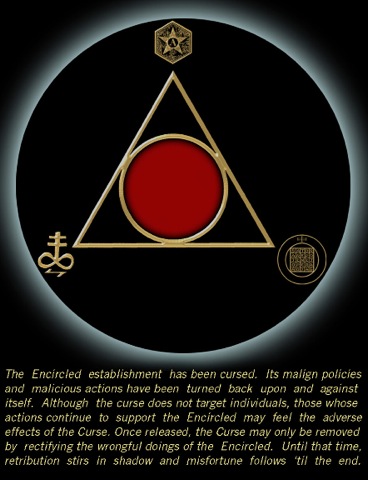
Above: A CTM-designed sticker, easily adaptable for re-use by you.
APPLIED MAGIC(K): Hex Files
by the Center for Tactical Magic
Originally published in Arthur No. 30 (July 2008)
The Center for Tactical Magic is no stranger to controversy. Even when we’re not actively setting out to conjure a bit of mischief, the imps often make the effort to conjure us. Since our projects frequently trespass into different cultural territories, it’s not uncommon to encounter an occasional cold reception or heated debate. Typically, these center around what the Center is or isn’t. Activists? Occultists? Conjurers? Tricksters? Contemporary artists? Martial artists? Con artists? Most of the time we feel that these debates are more productive for everyone when we stay out of them and let folks figure things out on their own. However, we recently received some paradoxical antagonisms via email regarding one of our distribution projects and thought it might be helpful to clarify a few misunderstandings.
To begin, the project in question is a curse. It is a curse in the form of a sticker that is specifically designed to target corporations, institutions, agencies, and the like. And the ire that we raised from two different people couldn’t be more divergent. The first, a self-proclaimed “activist” wrote:
I like a lot of what you guys do, but some of it doesn’t seem very productive. I mean, curses? I just read your article in Arthur about the difference between “magical thinking” and “wishful thinking” and then you suggest “cursing” people in power? This seems hypocritical and/or delusional. I’m open to different people’s spiritual viewpoints, and I don’t mean any offense, but I don’t really see how a curse can be as effective as a protest or a petition.
The second critic, a self-proclaimed “Wiccan High Priestess” wrote:
I have long-admired the Center for Tactical Magic for your innovative interpretations of ancient magickal wisdom. However, I am deeply disturbed and taken aback by your “Diagrammatic Hex.” This curse clearly defies the Wiccan rede: “That ye hurt none, do what thou wilt.” Further, it beckons doom. “That which ye sendeth out, shall returneth three-fold!” This hex you have devised is of the darkest magick, and can only reap darkness in return. It is not only dangerous for you, but irresponsible towards those who would follow you down the Left-hand path to their own demise.
Before we directly address either of the aforementioned concerns, we should set the stage with a short history lesson. The origin of curses is ill-defined; yet, it’s certain that we find hexes, whammies, jinxes, the “evil eye” and all sorts of maleficia in cultures spanning time and geography. More often than not, curses have been cast over personal disputes, vindictive rages, and petty jealousies. However, there have also been instances where curses have been deployed in collective struggles.
In the Middle Ages, the peasant class had no easy avenue of representation through which they could air grievances against their feudal lords. So somewhere between total subjugation and full-scale revolt, curses became a tactic of dissent. By discretely attaching hexes to the property of the feudal lord, the ruling authorities could be made aware of the growing social distemper. While the nobility might be quick to dismiss the hexes as mere foolishness, the laborers of the manor, who belonged to the “superstitious” peasant class, could be relied upon to take the hexes a bit more seriously (and perhaps melodramatically). And unless the feudal lord took steps to remove the curse, the manor and the fief would slip into a dysfunctional mess. Of course, the way to remove the curse would involve rectifying any prevailing injustices.
It’s not too difficult to imagine that similar dramas were no doubt enacted hundreds of years later on plantations across the colonized globe. A bit of well-placed Hoodoo or Voodoo could serve to amplify the collective concerns of house slaves and field slaves alike. Even if the plantation owner took little heed of the “mumbo-jumbo” the workers would certainly make a fuss until things were set right.
Based on these precedents, as well as on our contemporary context of corporate neo-feudalism and wage-slavery, it seemed only fitting that we should revive and update this bit of mojo. As such, we suggest that the modern sticker-hex might produce several positive results:
Continue reading





 Arthur Magazine
