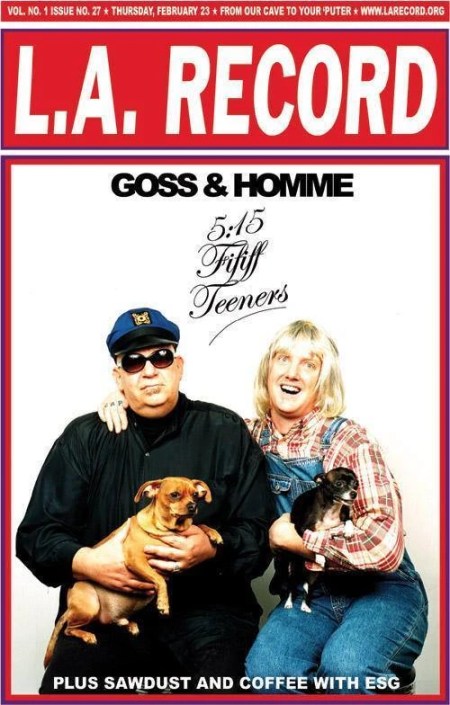
Advance press for ArthurBall’s Day Two headliners in the late, truly great L.A. Record.
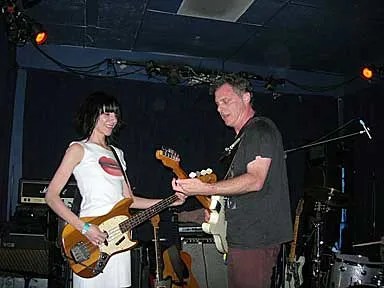
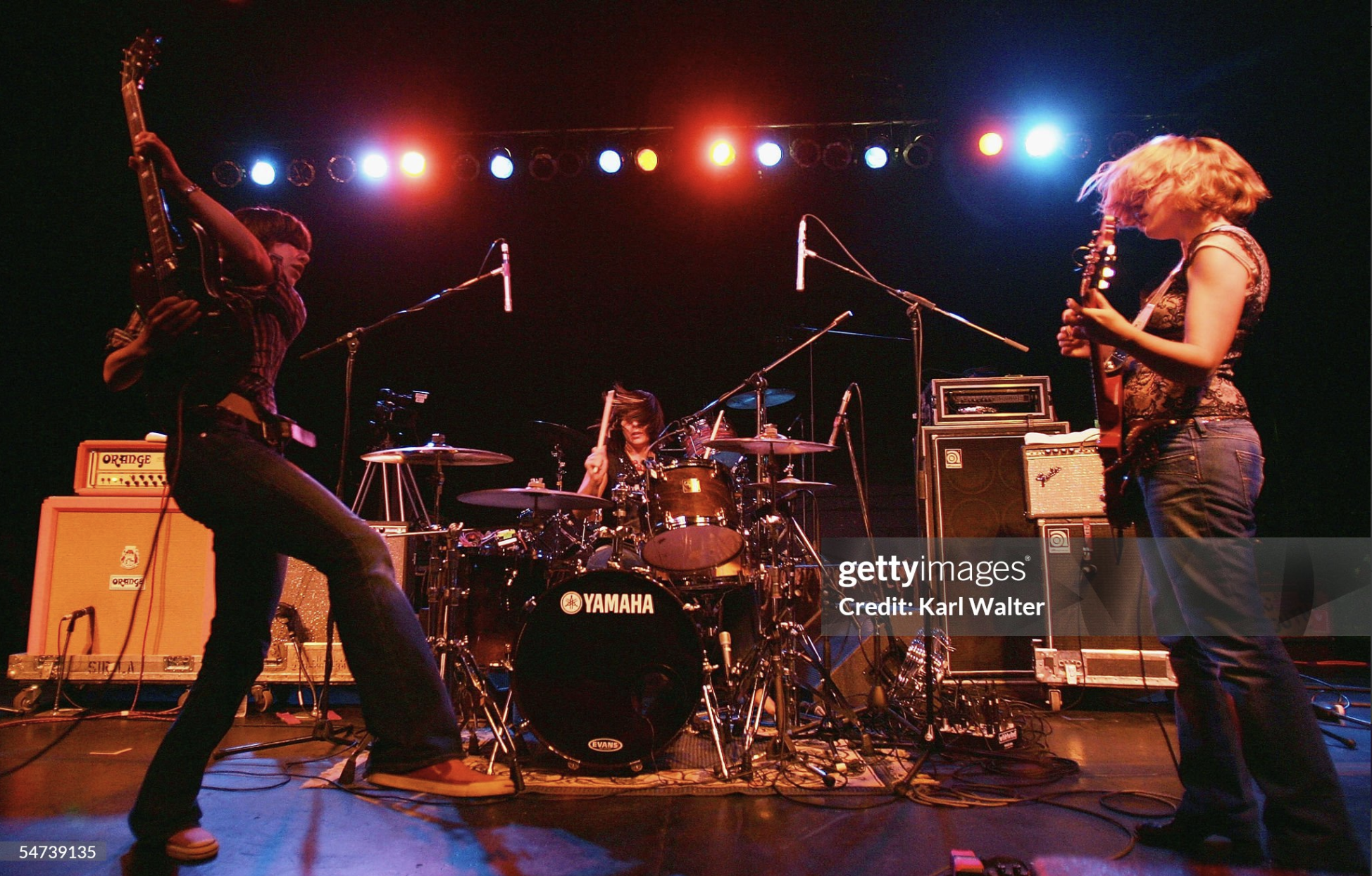
Polly Harvey (left) helps out on bass in Moris Tepper’s band at ArthurBall. Photo by Richard Pleuger
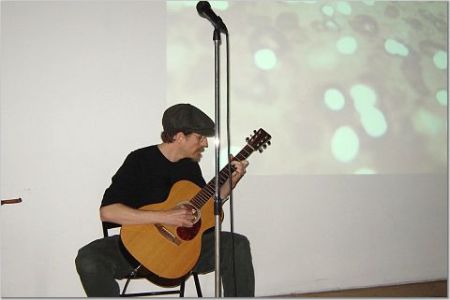
Erik Davis performs on solo acoustic guitar in front of an audience for the first time ever. Photographer unknown
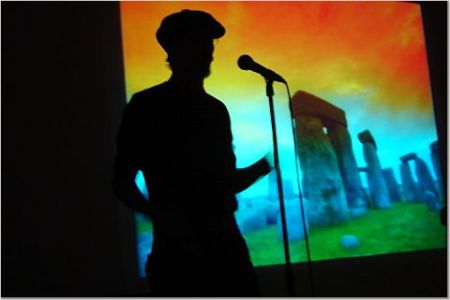
Erik Davis speaks. Photographer unknown
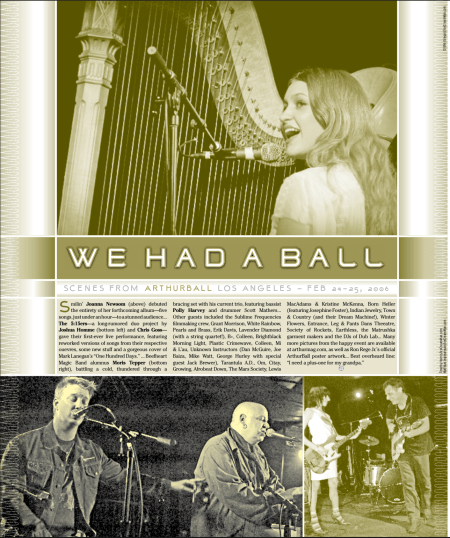
Brief report on the Ball from Arthur Magazine No. 22 (May 2006), designed by W.T. Nelson
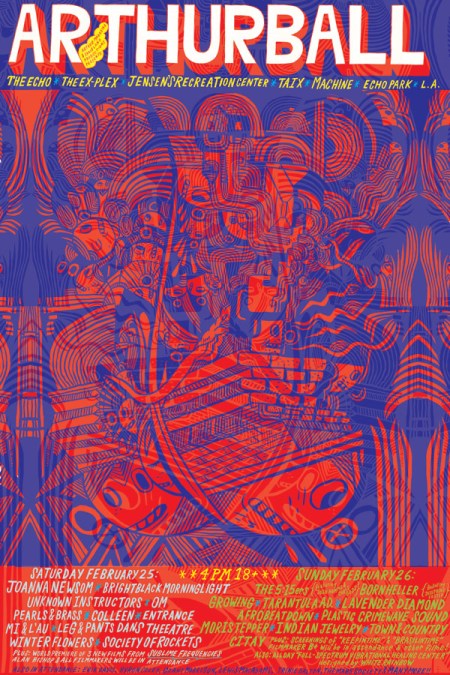
ArthurBall — a two-day, 1,000ish-capacity, multi-venue music & culture festival in Echo Park on Feb. 25-26, 2006, curated by Arthur Magazine and produced by Spaceland Productions — was the second of three Arthur festivals in a period of 14 months. Our ludicrous idealism was nearing its peak. I reminisce a bit about it in the latest (paywall-less) Landline. —Jay
I’ve pretty much finished restoring lost blog images and credits, as well as posting text, photos and art from old print issues of Arthur Magazine to this archive.
But there’s probably still some blanks and 404s. If there’s something you’d like to see that’s missing, please let me know in the “Comments” section below. Requested items will then be brought online, archived and highlighted in the blog.
Longtime Arthur readers may remember many of the essays featured herein from when they were presented as part of Freeman’s weekly “Sunday Lecture” series that we published on the Arthur website back in 2010-2011.
Freeman House
Amongst other things in his long and varied life, Freeman edited Innerspace, a mid-1960s independent press magazine for the nascent psychedelic community…
Innerspace No. 4, 1967. Might be the best purely psychedelic magazine I’ve ever seen. Copies are unfortunately rare and scans seem to be incomplete.
… and, as “Boo-Hoo” leader of the Neo-American Church, Freeman presided over the marriage of Abbie and Anita Hoffman at Central Park…
Freeman House (center) presides over wedding of Anita and Abbie Hoffman in New York’s Central Park (June 10, 1967). Photo by Fred W. McDarrah
…and Freeman was a member of both New York City’s Group Image and the San Francisco Diggers, before moving to Humboldt County, where he labored across four decades to restore the Mattole River watershed. Freeman’s award-winning 2000 book Totem Salmon: Life Lessons From Another Species was blurbed by poet Gary Snyder thus: “A grave and personal book, both personal and cosmic.”
“Endless bows of gratitude to Jerry Martien for his savvy salvage of Freeman House’s scattered essays and talks. Freeman’s essays, along with his longer works, are absolutely fundamental to understanding bioregionalism, living-in-place, living-by-life, or just drawing breath in these unsettled times where humans must deal with the damages wrought by everything from dammed rivers to internal combustion. Freeman offers insights into clearing the wreckage as well as a constant sense of delight in dealing with the natural world; we neglect his heart-root wisdom at our own peril.”
“Landline is a weekly-ish newsletter of ideas, nudges and recommendations that hopefully form a small bailiwick outside the cruddiness at large from the former editor of Arthur Magazine. Free to read, sustained by cheap subscriptions.”
“Daniel Chamberlin is an artist, writer, yin yoga teacher and Zen student based on the low-rolling plains of East Central Indiana. He’s also the host of Inter-Dimensional Music, a weekly broadcast of “heavy mellow, kosmische slop, and void contemplation tactics,” heard since 2010 on Marfa Public Radio in Far West Texas and broadcasting on 99.1FM WQRT Indianapolis and LOOKOUT FM in Los Angeles. His creative practice combines visual art, installation, performance, and audio with mindfulness teaching based on the radical implications of yoga and Zen. His visual art is concerned with uncovering the transcendent and psychedelic aspects of otherwise mundane objects and experiences.”
“I am Erik Davis (www.techgnosis.com), an author, scholar, award-winning journalist, podcaster, and professional talker. My wide-ranging work dances around the intersection of alternative religion, media, the popular imagination, and the cultural history of California. Burning Shore will continue to rove through this wide field, as I think about now and then, culture and catastrophe, through the lens of what I call ‘California consciousness.'”
“Team Human is a podcast striving to amplify human connection. Each week we are engaging in real-time, no-holds-barred discussions with people who are hacking the machine to make it more compatible with human life, and helping redefine what it means to stay human in a digital age.”
“The Day the Music Died”—not just the name of Don McLean’s too long song that refused to climax. It’s also a co-descriptive term referring to the aviation accident that took three of rock ‘n’ roll’s biggest names—Buddy Holly, Ritchie Valens, J.P. “Big Bopper” Richardson—and magnified them until they became analogous with—and even eclipsed—the music they made. Littlefield, Texas’ Waylon Arnold Jennings, then playing bass in Holly’s band, was supposed to have been on that flight. He gave up his seat to the Big Bopper, and settled for second-rate travel in a makeshift tourbus with Holly’s guitarist, Tommy Allsup, who’d lost his seat on the doomed plane to Ritchie Valens in a coin toss.
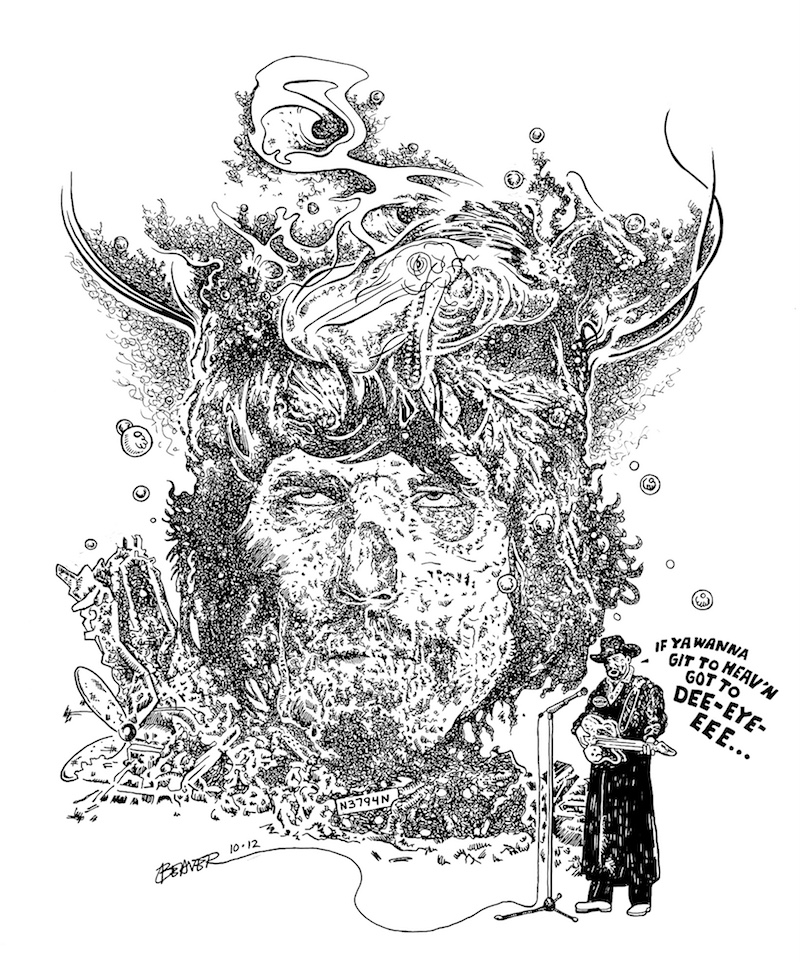
In its most savage—and strangely sacred—way, the accident mimes an offering to some cosmic god who rejected it, and sent it careening back to earth engulfed in flame. Take a look at the Civil Aeronautics Board’s crash site photo. Wreckage resembles one of Robert Rauschenberg’s early combines: an abracadabra of Americana—ambiguous machinery compacted and deconstructed into a monolith of hyper-meaning, conveying less and more than the sum of its parts, even with nary a corpse in the frame. A wheel. A wing. A barely identifiable frame of fuselage. All there amongst Iowan Albert Juhl’s snow-covered cornfield, a barbed-wire fence keeping it clear of the plain—separate, contained: an art installation to the everlasting gone awry.
Incapable of being quarantined, however, was the guilt Jennings walled himself up in the tragedy’s aftermath. Before the plane left the ground, Holly reportedly told Jennings he hoped his “ol’ bus would freeze up.” “Well, I hope your ol’ plane crashes,” Jennings responded. Illogically, but understandably, Jennings took sole responsibility for the crash. It’s so much salt thrown over the shoulder, but it makes great superstitious sense, especially since, in Jennings’ mind, those seven words worked up a hex heavy enough to take the lives of four men and Holly’s unborn child, as the tragic news caused his wife to miscarry. But the music, it never died. Jennings and Allsup even completed the midwestern tour, two men spreading song amongst a bottomlessly black sky bereft of its three stars.
And still the music kept on. Throughout the amphetamines and the cocaine and the drinking. Throughout the invention and reinvention. From rockabilly to “Outlaw Country” and all its trappings: big black hat and somber clothes, beard long as days spent in saddle, a voice drink and smoke ravaged carrying on about campfire yarns concerning women loved, men reckoned with, and the Almighty above watching it all transpire from eternal dusk to dawn. Sixteen years after Holly’s charter crashed, Jennings made what was arguably his finest record—and perhaps the finest of the “Outlaw Country” subgenre—Dreaming My Dreams. This compendium of the conscious unconscious harkened back to country music’s so-called “Big Bang,” the Bristol Sessions in 1927, and roared on far ahead to a future that saw this generation’s Sam Phillips—Rick Rubin—-coax Johnny Cash into songs sparer than those that tossed and turned throughout DreamingMy Dreams, and woke as grizzled fable, larger than the legends that wrote, played, and recorded them.
Contradictory Victory: Bigging Up Joe Higgs’ Reggae Classic “Life Of Contradiction”
by Peter Relic
Posted Apr 3, 2008 on the Arthur blog at Yahoo
The first thing that grabs you is the title: Life Of Contradiction. In the roots reggae world where Rastafarianism ruled, righteousness and preachy absolutism—and even Rasta’s red-gold-green primary color scheme—all seem to insist that there is one true way to do things, one true way that things should be. Thematic subtlety, and the admission of the validity of alternate viewpoints, are pretty thin on the ground (though to be fair, such single-mindedness is one of reggae’s greatest sources of strength).
Simply put, contradiction doesn’t spring to mind when listing the music’s top topics. As a result, Joe Higgs’ 1975 album Life Of Contradiction, newly and impeccably reissued by the ever-attentive Pressure Sounds label, is an LP whose nuanced vision makes it stand out within the pantheon of reggae classics.
Higgs was a music biz veteran by the time he recorded Life Of Contradiction for Chris Blackwell’s Island Records label in 1972 (its release was delayed a further three years until rights reverted to Higgs, who issued himself it in Jamaica and the U.K). As a youth in the early 1960s, Higgs and Roy Wilson formed the r&b duo Higgs & Wilson, voicing numerous hits for Edward Seaga’s WIRL label, including the shining gospel number “The Robe.” The duo went on to record Higgs’ superlative compositions for the likes of Coxsone Dodd and Duke Reid, including “There’s A Reward,” a track Higgs would re-record a decade later for Life Of Contradiction. But in the time-lapse between those two renditions, Higgs made a crucial contribution to Jamaican music, one that sealed his status as a primary architect of the island’s best-loved act.
“The Wailers weren’t singers until I taught them,” Higgs is quoted as saying in Reggae: The Rough Guide, referring to his time mentoring the then-green group in the kitchen of his Trench Town home.
“It took me years to teach Bob Marley what sound consciousness was about, it took me years to teach the Wailers.” The claim could be considered self-aggrandizing were it not for the fact that Higgs alone was qualified to take the place of Bunny Livingston when Bunny preferred chilling in Jamaica to joining the Wailers on a 1972 U.S. tour. And, of course, the splendid evidence of this album.
A Tragic Honesty: The Life and Work of Richard Yates by Blake Bailey (Picador, 2004)
The Bailey came out this past year or so, but I would recommend first reading Yates’ easiest-to-find novel, Revolutionary Road, before it goes out of print again. Eros, pathos, flop sweat, it’s all there; a man outside and inside his own time. Highs and lows as a writer, but at his best it does not get better; more of a grown man than Salinger and less of a prick than Updike: the comic and horrible desperation of the 1950s middle class white guy. I can’t get enough! The biography is filled with his drinking, mother, teaching, TB, women, self-defeat, madness, work, beard-growing and sadness.
Alex Nielson & Richard Youngs Electric Lotus LP (vhf, 2004)
Two guys make glue-sniffing rock and roll cast in the crucible of the entire recorded history of time and act really nonchalant about it.
Giant Skyflower Band show at the Hemlock
Closing out the show under swirling lights, Jason stumped out deep crazy timpani, Glenn sawed away at melodies and chords like a old-timy German cobbler channeling Dave Kusworth and Shayde “Mushmouth” Sartin slunk out basslines like a somnambulant Greg Lake. It was a night to remember. They’ve got a cd on Soft Abuse called Blood of the Sunworm, and name notwithstanding, it is effen rad.
The Evolution of a Cro-magnon by John Joseph (Punk House, 2007)
Finally. But don’t take my word for it, Adam Yauch has this to say:“So if you want to remember what NYC was like in the ’70s and ’80s, if you are interested in selling fake acid at Madison Square Garden, or dressing up like Santa Claus in a wheelchair to hustle money for the Hari Krishnas…put a read on this.” Also available in…audio book form, AH! Now, anyone who is anyone knows that this year John Bloodclot is also coming out with his own nutrition and fitness guide. Here is what he had to say in his press release: “I’m sick of people, who are either ignorant of the facts, or even worse, have hidden agendas, dissing vegetarians because we care about animals and the environment. What do you want to live in a barren wasteland dick wad?” Amen.
Joshua Burkett Where’s My Hat(Time-Lag, 2008)
The album long awaited by those who played holes into Gold Cosmos so many years ago is finally here. Joshua Burkett is known for co-owning Mystery Train—the best record store in Western Massachusetts—and for being a bit of a mystery train himself. Though a master musical craftsman, he rarely plays live and takes years to release records. Where’s My Hat starts with a bold electric bagpipe somewhere between an emergency siren and a diseased fog. Josh’s guitar braids mental rugs and smoothes down the rough edges. Though I think of Simon Finn at his gentlest, or Pip Proud or Skip Spence, it is not like anything else. And if you think there is you are wrong. There are efforts that wish they were this but they are not. You can hear the difference. Attempts at peace and a knawing ill-ease permeate the record, but it is above all a work of intricate idiosyncratic beauty.
Moving to San Francisco
I can’t believe this place. Lousy with people with the right ideas, jamming, playing good records and eating salmon tacos on the edge of green cliffs over the ocean.
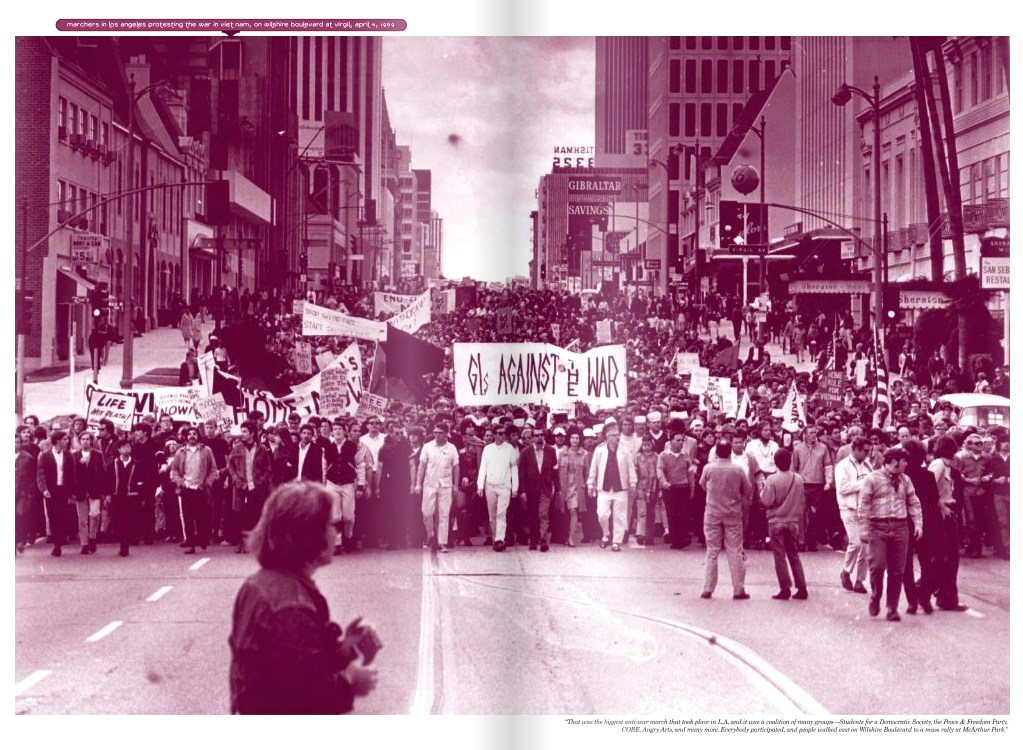
Poster-sized centerfold (17 in x 34 in) from Arthur’s January 2003 issue, published as mainstream USA was going all in to invade Iraq: an incredible, previously unpublished photograph by Charles Brittin of the April, 1969 anti-Vietnam War march down Wilshire Boulevard in Los Angeles .




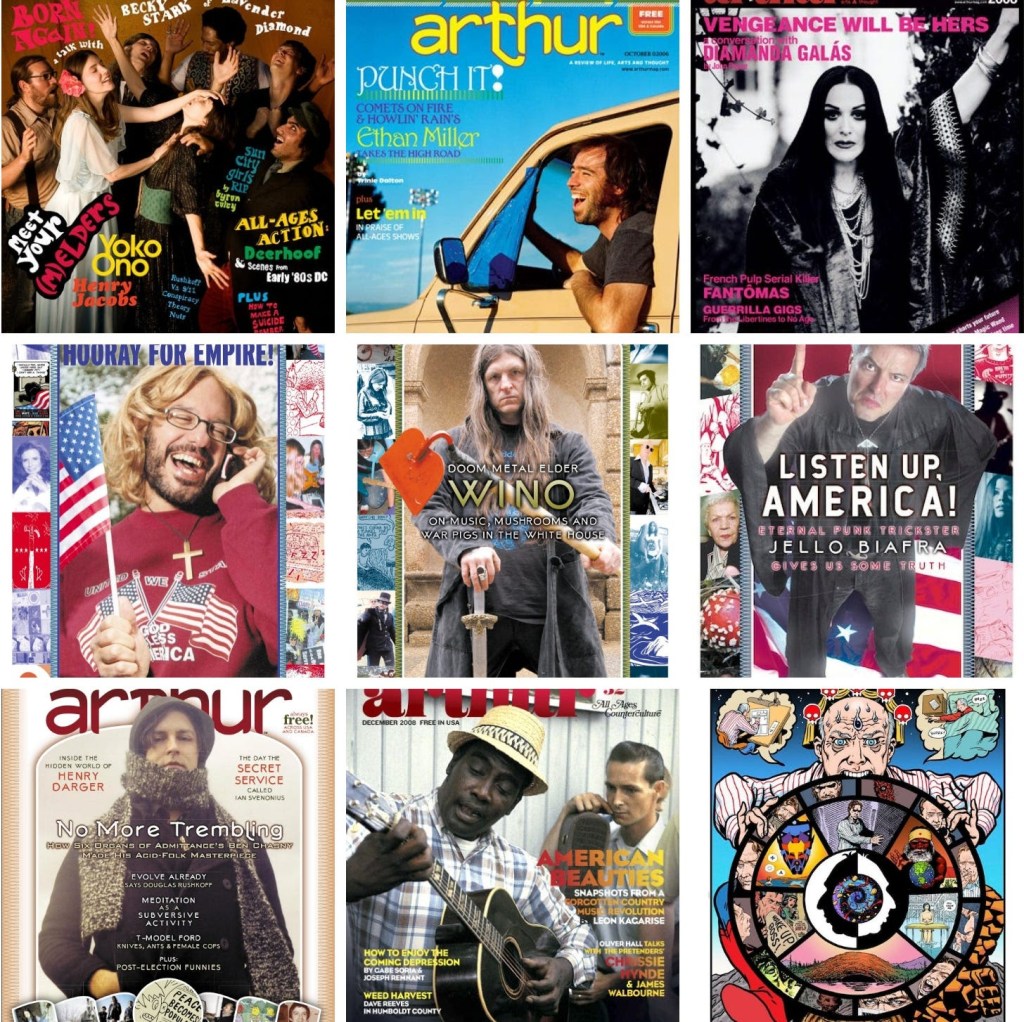



 Arthur Magazine