

Defense Industry Report VIII: WHERE HAVE ALL THE GOOD CRIMES GONE?
So. 9/11. Boom Boom. Civil rights canceled. Special Delivery. Airmail. And woe is us, for the forked phallus of Wall Street was the lodestone of the Bush Gang, without which maps and words lost meaning, until Operation “Enduring Freedom” kicked down the doors of the wrong war.
Most of the real terrorists were killed at the crash site, so the Department of Justice took advantage of aggressive new statutes to give a violent monster named “Free” twenty years of jail for burning down a beautiful young Truck. National discourse about this chain of events was relegated to sloganeering as the recently purchased Fourth Estate parroted the “For Us or against Us” hokum coming from our beloved “leaders”.

The message to The Left was clear: Motherfuckers ain’t up against The Wall no more. A New Dark Age was upon us, complete with thumbscrews and crusaders. So, all the protest kids lost their phone numbers, changed aliases, switched partners and cooped up in different crash pads. Scared. Riots failed to occur where they were guaranteed before and, consequently, tomatoes lost their flavor.
I put my Defend Brooklyn militia project on the back burner. Who knew what a “terrorism czar” was, or what he thought about jingoistic AK 47 t shirts? The Brooklyn we were defending had been overrun, anyway. By people like me, who I hate. It was fucked up.

The profits accrued during those <911 days afforded me the scratch to start looking for a neighborhood with hardwood floors where I could dig in and the copycat hipsters couldn’t follow me to make my rents go up. Queens was too complicated and there were too many honkies in Harlem. The South Bronx had real potential as the place from which to Defend Brooklyn.
The great restructuring of American cities by Robert Moses has rendered the south Bronx into a prep jail. The rate of incarceration was so high that certain surviving elders felt it wise to teach a lethal fighting style to the local youth in order to enable them to stay out of gangs.
It was a good pitch, anyway. Soon “Jail Karate” had a producer and some Swedish television station showed interest. (Films like “Jail Karate” constitute escapism in Sweden because an effective social system has dulled Svenski graffiti, hip hop and street violence to the most boring in the world.)
Jail Karate’s thesis dovetailed nicely with the previous Defend Brooklyn work and helped me define the nature of the resolve worn so readily on so many T-shirts. The clannish atmosphere of the various dojos and the vulgar noblesse oblige of the Bush administration made me want to conjure a serious, violent left-wing militia into existence, if only just to have someone to talk to.

Friends of mine from New Orleans told me about this guy named Jac Currie hacking the “Defend Brooklyn” meme with “Defend New Orleans.” Apparently he was claiming that he was the genius behind the brand that was sweeping the nation.
It didn’t bother me that much as I was busy parsing what it meant to “Defend” a neighborhood with a bunch of Five Percenters and Werner Herzog’s production manager without getting killed. I’d become inured to salon crusties making chippie money off my reverse prole drift since the third weekend.


Jac Currie’s plagiarized “Defend New Orleans” shirt had an old musket which will make a nice paddle the next time they blow the levies. I won’t even bother to crack on the skull-with-mohawk stencil stolen from Manic Panic hair dye kit. I emailed this Jac Currie and told him that I was about to hire a bunch of lawyers to monkeyfuck him if he didn’t quit messing with my Defense Industry project. I figured that would be all it took, as the threat of a righteous copyright litigation had worked on all the other wannabes.

Biters copying my work all over the country proved that I had a nationwide mandate. This spurred me to try and create more complex types of manipulation than just a T shirt. I was going to use my enormous talent as a documenter and a writertarian to subvert the dominant paradigm from within the military industrial entertainment complex, and make tons of money.
My first assignment was a piece on Larry Clark for The Face magazine, from which I quote myself, respectfully, with permission:
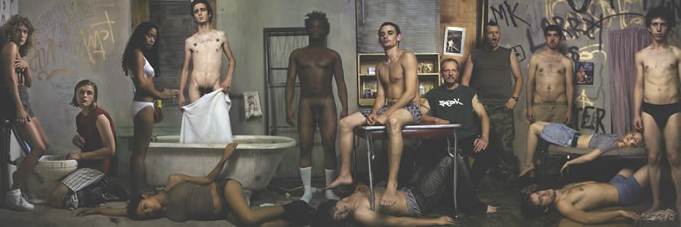
You are familiar with Larry Clark’s photography even if you have never perused his seminal photobooks Tulsa(1971) or Teenage lust (1983). Before Larry was a film director he was already ‘the photographer who changed American films and photography.’ The proof is found in the works of Mario Sorrenti, Nick Knight, Terry Richardson, Juergen Teller, Corrine Day, Nan Goldin, Bruce Weber, Steven Meisel, Alexie Hay, David Armstrong or Steven Klein (whose work graces the cover of this magazine).
So many photographers have bled Larry’s art for their advertising work that Larry has been implicated as the father of heroin chic. One critic so profoundly misunderstood the situation that he said “Kids” looked like a bad Calvin Klein ad.’ This is why Larry refers to anyone in the industry as “fashion cunts.”
“They got it all wrong. They don’t understand it. I’m documenting real life. They thought it was all about the drugs. They take what I do, use it and make a lot of money at it. My art is personal. I don’t fucking sell clothes. And then some art director goes out and buys a book and says ‘Here it is! This is the next ad campaign!’ Is that supposed to be talent?” Then Larry calls them cunts again.”

It was unnerving to listen to Larry rail about photograpers who’d stolen his style while they took the picture of him, as if Larry hadn’t shot a guy over a poker debt.
At the time, I thought all the outrage was due to Mister Clark’s prison inculcation, as his conversation is peppered with dogmatic rules like “Don’t talk for nobody,” “Get people back” and “Don’t pop off with no antisemitic bullshit.” Plus, it was hard to hate Steven Klein and his boyfriend as they were nice, cute, and didn’t call anybody the “C” word while their assistants made us coffee. They even let Larry pet their great danes.
The plagiarism implicit in mimeo art and sampled music had eroded the ethics of the arts world allowing Larry to be brazenly robbed in more than one format. If you believe a 19-year-old is capable of being the “creator” of a feature film like “Kids” then you might believe Larry Clark made Gummo, pissing him off all over again.

I didn’t know that having someone successfully plagiarize your work is akin to an artistic rape, resulting in a bastard which the artist can neither claim or deny. Or how distracting it is to lay in bed night after night thinking about how you are going to hit somebody in the head with a brick for pissing on your life work.

It wasn’t until I got the first emails accusing me of being the jerk for stealing Jac Currie’s idea that I began to understand the rage.
I was lying in bed, too angry to sleep, realizing that if violence was part of the Defend Brooklyn ouvre then plagiarism of that work demands a violent response. Or else I lose my tough guy rights. I called Jac Currie’s answering machine and called him a fashion cunt and told him I was serious about the lawyers and the monkeyfucking. For some reason I got no return call.
Then Hurricane Katrina hit. The “Defend New Orleans” flag made great video bites for the national news, emblematic of the necessary feel-good story about town pride bringing people together after a racist storm. Someone sent me a link of Jac Currie claiming the Defense Industry as his own on television.

I couldn’t believe it. After all my revolutionary talk and half-assed planning it had been stolen by a shakey-voiced party chaser wearing my name out like a bitch. Then I recognized him. The salon bedhead. The hundred dollar jeans slouched off the ass. I saw him get off the RISD bus. Jac Currie was the very guy we were Defending Brooklyn from! Of course he would be related to that thieving-ass Ellen…
I called some evil people I knew and plotted a trip to The Big Easy.
Tristan Pernet – "Jean Josef Jesus" – Supreme!

Our next installment in the Arthur Comics series drops…
so click here to check it out!
About Jean Josef Jesus:
Jean Josef Jesus is a comic zine, 30 pages long going on 100. The work will premiere in conjunction with a narrative installation in an exhibition in May 2010 at the ESAD, a school of decorative arts in Strasbourg, France, as part of its graduate degree program in illustration. Six pages from the collection will appear in the next issue of NYCTALOPE.*
About Tristan Pernet:
Tristan Pernet is a French illustrator/graphic designer and one of the founders of French Fourch, a non profit platform for multimedia publishing. You can check out his stuff over here: tristanpernet.com/
*Thanks to Emilie Friedlander for the worthy translation…
GLASS ROCK "Lion Dance" (music to drink wine and sway to)

Stream: [audio:http://www.arthurmag.com/magpie/wp-content/uploads/2010/03/7_lion_dance.mp3%5D
Download: “Lion Dance” — Glass Rock (mp3)
One of ten beauties on Glass Rock’s debut, Tall Firs Meet Soft Location, out now via Ecstatic Peace (more info…).
Arthur Radio Voyage #8 with Bobby Bouzouki
Last Sunday Arthur Radio embarked on its eighth voyage, this time to the wind-swept deserts of Greece, Morocco, Arizona and beyond… Special guest Robert Damore (aka Bobby Bouzouki) graced the Newtown Radio studio with the warm, nostalgia-inducing sounds of his bouzouki, and even took the time to tell us some of the narratives behind the rebetika (Greek folk songs) that he played during his set.
Before your journey begins, dear listeners, we have the following message to deliver from ye olde writing desk of DJ Hairy Painter…
The sun is here and opens the curtains slowly! It brings the slow glowing dust! It springs the earth out of polar jail, the winds blow the desert sand to make for better traction. If you sit, it will make your hair look sexier! The tectonic plates are shifting all around us, their quakes make the planet spin faster, and change the pitch! If you jump, you can land in buttes, the plateaus, or the Isle of Cyros! Through our earth’s muzak, the winds blow Bobby Bouzouki up to the Arthur radio treehouse for a jaunt upon rebetika mountain. Happy trials!

Stream: [audio:http://www.arthurmag.com/magpie/wp-content/uploads/2010/03/Arthur-Radio-Voyage-8-with-Bobby-Bouzouki-03-07-2010.mp3%5D
Download: Arthur Radio Voyage #8 with Bobby Bouzouki
This week’s playlist…
Continue reading
Diana Leafe Christian on ecovillaging
Long interview with the author of Finding Community: How to Join an Ecovillage or Intentional Community and Creating a Life Together: Practical Tools to Grow Ecovillages and Intentional Communities.
DID YOU FEEL THAT?
from : http://spectregroup.wordpress.com/2010/03/05/did-you-feel-that/

Days Now Slightly Shorter
http://jpl.nasa.gov/news/news.cfm?release=2010-071
http://bloomberg.com/apps/news?pid=20601124&sid=aLAUn4Gy92ss
“The earthquake that killed more than 700 people in Chile on Feb. 27 probably shifted the Earth’s axis and shortened the day, a NASA scientist has said. Earthquakes can involve shifting hundreds of kilometers of rock by several meters, changing the distribution of mass on the planet. This affects the Earth’s rotation, said Richard Gross, a geophysicist at NASA’s Jet Propulsion Laboratory in Pasadena, California, who uses a computer model to calculate the effects. “The length of the day should have gotten shorter by 1.26 microseconds (millionths of a second),” Gross said. “It’s what we call the ice-skater effect,” said David Kerridge, head of Earth hazards and systems at the British Geological Survey. “As the ice skater’s going around in a circle, and she pulls her arms in, she gets faster and faster. It’s the same idea with the Earth going around if you change the distribution of mass, the rotation rate changes.” The magnitude 9.1 Sumatran in 2004 that generated an Indian Ocean tsunami shortened the day by 6.8 microseconds and shifted the axis by about 2.3 milliarcseconds, Gross has said.”
(Rotation Affected Much More by Wind)
http://www.scientificamerican.com/article.cfm?id=did-the-earthquake-that-s

Core Flux
http://www.phy6.org/earthmag/dynamos2.htm
http://news.nationalgeographic.com/news/2009/12/091224-north-pole-magnetic-russia-earth-core.html
“The magnetic north pole moved little from the time scientists first located it in 1831. Then in 1904, the pole began shifting northeastward at a steady pace of about 9 miles (15 kilometers) a year. In 1989 it sped up again, and in 2007 scientists confirmed that the pole is now galloping toward Siberia at 34 to 37 miles (55 to 60 kilometers) a year. A rapidly shifting magnetic pole means that magnetic-field maps need to be updated more often to allow compass users to make the crucial adjustment from magnetic north to true North. Geologists think Earth has a magnetic field because the core is made up of a solid iron center surrounded by rapidly spinning liquid metal. This creates a “dynamo” that drives our magnetic field. Scientists had long suspected that, since the molten core is constantly moving, changes in its magnetism might be affecting the surface location of magnetic north. Nobody knows when another change in the core might pop up elsewhere, sending magnetic north wandering in a new direction.”

Earth’s Inconstant Magnetic Field
http://pubs.usgs.gov/gip/dynamic/dynamic.html
http://science.nasa.gov/headlines/Y2003/29dec_magneticfield.htm
“Every few years, scientist Larry Newitt of the Geological Survey of Canada goes hunting. He grabs his gloves, parka, a fancy compass, hops on a plane and flies out over the Canadian arctic. Not much stirs among the scattered islands and sea ice, but Newitt’s prey is there–always moving, shifting, elusive. His quarry is Earth’s north magnetic pole. Keeping track of the north magnetic pole is Newitt’s job. “We usually go out and check its location once every few years,” he says. “We’ll have to make more trips now that it is moving so quickly.” Earth’s magnetic field is changing in other ways, too: Compass needles in Africa, for instance, are drifting about 1 degree per decade. And globally the magnetic field has weakened 10% since the 19th century. They’ve also learned what happens during a magnetic flip. Reversals take a few thousand years to complete, and during that time–contrary to popular belief–the magnetic field does not vanish. “It just gets more complicated,” says Glatzmaier. Magnetic lines of force near Earth’s surface become twisted and tangled, and magnetic poles pop up in unaccustomed places. A south magnetic pole might emerge over Africa, for instance, or a north pole over Tahiti. Weird. But it’s still a planetary magnetic field, and it still protects us from space radiation and solar storms. And, as a bonus, Tahiti could be a great place to see the Northern Lights…”
North Magnetic Pole Shifting Rapidly Toward Russia
http://news.nationalgeographic.com/news/2005/12/1215_051215_north_pole.html
“New research shows the pole moving at rapid clip—25 miles (40 kilometers) a year. Over the past century the pole has moved 685 miles (1,100 kilometers) from Arctic Canada toward Siberia, says Joe Stoner, a paleomagnetist at Oregon State. At its current rate the pole could move to Siberia within the next half-century. “It’s moving really fast,” he said. “We’re seeing something that hasn’t happened for at least 500 years.” The shift is likely a normal oscillation of the Earth’s magnetic field, Stoner said, and not the beginning of a flip-flop of the north and south magnetic poles, a phenomenon that last occurred 780,000 years ago. Such reversals have taken place 400 times in the last 330 million years, according to magnetic clues sealed in rocks around the world. Each reversal takes a thousand years or more to complete. “People like to think something special is happening in their lifetimes, but despite the dramatic changes, I don’t see any evidence of it,” Stoner said. “It’s probably just a normal wandering of the pole.” The north magnetic pole shifts constantly, in loops up to 80 kilometers (50 miles) wide each day. The recorded location of the pole is really an average of its daily treks, which are driven by fluctuations in solar radiation. The pole is currently at about 80º north latitude and 104º west longitude, in the Canadian territory of Nunavut.”

Build Yr Own
http://www.npr.org/templates/story/story.php?storyId=90947943
“The compass has been around since at least the 12th century, but scientists still don’t know exactly how the Earth generates the magnetic field that keeps a compass needle pointing north. But geophysicist Dan Lathrop is trying to find out — by building his own planet. Later this year he plans to fill it with molten metal and set the whole 26-ton ball spinning. At top speed the equator will whirl by at 80 miles an hour. “It was a little scary the first time we spun it up,” he says. Lathrop figures it can’t be too hard to get a magnetic field — after all, most planets in our solar system have one. But while nature has an easy time making magnetic fields, scientists do not. This is Lathrop’s third attempt.
If you could dig a deep hole, about 2,000 miles down, you would hit the outer core, which is probably made of liquid iron. That iron can conduct electricity. And if it flows in the right way, it can turn the Earth into what scientists call a dynamo, generating a self-sustaining magnetic field — in Earth’s case, producing one pole up in Canada and another down in Antarctica. Iron only melts at high temperatures, though, so Lathrop’s team will fill his sphere with a different metal — sodium. Sodium becomes liquid at stovetop temperatures and conducts electricity well, but it’s flammable. A sodium fire can’t just be put out with water. Water can actually make things worse — so Lathrop’s team has disabled the sprinkler system…”
TONGUE TOP TEN by Byron Coley and Thurston Moore

1. Whatever generation it is now of the St. Marks Poetry Project New York School is beyond us, we stopped counting as soon as we saw Anselm Berrigan running the joint, remembering him as a kid banging around the folding chairs at the Project really not that long ago. Time flies in real time and in poet time and the last decade of young poets around that scene has been consistently engaging, though maybe exuding a transitional character that left us waiting for some kind of sick throw down. A recent publication that kind of comes very close to this is Mum Halo by New York City poet John Coletti, published by Rust Buckle Books. Coletti’s a pal of the true hearts writing, ruminating and starving around the historical churchyard on 2nd Ave and 9th street but keeps a slow and low profile. So when Anselm handed us this book we were curious, and when ripping through its pages we were left both stoned-brained and speed-slapped. Here is writing that takes the economy of word-mythos line play and evokes it with charm, humor and street sophistication. Check this out:
Opens Slowly
Because you’re patient
helping world being
less injured in it
pull up skirt hard inside
simple folding
burnt my finger
putting you out
Killer, here’s another:
Truce
Like to complicate my life no I don’t
sleep all day full pail &
feather your hair grinding sea
for Texas decades, sure
I might be a fuck-up
awesome fuck-up
2. The recent Jack Rose release party in Philly felt pretty cathartic for a bunch of the people who attended and it also kinda highlighted the wide breadth of style-glumph that is currently heralded as volk.
There is, of course, Jack’s own new album, Luck in the Valley (Thrill Jockey), which is a magnificent precis of his career, ranging from long raga fantasias to clackety neo-rags and stomps with Harmonica Dan, D. Charles Speer and other fellow travelers. The beauty and ease of his playing is something we will hold as a treasured memory as long as we live.

Jack’s long-time riding partner Glenn Jones also has a brilliant new album called Barbecue Bob in Fishtown (Strange Attractors Audio House), which is his best blast yet. Soloing on both guitar and banjo, Glenn’s playing has a precision and formal mastery that is jaw-dropping and so wide-ranging it’s incredible. And it’s definitely worth getting the LP version, since there’s a visual tribute contained to Muddy Waters’ Electric Mud album that is sure to crack up any knowledgeable collectors out there. I just hope he gets around to recording the Stockhausen music box pieces he’s been ruminating on for last decade or two. That would be a total gas.

One of the obsessive fanboy strands we’ve shared with Glenn over the years is the immortal Michael Hurley, and he has a smoking new LP as well. Ida Con Snock (Gnomonsong) was recorded over the course of a few years and features a mic of new & old material (as has been Hurley’s wont for a good long while.) What’s different and extremely special here is that he’s backed by the young Brooklyn folk-rock band, Ida, and also the great Tara Jane O’Neil. The gang really provides Hurley with the best backing band he’s had since Have Moicy! They usually hang back, only moving forward when it’s really appropriate, and the results are solid and as satisfying as a spliff, a jug and a warm fireplace. Hurley has the capacity to sound timeless, and he’s in rare form here, doing songs as transcendent as “Wildegeeses” and as boy howdy as “Ragg Mopp.” A massive favorite for all seasons.

Which reminds me of a show we put on in 2002 or so, where Hurley was backed on some numbers by the Philly band, Espers. That was a corker, as is Espers’ new LP, III (Drag City). Someone from the band told me they felt like this album was a holding-pattern in comparison to earlier work, but we sure don’t hear it. The CD has been stuck in the car stereo a lot lately, and the blend of Anglo-style female vocals (this time more like Celia Humpries—from the Trees—and Sandy Denny) and the male ones (which remind us of nothing so much the actually great—we swear—soft-rock of Mark-Almond and Sweet Thursday) is so fine. And the whole thing is laced with shots of guitar so goddamn psych you’ll swear they’re Japanese. But they aren’t. They’re just great.

Lastly in this category (for now) comes Peter Stampfel‘s long-overdue Dook of the Beatniks (Pietystreet Files and Archaic Media). Stampfel, of course, as half of the original Holy Modal Rounders has a pretty legitimate claim to being the founding father of the whole psych-volk shebang, so what does he do? Why he perversely records a rock & roll album with Mark Bingham producing. And it’s great, naturally—c’mon, nobody sings a song quite as crazily as Stampfel does—and contains everything from covers of obscure Johnny Cash b-sides to Sam Shepard’s “Take a Message to Omie” (Shepard was in the Rounders for a while too) and various other great damn tunes. It’s really nice that Stampfel allowed himself to take the lead on all the vocals here (something he never did in the Bottlecaps or the Rounders) and the results are extremely uplifting. You have to go online to read the fucking liner notes (similar to one of those Adelphi Rounders albums where you had to write the label to get ’em), but they’re typically fine and worth the effort. This still ain’t the exact Stampfel album we’re waiting for—back in the ’80s Ira Kaplan tried to strong-arm Peter into doing a solo LP with just voice and fiddle, and that’s the one we’re still holding our breath about. But this one’s a riot. And the cover pic of young beat Pete is wild. But hey—what happened to that album where he was gonna record a song from each year of the 20th Century? That’s due, too. Shake a leg, mofo.
3. Some superior communal and loose-tongue drone by Your Drugs My Money, a collective of peeps from all over the usa and one copenhagenite. They wrapped their heads together a couple years back in Portland and ran tape and it is deep wind-charmed fluidity, both sweet and raw. The session exists on a split tape released by oms/b tapes with Les Aus, two freaks from Barcelona who’ve been making records etc. for a while. Death trip momma Lydia Lunch shows up to intone on a track and the earth cracks open and cream gushes.
4. As it so often does, the Christmas season brought an avalanche of books about the Velvet Underground. Well, maybe not an avalanche, but THREE. And that seems like a lot for band that lost its leader (Lou Reed) 40 years ago, But we don’t wanna complain. ‘Cause the best thing is that whenever a buncha new books come out, it means there’ll be some pics we’ve never seen before. And it’s hard to think of a band that looked as consistently cool as the Velvets. The three are all by scribes we know, and each has a take somewhat reflective of author’s personality.

A Walk on the Wild Side author Jim DeRogatis
The first and most general one is A Walk on the Wild Side by Jim DeRogatis (Voyageur Press). Jim’s best known for daily newspaper work and his serviceable bio of Lester Bangs. His chief function as a rock scribe seems to be restating consensual realities, and so it is here. I mean, the book’s text is a solid introduction, but this is an intro that’s been made many times before. The volume’s raison d’etre, one assumes, is the new visuals. And it’s true—the pics look great (even though the most surprising ones now show up elsewhere as well), but the text is somewhat bland and the stuff about later solo work doesn’t carry the same charge. Still, a worthwhile filer. The Velvet Underground: New York Art by Johan Kugelberg (Rizzoli) is an outgrowth of the art catalog he did that we wrote about a couple of years ago. New York Art is a gorgeously printed, obsessive’s guide to the explosive confluence of Warhol’s scene and the Velvets. If you want a coffee-table Velvets book, this is the one to own. The text pieces are solid (an interview with both Lou and Maureen; random pieces by Bangs and Meltzer; memoirs from Rob Norris, Sterling and others) and the illustrations are pretty mind-bending. Very over-the-top, but wildly cool. White Light/White Heat (Jaw Bone Press) by Richie Unterberger: this one goes beyond obsession. It’s a day-by-day tracking of everything known about the band and their fellow travelers. And it is exhaustive. Richie has even dug up some images that eluded DeRogo and Johan, but the meat of this book is information overload. It’s the kind of book that can keep your ass glued to the toilet for days at a time. So don’t keep your copy in the bathroom. Might be hazardous to your very own ass health! Amazing work.
5. Caldera Lakes is Eva Aguila and Brittany Gould, two Los Angeles women who are displacing the Ladies of The Canyon mantle of Joni Mitchell by taking that songbird’s searching heart and massaging it against an amplified key grinder. And it is seriously killer. With a clutch of releases on Blackest Rainbow, Deathbomb Arc and 905they have proven to be one of the most arresting and savage femme noise units creepy-crawling the planet. Their latest self-titled tape on Accidie is as great as anything they’ve done, if not the greatest. Essential mayhem.

6. There are pretty many great jazz reissues and retrievals every year. People stumble over some crazy ass shit and we are goddamn happy when they deign to bring it to our attention. But it’s also fun to revisit old friends who’ve lingered in the shadows of our record collections for too long. So it was a sweet feeling to get a grey-area reissue of The Psychedelic Saxophone of Charlie Nothing, an LP that originally appeared on John Fahey’s Takoma label in 1967. Asked about it, Fahey would only say, “That was ED Denson’s idea!” But Nothing at this time was a Berkeley fixture and was known for wild alto sax improvisations as well as the huge book of writing and art he was always working on. Well, Charlie passed away a couple of years ago, and he recorded a bunch of interesting stuff that will hopefully see wide distribution one of these days, but this album is his first and it is a masterpiece of free improv—sax and percussion, unbridled from formal constrictions, allowed to weasel around like electrified rats. People have occasionally decried this LP in the same terms they use for Beefheart’s soprano playing (“that’s not playing—that’s just breathing!”), but we say “Fuck You,” to those who would quibble over such outmoded concepts. As Duke Ellington so famously said, “If it sounds good, it is good.” You are so right, Duke. And this Charlie Nothing album sounds GREAT.

7. Kryssi Battalene is a New Haven experimental angel who channels the sound of cosmic snowbirds through the physical friction of ferrous oxide tape against smoldering tapeheads. She also plays an astoundingly wicked guitar both traditionally and out of this world. We first saw her perform as a duo with Danny Moore in the amazing Heaven People, since disbanded, and she has been currently soloing every once in a while under the name Colorguard. She’s recorded a few weird cassettes handed off at gigs but thank the long red hair mystic Heath Moerland of Fag Tapes for releasing Shared Planet, a fine premier for this most awesome of wild improv enchantress.
8. Excellent to be able to screen Shout Factory‘s new, super clean DVD of the great American International teenage rock & roll spectacular, The T.A.M.I. Show. The older of us actually saw this screamfest at a movie theater when it came out in ’64, and it was amazing. The weirdest part of it may be the soundtrack, which has a persistent teen-scream huzz which (from the look of the crowd) is something that was tacked on to provide extra energy or somesuch. But the film doesn’t need it. Between the gyrations of the go-go girls (including Teri Garr and Tosi Basil back when they were part of Wallace Berman’s circle), the wild performances of the musicians (James Brown, the Stones, the Barbarians, Chuck Berry, etc.) and goofy MCing by the superb surf duo, Jan & Dean (the first group whose records I collected seriously). It is an insane blend and a testament to the heterogeneity of the early ’60s R&R experience, when the underground and commercial scenes were virtually interchangeable (apart from the creepy singers pushed by publishers and producers). This was shot at the Santa Monica Civic, and the tickets were given away free to local high schools. What a bonus fucking day that must’ve been.


9. One of the great small press poetry publishers, O Books, out of Oakland CA, issued in 1989 the first English translation of It Then, a book of poems by the late French poet Danielle Collobert. Collobert is little known outside the rabid circle of enthusiasts for her minimalist, self erasing style, but she has an intriguing history. Born in 1940, she published her first book of poems, Chant de Guerres (Song of Wars), in 1960, then hunted down every extant copy and destroyed them.


She became a political activist involved with publishing the Revolution Africaine newsletter. She published the Raymond Queneau-championed book Muerte (Murder) in 1964, traveled extensively, wrote and performed radio plays, published Il Donc (It Then) in 1976, and committed suicide in her hotel room in Paris the night before her birthday July 24, 1978. Collobert possessed a dark and romantic visage, especially evident when one notices her jacket photo with its downward gaze and the sensual sadness of her beauty. Her work astounds, moving across the page with a sonance both velvet and machine-gun like. The translation allows us to access her meaning, but the poetry here is compromised by not hearing the sound of the writer’s language. Even so, the thought process, the artistry of the trajectory, comes clear—and it is not always pretty. In fact it can be pretty frightening, detailing emotional negotiations with the poison of inhumanity as well as the living psychology of being female, indeed being REAL.
An excerpt:
I
It – flows – it bangs itself – slammed into walls – it picks itself up – stamps feet – it doesn’t go far – four steps to the left – new wall – it extends its arms – leans – leans hard – rubs its head – again – harder – forehead – there – the forehead – hurts – rubs harder – becomes inflamed – not the forehead – from within – cries
good start for the pain – head between arms – forehead against wall – and rubbing – skin breaks open a little – not enough – ooh the pain – there it is – feet kicking the wall down low – go on – with the toes – striking hard – thrashing – nothing to be done – doesn’t subside – never will subside – the rage – the pain – cries – hits with flat hands – dull noise – a cry – here a cry – no gasp – a little above a gasp – in shrillness – here it comes – collects at the back of the throat – what’s going to come out – still below the pain – not enough
sobs shaken – saliva at lips’ edge – bitter taste – slides a little towards the corner – nose smashing – lips – the lips twisted sideways – pulled back to the gums – moistening the wall – eyes closed – stomach and chest flattened – unsticks – comes back harder – sharp impact of shoulders – unsticks – comes back again with elbows with knees – bangs fists – fists’ backs – to the bone – starts over – skin reddens – rips at last – it falls – doubled up – dragging arms stretched along the wall – kept vertical by ends of fingernails – it collapses – impact of back – head rings on wooden floor – it pushes up onto its elbow – drags along the wall – reaches hung-up coat – hangs onto – hoists itself – buries its head in the wool – grabs the arms – holds the end of the sleeves tight – overlaps them around neck – expecting softness – but no – squeezes hard – chokes – coughs into tears – chokes – lets go – hangs onto cloth – pulls hard to rip – rips with all its strength – tears pieces with its teeth – spits – chokes – arms fall back down – sinks down – slips onto the ground
a body there – practicing pain – as if it hadn’t had enough of this suffering – at each moment – in floods – in vast wave – trying pathetically to practice it
body striking – disfiguring its limbs with the too full pain – which body sudden empty – which violence against – about empty – pain congealed at last – wanting to reach it to set it once and for all – to keep it there motionless – or set it down in front of it – itself – to make it really visible – in its infinitely numerous images – unceasingly
a body there – no – that body there – the one banging its face against the wall – maybe – no
walls fictive also – unnecessary walls – no – only to see from the place of the present invisible – here – facing the stripped body – arms motionless yet sweeping around in space without meeting anything to lean on – temporary connection – just for an instant – to slow the breathing down – slow down the beating – to quiet down – this body seeking the place – the hollow in which to melt back down again – heat ruptured – and cold of the world around – its place or position unsure to inscribe against the lack – the shocks of the day
(copyright © 2002 O Books)

It Then is available again through Small Press Distribution, a fantastic source for small press lit.
10. So many boss records floating through here, really have to just randomize & roll. Talk Normal‘s debut full-length, Sugarland (Rare Book Room) is a blazing extension of their earlier EPs. Their basic heft (UK ’78 DIY/No Wave squall) remains in places, but it is swamped by a new, venomous psychedelic thrust mixed with a post-scum instrumental chiming that is ridiculously effective. And their Roxy Music cover is as perfectly imagined as anything you’ve ever heard.
Then there’s the new album by Pete Nolan’s main non-Magik Markers project, Spectre Folk. Their second LP is called Compass, Blanket, Lantern, Mojo (Arbitrary Signs), which I suppose are the four main points on Pete’s aesthetic compass. Less massed and grueling than the Markers, this band’s sound is far more ramblesome and loosely psychedelic. Largely instrumental and as low-key as it is wasted, the LP wiggles beautifully from the instant it hits yr veins.

One of last year’s most profoundly underrated LPs was definitely Bats in the Dead Trees Parts I-IV (Lost Treasure of the Underworld) by Columbus, Ohio’s Cheater Slicks. This superb band—once based in Boston—has been churning brilliantly for a couple of decades now, and has created some of the world’s most tasty garage raunch in the process. Here they take the challenge and drop structure for an album’s worth of howling free-rock improv, and it sounds so fucking perfect, I just hope a whole lot of garage dudes/dudettes decide now’s the time to put up their own dukes and just LET ONE FLY. Would make for a lotta totally ginchy listening! Thank you, Cheater Slicks.
One band that was born in the land that form forgot was Detroit’s Destroy All Monsters. And luckily for us, Cary Loren has whipped out some expanded jams first presented in edited form in the 1974-1976 3CD box, and smeared them across a glorious slab of vinyl called Double Sextet (The End Is Here/Compound Annex). Yow. Only 500 pressed of this 33-minute chunk of free-form savagery, recorded in 1975, and it’s an instant classic.

Also instantaneous is the garage-vom-darkness of the long-lost LP by Michael & the Mumbles (De Stijl), a ’66 midwest session led by the teenaged Michael Yonkers. The band’s sound contains elements of frat-romp, folk-rock and pure-garage-fuzz, but the blend is definitely tentative and the sound quality is on a par with Justice albums of the era. Very cool, but only essential if you’re already a head. Which we are. But was this actually released at the time? We’d never even heard rumors of its existence. What the fuh?
Last brain-fugger this time out will have to be Major Stars‘ Return to Form (Drag City). We think it’s their second for the label, but our Drag City service is too spotty to be certain (hint hint). Regardless, we have loved this band’s core (Wayne, Kate and Tom) through decades and every combo mutation they’ve fronted. The Major Stars express more explosive improv gush here than they’ve done on some other LPs (they sometimes feel more like a live band than a studio one, which’s the opposite of some of their precursors), but the balance—as always—in the Major Stars rests on the balance of the instrumental frontline’s grotesque sonic overload and the massed rock-drive of the other players & singers. Sounds fucking incredible this time out (yin/yang energy up the ass), and the cover art by Bill Nace is as beautiful as a foot.
Alright. Gotta get this posted.
If you want some aktion, please send two (2) identical copies of yr object (archaic formats always appreciated) to:
Bull Tongue
PO Box 627
Northampton MA
01061
USA
New Archies!
New strength from longtime Arthur faves (and ArthurNights 2006 alumni) the Archie Bronson Outfit…
"Can you take me on a little journey through your face?"
 Arthur Magazine
