[SUNDAY LECTURE NO. 5] “Silent Future: Rachel Carson and the Creeping Apocalypse” by Freeman House

Freeman House is a former commercial salmon fisher who has been involved with a community-based watershed restoration effort in northern California for more than 25 years. He is a co-founder of the Mattole Salmon Group and the Mattole Restoration Council. His book, Totem Salmon: Life Lessons from Another Species received the best nonfiction award from the San Francisco Bay Area Book Reviewers Association and the American Academy of Arts and Letters’ Harold D. Vursell Memorial Award for quality of prose. He lives with his family in northern California.”

That’s the biographical note for Freeman House on the Lannan Foundation website. We would add that earlier in his life, Freeman edited Innerspace, a mid-1960s independent press magazine for the nascent psychedelic community; presided over the marriage of Abbie and Anita Hoffman at Central Park on June 10, 1967; and was a member of both New York City’s Group Image and the San Francisco Diggers.

This is the fifth lecture in this series. This series ran previously on this site in 2010-11, and is being rerun now because it’s the right thing to do.

This particular essay was prepared with the assistance of a literary fellowship from Lannan, and was first published in Courage for the Earth: Writers, Scientists, and Activists Celebrate the Life and Writing of Rachel Carson (edited by Peter Matthiessen) on the occasion of the 100th anniversary of Carson’s birth.
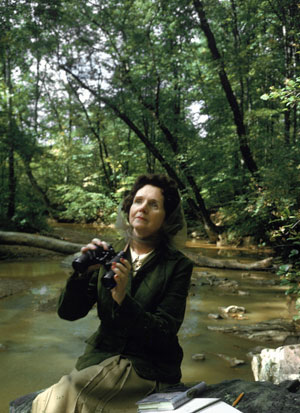

SILENT FUTURE

Rachel Carson and the Creeping Apocalypse

by Freeman House

1.
It must have been in 1970 when I was working with a collective fishing venture in Trinidad, California, that Rachel Carson enrolled me into the school of ecological activism. I was in a period of my life when the affairs of the world seemed so hopelessly screwed up that I had chosen to divorce myself from mainstream culture and work with others to build a world that fit my fallible sense of the proper way to live. We were in the habit of calling our position “building a new culture within the shell of the old.” A less friendly observer of our efforts might describe them as an attempt to escape the grim imperatives of history, and I would not argue.

I did pick up a copy of the San Francisco Chronicle once in a while and in one of them I read of a scientific report that predicted the imminent extinction of brown pelicans in California due to the thinning effect of the insecticide DDT on the eggs of the birds. The article referred to Silent Spring, and made me realize how much I loved brown pelicans.

The collective had acquired a double-ended Newfoundland dory, a pretty craft that bobbed in the water like an eggshell, narrow at the beam and twenty feet long. It had two sets of oarlocks and a place to step a mast near its center. It replaced our former noisy and greasy thirty-foot scow powered by an unreliable diesel engine. With the new boat we could row out in the dawn light to the rockfish holes seaward of the monoliths of stone that rose out of the water a half-mile or so offshore, to get some fishing done before the north winds roiled the water at midday. And then we could raise the sail as we headed for home, skimming into port and luxuriating like people on a pleasure cruise. The quiet on the water was wonderful. Where before we had been isolated from ocean life by a dense aural penumbra of engine-howl, now all the lives of the sea came round to investigate. Seals and sea lions followed us as if we were a carnival show; the gulls circled shrieking about our heads while common murres sped across our bow like very fast windup toys.

In the middle distance always the pelicans. They look like creatures from another age, their overlarge heads stretching forward, heads and beaks that from some angles appear to be larger than their aerodynamic bodies. There is rarely one alone; more often they fly in groups of six to 20. The flocks act as if they have a single mind, so precise and graceful are their formations. The pelicans fly most often in a line, one behind the other, the line rising up and plunging down thrillingly close to the water’s surface in rolling arcs that resemble drawings of a sine wave. But sometimes the birds fly in marvelously sinuous gathered formations, group mind and individual mind working in perfect harmony. The individuals within the group might glide past one another or fall back a bit, but the formation as a whole holds its shape as a mutable polygon, sometimes wheeling as a unit in a 90-degree turn, all white bellies exposed at once, to change direction. It is enough to make you forget the cuts on your hands and live for a moment in the perfect realm of the whole. It is tempting to think that the birds are tracing arabesques against the looming fog bank merely to pleasure our senses, but the pelicans are fishing, too. Perhaps the varieties of formations represent different strategies for different prey.

At the sight of a food fish, all semblance of group mind evaporates as one bird after another drops in twisting free fall, most of them entering the water head first with the perfect verticality of a practiced diver. But some birds belly flop with a huge commotion that can only be described as clumsy. It will take a few moments of shaking the water off their wings and reorienting themselves for the birds to recover their dignity. The sight can make me laugh out loud with empathy, having myself made moves equally indecorous.

Any bird that can move you to awe and, seconds later, make you laugh out loud has intrinsic value enough to burn. I was enraged that a bunch of mad utopians out to rid the world of insects that fit into no economic scheme was inflicting the collateral damage of depriving the world of pelicans. And that is how Rachel Carson, several steps removed, influenced a sense of myself as an ecological being, a reciprocal participant in the surrounding world. It was a sense that would inform the rest of my life.
Continue reading

[SUNDAY LECTURE NO. 4] “Ghost in the System” by Freeman House

Freeman House is a former commercial salmon fisher who has been involved with a community-based watershed restoration effort in northern California for more than 25 years. He is a co-founder of the Mattole Salmon Group and the Mattole Restoration Council. His book, Totem Salmon: Life Lessons from Another Species received the best nonfiction award from the San Francisco Bay Area Book Reviewers Association and the American Academy of Arts and Letters’ Harold D. Vursell Memorial Award for quality of prose. He lives with his family in northern California.”

That’s the biographical note for Freeman House on the Lannan Foundation website. We would add that earlier in his life, Freeman edited Innerspace, a mid-1960s independent press magazine for the nascent psychedelic community; presided over the marriage of Abbie and Anita Hoffman at Central Park on June 10, 1967; and was a member of both New York City’s Group Image and the San Francisco Diggers.

This is the fourth lecture in this series. This series ran previously on this site in 2010-11, and is being rerun now because it’s the right thing to do.

This piece was first published in 2002 in River & Range.


GHOST IN THE SYSTEM
by Freeman House

for John Bennett,
the good dentist

On our raw homestead in the Coast Range, Nina and I were attempting to domesticate a half-acre at the edge of ten acres of upland coastal prairie. We had knocked up a six-foot chicken wire fence, all we could afford at the time, to keep out the many deer that browsed our prairie. The deer had a taste for the new strawberry bed and the young climbing roses we had planted along the fence line. The fence served little purpose but to delay the deer for a week or two until they had discovered how easily they could leap over the strange enclosure. Once they had defoliated the roses and mowed the strawberry plants, they would move on to nibble at the broccoli and lettuce, ever curious. We cut scrap two-by-fours into three-foot lengths and nailed them onto the fence posts at an angle upward and outward, stapled a couple of runs of baling wire around their top ends. The deer stayed on their side of the fence, until, inevitably, someone left a gate open overnight. Without fail one deer would wander in and rediscover her love of rose leaves. We would chase her out in the morning, flapping our arms and yelling. The deer would panic and throw herself against the fence in one place after another until she found the open gates and bounded off. Early on, we assumed that the panic we had instilled would teach the deer a lesson in territory, and that they would avoid our little oasis of green in the summer-dry California prairie. But deer are evidently quickly addicted to rose and strawberry leaves. Once these treats had been rediscovered, the same deer and her cohorts would examine our fence for weaknesses with the intensity of a junkie searching for a connection. Once we saw a doe flat on her belly wriggling under the chicken wire where it lifted nine inches off the uneven ground. For a few years, then, our garden yielded venison at irregular intervals.

The deer were not the only ones who looked on us as new arrivals who were provisioners of exotic snacks. They were the only one of our co-inhabitants on the prairie who shared themselves with us, however; we never developed an appetite for the moles and gophers and raccoons and ravens and quail and slugs who fed freely on our young gardens and orchards. We grew accustomed to the yowling nightly squabbles between the skunks and raccoons over our compost pile. (The skunks would generally win first access. The raccoons didn’t like their stinging spray any more than we did. The raccoons would back off until the skunks had taken their fill and then take their turn at the luscious kitchen garbage, after which they would move on to the strawberries which would have been ripe enough for us to pick on the very next day.)

But we adapted. We planted our artichokes in wire cages to protect them from gophers, having discovered yet another addictive relationship between the ubiquitous soil dwellers and the sweet roots of young artichoke plants. We captured raccoons and skunks in Have-a-Heart traps and trucked them to locations where we thought they might be happier. We covered our newly planted winter gardens with bird netting because the tender seedlings emerged from the ground at about the same time large families of young quail fledged and ranged the dry August prairie with enormous appetites for young greens. We planted more than we needed, coming to understand that if the other residents of the prairie were going to share their habitat with us, we would have to reciprocate by sharing our garden with them. The only alternative to such reciprocity would be to pursue the logical extension of the notions of human control and exclusively owned property. We would have to dig our whole garden area to a depth of two feet or so, cover the subsoil with welded wire to exclude the gophers and moles before putting the soil back to grow our now-secured vegetables and fruits. We would have to build concrete walls sunk an equal distance into the ground and extending eight feet into the air to keep out the raccoons and skunks and foxes and bobcats and deer. Then we would have to cover the whole area with some kind of mesh to keep the fruits and berries safe from a whole sky full of birds. Our fantasies stopped just short of erecting gun towers at the corners of the concrete enclosure. Reciprocity seemed a preferable choice to such a logical demonstration of our singular rights to this corner of prairie.

After seven or eight years, we were providing a lot of our own food, and were becoming comfortable with our new relations. Then, during one particularly dry late summer, some new critters showed up. The new vegetarian was nocturnal, and for a period of several weeks, invisible. But the damage it was doing to the garden and young orchard was dramatic and it had the potential for being terminal. Continue reading

A poem from Oswald James

oswald-james
“So, this place was a morgue?”
by Oswald James

the singer said to silence
it was true
we heard this place was a funeral home
before a bar
earlier in the night
by a fire

silence
the locals seemed offended

Lara had taken up w/ some drifter
a table over
her man,
remarkably patient
bought her another

the band,
all tall and pale
were deep into the desert
and sounded like death
it was the last night of tour

I sat there feeling like a dried out yucca bloom
with a throat full of agave
every eye in the room
gazed upon the goddess on bass
until she stared back
and moved the place to envy or lust

under the icy stars
we rode out with the tumbling weeds
and wondered, “what next?”

Oswald James owns and operates Alta Real Pictures, a film/video production company based in Austin, TX

[SUNDAY LECTURE NO. 3] “Afterlife: On the great pulse of nutrients that feeds all of Creation” by Freeman House

Freeman House is a former commercial salmon fisher who has been involved with a community-based watershed restoration effort in northern California for more than 25 years. He is a co-founder of the Mattole Salmon Group and the Mattole Restoration Council. His book, Totem Salmon: Life Lessons from Another Species received the best nonfiction award from the San Francisco Bay Area Book Reviewers Association and the American Academy of Arts and Letters’ Harold D. Vursell Memorial Award for quality of prose. He lives with his family in northern California.”

That’s the biographical note for Freeman House on the Lannan Foundation website. We would add that earlier in his life, Freeman edited Innerspace, a mid-1960s independent press magazine for the nascent psychedelic community; presided over the marriage of Abbie and Anita Hoffman at Central Park on June 10, 1967; and was a member of both New York City’s Group Image and the San Francisco Diggers.

This is the third lecture in this series. This series ran previously on this site in 2010-11, and is being rerun now because it’s the right thing to do.


This piece was first published in Orion magazine, May-June 2003. It received the John Burroughs Award for best natural history essay of 2003.

AFTERLIFE: On the great pulse of nutrients that feeds all of Creation
by Freeman House

with photography by Scott Chambers, 1948-2008

The world is our consciousness. It surrounds us.
Gary Snyder

As an industrial fisherman I’ve taken hundreds, perhaps thousands of salmon lives. I’ve also eaten them—roasted over an open fire, poached with dill sauce, smoked on alder wood, and baked with sweet pepper and tomato. I’ve pursued salmon in the wild for livelihood and food, worked with my watershed neighbors to insure their continued presence in my home river, and written books and essays about them. I am in part a man made of salmon, so it doesn’t seem strange to me now to be pondering their lives after death.

For several months, Scott Chambers’ photographs of salmon, dead after spawning on the Starrigavin River near Sitka, Alaska, have been spread out on my worktable, pinned over whatever blank spaces remain on the walls of my office, and perched on piles of books waiting to be shelved. Their undeniable beauty is not enough to explain their grip on my mind.

Continue reading