MORE SMOKE THAN FOLK: A guide to important Matt Valentine listening experiences through 2012, by Dan Ireton and Byron Coley (Arthur, 2013)

A few important MATT “MV” VALENTINE listening experiences through 2012, assembled by Dan Ireton & Byron Coley and presented in chronological order. Links are to best current (2016) retail or wholesale source for the goods. This article originally published in Arthur No. 34 (2013) as a sidebar to Byron’s interview with Matt.

TOWER RECORDINGS Furniture Music for Evening Shuttles (Siltbreeze SB54 CD + LP, 1998)
Technically, the fourth Tower album, but the one where they really come together into a great stew of kosmische gushery. Someone told me if I liked German stuff I should listen to this. He was right.

TOWER RECORDINGS The Folk Scene (Shrat one-sided 12”, 2000; Communion CD, 2001)
You want the expanded CD reissue version, which is much longer. The vibe here mirrors the best work of those German and Scandinavian commune bands we all loved so much.

TOWER RECORDINGS The Futuristic Folk of Tower Recordings Vol. One & Two (COM CDR, 2002; Time-Lag 2LP, 2004)
Available as CDRs, individual LPs and a double LP (all of ’em limited and fine) this is the record where Tower seems to start really hearing the lessons of Sun Ra’s Arkestra and the AACM. Weird, pointedly obscure and deep.

MATT VALENTINE Space Chanteys (Fringes LP, 2002)
This early solo side, released by an Italian jazz label, has always felt like MV’s version of Astral Weeks (not that you’d confuse his voice with Van Morrison’s). You can hear the door closing on Matt’s New York period. The lyrics are super-personal and the musical arrangements are loose and flowing.

MATT VALENTINE Ragantula (COM 4, 2002; reissued in the COM-Relics series)
My favorite version has a small piece of printed cloth inserted, but that’s extremely rare, so let’s not mention it. This one is thematically linked to Matt’s transition to country life.The lyrics related to the move, and the music has a very rural vibe (even though some was recorded in NYC).

MATT VALENTINE Creek to Creation (QBICO LP, 2004)
The first completely overt hick move. Recorded in Vermont and sounding it. Every inch.

DREDD FOOLE Kissing the Contemporary Bliss (COM 2CDR, 2004; Family Vineyard 2CD, 2008)
Although credited just to Dredd, this is equally Matt’s album. The pair push against the envelope of how free “free folk” could ever get. This also marks the beginning of the Spectra Sound experiments, and sounds a big as the whole outdoors.

MATT VALENTINE & ERIKA ELDER Ragas & Blues — Fantastic String Music (Idea LP, 2004)
I particularly like this version because a few copies came with a screenprinted outer sleeve, which looks pretty great. And the music is an important transition, since this is where country blues starts to seep more obviously into the picture.

MV/EE WITH THE BUMMER ROAD Mother of Thousands (Time-Lag 2LP, 2006)
This marks the beginning of Matt’s heavy electric guitar period. An amazing sprawl of an album and spaced as fuck.

MV & EE WITH THE BUMMER ROAD Green Blues (Ecstatic Peace CD, 2006)
Some people love the way this connects the vocals of Skip James with the guitar of Neil Young, others think it’s just TOO MUCH. Regardless, this one is the first real rock-qua-rock record.

MV & EE WITH THE GOLDEN ROAD April FlowerTour (COM 8-CDR set, 2011)
Great document of some live dates (mostly from April, 2011) representing their annual Spring Fling with UK guitarist Mick Flower. There’s a heavy ruralist rock vibe to most of the action with bursts of lightning purity. More smoke than folk.

MV & EE Country Stash (Three Lobed LP, 2011)
When this one came out, I just said, “Wow.” It was the first album that really seemed to properly reconcile all of the threads Matt has chased. A favorite.

MV & EE Space Homestead (Woodsist LP, 2012)
Then this one came out, and it was even more holistic. Amazing.


AUTOMATIC FIVE STARS

Automatic five stars from Arthur HQ for any mixtape featuring latter-day Talk Talk, like this one…

turquoise-wisdom-aquarium-drunkard

And for the Talk Talk muso/geeks out there (we know who you are), here’s an absolute must-read on the making of those records: Are We Still Rolling?: Studios, Drugs and Rock ‘n’ Roll—One Man’s Journey Recording Classic Albums by Phill Brown

A typically provocative interview with Peter Lamborn Wilson (aka Hakim Bey), author of the T.A.Z. Manifesto, at The Brooklyn Rail

wilson-web1

Click on the portrait of PLW (pencil on paper by Brooklyn Rail mainman Phong Bui) to read the whole interview.

Choice cuts….

PLW on living in Iran in the ’70s:

They asked [playwright Robert Wilson], “We have all this money for you. What do you want to do?” He said, “I want to do a play that lasts for seven days and seven nights.”

On the Arab Spring:

I thought it was absolutely wonderful, it was like a big sigh of relief… But here it is, hardly a year later and already the promise is betrayed. The Islamists and the militarists have taken over again, and you just have to do it all over; that’s pretty depressing and I wouldn’t be surprised if people lost their impetus and weren’t able to keep up the pressure. Now, having said how wonderful I thought it all was, I will point out that…

On the state of America, post-Occupy:

I was beginning to feel that there would never be another American uprising, that the energy was gone, and I have some reasons to think that might be true. I like to point out that the crime rate in America has been declining for a long time, and in my opinion it’s because Americans don’t even have enough gumption to commit crimes anymore: the creative aspect of crime has fallen into decay. As for [Occupy], [an] uprising that takes a principled stand against violence, hats off to them, I admire the idealism, but I don’t think it’s going to accomplish much. I’m sorry to say that, but that is my feeling, despite all the brilliance that’s gone into it…

On uprising:

If you can’t have a revolution at least you can have an uprising. And then there’s this intense life that gets lived for usually no more than 18 months, or sometimes for just a few nights, but at least there can be this T.A.Z. where people live intensely and joyously in each other’s presence: what I call conviviality, living together, which is not to be sneered at.

On technology:

I’ve eliminated certain technologies from my life because I have the luxury to do so. It’s not something I’m prescribing for other people. I don’t have a TV, I don’t have a computer, I don’t have a car. I don’t have a record player, I don’t have a radio in my house. I’m like the Amish. I want it out of my house, but once I’m out of my house I’m probably willing to use these things. You can’t simply cut yourself off completely.

On the triumph of the machines:

We have no viable alternative economic institution that will help us live outside the monster of predatory capital. That doesn’t exist. And it’s the Internet which has facilitated that transition, so I call it the end of the world. On my bad days I believe in it, but on my good days I still try to maintain that history has not really come to an end and that that the possibility still exists that people will wake up and achieve a critique of technology. What is so frigging hard about this? Why are people so hypnotized, why do people think it’s a law of nature that technology has taken over the world to the extent that it has? It’s not natural: It has historical roots, it has economic explanations, and these things can be worked on. They could be changed, but I don’t see any will to it. I don’t see one single Luddite institution. Nobody is working for this. If I were to defend violence I would defend machine smashing over all, which is a total heresy. Nobody smashes machines. They’re sacred.

And so on, with lots more on PLW’s fascinating current art practice. Fantastic stuff, great questions from the Brooklyn Rail team. Read the whole thing here: The Brooklyn Rail

HOUSEKEEPING NOTE

BYRON COLEY, whose work has appeared in every single issue of Arthur ever published, has been named Arthur’s first and only “Senior Writer.”

Now enthroned, he has submitted his first-ever (!?!) cover feature for Arthur: a 10,000-word interview, with 202 sidenotes, that will run in Arthur No. 34, our March 5, 2013.

He will bury us all, and we will like it.

There was a time when this culture was massively interested in something as radical as the Whole Earth Catalog

(via Stephanie Smith…)

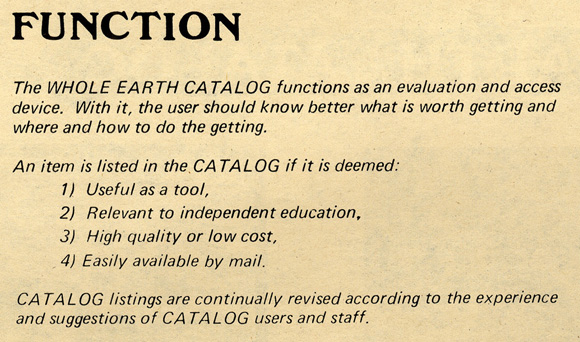
In 1968, Stewart Brand founded the Whole Earth Catalog. Brand’s goals were to make a variety of tools accessible to newly dispersed counterculture communities, back-to-the-land households, and innovators in the fields of technology, design, and architecture, and to create a community meeting-place in print. The catalogue quickly developed into a wide-ranging reference for new living spaces, sustainable design, and experimental media and community practices. After only a few years of publication it exploded in popularity, becoming a formidable cultural phenomenon…

Function

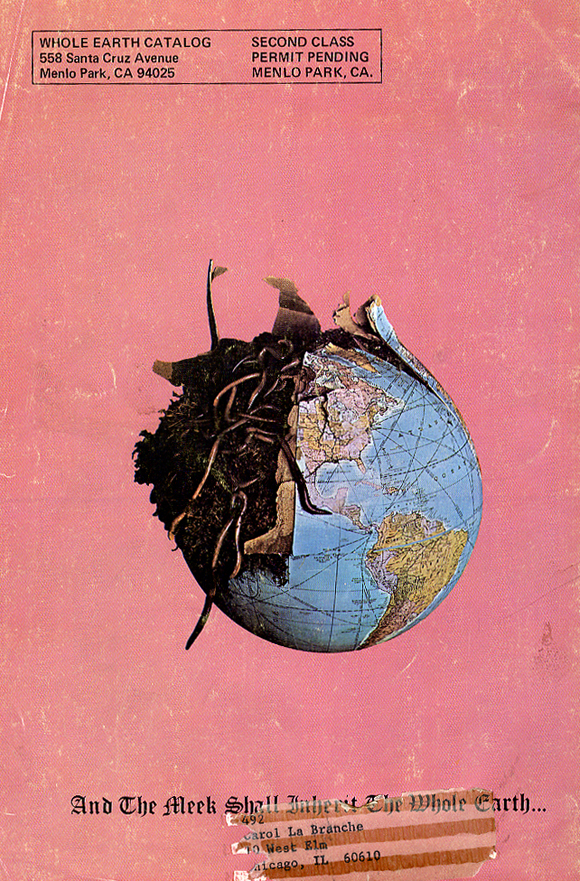
Whole Earth Advert

March 1971 back cover

More more MORE!: MOMA.org

“Google Invades”: Rebecca Solnit on Big Tech’s toll on San Francisco [London Review of Books]

A typically great, nuanced (and sad) piece in the London Review of Books by Rebecca Solnit on life in contemporary San Francisco amidst Google/Apple/Facebook corporate nerd-drones, and what they’ve wrought…

7 February 2013

Diary

Rebecca Solnit

The buses roll up to San Francisco’s bus stops in the morning and evening, but they are unmarked, or nearly so, and not for the public. They have no signs or have discreet acronyms on the front windshield, and because they also have no rear doors they ingest and disgorge their passengers slowly, while the brightly lit funky orange public buses wait behind them. The luxury coach passengers ride for free and many take out their laptops and begin their work day on board; there is of course wifi. Most of them are gleaming white, with dark-tinted windows, like limousines, and some days I think of them as the spaceships on which our alien overlords have landed to rule over us.

Other days I think of them as the company buses by which the coal miners get deposited at the minehead, and the work schedule involved would make a pit owner feel at home. Silicon Valley has long been famous for its endless work hours, for sucking in the young for decades of sixty or seventy-hour weeks, and the much celebrated perks on many jobsites – nap rooms, chefs, gyms, laundry – are meant to make spending most of your life at work less hideous. The biotech industry is following the same game plan. There are hundreds of luxury buses serving mega-corporations down the peninsula, but we refer to them in the singular, as the Google Bus, and we – by which I mean people I know, people who’ve lived here a while, and mostly people who don’t work in the industry – talk about them a lot. Parisians probably talked about the Prussian army a lot too, in the day.

My brother says that the first time he saw one unload its riders he thought they were German tourists – neatly dressed, uncool, a little out of place, blinking in the light as they emerged from their pod. The tech workers, many of them new to the region, are mostly white or Asian male nerds in their twenties and thirties; you often hear that to be over fifty in that world is to be a fossil, and the two founders of Google (currently tied for 13th richest person on earth) are not yet forty.

Another friend of mine told me a story about the Apple bus from when he worked for Apple Inc. Once a driver went rogue, dropping off the majority of his passengers as intended at the main Apple campus, and then rolling on towards San Jose instead of stopping at the satellite location, but the passengers were tech people, so withdrawn from direct, abrupt, interventionary communications that they just sat there as he drove many miles past their worksite and eventually dumped them on the street in a slum south of the new power centre of the world. At that point, I think, they called headquarters: another, more obedient bus driver was dispatched. I told the story to another friend and we joked about whether they then texted headquarters to get the email addresses of the people sitting next to them: this is a culture that has created many new ways for us to contact one another and atrophied most of the old ones, notably speaking to the people around you. All these youngish people are on the Google Bus because they want to live in San Francisco, city of promenading and mingling, but they seem as likely to rub these things out as to participate in them.

The Google Bus means so many things…

Continue reading: London Review of Books