Al Cisneros of Om (and Sleep, and Shrinebuilder) put so much work into this compilation — curating and carefully sequencing a wide-ranging selection of tracks, going over the mix and master four times to make sure it was perfect — for so few people to know about it. Chalk it up to unfortunate timing (2009 was a very rough year). We have a couple hundred copies left of the first (and only) printing. Cover artwork by longtime Cisneros collaborator and Arthur contributor/ally Arik Roper. $8 US. Track listing and order info: http://bit.ly/GZukmf
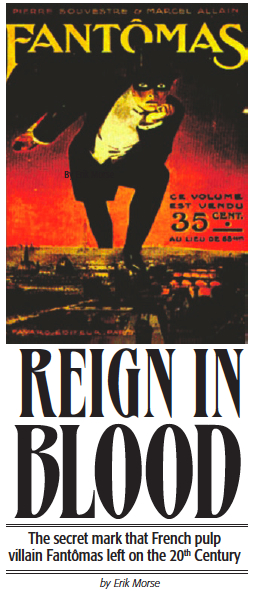
The secret mark that French pulp villain Fantômas left on the Twentieth Century
By Erik Morse
Art direction by Mark Frohman and Molly Frances
Originally published in Arthur No. 28 (March, 2008)
Early in 1911 popular French publishing house Fayard released the first of 32 monthly serial novels of Marcel Allain and Pierre Souvestre’s Fantômas. Subtitled ‘A Shadow on the Guillotine,’ this ultra-violent pulp tale recounted the exploits of the eponymous master villain as he reined blood and magick upon the boulevards of Paris. Pursued by police inspector, Juve, and his journalist sidekick, Jerome Fandor, Fantômas slaughters members of French high-society indiscriminately before stealing away with their wealth and, often, their very identities—in his travels between the Dordogne and Paris, Fantômas dispatches the Marquise de Langrune, her steward Dollon, Lord Beltham, Princess Sonia Danidoff, the famed actor Valgrand and a passenger liner full of travelers en route to South America. When Fantômas, alias Etienne Rambert, alias Gurn, is apprehended by Juve at Lady Beltham’s villa, he is brought to trial at the Palais de Justice, found guilty of murder and condemned to the guillotine. However with the aid of his mistress, Fantômas steals away from his Santé prison cell and fills the vacancy with an unsuspecting look-a-like who is left to the blade. When Juve discovers the ruse, he proclaims, “Curses! Fantômas has escaped! Fantômas is free! He had an innocent man executed in his place! Fantômas! I tell you, Fantômas is alive.”
Within months of its February debut, the Fantômas serial became a pop smash with the reading public, profiting no doubt from the French public’s unquenchable thirst for violence, mayhem and pulp. At 65 centimes a copy, sales for each volume reached easily into the hundreds of thousands. American poet and Fantômas enthusiast John Ashbery contends that the real success of the serial was its transcendence of class, education and sex, from “Countesses and concierges: poets and proletarians; cubists, nascent Dadaists, soon-to-surrealists. Everyone who could read, and even those who could not, shivered at posters of a masked man in impeccable evening clothes, dagger in hand, looming over Paris like a somber Gulliver, contemplating hideous misdeeds from which no citizen was safe.” Such was the popular reaction to the Fayard publication, Marcel Allain would later recall, with some hyperbole, “The adventures of Fantômas have surpassed those of the Bible.”
Nearly a hundred years later, we can see the frightening metastasis of the master of crime’s “brand”—from his beginnings amongst the Right Bank sophisticates who released him upon the world, to the marauding gangs plundering and murdering in his name, to the sacrificial cults who would congregate at the witching hour to reenact his sins. His trangressions—bold, fiendish and inexplicable—were the narratives of nightmares. Fantômas captured the imagination of his admirers and extended his influence through the artistic genealogies of Europe, leaving a catechism of excess, debauchery and violence to a brood as varied as Pablo Picasso, Andre Breton, Jean Cocteau, Georges Bataille, Alain Robbe-Grillet, James Joyce, Guillaume Apollinaire, Robert Desnos, Jean Marais, Alain Resnais, René Magritte, Francois Truffaut; and the Mike Patton-Buzz Osbourne-Trevor Dunn-Dave Lombardo art-rock superband of the same name. In their major contributions to the century, the words and deeds of France’s supreme villain pullulate still more revolutionary achievements and still darker crimes.
Here, in this extended fait-diver, is the unedited, uncensored and untold history of the criminal of the century.
Author VANESSA VESELKA has won the 2012 PEN/Robert W. Bingham Prize for her novel Zazen, serialized on Arthur’s website during 2009 and published by Red Lemonade in 2011.
“When practicing zazen, the disposition of our mind should be to see without being marred by what we see. This definition stands in stark contrast to the experience of reading Vanessa Veselka’s keen dystopian novel Zazen: we can’t help but be injured and destabilized. We can’t help but find the contents at once disturbing and funny, explosive and muted, encyclopedic, intimate, and painfully honest. On top of all this, Veselka has thrown herself into every single sentence of this lyrical, incisive, nervy book, turning even the most nightmarish scenes and satirical dialogue into effortless beauty. An ambitious encapsulation of our modern times, Zazen tackles counter-culture hipsters, geology, Buddhism, consumerism, terrorism, veganism, family drama, and, above all, love. In doing so, Zazen brings to the foreground the most fragile aspects of living the 21st century life, and how, in the end, we as a society can become the very thing we fear.”
The PEN/Robert W. Bingham Prize honors an exceptionally talented fiction writer whose debut work—a novel or collection of short stories—represents distinguished literary achievement and suggests great promise. The winner receives a cash award of $25,000, a stipend intended to permit a significant degree of leisure in which to pursue a second work of literary fiction. The winner is also encouraged to become an active participant in the PEN community and its programs.
2012 Judges: Lauren Groff, Dinaw Mengestu, and Nami Mun.
Past winners: Carolyn Cooke, Matthew Klam, Manil Suri, Jonathan Safran Foer, Monique Truong, Will Heinrich, Christopher Coake, Janna Levin, Dalia Sofer, Donald Ray Pollock, Paul Harding, Danielle Evans, and Susanna Daniel.
Terry Riley and Pandit Pran Nath relaxing at the Houston Astrodome, 1981.
Photo courtesy Marcus Boon. Originally published in Arthur No. 22 (May 2006) to accompany the 5-page article “Master of Breath: The life, work and inspiration of Pandit Pran Nath, guru to Western minimalists La Monte Young and Terry Riley” by Peter Lavezzoli, an excerpt from his book The Dawn of Indian Music in the West. Arthur No. 22 is available for $5 from the Arthur Store
From a 2010 conversation with Hakim Bey (aka Peter Lamborn Wilson) by Hans Ulrich Obrist at e-flux:
“l call it vanishing art, which means that the art comes into existence in the very moment that it disappears. For example, the first piece I did involved throwing gold rings into a river—like the ancient druids used to do. Each of these works is based on a place in the region where I live, and each one is based on a historical event or person that I find inspiring, either because they were mystical or revolutionary, or for some other reason. In each case I find a way to do an artwork that vanishes, either immediately or over the course of a few days. I have plenty of plans for other ways of doing this, but so far I’ve been throwing things into water and burying things. In the future I’ll be burning a lot of things as well. I want to get into pyrotechnics.
“And then in each case, I make a map similar to the one that you have, using collage, which is meant to be a sort of magical manipulation of the toposphere, of the map world, the image of the place. I use photographs and found objects and so forth to make these, and I also keep a box of documentation for each one, with photographs, drafts, essays, poems, souvenirs, and so forth. So even though the art disappears, the map and the box remain behind as a record of the work.
“[This one] originated as a nineteenth century Hudson River navigation chart. The important place there is Esopus Island, which is where Aleister Crowley camped out in 1918. I visited it with William Breeze, who is the official representative of Aleister Crowley’s occult and literary remains. He’s the literary executor, and he’s also the head of the Ordo Templi Orientis, which is the occult lodge that Crowley left behind. So Bill Breeze and I hired a sailboat for the day and went to that island and explored it. We had a nice time, came back, had a nice dinner, and that was pretty much the start of this whole series of works. I realized that I’ve been living up here and studying the local history for ten years, and I don’t know what to do with all this material about this place where I live. I didn’t want to turn it into some stupid guidebook for tourists. I didn’t want to turn it into a stupid academic book for an academic press. So for now I’m putting all this historical and topological knowledge into these works I make in a very private way, just for friends. Maybe sometime I will have an exhibition of the maps. But I would like to wait a year or so, until I’ve really got a good, solid collection before doing something like a gallery show. So next year, God willing, I’m going to do another seven or eight of these works, and that might be enough to start thinking about doing a show. But in the meantime I sort of like the idea that it’s private and secret, driven by word of mouth and magical influences rather than publication or publicity.”







 Arthur Magazine