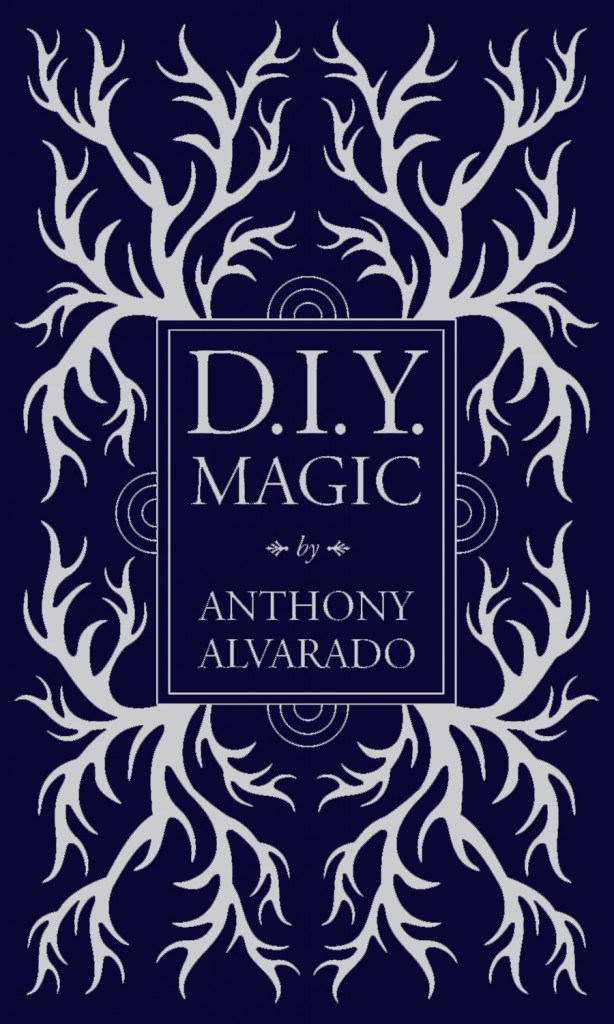
D.I.Y. MAGIC by Anthony Alvarado 40 b&w illustrations, cover design by Lord Breaulove Swells Whimsy First edition letterpress silver foil cover limited to 1000 copies, 176 pages, 5″ x 8″, $13.95 Shipping $5.30 US, $11 INTL, $8 CANADA Now available to order
What is magic? It is the fine and subtle art of driving yourself insane! No really, it is just that. It is a con game you play on your own brain. It is the trick of letting yourself go crazy, and when it’s done right, the magus treads the same sacred and profane ground where walks the madman…
We can read descriptions of myths, of the practices of shamans, but the descriptions we might read by a Pentecostal believer, or a voodoo practitioner ridden by the loa, will be meaningless to us unless we have already been in the state they describe. These are wholly subjective experiences.
If you take these many practices, from across countless fields, cultures, religions, modes of being and systems of ritual (hypnosis, song and dance, duende, speaking in tongues, enchantment, faith healing, divination, out of body experience, sweat lodges, drumming, yoga, drugs, fever and on and on), we find that we are really talking about the same thing: a state where the mind lets go of the normal way of being and is opened up to an experience of existence as a whole that is bigger and without time. These states are all really different forms of the same thing, or if not the precisely the same thing, then near and adjacent territories in a realm that lies parallel to this one, reachable by many means.
In short, rather than advertise this as a book of magick, it could just as well have been labeled a book of psychology hacking. Or a cookbook. Think of it as jail-breaking the iPhone of your mind. Teaching it to do things that its basic programming was never set up for. Advanced self-psychology.
Featuring over 40 b&w illustrations by: Lala Albert, Farel Dalrymple, Ines Estrada, Maureen Gubia, Kevin Hooyman, Dunja Jankovic, Aidan Koch, Jesse Moynihan, Luke Ramsey, Ron Rege Jr. & more!
“What makes this book vastly different from many other books on magic is that there’s no doubt in my mind that the author has actually done the things that he says he has. What’s more is that he has derived a great deal of pleasure and meaningful experience from the doing. And, so will you.” – Aaron Gach, Center For Tactical Magic
“Anthony Alvarado has concocted a cookbook for vivid living: poetry that’s lived rather than written. His “spells” are actually practical suggestions by which the reader may coax the extraordinary from the everyday—and from themselves.” – Lord Breaulove Swells Whimsy, author of The Affected Provincial’s Companion
“Few books are as immediately useful as this delightful, inspirational tips ‘n’ tricks tome. I’m having a backyard betel nut party in five minutes and everyone’s invited!” -Jay Babcock, editor of Arthur Magazine
This piece was originally published in Arthur No. 13 (Nov. 2004), with cover artwork by John Coulthart and design by William T. Nelson, pictured above (click image to view at larger size). A correction involving Cosmic Charlie published in a later issue has been embedded in the text here at the most natural point. I’m sorry that I’ve been unable to include the many fantastic photographs from the print article here. However, I have added a still from the film “Will the Real Norman Mailer Please Stand Up” by Dick Fontaine, which we did not have access to at the time of print publication into the text, and there are more stills from various films appended. —Jay Babcock
Clip from Arthur No. 13’s Table of Contents page, featuring photo by Robert A. Altman.
OUT, DEMONS, OUT!
On October 21, 1967, the Pentagon came under a most unconventional assault.
An oral history by Larry “Ratso” Sloman, Michael Simmons and Jay Babcock
* * *
INTRODUCTION BY MICHAEL SIMMONS By Autumn of 1967, the “police action” in Vietnam had escalated. The United States of America waged War—that hideous manifestation of the human race’s worst instincts—against the small, distant, sovereign land. 485,600 American troops were then stationed in Nam; 9,353 would die in ’67 alone. We were there under false pretenses (the “attack’ at the Gulf of Tonkin that never happened), operating under a paranoid doctrine (the Domino Theory, fretting that Vietnamese Communists fighting a civil war in their own country with popular support would envelop all of Southeast Asia and end up invading Dubuque, Iowa). Seven million tons of bombs would eventually be dropped, as opposed to two million during World War II. Indiscriminate use of gruesome weaponry was deployed, most infamously napalm, a jelly that sticks to—and burns through—human skin. Saturation bombings, free-fire zones, massive defoliation with the carcinogen Agent Orange. “Destroying the village to save it,” as one American military man put it.
For a generation that remembered the Nuremberg Trials of Nazi war criminals after WW II, something had to be done. Genocidal fugitive Adolf Eichmann’s “I was just following orders” excuse would not fly. The draft was sending 18-year-olds off to die. A domestic anti-war movement emerged, as had a counterculture of hairy young people who rejected the militarism, greed, sexual repression, and stunted consciousness of their parents and leaders to pursue Joy and Sharing as well as Dope, Rock and Roll, and Fucking in the Streets. Pundits spoke of The Generation Gap. A quaking chasm had split the nation.
San Francisco painter Michael Bowen had a dream of people coming together to celebrate his city’s burgeoning hippie subculture, and so he and his wife Martine initiated the Great Human Be-In on Sunday, January 14, 1967. Sub-billed as A Gathering of the Tribes, 10,000 hippies, radicals and free spirits convened in Golden Gate Park. Beat poets emceed (Allen Ginsberg, Gary Snyder, Michael McClure, Lenore Kandel), rock bands rocked (Grateful Dead, Big Brother & the Holding Company, Quicksilver Messenger Service, the Charlatans), Hell’s Angels returned lost kids to their mommies – and the cops busted no one, despite rampant open marijuana use. For many, the realization that there were other Martians was transcendental. Berkeley anti-war activist Jerry Rubin gave a speech, but his narrow political rap was dubbed “too histrionic” by Ginsberg and many in the crowd. It fortuitously forked Rubin’s direction. “It was the first time I did see a new society,” he said later. “I saw there was no need for a political statement. I didn’t understand that until then, either.”
Events ending with the suffix “In” became the rage. Bob Fass hosted the hippest radio show in the country, “Radio Unnameable” on New York’s WBAI. The all-night gab-and-music fest was Freak Centra, functioning as a pre-internet audio website. Regular guests included Realist editor Paul Krassner (dubbed “Father of the Underground Press”), underground film director Robert Downey Sr. (father and namesake of…), actor/writer Marshall Efron (arguably the funniest man on the planet), and a manic activist-gone-psychedelic named Abbie Hoffman—all rapping madly, verbally riffing and improvising like musicians. One night after participating in a UsCo avant-garde multi-media show of projections, movies, music, etc., at an airplane hangar, Fass stopped by nearby JFK International Airport and noticed a group of three dozen young people—clearly ripped to the tits—communally entranced by a giant mobile centerpiecing a terminal. The vast open spaces of an airport, with jet planes and stars in the sky, were the stage for dreams to come to life. Fass flashed on the infinite possibilities.
He conceived a Fly-In at JFK and announced it on Radio Unnameable. Though Saturday night, February 11, was freezing cold, 3,000 of the underground’s finest came to sing Beatles songs, torch reefers, dance the body electric, and groove with their sisters and brothers. “One of the things that happened,” Fass observed, “was that there was such a colossal amount of human connection that there was something akin to feedback that happened, and people really began to experience not ‘happiness,’ but Ecstasy and Joy. We’re planning another one at your house.”
New York responded to San Francisco’s Be-In with its own. Key to its success was Jim Fouratt, a young actor who’d become one of the most effective hippie organizers on the Lower East Side. Promotion for the event cost $250, which paid for posters and leaflets. On Easter Sunday, March 27, 10,000 full and part-time hippies came together—some in the carnal definition—at Central Park’s Sheep Meadow. It was a glistening, no bad vibes, lysergic day. Fouratt was central to virtually every NYC hip community event, including the infamous Soot-In at Consolidated Edison, where he, Abbie Hoffman, and others dumped bags of nasty black soot at the coal burning, energy company’s offices, in a protest that prefigured and influenced the birth of the environmental movement.
Emmett Grogan was a brilliant and enigmatic prankster/con man at the heart of San Francisco’s do-goodnik anarcho-rogues the Diggers. He suggested to his friend Bob Fass that a Sweep-In would strengthen the momentum the Fly-In had sparked. The idea was to “clean up the Lower East Side” area of NYC where the hippies dwelled. Fass conspired with Krassner and Abbie and listeners on his radio show, and they chose Seventh Street, where Krassner lived. The buzz grew louder and one day an inquiring bureaucrat from the Sanitation Department called Radio Unnameable. The potentates of garbage at City Hall were nervous about these beatniks with brooms taking their gig. While appearing cooperative on the phone and in a later meeting, the city pranked the pranksters on the day of the Sweep-In, April 8. When thousands of mop-wielding longhairs appeared at 11 a.m., they beheld a garbage-free, sparkling fresh, squeaky clean street of slums—courtesy of the Sanitation Department. Fass and Krassner were amused that they’d actually forced the city to do its job. Unfazed, they moved the Sweep-In to Third Street. When a city garbage truck turned the corner, the street peeps leaped on it and cleaned it as well.
No single human—other than Tribal Elder Allen Ginsberg—was as influential on this emerging culture than Ed Sanders. He led the satirical-protest-smut-folk-rock band The Fugs with East Village legend Tuli Kupferberg, ran the Peace Eye Bookstore (and community center) on 10th Street, published Fuck You: A Magazine of the Arts, made films like Mongolian Clusterfuck, wrote poetry, rabble roused for myriad peacenik causes and cannabis legalization. Sanders—one of the first public figures to live seamlessly within realms of Politics, Art, and Fun—was a first cousin to Che Guevara’s paradigmatic New Man—albeit thoroughly American and anti-authoritarian.
But the Life Actor who embodies the Revolutionary Prankster in 20th-century history books is Abbie Hoffman. And he is where our story begins…
For the final episode of Arthur Radio we bring you a live set by Baltimore’s Lower Dens, filmed and recorded in glorious hi-fi at Swan 7 Studios in Bushwick, Brooklyn, co-presented by Newtown Radio | Swan 7 Studio Sessions, and cushioned by an excerpt from a 5 hour DJ set recorded one joyous night in the depths of winter by Hairy Painter, Ivy Meadows and friends, re-broadcasted and cycled through a tunnel of radio feedback last week in the Newtown Radio studio.
We would like to say THANK YOU to the many guests who have graced the show with their talents (in backwards chronological order): Lower Dens, Salvia Plath, Gustav Ernst, Bryce Hackford, Laurel Halo, Saadi, Evie Elman, Mountainhood, kA, Mia Theodoratus, Spectre Group, A R P, Alice Cohen, Sonny Smith, Messages, Ami Dang, Ramble Tamble, James Ferraro, Up Died Sound, Prince Rama, Thomas (Ted) Rees, Nonhorse, The Beets, DJ Ron Like Hell, Gabe Soria, Bow Ribbons, Love Like Deloreans, Blondes, Overture Brown, Bobby Bouzouki, Excepter, The Holy Experiment, Visitation Rites, Chocolate Bobka and Tyler McWilliams. All episodes can be found in the Arthur Radio archive.
Ivy Meadows will continue to record radio shows with Arthur’s universal mutant Will S. Cameron, to be released in a similar format over at Perfect Wave Magazine.
Arthur ran a two page sample of Steve Aylett’s bizarro masterpiece in one of their back issues and I thought it was hilarious. Years later after opening my own comic shop I contacted Steve to see about reprinting THE CATERER in vintage comic form. I also emailed Jay and mentioned the project to him. A lightbulb must’ve gone on in Jay’s head. He put together that I was the publisher of Diamond Comics, a free comics newspaper anthology and he emailed me a few weeks later asking if I’d like to be comics editor for Arthur Magazine.
In the years since we’ve published work by dozens of incredible artists, interviewed folks, shared trippy animation and hopefully given a sense of what’s good and interesting in the international art comics scene. Will started collaborating with me later and introduced the full screen Greenermags format which I really dig.
We’re going to transfer all the Arthur Comics to my store’s website and I plan on curating more “Arthur Comics” there in the future.
I want to thank all the wonderful poets who allowed us to post their poetry on Arthur while I was the Poetics Editor. I had a wonderful time reading the work and comments and helping bring a poetic flavor to the content posted here. Many people asked me how I was chosen for this position and I tell them it was my resume. When asked to provide more color I refer them to my resume which I’ve posted here.
Thanks to everyone for a great ride into the world of Arthur poetry.
Probably the first private individual to manufacture LSD, Augustus “Bear'” Owsley Stanley III produced more than1.25 million doses of LSD between 1965 and 1967. Stanley was the grandson of one-time Kentucky governor and senator Augustus Owsley Stanley. He served in the U.S. Air Force for 18 months, studied ballet in Los Angeles and then enrolled at UC Berkeley. In addition to producing and advocating LSD, he adhered to an all-meat diet. His pioneering role made the name “Owsley,” a popular slang term for the drug. Also an accomplished sound engineer, Bear was the longtime sound man and financier for psychedelic rock band the Grateful Dead. Stanley designed some of the first high-fidelity sound systems for rock music, culminating in the massive “Wall of Sound” electrical amplification system used by the Grateful Dead in their live shows, at the time a highly innovative feat of engineering. Hendrix’s song “Purple Haze” was reputedly inspired by a batch of Stanley’s product, though the guitarist denied any drug link. The ear-splitting psychedelic-blues combo Blue Cheer took its named from another batch. He was involved with the founding of high-end musical instrument maker Alembic Inc and concert sound equipment manufacturer Meyer Sound.
Along with his close friend Bob Thomas, he designed the Lightning Bolt Skull Logo, often referred to by fans as “Steal Your Face”. The 13-point lightning bolt was derived from a stencil Stanley created to spray-paint on the Grateful Dead’s equipment boxes.
A naturalized Australian citizen since 1996, Stanley and his wife Sheilah lived in the bush of Far Northern Tropical Queensland where he worked to create sculpture, much of it wearable art. Bear moved to Australia in the 1980s after growing convinced that the northern hemisphere would be subsumed by another ice age and sold enamel sculptures on the Internet. He was killed when the car he was driving swerved off a highway Saturday during a storm and down an embankment into a tree. His wife, who was with him in the car, suffered minor injuries. He is survived by two sons and two daughters by four different women; Peter (1957), Nina (1962), Starfinder and Redbird (1970).
“Just because it is totally dark does not mean there is nothing to see.”
Maria Sputnik does the pictures. She’s been living in New York studying science writing and thinking about chromosomes and the moon. She misses Oregon. Van Choojitarom collaborated on the writing. He’s in Bangkok preparing to join a monastery. — Jason Leivian
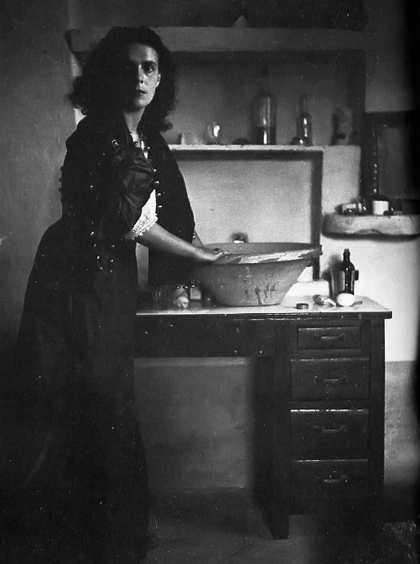
This poem by Peter Lamborn Wilson was published as a letter to the editor in the final issue of Arthur, No. 31 (Oct 2008). It was in response to the piece by Alejandro Jodorowsky in the previous issue, an excerpt from his newly translated memoirs, The Spiritual Journey of Alejandro Jodorowsky, detailing his informal apprenticeship to Leonora Carrington in Mexico City in the late ’50s…
FOR LEONORA CARRINGTON
# 1 Mexico City is absolutely. Or was. With a claridad that would’ve seemed glossy as bone except for the fecality of its plutonian fruit. Especially Leonora Carrington – the secret hardness of colonial baroque – its refusal to be reasonable – its crown of owls
#2 Chocolate is Mexico’s great contribution to Surrealism. With unbroken incantations in the voice of a lion prepare (on wild rocks) a soup made of half a pink onion, a bit of perfumed wood, some grains of myrrh, a large branch of green mint, 3 belladonna pills covered with white swiss chocolate, a huge compass rose (plunge in soup for one minute) Just before serving add Chinese “cloud” mushroom which has snail-like antennae & grown on owl dung
#3 As modern Hermeticist she ranks with Fulcanelli a Madame Paracelsa who tells yr fortune in the sense of buried treasure. It seems you yourself have psychic gifts which are only exacerbated by her soups. Molé as Dalí realized surrealizes all dishes via its resemblance to excrement e. g. over boiled lobsters (serve with pink champagne). Shit you can sculpt.
#4 Like gunpowder which was invented solely to exorcize demons – a secret passed along the Silk Road to Roger Bacon who unfortunately leaked the recipe to the uninitiated – Carrington embodies both the siesta & the anti-siesta. A Madam Adam with a handcranked gramophone with a horn lacquered black with gold pinstriping that plays only beeswax cylinders of Erik Satie or Gesualdo. Here alone exile attains an elegance & impassibility known only to stoned Rosicrucians.
#5 To live absolutely. A tricky trajectory between clinical dementia & the sloppy lace curtain Irish kitchen gemütlichkeit that usually passes (present company excepted of course) for life outside literature & even for true love. Or else it’s the altitude — mushrooms & chocolate — under the asphalt the bloodsoaked landfill — cactus cowskulls & drunken fusillades of flowers.
HIGH FIVE Detroit’s visionary MC5 receive a film tribute that aims to rewrite rock history By Steffie Nelson
On New Year’s Eve, 1972, the MC5 took the stage at Detroit’s Grande Ballroom, a vast psychedelic venue where they’d held court as the “house band” between 1966 and 1969. Their live shows had been so incendiary, the five band members so arrogant, that even a huge star like Janis Joplin, no slouch in the live department, once refused to go on after them. This gig, their swan song as it were, was sloppy and dispassionate; the ghosts of past glories even more unforgiving than the sparse, cynical crowd. Guitarist Wayne Kramer took off mid-performance to go cop dope, and the MC5 never played again. Kramer and guitarist Fred “Sonic” Smith were 22; singer Rob Tyner and drummer Dennis Thompson were 24; bassist Michael Davis was 26. In the end they’d effectively been “pulled apart by the killer forces of capitalism and competition,” which their manager John Sinclair had railed against, perhaps presciently, in the liner notes to their now-legendary debut album Kick Out The Jams.
The MC5 hold a curious place in rock history. Their ascendance represented a moment in America when art and commerce converged, when all that was vital and visceral was also the pinnacle of hip. As the flamboyant and badass musical mouthpiece of the White Panther Party, the MC5 did embody the soul of the late ‘60s counterculture: one foot in the optimistic past and the other in the disillusioned, deadly future; one hand holding a guitar, the other a shotgun. It’s an irresistible image, one which was unappetizingly co-opted by Levis last spring for a series of T-shirts. A promotional performance in London by the three surviving Five (Rob Tyner suffered a fatal heart attack in 1991; Fred Smith died of heart failure in 1994) was seen by detractors as a final, sad sellout.
The question of whether or not the MC5 failed at the end of the day is much debated in the riveting feature-length documentary MC5: A True Testimonial, directed by David Thomas and produced by Laurel Legler. All parties agree, however, that for a fleeting, incandescent moment the MC5 were “at the center of the yin-yang,” as Michael Davis philosophizes in the film, “and it was our job to keep it going in a positive direction.”
But the proverbial yin-yang was already spinning into darkness, and it took the MC5 with it. Like fireworks on the fourth of July, they rose with a bright, beautiful bang and, as far as mainstream America was concerned, disappeared with a puff of smoke into the night. They were, ultimately, sacrificial – the artistic entity that was the MC5 didn’t survive more than seven years—but their legacy has continually inspired legions of punks, rockers, artists and freaks, who got turned on to their music through word-of-mouth, or more than likely though the persistent echo of a call to arms that rings with timeless resonance: “kick out the jams, motherfucker.”
As David Thomas says, “The people who know, know. The other people don’t get it.” The Chicago-based Thomas and his wife Laurel Legler began working on MC5: A True Testimonial in 1995, spurred on through financial troubles and licensing hassles by sheer love and respect and the determination to do justice to these American legends. As Legler points out, few bands have received this sort of filmic treatment, and if they have their way MC5: A True Testimonial will revise rock history. On the eve of a limited theatrical release and the worldwide release of a nearly four-hour DVD edition of the film (including deleted scenes, complete live performances, interview outtakes and fan testimonials), David Thomas and Laurel Legler are ready to testify.





 Arthur Magazine
