THE SARAGOSSA MANUSCRIPT FINDS ITS IDEAL FORMAT

From LAWeekly:

The Saragossa Manuscript

The scene-selection menu has never been more useful than on the DVD for The Saragossa Manuscript (1965), an Arabian Nights-style tale directed by Polish filmmaker Wojciech Has. Here, the menu does’t simply help you navigate the three-hour film, its 44 chapter titles help make sense of a hypnotic, convoluted plot. Based on a 17th-century novel by Jan Potocki, The Saragossa Manuscript takes the flashback to quantum extremes with stories told within stories told, in turn, within other stories until we’re lost along looping tunnels of time through what appears to be an infinitely expanding universe — and a haunted one, at that. After a brief framing prologue, in which soldiers discover a dusty tome, we take up the travails of Alphonse van Worden (Zbigniew Cybulski), a Spanish army captain whose journey to Madrid ends up on permanent hold after two spellbinding Moorish princesses put the zap on him. Suddenly unable to travel beyond the cragged mountains where he spent the night, van Worden wanders a countryside populated by ghosts and littered with spiritualist imagery. Skulls, mysterious rock formations, tarot-card tableaux and cabalist signs surround him, all within Has‚ fun-house framing. When he finally finds refuge in a castle, a Gypsy chief opens the rabbit hole of stories in which magic and mysticism play a role in every tale and every tale holds a fatalistic clue to Worde’s predicament — if he can only sort them out. The Saragossa Manuscript gained an unlikely countercultural following in the 1970s as a good film for long trips. But while you may not need drugs to enjoy it, you should still keep the remote handy so you can find your way back. —Paul Malcolm

NEW FILTH FROM GRANT MORRISON

THE FILTH #1

Written by Grant Morrison;
art by Chris Weston and Gary Erskine; painted cover by Carlos Segura


In stores June 5.

Grant Morrison’s new, top-secret series for VERTIGO is here.  Get ready for the heady brew of psychedelia that you‚ve come to crave from the fan-favorite writer of New X-Men.  Prosthetically-outfitted dolphins in scuba gear, a hard-smoking chimpanzee who dresses like a guard at the Kremlin and some cryptic pronouncements that something sneaky is going on right under our very noses is just the
beginning of the world-class weirdness to come.

Morrison‚s return to VERTIGO with this 13-issue maxiseries guarantees readers the heady brew of big
ideas, exotic locales and bizarre action that they‚ve come to crave from the fan-favorite writer.  Fans have had their imagination rocked by his previous groundbreaking works such as ANIMAL MAN, DOOM PATROL and THE INVISIBLES, and watched as the writer helped reinvent and revitalize JLA and X-Men.  Now, joined by the stunning visuals of penciller Chris Weston (Ministry of Space, THE INVISIBLES) & inker Gary Erskine (THE AUTHORITY), Morrison‚s new series THE FILTH shows all the signs of an instant classic.  And speaking of notable art, the covers by progressive designer Carlos Segura stretch the boundaries of what has been previously seen, continuing VERTIGO‚s commitment to cutting-edge comics.

You‚ve seen the images.  You‚ve heard the buzz („THE FILTH is everything I can’t do in a mainstream
comic like X-Men,‰ says Morrison).  The time for THE FILTH is now. What does all this have to do with the Way We Live Today?  Want to know more about THE HAND and STATUS: Q?  That would be telling?  And our lips are sealed until June 5th!

THE FILTH is a 13-issue VERTIGO maxiseries edited by Karen Berger and is suggested for mature readers.  The 32-page issue #1 arrives in comic-book stores June 5 with a cover price
of $2.95 U.S.”

CORPORATE ROCKIN’

FROM CNN.COM:

Corporate anthems find Web fans
April 3, 2002 Posted: 9:47 AM EST

LONDON, England – Corporate songs, once the private embarrassment of the board room, have emerged as a cult musical genre with hundreds of thousands of devoted fans.

Through the Web the little-appreciated songs attracted previously unheard of popularity with firms including Deutsche Bank and IBM vying to top the charts.

More than 6,000 people downloaded this week’s chart-topper McKC from German-based McKinsey & Company.

Other top 20 anthems included KPMG’s “Our Vision of Global Strategy,” which has inspired a Nokia ring-tone, PricewaterhouseCoopers’ two songs “Your World” and “Downright Global,” and IBM’s “Ever Onward.”

The motivational company hymns were made popular last year by 23-year-old Chris Raettig, a London-based Web programmer, who created a site to chronicle other examples after he came across KPMG’s song.
    
A week after launch, Raettig’s site of corporate-cringe had attracted 200,000 visitors. The site continued to receive company anthems.


Raettig told CNN: “There was often rivalry between different companies over which song was the worst — especially between PricewaterCoopers and KPMG.”

“Some companies claimed the songs weren’t their official anthems but no firm asked to be removed from the site.”

As public demand soared, the project was taken over by technology-news Web site ZDNet last week.

“IT Anthems” — “Corporate Anthems” was renamed by ZDNet as all songs were from tech companies — initiated a Top 20 according to number of downloads for each anthem.

In the past week song downloads, from companies including Ericsson and PricewaterhouseCoopers,
have trebled the total bandwidth taken up by ZDNet’s British Web site.


ZDNet news editor Matt Loney said some songs are made by small departments as lighthearted entertainment, while others are created by management with high production values.

“In general the songs reflect managements’ poor sense of reality. Above a certain level in any company, executives operate in an environment where reality doesn’t intrude very much,” he told CNN.

“The songs are popular because they are generally awful. People download them for a cringe.”

McKinsey officials were reluctant to discuss their No. 1 status and said: “It’s not an official McKinsey anthem, just a group of people in our research and information unit having a bit of fun.”

But Jon Bunn, head of media relations at PricewaterhouseCoopers told CNN it was great the company had two songs on the chart.

This week’s top five of corporate anthems are:

McKinsey & Company “McKC”

KPMG “Our Vision of Global Strategy”
PricewaterhouseCoopers “Your World”
PricewaterhouseCoopers “Downright Global”
IBM “Ever Onward”

WHO IS CHRIS MORRIS?

A clown called Malice

Are there no lengths to which Chris Morris, one of our most original comic talents, will not go
to cause offence?

Euan Ferguson

Sunday July 22, 2001The Observer

A few days ago, as Phil Collins, the man who once made boatloads of money with an actionably mawkish song about the homeless called ‘Another Day In Paradise’, then threatened to leave the country if we didn’t vote Tory, was beginning to seethe at Chris Morris’s latest trick, his nemesis was walking out of Oxford Circus Tube station into a blattering rain.

Pamphlets were being rudely proffered, and rudely dumped, and left to slick the metalled stairs, and people had begun to slip and fall, and Morris thought this was Fairly Stupid and he decided to do something about it.

Told that Tube staff wouldn’t wouldn’t stop the leafletting, he went back to his office, called them up pretending to be management and ordered it halted. The station was closed for a while as the leaflets were cleaned up. Thus Morris had possibly upset as many people as he had helped, but he had struck a blow against Stupidity, and in his world this was another little victory.

Not as glorious, necessarily, as his famous – legendary in some circles – victories over the dozens of publicity-hungry celebrities and politicians who have, over the years, lined up, under Morris’s rigorously manipulative gaze, to condemn themselves by opening their mouths on his spoof TV programme Brass Eye.

Phil Collins is just the latest to have agreed to spout Morris’s carefully-crafted ludicrosities on to camera, thinking, when filmed, that he was helping to warn children against paedophiles on behalf of an imaginary
child-protection agency by dressing in a T-shirt emblazoned with the words ‘Nonce Sense’, though only one of the words apparently appears on film.

His first line is: ‘I’m talking Nonce Sense.’ DJ Dr Fox joins him to add that, genetically, paedophiles have more in common with crabs than with humans. The programme, aimed at satirising last year’s climate of fear over paedophiles, should air this Thursday; Collins last week threatened to sue.

He’s not the first. Funsters Noel Edmonds and Jimmy Savile have also threatened to sue Morris, their howls of shame and anger drowned only by our howls of delight. To have the likes of Edmonds, Bernard Manning and Tory MP David Amess pontificating autocued rot on the fabricated dangers of a fabricated drug (‘One girl threw up her own pelvic bone…’); to hear indignant panic at the new teen crime trend of shop-bursting (‘They fill the shops with rice, then they pour in water…’) was, for Brass Eye fans, to revel in what his own smoothly satirised TV anchors would probably call The Enigma That Is Chris Morris… once more driving an issue-bulging bull into the loudly crashing china shop of public morality.

Has he gone too far this time? Well, way too far for Collins. Way too far, almost without doubt, for the Daily Mail, which once called him ‘the most loathed man on TV’, and asked the Vice Squad to monitor him. Not far enough, probably, for his many fans, who deify him as Britain’s ‘only comic genius’. Not
far enough these days for Morris himself.

In this, after years in which he was (wrongly) seen as just a funny guy, he is completing a journey to
a different, darker place, and one that now has him
actually performing a vital service to the country as its one true satirist, the only one vivaciously unafraid of what governs so much of what we do, and say, and think.

He sees our more traditional ‘satire’ – Have I Got News For You and the rest – as part of the problem, rather than the solution, because of their collusion with the establishment (‘I think you can only really get underneath by deception,’ he has said), and shuns the London media scene for a small, sharp, loyal band of friends and his wife, actress Jo Unwin.

Where the anger comes from is impossible to gauge, even for friends. After a pleasant, some say idyllic,
childhood, with loving doctor parents, he took a
degree in zoology before spells in local radio – Radio Bristol and then GLR – where he was equally excited by the possibilities of the media and bored to distraction by its conventions.

He would quietly fill his rivals’ studios with helium. He amassed P45s. Later, Morris became the talent behind radio’s sublime On the Hour and its TV sister The Day Today. Later came the darker radio series, Blue Jam, the surreal TV spin-off, Jam, and the one that made his name, Brass Eye: his gulling of rentaquotes to spout nonsense on camera, particularly over the fake drug Cake, was TV’s success d’estime of 1997.

But it wasn’t just funny: it made several important points about the nonsense we usually listen to from these people. Brass Eye also helped split the country into those who ‘got’ him and those who didn’t, a valuable service in a time of confused political polarities. Either you thought Bad Things – death, disease,
loss – were to be skirted at all costs or you thought we should talk about them.

Either you simpered over the symptoms or you wondered about the causes. Either you were Nick Ross or Chris Morris.

By continuing to push the envelope as far as he could, he fell out with some allegedly on his side. Not
with friends (they all remain fiercely loyal) but
with the likes of then Channel 4 head Michael Grade, who delayed transmission of the Cake programme because of political fallout and cut one sketch about a musical on the life of Peter Sutcliffe.

Morris was livid. His revenge began subtly – writing to Nelson Mandela for comment and mentioning in passing that Grade had campaigned to have him kept on Robben Island; sending a note to Paul Simon wondering if he knew that Grade had always considered Art Garfunkel the more talented of the duo – but ended up simply scatological, inserting a flash-frame, when the programmes were eventually transmitted, which read ‘Grade Is A C***’.

Grade was livid in turn, feeling let down. ‘What upset me was… the breach of the oldest convention in
broadcasting – the editor trusts the presenter not to
speak or act unilaterally on air.’ Which misses the point gloriously. Morris despises convention, and a convention in broadcasting, the medium for which he
was born, is even fairer game.

Although in many ways he is a conventional man – a happy childhood, a happy marriage, quiet days at the cricket with friends, normal conversation (albeit shot through with abnormally fast wit) – other conventions simply pass him by.

And so the unilateral Tube action. And so the meals: he hosts celebrated dinner parties for his friends but, as one confided last week, to this day relishes slipping meat into the dishes of all friends who are veggies.

So what does he hate? ‘Pomposity of any type and stupidity,’ explains one friend. ‘Pomposity from the Left or Right; from old or young, from newspapers or telly. It’s that simple. Nothing happened to change him, to darken him; there’s no trauma in the past. He’s the most well-adjusted person I’ve ever met. He does it because he can. He does what all of us would do, all of us with a basic morality, if we were as clever as he is, but few people are.’

It remains to be seen whether that argument will convince the Mail. It hardly even convinced the paper’s
bete noir, Channel 4, which postponed transmission of
the paedophile spoof, scheduled for 5 July, because of the Danielle Jones story.

It could, fairly, be argued that C4, like so many of us, is riddled with the same bogus sentimentality he seeks to expose. Were Danielle’s parents suddenly going to feel great three weeks later? Or three years? The deliberate misdirection of emotions is one of Morris’s favourite targets, along with false thinking: his spoof Kilroy debate on ‘good’ Aids and ‘bad’ Aids (depending on how you caught it) remains one of the most uncomfortably astute pieces of comedy of recent years.

In an age when Damilola Taylor’s death is turned into hand-wringing on the alleged walk-on-by culture (rather than a chance to ask why we make people live in these estates in the first place), or Sarah Payne’s used as an excuse to hound paediatricians, his intellectual rigour has never been more valuable.

His surreality has been compared, erroneously, to the Pythons; in fact, it’s closer to Becket or Albee. But if there is one Python he could be compared to – certainly in obsessive attention to detail – it’s Terry Gilliam. Morris sees moral dwarves everywhere.

And he’s not going to solve the ills of the world himself. But he might, if he’s allowed, help us stop believing they’re going to be solved instead by piety, celebrity, mendacity or cant.

Chris Morris

Family: Partner is the scriptwriter and actress Jo Unwin; two children

Age: 38

Degree: Zoology (Bristol University)

Shows: On The Hour; The Day Today; Brass Eye

Stars duped: Claire Rayner, Bernard Manning, Petula Clark

Stars ‘killed’: Noel Edmonds, Jimmy Savile


From the Morris archive:

Edited extract from Cake, finally broadcast Feb 5, 1997, postponed from Nov 1996 following concerns over taste and decency.

The episode opens with Morris as reporter Ted Maul explaining the evil threat of a new drug.

Maul: It’s a new Czechoslovakian drug called Cake. And luckily the story involves these people: Free the United Kingdom from Drugs and British Opposition to Medically Bi-sterbile Drugs. [Morris holds up a T-shirt with the acronyms F.U.K.D and B.O.M.B.D and a series of interviews with concerned celebrities
follows]:

Bernard Ingham: …this is a piece of Cake [points to enormous yellow disk in his hand]

Bruno Brookes : …we all like to party, right? Absolutely. But only the fool would say, ‘Yeah, I’ll enter
the nightmare of Cake.’ [points to large yellow
disk in hand] And this is it.

Rolf Harris: This colour, that they thought would be a good selling point, is put in using an industrial
dye which in itself is a pollutant and is causing in
Czechslovakia something called ‘Czech neck’. It causes enormous water retention so that the body swells up … until the person that is on the trip dies from not being able to breathe at all.’

Bernard Manning: One little kiddie on cake cried all the water out of his body. Just imagine how his mother felt. It’s a fucking disgrace.

Noel Edmunds: What is cake? Well, it has an active ingredient which is a dangerous psychoactive compound known as di-mesmeric ansonphosphate. It stimulates the part of the brain that deals with time perception so a second feels like a month. Almost sounds like fun, unless you’re the Prague schoolboy
who walked out into the street in front of a tram. He thought he’d got a month to cross the street.

Brookes: You know they’ve even tested this stuff on rats. Turned them into bloody Space Hoppers.

Manning: And if you’re sick on this stuff, you can puke yourself to death. One girl threw up her own pelvis.
What a fucking disgrace.

David Amess, then MP: You’ve heard what Bernard Manning’s said: Cake’s a Bi-sterbile Cradabolic Anphetamoid – which is a made up psycho-active chemical. It comes from Prague, with its own culture of Boon raves, where kids wolf down vast quantities… Look at that [gestures to huge yellow pill of Cake in his hand] £100,000 in the pocket of the filth that sells it, a big yellow bullet in the head of some user.

Edited extract from Morris’s Blue Jam ‘interview’ with Princess Diana biographer Andrew Morton

CM: OK, let’s look at the book. New edition. Here it is. Em, first of all, its size; it looks bigger than it is, which is quite a crafty move. Was that the intention?

AM: Well it is a big book. It’s a lot bigger than…

CM: Than it is…

AM: Than the original one.

CM: But it does look bigger than it is as well.

AM: Well, I’m glad, I’m glad, you think that_

CM: Let me give you an example… ‘The tectonic plates which underpin society having shifted culturally, socially and politically in the previous few years.’

AM: Hmmm…

CM: Now that describes exactly what had happened after Diana’s death, so many people struggled to put
their finger on that. Was it something you worked hard
on or did it just come out? I mean how on earth…

AM: Well, I, I… (sigh).

CM: What I want to know is how you feel about other people who are feeding off the same … carcass. People who make computer games like ‘The Last Chase’ where you play a paparazzo chasing a car through a tunnel, subtitle of the game ‘Snap The Dying Bitch’.

AM: Well, I find them very abhorrent because all you’re doing is exploiting someone’s death.

CM: Hmm…

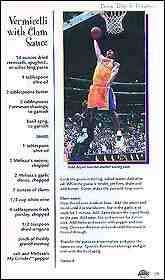
VERMICELLI WITH CLAM SAUCE, LAKERS-STYLE

“The Lakers Are Cookin’ Again!
The Lakers Cookbook is now available by mail order! It’s full of great photos and facts on your favorite Lakers and loaded with tasty recipes from all the Lakers’ players and coaches as well as celebrity VIP’s! The cost is $20.99 plus $1.73 sales tax for California residents. Orders outside North America, please add $4.50 for shipping and handling. Proceeds benefit the Lakers Youth Foundation. The cookbook is now available at Ralphs’ stores in Southern California!”

OUR UNIVERSE, BORN OUT OF BOUNDARY BRANE FIRE

From New Scientist magazine, vol 173 issue 2334, 16/03/2002, page 26:

Cycles of creation

Our Universe may be stuck
in an endless loop of death and rebirth. It’s an old idea, says Marcus
Chown
, but the strange power of nothingness has given it a new lease
of life

WHAT happened before the
big bang? If some physicists are to be believed, the question is about
as meaningless as asking what is north of the North Pole. But others don’t
give up so easily.


    According
to two cosmologists, before the big bang there was another big bang. And,
before that, another. “If we’re right,” says Neil Turok of the University
of Cambridge, “the big bang is but one in an infinite series of big bangs
stretching back into the eternal past.” And into the eternal future.

    What
Turok and his colleague Paul Steinhardt of Princeton University are advocating
is a new version of an idea that dates back to the 1920s. Back then the
Russian physicist Aleksandr Friedmann, the father of the big bang idea,
realised that if the gravity of all the matter in the Universe is powerful
enough, it could stop the expansion of the cosmos and turn it around. The
Universe would then carry on contracting down to a “big crunch”. If both
expanding and re-collapsing universes are permitted, it’s a simple step
to imagine the one changing seamlessly into the other. From the big crunch
the Universe would bounce or rebound in a new big bang and the whole cycle
would begin again.


    It was
a popular idea until the 1960s, when Roger Penrose and Stephen Hawking
scuppered it. Using Einstein’s general theory of relativity, which explains
gravity as a warp in space-time, they showed that the big bang must have
started in a singularity. A singularity is a point of infinite density
and temperature, and it’s a big problem for anyone taking a hard look at
the physics of the big bang. That’s because when everything in your equations
goes to infinity, the equations are meaningless. Physics breaks down.


    That
doesn’t rule out a cyclic Universe. But the singularity is like an opaque
curtain, preventing a view through the big bang to earlier times. With
the singularity in the way, it makes no sense to talk about any continuous
existence. If the Universe passes through a singularity, everything gets
scrambled in the breakdown of physics. Nothing in the new universe can
be affected by what happened before, so the previous cycle might as well
not have existed. This was very discouraging, and people abandoned the
idea of a cyclic Universe.


    Its rebirth
has come about because physicists are now convinced that Einstein’s theory
of gravity breaks down at the big bang. It’s all because of quantum mechanics,
which seems to impose a fundamental fuzziness on things. Quantum theory
is usually applied to particles of matter, but many physicists think it
must affect space-time too. The implication, they say, is that nothing
can collapse to a point. Instead there is a minimum size for anything.
The Universe may once have been pretty amazingly small, but it wasn’t infinitesimal,
so its temperature and density weren’t infinite. “The Universe may not,
after all, have begun in a singularity,” says Turok.


    Over
the past decade or so, this idea of space-time fuzziness has encouraged
some physicists to think about what happened before the big bang. But on
its own, it doesn’t prove there was anything, or give any hints about what
that was.


    Then
last year, Turok and Steinhardt came up with the first part of their new
theory. It builds on what are called brane-world scenarios, an outgrowth
of the idea that extra dimensions in space are needed to explain the fundamental
forces of nature. To explain why we experience only four of these dimensions,
physicists have come up with the peculiar idea that the matter and non-gravitational
forces of our Universe are stuck firmly to a four-dimensional island, or
“brane”, floating within a higher-dimensional space. Whereas most of the
extra space dimensions are supposed to be rolled up much smaller than an
atom, it may be that one of them is relatively large, and we simply don’t
see it because it is the exclusive realm of gravity ( New Scientist, 29
September 2001, p 26) .

    “The
brane-world scenario suggests a possible explanation for the big bang,”
says Turok. Branes have their own mass, so a moving brane has an enormous
amount of kinetic energy. And if our brane collided with another brane,
this kinetic energy would be liberated, he thinks. “This could have created
the fireball of the big bang and ultimately all the matter we see in today’s
galaxies and stars”.


    Turok
and Steinhardt, who developed this idea with Justin Khoury of Princeton
University and Burt Ovrut of the University of Pennsylvania, call it the
“ekpyrotic” universe, from the Greek for “born out of fire”.
They have
thought through several colliding-brane scenarios, some involving three
branes. But what they’ve ended up with is a relatively simple scenario,
in which two four-dimensional branes approach each other along a fifth
dimension. Turok and his colleagues call them “boundary branes” because
they form the ultimate boundaries of the Universe.


    “What
we have done is explore what would happen if one brane passes through the
other,” he says. They found that the kinetic energy of the colliding branes
is converted into heat energy within the branes when they collide with
each other, effectively conjuring real particles out of the vacuum. What’s
more, it naturally produces a Universe that is smooth on the largest scales,
but has small lumps and bumps in it to turn into galaxies and galaxy clusters.


    In this
basic model, there’s still no cycle. Just a phase of approaching, empty
branes before the big bang. Then Steinhardt and Turok asked themselves,
what could pull the branes together before their collision? That something
can only be the vacuum in between them, says Turok-because there’s nothing
else there.


    The vacuum,
as it turns out, changes everything. “The vacuum is like a spring between
the plates, or branes,” says Turok. Within our Universe it appears to be
generating a repulsive force-the so-called cosmological constant-which
is driving apart the galaxies. An attractive force would seem to be incompatible
with that. But it turns out that even while there is a repulsion along
the space dimensions inside each brane, there can also be an attraction
between the branes along the fifth dimension.


    Turok’s
team is considering a number of possible mechanisms that might be behind
this force. One suggestion is that there is a charge imbalance between
the two branes that creates an attractive force between them. “We don’t
have a complete theory in which this could be calculated,” Turok says.
“Our scenario is more of a guide as to how things could work.”

    He believes
that today, the spring is still being stretched, but in the far future
it will reach its maximum extension. Once that happens, the branes will
begin to accelerate towards each other until they collide again.


    So in
the new picture, the oscillation occurs only along the fifth dimension.
It happens like this: two branes are pulled together by the vacuum, and
collide. Inside both branes a huge amount of energy is released, and the
branes expand (if you can imagine an infinite rubber sheet being stretched
out, it’s a little like that). We brane-bound creatures call this event
the big bang.


    As the
branes expand and cool, matter and galaxies form. The galaxies drift apart
and age. After a while, the gently repulsive vacuum inside the branes makes
this expansion accelerate, so the galaxies fly apart faster still. The
end looks bleak.


    But meanwhile
the two branes have moved apart and then been pulled back together by the
attractive vacuum in between them. They rush towards a collision once more,
and a new big bang overwhelms both universes.


    So from
the perspective of someone stuck on the brane, space-time just keeps on
expanding, though the expansion is given repeated pushes by successive
bangs-that is, brane collisions. In other words, from the off-brane perspective,
we have something more like the traditional cyclic universe, yo-yoing back
and forth. Meanwhile, from the brane perspective, we have an altogether
different kind of cycle in an eternally expanding Universe.


    This
overcomes another big problem with the old-style cyclic universe. In each
cycle, stars radiate heat into space, but these cyclic models involve closed
universes, so each bang is hotter than its predecessor. Looking backwards
in time, then, the cycles get progressively cooler. The inescapable conclusion
is that the cycles must have begun at some time in the past. “But simply
pushing the origin of the Universe back before the big bang is not very
aesthetically pleasing,” says Turok. “This is another reason why the cyclic
universe was seen as unsatisfactory.”

    The new
cyclic universe avoids this problem. After the branes have passed through
each other, the spring of the vacuum is in compression and causes the space
of the branes to expand for a long time. That dilutes the heat from stars
so that the patch of space that experiences each new bang has essentially
the same temperature as the previous cycle. Consequently, all cycles are
the same and the universe can have oscillated for ever. “Such a universe
is more aesthetically pleasing than a big bang universe since the question
of what happened before is no longer a nagging problem,” says Turok. “The
Universe has been around for ever. There was no beginning.”


    Stars,
galaxies and life may therefore have existed in previous cycles of the
Universe. But, if the cycles are all identical, wouldn’t such endless repetition
be mind-numbingly dull? Turok and Steinhardt think not, because random
events will change the details each time. You won’t get the same galaxies,
planets and people each cycle. “Just because the cycles repeat does not
mean the events in each cycle are identical,” says Turok.


    More
speculatively, he points out that the extra rolled-up dimensions might
vary their sizes between cycles. The significance of this is that the fundamental
forces are suspected to be manifestations of the sizes of these extra dimensions.
“The laws of physics could change from cycle to cycle,” says Turok.


    If the
physical laws can change, they might be driven ever closer to some particular
set, what physicists call an attractor. “If we are lucky, we might find
that the sizes of the extra dimensions home in on particular values,” he
says. “We might then finally have an explanation for, say, the mass of
the electron.”


    Obviously,
both Turok and Steinhardt are excited by all these possibilities. Reactions
from their colleagues are more mixed. “At the moment I have an open mind
on the ekpyrotic universe and its latest oscillating version,” says Tom
Kibble of Imperial College in London. “There is no doubt an element of
hype here, but I think they are right to be excited.”


    Their
most outspoken opponent is Andrei Linde of Stanford University. “This is
mostly hype,” he says. He thinks the whole model is unnecessarily complicated,
like the epicycles that medieval astronomers used to describe the orbits
of the planets in our Solar System.

    But if
Steinhardt and Turok are right after all, the future is less bleak and
more dangerous than we have been told. Some cosmologists suggest that,
because the galaxies are now accelerating apart, the future holds nothing
but an ever emptier, cooler Universe. Now we have an alternative to look
forward to: an almighty surprise, one day, when we and our fellow universe
come together and collide once more in a spectacular finale. And who knows
what will emerge from the fire?

Further reading:

 “The ekpyrotic universe:
colliding branes and the origin of the hot big bang” by Justin Khoury,
Burt Ovrut, Paul Steinhardt and Neil Turok, ( http://www.arxiv.org/abs/hep-th/0103239)


“From big crunch to big
bang” by Justin Khoury, Burt Ovrut, Nathan Seiberg, Paul Steinhardt and
Neil Turok ( http://www.arxiv.org/abs/hep-th/0108187)


Paul Steinhardt’s website
is at http://feynman.princeton.edu/~steinh Neil Turok’s website is at http://www.damtp.cam.ac.uk/user/ngt1000

ROY WOOD BRINGS HIS BAGPIPE TO NEW YORK CITY

from the NYTimes–

March 28, 2002

ROCK REVIEW | ROY WOOD

Returning After 28 Years, Leading an Army of Brass

By JON PARELES

Bigger means better to Roy Wood, the English rocker whose four shows at the Village Underground were his first New York City performances since 1974. His music has always equated blare with rock ‘n’ roll bliss.

Electric guitars rang out when he led the Move in the late 1960’s; cellos took over when he founded the Electric Light Orchestra with Jeff Lynne in 1971; and saxophones and voices buttressed Wizzard, his next band. Roy Wood’s Army, the band he brought to the Village Underground, backed him with 12 musicians,
including an eight-member horn section. Most of the band members were women. Mr. Wood looked much as he did in the 1970’s, bearded with brightly dyed long hair.

Sunday’s set was a brass-pumped retrospective of Mr. Wood’s catalog from the Move to the present. Sung in his high, nervous tenor while female backup singers gestured in sync, the songs were the work of a songwriter proclaiming his love for an imagined 1950’s paradise, full of pretty girls jiving to jukebox rock, or a man in thrall to the fearful power of women’s charms. The Move’s “Fire Brigade” calls for firemen to cool him down; a newer song, “Kiss Me Goodnight, Boadicea,” begs the ancient warrior queen to “take a break from your pillage and destruction.”

The songs often harked back to grand Phil Spector marches or a swinging rockabilly two-beat, but they weren’t pure revivals; they threw in odd key changes or skipped beats, while Mr. Wood took guitar solos that swiveled their way toward brash dissonances.

Other songs took Beatles-style pop and added extra crimps. The Army also played the Move’s psychedelic artifacts “I Can Hear the Grass Grow” and “Flowers in the Rain,” which showed Mr. Wood’s ear for plant life.

With the horns hooting away, the Army came across like a mixture of a soul revue and a Las Vegas show band, conveying a skewed nostalgia. For “Are You Ready to Rock?” Mr. Wood piled on one more element: he marched onstage playing bagpipes.

Proud of his eccentricities old and new, he had clearly decided that nothing succeeds like excess.

DAVID BERMAN ON ECSTASY

From http://www.weeblackskelf.co.uk/cordsuit/articles/w_drugs.htm

THE SUMMER BEFORE THE NIGHT ECSTASY BECAME ILLEGAL IN THE STATE OF TEXAS

by David Berman

MY FRIEND KYLE always had a lot of money and could get me into the expensive kind of trouble without
the trouble sticking. He didn’t mind paying for me if it meant raising hell with loyal company. We were seventeen. You only needed one reason to be friends at that age. I figured we had at least three. So we broke the law every day in every way and laughed our asses off at the fucking stupid world.


    In late April we began to hear rumors about a new drug in the Metroplex. It was in the gay bars. Kids at the Arts Magnet were getting it. Certain people at certain parties had it and it was magical.

    They called it X. It was supposed to make you unaccountably happy and tolerant of everyone from headbangers to rich fucks. Even “douchebags.”

    Psychiatrists had been using it in therapy for years, we were told. It was legal and local product (it was still special to Texas at that time). It would make you love and accept anyone. Even yourself.

    This was a complicated promise for the teenager roiling with hate and confusion. I hardly believed it. But one night Kyle pulled out some foil holding four tablets, we each swallowed two, and went to a party where a lot of people were going to be doing it.

    Coming around the corner of that house, I’ll never forget the scene. Every high-school rule was being broken before me. The lions were chatting up the lambs. I saw sworn enemies talking like longtime companions; a prickly society bitch on her knees sifting white garden pebbles through her hands with
happy eyes; a brutal wrestler from my school with his arms wrapped around the trunk of a pecan tree, saying his first words to me ever, “Hi David,” sweetly, as I walked by.


    I rolled my jeans up to my knees and sat at the edge of the pool. Maybe for the first time I felt like no one was going to try to push me in. The stereo was playing “Blues for Allah” instead of the customary “Eliminator.” Nearby, two linebackers were confessing how much they depended on each other “on
and off the field.” I felt myself giving in to all the kindness, not caring if it was a lie or not. By the time a hot Fort Worth Jewess sprang into in my lap and began running her fingers through my hair, I was sold.


    At sunrise, I came in through the sliding glass. I woke my father and his new bride, apologized for staying out all night, and pulled a chair up beside the bed. I continued to sit there and smile down on them. I said, “I just want you to know how much I love you, Dad.” Incredibly, he did not kick my ass.
That morning was never mentioned again.

AS I SAID BEFORE, ecstasy was still legal and as such carried virtually no stigma. Kyle’s uncle kept
a jar of tablets on his desk at his car dealership. Law-abiding adults were taking them at North Dallas cocktail parties. They were even sold behind the bars like cigarettes and openly hawked on street corners downtown.


    That summer, I crushed two sports cars with my homely Buick, received six speeding tickets (three in one day), two tickets for public urination, impregnated a Collin County judge’s daughter, and had a bottle of MD 20/20 broken over my head. Approximately none of it registered with me. A very real fault of the drug.

    I’m going to skip the scenes of me chasing daisies and singing to stray dogs from still bulldozer cabs. I was exercising horses that summer for cash, and X hangovers were A-OK for barreling over the dull scrubland.

    Sometime in August, the lawmakers in Austin finally got around to outlawing ecstasy. What a gift for the dealers! The price of ecstasy immediately quadrupled and the production costs plummeted as the manufacturers began cutting the pills with all manner of horrible stuff.

    The night the law went through, I went to a concert at the Bronco Bowl and snagged two of the newly illegal pills for a dear price. I had never seen them in capsules and had no idea it was a sign they were crushing the old “legal” pills and mixing them with laxative, mannitol, low-grade speed, whatever.

    Once inside, I spent a half hour wiggling my way to the front of the floor. Unfortunately, when I got there I had a big problem. Not only were the drugs not kicking in, they were causing me to have to shit real bad. Michael Stipe was singing “Moon River” (hey!) a cappella and I knew I was going to blow if I didn’t part this shoulder-to-shoulder crowd and make it to the restroom. The audience was frozen in place and dead silent as I plowed through, “Excuse me, excuse me, emergency here, please, please” ( I think
I even yelled “gangway,” such was my ambition to get through), completely stepping on the vocalist’s Ethel Merman star turn and nearly getting shhhhhed to death.


    I passed the rest of the concert in a nasty stall gritting my teeth, sweating and coming to terms with what was clearly the symbolic end of a spaced-out summer.

    Fifteen years on, I can honestly say I’m glad it was outlawed. After three months of its use I had lost all discretion and was prepared to trust just about anyone. Worse yet, it was turning me into a joiner. That’s not who I am. Anyway, ecstasy was not to find its true customer base until years later, when the strangely passive kids who grew up in the child protectorate of the U.S. eighties and nineties came of age, craving depersonalization. Apparently it helps them dance. They’re a very attractive lot. Have you seen them dance?

David Berman lives in Nashville. His first book, Actual Air, came out last year via Open City Press.

NIGHTMARES OF AN ETHER-DRINKER BACK IN PRINT

“The next title to be published by the Tartarus Press will be Nightmares of an Ether-Drinker by Jean Lorrain, translated by Brian Stableford. Lorrain was an archetypal doomed decadent of the 1890s whose chosen drug, ether, killed him horribly, though not before it had inspired him to write a series of morbid
tales which are translated and collected by Brian Stableford for the first time. It will be published in the slightly different format which we have just used for John Gale’s collection of prose poems, A Damask of the Dead. It will also have 1890’s style boards printed in two colours, and a dustjacket.”