THE JUDAS OF THE WESTERN HIGHLANDS: James Marriott on Maximon (Arthur, 2004)

Encounter With Maximon
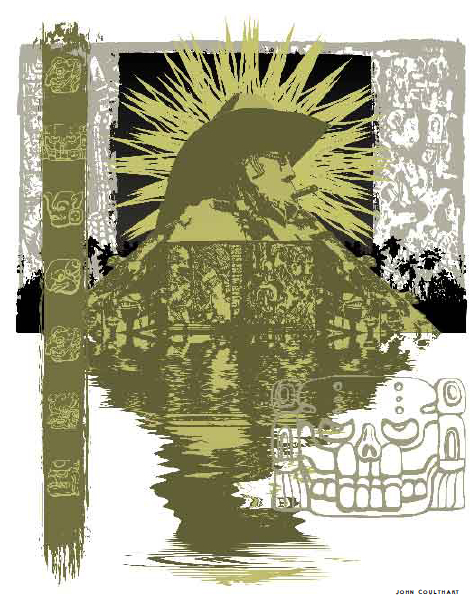
While investigating Guatemala’s folk-magic patron saint of thieves and whores, James Marriott made a serious mistake. Illustration by John Coulthart.

Originally published in Arthur No. 8 (Jan 2004)

The first children I asked to show me the way to the house of Maximon, Guatemala’s ‘evil saint’, turned tail and fled. The next boy I approached was unable to escape, hobbled by a pair of oversized rubber boots, and pointed me in the right direction. The building wasn’t much to look out—unpainted concrete blocks with a corrugated iron roof—but once I was in I knew I’d come to the right place.

Maximon sat at one end of a dark room, the life-sized dummy of a moustachioed white man wearing a suit, sunglasses, a felt hat and a silk scarf, with a garish handkerchief over his mouth. Candles were arrayed before him, and towards the entrance, at the opposite end of the room, tarot and palm readings were taking place. Another doorway led through to a courtyard, beyond which was a shop selling cigars, magical potions, herbs, candles and anything else the devotee might need.

There was a fire in the courtyard, around which a Mayan woman with gold teeth, a ladino woman and two boys of around six hyperventilated on huge cigars, working themselves into a sweat. The Mayan woman offered to read my palm. When I foolishly declined, she shrieked with laughter and returned to the serious business of her cigar. The ladino woman didn’t even look at me—Maximon is the patron saint of thieves and prostitutes, but I couldn’t very well ask her if either of these applied—and when the nicotine-crazed boys started to run around my legs, I went back into the main room to take a seat at the back and make myself as inconspicuous as possible.

New arrivals would walk straight past the tarot readers and into the courtyard, where they consulted with the Mayan woman before puffing on cigars and preparing themselves for a consultation with the saint. They would then approach the impassive figure and speak to him, stroking his arms and laying money and other offerings in a bowl in his lap. A smartly dressed man standing by the saint appeared to be his keeper, putting offerings of cigars in his mouth and tipping aguardiente, a fiery local spirit, down his wooden throat, or gently lashing the devotees with a bundle of herbs during a limpia, or soul cleansing.

The children came in, one looking demonic as he threatened the other with a bottle, then tied his feet together with a length of twine. The keening victim tried to hide behind me, crawling into a safe position sheltered by the gringo as the increasingly demented bully giggled and made throat-slitting gestures, the pain and anguish in his victim’s face only spurring him on to greater fury. For a terrible moment I thought that I was mistaken—they weren’t children at all, but rather stunted adults, their growth arrested by heavy nicotine use—but the pitch of the victim’s whine reassured me. As the bullying grew nastier in tone, I wondered if I should intervene, but it seemed patronizing to do anything— the only attention the other adults paid was to motion to the weaker child to be quiet. Eventually the bully left the room, and his charge fled. It seemed a fitting introduction to the world of the Judas of the Western Highlands.

* * *

Continue reading

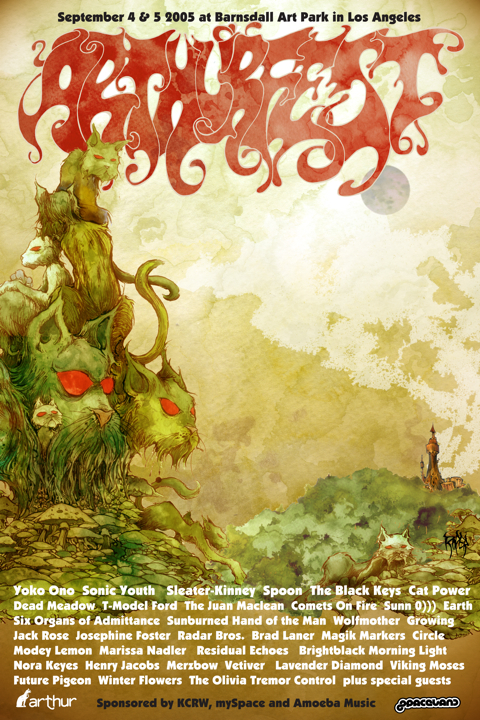
ARTHURFEST 2005

Notes: Poster artwork and design by Arik Roper. Devendra Banhart performed a set but could not be announced in promotion because he had an upcoming headlining show in the area. Pole, Dos (featuring Mike Watt and Kira), The Night Porter (featuring Carla Bozulich), Fatso Jetson, Young Jazz Giants, The Time Flys, Geronimo and poets Michael Brownstein and Charles Potts were special guests added to the program after the poster had been printed. Deejays included Brian Turner (WFMU) and Plastic Crimewave. “Film No. 5 (Smile)” by Yoko Ono starring John Lennon was screened on the main stage, as well as excerpts from Henry Jacobs’ “The Fine Art of Goofing Off.” Yoko Ono’s appearance included a performance of ONOCHORD. ArthurFest was filmed by Lance Bangs.

"Preserve That Beauty": talking with CHRIS GOSS of MASTERS OF REALITY

Two endangered species, photographed by Stephanie Smith

A MAGICAL SKILL
Chris Goss, a godfather of desert rock, on the return of Masters of Reality
By Jay Babcock

Originally published November 11, 2010 in LAWeekly

Chris Goss, the 52-year-old leader of Masters of Reality, is near tears. A mountain of a baldheaded man, part Aleister Crowley, part Admiral Kurtz, Goss has been involved in some of the most vital rock ‘n’ roll music made in the last two and a half decades. Masters of Reality’s 1988 debut, a masterwork of concise songwriting and classic rock riffage, was produced by Rick Rubin; their second, the lovely Sunrise on the Sufferbus, featured an actual classic rocker, the formidable Cream drummer/crankyman Ginger Baker.

Around that time, Goss discovered a group of teenagers from the California Low Desert called Kyuss, who played a heavy, trippy mix of Black Sabbath and the Misfits. Goss produced Kyuss’ best work, inaugurating a relationship with guitarist Joshua Homme that would continue into the latter’s subsequent Desert Sessions and Queens of the Stone Age projects.

And while there would be other Masters of Reality albums, other production gigs of varying profile and quality — my favorite is Mark Lanegan’s Bubblegum — and an album-and-a-half as Goon Moon, a bizarro-rock collaboration with Marilyn Manson guitarist Twiggy Ramirez (and, on the first EP, underground free-rock drummer Zach Hill), generally speaking, Goss has slipped into legend: one of those musician’s musicians, a guy who knows the occult secrets of the creative process and can get a great drum sound, who somehow, in this devolved age, still feels it.

Which, I think, is why he’s near tears, as we sit on a patio outside his Joshua Tree home. Masters of Reality have a new album out — a beautiful, musically adventurous, warm affair with double-name Pine/Cross Dover — and are about to play a set of West Coast dates. It’s the first time in years that Goss has been able to line everything up: a great album, a happening band, U.S. gigs. But who is there to hear anymore?

“Hard time for art right now,” he says. “Socially, politically, economically — this is awful right now for everyone, this confusion. We’re in the new Dark Ages. It’s very hard and depressing, and you get angry because just so much attention is paid to so much shit. It’s a shit storm. But there’s no reason to stop making music. The market is down? Fuck the market. If you love what you’re doing, you gotta keep doing it.”

Even making record albums, when record stores are going out of business and everything is available for free on the Internet? Isn’t that tactile experience over?

“I love the album format. I’ll never lose that. Never. I don’t want to lose it. I mean, why can’t we keep experiencing it? It’s easy, it’s palatable. I’m so used to buying music in my hand and I can’t get over it. Packaging matters. The visual album-cover connection to the music matters. Remember the gatefolds with the storybooks in them and the pop-up photos and stuff? This kind of thing is a boutique, elitist origami item now, but when I was a kid it was a five-and-dime item. I remember how it felt when I had Jethro Tull’s Passion Play in my hands as a kid, from a poncy Shakespearean Renaissance Faire English hippie guy, knowing that, like, another million kids also were reading this storybook. There was this feeling that so many other people were experiencing what I was experiencing, at the same time. It was like combining that Harry Potter intrigue with the music for the kid of the time. That’s empowering. Those records connected us. …”

The music experience is more than what meets the ear — is it about actual physical contact?

“This is about warmth, and beauty,” Goss says. “Now vocal tuning is everywhere. What a horrid tone. The chipmunk-robot people are here! Great. Lovely. Did you see Shania Twain live at the CMAs this year, maybe last year, with a vocal tuner on her voice when she was singing live? “And! I! Love! YouuuuUUUU!” It puts that thing on the tone at the end, an artificial lengthening of when you land on the note. So the person’s natural phrasing is gone. Why? When Lennon was flat, it was wonderful. When Keith Richards is flat, it’s wonderful. Because it sounds like the guy is sitting right next to you. He hasn’t been chopped to spam before he gets to you.”

People don’t even know what they’re missing.

“I remember going to see Yes in the ’70s, back when people knew the lost art of properly mic-ing an acoustic guitar live. It has to have a low end, so that if you bump the guitar with an elbow, the PA goes boomf. You need that full spectrum of sound — you gotta feel the chest, and the belly, that part of the sound spectrum. Music should come through your chest, your eyes, your belly, that part of the sound spectrum. I think that’s my favorite part.

“There’s some great Israel Regardie Golden Dawn meditation tapes,” he says, describing one of Crowley’s disciples and his mystical society, “where he talks about getting into a state where your body is made out of spiderweb, like mesh. Continue reading

Ecstasy by Anthony Alvarado

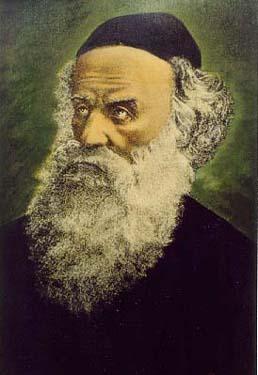
The Baal Shem Tov was the founder of Hasidic Judaism

The Dance of the Hasidim

At the festival of Simhat Torah, the day of rejoicing in the law, the Baal Shem’s disciples made merry in his house. They danced and drank and had more and more wine brought up from the cellar. After some hours, the Baal Shem’s wife went to his room and said:”If they don’t stop drinking, we soon won’t have any wine left for the rites of the sabbath, for Kiddush and Havdalah.”

He laughed and replied: “You’re right. So go and tell them to stop.”

When she opened the door to the big room, this is what she saw: The disciples were dancing around in a circle, and around the dancing circle twined a blazing ring of blue fire. Then she herself took a jug in her right hand and a jug in her left and – motioning the servant away – went into the cellar. Soon after she returned with the vessels full to the brim.

It is said the Sufi Muslim poet Jalaludin Rumi invented the whirling dance of the dervish when he was walking past a the sound of a goldsmith at work with his hammers. In the rhythm of the hammering he heard ecstatic music and he began to turn and to turn . . .

Dance, when you’re broken open.

Dance, if you’ve torn the bandage off.

Dance in the middle of the fighting.

Dance in your blood.

Dance, when you’re perfectly free.

– Rumi


DIY : Dance, dance dance!

“The sound of sweat, hallucination and revelation”: Gabe Soria meets BELONG (Arthur, 2006)

Originally published in Arthur No. 23 (June 2006)

HEAVY AIR
An Orchestra of Feedback and Humidity, Courtesy of New Orleans duo Belong

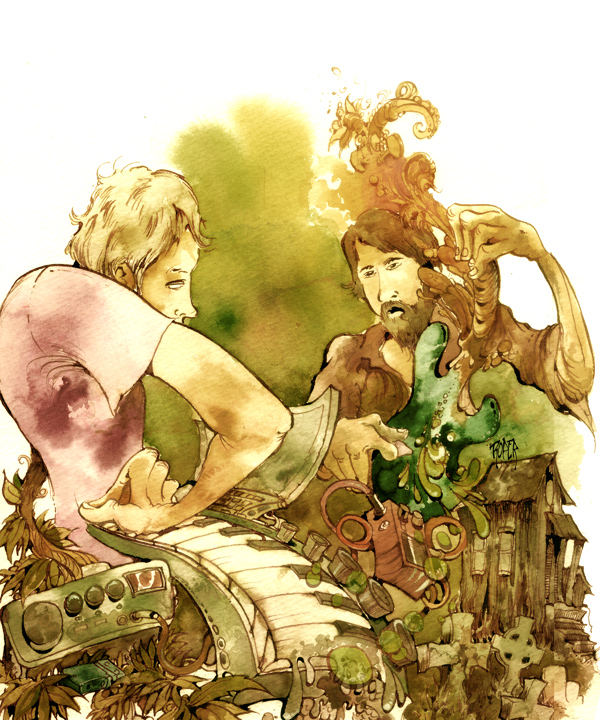
Text by Gabe Soria, illustration by Arik Moonhawk Roper

There’s a ‘round-the-clock environmental buzz everywhere in New Orleans if you’ve got the ears to hear it. It’s a deep, almost sub-sonic, earth-drone that’s especially evident during the wicked days of summer. It’s in the awesome silence of the baking, deserted streets at noontime; it’s in the deafening biological volume of the wild, tropical greenery and of bugs reproducing insanely; it’s in the groaning of the cracked sidewalks, ancient houses and crumbling cemeteries; it’s in the LSD-like intoxication produced by the common cocktail of casual drinking crossed with 100 percent humidity and three-digit thermometer readings.

October Language, the stunning debut album from New Orleans drone guitar-duo Belong, is a de facto impressionistic field recording of the ineffable and beautiful noise that permeates the city. Miles away from the jazz, funk and bounce hip-hop that defines New Orleans music to the world at large, October Language still manages to be as genius an expression of the soul of the city as Professor Longhair’s “Tipitina,” Juvenile’s “Back That Azz Up,” Dr. John’s ” Right Place, Wrong Time” or Irma Thomas’s “Ruler of My Heart.” It’s the sound of sweat, hallucination and revelation, and every cat who’s made it through a couple of New Orleans summers can dig that.

Belong is comprised of New Orleans natives Turk Dietrich, 28, and Mike Jones, 27. Dietrich—lanky and gregarious, possessor of the strange New Orleans accent that sounds strangely Southern and Brooklyn-esque at the same time—is the talker of the two. Both came back to New Orleans a few weeks after Hurricane Katrina hit the Gulf Coast, and both plan on staying for the forseeable future. Both are the type of guys who you want to knock back beers with all night with in a smelly bar, fellas you’d want to have on your side in a fight. Having heard snatches of their brilliant debut scant days before a second trip to his old habitat of New Orleans inside a month [the last being a Mardi Gras visit detailed last issue], your correspondent made a few phone calls and tracked Belong down to a bustling coffeehouse on Magazine Street for a quick talk. Decompressing from a recent U.S. tour with Ariel Pink and preparing to embark on a European tour, the band was eager to jaw about video games, the peculiar habit of some New Orleans residents of beginning evenings out at midnight, and plans to attend work parties to help Ms. Antoinette K-Doe repair the fire damaged Mother-in-Law Lounge. We also managed to talk about music a bit…

Continue reading

NEW MUSIC: Belong

New cut “Perfect Life” off Belong’s forthcoming album ‘Common Era,’ out March 21 through the good folks at Kranky. The dreamy fog/mugginess-on-the-needle sound, memorably investigated by Gabe Soria in his piece on Belong in Arthur No. 23 (with illustrations by Arik Moonhawk Roper) is still here, but now the New Orleans duo have ’80s (read: Martin Hannett) electronic drums and Syd Barrett/young-man-lost vocals. Not gloomy in the least—beautiful, like an electric swan in a starlit bayou.

Belong: http://belongneworleans.blogspot.com

[SUNDAY LECTURE] "I will speak to you now from the future."

Note: This piece was first published in Summer 1992 on the sesquicentennial of Columbus’ landing on North America in the Journal of the Society for Ecological Restoration.

DREAMING INDIGENOUS

One hundred years from now in a northern California valley

by Freeman House

Contact between whites and natives didn’t happen here in my part of North America until 150 years ago, which makes it easier to think like this. You can still see enough of the earlier patterns in the landscape to be able to guess at what it looked like then. Once contact did happen, however, it proceeded with unrelenting fury. Within a seven year period ending in 1862, the 10,000-year-old culture that had been so wonderfully adapted to this little tuck in the Coast Range was reduced to a few broken individuals hanging on locally and a handful more isolated from the source of their identity, bereft of home on the reservation a hundred miles away.

Life was pleasant for the whites, in a rough sort of way. For a hundred years or so, pleasant enough so that even now some cowboys look back on that time as the very peak of existence. It was the usual scene for the North American West: a few steers and dairy cows, some hogs for market, and an economic boom every 30 or 40 years to keep things interesting—and growing. The tanbark boom kept quite a few of the boys busy for a time. And even though the oil boom fizzled, it brought the aura and glamour of the great world into the valley for a while, and Petrolia got a hotel. Come the bust, as it always did, well, subsistence was not so bad, with salmon and venison steak to fall back on.

The really big boom, the one that makes you wonder if anyone will survive the bust, came as a windfall to the handful of large landowners. A whole slew of events, historical and technological, had conspired to make the ubiquitous Douglas-fir worth something, worth a lot, after decades of laying it down around the edges of the prairies and burning over it year after year to expand the pasture. Three quarters of the landscape was suddenly marketable after three generations of living well enough off the other one quarter.

It came out fast—90 percent of three quarters of 300 square miles of timber from some of the most erodible forest slopes in North America, all in the space of a single generation. No one paid any attention to what anyone else was doing. There was no awareness, really, that a whole watershed was being stripped of its climax vegetation all at once. For most of the years between 1950 and 1970, several mills were kept running ‘round the clock, and the trucks taking timber out of the valley were so numerous and frequent that their drivers had to agree on one route out and another one in. There was a lot of money; anyone could find a job who wanted one. The schoolteacher worked at the sawmill at night.

Two 100-year storms within a ten year period was bad luck, they said, coming at a time when so many acres of soil were exposed to the sky. But exposed they were, and a vast warm rain on top of an unusually heavy snowpack on the ridges sent thousands of tons of sediment into the creeks and then into the river. In one week in 1955, the structure of the river was altered completely, from a cold, stable, deeply channeled waterway enclosed and cooled by riparian vegetation to a shallow, braided stream with broad cobbled floodplains, warm in summer, flashy in winter. And then it happened again in 1964.

When the new homesteaders began to arrive in the early 1970s, all we knew was that the king salmon and the silver salmon were almost gone. A few of us tried to do something about it, and by 1981 had established a sort of volunteer cottage industry in salmon propagation. We learned quickly that the key to the restoration of wild populations was habitat, and we found ourselves creating jobs along with volunteer and educational programs in reforestation, in erosion control. One thing leads to another—now we hear ourselves talking landscape rehabilitation, watershed restoration planning, water quality monitoring,

We were only vaguely aware that we were engaged in something called environmental restoration, and it wasn’t until the Restoring the Earth conference in Berkeley in 1988 that we realized that we were part of a planet-wide movement. Even before that, however, we had become aware of some of the pitfalls of this new terrain of consciousness. Logging was still a part of the essential economy of our valley. It was happening on nowhere near the scale of the bad old days, and practices had improved considerably thanks to well-reasoned timber harvest rules established during the Jerry Brown administration, but ecological systems were still being disrupted in ways not clearly understood. As we became more skilled in repairing damaged areas, we became aware of the danger of becoming the source of cheap janitorial services for corporate industry and others that might be opening up new wounds even as we were attempting to heal the old ones. It was not enough to become expert in putting back together what had been torn apart. Unless we adopted the cause of local ecological reserves, unless we tried to educate ourselves against destructive land use practices and tried to prevent them when education failed, unless we helped establish new small-scale resource extraction industries rooted in the ethic of ecosystem health, we were in danger of becoming Roto-Rooter persons for a dysfunctional society. If we practiced environmental restoration out of the same short-term assumptions that had created the disturbances in the first place, where could we end but as apologists for new deserts? Even the Roto-Rooter man tells the homeowner to stop pouring bacon grease down the toilet!

We are now concerned with the cultural content of the next 150 years because our experience tells us we must be. A successful sustainable human culture is a semi-permeable membrane between nature and human society, with information flowing freely in both directions. Having put ourselves in the way of some of the physical data coming toward us from the natural world, we are given both the rationale and the imperative for our roles in social transformation. Having perceived the reciprocal relationship between natural systems and local cultures, we have little choice but to work to make the latter more adaptive, more indigenous.

* * *

In making my contribution to this collection of restorationists’ reflections on the 500th anniversary of Columbus’ landing, I will allow myself two assumptions: that profound cultural shifts can happen suddenly and at any time; and that we are now in the midst of a pivotal era that offers us chances to abandon our more deadly economic practices, and begin to seek ways to adapt—and survive.

Because indigenous culture is always a response to locale, I will paint an imaginary picture of some aspects of life in our little valley 100 years from now. I will take a look at how a future might look if the insights available to one environmental restorationist were available to everyone. I will portray a future where timber, fish, and ranching are still the mainstays of economic life because I wish it to be that way; any other alternative seems less attractive. And for the treeplanter who is irritated by heady abstractions—who asks little more, after all, than for good work unfreighted with ambivalence—I will focus on some of the workaday themes of everyday life.

I will speak to you now from the future.
Continue reading

A Poem from Edward Hirsch

Early Sunday Morning
by Edward Hirsch

I used to mock my father and his chums
for getting up early on Sunday morning
and drinking coffee at a local spot,
but now I’m one of those chumps.

No one cares about my old humiliations,
but they go on dragging through my sleep
like a string of empty tin cans rattling
behind an abandoned car.

It’s like this: just when you think
you have forgotten that red-haired girl
who left you stranded in a parking lot
forty years ago, you wake up

early enough to see her disappearing
around the corner of your dream
on someone else’s motorcycle,
roaring onto the highway at sunrise.

And so now I’m sitting in a dimly lit
café full of early- morning risers,
where the windows are covered with soot
and the coffee is warm and bitter.

First footage of uncontacted tribe in Brazil

This aerial footage showing one of the world’s last uncontacted tribes living in the Amazon rainforest of Brazil was filmed by the BBC for their new series “Human Planet” and released via uncontactedtribes.org on February 4, 2011.

“Without proof they exist, the outside world won’t support them,” says José Carlos Morelos, whose job it is to monitor the endangered tribe’s land and protect it from invaders. “One image of them has more impact than a thousand reports.”