“Sun Boxes is a solar powered sound installation. It’s comprised of twenty speakers operating independently, each powered by the sun via solar panels. Inside each Sun Box is a PC board that has a recorded guitar note loaded and programmed to play continuously in a loop. These guitar notes collectively make a Bb chord. Because the loops are different in length, once the piece begins they continually overlap and the piece slowly evolves over time.
“Participants are encouraged to walk amongst the speakers, and surround themselves with the piece. Certain speakers will be closer and, therefore, louder so the piece will sound different to different people in different positions throughout the array. Allowing the audience to move around the piece will create a unique experience for everyone. in addition, the participants are encouraged to wander through the speakers, which will alter the composition as they move. Given the option two people will take different paths through the array and hear the composition differently. Sun Boxes is not just one composition, but, many.
“We are all reliant on the sun. It is refreshing to be reminded of this. Our lives have filled up with technology. But we still need the sun and so does Sun Boxes. Karlheinze Stockhausen once said ‘using Short-wave radios in pieces was like improvising with the world.’ Similarly, Sun Boxes is collaborating with the planet and its relation to the sun.
“Come be part of the drone.
“For the first three weekends of November Turners Falls River Culture will present Craig Colorusso’s latest piece Sun Boxes. At three locations, allowing the participants to observe the piece evolve as it moves through the town.
Nov. 5-7 Lawn of the Great Falls Discovery Center, 2 Ave.
Nov. 12-14 Peskeomskut Park, Ave. A + 7th Sts
Nov. 19-21 Lawn at the beginning of the bike path, 1st St
From Coca Crystal’s “If I Can’t Dance, You Can Keep Your Revolution”…
This is the kind of thing you will see at the Tuli Kupferberg Memorial Screening on November 14, 2010 at Anthology Film Archives in New York City, presented by Arthur. More info on that here.
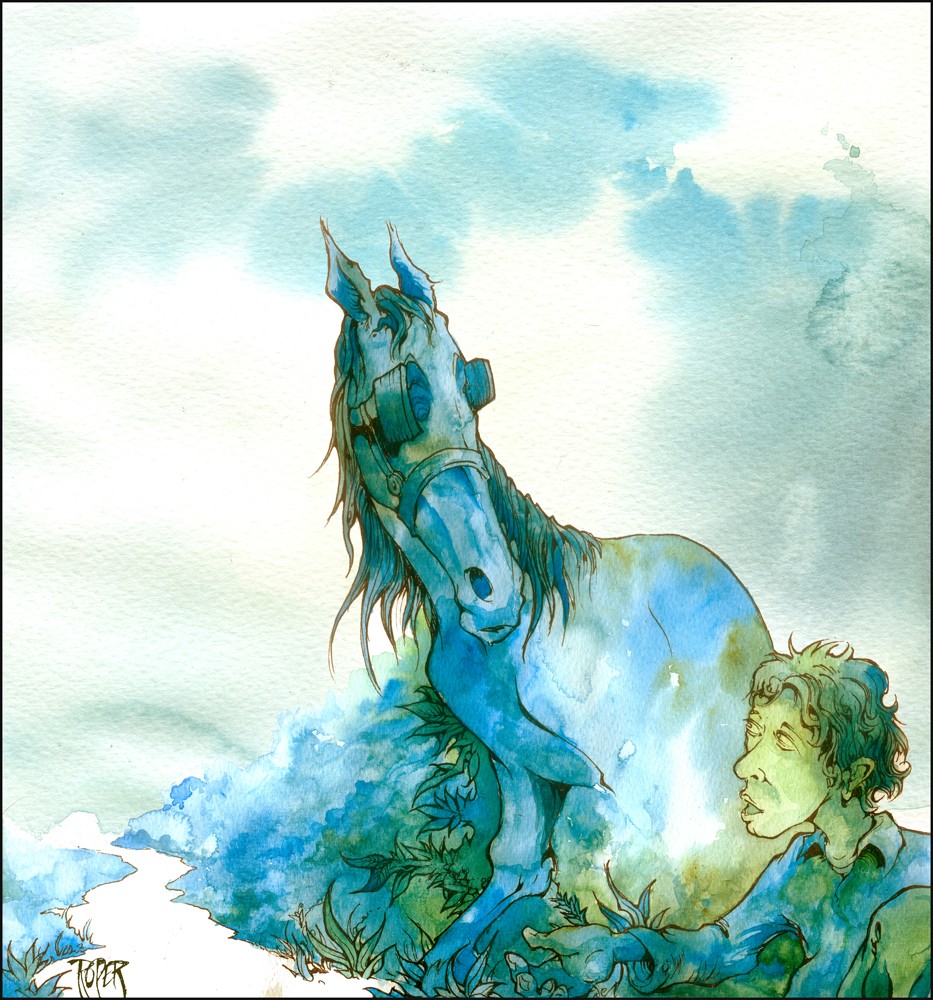
STRANGE BREW Canadian-Swiss anthropologist JEREMY NARBY on what hallucinogens like LSD and the Amazonian drink ayahuasca have to teach us
Introduction by Erik Davis Q & A by Jay Babcock Illustration by Arik Roper
Originally published in Arthur No. 22/May 2006
INTRODUCTION by Erik Davis
The anthropologist and author Jeremy Narby hit the intellectual freak scene in 1998 when he published The Cosmic Serpent, an audacious, intriguing, and entertaining dose of righteous mind candy that grew out of his decades-long explorations—both personal and scholarly—of the ayahuasca-swilling tribes of the upper Amazon. A Canadian living in Switzerland—at least when he’s not researching in the jungle or working on indigenous rights—Narby is no bug-eyed hippie prophet of “the tea.” He is a grounded, sensible fellow with a dry wit, an unromantic but respectful view of shamanism, and an allergy to vaporous supernatural claims. (In Europe he also sometimes performs with the guys behind the Young Gods, a seminal Swiss industrial band that led the Wax Trax pack back in the day.) While Narby’s head has definitely been broken open, his book does not spend a lot of time on the “spiritual” import of the jungle brew. Instead, Narby focuses on one of the biggest claims made by the Amazonian shamans: that their ritual ingestion of the hallucinogenic brew not only brought them contact with the spirits of animals and healing forces, but actually gave them knowledge—actual data—about the workings of the jungle around them.
After all, some sort of weird data transfer is going on in the jungle (though its hard to say it reaches the increasing numbers of spiritual tourists who are now hustling down to the Amazon and transforming shamanic culture with first world dollars). The existence of ayahuasca itself may be one of the greatest mysteries. Ayahuasca is not one plant, but a relatively complex brew that requires a fair amount of preparation. How did the old ones know that, out of the 80,000 some species of plants in the jungle, only this vine, combined with that shrub, and then boiled down into black gook, can produce the mother of all trips (not to mention some grade-A karmic Drain-O)?
Narby takes the mystery one step further: could the shamans be right? Could the brew, which one informant calls “the television of the jungle,” facilitate the knowledge of the jungle? To approach this question, Narby attempts to “defocalize” his gaze so that he can perceive science and indigenous understandings at more or less the same time. This trippy conceptual exercise leads him to the central mindfuck of the book: that the serpents that commonly slip into the visual field during ayahuasca trips are a figurative expression of the ultimate source of ayahuasca’s visionary communiqués: the coils of DNA. Ayahuasca is not just a head trip – it is a communication with the “global network of DNA-based life.” Narby is no true believer, and he is somewhat startled by his own hypothesis, but that makes it all the more compelling, and the lengthy notes in the back of the book prove he is doing more than riffing.
After co-editing a powerful collection of first-hand reports of Western encounters with shamans, Narby came out with the book Intelligence in Nature. Rejecting the idea that plants and “lower” animals are mute mechanisms, Narby uncovers scientific evidence that impressive feats of cognition are going on outside the precious smartypants club of the higher primates. Narby looks at bees capable of abstract thought, and unicellular slime molds who are able to solve mazes. Perhaps inevitably, the book is not as wild a ride as The Cosmic Serpent, and Narby spends too much time describing his mundane journeys to research labs and too little time wrestling with how “intelligence” relates to choice, or awareness, or intention. Nonetheless, the book is a worthwhile example of Narby’s “defocalized” gaze – an undeniably scientific appreciation whose inspiration lies with the fundamental shamanic belief that other creatures, and even some plants, are, in their own world, “people” like us.
INTERVIEW Cby Jay Babcock over the telephone in late January, 2006
Arthur: You attended the conference on LSD held in Basel this past January to coincide with the 100th birthday of the father of LSD, Dr. Albert Hoffman. What happened there?
Jeremy Narby: What didn’t happen? I think one needs metaphors to get at it, really. When LSD hit in the ‘60s, it was like a drop of mercury that went in all kinds of directions, broke into a lot of different shards. Because LSD affects consciousness and consciousness affects everything, LSD had an impact in art, in music, in thinking, in the personal computer industry, in biology, and so on. In Basel all the different little pieces came back together and arranged themselves in a kind of mosaic that was psychedelic, multi-faceted and beautiful. All the chickens came home to roost after 40 years, looking good. One of my favorite moments was when Christian Ratsch came on the big stage with Guru Guru, which is the original Krautrock band. He was walking around with amber incense and stuff, providing incantations and shamanistic energy during the set, and these sprightly gentlemen, who must be about 55, just rocked the house down. It was fantastic.
Arthur: So, where does it go from here?
Jeremy Narby: One of the aims of the symposium was a kind of explicit political aim at getting psychedelic research back on the scientific map, and I think the point’s well taken. But you know, I’ve been working as an activist to get recognition for the knowledge systems of indigenous peoples and essentially despite a couple of decades of work and a lot of clear data (it seems to me), there’s really a fundamental resistance coming out of rationalism, coming out of Western cultures, coming out of the political systems. So I have the feeling of having led the horse to water but it didn’t want to drink. Sure, we can talk to the horse nicely and try and get it to drink the water some more, but finally I feel like more drastic tactics are needed. Like kicking the horse in the butt, or telling it to go and take a hike, or turning your back on it.
So I applaud these efforts to legalize psychedelic research, but… There are those among us who have wanted to use hallucinogens how indigenous people use them—in a serious way to understand the world. And we’ve been doing it, underground, for the last bunch of decades, and getting results that are richer and more interesting than what the Western rationalists are producing. So, I’d say that I’d rather take hallucinogens and then write stunning books than make speeches about hallucinogens.
Arthur: What was the response of Western rationalists to your hypothesis in The Comsic Serpent—that Amazonian shamans were actually receiving information at the molecular level via the ayahusaca trance?
Jeremy Narby: Scientists said that I hadn’t tested my hypothesis. Well, okay : I was just happy to have it considered testable! [chuckles] So how do we test it? Well, you try to falsify your hypothesis. You come up with a test to try to demonstrate that it’s wrong. That’s the scientific method. So, I thought, let’s send three Western molecular biologists with questions in their labwork down to the Amazon and put them into ayahuasca-induced trances. If they didn’t come up with any information then my hypothesis would start to look falsified. Now, it is a heavy thing to ask people who have never taken mindbending hallucinogens before to submit themselves to the experience in the name of science. These people are making their psyches available to you and then you distort them with these powerful hallucinogenic plants. In terms of ethics, this is even worse than experimenting on animals. It’s experimenting on humans. They were consulting subjects and all, but sheesh, this is serious business. I mean, the first thing that ayahuasca does, before it answers whatever questions you might put to it, is it tells you about yourself. It puts its finger on your weak spots, fast. It encourages you to clean up your act. This makes it a hard path to knowledge for somebody who’s into ‘being objective’ in the lab. As a scientist, you’re not supposed to pay attention to your subjectivity—you’re supposed to jettison it. But when you end up in an ayahuasca experience, it’s your little subjective self that is the hot point. Your subjective self comes to the forefront in your acquisition of knowledge. For a scientist, that’s a rough one.
Arthur: You were able to find volunteers, nonetheless. I gather they were colleagues… ?
Starring Isabelle Huppert, Olivier Gourmet, Adelaïde Leroux, Kacey Mottet Klein
Official Selection: Cannes International Critics’ Week
Official Entry from Switzerland for the 2010 Academy Awards
A family’s peaceful existence is threatened when a busy highway is opened only meters away from their isolated house in the middle of nowhere. Refusing to move, Marthe, Michel and their three children find innovative ways to adapt to their new environment. They continue their happy-go-lucky routine despite the daily stress of hundreds of noisy speeding cars. But suspicions about the highway’s unknown long-term dangers cause family tension. Remaining in the disrupted household might not be so easy, but it’s still their home.
Not rated. Running time: 98 minutes. In French, with English subtitles.
OCTOBER 20 — ARTHUR RIMBAUD
Gay poet, gun runner, anarchist activist.
“I have stretched ropes from steeple to steeple; garlands from window to window; golden chains from star to star, and I dance.”
OCTOBER 20 HOLIDAYS AND FESTIVALS
Bahai‘i: BIRTH OF THE B‘AB.
FEAST OF NO EXCUSE FOR A FEAST.
ALSO ON OCTOBER 20 IN HISTORY…
1854 — Gay French poet, gunrunner Arthur Rimbaud born, Charleville, France.
1859 — American pragmatist philosopher John Dewey born, Burlington, Vermont.
1874 — Modernist composer Charles Ives born, Danbury, Connecticut.
1890 — British adventurer Sir Richard Francis Burton dies, Trieste, Italy.
1918 — Germans accept U.S. peace terms, ending World War I.
1926 — American socialist leader Eugene Debs dies, Chicago, Illinois.
1947 — U.S. House Un-American Activities Committee begins investigation of the entertainment industry.
ANTHOLOGY FILM ARCHIVES
32 SECOND AVENUE NEW YORK, NY 10003
(212) 505-5181
A tribute to the 60s icon, Fugs co-founder, cartoonist, and New York underground beat poet laureate, who passed away in July. Two shows of shorts, clips, and U.S. premiere of the new high-def transfer of the long-unscreened underground film VOULEZ-VOUS COUCHER AVEC GOD?
Sixties icon, Fugs co-founder, cartoonist, and New York underground beat poet laureate Tuli Kupferberg passed away in July 2010 at age 86, leaving a rich legacy of a lifetime’s worth of artistic radicalism and fun, including many rarely-seen film and video appearances. This special memorial screening presents a diverse collection of short films and videos from the 1960s onward, including Tuli’s appearances on the public access programs REVOLTING NEWS and IF I CAN’T DANCE YOU CAN KEEP YOUR REVOLUTION, some of Tuli’s more recent web clips, and other odds and ends. Not to mention the first screening in many a moon of the long-lost counter-culture feature VOULEZ-VOUS COUCHER AVEC GOD?, starring Tuli in the title role!
To be screened:
PROGRAM 1
Shorts, clips, and odds & ends, including Edward English’s short film:
FUGS
(1960s, 12.5 minutes, 16mm)
“(Sights and sounds of the lower East Side rain forest.) This film captures a bit of the Fugs’ environment, which includes the lower East Side, the Waldorf Astoria, the MacDougal Street scene, police harassment, show biz, humanity, their audiences, and the filmmaker.” –E.E.
–Sunday, November 14 at 6:00.
Tuli with hat, taken from the film. Tuli plays God. Image courtesy Jack Christie and Michael Hirsh
PROGRAM 2
Michael Hirsh & Jack Christie
VOULEZ-VOUS COUCHER AVEC GOD?
(1972, 69 minutes, 16mm-to-video.)
(U.S Premiere of new high-definition transfer from original 16mm elements.)
Voulez-vous coucher avec God? Judge for yourself at the New York premiere of this vintage, Canadian-made experimental flick featuring a groundbreaking potpourri of live action and animation, backed by a rollicking soundtrack of 1960s hits. As portrayed by Kupferberg, there’s no messing with this Yahweh who’d just as soon enjoy a blow job from an inflatable schmoo as mastermind a presidential election from the cozy confines of his bathtub in Hashish Seventh Heaven, where a cast of pipe-dreaming souls journeys to be reborn. All hell breaks loose when the angel of the Lord attempts to cover up his failure to avert the sacrifice of young Isaac by his father, Abraham (also played by Kupferberg).
–Sunday, November 14 at 8:30.
Directions: Anthology is at 32 Second Ave. at 2nd St. Subway: F to 2nd Ave; 6 to Bleecker. Tickets: $9 general; $8 Essential Cinema (free for members); $7 for students, seniors, & children (12 & under); $6 AFA members.
OCTOBER 19 — LU XUN
Famed Chinese writer of rebellion and revolution.
OCTOBER 19 HOLIDAYS AND FESTIVALS
FEAST OF THE WICKED SCAM. LAILAT UL QADR.
ALSO ON OCTOBER 19 IN HISTORY…
1433 — Metaphysical giant Marsilio Ficino born, Figline, Florentice Republic.
1745 — Irish satirist and scatological critic Jonathan Swift dies, Dublin, Ireland.
1781 — Cornwallis surrenders at Yorktown; world turned upside down.
1862 — Auguste Lumière, French film pioneer, born.
1895 — Architect and culture critic Lewis Mumford born, Flushing, New York.
1899 — Guatemalan novelist Miguel Angel Asturias born, Guatemala City.
1936 — Chinese revolutionist, writer Lu Xun dies, Shanghai.
1983 — Grenadan leader Maurice Bishop killed in internal political coup, Grenada.
1987 — “Black Monday” stock market crash, world-wide.
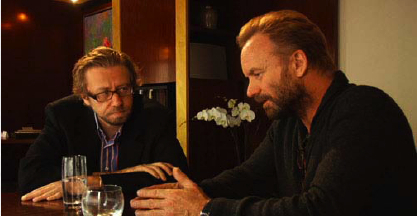
Best caption for this promotional photo starring author/once-upon-a-time Arthur columnist Daniel Pinchbeck and bassist Gordon “Sting” Sumner wins something TBD. Submissions are welcome in the “Comments” section below.
WE HAVE A CAPTION CONTEST WINNER:
“See Daniel, if we go by the Mayan long count, I can actually maintain an erection for 26 hours…”
Originally published, with photography by Melanie Pullen and page layout by W.T. Nelson, in Arthur No. 10 (May 2004)…
Glitter and Gleam The two sisters who are CocoRosie have made an astonishing, haunting debut album. Trinie Dalton finds out how they did it.
CocoRosie’s debut La Maison de Mon Rêve capitalizes on its sexy feminine allure to seduce the listener into a dream state, one that’s half bliss, half nightmare. CocoRosie’s two singers and sole band members, Bianca and Sierra Casady, could be compared to sirens if their wailing was deeper instead of high-pitched and tweaky like Billie Holiday’s on 45rpm. Listening to La Maison gives you an opiated sense of well-being; here are two beautiful young ladies singing sweet harmonies together, their lyrics about Skittles and diamond rings and other things being disturbed by an undertow of discontent. CocoRosie songs put old folk tunes into new perspective; take the sardonic lyrics that critique Christianity in their cover of “Jesus Loves Me”: “Jesus loves me/but not my wife/not my nigger friends/or their nigger lives/but Jesus loves me/that’s for sure/‘cause the Bible tells me so.” The last song on the album, “Lyla,” is about a child prostitute sold into slavery who “ate McDonalds all day/ and never had a chance to play.” Toys, penny whistles, Casios, and thrift store drum machines keep the beats: they’re reminders of sinister deeds. The magic of childhood is built up then trashed like a sandcastle.
The acts of reminiscing, relishing and examining childhood were a natural place to start for two sisters who hadn’t seen each other in years. Bianca was living in the U.S. while Sierra studied music in Paris. Once Bianca decided to move to France, they found their interests finally overlapping, as Bianca had just begun to write songs…
Q: Sierra studied gospel and opera. Did you study music too?
A: Not at all. I didn’t even start singing really until over a year ago. I used to read poetry out a lot but there was something unsatisfying about it. Then I wrote a small series of songs that weren’t very typical, they didn’t have choruses or anything, and I did a show where I sang them a capella. I felt really good singing. That was right before I went to Paris. I had never sung in front of an audience.
Q:Was it scary when you first started performing?
A: Yes, it was. It was scary but it was a wonderful high simultaneously. I got sort of addicted to it. It was way more intense. I think that my writing is more accessible through music, or more enjoyable. Sierra has been singing most of her life. She always sang. In junior high she was in a choir, she got really into choral music, had a special teacher who encouraged her. Immediately her teachers saw that she had an operatic soprano voice and pushed her into that. She just went for it. So she spent the last five years in music school. She did really well, got many accolades, won awards…she was told that she should go for it. But it takes 100%. Not just of your time, but you can’t want anything else. It’s a thing that’s so hard to succeed in, that you can’t even lie to yourself, you have to want it all, and she didn’t. It was creatively stifling. They didn’t encourage her to compose, or try other types of music. It’s as if that’s your only job in life.



 Arthur Magazine