A double-disc dvd with over three hours of exclusive bonus material.
“The film leads the audience through Moore’s world with the writer himself as guide, beginning with his childhood background, following the evolution of his career as he transformed the comics medium, through to his immersion in a magical worldview where science, spirituality and society are part of the same universe.”
78-minute documentary feature with Dolby Digital surround sound. Original music by Drew Richards with additional music by Bill Laswell & Alan Douglas, Lustmord and Spectre. Design by John Coulthart.
Written & directed by DeZ Vylenz.
Region 0. PAL & NTSC
DISC 1 includes ‘Making a Mindscape’ documentary, interviews with the director, special fx make-up artist and music composer, plus trailers and voiceover commentary. English, French, Spanish and Portuguese subtitles.
DISC 2 features exclusive interviews with artist collaborators Melinda Gebbie, Dave Gibbons, David Lloyd, Kevin O’Neill and José Villarubia, and comics historian Paul Gravett.
Cover photograph by Jose Villarrubia. Art direction by W.T. Nelson.
Magic Is Afoot
Celebrated comics author ALAN MOORE gives Jay Babcock a historical-theoretical-autobiographical earful about the connection between the Arts and the Occult
Gen’rals gathered in their masses/Just like witches at black masses/Evil minds that plot destruction/Sorcerer of death’s construction/In the fields the bodies burning/As the war machine keeps turning/Death and hatred to mankind/Poisoning their brainwashed minds” — Black Sabbath, “War Pigs” (1970)
As author Daniel Pinchbeck pointed out in Arthur’s debut issue last fall, magic is afoot in the world. It doesn’t matter whether you think of magic a potent metaphor, as a notion of reality to be taken literally, or a willed self-delusion by goggly losers and New Age housewives. It doesn’t matter. Magic is here, right now, as a cultural force (Harry Potter, Buffy, Sabrina, Lord of the Rings, the Jedi, and of course, Black Sabbath) , as a part of our daily rhetoric, and perhaps, if you’re so inclined, as something truly perceivable, in the same way that love and suffering are real yet unquantifiable–experienced by all yet unaccounted for by the dogma of strict materialism that most of us First Worlders say we “believe“ in. Magic is here.
It’s the season of the witch. And arguably the highest-profile, openly practicing witch–or magus, or magician, or shaman–in the Western world is English comics author Alan Moore. You may know Moore for the mid-’80s comic book Watchmen, a supremely dark, exquisitely structured mystery story he crafted with artist Dave Gibbons that examined, amongst other things, superheroes, Nixon-Reagan America, the “ends justify the means” argument and the nature of time and space. Watchmen was a commercial and critical success, won numerous awards, and made the tall, Rasputin-like Moore a semi-pop star for a couple of years. Watchmen re-introduced the smiley face into the visual lexicon, the clock arrow-shaped blood spatter on its face studiously washed off by the late-’80s/early ‘90s rave scene. Rolling Stone lovingly profiled Moore; he guested on British TV talkshows; he was mobbed at comics conventions; and he got an infamous mention in a Pop Will Eat Itself song.
Recoiling in horror from the celebrity status being foisted on him, Moore withdrew from public appearances. He also withdrew from the mainstream comics industry, bent on pursuing creative projects that had little to do with fantasy-horror and science fiction and adult men with capes. Some of these projects, like the ambitious Big Numbers, fell apart; others were long-aborning sleeper successes that took years to produce, like From Hell (Moore and artist Eddie Campbell’s epic Ripperology), Voice of the Fire (Moore’s stunning first novel) and The League of Extraordinary Gentlemen (a clever Victorian pulp hero romp in comics form, drawn by Kevin O’Neill); and still others were good-faith genre comics efforts to pay the rent and restore certain storytelling standards to a genre (superhero comics) in decline.
In recent years, Moore’s public profile has been rising again, partly due to the embrace of Hollywood. This summer will see the release of the second high-profile film based on an Alan Moore comic series in three years: a $100-million film version of League of Extraordinary Gentlemen, starring Sean Connery. But like the Hughes Brothers’ 2001 radically simplified, arthouse/Hammer adaptation of From Hell starring Johnny Depp and Heather Graham, League will only have some surface similarity to the comics work that inspired it. That’s down as much to typical Hollywood machinations as much as the sheer unadaptability of Moore’s comics–these are works meant to function as comics. Even Terry Gilliam couldn’t see a way to make a film out of Watchmen. Moore’s comics are as tied to the peculiar, wonderful attributes of the comics form as possible.
Comics is itself where the magic comes in. The comics medium is one of the few mainstream entertainment industries open to folks who are openly into what is considered to be very weird, spooky and possibly dangerous stuff. Alejandro Jodorowsky, best known for the heavily occultist films El Topo and Holy Mountain, has been happily doing comics in France for decades. The English-speaking comics industry, meanwhile, has always been open to these sorts of people; indeed, Steve Moore (no relation) and Grant Morrison had been doing magic long before Alan Moore’s late-1993 foray into magical practice. Comics, it seems, attracts–or breeds–magicians, and magical thinking. Perhaps it’s that the form–representational lines on a surface–is directly tied to the first (permanent) visual art: the paintings on cave walls in what were probably shamanistic, or ritualistic settings. In other words: magical settings. Understood this way, comics writers and artists’ interest in magic/shamanism seems almost logical.
For Alan Moore, as the conversation printed below makes clear, this stuff isn’t just the stuff of theory or history or detached anthropological interest. It’s his reality. It informs his daily life. And it informs his artistic output, which in recent years, has been a prodigious outpouring of comics (his ongoing Promethea series, ingeniously drawn by J.H. Williams III, is by far the best), prose essays, “beat seance” spoken-word recordings and collaborative magical performances–one of which, a stunning multimedia tribute to William Blake, I was lucky enough to witness in London at the Queen Elizabeth Hall in February 2000. I did not get to meet Alan Moore at that performance, but I was able to interview him later that year by telephone. We talked for two and a half hours. Rather, Alan talked and I made occasional interjections or proddings. What I found is that Alan doesn’t speak in whole sentences. He doesn’t speak in whole paragraphs. He speaks in whole, fully-formed essays: compelling essays with logical structure, internal payoffs, joking asides, short digressions and strong conclusions. Reducing and condensing these enormously entertaining and enlightening lectures proved not only structurally impossible, but ultimately undesirable. So here are thousands upon thousands of words from Mr. Moore, with few interruptions, assembled from that first marathon in June 2000 and a second in November 2001. Don’t worry–these conversations are not out-of-date. They were ahead of their time. Their time is now.
Because Black Sabbath told us only half the story. There are other, largely forgotten purposes for magic…
Arthur: How did your interest in becoming a magician develop? How has being a magician affected how you approach your work?
Alan Moore: Brian Eno has remarked that a lot of artists, writers, musicians have a kind of almost superstitious fear of understanding how what they do for a living works. It’s like if you were a motorist and you were terrified to look under the bonnet for fear it will go away. I think a lot of people want to have a talent for songwriting or whatever and they think Well I better not examine this too closely or it might be like riding a bicycle–if you stop and think about what you’re doing, you fall off.
Now, I don’t really hold with that at all. I think that yes, the creative process is wonderful and mysterious, but the fact that it’s mysterious doesn’t make it unknowable. All of our existences are fairly precarious, but mine has been made considerably less precarious by actually understanding in some form how the processes that I depend on actually work. Now, alright, my understanding, or the understanding that I’ve gleaned from magic, might be correctly wrongheaded for all I know. But as long as the results are good, as long as the work that I’m turning out either maintains my previous levels of quality or, as I think is the case with a couple of those magical performances, actually exceeds those limits, then I’m not really complaining.
Arthur: You work mostly in comics, which is interesting, as so many magicians–maguses? magi?–have been involved in the visual arts in the last century. Austin Osman Spare, Harry Kenneth Anger, Maya Deren. Aleister Crowley did paintings and drawings.
Crowley lamented that he wasn’t a better visual artist. I went to an exhibition of his and well, some of the pictures work just because they’ve got such a strange color sense, but…it has to be said that the main item of interest was that they were by Crowley. But yes, there’s that whole kind of crowd really: Kenneth Anger, Maya Deren, Stan Brakhage, Harry Smith. And if you start looking beyond the confines of self-declared magicians, then it becomes increasingly difficult to find an artist who wasn’t in some way inspired either by an occult organization or an occult school of thought or by some personal vision.
Most of the Surrealists were very much into the occult. Marcel Duchamp was deeply involved in alchemy. “The Bride Stripped Bare by Her Bachelors”: that relates to alchemical formulae. He was self-confessedly, he referred to it as an alchemical work. Dali was a great many things, including a quasi-fascist and an obvious scatological nutcase, but he also was involved deeply in the occult. He did a Tarot deck. A lot of the Surrealists were taking inspiration from alchemical imagery, or from Tarot imagery, because occult imagery is perhaps a natural precursor of a lot of the things that the Surrealists were involving themselves with.
But you don’t have to look as far as the Surrealists, really. With all of those neat rectangular boxes, you’d think Mondrian would be rational and mathematical and as far away from the Occult as you could get. But Mondrian was a Theosophist. He [borrowed] the teachings of Madame Blavatsky–all of those boxes and those colors were meant to represent theosophical relationships. Annie Besant, the Theosophist around the turn of the last century, published a book where she had come up with the idea, novel at the time, that you could represent some of these abstract energies that Theosophy referred to by means of abstract shapes and colors. There were a lot of people in the art community who were keeping up upon ideas from the occult and theosophy, they immediately read this and thought, Gosh you could, couldn’t you? And thus modern abstract art was born.
One of the prime occult ideas from the beginning of the last century, which is also interesting because it was a scientific idea, and this was the sudden notion of the fourth dimension. This became very big in science around the end of the 19th century, beginning of the 20th, because of people like these eccentric Victorian mathematicians like Edwin Abbot Abbot–so good they named him twice–who did the book Flatland, and there was also C. Howard Hinton, who was the son of the close friend of William Gull, he gets a kind of walk-on in From Hell, who published his book, What is the Fourth Dimension?
And so ‘the fourth dimension’ was quite a buzzword around the turn of the last century and you got this strange meeting of scientists and spiritualists because the scientists and the spiritualists both realized that a lot of the key phenomena in spiritualism could be completely explained if you were to simply invoke the fourth dimension. Two woods of different materials, two rings of wood, different sorts of wood, but at seances could become interlocked. Presumably. This was some sort of so-called stage magic. The idea of the fourth dimension could explain that — how could you see inside a locked box? Or a sealed envelope? Well in terms of fourth dimension, you could. Just as sort of three-dimensional creatures can see the inside of a two-dimension square. They’re looking down on it through the top, from a dimension that two-dimensional individuals would not have.
So you got this surreal meeting of science and spiritualism back then, and also an incredible effect upon art. Picasso spent his youth pretty well immersed in hashish and occultism. Picasso’s imagery where you’ve got people with both eyes on one side of their face is actually an attempt to, it’s almost like trying to create, to approximate, a fourth dimensional view of a person. If you were looking at somebody from a fourth dimensional perspective, you’d be able to see the side and the front view at once. The same goes with Duchamp’s “Nude Descending A Staircase” where you’ve got this sort of multiple image as if the form was being projected through time, as it descends the staircase.
The further back you go, the more steeped in the occult the artists become. I’ll admit to you, this is looked at from an increasingly mad perspective on my part, but sometimes it looks to me like there’s not a lot that didn’t come from magic. Look at all of the musicians. Gustav Holst, who did The Planets? He was working according to kabbalistic principles, and was quite obsessed with Kabbalah. Alexander Scriabin: another one obsessed with Kabbalah. Edward Elgar: He had his own personal vision guiding him, much like Blake had got. Beethoven, Mozart, these were both alleged, particularly Mozart, were alleged to belong to Masonic occult organizations. Opera was entirely an invention of alchemy. The alchemists decided that they wanted to design a new art form that would be the ultimate artform. It would include all the other artforms: it would include song, music, costume, art, acting, dance. It would be the ultimate artform, and it would be used to express alchemical ideas. Monteverdi was an alchemist. You’ve only got to look at the early operas, and see just how many of them are about alchemical themes. The Ring. The Magic Flute. All of this stuff, there’s often overt or covert alchemical things running through it all.
And there’s Dr. Dee, himself. One of the first things he did, he used to do special effects for performances. He got a reputation for being a diabolist just through doing…I suppose it was a kind of 14th-century Industrial Light and Magic, really. He came up with some classical play, which required a giant flying beetle. He actually came up with a giant flying beetle! [laughs] I think that did more to get him branded as a diabolist than any of his later experiments in angels. No one could understand all this stuff that he was doing with the Enochian tables–they weren’t really bothered by that. But he’d made a man shoot up into the air! [laughter] So he must be the devil or something…
Given the sheer number of people from all fields that would seem to have a magical agenda, it’s even more strange that magic is generally held in such contempt by any serious thinkers. I think that most people that would think of themselves as serious thinkers would tend to assume that anybody in Magic must be some kind of wooly headed New Age mystical type that believes every horoscope that they read in the newspaper. That would be completely dismissive of giving the idea of Magic any intellectual credibility. It’s strange–it seems like you’ve got a world where most of our culture is very heavily informed by Magic but where we almost have to keep up the pretext that there isn’t any such thing as magic, and that you’d have to be mad to be involved in it. It’s something for children or Californians or other New Age lunatics. That seems to be the perception and yet once you only scratch the surface in a few areas, you find that magic is everywhere.
BEFORE AND AFTER SILENCE On the eve of the release of his first album of vocals songs in decades, pioneering musician-artist-thinker BRIAN ENO speaks with Kristine McKenna in a conversation as wide-ranging and profound as his singular career.
I’ve met lots of charming people in my life and Brian Eno may well be the most charming person I’ve ever met. What’s the secret of his devastating charm? It comes down to a few things. He has impeccable manners. He gives you his full, undivided attention when he speaks with you. He’s interested in everything under the sun. He has a wonderful sense of humor. Finally, and most importantly, he has an incredibly light touch. What I mean by that is that he can discuss just about anything and be genuinely involved without getting hot and bothered. Eno so relishes the process of examining things from various angles that he can’t be bothered to take it personally if you don’t agree with him. He’s fun.
Born in Suffolk, England in 1948, Eno was in art school in the early‘70s when he became a founding member of pioneering glam band, Roxy Music. He left the group in 1973 and embarked on a solo career that quickly expanded in several directions at once. Regarded as the inventor of ambient music—atmospheric washes of sound that settle in like weather and eschew the linear structure central to most music—Eno helped pioneer the use of sampling and computers in the recording studio, has contributed to more than 150 albums as producer, composer or performer, and has overseen the making of critically acclaimed records by David Bowie, U2 and Talking Heads. A visiting professor at London’s Royal College of Art since 1995, Eno has created audiovisual art installations at sites around the world since the early ’80s, and in 1983 he was a co-founder, with Anthea Norman-Taylor, of Opal Records. Five years later the co-founders married and settled in London, where they’re raising two teenage daughters. (Eno also has a 30-year-old daughter, Hannah, from a previous marriage).
One thing Eno hasn’t done for quite a while is sing, so the release of Another Day on Earth—his first record of songs in more than two decades—is something of an occasion. This was the ostensible reason we recently hooked up to chat, but as is always the case with Eno, our conversation roamed far and wide. Herewith, a few of the high points.
Arthur: What seemed desperately important to you as a young man that no longer seems quite so pressing?
Brian Eno: I’ve somewhat lost faith in art and the cultural world because I think it has no faith in itself. Culture is the most important thing we do, but it seems to me that we don’t take it seriously, and the visual arts in particular are in very dire straits at the moment. I don’t think any of it makes much difference, although there are some painters working now that I like very much. Lari Pittman, for instance, makes beautiful paintings that absolutely blow me away.
If you could own any artwork, what would you want?
There’s a room at the Museum of Modern Art that has a beautiful Rothko, two de Koonings, and a huge Monet Water Lilies. I’d be happy to have that room.
What aspect of middle-age weren’t you prepared for?
That women would find me more attractive. I’ve never thought that highly of myself so this came as a bit of a surprise. Perhaps it’s just that as you get older women are more inclined to tell you how they feel. When people are young they tend to beat around the bush a lot of the time.
How many times have you been in love?
Maybe half a dozen times.
What do you know about romantic love today that you didn’t know ten years ago?
That women are much more romantic than they care to let on—the old clichés are much truer than people care to admit. I would add, however, that notions of romance seem to become more potent for men as they age, too, and it starts to seem like more of the reason that you’d want to do it. You get into the joy of the process more as you get older and care less about the cum shot.
Why does love die?
It often happens that you love someone because they reflect you particularly well, and you basically like the person because they like you. This is a rather slender basis for building a relationship but it’s a trick people use to intrigue you—they look very interested so you think gosh, what a clever person! They’re really interested in me!
How do you explain the aversion to aging that’s an intrinsic part of western culture? Is it simply a fear of death?
I don’t think it’s fear of death so much as fear of the loss of one’s powers. For instance, I notice it in my eyesight. I hate the fact that I can’t see as well as I used to, I’m aware that I’m not seeing the detail I used to see, and I miss that visual side of my life everyday. It’s interesting that as you get older your vision treats your contemporaries better. You look at people your own age and think O.K., she looks nice, then you put your glasses on and think, good lord, do I look like that?
What’s the greatest privilege of youth?
The fact that nobody wants anything from you, you’re free to do anything and you’ve got every avenue open to you. When you’re young you have this capacity to roam, which just disappears. When you’re older either you’re not successful, and many avenues have consequently closed to you, or you are successful and there’s a huge pressure to do more of what you’ve done before. I know so many musicians who’ve told me that when they were young words just flew out of them—sometimes they didn’t even know where they came from—because when nobody cares, you don’t have all these voices in your head saying “that’s immature, you’ve been there before, we’ve heard so-and-so do that.” Because there are no critical voices in your mind it just throws out stuff. I’ve lost that freedom as far as lyric writing goes.
Your new record has a very wistful quality; were you feeling that way when you made it?
Yes, it is something of a getting older record. The other thing I hope it conveys is the idea that each day will pass as all the others have, and it will be just as amazing and disappointing as all the others have been.
The feeling you just described has to do with the fleeting and ephemeral nature of existence, and yet the work you do with the Long Now Foundation is predicated on notions of permanence and longevity.
Yes, Long Now is about thinking long term and was conceived to pose the question; if you really believed there would be people on earth 10,000 years from now, how would that affect how you live today? Most of us live as if there isn’t going to be a future, and few of us are conscious of how heavily we tread on the earth and what we leave behind. These are hard questions to ask ourselves, of course, because essentially they ask you to unpick your life. We’re born into intensely constructed lives that involve high energy consumption, the eating of expensive food—all the things I do along with everybody else I know.
We all live in varying states of denial of the fact that there are a number of converging crisis bearing down on us right now. One of them is the increasing prevalence of really nasty diseases spread by air travel—I have a theory about air travel, by the way. I think we’ve reached the peak of air travel and that it will go into decline for three reasons. One is that it will become associated with the spread of diseases — people will be unwilling to expose themselves to just to go on holiday. People will either drive somewhere or they’ll stay home. Two, there will be a few more spectacular terrorist incidents, and we all remember the effect that had on air travel last time. Three, sooner or later governments are going to have to tackle the fact that air travel is the hugest producer of pollutants we have. There’s been a big debate going on in England about a wind farm they’re thinking of building in the north of the country, and the argument for it is that it would prevent 250,000 tons of pollutants going into the air per year. That sounds good until you realize that one plane doing a London to Miami route for a year releases half a million tons of pollutants into the atmosphere per year. I’d be quite happy if there was a credible world movement against travel because communities would begin to return and people would start to rediscover where they are now. And needless to say, the romance of travel is diminished dramatically by the fact that no matter where you go there will be a Gap store.
Who makes you feel starstruck?
No stars do—it’s funny but I’ve never been impressed by those kind of celebrities. The closest I’ve come to being star struck is by the biologist Richard Dawkins. I’m so impressed by the work he’s done that when I met him I found myself wondering what I could say that would possibly be of interest to him.
What do you long for?
Discipline and some kind of routine. There always seem to be so many things going on in my life and I’m never quite prepared for any of them. Take a simple thing like collecting cuttings out of the newspaper—you’d think that would be a pretty easy thing to organize. I’m always cutting things out, and there are little stacks of clippings all around my studio, but there’s never any time to create a filing system and actually file them. In my imagined life of discipline and routine there would be 20 minutes each morning to file clippings, then half an hour for a swim, which is something I actually do manage to do most days. I just wish there was more of that structure.
What’s your idea of an important achievement?
Years ago my assistant bought a chair for a thousand pounds at a fishing lake owned by 300 fishermen, and nearly every weekend he goes there and basically meditates with a fishing rod in his hand—that’s what people are really doing when they fish. This strikes me as a great thing to achieve, probably because it speaks to my hankering for simplicity and routine. I also admire people who say ‘fuck this’ to the lot they’ve been dealt in life and demand something more for themselves. I have a nephew who has Lowe’s Syndrome and he’s got very poor eyesight and several other little things wrong with him, but this kid is so full of life, partly because my sister—his mother—told him ‘don’t accept your lot.’ She could’ve taken the attitude, ‘oh he’s disabled, he can’t do much,’ but she just sort of threw him into life. So, to make maximum use of what you’ve got is an important achievement. Take Lou Reed as a guitar player. The early records by the Velvet Underground have some of the most inspiring guitar playing I’ve ever heard, but I don’t think anyone would say Lou Reed is a great guitar player. He just knows how to use the gift he has to maximum effect.
Which song is in your mind when you think of Reed’s playing with the Velvet Underground?
“What Goes On.” I almost included a cover of the Velvet Underground song “I’m Set Free” on this record. I did rather a good version of it, too, and I will release it, but I didn’t want to make a record that was too long because I hate long records and think people don’t listen to them. I remember working on Laurie Anderson’s album Bright Red and there was a song on there that was just gorgeous, but she made it track 13 and I’ve never met anyone who’s heard it. By the time people get to track 13 they’re off somewhere else.
What’s your favorite song today?
I can never give one answer to any question, so I have a few. I spent the day digging a fish pond so I was listening to my Ipod, and I’d programmed a song into it by a Turkish singer named Belkis Akkale who has the most erotic voice I’ve ever heard. It absolutely drives me mad and my hear leaps with joy when she sings. Funnily enough, there’s a song I did with Bowie on the record Outside called “We Prick You,” which is amazing. When I heard it today I thought to myself, how on earth did we get that? I rarely listen to my old records and I must say, I was impressed. I’ve also been listening to an inspiring song by Me’Shell N’dege’Ocello called “Loyalty” that’s on a beautiful album she made called Bitter.
What was the last thing you learned?
I’m reading a fabulous book at the moment called Seeing Like a State: How Certain Schemes to Improve the Human Condition Have Failed, by a guy called James Scott. The first section of the book deals with city planning, the science of forestry, the invention of surnames, and weights and measures, and it made me realize that everything in society is built on fundamental infra-structural divisions. They’re so deeply embedded in the way we live that we’re often unaware that they’re at the core of many of the problems we wrestle with. That’s why the attempt to export free market capitalism to what was formerly the communist world hasn’t gone smoothly; there’s an intricate infrastructure of social agreements that must be in place for such things to work.
The first time I interviewed you was 25 years ago, and thinking back to that time it seems the world was a much safer and slower place. Is it simply a trick of the mind that we tend to recall the past as somehow simpler, or is the world actually picking up ever greater speed and complexity?
I don’t think it’s a trick of the mind. A few years ago the U.N. published a graph that charted various indicators of human well-being like security, equality, freedom, employment, access to clean water—all sorts of things. It was interesting to me that there is objective evidence for the incremental changes people feel, and the rather alarming conclusion they drew was that Western civilization peaked in 1976. I think it’s true that up until the early ‘80s people felt they were on an upward curve, at least in our culture. This isn’t true for every culture, but here in the West I think people believed things were getting better and globalization was a good idea. Today, most people seem to feel that the threats outnumber the promises and the dangers outnumber the freedoms.
So what are the long-term implications of this U.N. graph? That man’s on the road to extinguishing himself?
I think there’s a very good chance of that, actually, and having young children I find it absolutely alarming to contemplate what kind of world they’ll be living in when they’re my age. There have been various points in human history when people felt the end really was near, but the difference now is that we’re more powerful than we’ve ever been. Any one of us as individuals is almost as powerful as whole nations were in the past, in terms what we can handle, damage and effect. Of course, we can do good things too, but those things are less easy to achieve single-handedly. Good projects require co-operation, but you can create quite a lot of damage all by yourself.
An unfortunate shift in America’s political landscape is the fact that the will of the people no longer seems to mean much; our government does what it damn well pleases regardless of public response to their decisions.
I think that’s true. In the ‘60s people perhaps naively thought that democracy meant what it’s supposed to mean, but today, with Fox News and professional liars in politics, we’ve come to realize that democracy doesn’t mean anything really. As was evidenced in the recent U.K. elections, things aren’t quite so dire yet in England. Yes, Tony Blair was re-elected, but he won with a much reduced majority and a strong message from the people which was this: don’t fuck about with us. It became increasingly obvious to the British people that Blair had deceived them, and that the story of why we were going to war was untrue, and his re-election was essentially a vote of confidence for the Labor Party which has been a quite successful government in many ways—except for its alignment with Bush. England is basically a center-left country and I don’t think any members of the Labor Party approve of Bushism as a style. Bush is a very charismatic man, though, and I think Blair is a bit of a groupie. Obviously, Bush is an ignorant bully but he’s a confident man, and lots of people really go for that.
What’s the first thing you’d do if you were running the world?
I’m a patron of this thing called the Global Ideas Factory that was founded 15 years ago, and it’s an organization that collects ideas about how to make the world a better place. These ideas range from what to do with dog pooh to how to solve the global energy crisis, and some of these ideas are totally amazing. The first thing I’d do would be to set up an international body to examine the feasibility of some of these ideas. We simply waste the wisdom of our great thinkers—it’s amazing how little we use of human intelligence—and creating an internationally funded global ideas bank committed to actually doing something would be a way of putting a world changing culture in place.
To what degree do we inadvertently fictionalize our own past?
I’ve often thought that children should be taught how to watch television, read papers and listen to the radio, because most of our experience now is lived through media in one way or another. That’s particularly true in America where many people get most of their information about the world from television, which fictionalizes the past to a dramatic degree. That’s part of their raison d’etre, to tell us stories about the past.
Towards what end? How does it serve us to fictionalize the past?
It doesn’t serve us at all. Occasionally, for the sake of family coherence, you might tell a story that you know is a rather rosy version of events, but generally it’s imperative to maintain as accurate a grip on the past as one can manage. Very few people seem to appreciate the effort the Germans have made to not fictionalize their past, and it really pisses me off when that idiot Rumsfeld talks about old Europe as if to imply, “what do they know?” Germany has made a huge effort to face its past and come to terms with the fact that it acted absolutely abominably, and this is something America never has done and never will do. America will never ever say the Viet Nam War was a terrible mistake and what happened to the Vietnamese people was a disgrace, but young Germans talk about World War II with genuine passion and honesty.
There’s been quite an uproar about Downfall, the recent film about Hitler; many people have objected to the film on the grounds that it’s dangerous to humanize Hitler. Do you find any merit in those objections?
No, I think this is an important aspect of not fictionalizing the past. It’s a dangerous fiction to regard Hitler as a one-of-a-kind monster. I read an interesting book last year called Defying Hitler by a German historian named Sebastian Haffner, who was born in 1906 and grew up in Berlin where he watched the growth of the Nazi phenomenon. What becomes terrifyingly obvious in reading his book is how easy it is for a society to slip into barbarism. It starts very gently with all the intellectuals and clever people saying ‘bloody Hitler, what an idiot, he’s not going to last.’ All the things we’ve been saying about Bush, who was regarded as just a joke when he first appeared on the political scene. Things get worse and people start saying ‘shocking, disgraceful, we must get rid of this guy, but I’m busy right now writing a book—when it gets bad we’ll all pull together.’ But by the time it reaches that point it’s too late and there is no easy exit.
This is why I’ve started to get political in the last few years—I think we’re at the beginning of a new kind of technocratic tyranny. The manipulation of public opinion is so easy now; for evidence of that look no further than the fact that in a matter of months it was possible to convince most Americans that Saddam Hussein was responsible for the Twin Towers. It was just incredible. A key strategy in the manipulation of public opinion is to get the public excited about moral issues that don’t really matter like abortion and gay marriage. In England the issue is immigration, which is a minor problem but is something everyone feels they must have an opinion about. Governments love those issues because while everybody’s arguing about them, they’re left alone to pursue the business of world domination.
How did having children change you?
It certainly anchored me much more. I don’t like to be away from my children for too long because I hate the thought that I might miss some little part of their story. It also made me think about the future a lot more, and made me realize I had the capacity to feel absolutely unqualified love. One day a situation came up where there was some danger and I realized that without question I would’ve sacrificed my own life without even thinking about it. This came as a surprise to me because I’ve never considered myself a generous or altruistic person, and I don’t regard myself as brave in any way at all.
Do you believe in destiny?
No, but I believe that if you believe in destiny it will make a difference in what happens to you. Some people think ‘I am chosen and I’m a favored person,’ and that gives them a confidence that has the effect of making them chosen. The reverse happens as well. Some people consider themselves cursed and believe nothing will ever go right for them, and of course, nothing does.
What role does faith play in your life?
Last year I went to see Archbishop Desmond Tutu speak, and I was struck by the fact that on several occasions he made the observation, ‘you have no idea what goodness there is in people.’ This really impressed me, given that this was a guy who’d really seen some of the worst that people are capable of. He was talking about the Truth and Reconciliation Council and the great surprise of that endeavor was the incredible generosity of feeling people had, and their ability to forgive really awful things. So, I agree with Desmond Tutu’s comment, for the simple reason that I have faith in human intelligence.
Kristine McKenna is a Los Angeles-based writer. She recently co-curated Semina Culture: Wallace Berman & his Circle, a historical survey of West Coast Beat culture that opens in September at the Santa Monica Museum, accompanied by a catalogue published by D.A.P. She is presently co-producing a documentary film about the Ferus Gallery.
Page 12
A set of production errors resulted in Erik Davis’s article on Joanna Newsom being published without some minor changes he had made to the text, and with the entire first paragraph garbled. That paragraph should read:
Last February, in Los Angeles, Joanna Newsom took to the stage at the ArthurBall and performed, for the first time in their entirety, the five loonnggg songs that make up her new album Ys. Many folks present were already chest-deep in the cult of Joanna, a fandom that made 2004’s The Milk-Eyed Mender a leftfield indie hit and that turned Newsom herself into the sort of music-maker that inspires obsessive devotion as well as pleasure. At the time I admired Mender, but was, as of yet, no acolyte. I dug a handful of songs, but like many listeners, I found the eccentricity of Newsom’s voice sometimes rather grating. I also feared that the outsider waif thing was just an underground pose stitched together with lacy thrift-store duds and an iPod stuffed with mp3s of the Carter Family and Shirley Collins.
Page 33
The visuals on this page have been incorrectly identified in the caption. They are actually, from left to right: a photo of Oscar Wilde, a photo of Aubrey Beardsley and a drawing by Robert Crumb.
Page 34
The “Pricksters” comic strip at the top of the page is by Robert Crumb.
The correct title of the Aubrey Beardsley drawing is “Examination of the Herlad.”
The covers of the Tijuana Bibles appear to the right of the caption.
Page 42
Chuck Dukowski’s wife is named Lora (not “Nora”).
Also, we should’ve printed a special thanks to John Coulthart, Arthur’s Man in Manchester, for his generous work in providing appropriate images to illustrate the Alan Moore essay. Cheers John!
Alan Moore, the king of comics, is at his home in Northampton, England. He’s been working on a new story called “Lost Girls.” Actually he’s been working on it for the last 16 years, but now it’s done and due out this summer as a graphic novel, illustrated by his fiancee, the artist Melinda Gebbe. It’s a wild tale, even by the 52-year-old Moore’s standards: Three heroines of classic children’s literature — Alice from “Alice in Wonderland,” Dorothy from “The Wizard of Oz” and Wendy from “Peter Pan” — meet up in London in 1913 and realize that their respective stories are actually metaphors for sexual awakening. Very erotic. Or, as Moore prefers to think of it, very pornographic.
The sex-filled “Lost Girls” may be a little too scary for Hollywood, which has heretofore adored Moore’s work and turned three of his creations (the graphic novels “From Hell” and “The League of Extraordinary Gentlemen,” as well as the supernatural investigator John Constantine) into very bad movies. Moore’s densely complex 1987 graphic novel, “Watchmen” (illustrated by Dave Gibbons), has been banging around Hollywood for years (director Terry Gilliam was once attached to it), but has yet to be made. “V for Vendetta,” however, the ’80s series he did with artist David Lloyd, has — and Moore is not happy about it. He read the script and hated it and, as is now his customary practice, he’s had his name taken off the movie and directed that all profits he might be due from the film be given to Lloyd instead.
Alan Moore very rarely gives interviews, but MTV News’ Jennifer Vineyard spoke to him at length by phone recently about “V for Vendetta,” about his Hollywood problem, about the perils of working with Johnny Depp and Sean Connery, and about his latest project.
MTV: Could you see “Lost Girls” being made into a film?
Alan Moore: I don’t see how adapting it to another medium makes any sense at all. But that’s me. I am a little cranky sometimes. And it wouldn’t be fair of me to say no if Melinda [Gebbe] did want to see “Lost Girls” made into a film. My position is, I don’t want my name on it and I don’t want the money. But also, how would they get actors of any quality to appear in a hard-core sex film? We’d need Judi Dench for it, and I don’t think she’d do it. But I really doubt that any of my comics can be [successfully] made into films, because that’s not how I write them.
MTV: But you do have a very cinematic style.
Moore: In comics the reader is in complete control of the experience. They can read it at their own pace, and if there’s a piece of dialogue that seems to echo something a few pages back, they can flip back and check it out, whereas the audience for a film is being dragged through the experience at the speed of 24 frames per second. So even for a director like Terry Gilliam, who delights in cramming background details into his movies, there’s no way he’d be able to duplicate what Dave Gibbons was able to do in “Watchmen.” We could place almost subliminal details in every panel, and we knew that the reader could take the time to spot everything. There’s no way you could do that in a film.
I met Terry Gilliam, and he asked me, “How would you make a film of ‘Watchmen’?” And I said, “Don’t.” I think he eventually came to agree with me that it was a film better unmade. In Hollywood you’re going to have the producers and the backers putting in their … well, I don’t want to dignify them by calling them ideas, but … having their input, shall we say. You’re going to get actors who’ll say they don’t want to say this line or play this character like that. I mean the police inspector in “From Hell,” Fred Abberline, was based on real life: He was an unassuming man in middle age who was not a heavy drinker and who, as far as I know, remained faithful to his wife throughout his entire life. Johnny Depp saw fit to play this character as an absinthe-swilling, opium-den-frequenting dandy with a haircut that, in the Metropolitan Police force in 1888, would have gotten him beaten up by the other officers.
On the other hand when I have got an opium-addicted character, in Allan Quatermain [in “The League of Extraordinary Gentlemen”], this was true to the [original] character — he showed a fondness for drugs on several occasions. But Sean Connery didn’t want to play him as a drug-addled individual. So the main part of Quatermain’s character was thrown out the window on the whim of an actor. I don’t have these problems in comics.
MTV: So why sell the film rights in the first place?
Moore: My position used to be: If the film is a masterpiece, that has nothing to do with my book. If the film is a disaster, that has nothing to do with my book. They’re two separate entities, and people will understand that. This was very naive because most people are not bothered with whether it’s adapted from a book or not. And if they do know, they assume it was a faithful adaptation. There’s no need to read the book if you’ve seen the film, right? And how many of the audience who went to see “O Brother, Where Art Thou?” thought, “Hmmm, I’ve really got to go read ‘The Odyssey’ “?
When you’re talking about things like “V for Vendetta” or “Watchmen,” I don’t have a choice. Those were works which DC Comics kind of tricked me out of, so they own all that stuff and it’s up to them whether the film gets made or not. All I can do is say, “I want my name taken off of it and I don’t want any of the money.” I’d rather the money be distributed amongst the artists. But even though [the filmmakers] were aware that I’d asked that my name be taken off “V for Vendetta” and had already signed my money away to the artist, they issued a press release saying I was really excited about the film. Which was a lie. I asked for a retraction, but they weren’t prepared to do that. So I announced I wouldn’t be working with DC Comics anymore. I just couldn’t bear to have any contact with DC Comics, Warner Bros. or any of this shark pool ever again.
One of the things I don’t like about film is its incredible immersive quality. It’s kind of bullying — it’s very big, it’s very flashy, it’s got a lot of weight and it throws it around almost to the detriment of the rest of our culture.And I have gotten tired of lazy critics who, when they want to insult a film, they’ll say it has “comic book characters” or a “comic book plot” — using “comic book” as code for “illiterate.”
MTV: They’ve probably never read a comic book.
Moore: That’s it. I’m not going to claim all comic books are literate — there’s a lot of rubbish out there. But there have been some very literate comic books done over the last 20 years, some marvelous ones. And to actually read a comic, you do have to be able to read, which is not something you can say about watching a film. So as for which medium is literate, give me comics any day.
MTV: There is one possible solution, something that Neil Gaiman is now doing with his “Death: The High Cost of Living” and Frank Miller has done with “Sin City”: Why not direct the films yourself?
Moore: I don’t have any interest in directing films of my work. If something worked perfectly in one genre, why is there any reason to assume it’s going to work as well or better in another genre that it wasn’t designed for? I’ve not seen “Ghost World,” but I’ve been told it’s very good. I’ve not been told that it’s better than the comic.
MTV: What about something that is true to the spirit of the original work, like “The Lord of the Rings”?
Moore: CGI makes me spit vitriol and bile and venom. When it comes to films, give me someone like [surrealist filmmaker] Jean Cocteau. When he wants to have somebody reaching into a mirror, he spends all of about five dollars on the special effect: He gets a tray, fills it with mercury and then turns the camera on its side. That is poetry. That is magic.
I have a theory, which has not let me down so far, that there is an inverse relationship between imagination and money. Because the more money and technology that is available to [create] a work, the less imagination there will be in it. My favorite films are those that were made on a shoestring. And they weren’t adaptations of some other work, they were original pieces of cinema. All right, [Cocteau’s] “La Belle Et La BÔø?te” is an adaptation of “Beauty and the Beast” — but it was made into something very different. And I mean, John Waters, his early films, they’re terrific! Because he was making them with some friends of his from Baltimore, with whatever cheap film stock he could borrow or steal. George Romero, in “Dawn of the Dead,” “Day of the Dead,” all the rest of them, he ingeniously used the fact that he had almost no budget to his advantage — claustrophobic sets, everyone’s trapped in the cellar and the zombies are trying to dig their way in. Very inexpensive, incredibly powerful. That is where cinema really works for me.
If you give me a typewriter and I’m having a good day, I can write a scene that will astonish its readers. That will perhaps make them laugh, perhaps make them cry — that will have some emotional clout to it. It doesn’t cost much to do that. But if you said, “Astonish the audience,” and you gave me a quarter of a million — well, my auntie could astonish an audience if she got that much money! Real art and the things that actually change our culture tend to happen on the margins. They don’t happen in the middle of a big marquee.
MTV: But couldn’t there ever be an exception? And since you haven’t seen it, couldn’t “V for Vendetta” be that exception?
Moore: I’ve read the screenplay, so I know exactly what they’re doing with it, and I’m not going to be going to see it. When I wrote “V,” politics were taking a serious turn for the worse over here. We’d had [Conservative Party Prime Minister] Margaret Thatcher in for two or three years, we’d had anti-Thatcher riots, we’d got the National Front and the right wing making serious advances. “V for Vendetta” was specifically about things like fascism and anarchy.
Those words, “fascism” and “anarchy,” occur nowhere in the film. It’s been turned into a Bush-era parable by people too timid to set a political satire in their own country. In my original story there had been a limited nuclear war, which had isolated Britain, caused a lot of chaos and a collapse of government, and a fascist totalitarian dictatorship had sprung up. Now, in the film, you’ve got a sinister group of right-wing figures — not fascists, but you know that they’re bad guys — and what they have done is manufactured a bio-terror weapon in secret, so that they can fake a massive terrorist incident to get everybody on their side, so that they can pursue their right-wing agenda. It’s a thwarted and frustrated and perhaps largely impotent American liberal fantasy of someone with American liberal values [standing up] against a state run by neo-conservatives — which is not what “V for Vendetta” was about. It was about fascism, it was about anarchy, it was about [England]. The intent of the film is nothing like the intent of the book as I wrote it. And if the Wachowski brothers had felt moved to protest the way things were going in America, then wouldn’t it have been more direct to do what I’d done and set a risky political narrative sometime in the near future that was obviously talking about the things going on today?
George Clooney’s being attacked for making [“Good Night, and Good Luck”], but he still had the nerve to make it. Presumably it’s not illegal — not yet anyway — to express dissenting opinions in the land of free? So perhaps it would have been better for everybody if the Wachowski brothers had done something set in America, and instead of a hero who dresses up as Guy Fawkes, they could have had him dressed as Paul Revere. It could have worked.
“War is a perversion of sex. You only have to look at things like the language of war, any of these excitable young American pilots coming back from bombing Libya, and they’re saying: ‘Yeah, we shot our missiles right up their back door.’ Homoerotic. They will also, just before they attack somewhere, generally launch a sort of propaganda campaign saying the enemy is a homosexual… They have to make him into a woman. The Ayatollah Khomeini: ‘Oh yeah, he likes little boys,’ that’s what we were saying just before we bombed the shit out of Iran, or were going to, or that Colonel Gadaffi: ‘He dresses up as a woman,’ this was the CIA rumor put around just before we bombed Tripoli…there’s a lot of connections between war and eroticism.” — Alan Moore interview, 2002
WASHINGTON (CNN) — A three-star Marine general who said it was “fun to shoot some people” should have chosen his words more carefully, the Marine Corps commandant said Thursday. Lt. Gen. James Mattis, who commanded Marine expeditions in Afghanistan and Iraq, made the comments Tuesday during a panel discussion in San Diego, California. “Actually it’s quite fun to fight them, you know. It’s a hell of a hoot,” Mattis said, prompting laughter from some military members in the audience. “It’s fun to shoot some people…You go into Afghanistan, you got guys who slap women around for five years because they didn’t wear a veil. You know, guys like that ain’t got no manhood left anyway. So it’s a hell of a lot of fun to shoot them.“
Mattis’ press office has not yet responded to a request to answer questions about his comments.
However, the Marine commandant, Gen. Michael Hagee, defended Mattis, calling him “one of this country’s bravest and most experienced military leaders.”
KAOS is an occult magazine first published in London in the 1980s. It was the underground zine that introduced the writings of Hakim Bey to Europe, and published new work by Lionel Snell, Stephen Sennitt, Mouse (ex Psychic TV), and others. KAOS influenced the comic-book writer Alan Moore, who now writes in the latest edition, a 200 page large format book that appears after a 13 year absence.
In 1988, in London, Joel Biroco performed a magical operation with Babalon that has subsequently become known as the “KAOS-BABALON Working”. The object of the operation was to initiate the “156 current”, essentially the Cult of “Chaos conjoined with Babalon”, to advance and supersede the now defunct 93 current of Thelema and transform the Chaos current. Initial details were published in the last KAOS in 1989, just before Biroco disappeared from the occult scene altogether. The latest KAOS contains further information about this Working and explores the significance of the KAOS-BABALON 156 current, the impetus of which arose out the skrying of the Enochian Æthyrs by Aleister Crowley and Victor Neuburg in Algeria in 1909, and prior to that from the receipt of the Angelic language by Dr John Dee and Edward Kelly in Cracow, Poland, in 1584. In the aftermath of the KAOS-BABALON Working in 1989 it seemed that this magick, despite its intensity, had failed to achieve its objective, but in 2001 it became apparent that all along it had been a dormant seed awaiting the right conditions for its growth. There has been a great need to make available all that is known about the 156 current to provide a background for those seeking initiation into its mysteries.
In addition to this main theme, KAOS continues the documentation of recent underground occult history that proved immensely popular in the 80s, which gained the magazine a reputation for being remarkably well-informed about the magick and personalities of contemporary occultism. KAOS also analyses in depth Kenneth Grant’s contribution to the occult and discusses the ultimate aim of the Ordo Templi Orientis. Other topics range from the seven-headed dragon and the demon Choronzon to Austin Osman Spare, Jack Parsons’ relationship with Babalon, and “The Black Room, the Chamber of Death, and the Red Room”. The Moon and Serpent Grand Egyptian Theatre of Marvels, long rumoured to be an actual occult order set up by the magus Alan Moore, comes out of silence in this issue. Published as a signed limited edition of 156 copies in April 2002, KAOS is now available for free download as a PDF. Plus a supplement, “The Black Lodge of Santa Cruz”, a personal memoir by an Enochian magician who was at the heart of a chaotic magical working in the States in the early 90s that also appears to have been a party to the birth of the 156 current.
About Joel Biroco
After studying chemistry at University in London, Biroco secluded himself away to write. KAOS began in 1985 when Joel decided to publish his “attic writings”, typified by The Exorcist of Revolution (1986) and other juvenilia, interspersed with comment on the then burgeoning “Chaos current” and “Chaos magick”. But in 1989 after the KAOS-BABALON Working, a slightly infernal magical operation with a female erotic entertainer from the Church of Satan in Amsterdam, Biroco put together what was to be his last KAOS for 13 years and promptly disappeared from the occult scene.
In the 90s he still continued to bash out writings on an old typewriter under various pseudonyms (including Coleman Healy) and to paint pictures. Some of these writings were published in limited editions at his own Herculaneum Press. He also attained recognition for his major scholarly work on the Chinese I Ching oracle. When some of his more political writings were published in Russian and Romanian translation, he enjoyed notoriety in the anarchist poetry scene of the Black Sea area. KAOS was a thing of the past.
Unexpectedly, in early 2001 Babalon revisited Biroco and told him it was time to go back on the black pilgrimage. At first Biroco rejected the challenge, wishing only for the comforts of his “miaunici” in Bucharest. But on a return to London his presence was demanded at an important meeting of The Moon and Serpent Grand Egyptian Theatre of Marvels, at which the Exquisite Basilisk himself would be present, otherwise known as the supreme magus Alan Moore. After an evening of excellently skinned “Camberwell carrots”, Moore managed to persuade Biroco to bring back KAOS, and promised him an article or two, but little did Biroco realise that KAOS would swell to 200 pages and take over a year to complete.



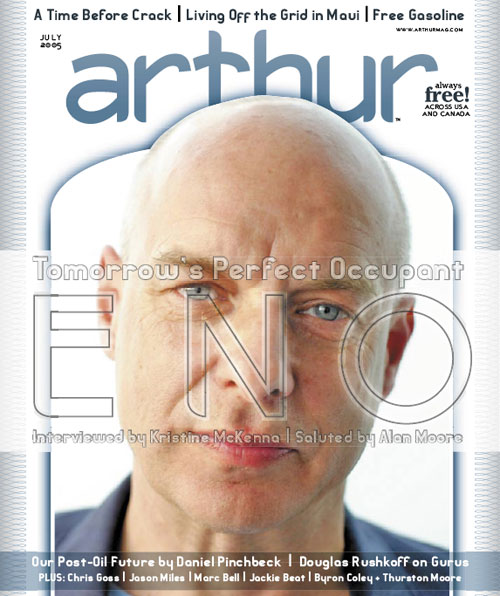
 —his first record of songs in more than two decades—is something of an occasion. This was the ostensible reason we recently hooked up to chat, but as is always the case with Eno, our conversation roamed far and wide. Herewith, a few of the high points.
 Arthur Magazine