Originally published, with photography by Melanie Pullen and page layout by W.T. Nelson, in Arthur No. 10 (May 2004)…
Glitter and Gleam The two sisters who are CocoRosie have made an astonishing, haunting debut album. Trinie Dalton finds out how they did it.
CocoRosie’s debut La Maison de Mon Rêve capitalizes on its sexy feminine allure to seduce the listener into a dream state, one that’s half bliss, half nightmare. CocoRosie’s two singers and sole band members, Bianca and Sierra Casady, could be compared to sirens if their wailing was deeper instead of high-pitched and tweaky like Billie Holiday’s on 45rpm. Listening to La Maison gives you an opiated sense of well-being; here are two beautiful young ladies singing sweet harmonies together, their lyrics about Skittles and diamond rings and other things being disturbed by an undertow of discontent. CocoRosie songs put old folk tunes into new perspective; take the sardonic lyrics that critique Christianity in their cover of “Jesus Loves Me”: “Jesus loves me/but not my wife/not my nigger friends/or their nigger lives/but Jesus loves me/that’s for sure/‘cause the Bible tells me so.” The last song on the album, “Lyla,” is about a child prostitute sold into slavery who “ate McDonalds all day/ and never had a chance to play.” Toys, penny whistles, Casios, and thrift store drum machines keep the beats: they’re reminders of sinister deeds. The magic of childhood is built up then trashed like a sandcastle.
The acts of reminiscing, relishing and examining childhood were a natural place to start for two sisters who hadn’t seen each other in years. Bianca was living in the U.S. while Sierra studied music in Paris. Once Bianca decided to move to France, they found their interests finally overlapping, as Bianca had just begun to write songs…
Q: Sierra studied gospel and opera. Did you study music too?
A: Not at all. I didn’t even start singing really until over a year ago. I used to read poetry out a lot but there was something unsatisfying about it. Then I wrote a small series of songs that weren’t very typical, they didn’t have choruses or anything, and I did a show where I sang them a capella. I felt really good singing. That was right before I went to Paris. I had never sung in front of an audience.
Q:Was it scary when you first started performing?
A: Yes, it was. It was scary but it was a wonderful high simultaneously. I got sort of addicted to it. It was way more intense. I think that my writing is more accessible through music, or more enjoyable. Sierra has been singing most of her life. She always sang. In junior high she was in a choir, she got really into choral music, had a special teacher who encouraged her. Immediately her teachers saw that she had an operatic soprano voice and pushed her into that. She just went for it. So she spent the last five years in music school. She did really well, got many accolades, won awards…she was told that she should go for it. But it takes 100%. Not just of your time, but you can’t want anything else. It’s a thing that’s so hard to succeed in, that you can’t even lie to yourself, you have to want it all, and she didn’t. It was creatively stifling. They didn’t encourage her to compose, or try other types of music. It’s as if that’s your only job in life.
“Everything is worse than ever” A conversation with righteous MC5 manager/poet/scholar/activator and great American JOHN SINCLAIR, who is leaving the country
Introduction by Byron Coley
John Sinclair casts a huge shadow across the American underground. The force of his personality and energy of his vision kept the midwest alive for several years. His writings, howlings and example ignited fires in the brains of kids everywhere, and his return to live performance in the last few years has been a cause for elation.
Sinclair was born in Flint, Michigan in 1941. His father worked building Buicks. John would have followed his footsteps had he not been driven mad by hearing R&B. The music—so alive, foreign, transformational—clicked a switch and he was never the same. In high school John became a party DJ and record nut. After graduation, he found affinity with words, especially those of Charles Olson and the beats. He dropped out of college after two years, getting heavily into jazz, writing poetry and doing drugs. Newly illuminated, Sinclair finished his BA, and began graduate studies.
John’s high profile drew lotsa heat. He was busted for pot in 1964, again in 1965. Shifting his wheels out of the academic rut, along with his partner Leni, John founded the Artists Workshop—a collective involved in publishing, presenting readings, film showings and concerts. He also wrote about high energy music for Downbeat and elsewhere. After Cecil Taylor played him the Beatles’ Revolver LP, Sinclair made the pivotal decision to get back into rock music.
Busted again in 1967, John began a long legal odyssey. At this time, the Artists Workshop transmuted into Trans-Love Energies, and he began working with a young band called the MC5. By filling their brains with righteous dope, free-jazz and politics, a quintet that might have been remembered as the American Troggs was transformed into the pinnacle of free-rock perfection. In 1968, the tribe moved to Ann Arbor and the White Panther Party was founded. The Panthers’ stated goal (revolution via rock and roll, dope and fucking in the streets) seems a bit naive now, but at the time it sounded perfect.
By upping his political content, Sinclair got deeper into shit. After producing the first Detroit Rock & Roll Revival in 1969, he got 10 years for having given a nark two joints. Sinclair continued to write from prison (mostly politically charged music criticism). This work was collected into the essential Guitar Army. [Guitar Army was reissued by Process Media in 2007: http://processmediainc.com] The MC5 couldn’t handle his imprisonment, however, and left Trans Love (at the behest of future Springsteen slave, Jon Landau). Fortunately, others took up his cause. There were numerous benefits, culminating in a massive Detroit rally, featuring John & Yoko, Archie Shepp, Stevie Wonder, Phil Ochs, Bob Seger, the Up and Ed Sanders. In 1971 the case was tossed out.
Sinclair continued to mix politics and music, although the Panthers were folded into the Rainbow People’s Party (a less obstinately provocative organization). A full time political activist, Sinclair lobbied for marijuana reform, involved himself in community work and put together the Ann Arbor Blues & Jazz Festivals. Sinclair also had a book of poetry published in 1988, at which time he returned to the live stage. But by 1991, local politics had bogged him down and he headed south to New Orleans.
Sinclair continued to do radio shows, edit magazines, write about music, and do wild-ass performances of investigative jazz poetry. He formed a band called the Blues Scholars, and recorded explosively syncopated albums of music and words. He also rekindled his friendship with former MC5 guitarist, Wayne Kramer, which resulted in excellent new work, fantastic archival releases and the promise of much more of both. His latest book is a blues suite Fattening Frogs for Snakes and many future projects beckon.
Hearing through the underground grapevine that Sinclair was preparing to exit America, Arthur arranged a phoner with the great man. The following Q & A was conducted by Jay Babcock in July [2003].
ARTHUR: So you’re leaving America.
JOHN SINCLAIR: Yes, God willing.
ARTHUR: And you’re going to…?
SINCLAIR: Amsterdam. I have a patron there and they said if I came over they would take care of me until they could get me set up and then I could call for my wife. That’s an offer I’ve been waiting for all my life. Now I’m old and I can really use it. [laughs] I wanna get the hell out of here. [laughs]
ARTHUR: You’ve been traveling around the last couple of months, so you’ve been getting a good look at the mood of the country. And you can remember when the resistance to the Viet Nam war was starting. Is the current situation—the state of the country now—worse than it was back then?
SINCLAIR: Oh yeah. The people are so much dumber now. They’re just…painfully dumb. They love this guy Bush, they love all this stuff that’s going on, and they’re gonna return him to office in a big way, and it’s gonna get worse and worse. That’s what I see. And except for the occasional glimmer of light like that new issue of Arthur, [laughs] it’s hard to even find people who have any inkling of what they’re doing.
The shame in the church crawls out of each human. A mild sin grows first behind the ears.
The wind: it comes without thought or any use of my hands. My hair grows the same color as the red scarf covering a lamp. I’ve heard of women who lead men into a chamber that is stained like the pit of a cherry. Place something upon the tongue. Go in peace.
Pretending there is no time to stop and look at the old gravestones that lean south, my father keeps driving. The common is cold and blown clear of leaves. This is near Chocksett School playground where a German shepherd tore up my soft back. My father took me to the dog that night to let it smell me. I held it in my arms. We’re all bound to something.
The strain of the body in trauma stresses the heart muscle. When I come up for air, the wind fills my throat before I realize I want it to.
When I think of what I am, I think of this small town. The dog, my back, the women, my dog.
Originally published in Arthur. No. 21 (March 2006)
Mind-Melders At home, at work and at play with visionary artist-musician duo Delia Gonzalez & Gavin Russom
by Trinie Dalton
My boyfriend Matt and I arrived on our bikes to this chic Berlin restaurant that had no sign, and I wouldn’t have known we were at the right place had there not been a long dinner table set outside where a Stevie Nicks-ish redhead sporting a ’70s military jacket sat next to a semi-crusty, spaced out guy with really long hair and a beard that looked matted as if he had just gone scuba diving; his locks looked like they were caked with sea salt. I hope we’re eating with them, I thought, in awe of their awesome style. I also immediately liked them because we were gathered to visit mutual friend, artist AVAF, a.k.a. assume vivid astro focus, a.k.a. Eli Sudbrack, and friends of Eli’s are all jovial and talented. Eli had just come from Brazil via London and was in Berlin for two days before going to Barcelona, or something. Next to him was artist (and also, like Matt and me, summer Berlin resident) Terrence Koh, wearing a buckled-up Michael Jackson leather jacket. Then there was gallerist Javier Peres, the ultimate host, who’d just flown in from somewhere like Greece, England, or the U.S., and was stopping through before a trip to Estonia to pick up travel partner and permanent Berlin resident, Danish artist Kirstine Roepstorff. The other ten people at the table were French or Spanish DJs.
I locked up my bike, sat down, ordered some champagne and a bowl of white asparagus soup, and introduced myself to Delia Gonzalez and Gavin Russom, the most stylish couple in the world. They looked like a couple I could relate to: same age as me, creative, but with a way advanced fashion sense. I chatted with them while I waited two hours for the waitress to come out and tell me they were out of soup, and it was now too late to order more food since the kitchen was closed. Oh well, I enjoyed more champagne and listened to Delia talk about horoscopes and her visit to a highly-skilled psychic. It was a summery night and Delia and Gavin had only spent a few months thus far in their new Berlin apartment, where they moved to escape the New York art world and high cost of living. They met eight years ago in New York. Matt and I enjoyed discussing the beauty of discovering a new city with them. I felt a bond with Delia and Gavin, a sense of expatriate camaraderie, which imbued the rest of my stay in Germany with the comforting knowledge that other youngish American artists were living only blocks away. Even if I didn’t get to hang out with them, since they had an intense traveling schedule, they were still there, making the city cooler. Delia and Gavin made Berlin feel less foreign to me.
Therefore, I first met Delia Gonzalez and Gavin Russom as visual artists. They’ve worked as a pair for the past seven years, used to be a couple but aren’t anymore, and live separately, sharing each others’ apartments; Delia’s house is the art studio and Gavin’s is the music space. I’d seen their sculptures, knew they were represented by Daniel Reich, and seen another piece of theirs in a catalog for a group show in Austria. Their sculptures look like minimalist architecture, gleaming and pristine, hypnotically formal, and are either covered in cowrie shells or sequins. Sometimes they’re laquered or gold-leafed. They have a sort of punk-new age spirit, if one could mention the two together without extreme cheesiness. Their artwork’s punk glamour is cross-pollinated by a fascination with the occult. The sculptures are inspired by Art Deco, the golden age of Disco, and 70s Italian horror movie sets; some pieces have religious undertones, referencing Latin-American and African ceremonial totems and shrines, and illuminated manuscripts. Human-sized cubes and cones get cowrie shell eyes and mouths, transforming simple geometric shapes into magical talisman. Most of their sculptures are soundtracked by Delia and Gavin’s trance-inducing disco.
But Delia and Gavin didn’t begin as a collaborative sculpture team. Delia, originally from Miami, moved to New York in the mid-’90s to dance in troupes like Fancypants. Gavin, from Providence, was hosting magic shows under the name The Mystic Satin when the two met at a loft party. At first, Delia joined The Mystic Satin, while her and Gavin tinkered with prop making, set design and several varieties of modern dance. Since then, they’ve made videos, starring themselves, about zombies who wander Times Square; performed live magic acts dressed as a ballerina (Delia) and a warlock (Gavin); danced in their troupe called Black Leotard Front, and played in a heavy metal band, Fight Evil With Evil. Their first 7” single (and straight-up music project) “El Monte,” came out in 2004. Last October, hip electronic label, DFA (home of LCD Soundsystem and The Juan Maclean) released Delia and Gavin’s first full-length album, The Days of Mars. They’ll be playing some U.S. gigs while here for their art opening at Peres Projects Los Angeles in April. They’ll also be promoting the release of their single and video, “Relevee,” out this month.
Days of Mars is like Brian Eno, Goblin, and Kraftwerk combined into four long synthesizer tracks that are ambient but layered with pulsating rhythm. Gavin makes their analog synthesizers. When you listen to it you feel like you’re traveling to well, Mars. But their music is really more about life on Earth, Delia and Gavin each told me separately over the phone from Berlin. I spoke with them both as they passed their phone back and forth. Their wide range of interests reflect how limitless the idea of making art is to them. Genres don’t matter. Music, video, dance, magic show, sculpture, drawing: they love it all.
ON SCIENCE FICTION SOUNDTRACKS, HOT LESBIAN AUTHORS, AND HOMEMADE SYNTHESIZERS Delia: Days of Mars is named after a Winifred Bryher book. She was Hilda Doolittle’s girlfriend. I had a little crush on her. It’s about WW2 in England. Bryher lived in Switzerland, but when the Germans were bombing England, she went back to support her friends, and kept a diary. The way she described people’s reaction to the war, the way they ignored everything that was going on, reminded me of Bush’s re-election. Everyone was threatening to leave the country, revolt, but when he was reelected, no one did anything about it. Everyone was in denial. “Black Spring,” the fourth song on the album, is also named after a book, by Henry Miller. I found out about that while reading Anais Nin.
I was going to write a poem I made a pie instead it took about the same amount of time of course the pie was a final draft a poem would have had some distance to go days and weeks and much crumpled paper the pie already had a talking tumbling audience among small trucks and a fire engine on the kitchen floor everybody will like this pie it will have apples and cranberries dried apricots in it many friends will say why in the world did you make only one
this does not happen with poems because of unreportable sadness I decided to settle this morning for a re- sponsive eatership I do not want to wait a week a year a generation for the right consumer to come along
REIGN IN BLOOD The secret mark that French pulp villain Fantômas left on the 20th Century
By Erik Morse
Early in 1911 popular French publishing house Fayard released the first of 32 monthly serial novels of Marcel Allain and Pierre Souvestre’s Fantômas. Subtitled ‘A Shadow on the Guillotine,’ this ultra-violent pulp tale recounted the exploits of the eponymous master villain as he reined blood and magick upon the boulevards of Paris. Pursued by police inspector, Juve, and his journalist sidekick, Jerome Fandor, Fantômas slaughters members of French high-society indiscriminately before stealing away with their wealth and, often, their very identities—in his travels between the Dordogne and Paris, Fantômas dispatches the Marquise de Langrune, her steward Dollon, Lord Beltham, Princess Sonia Danidoff, the famed actor Valgrand and a passenger liner full of travelers en route to South America. When Fantômas, alias Etienne Rambert, alias Gurn, is apprehended by Juve at Lady Beltham’s villa, he is brought to trial at the Palais de Justice, found guilty of murder and condemned to the guillotine. However with the aid of his mistress, Fantômas steals away from his Santé prison cell and fills the vacancy with an unsuspecting look-a-like who is left to the blade. When Juve discovers the ruse, he proclaims, “Curses! Fantômas has escaped! Fantômas is free! He had an innocent man executed in his place! Fantômas! I tell you, Fantômas is alive.”
Within months of its February debut, the Fantômas serial became a pop smash with the reading public, profiting no doubt from the French public’s unquenchable thirst for violence, mayhem and pulp. At 65 centimes a copy, sales for each volume reached easily into the hundreds of thousands. American poet and Fantômas enthusiast John Ashbery contends that the real success of the serial was its transcendence of class, education and sex, from “Countesses and concierges; poets and proletarians; Cubists, nascent Dadaists, soon-to-be-Surrealists. Everyone who could read, and even those who could not, shivered at posters of a masked man in impeccable evening clothes, dagger in hand, looming over Paris like a somber Gulliver, contemplating hideous misdeeds from which no citizen was safe.” Such was the popular reaction to the Fayard publication, Marcel Allain would later recall, with some hyperbole, “The adventures of Fantômas have surpassed those of the Bible.”
Nearly a hundred years later, we can see the frightening metastasis of the master of crime’s “brand”—from his beginnings amongst the Right Bank sophisticates who released him upon the world, to the marauding gangs plundering and murdering in his name, to the sacrificial cults who would congregate at the witching hour to reenact his sins. His transgressions—bold, fiendish and inexplicable—were the narratives of nightmares. Fantômas captured the imagination of his admirers and extended his influence through the artistic genealogies of Europe, leaving a catechism of excess, debauchery and violence to a brood as varied as Pablo Picasso, Andre Breton, Jean Cocteau, Georges Bataille, Alain Robbe-Grillet, James Joyce, Guillaume Apollinaire, Robert Desnos, Jean Marais, Alain Resnais, René Magritte, Francois Truffaut and the Mike Patton-Buzz Osbourne-Trevor Dunn-Dave Lombardo art-rock superband of the same name. In their major contributions to the century, the words and deeds of France’s supreme villain pullulate still more revolutionary achievements and still darker crimes.
Here, in this extended fait-diver, is the unedited, uncensored and untold history of the criminal of the century…
This article continues, for 9,500 more words, in Arthur No. 28 (March 2008)
SILLY BEASTS IN SACRED PLACES Karin Bolender on the secret truths that Dollywood reveals
As published in Arthur No. 8 (January 2004), with illustrations by Emily Ryan and art direction by W.T. Nelson
. . . And me astride a mighty rooster, with a raging red crown and swelled breast and silver claws, and it running, running: but suspended, rising and falling slow like tides, like a horse in a dream who gallops without going anywhere-rising and falling with hydraulic and dreamlike monotony, round and round, the same dim motion ascribing its circumference of colored lights and warped music round and again like a lathe into the world’s great big empty bowl. The next time around, it was a goat I rode. (1)
Oh it may have all started way back, when I was nine and saw a unicorn while on a honeymoon in Mexico. It was 1984: the beginning of the end for so many of us, God’s children. Of course nobody believed me. We also saw the Love Boat on that honeymoon, docked in Puerta Vallarta. It was my mother’s second marriage, the real one. But what does it matter now, anyway? That was another age, a virgin country.
And I can tell you, because you already know, how the paths that bring us from childhood to this are crooked and fraught with pitfalls. And this is what we get for our troubles: a soul full of rusty fish hooks and bullet holes, eyes that squint, hands that shake. But there are certain little comforts of adulthood. Whatever your poison happens to be, you seek succor where you can. In a time of great need—starvation, privation, aggravation, a broken heart and a broken head—I found succor at Dollywood.
I suppose I should thank the Bearded Menace, because I never would have discovered Dollywood if he had not smashed up a dream and sent me packing. So it was a fine gift he gave me, in the end. This hotblood from sweethome Georgia who said, “Come on baby, let’s go down south where I am from: I’ll build a mansion in your name, we’ll swim in the black creeks, lay down in the weeds, anywhere we want, lay back on the front porch or on piles of old tires and rock and rock until we are old and wise and ugly to everyone but each other, ourselves. And we’ll hold hands and murmur this dreaming talk with dogs at our feet licking and scratching, rolling in play with our naked children, who will cackle in raucous joy and swing from the scuppernong vines-wild flesh, dying light, faint music wafting in from somewhere. Ripe peaches and pokeberries’ll be washed clean and brought to the porch steps for us by possums and coons. Fruits of the land collected and carried to us by the crows and ants and snakes, who will all gather round in the evening to hear us speak in tongues and sing tales of these very days we are living now and the glory days to come, full of moon-age romance and steamy concupiscence, and don’t forget adventuring, on the sea, in the air, by camelback and purple Triumph: come on baby, let’s go down. Go down with me.”
Back in 1984, when I saw the unicorn in the month of November, I knew that you only have to believe in something enough to make it come true. I knew this because my mama told me, and it was confirmed by Robert Vavra’s 1984 “Unicorns I Have Known” calendar, which advised the following “to the pure of heart: watch carefully entering each forest glade as though you were the first human to set foot there; take time to sample pollen carried on a golden breeze; do not use deodorants or insect repellents or wear leather shoes or belts; and believe. Yes, above all, believe, and you will surely meet as lovely and noble and snow-white a single-horned creature as any who pirouette upon these pages.”
And so I did. All over 1984, I scrawled with the new calligraphy pen that was also a Christmas present that year: “I BeLIeVe! UnICorNS arE ReAl! UniCoRNs LiVe in 83! I [HEART] UNicOrnS!” And almost a year later, on the honeymoon, it came true. Nobody saw it but me. Not even my mother, who was wrapped up in her own love dream in the Mexican jungle, brighter and more free and happy than she had ever been before, or has been ever since.
* * *
“Women are so wise. They have learned how to live unconfused by reality. Impervious to it.” (2)
This comes from William Faulkner. But it might just as easily come from the pages of Dolly Parton’s autobiography, Dolly, if you read between the lines. Or it could be painted like a motto in twenty-foot letters, alongside a gigantic pink butterfly and an even more gigantic image of Dolly herself, all a-sparkle with sequins and high nest of golden hair, on one of the billboards along the highway in northeast Tennessee, advertising how many miles are still to go before the pilgrim shores up at Dollywood.
But of course, that couldn’t be. Because what lies under the however-many square acres of the Dollywood park is not the glitterful attractions and family entertainments that lure people in, but an old organic thing buried beneath. A mighty powerful secret. Primeval, even.
But oh, the unicorn: it’s not that I ever really forgot it, it’s just that after a while, in time, that quarry was overrun with the dream of other beasts-boys and men, but mostly boys. And with pubescence, I began a metamorphosis into a new and strange kind of being myself: some kind of rootless hairy hallucinating mushroom with linguistic and motor skills.
As if the hormones of pubescence themselves are this bewitching and infinitely powerful kind of hallucinogen, the effects of which never quite wear off, and make you hear and see, and more so believe, all sorts of beautiful monstrosities and warped miracles that fall under the rubric of sexlove. Wild imaginings like “I saw a unicorn” get replaced by wilder ones, like “I will love you forever.”
And somewhere along the seam between childhood and this circus that is sexlove, we are supposed to weed out illusions and fantasies and find out what reality is. A dark time is had by all, for a while anyway. But most of us make it out of adolescence somehow, and emerge as more mature human beings with hopes and desires and even, heaven help us, beliefs. Beliefs are great and all, until they stray toward the sayings and doings of other people. Then, we are all screwed. Yes, that’s exactly what we are.
Well, that’s how I got screwed by the Bearded Menace anyway. Hell, you heard what he said! Let’s see you try to not fall in love with somebody who vows, with an avowal disturbingly familiar to the last letter-every pitch and note and rhythmic twang-to work to construct the world newly every moment, build it with words and woods and other raw materials into what he believes it should be, all the forms and lights and glories, that seem to be exactly what you have been longing and working for all this time, and trying to build, alone. Just see if that doesn’t get all your electrical juices flowing. Silly beast, you believed in this—that the words and deeds building up between the two of you were plank-for-plank making something real and solid of a dream, and not just playing around in funhouse mirrors.
Well, when the blue lightning was over down in Georgia, the darkness that followed was profound. I was thinking all this over one evening, lying there alone in twisted sheets, in the fall, in his parent’s attic, when it was dead. That is when it came to me like a startling burst, hovering over the dark filthy futon, in the sheets full of our scabs and little bloodstains left over from the plague of seedticks we had suffered together with our mutts. And the last kiss—a desperate end-kiss. I will tell you. It was something I had never thought of before, but suddenly there it was. DOLLYWOOD. That’s how it came, a vision, like Jim Morrison’s Indian. Except it was not a figure but a booming sourceless voice that came into my head, out of nowhere, and commanded, “YOU MUST GO TO DOLLYWOOD.”
What? You mean Dolly Parton’s theme park? What the hell?
“NO, NOT HELL, THAT’S TOO EASY. DOLLYWOOD. GO THERE. GET THEE.”
And how can you argue with a booming sourceless voice that commands you to go somewhere, especially when you are no longer welcome where you are, and you have nowhere else in mind to go?
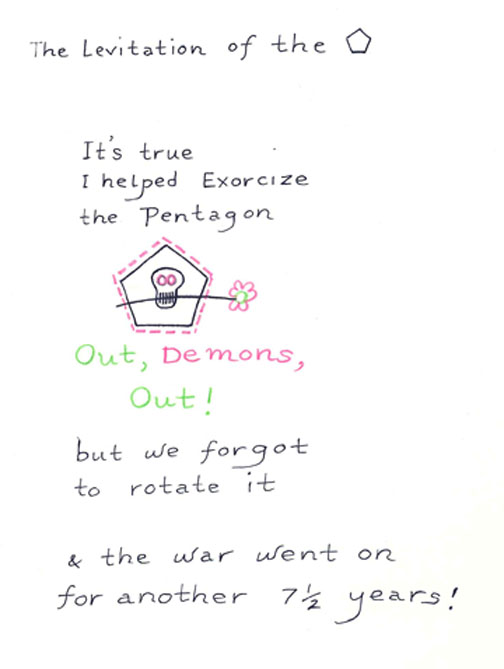
This refers to the Oct. 21, 1967 exorcism of the Pentagon. A 10,000-word oral history of the event, including testimony from Mr. Sanders himself, was the cover feature for Arthur No. 13.
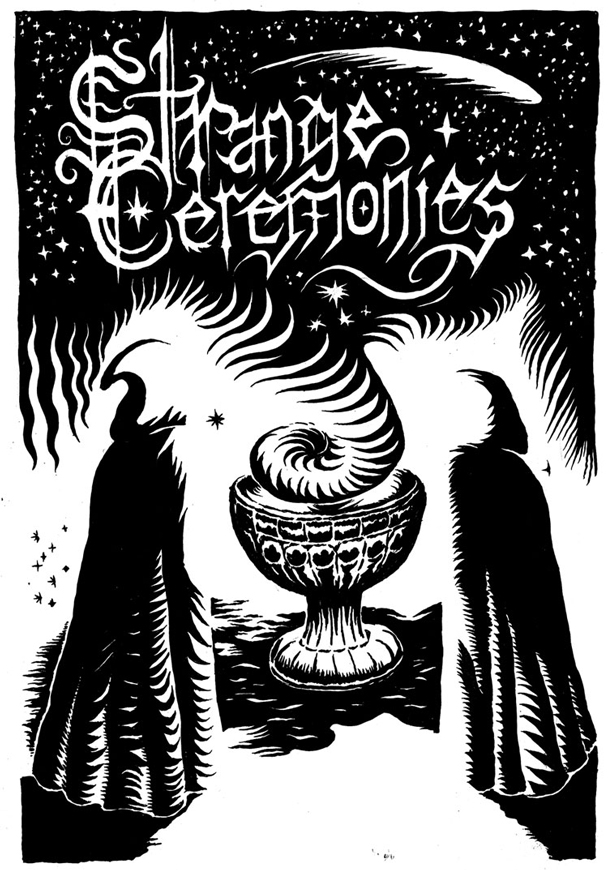
Lane Milburn was born in Lexington, KY and studied Painting at the Maryland Institute College of Art. He currently lives in Baltimore, MD. He is currently at work on a long science fiction graphic novel that is coming along in fits and starts. His new book DEATH TRAP is available from Sparkplug Comics (http://www.sparkplugcomicbooks.com/) or directly from Lane at: http://closedcaptioncomics.blogspot.com/2010/03/death-trap-has-arrived.html






 Arthur Magazine