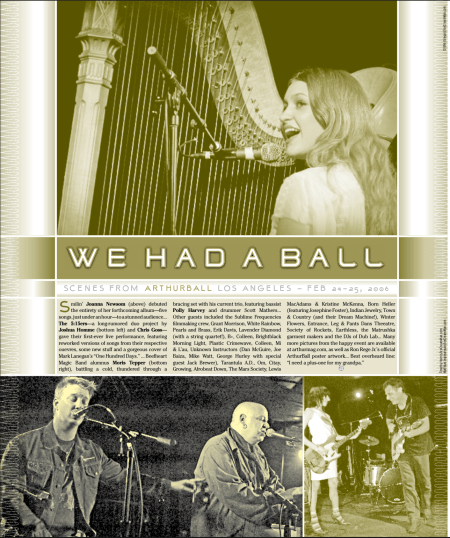
ARTHURBALL, 20 years later

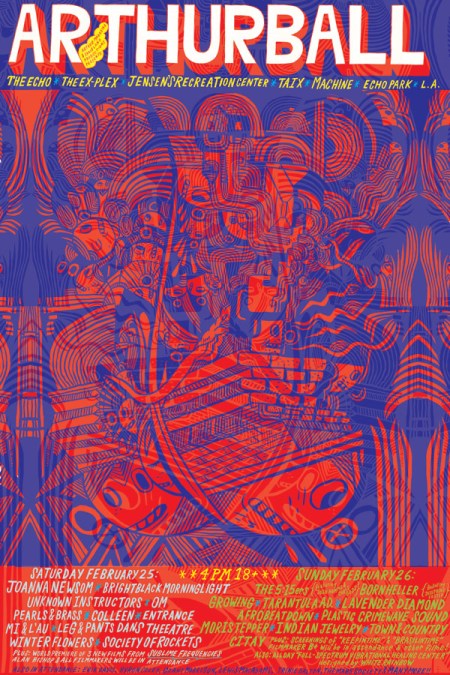
ArthurBall — a two-day, 1,000ish-capacity, multi-venue music & culture festival in Echo Park on Feb. 25-26, 2006, curated by Arthur Magazine and produced by Spaceland Productions — was the second of three Arthur festivals in a period of 14 months. Our ludicrous idealism was nearing its peak. I reminisce a bit about it in the latest (paywall-less) Landline. —Jay

"Preserve That Beauty": talking with CHRIS GOSS of MASTERS OF REALITY

Two endangered species, photographed by Stephanie Smith

A MAGICAL SKILL
Chris Goss, a godfather of desert rock, on the return of Masters of Reality
By Jay Babcock

Originally published November 11, 2010 in LAWeekly

Chris Goss, the 52-year-old leader of Masters of Reality, is near tears. A mountain of a baldheaded man, part Aleister Crowley, part Admiral Kurtz, Goss has been involved in some of the most vital rock ‘n’ roll music made in the last two and a half decades. Masters of Reality’s 1988 debut, a masterwork of concise songwriting and classic rock riffage, was produced by Rick Rubin; their second, the lovely Sunrise on the Sufferbus, featured an actual classic rocker, the formidable Cream drummer/crankyman Ginger Baker.

Around that time, Goss discovered a group of teenagers from the California Low Desert called Kyuss, who played a heavy, trippy mix of Black Sabbath and the Misfits. Goss produced Kyuss’ best work, inaugurating a relationship with guitarist Joshua Homme that would continue into the latter’s subsequent Desert Sessions and Queens of the Stone Age projects.

And while there would be other Masters of Reality albums, other production gigs of varying profile and quality — my favorite is Mark Lanegan’s Bubblegum — and an album-and-a-half as Goon Moon, a bizarro-rock collaboration with Marilyn Manson guitarist Twiggy Ramirez (and, on the first EP, underground free-rock drummer Zach Hill), generally speaking, Goss has slipped into legend: one of those musician’s musicians, a guy who knows the occult secrets of the creative process and can get a great drum sound, who somehow, in this devolved age, still feels it.

Which, I think, is why he’s near tears, as we sit on a patio outside his Joshua Tree home. Masters of Reality have a new album out — a beautiful, musically adventurous, warm affair with double-name Pine/Cross Dover — and are about to play a set of West Coast dates. It’s the first time in years that Goss has been able to line everything up: a great album, a happening band, U.S. gigs. But who is there to hear anymore?

“Hard time for art right now,” he says. “Socially, politically, economically — this is awful right now for everyone, this confusion. We’re in the new Dark Ages. It’s very hard and depressing, and you get angry because just so much attention is paid to so much shit. It’s a shit storm. But there’s no reason to stop making music. The market is down? Fuck the market. If you love what you’re doing, you gotta keep doing it.”

Even making record albums, when record stores are going out of business and everything is available for free on the Internet? Isn’t that tactile experience over?

“I love the album format. I’ll never lose that. Never. I don’t want to lose it. I mean, why can’t we keep experiencing it? It’s easy, it’s palatable. I’m so used to buying music in my hand and I can’t get over it. Packaging matters. The visual album-cover connection to the music matters. Remember the gatefolds with the storybooks in them and the pop-up photos and stuff? This kind of thing is a boutique, elitist origami item now, but when I was a kid it was a five-and-dime item. I remember how it felt when I had Jethro Tull’s Passion Play in my hands as a kid, from a poncy Shakespearean Renaissance Faire English hippie guy, knowing that, like, another million kids also were reading this storybook. There was this feeling that so many other people were experiencing what I was experiencing, at the same time. It was like combining that Harry Potter intrigue with the music for the kid of the time. That’s empowering. Those records connected us. …”

The music experience is more than what meets the ear — is it about actual physical contact?

“This is about warmth, and beauty,” Goss says. “Now vocal tuning is everywhere. What a horrid tone. The chipmunk-robot people are here! Great. Lovely. Did you see Shania Twain live at the CMAs this year, maybe last year, with a vocal tuner on her voice when she was singing live? “And! I! Love! YouuuuUUUU!” It puts that thing on the tone at the end, an artificial lengthening of when you land on the note. So the person’s natural phrasing is gone. Why? When Lennon was flat, it was wonderful. When Keith Richards is flat, it’s wonderful. Because it sounds like the guy is sitting right next to you. He hasn’t been chopped to spam before he gets to you.”

People don’t even know what they’re missing.

“I remember going to see Yes in the ’70s, back when people knew the lost art of properly mic-ing an acoustic guitar live. It has to have a low end, so that if you bump the guitar with an elbow, the PA goes boomf. You need that full spectrum of sound — you gotta feel the chest, and the belly, that part of the sound spectrum. Music should come through your chest, your eyes, your belly, that part of the sound spectrum. I think that’s my favorite part.

“There’s some great Israel Regardie Golden Dawn meditation tapes,” he says, describing one of Crowley’s disciples and his mystical society, “where he talks about getting into a state where your body is made out of spiderweb, like mesh. Continue reading

NEW AEON MASTERS OF REALITY

New Masters of Reality album out in North America in October, with tour (!). Info: mastersofreality.com

Chris Goss: beloved Masters of Reality mainman for twenty-plus years—a storied New York band whose debut album was produced by Rick Rubin and released on American Records, which was followed by a move to California and some time on the record label that brought us Tone-Loc. For two years, three tours and a studio album, Masters of Reality’s drummer was legendary fiercehead Ginger Baker of Cream. Pine/Cross Dover is the band’s first studio effort in five years, and finds longtime drummer John Leamy once again on skins, joined by Brian O’Connor on bass, and Dave Catching (Eagles of Death Metal, Earthlings, QOTSA, etc) and Mark Christian on guitars.

Here’s the two covers for the new album, and the opening salvo…

263_BRH9905-Animated_300

Download: “King Richard TLH” — Masters of Reality (mp3)

Stream: [audio:http://www.arthurmag.com/magpie/wp-content/uploads/2009/08/King-Richard-TLH-128.mp3%5D

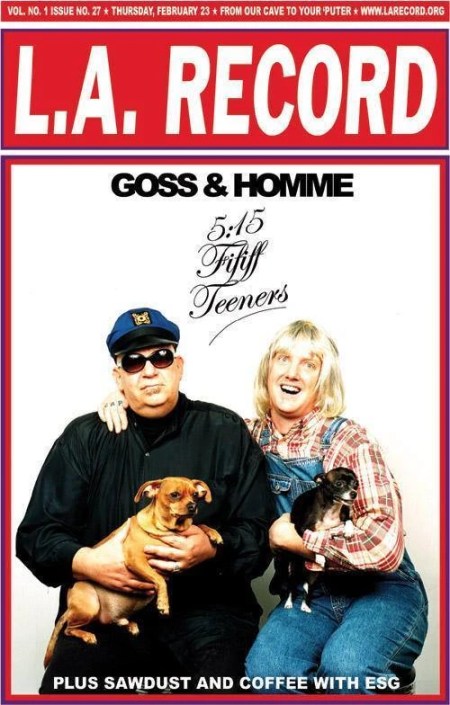
Goss is also known as: Kyuss producer, occasional Queens of the Stone Age/Desert Sessions member/collaborator, UNKLE contributor, and, with Twiggy Ramirez and Zach Hill, one-third of Goon Moon. As one-half of the pictured-below The 5:15ers (QOTSAer Josh Homme was the other half), he headlined the second night of ArthurBall in Los Angeles in spring 2006.

LARecordBall

Let’s have some classic Masters from the past. Here’s a couple from the Ginger Baker era, first up is a live rendition of “John Brown” off Masters’ first album…

“Mister Who?”: A video by Casey Niccoli from the Ginger Baker era…

A live one from the Queens era…

And an unbelievably majestic 1999 live take on another classic from Masters’ first album…

Also….

“Sound Methods and Weird Channels: How producer and Masters of Reality main man Chris Goss got his groove” (2004 profile I did for the LAWeekly)

Goss is the author of arguably the best piece of neighborhood/cooking writing to appear so far in the pages of Arthur: check out his super-porkout Immigrant’s Sauce recipe/reminisence from the Brian Eno cover ish (No. 17, July 2005—still available, collectors!).

Let’s wrap it up with a message/manifesto to artists from Goss…

One from the Desert Files: CHRIS GOSS (2004)

Sound Methods and Weird Channels
How producer and Masters of Reality main man Chris Goss got his groove

by Jay Babcock

Originally published August 26, 2004 in the LAWeekly

Over a recent leisurely afternoon lunch at Silver Lake’s Astro Family restaurant, musician/producer Chris Goss is in muse-aloud mode.

“Music usually makes its way into the hands that want it,” he says quietly. “Eventually, if you’re meant to have it, it’ll get to you, through weird channels that you’d never expect.”

I’m catching up with Goss at an interesting point in his career. The night before, he was in Studio City, contributing work to the new Queens of the Stone Age album at the request of longtime friend Joshua Homme, with whom Goss has collaborated since taking Homme’s desert-rock teenagers Kyuss under his producer’s protective wing in 1992. (Goss was featured on last year’s Homme-supervised The Desert Sessions Volume 9 & 10 in a duet with PJ Harvey on the desolate “There Will Never Be a Better Time.”) QOTSA co-vocalist Mark Lanegan’s new solo album, Bubblegum, which Goss co-produced and performs on, is finally out. Goss just finished producing the new album from buzzed-up Britfreaks the Eighties Matchbox B-Line Disaster, and is itching to start writing songs in a new project called Sno-Balls [eventually renamed Goon Moon—Ed.], with ex–Marilyn Manson bassist Twiggy Ramirez and Hella drummer Zach Hill. And his old band, Masters of Reality, has a new album out.

Well, in Europe, anyway. Like the last three Masters albums, Give Us Barabbas has no American distribution and is available only as an import at specialty stores on- and offline. And Barabbas, technically credited to “Masters of Reality/Chris Goss,” is not really a “new” album, it’s a collection of Goss-penned songs from the last 20 years that have gone previously unreleased in studio form. Why many of these songs are only appearing now is a long, serendipitous story involving Rick Rubin, band turnover, a grunge-choked ’90s marketplace inhospitable to the Masters’ varied classic rock sound and non-pretty-boy look, an impasse with a major record label, a “lost” album and Goss’ busy career as a producer. Cautionary and instructional as that tale may be, it is ultimately less important than the songs themselves: gems like the windswept, string-laden “The Ballad of Jody Frosty,” the campfire sing-along “I Walk Beside Your Love,” the majestic chorale “Still on the Hill,” the country-blues chantey “Bela Alef Rose,” the gorgeous epic “Jindalee Jindalie.” Any collection spanning two decades inevitably carries with it the air of biography, and Barabbas is certainly that; but it also feels like a secret monograph—a collection of timeless scrolls from a legendary Master that will be passed among acolytes and disseminated to those who are meant to hear it.

“Whatever will be, will be,” says Goss, with a smile.

Continue reading

Nov. 4, London: Ginger Baker's 70th Birthday Jam at Jazz Cafe

Mighty Chris Goss will be joining Steve Winwood, Jonas Hellborg, Eric Clapton, Jon Lord, Charlie Watts, Courtney Pine, Kofi Baker, John McLaughlin and of course Ginger Baker at Ginger’s 70th Birthday Party Jam on November 4 at London’s famous Jazz Cafe.

Chris sez: “We’ll be covering 45 years of musical selections that span the career of one of the centuries most influential musical geniuses. It looks like we may be including a song or two from Masters of Reality’s ‘Sunrise on the Sufferbus’ as well.”

The night before the jam Ginger will be honored at a dinner hosted by Classic Rock Magazine.

Goss adds: “Since Ginger has been living in South Africa, this is a rare, mindblowing occasion to reunite with a dear friend and musical mentor that taught me so much.”

Interview with a Master

KTVU.com Talks To Goon Moon’s Chris Goss
By David Pehling

UPDATED: 12:55 am PDT October 26, 2007

http://www.ktvu.com/entertainment/14424829/detail.html

He may not be a household name, but guitarist, songwriter and producer Chris Goss has had a sizeable influence on the sound of underground hard rock over the past two decades. His band Masters of Reality was one of uber-producer Rick Rubin’s great discoveries in the ’80s, showing a depth and level of songwriting rarely heard hard-rock groups of the era on its eponymous debut for Rubin’s Def American label.

Though the band dissolved soon after the release of the album, Goss would later resurrect the band with such illustrious members as former Cream and Blind Faith drummer Ginger Baker. Around this time the musician would enter into another line of work after providing his services as producer for downtuned Palm Desert band Kyuss. The three early ’90s Kyuss albums he helmed in the studio — Blues for the Red Sun, Welcome to Sky Valley and …And The Circus Leaves Town — would become hugely influential to legions of so-called “stoner rock” bands that would follow, mixing elements of psychedelia and monolithic, Sabbath-flavored heaviness.

Goss would continue his collaboration with Kyuss guitarist Josh Homme as producer on several Queens of the Stone Age albums and as a principle player on recordings for Homme’s Desert Sessions side project. The songwriter has continued to use Masters of Reality as a creative outlet, but Goss takes to the road for the first time in ages with his latest band, Goon Moon. Teaming with former Marilyn Manson/A Perfect Circle and current Nine Inch Nails band member Jeordie White (aka Twiggy Ramirez) as well as an A-list group of players including Homme, frequent Desert Session member David Catching and monster drummers Zach Hill (of the band Hella) and Josh Freese (Guns N’ Roses, The Vandals and both NIN and A Perfect Circle with White), the group’s sophomore effort on Ipecac Records Licker’s Last Leg ranges from noisy, experimental dissonance to bracing, hook-filled heavy songs that would sound perfectly at home on modern rock radio. In advance of playing their second show ever at Mezzanine in San Francisco opening for acclaimed British electronic act UNKLE (who’s latest album he produced), Goss took time out to talk to KTVU.com about his rich history in music and his latest projects.

KTVU.com: The songs on Masters of Reality’s debut album were much more sophisticated than the material being recorded by most hard-rock bands in Los Angeles at the time. You managed to sound much more seasoned than the legions of late ’80s bands copying AC/DC or Aerosmith. You were in your late 20s when the debut came out; what previous band experience did you have and had you put out anything prior to Masters of Reality? Were you just working in various bands that never quite got to that level leading up to that band?

Chris Goss: Yeah, basically that was it. I was a club DJ too.

KTVU.com: Really? DJing in rock clubs?

Chris Goss: No, I liked really early electronic stuff. I started spinning records when I was 20 years old. I was spinning Kraftwerk, early industrial stuff and the Psychedelic Furs. Early ’80s all the way through mid ’80s dance music. I was actually one of the first DJs in the country to play Madonna’s stuff.

KTVU.com: Was that after you’d moved to LA?

Chris Goss: No, that was in New York.

KTVU.com: Maybe I should go back a little further. I don’t think of Masters of Reality as from the LA rock scene, but I guess I always associated you with Southern California because of the link to Rick Rubin and American Records.

Chris Goss: When Rick moved from New York and moved his base from Def Jam to Def American, I came out with him.

KTVU.com: So you knew him already in New York?

Chris Goss: Just prior to him putting out our first record, we started hanging out.

KTVU.com: So you were DJing in New York at the same time you were playing guitar in bands?

Chris Goss: I originally came from Syracuse. That was my hometown and I started spinning records there. I’d also played in some punk band in the late 1970s. But my roots go back to when I started listening to music when I was really, really little. I bought my first Beatles album when I was six years old. So it really started early; going out and buying records and aping them as much as I could. I think one of the reasons Masters of Reality stood out at the time is that the water ran a little deeper than most bands as far as the background and the musicianship and what our influences were.

We were never a dumb-ass metal band. I was actually repulsed by that. The championship wrestling kind of quality to metal that Spinal Tap made fun of, you know? And as the ’80s progressed, I realized where my roots were really was classic rock. I was weaned on Beatles, Stones, Zeppelin and other classic rock records. That’s were I felt comfortable. So after going through all these different stages over all the years and listening to lots of stuff, applying all these different aesthetics from different styles of music, that’s what made it what it was. And probably what made it not as big as other things that were going on (laughs).

KTVU.com: It was definitely a very refined distillation of a lot of influences…

Chris Goss: I think Jimmy Page and Robert Plant – to reach back as obvious examples people can relate to – were musicians who were playing hard rock music but when they went home at night, what they listened to wasn’t other hard rock bands. They were listening to more exotic music. I mean, you can hear James Brown and Barry White in mid-70s Zeppelin stuff. You could tell they were listening to the soul music that was going on at the time. And that kind of gets ignored by the dumbed down metal press. These guys don’t go home and listen to Judas Priest. Robert Plant is a musicologist; he keeps up with everything. It’s a matter of keeping aware. You never go stale that way.

KTVU.com: As a respected producer now, is there anything you took away from your experience working with Rick Rubin that has carried over into your own processes as far as producing bands or producing your own material?

Chris Goss: I think I learned what not to do more than what to do. That first record that Rick did, the band was at odds with each other. It wasn’t a very fun record to do. It had a lot to do with where we were all at personally with each other. At that point, I decided that this wasn’t what I’d worked all these years to do and that I wanted to have more fun doing it. The process shouldn’t be belabored or miserable. That record still rings of a very difficult period for me. So from that point on, I’ve gauged the quality of what I’m working on to how much I enjoy doing it. Very few times do miserable records come out well.

KTVU.com: I’m surprised there was so much tension surrounding that album. It’s one of my favorite hard-rock records of the last two decades. There’s a great resonance to it and I still listen to it regularly today. Though I guess the fact that the original band split up not long after it came out hinted that there were some problems. When you decided to put Masters of Reality back together a few years later, you end up working with former Cream drummer Ginger Baker. How did that come about?

Chris Goss: I met him at a barbeque and someone suggested that we jam. And a few days later, we did. We got along really wonderfully musically. It was instantaneous, really. At the end of the jam that day, he said “We should do something together.” So we did.

KTVU.com: Your association with Josh Homme from Queens of the Stone Age dates way back to your production work on several albums with his hugely influential “desert rock” band Kyuss back in the early ’90s. How did you end up meeting the band and producing them?

Chris Goss: Actually, my wife had received a demo of theirs from a friend and she loved it. And then I caught on to it. We went and saw them play their first LA show, I believe in 1990. There were just a few people there in a really small club. And it was such a breath of fresh air; there wasn’t much metal or hard rock out there at the time that was doing it for me. And they swung; I think that was the thing that made the difference to me. It wasn’t that uptight, staccato style of rhythm. It was very swinging and slow moving. I just think of swing when I think about why I loved Kyuss so much. And they were tuned down lower than anybody at the time. The reason that I got involved with it is that they were tuned down so low and were so original sounding, I was afraid some metal producer – whatever that means – would get a hold of them and ruin it. You know, make them tune up and play more like the flavor of the day whether it was Megadeth or Pantera or whatever was going on at the time.

And so I just really wanted to get it the way they were playing it and record it that way as I was sitting there watching these kids. I hadn’t planned on being a rock producer; I was pretty much content being a songwriter and a guitarist/singer. At this point Ginger was in the band and I pretty much had a course set for myself. Then I saw Kyuss and thought ‘Well, let me be the guy who turns the tape recorder on for them and allows them to be themselves.’ And that was the whole story really.

KTVU.com: Something that’s always struck me about Kyuss is the wealth of great songwriters they had. Usually in a hard rock band you have one or two people writing songs, but here you had Josh Homme and drummer Brant Bjork coming up with great material as well as John Garcia and at various points Nick Oliveri and Scott Reeder. To what extent did you have a hand in determining what songs would make it onto the albums?

Continue reading