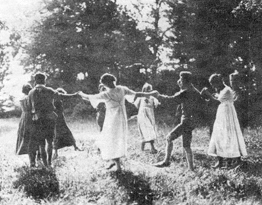
“Children of the Sun: German and California Proto Hippies” by Robby Herbst

It’s fig season in California. Those sweet tree warts are beginning to sag with the weight of their sugars. True bliss for urban and rural foragers alike. The season reminds me of these folks…

Natural music and vine ripe watermelon with Gypsy Boots and his talented friends on a summer day in Hollywood,1948. Gypsy Boots and his pals would often travel over 500 miles just to pick and eat some fresh figs.

Seven of California’s “Nature Boys” in Topanga Canyon, August 1948. They were the first generation of Americans to adopt the “naturemensch” philosophy and image, living in the mountains and sleeping in caves and trees, sometimes as many as fifteen of them at a time. All had visited and some were employed at “The Etropheon” where John Richter gave his inspiring lectures about raw foods and natural living.

This magnificently illustrated book chronicles the philosophy, lifestyle and dissemination of Lebensreform, (Life Reform – “neither communism nor capitalism, but land reform”). In reaction to industrialization, from Hermann Hesse and the artist Fidus wanderings through pre-WW1 Germany in edenic bliss to Bill Pester going natural in a Palm Springs canyon. Pester, a German born immigrant, was counted in the 1920 census as one of the 24 members of the Cahuilla tribe.

[image missing]

Bill Pester at his palm log cabin in Palm Canyon, 1917; note palm blossom walking sticks leaning on left side of the door.

Man was intended to live in a state of nature. All man’s troubles, sickness, anxieties and discontent come from a departure from nature. I would advise you to go back to nature, if you want to be cured; give up your extravagant habits, your high-priced hotel life, quit taking medicine and discharge your doctor. -Bill Pester

Image by Fidus

cs7.jpg

Wandervogel means “migrant birds/free spirits.”

Why are so many Americans in prison?

from Boston Review

Why Are So Many Americans in Prison?

Race and the transformation of criminal justice

Glenn C. Loury

The early 1990s were the age of drive-by shootings, drug deals gone bad, crack cocaine, and gangsta rap. Between 1960 and 1990, the annual number of murders in New Haven rose from six to 31, the number of rapes from four to 168, the number of robberies from 16 to 1,784—all this while the city’s population declined by 14 percent. Crime was concentrated in central cities: in 1990, two fifths of Pennsylvania’s violent crimes were committed in Philadelphia, home to one seventh of the state’s population. The subject of crime dominated American domestic-policy debates.

Most observers at the time expected things to get worse. Consulting demographic tables and extrapolating trends, scholars and pundits warned the public to prepare for an onslaught, and for a new kind of criminal—the anomic, vicious, irreligious, amoral juvenile “super-predator.” In 1996, one academic commentator predicted a “bloodbath” of juvenile homicides in 2005.

And so we prepared. Stoked by fear and political opportunism, but also by the need to address a very real social problem, we threw lots of people in jail, and when the old prisons were filled we built new ones.

But the onslaught never came. Crime rates peaked in 1992 and have dropped sharply since. Even as crime rates fell, however, imprisonment rates remained high and continued their upward march. The result, the current American prison system, is a leviathan unmatched in human history.

According to a 2005 report of the International Centre for Prison Studies in London, the United States—with five percent of the world’s population—houses 25 percent of the world’s inmates. Our incarceration rate (714 per 100,000 residents) is almost 40 percent greater than those of our nearest competitors (the Bahamas, Belarus, and Russia). Other industrial democracies, even those with significant crime problems of their own, are much less punitive: our incarceration rate is 6.2 times that of Canada, 7.8 times that of France, and 12.3 times that of Japan. We have a corrections sector that employs more Americans than the combined work forces of General Motors, Ford, and Wal-Mart, the three largest corporate employers in the country, and we are spending some $200 billion annually on law enforcement and corrections at all levels of government, a fourfold increase (in constant dollars) over the past quarter century.

Never before has a supposedly free country denied basic liberty to so many of its citizens. In December 2006, some 2.25 million persons were being held in the nearly 5,000 prisons and jails that are scattered across America’s urban and rural landscapes. One third of inmates in state prisons are violent criminals, convicted of homicide, rape, or robbery. But the other two thirds consist mainly of property and drug offenders. Inmates are disproportionately drawn from the most disadvantaged parts of society. On average, state inmates have fewer than 11 years of schooling. They are also vastly disproportionately black and brown.

How did it come to this? Continue reading

NYPD covert surveillance for RepubCon 04 – update

The New York Times- August 7, 2007

Judge Orders Release of Reports on ’04 Surveillance

By ROBERT D. McFADDEN

A federal judge yesterday rejected New York City’s efforts to prevent the release of nearly 2,000 pages of raw intelligence reports and other documents detailing the Police Department’s covert surveillance of protest groups and individual activists before the Republican National Convention in 2004.

In a 20-page ruling, Magistrate Judge James C. Francis IV ordered the disclosure of hundreds of field intelligence reports by undercover investigators who compiled dossiers on protest groups in a huge operation that the police said was needed to head off violence and disruptions at the convention.

But at the behest of the city and with the concurrence of civil liberties lawyers representing plaintiffs who were swept up in mass arrests during the convention, the judge agreed to the deletion of sensitive information in the documents to protect the identities of undercover officers and confidential informants and to safeguard police investigative methods and the privacy of individuals caught up in investigations.

The city had largely based its contention for nondisclosure on the need to protect those identities and methods, and had also argued against disclosure because the public might misinterpret the documents or the news media sensationalize them.

But the civil liberties lawyers insisted that the documents — even without the sensitive materials — were needed to show in court that the police had overstepped legal boundaries in arresting, detaining and fingerprinting hundreds of people instead of handing out summonses for minor offenses.

The ruling was the latest development in the long-running case, which posed thorny questions about the free speech rights of protesters and the means used by law enforcement officials to maintain public order.

It appeared that the plaintiffs, who had denounced the police for trampling on the civil liberties of protesters who were fingerprinted and detained at length for minor offenses, had largely won the day, while the city had achieved a more limited objective.

The city and the Police Department have come under intense scrutiny over the surveillance tactics, in which for more than a year before the convention undercover officers traveled to cities across the country, and to Canada and Europe, to conduct covert observations of people who planned to attend. But beyond potential troublemakers, those placed under surveillance included street theater companies, church groups, antiwar activists, environmentalists, and people opposed to the death penalty, globalization and other government policies.

And as the convention unfolded, more than 1,800 people were arrested, mostly for minor violations, and many were herded into pens at a Hudson River pier and fingerprinted instead of being released on summonses or desk appearance tickets, which are more customary for such minor charges.

As scores of federal lawsuits challenging the mass arrests on Aug. 31, 2004, were filed in Federal District Court in Manhattan, with plaintiffs claiming wrongful detentions of up to two days and other violations by the police to keep protesters off the streets, the outlines of the extensive covert surveillance operation began to emerge from court records.

In March, The New York Times disclosed details of the sweeping operation, including a sample of raw intelligence documents and summaries of observations from field agents and the police cyberintelligence unit. Some plaintiffs and their lawyers, seeking to bolster their cases, asked the court to disclose the documents. In May, Judge Francis allowed the disclosure of 600 pages of secret documents relating to preconvention security preparations.

But a second batch of documents, including pictures and reports by undercover agents detailing which protest groups were infiltrated and the results of the surveillance operations, remained in contention. The city argued that disclosure would reveal sources, methods and other information that might compromise current and future investigations, while the plaintiffs contended that the reports would disprove city claims that the protesters planned to engage in violence, and would show that mass arrests had been unnecessary.

In his ruling yesterday, Judge Francis acknowledged that some information in the documents needed to be protected. He himself edited out what he regarded as privileged law enforcement information in many “field intelligence reports” from agents covering confidential sources and techniques. And he did not order the release of documents in which the Republican convention was not mentioned.

But he rebuffed city arguments that general information gathered about an organization would necessarily jeopardize confidential police matters. “It is difficult to imagine how someone could determine the identity of an undercover officer simply from the fact that he or she was present at a meeting or protest attended by dozens, if not hundreds, of people,” the judge declared.

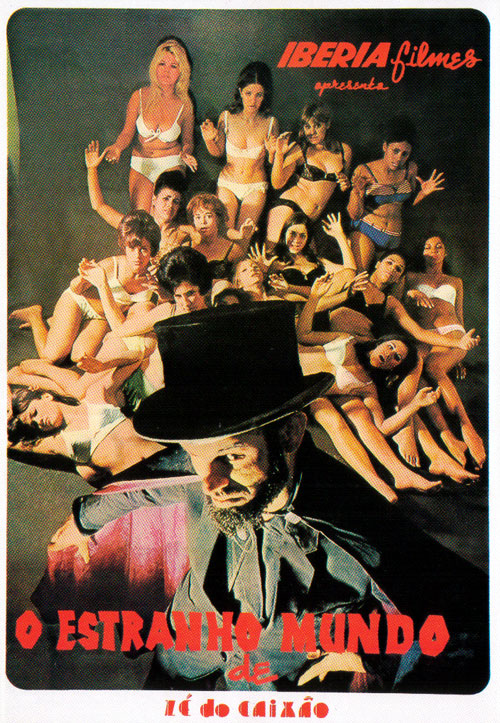
"Kingdom of Fungi" Mouse Pad by Taylor Lockwood

“Another show-stopper from Taylor Lockwood, this durable rubber-backed computer mouse pad features a breathtaking photographic composition of colorful forest fungi. Not some photo-booth quick-print accessory that will quickly smudge or fade, this is a high-quality, professionally printed product that will grace your desk or workstation for years to come. Measures 9 1/4 x 7 3/4″ , with a 3/32″ rubber backing.”

Available from Fungi Perfecti, of course. Be a dear and tell them Arthur Magazine sent you.

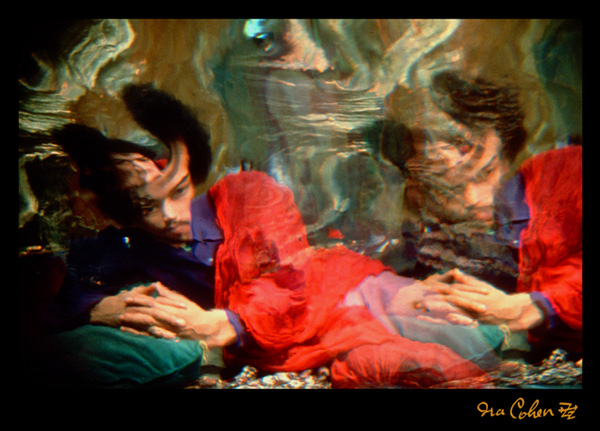
ENDS AUG. 7 – ebay auction to benefit Arthur Magazine: Jimi Hendrix, photographed by Ira Cohen in the mylar chamber (1968) – ltd edition signed print

TITLE: Jimi Hendrix
YEAR: 1968
SIZE: 16” x 20”
FORMAT: cibachrome, signed and unframed

All proceeds from the sale of this photograph will be donated to support ARTHUR MAGAZINE.

Currently on exhibit at the Whitney Museum’s “Summer of Love” program

“Looking at these pictures is like looking through butterfly wings …” – Jimi Hendrix

“A rare portrait of Jimi Hendrix with his double, one of the last portraits taken in the Mylar Chamber and one of the most memorable.” – Ira Cohen.

IAN MACFADYEN ON IRA COHEN’S PHOTOGRAPHS

MacFadyen on Ira Cohen: ” Cohen’s colour photographs are reflections in sheets of mylar, images of reversal and transformation, the human form in fluid metamorphosis. These images split and coalesce and vibrate in phantasmagoric configurations, suggesting both the flux of psychedelic consciousness and the reconstitution of physical matter at the atomic level. Henri Michaux, in The Major Ordeals of the Mind, writes of this “disorganizing flux, the frenzied surge which overflows in every direction, which cannot be controlled, retained or contained…” Cohen’s photographs do in fact frame and fix this delirium to an extent, which Michaux saw as the function of the artist who has been there, and brought back evidence: “For someone who knows how to deal with it…there exists a possibility of transforming the scattering, dissipating, dislocating, devastating, breaking, tearing, disco-ordinating convulsiveness into an ally, into the prop, the support of a future radiance and illumination, the very springboard of transcendence…”.

Every few years we exist in a new body, down to the last molecule, and in these hallucinatory photos we see ourselves as shape-shifters, fugitive apparitions of life which dematerializes all around us, every day, in secret. We are, in Deborah Levy’s phrase, the ‘Beautiful Mutants’. It is as if Cohen, recognizing the quality of pose and arrangement in his black-and-white portraits, at some stage felt compelled to shatter the image of contained consciousness, fixed body, permanent personality. His mylar pictures reveal to us another world, an anti-world of anti-matter where sub-atomic particles spin in an orbit reverse to the world we think we know. In Cohen’s swirling, vertiginous movie The Invasion of Thunderbolt Pagoda, the human form becomes pure image–stretched, twisted, continually in the process of appearing and disappearing. These mutations and metamorphoses of body and consciousness resemble psychic ‘spirit photography’ of the 1920s, La photographie Transcendantale. Significantly, Cohen refers to these mylar images as astral projections and clearly they have emerged from the outer regions of photography itself – etheric spectres of the Image, psychic apparitions and alien visitations. This is the photography of the séance, and the quantum photography of other worlds.”

MORE ABOUT IRA COHEN – www.iracohen.org


"Until he came to London Kumti Majhi had never worn shoes before – he had never needed to."

Mining giant faces tribal protest

06 August 2007 – The Independent

Until he came to London Kumti Majhi had never worn shoes before – he had never needed to. A member of the Dongria Kondh, one of India’s most traditional tribes from the forested hills in the state of Orissa, he had never had any need to put any protection on his feet.

But the tribal leader knew shoes would be needed if he was to try to halt the construction of a £400m bauxite mine on the Niyamgiri Mountain, the Dongria Kondh’s homeland and a hill they worship as their god.

Since building of the mine and its adjacent alumina refinery first began in 2004 by the UK-based mining giant Vedanta Resources, a battle has raged between the FTSE-100 company on one side and environmentalists and tribal members on the other who say the mine has already caused untold misery and is an ecological disaster waiting to happen.

Last week Kumti Majhi travelled from his village to the annual general meeting of Vedanta Resources to inform shareholders of the fate of his people. Although reporters were banned from attending the AGM, The Independent spoke to Mr Majhi outside the Mayfair conference centre.

“Niyamgiri Mountain is a living god for us,” said the father of four who until now had never left the state of Orissa. “It has provided us with food, water and our livelihoods for generations. Even if we have to die protecting our god we will not hesitate, we will not let it go.”

On Thursday critics of the mine will finally find out whether their three-year campaign has been successful when the Indian Supreme Court sits to rule on the construction’s legality. Three petitioners have brought cases against Vedanta in what could be a landmark ruling .

A Supreme Court committee has already accused Vedanta of “blatant violation” of planning and environmental guidelines. A separate report from the Wildlife Institute of India also criticised the project citing its “irreversible” impact on the environment.

Activists say the project is a threat to the environment and to the distinct culture and practices of the three Kondh tribes that for centuries have had a symbiotic relationship with their sacred mountain, foraging and hunting in some areas and eschewing other areas out of respect.

Vedanta rejected accusations that the rehabilitation of families was unsuitable and strongly defended its environmental record saying the company had abided by all environmental regulations.

"He is Twilight's Last Gleaming."

The government has commissioned living weapons of mass destruction to wage war on terror. The survivors return home broken, bitter, insane. Some form gangs, some go psycho. Some turn into ‘A’ list celebrities with ‘A’ bomb fists. The city is now a war zone.

San Futuro needs a Super Cop to enforce summary justice. His eyes will reflect the rocket’s red glare. He is Twilight’s Last Gleaming.

MARSHAL LAW

A bad choice is better than no choice at all.

**********************************

“Top Shelf is proud to announce that it has just signed Pat Mills and Kevin O’Neill’s MARSHAL LAW, and will publish a MARSHAL LAW Omnibus next year — THE all-up one-volume, full-color, 500(+)-page definitive MARSHAL LAW collection.”