THE YELLOW BITTERN, a new feature documentary from Alan Gilsenan, is an intimate, confessional yet highly cinematic film charts the remarkable rise to fame of the Clancy Brothers and Tommy Makem from their small-town beginnings in County Tipperary in Ireland to the folk hey-day of Greenwich Village in the Sixties where they absorbed black musical influences and out-sold the Beatles. But these devil-may-care Irish actors (as they were then) were, in turn, to influence a host of artists from Bob Dylan and Pete Seeger to The Pogues. But this darkly revealing portrait also goes behind the mask of the performer and delves into the psyche of Liam Clancy andhis troubled personal life where the excesses of rock-and-roll found their way in to the world of folk.
Floating World Animation Fest returns with a new name and trippier mission. We’ve dug even deeper into the vaults of psychedelic animation to curate a heroic dose of visionary video art for this year’s animation fest.
For our fourth annual animation fest it was time to focus on what we liked best from previous shows and continue to seek out films that really embrace the infinite mysteries that resonate with us. The result is DMTV, a program that goes further into experimental realms of video art and abstract visuals.
Rounding out the evening are two of my favorite local bands, Atole and Nice Nice who will perform with live visuals mixed by e*Rock and Yoshi Sodeoka.
LISTING INFORMATION:
WHO: Atole, Nice Nice; films by: Barry Doupe, Michael Robinson, James Mercer, Eurico Coelho, Jacob Ciocci, Milton Croissant, David O’Reilly, Dash Shaw, Dalibor Baric, Kihachiro Kawamoto, Max Hattler, Jesus Rivera, Max Capacity and more!
WHAT: FWC’s 4th annual animation fest & live music by Atole, Nice Nice
Travel, aka The Trip (1973) – Kihachiro Kawamoto studied puppet animation in Prague in 1963 before going on to create his own haunting puppet and cut-out animations drawing from his own Japanese heritage. Travel depicts the journey of a young girl into the Dali-esque landscape of her own psyche.
Apeiron (1996) – Eurico Coelho depicts a modern technological labyrinth where society has surrendered to the cold lamps of their computer screens. The entirety of this ten minute film was animated on a Commodore Amiga 4000, giving the film a completely fresh aesthetic that has outlived the technology with which it was created.
The Peace Tape (2008) – With a title hearkening back to the analog era, The Peace Tape is a frenetic remix of old and new “found” video. Culling his sources from thrift stores (countless straight-to-VHS childrens’ programs), the Internet (a single YouTube clip featuring “dog in a dog costume”), and his own designs (flash animation of eyes and mouths, subliminal flickers of text), Ciocci concentrates hours of light entertainment into a dense, four-minute block. Saved from total sensory overload by the musical logic of Extreme Animals’ “A Better Way,” The Peace Tape is cryptic, hypnotic (and above all), empathetic. “Culture is out of control,” Ciocci explains, “but it is ok.”
Whose Toes (2009) – Barry Doupé’s films are as surreal as any Lynch or Jodorowsky movie, but with an added level of weirdness because they are rendered with Sims-like polygon graphics. Showcasing the late Princess Diana and JFK as its main characters, we are invited to return to past events that have caused discomfort, and to re-imagine a misstep in time.
The Unclothed Man in the 35th Century A.D (2009) – This original animated web series is based on graphic novelist and comic book artist Dash Shaw’s latest book of the same title. Shaw’s animation has been widely praised for its eclectic style, innovative design and emotional depth.
SEPTEMBER 28 —VICTOR JARA
Chilean song-writer, activist, martyr of Pinochet coup.
httpv://www.youtube.com/watch?v=6qXkXTaZiXg&feature=related
SEPTEMBER 28 HOLIDAYS AND FESTIVALS
Jewish: YOM KIPPUR. Old China: CONFUCIUS DAY.
Egypt: FEAST OF KHEPERA, the Beetle God.
Huichol, Mexico: FESTIVAL OF WAWATSARI, God of Deer Peyote.
ALSO ON SEPTEMBER 28 IN HISTORY…
551 BC — Chinese sage Confucius born.
1573 — Painter of Italian street life Caravaggio born, Milan, Italy.
1820 — Marxist Comrade Friedrich Engels born, Barmen, Rhine, Prussia.
1864 — First Communist International formed, London, England.
1891 — American novelist Herman Melville dies, New York City.
1938 — Chilean folksinger Victor Jara born, Lonquen, Chile.
1966 — French surrealist André Breton dies, Paris, France.
1978 — Pope John Paul I dies suspiciously after only 34 days in office.
Towards a Jungian Model of the Supernatural, part one
Let’s talk about paranormal activity. I want to take a look at some well documented phenomena, ranging from UFOs and Bigfoot to Ghosts and fairy tales; the idea here is to look for commonalities. We are going to take a very brief survey of the history of the paranormal this month, and pay attention to the common threads. From this I hope to weave a tapestry using Jungian psychology as a working model from which to consider the occult. My idea is that within the proper framework, many of these seemingly different kinds of phenomena are actually different facets or paradigms of the same thing.
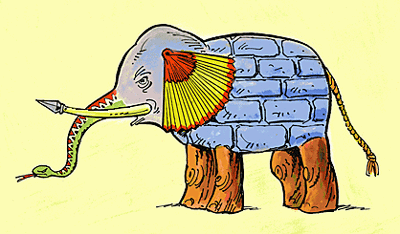
There is an old fable that goes something like this: three blind men encounter something in the jungle, and they are trying to figure out what it is. The first man goes up to it and feels its legs, which are huge, and he says, “Well, what we have here are a couple of really big trees.” The second blind dude feels the tail of the large creature and proclaims, “You’re crazy, what we have here is a simple paint brush.” The third blind man reaches out and, touching the nose of the creature, declares, “Both of you must be loco! Even a blind man could tell you this is a boa constrictor.”
I would like to suggest that part of why the accounts of the paranormal appear so mysterious (and as we shall see baffling to the point of appearing silly) is because when considered just on their own, for example a specific account of Bigfoot or a UFO encounter, often smacks of strange, whimsical, and ridiculous details. Consider cow mutilation for example – the idea that sentient beings capable of traversing Space-Time have nothing better to do then anally mutilate cattle! Likewise a person who tries to build a theory that accounts for the literal occurrence of every known paranormal activity soon is tied up in the most absurd, illogical and paranoid pretzels. That leaves a middle path that few have trod. It is only by stepping back and looking at the big picture, and allowing our minds to play with the inherent contradictions, that the true picture begins to emerge.
This video just surfaced. “Why the Fly” 10 minutes, live in Frankfurt, 2001 by Masters of Reality in that special Chris Goss-Joshua Homme-Nick Oliveri formation
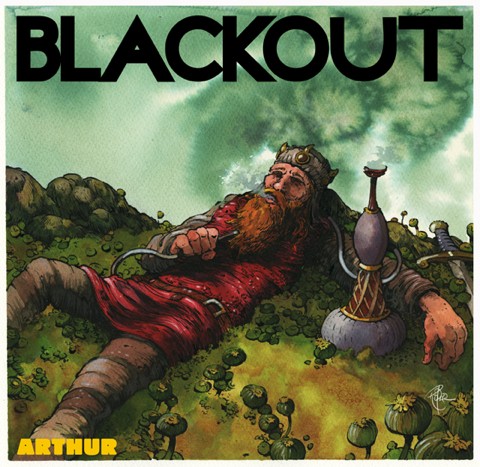
Arthur’s new 49-minute mixtape, specially designed to accompany (or simulate) a human-plant interaction, is now available as a digital download, featuring a high resolution JPG of the Arik Roper artwork (above), some additional art and text, and the following sequence of songs, as selected by Arthur editor Jay Babcock and sewn together by engineer/mixer Bobby Tamkin.
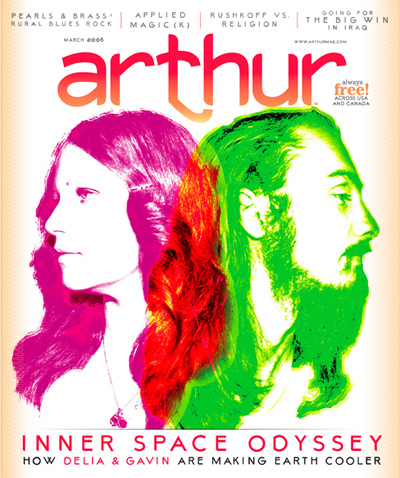
Originally published in Arthur. No. 21 (March 2006)
Mind-Melders At home, at work and at play with visionary artist-musician duo Delia Gonzalez & Gavin Russom
by Trinie Dalton
My boyfriend Matt and I arrived on our bikes to this chic Berlin restaurant that had no sign, and I wouldn’t have known we were at the right place had there not been a long dinner table set outside where a Stevie Nicks-ish redhead sporting a ’70s military jacket sat next to a semi-crusty, spaced out guy with really long hair and a beard that looked matted as if he had just gone scuba diving; his locks looked like they were caked with sea salt. I hope we’re eating with them, I thought, in awe of their awesome style. I also immediately liked them because we were gathered to visit mutual friend, artist AVAF, a.k.a. assume vivid astro focus, a.k.a. Eli Sudbrack, and friends of Eli’s are all jovial and talented. Eli had just come from Brazil via London and was in Berlin for two days before going to Barcelona, or something. Next to him was artist (and also, like Matt and me, summer Berlin resident) Terrence Koh, wearing a buckled-up Michael Jackson leather jacket. Then there was gallerist Javier Peres, the ultimate host, who’d just flown in from somewhere like Greece, England, or the U.S., and was stopping through before a trip to Estonia to pick up travel partner and permanent Berlin resident, Danish artist Kirstine Roepstorff. The other ten people at the table were French or Spanish DJs.
I locked up my bike, sat down, ordered some champagne and a bowl of white asparagus soup, and introduced myself to Delia Gonzalez and Gavin Russom, the most stylish couple in the world. They looked like a couple I could relate to: same age as me, creative, but with a way advanced fashion sense. I chatted with them while I waited two hours for the waitress to come out and tell me they were out of soup, and it was now too late to order more food since the kitchen was closed. Oh well, I enjoyed more champagne and listened to Delia talk about horoscopes and her visit to a highly-skilled psychic. It was a summery night and Delia and Gavin had only spent a few months thus far in their new Berlin apartment, where they moved to escape the New York art world and high cost of living. They met eight years ago in New York. Matt and I enjoyed discussing the beauty of discovering a new city with them. I felt a bond with Delia and Gavin, a sense of expatriate camaraderie, which imbued the rest of my stay in Germany with the comforting knowledge that other youngish American artists were living only blocks away. Even if I didn’t get to hang out with them, since they had an intense traveling schedule, they were still there, making the city cooler. Delia and Gavin made Berlin feel less foreign to me.
Therefore, I first met Delia Gonzalez and Gavin Russom as visual artists. They’ve worked as a pair for the past seven years, used to be a couple but aren’t anymore, and live separately, sharing each others’ apartments; Delia’s house is the art studio and Gavin’s is the music space. I’d seen their sculptures, knew they were represented by Daniel Reich, and seen another piece of theirs in a catalog for a group show in Austria. Their sculptures look like minimalist architecture, gleaming and pristine, hypnotically formal, and are either covered in cowrie shells or sequins. Sometimes they’re laquered or gold-leafed. They have a sort of punk-new age spirit, if one could mention the two together without extreme cheesiness. Their artwork’s punk glamour is cross-pollinated by a fascination with the occult. The sculptures are inspired by Art Deco, the golden age of Disco, and 70s Italian horror movie sets; some pieces have religious undertones, referencing Latin-American and African ceremonial totems and shrines, and illuminated manuscripts. Human-sized cubes and cones get cowrie shell eyes and mouths, transforming simple geometric shapes into magical talisman. Most of their sculptures are soundtracked by Delia and Gavin’s trance-inducing disco.
But Delia and Gavin didn’t begin as a collaborative sculpture team. Delia, originally from Miami, moved to New York in the mid-’90s to dance in troupes like Fancypants. Gavin, from Providence, was hosting magic shows under the name The Mystic Satin when the two met at a loft party. At first, Delia joined The Mystic Satin, while her and Gavin tinkered with prop making, set design and several varieties of modern dance. Since then, they’ve made videos, starring themselves, about zombies who wander Times Square; performed live magic acts dressed as a ballerina (Delia) and a warlock (Gavin); danced in their troupe called Black Leotard Front, and played in a heavy metal band, Fight Evil With Evil. Their first 7” single (and straight-up music project) “El Monte,” came out in 2004. Last October, hip electronic label, DFA (home of LCD Soundsystem and The Juan Maclean) released Delia and Gavin’s first full-length album, The Days of Mars. They’ll be playing some U.S. gigs while here for their art opening at Peres Projects Los Angeles in April. They’ll also be promoting the release of their single and video, “Relevee,” out this month.
Days of Mars is like Brian Eno, Goblin, and Kraftwerk combined into four long synthesizer tracks that are ambient but layered with pulsating rhythm. Gavin makes their analog synthesizers. When you listen to it you feel like you’re traveling to well, Mars. But their music is really more about life on Earth, Delia and Gavin each told me separately over the phone from Berlin. I spoke with them both as they passed their phone back and forth. Their wide range of interests reflect how limitless the idea of making art is to them. Genres don’t matter. Music, video, dance, magic show, sculpture, drawing: they love it all.
ON SCIENCE FICTION SOUNDTRACKS, HOT LESBIAN AUTHORS, AND HOMEMADE SYNTHESIZERS Delia: Days of Mars is named after a Winifred Bryher book. She was Hilda Doolittle’s girlfriend. I had a little crush on her. It’s about WW2 in England. Bryher lived in Switzerland, but when the Germans were bombing England, she went back to support her friends, and kept a diary. The way she described people’s reaction to the war, the way they ignored everything that was going on, reminded me of Bush’s re-election. Everyone was threatening to leave the country, revolt, but when he was reelected, no one did anything about it. Everyone was in denial. “Black Spring,” the fourth song on the album, is also named after a book, by Henry Miller. I found out about that while reading Anais Nin.
SEPTEMBER 26 — CYPRIAN EKWENSI
Nigerian short story writer, committed journalist.
ALSO ON SEPTEMBER 26 IN HISTORY…
1774 — Johnny “Appleseed” Chapman born, Leominster, Massachusetts.
1869 — “Little Nemo” cartoonist Winsor McCay born, Woodstock, Canada.
1874 — American photographer Lewis Hine born, Oshkosh, Wisconsin.
1899 — Nazi-synp existentialist philosopher Martin Heidegger born, Messkirch.
1921 — Nigerian short-story writer, journalist Cyprian Ekwensi born, Minna.
SEPTEMBER 26, 2009 HOLIDAYS AND FESTIVALS
India: THE FEAST OF LAMPS, a memorial to the dead in which every lamp is lighted, a harvest feast is eaten, cakes are placed at crossroads for evil spirits to eat. Jains polish their jewelry, attend worship and have books blessed.
Gabon: FEAST OF ZAME YE MEBEGE, God of Narcotics.
Above: “Little Nemo in Slumberland” by Winsor McCay. Click to enlarge.








 Arthur Magazine