With the end of summer upon us, here’s a vintage half-page from Arthur No. 26 (2007) profiling the season’s signature seeded fruit. Click to enlarge…
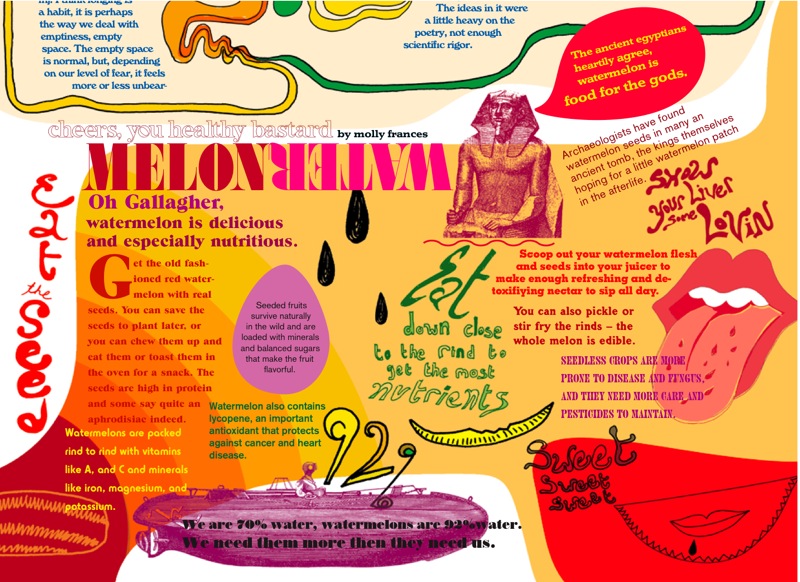

With the end of summer upon us, here’s a vintage half-page from Arthur No. 26 (2007) profiling the season’s signature seeded fruit. Click to enlarge…
From the album Le Noise, out Sept. 28.
This essay was originally published in Fly Fishing Catalog 2004; it is available online from Patagonia…
Fishing for Paradise
by Freeman House, author of Totem Salmon: Life Lessons from Another Species
Humans need a taste of wild foods once in a while, preferably gathered with one’s own hands. The basic psychic comfort of experiencing the earth as a place that welcomes us by feeding us was hardwired into each of us during our long residence in the Pleistocene. We haven’t evolved very far from that need: It’s still part of the basic definition of being human. It’s this need, I think, that accounts for the undiminished taste for hunting and fishing for which modern supermarkets offer no substitute.
But we are losing ground in our relationships with nature. Within the last century, the developed world has embraced expensive technologies in transportation, agriculture and energy, which in turn provide us with an illusory sense of comfort and prosperity. The expense of those technologies can be calculated in lost topsoil, deforestation, the dewatering of our rivers – the list goes on. Our “comforts” are killing us just as surely as they are making us feel safe. Meanwhile, we grow further and further from the sources of our sustenance, and our very imaginations are drying up as a result of the absence of our primary teachers – the lands and waters themselves, and the creatures with whom we share them. The pleasure of fishing is now tainted by the question of how long such pleasures will be available to us.
Tom Wesoloh, manager of North Coast projects for Cal Trout, tells of fishermen who say to him “If we just let ‘em go, everything will be fine.” Or “If we just stopped fishing for five years, wouldn’t the fish come back?” He replies sadly, “if only it were true.” A growing number of activists and scientists think that we need a more proactive approach to the restoration of our fish populations and (especially) the habitats that support them.
Few individual human minds can grapple with global ecological problems without falling into despair. A watershed, however, presents a scale of possibility in terms of working with nonprofessional residents and neighbors toward a common understanding of home. The goal of working in common toward optimum health and productivity of a complex system is scaled down to fit within our daily experience. You may very well have political and practical differences with a watershed neighbor, but if you are standing on the ground discussing what’s before you, ideological differences have a way of resolving themselves, mediated by the place itself. If you happen to share a watershed with native salmon or trout, it’s not hard to find allies in such work.
In 1978, when my wife and I bought land in remote northern California, watershed restoration was a new idea to most people. It was not a new idea for native Californians who had, before contact, tended to organize their cultures within watershed constraints for millennia. But we moderns had drifted away from our connection to place. In our new home, we identified the obstacles to salmonid reproduction, and introduced the first community-based native salmon streamside hatchery system in California. The idea was to maintain a remnant salmon population while the river recovered from the logging boom of the fifties and sixties.
Although our early efforts showed promise, resulting in an egg-to-fry survival rate consistently higher than 80 percent (compared to 5 or 10 percent in the damaged river), we realized during the first year’s work that it wasn’t nearly enough. It just wasn’t that simple. We needed to develop strategies to hasten the recovery of habitat and ultimately to develop community standards of behavior that wouldn’t replicate the mistakes of the past. We were involved in a timescale much longer than that of a few salmon generations – it was more likely we were looking at a project that might involve several human generations. Public schools and community meetings became as important a part of our activities as were projects to improve riverine habitat and repair sources of future sedimentation.
Twenty-five years later, it’s hard to find a watershed without its own watershed council, at least on the west coast of North America. People who fish, either commercially or recreationally, are often core members of these groups. In my mind, community watershed groups represent the stirrings of a metaproject overdue in modern America – the project of learning to live where we are.
Mike Getsiv has completed three books of wordless comics (Eyeballs, Lightbeam and one more as yet untitled) plus the anthology he edited called Snow Stories. He was a major supporter and contributor to the Eisner-nominated anthology Abstract Comics published by Fantagraphics and now he’s working on a full-length autobiographical comic book called The Green Kid.
He also started a collaborative project called ABCOLAB on Abstract Comics: The Blog and received contributions from ten countries: Argentina, Australia, Belgium, Cyprus, England, Finland, Portugal, Russia, the United States and Uruguay.
Twitter along with him at: http://twitter.com/MikeGetsiv


Getting It Right
by Jack Gilbert
Lying in front of the house all
afternoon, trying to write a poem.
Falling asleep.
Waking up under the stars.

“This Month is a Mission” – IDLE TIMES (mp3)
Seattle. A bonus song on Hookup Klub Round 1 compilation LP/CD. New album out next month thru Chicago’s great Hozac Records. More info here. Whiffs of Nirvana, Guided by Voices. Why say more?

The Last Dave, Never Another
by Pat A. Physics
My hit list is riddled with names
that are homogenous. Joe Joe Joseph,
Mary Mary Marianne, William William
Bill Bill Bill, but never another
Dave. This Dave was a special
assignment involving something
that I can’t disclose here, but
I want to remember Dave as
a person I took immense pleasure
in snuffing out. A Dave whose
existence can never be
anything other than Dave. And so,
I have a six-sided Chinese star
of David, and it’s David David David
from now on.

From Dorian Cope’s On This Deity:
Thirty-nine years ago today, the white authorities of Attica State prison in the so-called liberal state of New York – desperate to restore some semblance of order amongst the concentration camp-like conditions they’d imposed upon their primarily Afro-American inmates – embarked on a murderous and racist policing so brutal, so terminal and so careless of the lives of the innocent hostages, that their end-game proved to the world what Malcolm X had declared to be the case on page 271 of his autobiography: that the so-called liberal white Northerner was not one iota less racist than his Southern opposite number, just more devious in the manner in which he controlled “the Negro.”
Continues: On This Deity

From Eric Reynolds:
Fantagraphics Books is proud to announce the acquisition of the only graphic novel written by — and possibly the last unseen work of his to be published — the innovative Beat writer and Naked Lunch author, William S. Burroughs. This lost masterpiece, Ah Pook Is Here, created in collaboration with artist Malcolm McNeill in the 1970s, will be published in the summer of 2011 as a spectacularly packaged two-volume, hinged set, along with Observed While Falling, McNeill’s memoir documenting his collaboration with one of America’s most iconic authors.
Ah Pook Is Here is a consideration of time with respect to the differing perceptions of the ancient Maya and that of the current Western mindset. It was Burroughs’ contention that both of these views result in systems of control in which the elite perpetuate its agendas at the expense of the people. They make time for themselves and through increasing measures of Control attempt to prolong the process indefinitely.
Read the full press release and see more of Malcolm McNeill’s incredible artwork here.

 Arthur Magazine