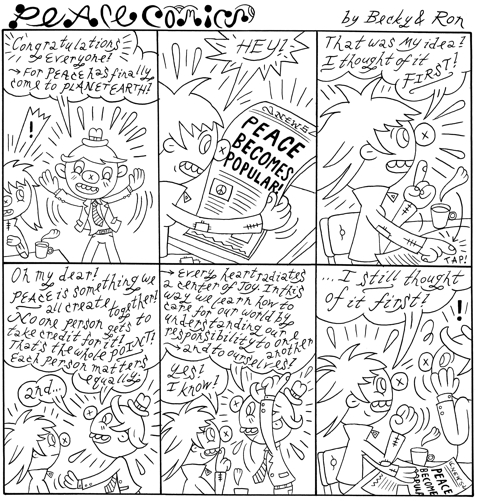
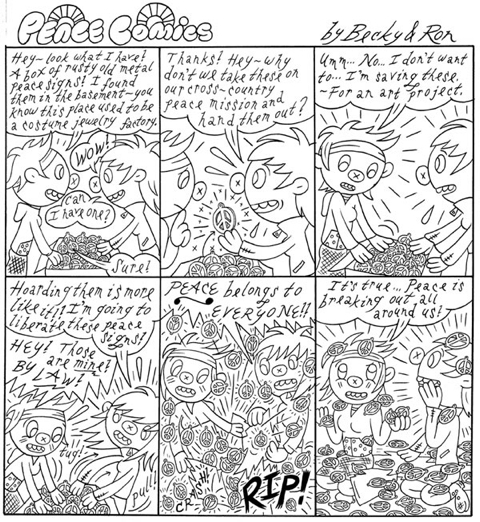
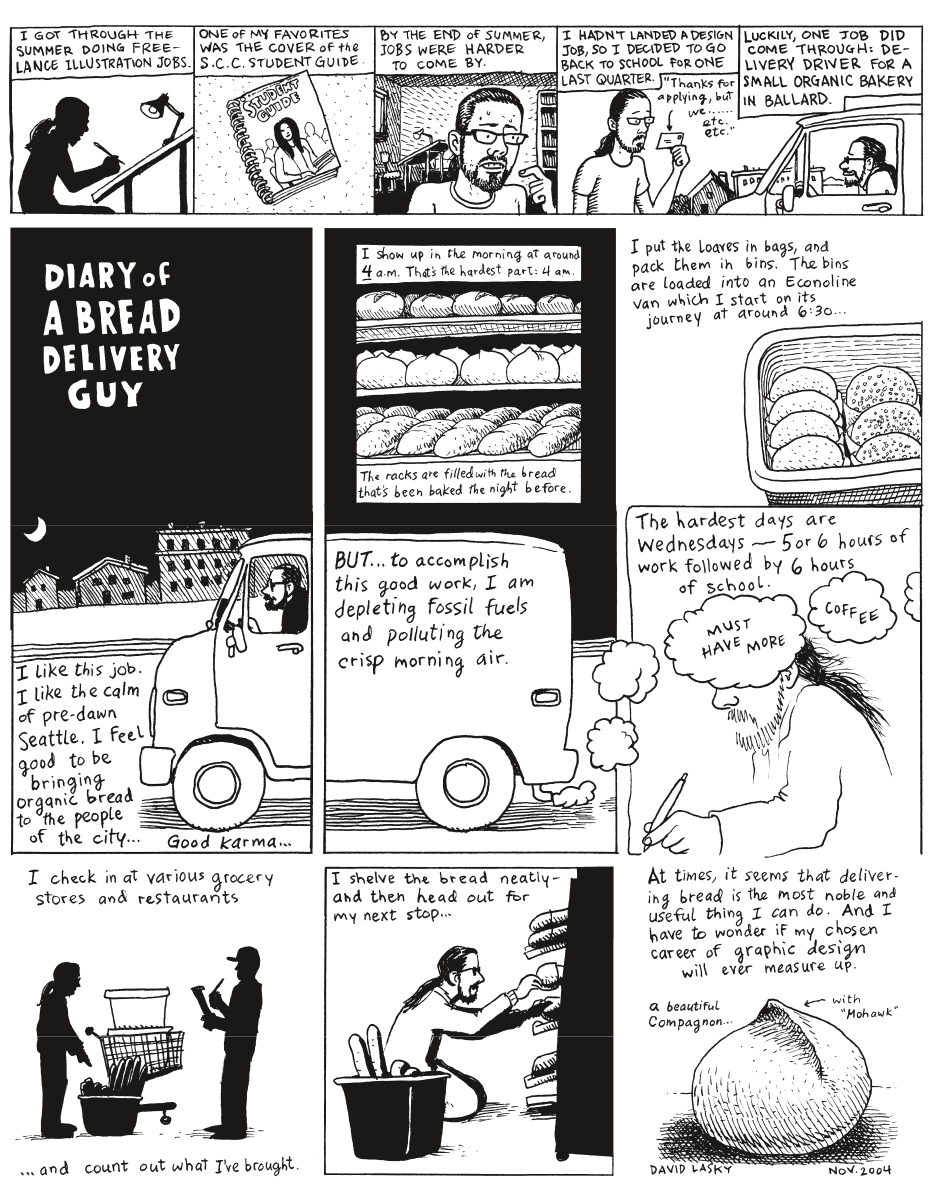
"Post-Election Funnies: How do we make art in this political climate?" edited by Tom Devlin (Arthur No. 15/March 2005)

Post-Election Funnies

It’s George Bush’s world, they just draw comics in it. A special feature on making art in troubled times, featuring work by Chris Wright, Brian Ralph, Dan Zettwoch, Megan Kelso, Ben Jones, Paul Lyons, David Lasky, Tom Hart, Vanessa Davis, Greg Cook, Marc Bell, Amy Lockhart and John Hankiewicz. Edited by Tom Devlin.

Originally published in Arthur No. 15 (March 2005). Click each image (page) to really enlarge. It’s still not gonna be completely legible—for that, you’ll have to see the actual magazine (available at the Arthur Store for cheep)—but it’s pretty good.

"My Conversation With the Secret Service" by IAN SVENONIUS (Arthur No. 15/March 2005)

Originally published in Arthur No. 15 (March 2005)

A Conversation With the Secret Service
Was I being investigated as a threat to the president—or as a potential hire for a sinister job?

By Ian Svenonius

I have a suspicion that the current president might be assassinated. How do I know? I was interviewed for it.

About a year and a half ago, I took a call from people who identified themselves as the Secret Service. They expressed an urgent desire to see me, which in their highly considered psycho-babble, was made to sound like a choiceless inevitability.

On the demand for an explanation, the agent, a woman, told me that they had intercepted an email which seemed to implicate me in a plot to harm the POTUS: that is, the President Of The United States.

I immediately surmised that her concern was related to a mass mailing I’d written in beat-prose to attract attendees to a night of record playing at a local club, called “Spilt Milk.” Thinking that my audience would enjoy the same amusements as myself, I had perhaps contained some reference to a dispatched leader of the free world.

The Secret Service’s responsibility was to check out every instance of a threat, no matter how far-fetched.

“We need you to come down to the office. It’s extremely important,” the woman insisted.

To get the initial sale, through, they used a female agent, knowing via a psychological assessment based on telephone and computer surveillance, that this would seem less threatening to me. Like a talented telemarketer, she was gentle but firmly coercive. In fact, the two professions are related, as the FBI and CIA’s inquisition techniques are lifted straight from Nelson Rockefeller’s bible for salesmen, How to Win Friends and Influence People, and feature the exact same mind control tricks. Of course, telemarketers don’t have the weight of state security at their disposal.

“I can’t come down, I’m really busy,” I told her, though my inbred instinct was to obey.

“We’ll come to your house, then,” she insisted, another offer I evaded.

After much back and forth, I agreed to meet “them,” the Secret Service agents, at a French bistro not far from my house. It seemed less likely that they’d kill or abduct me in a public setting.
Before I left my home, I alerted a few people as to the nature of my rendezvous and they agreed to witness the interrogation from afar, unannounced.

When I arrived, the officers were sitting in the outside cafe section under a sun umbrella which said “CHIMAY.” One was the woman I had spoken with on the telephone and she was accompanied by a man in a lowslung baseball cap with some rugged facial growth.

They looked drab and angry, respectively.

As the woman agent clasped the evidence and sat businesslike, her partner assumed the “bad cop” persona, searching me like a berserker and then scowling fiercely through the duration of the meeting. The implication was clear; if he were let off his chain, he would make quick work of me for god and country.

The purpose of this choreographed psycho-ballet is of course to draw the detainee into the maternal arms of the good cop so as to escape the paternal bad cop figure’s wrath. This psy-op cliche was immediately transparent, but it still worked; psychological reflex is at least as dependable as the blood-and-guts kind.

Meanwhile, my own spy witnesses had taken their anonymous positions, taking snapshots innocuously in case I were later dangled from a helicopter by these freak thugs.

When the waiter came by, I ordered a latte.

The mama character drew the offending email from a folder dramatically, like it was a bad report card. She read it aloud, slowly and haltingly as if translating from hieroglyphs.

Continue reading

HOROSCOPE by Becky Stark (Arthur No. 15/March 2005)

Horoscope by Becky Stark

Originally published in Arthur No. 15 (March 2005)

Aquarius
(January 21 – February 19)
Many of your judgments have accumulated to create a fortune, a palace and a miracle. You choose again, and you choose the miracle. In your vast explorations of horizons rising and falling, the delight you bring and the fascinations you lead are the priceless seeds of revolution, thought up on a ferris wheel ride!

Pisces
(February 20 – March 20)
In dreams the water comes most. This mystery of you is everlasting, and rest comes from the sands. We take the sand as our character and our part. To feel the whole, we wash these small pieces through our hands. Return to the sand—walk on it, too!

Aries
(March 21-April 21)
Always beginning: the paradox of sublime sorcery. There is none more beautiful than the infant! Beautiful, perfect, divine, child. You are weeping new tears that we can drink. Thank you for the new dance steps, too.

Taurus
(April 21 – May 21)
Dear sweet power of thought: I now devote myself to your relation. The miracle of thinking and how magical this ability is to make reality—these thoughts guide my new world. I accept my leadership within this heaven of earth that is of my mind.

Gemini
(May 22 – June 21)
O my best friend, best friend of all life—the saddest and most funny—in your nature, human life rests its paradoxes. You are greatly loved as the keeper of the key as we enter the theater of utopia. Thank you for having carried this key with you all along!

Cancer
(June 22 – July 22)
You know everything! With this knowledge you also possess everything. The question is: how can you begin to not know things? Your perfect creative mind is manifested when you have the ability to choose what you see, what you hear, what you know, who you are. You already have this ability.

Leo
(July 23 – August 22)
Forgive the sugar. Forgive the salt. Forgive the beginning, forgive the end. Forgive what you’ve taken, forgive what you stole. Forgive when you waken, forgive when you’re old. Love is the beginning, love is the end. Teach me how to waken, teach me how to mend.

Virgo
(August 23 – September 23)
Do you remember when you witnessed the animals coming to drink at the pool below your rock? You sat for hours as they came, some smiling at you. You tell this story to a stranger and the two of you weep with its tenderness. Remember your tenderness: it is the revelation of music.

Libra
(September 24 – October 23)
If a stranger offers you candy, you should take it. If taking it makes you fear for your life then you should take two pieces. Then also you should start giving candy out to strangers, or maybe something more wholesome than candy.

Scorpio
(October 24 – November 22)
Hello children of desire! Be sure your passions are breaking upon the opening chances for life. Remember: choose ecstasy if it is new. When faced with the prison of before, choose the new ecstasy right now. You may experience this as the opposite of your previous or present body. Now prepare for your own power of god.

Sagittarius
(November 23 – December 21)
O sweet love of the perfect aim! I know that your arrows can go anywhere so you don’t like those targets anymore? Go beyond the target and make your arrows return. This is your new practice. Now we all fly on the wings of your arrows! See how we fly! Your cooperative nature is the sexy side effect of such skillful flight.

Capricorn
(December 22 – January 20)
If clowning was like flying, you are a kite! In this way, you catch electricity from the sky! Lightning travels to your paper and pen and we trust your words. This love is so strong around you that soon your comedies will manifest. Keep the comedies in your heart like you keep the money in your chest! If you are wondering, Hmm. Does it matter if my soul lives or dies? The answer is yes—it matters !! P.S. Your soul never dies.

DREAMWEAPON – The Art and Life of Angus MacLise opens May 10, 2011 in New York


Photo of Angus MacLise in Kathmandu by Ira Cohen

Via Boo-Hooray:

DREAMWEAPON / The Art and Life of Angus MacLise is the upcoming exhibit at pop-up / parasite gallery Boo-Hooray presenting the work of the American artist, poet, percussionist, and composer active in New York, San Francisco, Paris, London and Kathmandu in the 1960’s and 1970’s. The exhibition series is open every day May 10th – May 29th and will include an overview of poetry, artwork, and publications in Chelsea, a sound installation featuring the complete MacLise tapes archive in Chinatown, and a night of film at Anthology Film Archives screening never-before seen outtakes from Ira Cohen’s The Invasion of Thunderbolt PagodaDREAMWEAPON is curated
by Johan Kugelberg and Will Cameron.

"A Future Worth Having" by Daniel Pinchbeck (Arthur No. 16/May 2005)

Originally published in Arthur No. 16 (May, 2005)

Illustration by Arik Roper

“Here and Now” column by Daniel Pinchbeck

“A Future Worth Having”

I first encountered the idea that we are quickly approaching a “Technological Singularity” in the works of Terence McKenna. In McKenna’s great essay, “New Maps of Hyperspace,” published in The Archaic Revival, he wrote, “We are like coral animals embedded in a technological reef of extruded psychic objects. All our tool making implies our belief in an ultimate tool.” He saw the archetypal apparition of the UFO or Flying Saucer as a foreshadowing of this tool awaiting us at the end of history. For him, this ultimate tool would exteriorize the human soul and interiorize the body, releasing the psyche into the infinite realm of the Imagination—”a kind of Islamic paradise in which one is free to experience all the pleasures of the flesh provided one realizes that one is a projection of a holographic solid-state matrix.”

McKenna was writing in the first flush of technological euphoria that accompanied the “dot-com” boom, and his perspective reflects a certain amount of that decades-long bedazzlement with the new forces unleashed by the extraordinary evolution of the Internet. Ultimately, however, his perspective was Gnostic, as well as Apocalyptic, informed by his psychedelic journeys into psilocybin and DMT-space. McKenna was a brilliant man. However, his euphoric focus on the self-organization of this technological event—which he often correlated with the 2012 end-date of the Mayan Calendar—left in its wake a certain passivity. The hipster counterculture that has beamed into this meme is too quick to celebrate the upcoming Eschaton, without doing the hard work required to bring it into being. From my perspective, what we need to consider now is not technology, but technique.

Before elaborating on that idea, let’s take a brief look at the “Technological Singularity” meme as it is currently propounded on the Internet by John Smart, of Singularity Watch, and Ray Kurzweil, author of The Age of Spiritual Machines and operator of the KurzweilAI.net website. Kurzweil and Smart are “transhumanists,” who promote the prospect of an imminent super-technological future in which humans have merged with machines in order to transcend our biological limits. In his essay “The Law of Accelerating Returns,” Kurzweil looks at the exponential evolution of technology, and argues that this mathematical growth-curve eventually reaches a point where it accelerates to a level that is close to infinite. He believes that this will most likely occur sometime in this century: “Within a few decades, machine intelligence will surpass human intelligence, leading to The Singularity—technological change so rapid and profound it represents a rupture in the fabric of human history. The implications include the merger of biological and nonbiological intelligence, immortal software-based humans, and ultra-high levels of intelligence that expand outward in the universe at the speed of light.”

Smart shares Kurzweil’s euphoria: “Technology is the next organic extension of ourselves, growing with a speed, efficiency, and resiliency that must eventually make our DNA-based technology obsolete, even as it preserves and extends all that we value most in ourselves,” he noted in a 2003 interview. Unlike Kurzweil, who sees humans evolving technologies that expand out to fill up the universe, Smart sees the eventual destiny of the species in what he calls “transcension,” essentially escaping this universe in the other direction, by creating simulations or virtual realities that will be like new universes—or, in fact, new universes, as we draw all local information into the black hole of our information-processing and technology-generating engines.

The transhumanists begin with the idea that our biological limitations should be overcome through mechanical augmentation. We are too slow, too cumbersome in our inherited meatsuits, and therefore trapped in what John Smart calls “slowspace.” Through immersion in virtual realities or direct fusion with cerebrally accelerating artificial intelligence agents—or some other technological genie—we will leap beyond our current imprisonment in the organic realm, and attain a higher, faster, snazzier state of being. Kurzweil notes: “Biological thinking is stuck at 1026 calculations per second (for all biological human brains), and that figure will not appreciably change, even with bioengineering changes to our genome. Nonbiological intelligence, on the other hand, is growing at a double exponential rate and will vastly exceed biological intelligence well before the middle of this century.” By inserting “nanobots” into our brains or ultimately perhaps downloading our psyches into immortal silicon-based supercomputers, humans will be able to contribute our pitiful little brain-wattage and antiquated personalities to the evolution of A.I.’s higher, faster levels of functioning.

We can, in fact, according to Smart, even feel some compassion for the next level of machine consciousness we are currently gestating to succeed us. He writes, “Consider that once we arrive at the singularity it seems highly likely that the A.I.s will be just as much on a spiritual quest, just as concerned with living good lives and figuring out the unknown, just as angst-ridden as we are today.” Even if, during some hyper-insectile phase of Terminator-style behavior, the A.I,’s accidentally destroy the human species, Smart reassures us, they would no doubt want to recreate us eventually – just as we build museums to understand the history of our planet and how we arose out of earlier life-forms, as well as documenting indigenous cultures that we too have accidentally destroyed.

It is instructive to consider—and to dismiss—the transhumanist perspective, as it reflects our cultural fantasies about technology and about transcendence, as well as our deep anxiety and deeper misconceptions about the essence of time, space, consciousness, and being. It may be the case—I would propose—that our future lies in an entirely different direction. To begin to conceptualize that direction—to draw in an imprint of what a truly human future might look like—we first have to give some thought to the essential nature of technology. Continue reading