
Some recent Arthur articles have now been read by more people online than in print. Hmm.
Author Archives for Jay Babcock
TOOOOO MUCH
THIS is the main gig of Arthur contributors Stewart Voegtlin and Beaver. Via 20 Buck Spin …

CHIPS & BEER THE MAGAZINE #6
Read Dawn: Chips & Beer Mag #6 features all the usual bizarro features, rantings and ravings from the most loved writers in the Heavy Metal Pantheon. Interviews with some band called Scorpions, a guy named Uli Jon Roth and another named Herman Rarebell. Not to mention Omen, Ranger, Autopsy, Zemial, Power Trip, Chris Bruni, incredibly thoughtful think pieces on the Twisted Sister Documentary, The Bad News Bears, Lon Chaney and other panty wetting fun. 128 pages. Welcome to the party pal.
Chips & Beer the Magazine: The Tumblr
“When quiet, plot the bee’s course, mapping out the sweet spots”

A full-page piece of artwork by Leif Goldberg was published in Arthur No. 9, back in March 2004. Here’s a new interview with the great transnaturalist, now living in Vermont…
Q: Can you describe your artistic process a little?
A: It’s called the hollow frog approach. You hollow out a frog and then climb inside. Try to see through the frog’s eyes. Then, wish very hard that you were a salamander that could always change to bend around its surroundings. Listen like a deer, for shifting timbres from the earth’s crust, and move carefully. When quiet, plot the bee’s course, mapping out the sweet spots. Arrive like airplanes on autopilot at La Guardia. Dial it in and let it happen.
More at the Cinders Gallery blog
DAVID CHAIM SMITH’S NEW BOOK IS NOW AVAILABLE
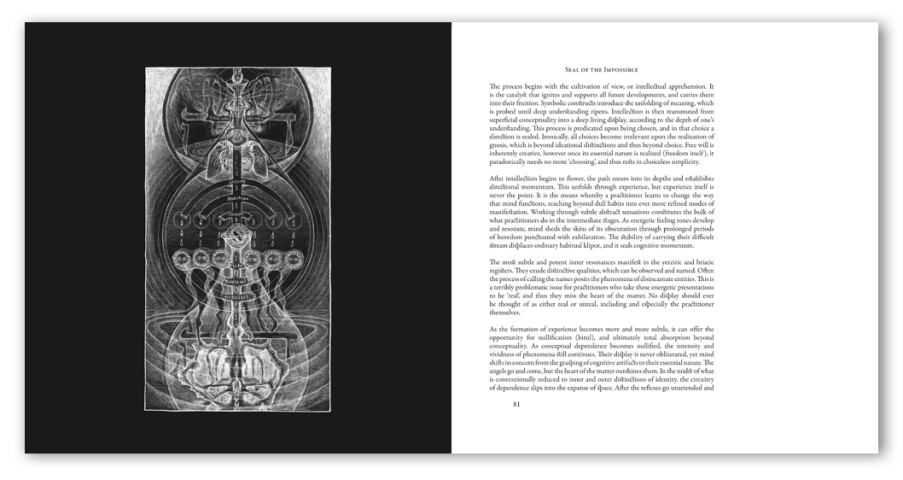
Artist David Chaim Smith was interviewed in Arthur No. 34 (complete text here).
His newest book, The Blazing Dew of Stars, (two-page spread posted above), has just been published by Fulgur.
“Having racked up hundreds of billions of dollars in opaque Fed subsidies, U.S. banks have seen their collective stock price triple…”
Via Bill M. from Brooklyn…
From The Wall Street Journal …
Andrew Huszar is a senior fellow at Rutgers Business School, is a former Morgan Stanley managing director. In 2009-10, he managed the Federal Reserve’s $1.25 trillion agency mortgage-backed security purchase program.
Confessions of a Quantitative Easer
We went on a bond-buying spree that was supposed to help Main Street. Instead, it was a feast for Wall Street.
by Andrew Huszar
Nov. 11, 2013 7:00 p.m. ET
I can only say: I’m sorry, America. As a former Federal Reserve official, I was responsible for executing the centerpiece program of the Fed’s first plunge into the bond-buying experiment known as quantitative easing. The central bank continues to spin QE as a tool for helping Main Street. But I’ve come to recognize the program for what it really is: the greatest backdoor Wall Street bailout of all time.
Five years ago this month, on Black Friday, the Fed launched an unprecedented shopping spree. By that point in the financial crisis, Congress had already passed legislation, the Troubled Asset Relief Program, to halt the U.S. banking system’s free fall. Beyond Wall Street, though, the economic pain was still soaring. In the last three months of 2008 alone, almost two million Americans would lose their jobs.
The Fed said it wanted to help—through a new program of massive bond purchases. There were secondary goals, but Chairman Ben Bernanke made clear that the Fed’s central motivation was to “affect credit conditions for households and businesses”: to drive down the cost of credit so that more Americans hurting from the tanking economy could use it to weather the downturn. For this reason, he originally called the initiative “credit easing.”
My part of the story began a few months later. Having been at the Fed for seven years, until early 2008, I was working on Wall Street in spring 2009 when I got an unexpected phone call. Would I come back to work on the Fed’s trading floor? The job: managing what was at the heart of QE’s bond-buying spree—a wild attempt to buy $1.25 trillion in mortgage bonds in 12 months. Incredibly, the Fed was calling to ask if I wanted to quarterback the largest economic stimulus in U.S. history.
This was a dream job, but I hesitated. And it wasn’t just nervousness about taking on such responsibility. I had left the Fed out of frustration, having witnessed the institution deferring more and more to Wall Street. Independence is at the heart of any central bank’s credibility, and I had come to believe that the Fed’s independence was eroding. Senior Fed officials, though, were publicly acknowledging mistakes and several of those officials emphasized to me how committed they were to a major Wall Street revamp. I could also see that they desperately needed reinforcements. I took a leap of faith.
Continue reading: The Wall Street Journal
SUN RA, ON LOCATION
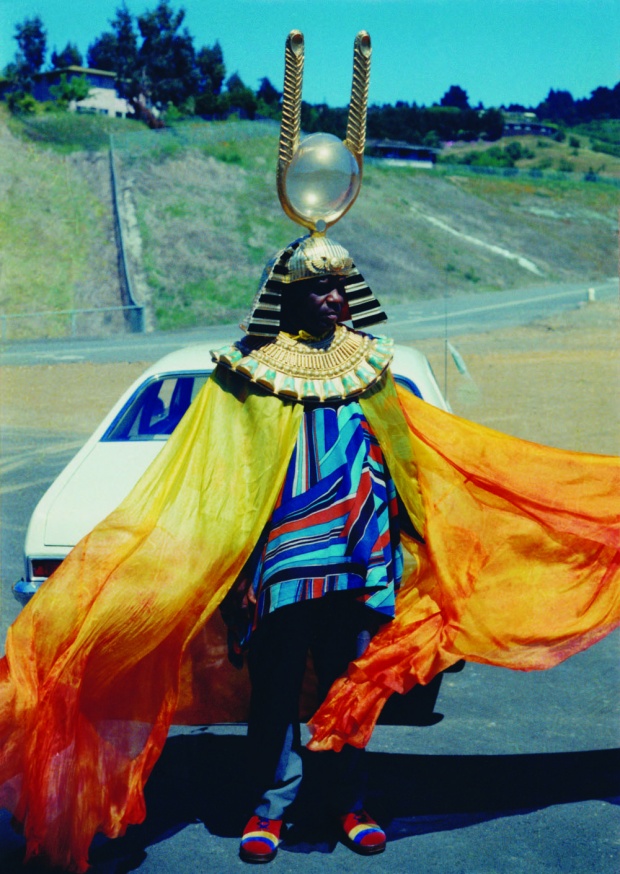
THE WIRE magazine has a gallery of wonderful vintage Sun Ra photos and related artworks up on their website, excerpted from the recently published Sun Ra + Ayé Aton: Space, Interiors and Exteriors, 1972 by John Corbett (paperback, PictureBox).
“I took LSD, which gave me the courage to be the person I wanted to be”

Great interview by Tim Teeman with the ever brilliant John Waters in The Guardian ahead of his recent one-man show at this year’s Homotopia in Liverpool. Why won’t The Powers That Be give this national treasure his own nightly television talk show already?
BULL TONGUE review column by Byron Coley and Thurston Moore (Arthur 33/Jan 2013)
Originally published in Arthur No. 33 (Jan 2013)…
BULL TONGUE
by Byron Coley & Thurston Moore
– Exploring the voids of all known undergrounds since 2002 –
1 CLAUDE PELIEU It has been ten years since the French-born artist, writer, and translator Claude Pelieu died at his home in upstate New York. His memory has been well served this past year, by the publication of at least three books that should be of extreme interest to anyone with a true hankering for the avant garde. The first is Kali Yug Express (Bottle of Smoke Press, bospress.net), a fantastic cut-up novel originally published in France in 1974. Translated by Pelieu’s late widow and long-time partner-in-crime, Mary Beach, it’s great to finally have a chance to read this book in a language we completely understand. As with some of his other work, Pelieu’s cut-ups do not always flow with the same dream-logic that guides Burroughs’ hand when he’s navigating similar waters, but it reads quite well. And Bill Roberts’ production standards are as high as ever. Second up is Un Amour de Beatnik (Non Lieu, editionsnonlieu.fr), a collection of letters and poems sent to Pelieu’s first wife (Lula Nash) in 1963-64, along with examples of his visual work from the early ‘60s. Although it’s all in French, the book is written in a relatively straightforward way, so you can parse it out even if yr French is as rusty as ours. Fully annotated, with period photos, a good chronology and whatnot, it’s a very solid read (and Claude’s early Leger-influenced paintings are quite a revelation). Third is Pelieu Mix/Etat des Lieux (la Notonecte, 15 bis rue Noel du Fail, Rennes, 35000, France), assembled by Benoit Delaune. Pelieu Mix is mostly a facsimile edition of some of Pelieu’s notebooks from the late ‘90s, filled with various texts, collages. It’s a great, beautiful jumble of stuff, presented spiral-bound, and now that we’re examining it more closely we realize it may have come out a while ago. But we just got it, so fuck you. More info on Pelieu and his art (as well as Mary Beach’s) can be had at beachpelieuart.com. Worth whatever eye strain it takes.
2 SPECTRE FOLK Spectre Folk is Pete Nolan’s long-running non-Magik Markers combo. And their new album, The Ancient Storm (Vampire Blues, vampireblues.net), is a quartet scene, with Pete joined by Aaron Mullan, Steve Shelley and Peter Meehan. Dreamier, poppier and ghostlier than previous efforts, it is tempting to call this the best record with a world class foodie (Meehan) since Robert Sietsema’s last recording with Blinding Headache. The longer tracks have a splendid psych droopiness and the whole thing just flows like butter. Meanwhile, Nolan’s label, Arbitrary Signs (arbitrarysigns.blogspot.com, has continued to flower slowly. Most recent drop was Your First Ever River by United Waters. UW is the new solo (or solo-esque) project by Brian Sullivan from Mouthus. The guy’s a brutal arm-wrestler (take our word!), but he also shows an incredible deftness with deeply murky pop constructions on River. Even more than with Brian’s other project, Eskimo King, the sounds here are bizarre but assembled with a precision recalling some of the best efforts of the long-gone Bobby J label. It’s a record that rewards heavy, smoked listening. Don’t think we ever mentioned the last record on Arbitrary Signs either, which was Four Corners Bounce by Devin, Gary & Ross. The surnames invovled are Flynn, Panter & Goldstein, so you can be assured this project is also a riot of screwed-up ‘60s pop readymades, interspersed with doper madness and actual songs that will twist yr mind like taffy. Don’t not check it out.
“Ashik Kerib” by the master SERGEI PARAJANOV (1988)
Haven’t seen this one before. All of his works are precious treasures. Total genius.
Sergei Parajanov: wikipedia
ON DRONES by the Center for Tactical Magic (Arthur, 2013)
Originally published in Arthur No. 35 (August 2013)…
Column: Applied Magic(k)
Author: The Center for Tactical Magic
Title: “The Deception of Robot Demons”
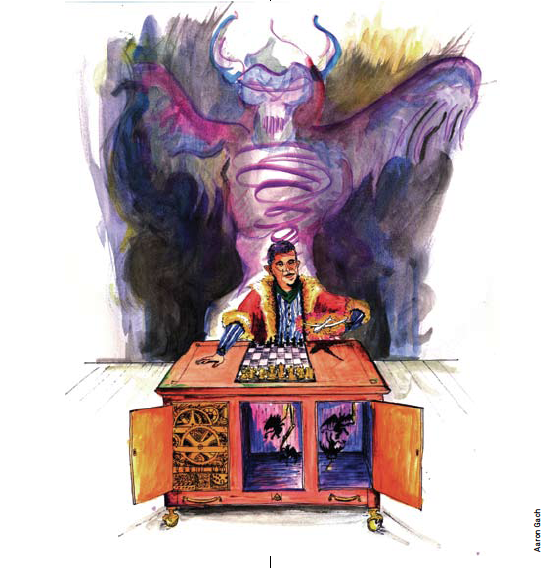
Illustration: Aaron Gach
Seldom used in stage magic today, automata (self-operating mechanical figures) featured prominently among conjuror’s acts before the 1900’s. Skillful craftsmen offered public demonstrations of elaborate clockwork characters that could perform entertaining miracles. Perhaps the most famous automaton of all time was the chess-playing spectacle known as The Turk. From the late 1700’s through the mid-1800’s, the turban-topped, robe-wearing, moustachioed machine amazed audiences in Europe and the Americas as he defeated the majority of his opponents, including Ben Franklin and Napoleon Bonaparte.
Despite an intense amount of public speculation and scrutiny, the mystery of its inner workings remained a closely guarded secret for many years. Although some correctly suspected that The Turk was in fact a mechanical illusion that concealed a human chess master, these theories were particularly difficult to prove since The Turk was opened up at the beginning of performances to provide the audience with a view of its interior.
In crafting illusions, it is essential for magicians to deflect suspicion by guiding audience perception. This may occur through misdirection, camouflage, patter—or, in the case of The Turk—a combination of all three presented through a carefully orchestrated sequence of events that gives a false appearance of reality. The final effect in this case was an amusing battle of wits apparently between man and machine that was way ahead of its time. Resonating with some of the earliest fears and hopes of the posthuman condition, it predated Mary Shelley’s techno-angst classic, Frankenstein, by nearly 50 years, and IBM’s Deep Thought chess computer (which lost to chess champion Garry Kasparov in 1989) by more than 200 years.
Somewhere between the horror of Frankenstein and the hubris of Deep Thought a melange of other mechanistic mayhem has emerged with far less entertaining implications. Although Nikola Tesla first conjured the notion of a squadron of remotely piloted warplanes in 1915, it has only been in the past decade that drone warfare has moved from from the shadows into the spotlight. In this “theater of conflict,” we find ourselves once again presented with the illusion of intelligent machinations. As with The Turk, we are often presented with a well-choreographed display intended to subvert our logic through partial truths and deceptive patter.
Drone strikes (particularly when they run afoul) are frequently discussed by government spokespersons as if the machines were making their own decisions, with zero accountability for their human operators, strike teams, or the officers and officials who authorize and oversee these missions from an air farce base outside of Las Vegas. When US missiles kill people in countries that we’re not even at war with, should it even matter if the aircraft had a human being sitting in the cockpit?
Continue reading Arthur Magazine