THEY called it a lesbian paradise, the pioneering women who made their way to St. Augustine, Fla., in the 1970s to live together in cottages on the beach. Finding one another in the fever of the gay rights and women’s liberation movements, they built a matriarchal community, where no men were allowed, where even a male infant brought by visitors was cause for debate.
Emily Greene was one of those pioneers, and at 62 she still chooses to live in a separate lesbian world. She and 19 other women have built homes on 300 rural acres in northeast Alabama, where the founders of the Florida community, the Pagoda, relocated in 1997.
Behind a locked gate whose security code is changed frequently, the women pursue quiet lives in a community they call Alapine, largely unnoticed by their Bible Belt neighbors — a lost tribe from the early ’70s era of communes and radical feminism. “I came here because I wanted to be in nature, and I wanted to have lesbian neighbors,” said Ms. Greene, a retired nurse. She hopes the women, ages 50 to 75, will be able to raise enough money to build assisted-living facilities on the land and set up hospice care.
She walks each day in the woods with her two dogs, Lily, a border collie mix, and Rita Mae, a Jack Russell terrier and beagle mix named for Rita Mae Brown, the feminist activist and author of the lesbian classic “Rubyfruit Jungle.” Ms. Greene trims branches of oak, hickory and sassafras trees and stops by the grave of a deer she buried in the woods after it was hit by a car. She named it Miracle. “I talk to Miracle every day,” Ms. Greene said. “That is one of my joys of living here.” Continue reading →
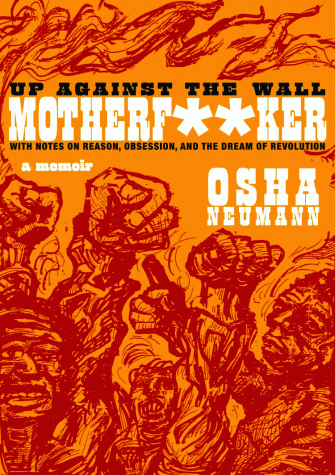
Anarchist Forum: “The Up Against the Wall Motherfuckers”
A look back at the fascinating Lower East Side anarchist group first known in ’66 as a Dada art movement called the Black Mask, but then in ’68 became more active by feeding the poor, setting up crash pads, occupying a Columbia University building, promoting surrealist protests, shutting down MOMA, providing free weekly musical events and irritating the police. They became known widely as the Up Against the Wall Motherfuckers.
The event will take place at The Living Theatre, 21 Clinton Street, Manhattan (just south of Houston St) (212-792-8050). Coming from uptown, take the F or V train to “2nd Avenue” (exit front of train on 1st Ave, walk east along Houston and turn right on Clinton) or coming from downtown, take the F, V, M or Z train to “Delancey – Essex” and walk east on Delancey three blocks and turn left on Clinton for 2 and a half blocks.
Everybody is welcome and invited to come and to have their say. There is no set fee for the presentation, but a contribution to aid the LBC is suggested.
If you have questions, contact the Libertarian Book Club/Anarchist Forum, 212-475-7180 or e-mail: roberterler (at) erols.com
1971: a massive GI Movement to end the Vietnam war was sweeping through troops, wreaking havoc on the U.S. military. Into that mix came the FTA Show, a caustic, electrifying, sharply antiwar comedy review led by Jane Fonda & Donald Sutherland. As they toured outside military bases from Guam to the Philippines, over 60,000 soldiers cheered and joined the show’s call to end the war.
Available for the first time since it mysteriously disappeared in 1972 after only one week in theaters, this raucous film is a riveting slice of the Vietnam anti-war movement. Reviving the wonderfully campy, yet biting theater of Jane Fonda and Donald Sutherland’s Free The Army (or, more popularly, “Fuck The Army”) Tour, FTA captures the entertaining magic and mayhem of the anti-war and pro-labor show as it rallies and rouses dissident GIs stationed along the Pacific Rim.
A gritty mix of rollicking performances and GI interviews, FTA juxtaposes lighthearted political satire with the somber realities of war, occupation, and the absurdities of military life, a barbed rebuke to the staid USO program. From Okinawa to the Philippines, stirred by the show’s provocative message, the members of the U.S. military find courage to speak out candidly in front of the camera.
Fonda and Sutherland are joined on stage by an all-star cast of musicians and activists including folk musician Len Chandler, songstress Rita Martinson, and comedian Paul Mooney.
A fresh look at the Vietnam anti-war movement through the songs and skits that shook a generation, this film will leave you singing along with the fired-up men and women of the military. Foxtrot, Tango, Alpha… Fuck the Army!
DVD Extras Include an Interview with Jane Fonda About Her Perspective on the Film Now
Street date: February 24 , 2009
Sug. Retail Price: $26.95
Catalog #: NNVG146161
Running Time: 97 mins + extras
Part rough-cut, part camera test, this video is going to be part of a longer documentary project about the evolution of the concert industry in the 1960s, early 70s DC/MD/VA area, told through the words of promoters, musicians, journalists and the fans.
If you were at the Wheaton Youth Center when LED ZEPPELIN PLAYED HERE, please get in touch:
jeff@jeffkrulik.com
And a special thank you to Brian and Andre Dahlman of http://www.hiptv.com for helping with this video.
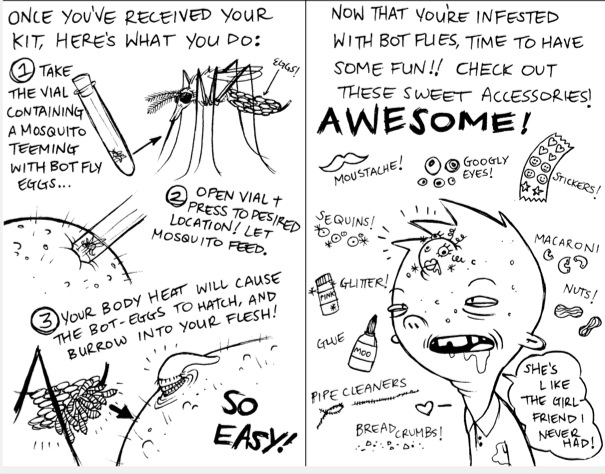
The Small Science Collective makes free, totally awesome zines about earwigs, protein structure, intestinal bacteria and facial gestures. Their motivation for this DIY public science publishing project? “Overall scientific literacy in the U.S lags at the very same time that the privatizing and patenting of scientific knowledge becomes more and more common.”
All the SSC zines are available as downloadable PDFs, and are distributed for free in “subways, benches, coffee shops, and any place someone might least expect them. Perhaps catching the attention of strangers who might what to learn something new about ants, spirals, food, or genetics?” Or those who want to know how to best play host to the parasitic bot fly.
Check out the full zine library here. Print one out, follow the folding instructions and pass it along. They’re looking for new contributors too. Sweet. Read their manifesto after the jump. (via Bug Girl’s Blog.)
Sterling Morrison: Reflections In A Lone Star Beer by Nick Modern, et al
The complete transcript of this interview originally appeared in SLUGGO magazine. It was reprinted in NYROCKER July/August 1980.
SLUGGO: What do you think of this music compared to what you used to play? Or what you’re playing now? STERLING MORRISON: What I play now is different. But this is very close to what we used to play. What I’m doing now is a diddling homage to old rock ‘n’ roll.
S: Do you think New Wave is new, or is it just a rehashing of old stuff? SM: I’m afraid to say what I think about New Wave.
S: Don’t be. Go ahead. Please. SM: I’m worried a whole lot about it. People that have known me know that the major bitch in my life has been between rock ‘n’ roll and folk singers. That’s it.
S: Is New Wave rock ‘n’ roll or is it folk? SM: I’m afraid it’s folk singing and this pains me.
S: What do you mean, it’s folk singing? SM: Well, let’s drag Lou Reed into this. (Not to embellish me or diminish him.) Lou and I had some of the shittiest bands that ever were. They were shitty because we were playing authentic rock ‘n’ roll. If you were playing authentic rock ‘n’ roll in 1963 that meant you were playing the stuff that people think it’s very fashionable to revive now… Old Chuck Berry and Jimmy Reed.
S: Why do you say that New Wave music is folk music? SM: Maybe I’m trapped by certain beliefs, but in the early ’60s, on college campuses, you went one of two ways. Either you were a very sensitive young person, who cared about air pollution and civil rights and anti-Vietnam or you were a very unsensitive young person, who didn’t care about civil rights because all the blacks he knew were playing in his band or in his audience. I was a very unsensitive young person and played very unsensitive, uncaring music. Which is Wham, Bam, Pow! Let’s Rock Out! What I expected my audience to do was tear the house down, beat me up, whatever. Lou and I came from the identical environment of Long Island rock ‘n’ roll bars, where you can drink anything at 18, everybody had phony proof at 16; I was a night crawler in high school and played some of the sleaziest bars. You can’t quite imagine them in Texas – people didn’t carry guns, that’s the only difference. In the ’60s, I had King Hatreds. I was a biker type and hung around with nasty black people and nasty white people and black rock ‘n’ roll music. On the other hand, you had very sensitive and responsible young people suddenly attuned to certain cosmic questions that beckon us all, and expressing these concerns through acoustic guitars and lilting harmonies and pale melodies. I hate these people.
S: Do you think we should go back to the basics? SM: Yeah. When I talked with Joe Nick Patoski, he said, what do I think the future of rock ‘n’ roll music is? And I said, “Whatever’s being played in garage band today.” And I believe that! It excludes so much. What does a garage band do with ELO? Nothing. ELO doesn’t exist. What do they do with Fleetwood Mac? Nothing. the whole joy of rock ‘n’ roll music was anybody could play it if they wanted to. But the ’60s fouled that whole thing up. Everybody decided to get good and they pursued virtuosity. The thing that ruined music was virtuosity – competence – as an end in itself. It means nothing. It was a very terrible thing.
S: But what were you trying to accomplish with the Velvet Underground? Just play music? SM: It was self indulgence. We wanted to play a certain kind of music. However far we could carry it, more power to us. We were fired from our first gig as the Velvet Underground. We played “Black Angel’s Death Song” and the owner came up to us on a break and said, “You play that song one more time and you’re fired.” So we opened with it next set. The best version of it perhaps ever played. We just wanted to do whatever we wanted to do. And some people came up and said, “Hey, would you like to have a record contract?” We said, “Might as well.”
S: Who in New Wave makes you “afraid” of it being folk music? SM: Look at a recent Rolling Stone – it’s happening to Elvis Costello: “You’re rocking to Elvis Costello, but did you ever sit down, Jack, and listen to the lyrics?” Well, no Jack, I never sit down and listen to lyrics, because rock ‘n’ roll is not sit-down-and-listen-to-lyrics music! Why is it that the Velvet Underground’s celebrated lyricsmiths never published a lyrics sheet? Was that to make you strain to hear the lyrics that you could never hear? No. It’s because they were saying, “Fuck you. If you wanna listen to lyrics, then read the New York Times.” It has nothing to do with the intellectual apprehension of content.
S: Everything I’ve heard about the Velvet Underground made them seem very gloomy… SM: We used to play the Whisky A Go Go all the time, so how gloomy could we have been?
S: Well, “Sister Ray” still seems to me like a really perverse song… SM: It’s a good dance song! I presume that nobody can hear the lyrics – I did my best to drown them out!
S: Why do you have such an aversion toward people who talk to you? SM: ‘Cause I read books!
S: You don’t believe you can get the same stuff through music? SM: Anybody who needs Bob Dylan to tell him which way the wind is blowing is a serious mental defective. See, I go back to: How well can you hear the words in a rock ‘n’ roll song? Listen to Rolling Stones records. The words are mixed so far back… they are non-important. If you’re going to rock music to learn something verbally rather than physically or viscerally, then you’re in a sad shape, baby. Death to me – and one of the reasons I wanted to stop playing – was when when we had start doing these giant sit-down things – where you stood on the edge of the stage and you’d look at people sitting down, gazing up reverently.
S: So you’d rather have your audience up on its feet dancing? SM: Yeah! Or else no one there – let’s just have a practice. For that reason I like Kiss. If they would turn their flames on the audience, set fire to the first three rows, that might sorta wake them up! … We had one protest song in the Velvet Underground and that was “Heroin”. And we said, “Thank God I just don’t care.” You know – we don’t like anything that you do – let’s not get specific!! We don’t want any of it, just leave us alone.
S: Do you still want to be left alone? SM: Me? Oh sure! Solipsism has been the real threat to me in my life. In spite of the fact that I’ve said a few things lately in public, I’ve said almost nothing in ten years. Not because I couldn’t, but because I didn’t want to. I know what I think. It’s not important for me to communicate.
S: Why did you start studying English? SM: ‘Cause it was my old major. Same as Lou Reed… that’s how we met, in college dining rooms. Also, if you’re a solipsist and you wanna live on your own thoughts, then once in a while you have to reload the data banks.
S: How come the Velvets were never played in New York? SM: ‘Cause we were banned! They didn’t like our songs there.
S: So what did you do? SM: We refused to play in New York. Now, anybody that’s clear-headed would say, “Well, we can’t be played on the radio, so we’ll redouble our live performances,” you know, play every night in New York. We said, “Well, goddamn, if they’re not gonna play us on the radio, we’re not gonna play here at all!” So we just went up to Boston.
S: What happened with the whole thing with Andy Warhol? SM: Nothing. We just stopped doing it. We were always friends. Once light shows caught on, once they got the message, we said, “Why do we have to keep bringing it all in?” We were never separate from Andy. We didn’t have to do it any more. We built the light show in the Fillmore West. Which is why Bill Graham hates us to this day. I could tell Bill Graham stories… I hate him. He’s one of the people I really hate. Bob Dylan I hate.
S: Who do you like? SM: I like the Doors. I like Jim Morrison, but for different reasons probably than you people think you like the Doors. I like Jim Morrison, he’s real nice.
S: Yeah, but he’s dead. SM: Yeah, most people I like are dead. I like Jimi Hendrix, he’s real nice. I like Mickey Dolenz. He was very far away from it all. he was real interesting. I don’t know John Lennon, but I admire him immensely. Oh, I hate Frank Zappa. He’s really horrible, but he’s a good guitar player.
BYSTANDER: He’s got a really shitty attitude. His attitude is similar to yours. SM: I don’t have a shitty attitude at all. He does, but I don’t. Because he has an exploitative approach to life and I don’t. Mine is just self indulgent. There’s a world of difference. If you told Frank Zappa to eat shit in public, he’d do it if it sold records. I would do it if I like to. And if they told me it wouldn’t sell records.
S: He came across as pretty Puritan – the lectures about drugs and stuff. SM: He’s purely venal. He thinks that elevates him above his audience. I don’t take drugs either, which has nothing to do with religious scruples. I just don’t feel like doing it now. I once asked a friend of mine if he took amphetamines, he said, “No, but do you know where I can get some?” That’s my attitude about drugs. Lou does that on stage, too. He recoils in horror if people throw lit joints on the stage or whatnot.
S: In Houston somebody threw a syringe at him. SM: What’d he do?
S: He got really pissed off and kicked it off the stage. SM: It must have had a blunt point.
S: Whet do you think of how he is no? I think, musically, there’s is no comparison between then and now. SM: How could there be? How could Lou, seriously, be better off without John Cale, and without me, than he was with us? That was the thing in the Rolling Stone interview – “How can you explain the fact that it took your ‘creative momentum’ nine years to get cranked up as a solo act?” He was talking about record company problems. Well I could name a lot of reasons. How the hell much can he do by myself? There’s a limit. With Cale and I, we were a real creative band. Lou really did want to have a whole lot of credit for the songs. So on nearly all the albums we gave it to him. It kept him happy. He got the rights to all the songs on Loaded, so now he’s credited with being the absolute and singular genius of the Underground, which is not true.
S: Was Nico as vapid as she seems now? SM: She speaks about six languages; English is her worst.
S: You can speak a lot of languages and still be a dodo. SM: Well speak to her in Italian…
S: Did she come up with many musical ideas for the band? SM: No, none whatsoever. We were together as a band, and then Nico showed up at the Factory. Andy said, “Oh, here we have Nico. Would you like her to sing with you?” We said, “Well, we couldn’t dis-like it.” That’s how we became the Velvet Underground and Nico. She just came kind of creeping in. We knew that it couldn’t last, because we didn’t have that many songs she could sing. Lou and I cranked out some songs for her. “Femme Fatale” – she always hated that. [nasal voice] Nico, whose native language is minority French, would say, “The name of this song is ‘Fahm Fahtahl’.” Lou and I would sing it our way. Nico hated that. I said, “Nico, hey, it’s my title, I’ll pronounce it my way.”
S: Did you ever consider pursuing a solo career? SM: And what – be Jackson Browne? I can write about lost love and “desuetude”. It’s tedious. Who wants to listen to that stuff?
S: Why did you come to Texas? Why this hole? SM: The perfect place! I didn’t know a single person here, no rock ‘n’ roll person I ever knew, or was likely to know, ever came here. Nobody saw me for five years, no telephone for two and a half…
S: Why? Did you wanna get away from it all? SM: Yeah. I was tired. I wanted to go back to school – to fuel my solipsism. I was tired of the lingerie salesmen, of sleazy club owners…
S: Did you ever make any money out of all this? SM: Oh, yeah, but I spent it all. On loose living, as it’s generally described.
S: Did you sell any records? SM: We actually sold more records than people would lead you to believe. The first week we played with the band, we made like $18,000 – it was all in cash, and it was all in paper bags. So I went from $5 to $15 [???] a day. I just didn’t know what to do with all that money, but then we went out to California and spent it all. When we were there, we cut quite a figure.
S: When did you first go out there? SM: ’66. People were afraid to visit us. We were living in this castle up by Mount Wilson Observatory. These weird stories kept drifting down…
Shorter hours would be preferable to mass unemployment, say government sources
By Jane Merrick, Brian Brady and Cole Moreton Sunday, 25 January 2009
The prospect of the three-day week returned to haunt Britain yesterday as it emerged that ministers are considering paying firms to cut hours in order to survive the recession.
Tens of thousands of businesses are already planning to scale back working hours this year in an effort to stay afloat. But as the country comes to terms with the reality of a recession, it emerged that the Government is looking at compensating employees, through their firms – thereby drawing comparisons with the shutdowns of the 1970s.
…
Ministerial sources insisted last night that a scheme to help compensate workers was “not imminent” but said it was an option being discussed. It would match measures introduced by the German government.
The Thatcher government brought in a short-time working directive in the 1980s to cover earnings lost through shorter hours. Such a move would cost the Government millions of pounds, but would be cheaper than the huge rise in unemployment benefit claims as a result of job losses. …
Many firms in the car industry have introduced or are considering a three-day week, such as Bentley Motors in Crewe and Nissan in Sunderland. But the practice is spreading to the rest of the manufacturing sector, and business leaders fear it is only a matter of time before other industries resort to the measure.
…
Three-day weeks have been backed by the unions, whose members are happier to take pay cuts than lose their entire salary and pension benefits.
“Tales of a Hippy Kid” chronicles the real life childhood adventures of Jon Kroll, who lived from 1971-1980 on a hippy commune in Mendocino County, California without television, phones, electricity or running water. People came and went, more than 300 over the years, and Jon experienced every New Age cult, fad, diet and trend that the ‘70’s had to offer. There was plenty of sex, tons of drugs and lots of people walked around naked.
Jon moved to the commune at age nine and soon abandoned Spiderman and Archie in favor of Robert Crumb and Gilbert Shelton. Imagine his surprise when Crumb’s first wife, Dana, moved to the commune and became the cook for a while! It’s only natural that he would choose to tell his story in comic form.
In looking for a collaborator, Jon turned to Dave Bohn, an accomplished illustrator who shares his passion for comic art. The two worked together in advertising in the 1980’s and have remained good friends ever since. Dave’s work has appeared in everything from The Wall Street Journal to the Washington Post.
THE WOMAN WHO KNOWS TOO MUCH A conversation with pianist-vocalist Diamanda Galas: Avenging queen of the damned, obvious musical genius and the only person alive who’s a fan of Doris Day and Vlad the Impaler
By John Payne Photography by Susanna Howe Make-up and styling by Kristofer Buckle
Originally published in Arthur No. 28 (March 2008)
“Get up off your knees, you weak bastard, and fight!” —Katzanzakis
Diamanda Galas made her solo recording debut in 1982 with The Litanies of Satan, a bloodcurdling blast of screaming, sighing, sneering, spitting sonority based on texts by the poet Charles Baudelaire. Recorded in a freezing cold basement studio in London after she’d been awake for 24 hours, Litanies is a glossolalic galaxy further perverted by insane floods of reverb, spatial delay, complex signal processing and overdubbing. Twenty-six years later, it remains quite terrifying in effect.
That initial recorded outpouring established Galas as a troubling and troublesome singer of the avant-garde and beyond, one who boasted a multi-multi-octave voice of unparalleled power and technical command along with a contemporary-classical/new-thing piano style the equal to and great leap forward past the storied prowess of your baddest dudes of the modern jazzbo scene. But all that’s just the mechanics of it; her performances have combined these vocal acrobatics with electronics and triple- and quadruple-mike techniques that’d fling the voice around in horrific battles between the Devil, God and all us poor victims – sometimes with her back to the crowd. Her topics? AIDS, rape, torture, genocide.
Galas was born in San Diego in 1955, daughter of a Turkish-Armenian father and an Armenian-Syrian mother. She grew up in a very strict and isolated kind of environment – no TV, no radio, no nothing like that. She wasn’t allowed to wear a two-piece bathing suit, couldn’t go on any dates, not until she left the house at the age of 19. So she and her brother Philip-Dimitri, a future renowned playwright, got real good at creating their own very individual worlds holed up at home, where, interestingly, they both dug the dark stuff from early on: Marquis de Sade, Friedrich Nietzsche, Antonin Artaud, and Edgar Allan Poe, especially. Diamanda’s father pushed her into piano lessons at a young age, but he forbid her to sing, ‘cause he thought singing was basically for idiots. He’d been a lounge band leader and had conducted gospel choirs, which by age 12 Diamanda had begun to accompany on piano or listened to from the top of the stairs. “Then when people would leave I would sing the music by myself, because I loved this music so much.” By age 14, she was playing with the San Diego Symphonic Orchestra.
Galas was a premed and then biochemistry student at Revelle College at UCSD. Though she became involved in the neurochemistry department at the UCSD medical school, she became aware during this time that what she really wanted to do was to use herself as a guinea pig.
“That was not an unpopular concept in the ‘70s,” she says, “and so that is what I did. This led to a complete destruction of my previous ideals and put me in the perfect place for vocal research later, although at the time I was exposed to Pasolini, Lilly, B.F. Skinner, Janov, Nietzsche and so on. But I had the uncomfortable feeling that I had no idea how to combine research with music-making until the vocal experimentation work was begun six years later.
She enjoyed her biochemistry studies in college, she wasn’t just killing time. “But I ended up spending too much time in the practice room playing the piano and singing and doing things like going into anechoic [silence] chambers and taking LSD and then trying everything with my voice, and getting into a lot of thinking that dealt with sensory deprivation, and that went with using your body as an instrument for your research, how the voice, word came out of it. If I couldn’t hear the reverberation inside, then nobody could hear me outside, and that was the most important thing to me. I didn’t want anyone to know what I was doing. I wanted to be completely free to do what I was doing. That was just an instinct.”
While Galas’ training in biochemistry enabled her to form solid views on medicine, and on music as well (“It trains you in seeing things as paradigms, seeing large situations; it influences the way you perceive things, how things work”), her experiences in school with a sado-masochistic boyfriend held equal fascination, and led to her channeling the discipline’s extremist views into her art. Early performances of her vocal experimental works were done in mental hospitals, fittingly.
“I was asked by some guys in the Living Theater, they said that was what they were going to do and I should do it, too. At that time, I was just standing with my back to an audience and I would not make a sound for maybe 10 minutes, until I felt it was kind of kicked out of me. Then I would do this for 15-20 minutes. And when I did, there were some very interesting responses. The strongest were from women, who really liked the freedom of that, the freedom of inappropriate behavior.” She laughs.
During her school years Galas had played and sang in a weird variety of bands, such as a circa-’74 combo in Pomona that included jazz critic Stanley Crouch along with Butch Morris, David Murray, Mark Dresser and several other heavies of the new-jazz thing. She also served time as an organist at a Holiday Inn lounge, doing Carpenters covers in a band with avant guitarist Henry Kaiser. Though she’d had extensive formal training on piano, Galas’ vocal techniques were from the start purely instinctual. And at some point a few years into it, she decided that it was important to develop maximum vocal power so that she could sustain long phrases, and sing without harming her vocal cords. In 1979, while Galas was still pursuing a postgrad degree in neurochemisty, Yugoslavian composer Vinko Globokar offered her the lead role as a Turkish torture victim in his opera Un Jour Comme Un Autre. In order to meet the harsh vocal demands of Globokar’s piece, she trained like a boxer, and set her goal of becoming the world heavyweight champ of the voice. Her 1980 work in Paris on the late Greek composer Ianis Xenakis’ extraordinarily complex microtonal pieces quickly sealed her reputation as perhaps the only singer physically capable of performing these works’ devilish difficulties.
The Litanies of Satan and its accompanying piece, Wild Women With Steak Knives, were deliberately titled to provoke, and when they appeared in 1982 they did generate a lot of early controversy about Galas. Wild Women was inspired by the Greek tradition in which women preside over the funerals by carrying large knives. Although Galas calls it a ritual of female empowerment, meant to inspire revenge for the dead, its use for a staged performance resulted in Galas’ interesting early notoriety as both a radical feminist and misogynist.
It was a reputation the bad bitch of new music seemed to relish. As if to further provoke reaction from both sides of the cultural divide, she begin composing her crucial Plague Mass, an eventual trilogy of late-‘80s works including Masque of the Red Death, in which she explored the AIDS epidemic by linking it to texts from Psalms and the Book of Leviticus. Today she calls Plague Mass a documentation of “the process of slow death in a hostile environment” in confrontation with “those who’ve twisted Christ’s teaching into socially sanctioned condemnation of sexual difference.” Her brother Philip died of AIDS in 1986, the year she began the work; she dedicated the trilogy to him and her friend Tom Hopkins, another close friend and AIDS victim.
Galas soldiered on with a series of confrontational and musically groundbreaking performances akin to a new Greek tragedy in defense of the displaced and diseased, whose timeless reversals of fortune were decried with the instinctive bloodlust of a frothing mad dog and the doom of a thousand dark angels. Her late-’80s work included vocal contributions to the score of Derek Jarman’s film The Last of England, which also deals with the AIDS epidemic. She also released the third installment of Plague Mass, entitled You Must Be Certain of the Devil, wherein she rails against bogus piety and homophobia.
Galas’ fame as a virtuosic performer grew of course in large part because of her reputation as a cultural/political agitator. In 1989, she was arrested while participating in a “die-in” at St. Patrick’s Catholic Cathedral in New York City, objecting to what she calls a “war against people with AIDS” by Cardinal O’Connor, who was trying to stop safe sex campaigns. Galás charged the Cardinal with complicity in the plague. In 1990 Galás performed the entire Plague Mass at the Episcopalian Cathedral of Saint John the Divine in New York City, where she doused her naked torso with blood while performing at the altar. In 1994 she performed The Masque of the Red Death in Italy, whose Christian Democratic Party formally accused her of blasphemy at the recitation in Italian of a section of Masque’s text. In the USA, Christian television shows put her alongside Ozzy Osbourne on their official lists of Satanic celebrities to be purged or blocked from the airwaves.
Galas remained brutally outspoken, calculatingly callous. In 1991’s influential Re/Search: Angry Women anthology of interviews, she ripped a few memorable zingers: “I believe childbirth is obscene. I consider it very alien . . . The myth I always aspired to was that of Artemis or Diana, the goddess of the hunt. She was a warrior and a fighter who had nothing to do with procreation”; “You’re either part of the Resistance or you’re a collaborator” [on AIDS activism]; “I pity weak men: They should be dragged out into the middle of the street, beaten, humiliated, degraded and sodomized by my friends and me just for sport. I love seeing weak men cry—my heart races.”
In all of her pieces, the vocal sound is more than simple beautiful sound, it’s an articulation of suffering – an idea that played a part in Artaud’s theatre of cruelty. The chilling 1993 Vena Cava album of solo vocal and electronic processing effects involved up to four microphones and a tape delay system; lyrics come from a text written by her late brother while enduring the mental and physical degradations of AIDS. Schrei X (1996) is a densely technique-packed 35-minute piece for solo voice, ring modulators and other electronic treatment, performed in quadraphonic sound and total darkness; it deals in sensory deprivation, rape and violence with no escape.
At times Galas seems to be seeking her fate by enacting and fulfilling her own modern Greek tragedy. Her beliefs are in part a byproduct of hearing her father tell her stories of growing up barely second-class in his own country, or worse, his friends hunted down by the Turks, literally pushed into the sea. She has a burning need to set the record straight on our shared history of atrocity. That is the material essence of recent works such as Defixiones, Will and Testament: Orders From the Dead, a solo voice and piano work based on texts related to the Armenian and Anatolian Greek massacres of 1915 and 1922. A grandly ambitious work involving extended passages from the Armenian liturgy, recitations of poetry such as Adonis’ The Desert and various other settings of Middle Eastern poets as well as Galas’ own “Birds of Death” and the gospel traditional “See That My Grave Is Kept Clean,” Defixiones is a harrowing maelstrom of Eastern vocal modes and volcanic piano explosions, as Galas intones “the world is going up in flames.”
If only to prevent devolving into a caricature of her wicked self, or perhaps to take a kind of breather (who could blame her?), by the early ‘90s Galas had begun developing the art of the “homicidal love song” in a series of song cycles, which she’s continued to write or interpret in recent years, beginning in ’94, when she and Led Zeppelin bassist John Paul Jones collaborated on The Sporting Life album (Mute), a very bent and very, very heavy set of “rock” tunes taken to epically bizarre extremes, and funny extremes as well, Galas soul-wailing with abandon while pumping a mean whorehouse piano. The song cycles include The Singer in 1992, Malediction and Prayer (1998 Asphodel) and the live La Serpenta Canta (2003 UK Mute STUMM), which scaled back from the epic proportions of her previous decade’s work to explore equally disturbing nuance in blues and gospel standards such as “I Put a Spell on You,” “Balm in Gilead/Swing Low Sweet Chariot” and “See That My Grave Is Kept Clean.” The latest in the series is the live Guilty Guilty Guilty (out in March on Mute UK).
Today, Diamanda Galas is having toast and tea in the back booth of a restaurant in breezy, sunny San Diego, not far from the waterfront. She’s a tall woman, dressed in black, as you’d expect – heavy black coat, blackest long snaky hair, blacker still eyes that don’t drill holes in my forehead but rather dart and flicker about the room, leaving singe marks across the naughahyde counter stools. She wants to go deep inside her music, to make the how of it understood, so she’s talking and talking, gesturing widely with long spindly arms, then talking some more, there’s so much to say.
Galas expresses herself in forceful and earthy and beautifully direct ways, in a melodious, cackling rasp … While she’s onstage—and probably in most of her daily interactions with people—she is quite an actress, of high, high drama and blackest, gruesomest comedy. Camp is valuable for how it speaks truths obviously, in black and white. But Diamanda’s Morticia-like character tends to stomp on mere camp. She knows too much. She is all the while shockingly human; she sips her tea, and tattoed on the fingers of her hand I see: “We are all HIV-positive.”
ARTHUR: First, tell me a little bit about what set you off on your own musical path. You must have had reasons why you needed to break all the rules.
DIAMANDA GALAS: It was the middle of the ‘70s, and I had come up as both a jazz and a classical pianist at the same time. Doing improvisation without reading first, then reading music. And then after playing classical music for a while, and classical concertos, including Cesar Franck, wonderful, wonderful, and Beethoven, and doing Fats Waller, and then doing things with some guys who had been influenced by Ornette and Ayler and stuff. I just decided that the fact is that the voice is the leader of the band, but I don’t want to be in the jazz ghetto, I don’t want to be in the new-music ghetto, I don’t want to be in any ghetto; I think I’ll just use my own name, and that’s the ghetto I’ll settle for. In the ‘70s, if you decided that you were gonna do jazz, then that meant that it had to be about music that had this swing, and I’m like, buddy, sometimes I want the music to swing, sometimes I don’t want the music to fuckin’ swing. Like, what the fuck do I care if the music swings?






 Arthur Magazine